Lecture | Sally Jeffery on Nicholas Hawksmoor at Castle Howard
This talk by Sally Jeffery is part of The Gardens Trust’s Winter Lecture Season:
Sally Jeffery, Nicholas Hawksmoor and Castle Howard Gardens
The Gallery, 77 Cowcross Street, London, 6 March 2019
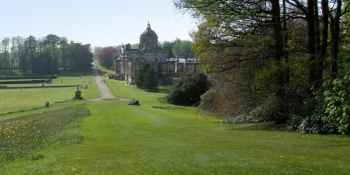 Architectural and garden historian Dr Sally Jeffery will discuss her recent research on Hawksmoor’s designs for Wray Wood, Castle Howard. Among documents formerly at Wilton House are four sketches for streams and rockwork attributed to Nicholas Hawksmoor (1661–1736) that have recently been identified as projects for the garden in Wray Wood, Castle Howard. This naturalistic woodland garden was much admired by early visitors, who commented on its innovative features, including a cave, an artificial stream with cascades and rockwork, and much classical sculpture inspired by Ovid. Little now survives, but using these drawings and other records, a picture of the garden can be constructed, and Hawksmoor’s role in the design can be better appreciated. Wednesday, 6 March 2019, 18:00.
New Book | Eighteenth-Century Art Worlds
Published this month by Bloomsbury:
Stacey Sloboda and Michael Yonan, eds., Eighteenth-Century Art Worlds: Global and Local Geographies of Art (London: Bloomsbury Visual Arts, 2019), 312 pages, ISBN: 978-1501335488, $117.
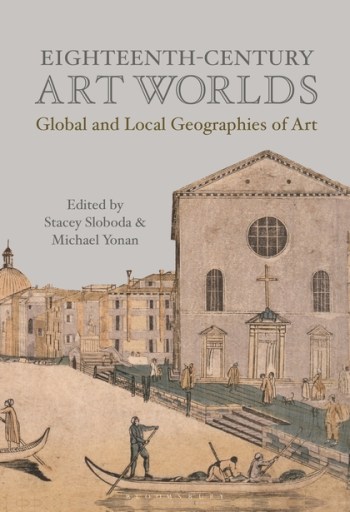 While the connected, international character of today’s art world is well known, the eighteenth century too had a global art world. Eighteenth-Century Art Worlds is the first book to attempt a map of the global art world of the eighteenth century. Fourteen essays from a distinguished group of scholars explore both cross-cultural connections and local specificities of art production and consumption in Africa, the Americas, Asia, and Europe. The result is an account of a series of interconnected and asymmetrical art worlds that were well developed in the eighteenth century.
Capturing the full material diversity of eighteenth-century art, this book considers painting and sculpture alongside far more numerous prints and decorative objects. Analyzing the role of place in the history of eighteenth-century art, it bridges the disciplines of art history and cultural geography, and draws attention away from any one place as a privileged art-historical site, while highlighting places such as Manila, Beijing, Mexico City, and London as significant points on globalized map of the eighteenth-century art world. Eighteenth-Century Art Worlds combines a broad global perspective on the history of art with careful attention to how global artistic concerns intersect with local ones, offering a framework for future studies in global art history.
Stacey Sloboda is Paul H. Tucker Professor of Art at the University of Massachusetts Boston. Michael Yonan is Associate Professor of Art History at the University of Missouri.
C O N T E N T S
List of Illustrations
Acknowledgements
1 Stacey Sloboda and Michael Yonan, Mapping Eighteenth-Century Art Worlds
2 Kristina Kleutghen, Flowering Stone: The Aesthetics and Politics of Islamic Jades at the Qing Court
3 Michele Matteini, The Market for ‘Western’ Paintings in Eighteenth-Century East Asia: A View from the Liulichang Market in Beijing
4 Timon Screech, Floating Pictures: The European Dimension to Japanese Art during the Eighteenth Century
5 Yeewan Koon, A Chinese Canton? Painting the Local in Export Art
6 J. M. Mancini, Pedro Cambón’s Asian Objects: A Transpacific Approach to Eighteenth-Century California
7 Kelly Donahue-Wallace, Making It Ours: Religious Art in Eighteenth-Century Colonial Spanish American Newspapers
8 Mari-Tere Álvarez and Charlene Villaseñor Black, Tortoiseshell and the Edge of Empire: Artistic Materials and Imperial Politics in Spain and France
9 Kristel Smentek, Other Antiquities: Ancients, Moderns, and the Challenge of China in Eighteenth-Century France
10 Hannah Williams, Drifting through the Louvre: A Local Guide to the French Academy
11 Carole Paul, The Art World of the European Grand Tour
12 Michael Yonan, The African Geographies of Angelo Soliman
13 Prita Meier, Toward an Itinerant Art History: The Swahili Coast of Eastern Africa
14 Stacey Sloboda, St. Martin’s Lane in London, Philadelphia, and Vizagapatam
List of Contributors
Bibliography
Index
At Sotheby’s | The Female Triumphant
Press release (30 January 2019), from Sotheby’s:
The Master Paintings Evening Sale, N10007
Sotheby’s, New York, 30 January 2019
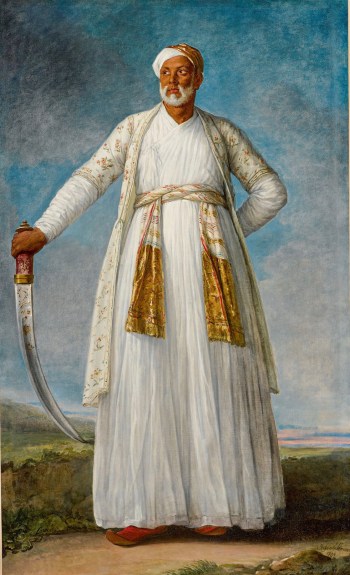
Elisabeth-Louise Vigée Le Brun, Portrait of Muhammad Dervish Khan, 1788. The painting of India’s ambassador to France sold for $7.2million, surpassing it’s high estimate of $6million.
Sale of Elisabeth-Louise Vigée Le Brun’s Portrait of Muhammad Dervish Khan establishes a new world auction record for any female artist of the pre-modern era.
Sotheby’s annual Masters Week sales series kicked off on Wednesday in New York, with 170 paintings and drawings sold across two auctions for an overall total of $67.8 million. The day began with Sir Peter Paul Rubens’s drawing of a Nude Study of Young Man with Raised Arms (Lot 15) selling for $8.2 million—a new world auction record for any drawing by the iconic artist. That result helped propel the Old Master Drawings Sale (N10006) to a $15.1 million total, which itself marks the highest total for this category in Sotheby’s history. The Master Paintings Evening Sale (N10007) included the work of groundbreaking female artists of the 16th–19th centuries and established multiple auction records, most notably for Elisabeth-Louise Vigée Le Brun, whose Portrait of Muhammad Dervish Khan (Lot 48) achieved an incredible $7.2 million—a new world auction record for any female artist of the pre-modern era.
Sotheby’s Masters Week series continued through Saturday, with online sales of Old Masters and 19th Century European Art open for bidding through 6 February. Below is a look at some of the highlights that drove the results of Wednesday’s auctions:
The Female Triumphant
To highlight this year’s Masters Week sales series, Sotheby’s assembled a group of works by female artists of the pre-Modern era, celebrating the lives and important work of these groundbreaking women. Titled The Female Triumphant, the group features major paintings, drawings and sculpture created by leading female artists from the 16th through the 19th centuries.
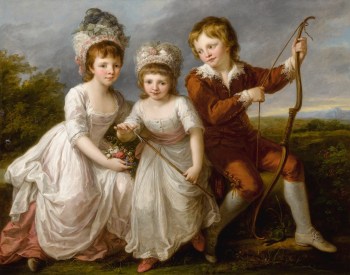
Angelika Kauffmann, Portrait of Three Children, Likely Lady Georgina Spencer (Later Duchess of Devonshire), Lady Henrietta Spencer, and George Viscount Althorp, ca. 1766–70, oil on canvas.
Calvine Harvey, Specialist in Sotheby’s Old Master Paintings Department in New York, commented: “The number of Old Master female artists who succeeded and are known to us today remains incredibly few: in 2018, Sotheby’s sold only 14 works by female Old Masters, compared to 1,100 male artists. It’s important to remember that the obstacles women artists of the pre-Modern era faced were substantial, and those that broke down those barriers were truly triumphant. It was therefore such a thrill to see strong prices throughout our initial offering of works from The Female Triumphant—none more so than the monumental portrait by Elisabeth-Louise Vigée Le Brun that achieved a new auction record for any work by a female artist of the pre-Modern era. With additional records established for the work Fede Galizia, Angelica Kauffmann, and Giulia Lama, the market clearly responded to the work of these groundbreaking women, including both new and established collectors.”
The initial offering of The Female Triumphant collection featured the top lot of tonight’s auction: Elisabeth-Louise Vigée Le Brun’s life-sized Portrait of Muhammad Dervish Khan, which achieved an astounding $7.2 million, a new world auction record for any female artist of the pre-modern era. Painted in the summer of 1788 and exhibited at the Salon of 1789, when political unrest had begun to boil in France, the work stands today as a symbolic testament to the relationship between Pre-Revolutionary France and India.

Fede Galizia, A Glass Compote with Peaches, Jasmine Flowers, Quinces, and a Grasshopper, oil on panel.
Works from The Female Triumphant established additional auction records for Fede Galizia, Angelika Kauffmann, and Giulia Lama. A pioneer of the still life genre, which she helped invent in the early 17th-century, Fede Galizia’s A Glass Compote with Peaches, Jasmine Flowers, Quinces, and a Grasshopper (Lot 42) achieved $2.4 million (estimate $2/3 million). Although she produced fewer than 20 refined, naturalistic still life compositions on panel, these works inspired followers in her lifetime and are now considered her most important paintings.
One of the wealthiest families in England, the young generation of Spencers likely depicted in Angelika Kauffmann’s Portrait of Three Children (Lot 52), sold for $915,000, surpassing its high estimate of $800,000. One of the most cultured and influential women of her generation, Angelika Kauffmann holds a place of particular importance in European art history as one of only two female founding members of the Royal Academy.
The full press release is available here
More information about Le Brun’s Portrait of Muhammad Dervish Khan is available here
Lecture | Susan Rather, “Constructing the American School”
Susan Rather, “Constructing the American School”
The Smithsonian American Art Museum, Washington, D.C., 7 February 2019
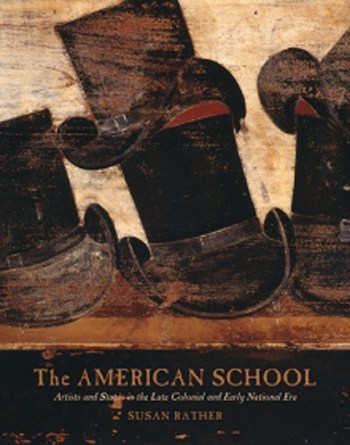 The Smithsonian American Art Museum invites you to join Dr. Susan Rather, Professor of Art History at the University of Texas at Austin, for a lecture entitled “Constructing the American School” on Thursday, 7 February 2019, at 4:00pm EST at the museum.
Professor Rather is the author of The American School: Artists and Status in the Late Colonial and Early National Era (New Haven and London: Yale University Press for the Paul Mellon Centre for Studies in British Art, 2016), which was awarded the 2018 Charles C. Eldredge Prize for Distinguished Scholarship in American Art from the Smithsonian American Art Museum–in addition to winning the New England Society Book Award for Art and being short-listed for the William MB Berger Prize for British Art History.
What did it mean to be an artist in the 18th- and early-19th-century Anglophone world, and how did artists come to be regarded as professionals distinct from artisan makers? Professor Rather addresses how she came to this project and how it developed, as well as the benefits of mining even the most familiar or the slightest textual evidence. Following brief consideration of well-known painters (Copley, West, and Stuart) who successfully engineered their own legacy, the lecture focuses on the necessity, challenges, and rewards of restoring non-elite painters to the narrative of American art at its beginnings.
Those unable to attend the lecture can watch a live webcast here»
New Book | Kunstmarkt und Kunstbetrieb in Rom, 1750–1850
From De Gruyter:
Hannelore Putz and Andrea Fronhöfer, eds., Kunstmarkt und Kunstbetrieb in Rom, 1750–1850: Akteure und Handlungsorte (Berlin: De Gruyter, 2019), 304 pages, ISBN 978-3110621884, €100 / $115. Series: Bibliothek des Deutschen Historischen Instituts in Rom 137.
 Rom erlebte in der zweiten Hälfte des 18. Jahrhunderts und in den ersten Jahrzehnten des 19. Jahrhunderts tiefgreifende politische Umbrüche und ökonomische Krisen. Gleichzeitig prägte es als Kunstmetropole wie kein anderer Ort die europäischen Künstler und Kunstszene sowie den Kunstmarkt zwischen Klassizismus und Romantik. Hier studierten die jungen Maler, Bildhauer und Architekten antike und nachantike Kunstobjekte. Sie bildeten sich bei den zeitgenössischen Künstlern fort und nahmen im gegenseitigen Austausch kreativ Impulse auf. Auf dem in Europa rasch an Bedeutung gewinnenden freien Kunstmarkt trieb gerade der schier unerschöpfliche römische Sekundärmarkt (Handel mit Kunstobjekten, die sich auf dem Markt befinden), zu dem auch der Handel mit Antiken gehörte, auch den Primärmarkt (Handel mit „atelierfrischen“ Objekten) an. Der Tagungsband nimmt dieses lebendige und pulsierende Kunstgeschehen in den Blick. Er untersucht Produzenten, Agenten, Verkäufer und Käufer, widmet sich Verhandlungen um Preis und Wert und stellt auch die Frage nach dem Einfluss von Künstlern und Käufern auf die Produktion und Rezeption von Werken Bildender Kunst.
Hannelore Putz, Ludwig-Maximilians-Universität München; Andrea Fronhöfer, Oberhausmuseum Passau.
I N H A L T
Hannelore Putz, Andrea Fronhöfer, Vorwort
• Hannelore Putz, Kunstmarkt und Kunstbetrieb in Rom in der ersten Hälfte des 19. Jahrhunderts: Eine Hinführung
• Paolo Coen, Fra tutela e mercato: Johann Joachim Winckelmann Commissario alle Antichità e Belle Arti
• Clare Hornsby, ‘Rome … to say the Truth Seems to be in a most Tottering State’: The Contrasting Fortunes of Some British Artist-Dealers, 1797–1805
• Gabriele B. Clemens, Die Kunstverkäufe des römischen Adels: Eine Basis neuer europäischer Sammlungen
• Valeria Rotili, L’atelier di Carlo Albacini tra collezionismo e mercato
• Marina Unger, Durand’sche Preise: Archäologie zwischen Wissenschaft und Kunstmarkt im Rom der 1830er Jahre
• Johannes Erichsen, Mehr als ein Sammler: König Ludwig I. von Bayern und die Korona der Kunst
• Mathias René Hofter, Winckelmann und die Kunstkäufe Ludwigs I. von Bayern
• Stefan Morét, Martin von Wagner (1777–1858): Ein Bildhauer und Maler im Dienst König Ludwigs I. von Bayern als Kenner und Käufer von Gemälden
• Johanna Selch, Der Kunstagent und sein Netzwerk. Johann Martin von Wagner in Rom
• Anne Viola Siebert, ‘… so bringen wir noch in Hannover so viel zusammen, um den Geschmack zu wecken’: August Kestner als Kunstkenner und Sammler in Rom, 1817–1853
• Susanne Adina Meyer, ‘Prima di partire’: Orte, Akteure und Strategien des römischen Ausstellungswesens, 1750–1840
• Andreas Stolzenburg, Franz Ludwig Catels Engagement für die deutsche Künstlerschaft in Rom und die Gründung des Pio Istituto Catel
Personen- und Ortsregister
Exhibition | Bellotto at the Court of Saxony
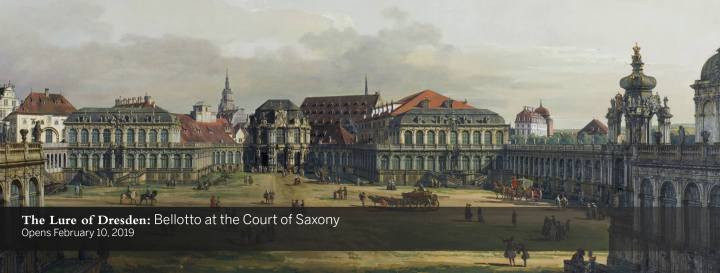
Bernardo Bellotto, The Zwinger Complex in Dresden, 1751–52, oil on canvas (Gemäldegalerie Alte Meister, Staatliche Kunstsammlungen Dresden, photo by Elke Estel/Hans-Peter Klut).
◊ ◊ ◊ ◊ ◊
From the Kimbell:
The Lure of Dresden: Bellotto at the Court of Saxony
Kimbell Art Museum, Fort Worth, 10 February — 28 April 2019
Bernardo Bellotto (1722–1780) is recognized as one of the greatest view painters in history, acquiring his fame in mid-18th-century Dresden as the court painter for the elector of Saxony, Frederick Augustus II—who was also King Augustus III of Poland. Over the course of a decade, Bellotto produced dozens of breathtaking depictions of the city and its environs, most measuring over eight feet in width. The success and renown of these grand, expansive works would earn Bellotto prestigious commissions at prominent courts throughout Europe.
Bellotto’s magnificent paintings of Dresden are now in the collection of the Gemäldegalerie (Picture Gallery) of the Dresden State Art Collections and will be on loan to the Kimbell Art Museum for the special exhibition The Lure of Dresden: Bellotto at the Court of Saxony. They will be accompanied by portraits and allegories of the elector and his queen, as well as view paintings of Venice and Saxony by Bellotto’s uncle and teacher Antonio Canaletto and Dresden court painter Alexander Thiele. Visitors to the exhibition will have the unique opportunity to view the majesty that was Dresden in the 1700s. One of the greatest cities of 18th-century Europe, it is only now, following its near-total destruction in the Second World War, being rebuilt to its former glory—with the aid of Bellotto’s pictorial legacy.
This exhibition is organized by the Staatliche Kunstsammlungen Dresden in cooperation with the Kimbell Art Museum.
Exhibition | Futuruins

Now on view at the Palazzo Fortuny:
Futuruins
Palazzo Fortuny, Venice, 19 December 2018 — 24 March 2019
Curated by Daniela Ferretti and Dimitri Ozerkov with Dario Dalla Lana
Over 250 works from the Venetian Civic Museums and the State Hermitage Museum, as well as from other Italian and international public and private collections, illustrate the multiple meanings attributed to ruins through the centuries: from the architectural and sculptural remains of the Greco-Roman, Egyptian, Assyrian-Babylonian and Syrian civilisations, to contemporary art that looks at the physical and moral ruins of today’s society—ruins of its architecture, cities and suburbs, but also of men and ideas, as the result of time, negligence, degeneration, natural or political tragedies such as war and terrorism.

Giovanni Battista Piranesi, View of the Foundations of the Theater of Marcellus, detail, from Antichità Romane, volume 4, 1756–57 (Venice: Fondazione Musei Civici di Venezia, Museo Fortuny).
As a result of the collaboration between the City of Venice, the Fondazione Musei Civici di Venezia, and the State Hermitage Museum of St. Petersburg—strengthened by the agreements signed in recent years and the presence of ‘Ermitage Italia’ in the lagoon city—and following Dimitri Ozerkov’s proposal, Palazzo Fortuny will host the exhibition Futuruins from 19 December 2018 to 24 March 2019.
The exhibition reflects on the theme of ruins: an allegory for the inexorable passage of time, always uncertain and changeable, disputed between past and future, life and death, destruction and creation, nature and culture. The aesthetics of ruins is a crucial element in the history of Western civilisation. The ruin as concept symbolises the presence of the past but at the same time contains within itself the potential of the fragment: a fragment that comes from antiquity, covered by the patina of time, which with its cultural and symbolic implications also becomes a valid ‘foundation stone’ for building the future. It comes from the past, confers a wealth of meaning on the present, and offers an awareness to future projects.
 The contemporary itinerary opens with the extraordinary environmental installation by Anne and Patrick Poirier and is followed by works by Acconci Studio, Olivio Barbieri, Botto & Bruno, Alberto Burri, Sara Campesan, Ludovica Carbotta, Ugo Carmeni, Lawrence Carroll, Giulia Cenci, Giacomo Costa, Roberto Crippa, Lynn Davis, Giorgio de Chirico, Federico de Leonardis, Marco Del Re, Paola De Pietri, Jean Dubuffet, Tomas Ewald, Cleo Fariselli, Kay Fingerle, Maria Friberg, Luigi Ghirri, Gioberto Noro, John Gossage, Thomas Hirschhorn, Anselm Kiefer, Francesco Jodice, Wolfgang Laib, Hiroyuki Masuyama, Jonatah Manno, Mirco Marchelli, Steve McCurry, Ennio Morlotti, Sarah Moon, Margherita Muriti, Claudio Parmiggiani, Lorenzo Passi, Fabrizio Prevedello, Dmitri Prigov, Judit Reigl, Christian Retschlag, David Rickard, Mimmo Rotella, Anri Sala, Alberto Savinio and Elisa Sighicelli. In line with the tradition of exhibitions at the Fortuny, there are also a series of works specifically made for Futuruins that offer new stimuli for reflection on the present, works by Franco Guerzoni, Christian Fogarolli, Giuseppe Amato, Renato Leotta, and Renata De Bonis.
Between the two chronological extremes of the exhibition, there is a series of masterpieces in various media—paintings, sculptures, applied arts, graphic works—to suggest the major themes being examined. Many have been selected from Venetian collections—ranging from the jellyfish by Arturo Martini and Franz von Stuck to the fire-lit nocturnal ruins of Ippolito Caffi and Urbino-made ceramics bearing themes of genesis and death—while others come from museums and private collections. For its part, the State Hermitage Museum has loaned more than 80 works by such artists as Albrecht Dürer, Monsù Desiderio, Giovanni Paolo Pannini, Jacopo and Francesco Bassano, Parmigianino, Veronese, Jacob van Host the Elder, Arturo Nathan, and Alessandro Algardi.
The contemporary relevance of ruins has been made apparent in the light of recent history, characterised by wars in which iconic and symbolic aspects stand out (the collapse of the Twin Towers, the devastation of the Baghdad museum, Palmyra…) and of the increasingly extreme climate changes on our planet.
Dimitri Ozerkov, ed., with contributions by Dimitri Ozerkov, Mikhail Piotrovsky, and Gabriella Belli, Futuruins: The Future of Ruins and Ruins of the Future (Berlin: Hatje Cantz, 2019), 816 pages, ISBN 978-3775745413 (English edition), €50.
Exhibition | Anton Maria Zanetti and His Collections
The exhibition closed a few weeks ago, but the catalogue is available from ArtBooks.com:
A Life as a Work of Art: Anton Maria Zanetti and His Collections
Ca’ Rezzonico, Venice, 29 September 2018 — 7 January 2019
Curated by Alberto Craievich
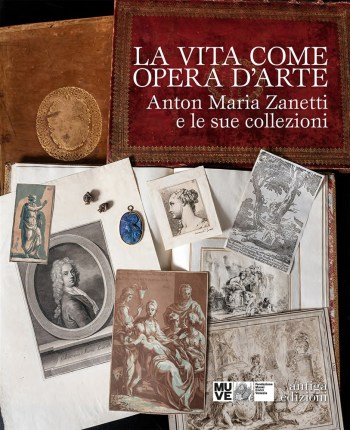 Anton Maria Zanetti (1679–1767) was a central figure in the eighteenth-century history of Venetian collecting and in the world’s endorsement of Venetian art. An art patron and influential intermediary on behalf of nobles and sovereigns, commissioning and purchasing works by Venice’s most famous artists, Zanetti was perhaps the most influential character in the Venetian art scene of the time. Known as ‘il Vecchio’, or ‘di Girolamo’—to distinguish him from his namesake younger cousin, a famous librarian at the Marciana Library in Venice—Zanetti was not only a passionate collector but also a talented draughtsman and skilled engraver.
After his father’s death in 1711, he was forced to provide for the rest of the family as an insurance agent, but despite difficulties, this did not prevent him from following his own inclinations. A friend to artists such as Canaletto, Rosalba Carriera, Sebastiano and Marco Ricci, and Giambattista Tiepolo, Zanetti was in close contact with the most important European collectors. He himself assembled an extraordinary collection of antique gems, drawings, and prints that was dispersed after his death. He also promoted splendid publishing initiatives, most notably two volumes on ancient sculpture, now conserved in the vestibule of the Marciana Library and one of the most beautiful and luxurious illustrated publications of the entire eighteenth century. An inexhaustible collection of letters, now spread among libraries and private collectors, documents his dense network of relationships and friendships and offers a rare insight into the cultural life of the period.
To commemorate this extraordinary figure, the Fondazione Musei Civici di Venezia presents an exhibition highlighting Zanetti’s activities as an artist and patron. Testimonies from his life in the form of books, letters, engravings, and drawings—none of which are usually exhibited for conservation reasons—will be shown together with art from his collection, including works by Tiepolo, Sebastiano and Marco Ricci, Palma il Giovane, and others, now preserved in the city’s museums, including the Gallerie dell’Accademia di Venezia, the Giorgio Cini Foundation, the Biblioteca Nazionale Marciana, and Venice’s civic museums, as well as in several private collections.
Alberto Craievich, La Vita Come Opera d’Arte: Anton Maria Zanetti e le sue collezioni (Antiga: Crocetta del Montello, 2018), 336 pages, ISBN: 978-8884351029, €38 / $60 (on sale for $42).
Seminar | Matthew Hargraves on Watercolor

J. M. W. Turner, The Pass at St. Gotthard, near Faido, 1843, watercolor over graphite
(New York: The Morgan Library & Museum, 2006.52)
◊ ◊ ◊ ◊ ◊
From the seminar flyer:
Seminar on Watercolor with Matthew Hargraves
The Morgan Library & Museum, New York, 15 March 2019
Applications due by 1 February 2019
The Morgan Library & Museum has an extensive collection of drawings from the Renaissance to the present, many of which feature the use of colored washes. Participants in this graduate seminar will look closely at the use of watercolor by artists of different schools, with a particular focus on the widespread use of the medium during the late eighteenth and early nineteenth centuries in Britain. From around 1750 to 1850, the period typically considered to be watercolor’s ‘golden age’, the medium came to be seen as a distinctively British art. In fact, however, watercolor had been used across Europe for centuries, and this seminar will examine the origins of watercolor, its adoption and development by British artists in the eighteenth century, and the spread of watercolor as a drawing medium in the Romanic period. Among the sheets examined will be examples by Albrecht Dürer, William Blake, Caspar David Friedrich, Eugène Delacroix, and J.M.W. Turner. The seminar will begin at 10am and last until 4pm.
Matthew Hargraves is Chief Curator of Art Collections at Yale Center for British Art in New Haven.
This seminar is open to graduate students in the history of art. Interested participants are kindly
invited to submit a one paragraph statement, which should include the following:
• Name and email
• Academic institution, class year, and field of study
• Interest in drawings
• Reason/s for wanting to participate in the seminar
A brief recommendation from the student’s advisor is welcome but not required. Applications should be submitted electronically by 1 February 2019 with the subject header ‘Watercolor Seminar’ to: drawinginstitute@themorgan.org. Participants will be notified by 11 February 2019.
Call for Content | Instagram Series, Furniture History Society
From the Call for Content:
#CuratorsChoice
A Furniture History Society Instagram Series
The Furniture History Society has recently joined Instagram, @furniturehistorysociety. Following the success of our ongoing Instagram series #ChippendaleTuesday we will shortly launch another titled #CuratorsChoice. This series will highlight the work of curators engaged in the research of decorative arts, specifically furniture, interiors and archives relating to such. This platform will provide a conversational way for curators to highlight objects in their collections, exhibitions they are preparing or indeed discoveries they have made.
 Getting involved is simple:
1. Choose your topic.
2. Write approximately three short sentences about it. Feel free to use a more casual and conversational style than one might for an article or talk.
3. Pick your image or images.
4. Send us the above and, if you have one, your Instagram handle. We will take care of weaving the information together and posting to our account.
No matter if you have a fully formed idea or post, or indeed are interested in this project and would like to know more, please feel free to contact, Natalie Voorheis on natalievoorheis@gmail.com. We look forward to hearing from you.
The Furniture History Society (FHS) was founded in 1964 to study furniture of all periods, places and kinds, to increase knowledge and appreciation of it, and to assist in the preservation of furniture and its records.










 Enfilade
leave a comment