Exhibition | Marie Antoinette Style
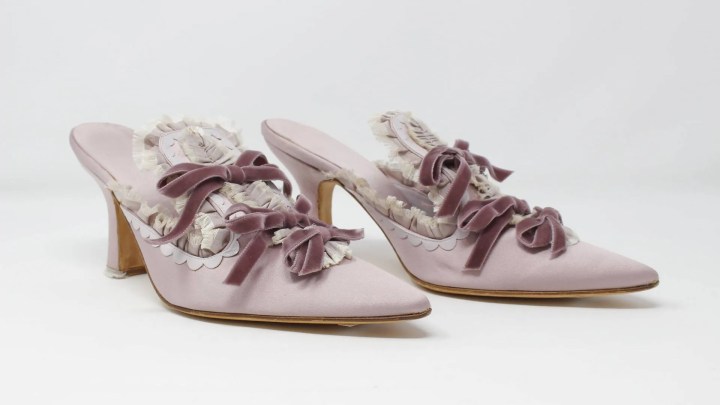
Manolo Blahnik, Antonietta, 2005.
◊ ◊ ◊ ◊ ◊
Curator Sarah Grant provides a preview of the exhibition with a focus on scent in a recorded talk from the study day The Museum and the Senses, held at the Barber Institute of Fine Arts (February 2025). From the press release for the exhibition:
Marie Antoinette Style
Victoria & Albert Museum, London, 20 September 2025 – 22 March 2026
Curated by Sarah Grant
Opening in September 2025 at V&A South Kensington, Marie Antoinette Style will be the UK’s first exhibition on the French queen Marie Antoinette (1755–1793). It will explore the origins and countless revivals of the style shaped by the most fashionable queen in history. Marie Antoinette not only contributed to the fashions, interiors, gardens, and fine and decorative arts of her own time, but continued to influence more than two and a half centuries of graphic and decorative arts, fashion, photography, film, and performance. This excessive, lavish, and feminine style will come to life through some 250 objects, including exceptional loans from the Château de Versailles never before seen outside France. Historical and contemporary fashion, alongside audio visual installations and immersive curation, will explore how and why Marie Antoinette, the person, has provided a constant source of inspiration. The exhibition will consider afresh the legacy of this complex figure whose style, youth, and notoriety have contributed to her timeless appeal. The exhibition will also trace the cultural impact of the Marie Antoinette style and her ongoing inspiration for leading designers and creatives, from Sofia Coppola and Manolo Blahnik to Moschino and Vivienne Westwood.

François-Hubert Drouais, Portrait of Marie Antoinette, Queen of France, in a Court Dress, 1773, oil on canvas (London: V&A, Jones Collection, 529-1882).
On display will be exceptionally rare personal items owned and worn by Marie Antoinette including richly embellished fragments of court dress, the Queen’s own silk slippers, and jewels from her private collection. Other highlights include personal effects such as the queen’s dinner service from the Petit Trianon, a selection of her accessories, and intimate items from her toilette case. A scent experience will re-create scents of the court and the perfume favoured by the Queen herself. The exhibition will also feature contemporary clothing including couture pieces by designers such as Moschino, Dior, Chanel, Erdem, Vivienne Westwood, and Valentino, along with costumes made for Sofia Coppola’s Oscar winning Marie Antoinette (staring Kirsten Dunst), as well as shoes designed for the film by Manolo Blahnik.
Sarah Grant, curator of Marie Antoinette Style, said: “The most fashionable, scrutinised, and controversial queen in history, Marie Antoinette’s name summons both visions of excess and objects and interiors of great beauty. The Austrian archduchess turned Queen of France had an enormous impact on European taste and fashion in her own time, creating a distinctive style that now has universal appeal and application. This exhibition explores that style and the figure at its centre, using a range of exquisite objects belonging to Marie Antoinette, alongside the most beautiful fine and decorative objects that her legacy has inspired. This is the design legacy of an early modern celebrity and the story of a woman whose power to fascinate has never ebbed. Marie Antoinette’s story has been re-told and re-purposed by each successive generation to suit its own ends. The rare combination of glamour, spectacle, and tragedy she presents remains as intoxicating today as it was in the eighteenth century.”
Presented chronologically, the first section, Marie Antoinette: The Origins of a Style, begins in 1770 and ends at Marie Antoinette’s execution in 1793. It sets the scene by presenting her life and the story of the beginnings of the style she shaped. On display will be key pieces of furniture, fashion, jewellery, porcelain, and musical instruments from her court, revealing her roles and interests as queen consort. It will consider the way in which she embraced some aspects of enlightenment thought, through her approach to maternity and childhood and support of new technologies. It will also address the ‘let them eat cake’ mythology and mythmaking that surround the queen to this day, drawing on recent research on early modern women, queenship, and celebrity. Highlights in this section include a replica of the Boehmer and Bassenge diamond necklace, from the diamond necklace affair of 1784–85, commissioned for Madame du Barry in 1772. The original necklace was famously stolen, broken up, and sold in Bond Street; the replica will sit alongside the Sutherland diamond necklace from the V&A collection, thought to be made from the original diamonds.
The first section will also display exceptionally rare loans that have never before left France, including personal effects such as the queen’s dinner service from the Petit Trianon, her accessories, and items from her toilette case. Other personal items include the queen’s armchair from the V&A’s collection with Marie Antoinette’s monogram and a jatte téton / bol sein or ‘breast cup’—one of four from the queen’s Sèvres Rambouillet dairy service delivered in 1787—which has led to the persistent though erroneous belief that it was modelled on the queen’s own breast, inspiring modern-day examples. Finally, this section includes the last note Marie Antoinette wrote before she died, on a blank page in her prayer book.
 The second section, Marie Antoinette Memorialised: The Birth of a Style Cult, explores the revival of Marie Antoinette’s style in the mid-1800s, at the impetus of Empress Eugénie. A romanticised and sentimental view of the queen took hold, and a phenomenal wave of interest continued throughout the century, peaking again in the 1880s and 1890s. Elements of Marie-Antoinette’s style became the ‘French’ or ‘French Revival’ style—the dominant style in Britain and North America for over fifty years. English collectors sought to acquire objects, furniture, and mementoes associated with the queen, and important collections of eighteenth-century French art were formed. Highlight objects include fancy dress costumes by Worth and other couturiers and photographs by Eugène Atget and Francis Frith.
Marie Antoinette: Enchantment and Illusion, the exhibition’s third section, looks to the late 19th century when the Marie Antoinette style entered a new phase of fantasy, magic, and fairy tales. The queen’s image came to embody escapism and beauty, as well as decadence and debauchery. Objects and artworks will illustrate this shifting narrative through the Art Nouveau and Art Deco periods, including the evening dress designs of couturiers such as Jeanne Lanvin and the Boué Soeurs, alongside luminous watercolour illustrations by Golden Age illustrators Erté, George Barbier, and Edmund Dulac.
The final section, Marie Antoinette Re-Styled, considers the modern and contemporary legacy of the Marie Antoinette style from the 20th century to the present day, in fashion, performance, and pop culture. Couture pieces by designers such as Moschino, Dior, Chanel, Erdem, Vivienne Westwood, and Valentino alongside photographs by Tim Walker and Robert Polidori will highlight Marie Antoinette’s continued influence on fashion globally. Costumes, accessories, film, and stills will bring to life the queen’s enduring legacy in film, stage, and even music videos. Artist Beth Katleman and designer Victor Glemaud will also showcase contemporary works inspired by elements of Marie Antoinette’s timeless style and period.
Support for the V&A is more vital than ever. Marie Antoinette Style is sponsored by Manolo Blahnik, with support from Kathryn Uhde.
Sarah Grant, ed., with forewords by Antonia Fraser, Manolo Blahnik, and Sofia Coppola, Marie Antoinette Style (London, V&A Publishing, 2025), 304 pages, ISBN: 978-1838510541, £40 / $70.
V&A East Storehouse Opens
◊ ◊ ◊ ◊ ◊
The V&A Storehouse has now been open six weeks. The East London building, designed by Diller Scofidio + Renfro, houses some 250,000 objects, 350,000 books, and nearly 1,000 separate archives (with the David Bowie Collection scheduled to open in September). With costs undisclosed, estimates range from £64 to £100million (or more). I found the above video by Jessica ‘The Museum Guide’ to be helpful for conceiving of the space from afar. The storehouse is being compared to a cabinet of curiosities and IKEA. I’ll look forward to critical responses that aim to understand the project in terms of what a museum is now expected to be or do. There are obviously plenty of new things in play here; one would seem to be a new way of navigating the individual vs. group experience of a museum. –CH
From the V&A press release (28 May) . . .
• For the first time, visitors can step inside V&A East Storehouse—the V&A’s unique museum experience and busy working store designed by architects Diller Scofidio + Renfro.
• Visitors can now get closer to their national collections than ever before through the V&A’s radical new Order and Object experience—now live.
• Over 1,000 objects ordered so far—with the most-ordered object a 1954 Balenciaga evening dress.
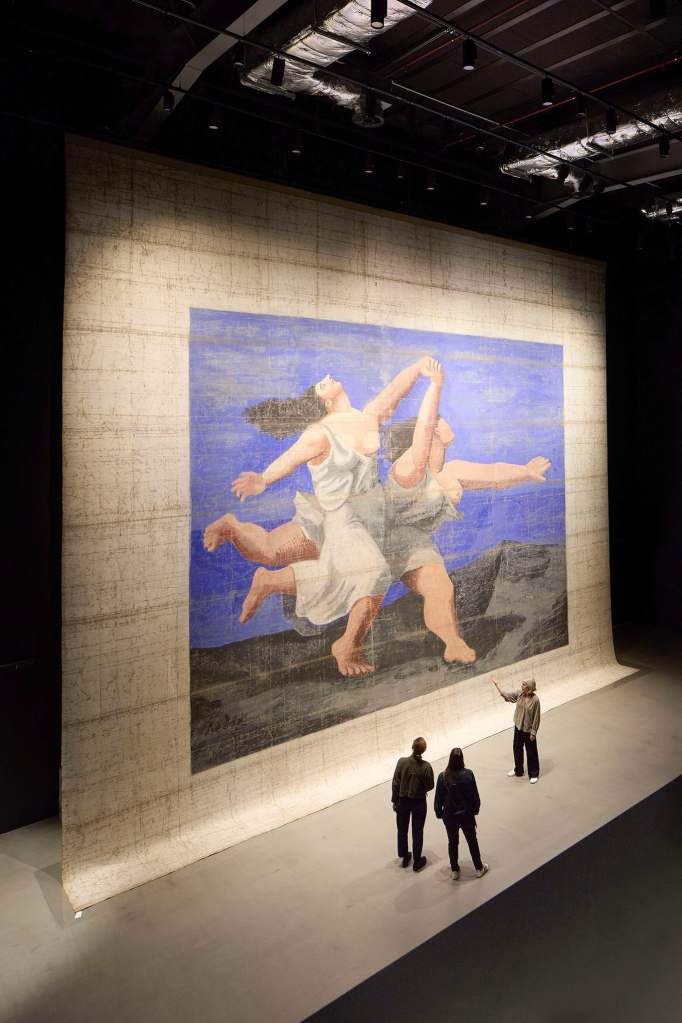
• The largest Pablo Picasso work in the world—the rarely displayed Ballets Russes Le Train Bleu stage cloth—is now display for the first time in over a decade alongside a series of monumental objects from architect Frank Lloyd Wright’s 1930s Kaufmann Office to the 15th-century Spanish Torrijos ceiling.
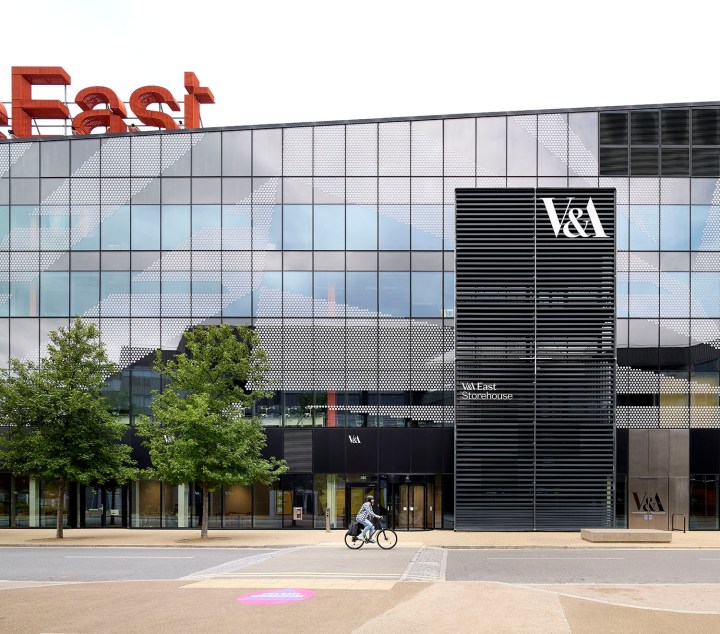 On Saturday, 31 May 2025, the V&A’s new working store and visitor attraction, V&A East Storehouse, opens its doors to the public for the first time following 10 years of planning and extensive audience consultation, with input from V&A East’s Youth Collective. Designed by world-renowned architects Diller, Scofidio + Renfro, it opens as part of East Bank, the new cultural quarter in the Queen Elizabeth Olympic Park supported by the Mayor of London.
A ground-breaking new museum experience spanning four levels, and at 16,000m2—bigger than 30+ basketball courts—V&A East Storehouse takes over a large section of the former London 2012 Olympics Media and Broadcast Centre (now Here East). It is a new purpose-built home for over 250,000 objects, 350,000 books, and 1,000 archives. A world-first in size, scale, and ambition, V&A East Storehouse immerses visitors in over half a million works spanning every creative discipline from fashion to theatre, streetwear to sculpture, design icons to pop pioneers. A busy and dynamic working museum store with an extensive self-guided experience, visitors can now get up-close to their national collections on a scale and in ways not possible before.
Tim Reeve, Deputy Director and COO, V&A, who developed the concept for V&A East Storehouse, said: “V&A East Storehouse is a completely new cultural experience and backstage pass to the V&A, transforming how people can access their national collections on a scale unimaginable until now. From conservation and how we care for our collections and cultural heritage around the world, to the artistry of our Museum Technicians and new research—there’s so much to discover. I hope our ground-breaking V&A East Storehouse opens to the public on Saturday 31 May visitors enjoy finding their creative inspiration and immersing themselves in the full theatre and wonder of the V&A as a dynamic working museum.”
Through the V&A’s radical new Order an Object service, anyone can now book to access any object at V&A East Storehouse, for free, seven-days-a-week. From mid-century furniture to ancient Egyptian shoes and Roman frescoes, an early 14th-century Simone Martini painting, Leigh Bowery costumes, Althea McNish fabrics, vintage band t-shirts and performance posters, and avant-garde fashion and couture from Balenciaga, Schiaparelli, Comme des Garcons, Issey Miyake and Vivienne Westwood, there’s something for everyone to explore. Since going live on 13 May, over 250 appointments have been booked to see over 1,000 objects from 14th-century and contemporary ceramics to a 17th-century carpet from Iran, 1930s wedding dresses and Julia Margaret Cameron photographs. So far, the most popular item ordered is a 1954 pink silk taffeta evening dress by Cristóbal Balenciaga.
Elizabeth Diller, Founding Partner, Diller Scofidio + Renfro, the firm that designed the architecture for V&A East Storehouse, said: “To celebrate the heterogeneity of the V&A’s collection of collections—spanning a broad variety of mediums, scales, and historical periods—visitors will experience a sense of being immersed in a vast cabinet of curiosities. The Collections Hall invites visitors to explore pre-curated works surrounding them, not according to conventional curatorial logics or standard storage taxonomies, but guided instead by their own curiosities. It has been a joy to work with the V&A’s curators and conservators in creating this new kind of institution: neither warehouse nor museum, but rather a hybrid shared by staff and the public with expanded opportunities for access and exchange.”
Museums Minister, Sir Chris Bryant said: “It’s great to see the V&A innovating in this way—V&A East Storehouse makes it possible for everyone to delve into a massive treasure trove of art, design and performance history in ways never seen before.”
 The Mayor of London, Sadiq Khan, said: “V&A East Storehouse is a brand-new, groundbreaking museum experience in East Bank, London’s new educational and cultural district, that will revolutionise access to the world’s leading collection of art, design and performance. I’m proud to be supporting this landmark project, which will allow Londoners and visitors to go behind the scenes for the first time ever and explore some incredible treasures, from Roman artefacts and modern-day music archives to the largest Picasso work in the world, all for free. It’s the next building to open at East Bank and marks a hugely significant moment in our work to create the most ambitious cultural development in decades, helping us to ensure London stays the creative capital of the world.”
From the moment they emerge into the central Weston Collections Hall, visitors will be captivated by stunning vistas across all levels, surrounded by a cross-section of the V&A’s collections. Spanning ancient Buddhist sculpture to PJ Harvey’s guitar, paintings by Angelica Kauffman’s circle, costumes worn by Vivien Leigh, works by Sir Frank Bowling and Hew Locke, items from the Glastonbury Music Festival, Suffragette scarves, vintage football shirts, Thomas Heatherwick’s model for the London 2012 Olympic Cauldron and road signs designed by Margaret Calvert, visitors can take their own path through over 100 mini curated displays hacked into the ends and sides of the storage racking.
Six large-scale objects anchor the space, on display for the first time in decades. Highlights include the 1930s Kaufmann Office, the only complete Frank Lloyd Wright interior outside of the US, an exquisite 15th-century carved and gilded wooden ceiling from the now lost Torrijos Palace in Spain, and a full-scale 20th-century Frankfurt Kitchen designed by Margarete Schütte-Lihotzky.
Also on show is a building section from Robin Hood Gardens, a former residential estate in east London, the 17th-century Agra Colonnade, an extraordinary example of Mughal architecture from the bathhouse at the fort of Agra, and the largest Picasso work in the world—a monumental Ballets Russes Le Train Bleu theatre stage cloth. At 10 metres high and 11 metres wide, the Picasso-signed stage cloth has been rarely seen since its debut in 1924. It is on display in the new David and Molly Lowell Borthwick Gallery of epic proportions, built to show the V&A’s striking collection of large-scale textiles and theatre stage cloths on rotation. These large objects are brought further to life with a series of co-production projects in collaboration with young east Londoners, communities, and creatives, highlighting multiple new voices and perspectives across the space, including oral histories, new films, publications, and artworks in response.
V&A East Storehouse is the first of V&A East’s two new cultural destinations to open in east London. The second, V&A East Museum, is scheduled to open in spring 2026 and celebrates making and creativity’s power to bring change. Created with young people and rooted in east London’s heritage, V&A East Museum spotlights the people, ideas, and creativity shaping global culture right now.
Call for Papers | Idioms of Rococo in Switzerland

Interior view, Reformierte Kirche Trogen, Hans Ulrich Grubenmann (architect), Andreas and Peter Anton Moosbrugger (stucco work), 1779–82.
(Photograph by Noelle Paulson)
◊ ◊ ◊ ◊ ◊
From the Call for Papers:
Idioms of Rococo in Switzerland
Session at the 6th Swiss Congress for Art History
Vereinigung der Kunsthistorikerinnen und Kunsthistoriker in der Schweiz (VKKS), Geneva, 7–9 September 2026
Session convened by Maarten Delbeke, Nikos Magouliotis, and Noelle Paulson
Proposals due by 12 September 2025
The 18th century transformed Switzerland: proto-industrialization brought new material wealth to rural homes, while mercantile elites built mansions to fit increasingly cosmopolitan tastes. Simultaneously, confessionalization continued to alter the religious and architectural landscape. Switzerland was a territory divided by language, class, and religion, yet visually unified through the broad adoption of Rococo ornament, from the facades of urban mansions to rural interiors, to decorations for Catholic and Protestant churches.
We argue that the rocaille’s ubiquity in Swiss art and architecture should not be seen as the homogenizing effect of a cultural hegemony. Rather, it may be understood as a process where different groups adapted it to their circumstances and generated distinct decorative idioms, which could serve antagonistic identities. There was not just one Swiss Rococo, but many.
The project Swiss Rococo Cultures examines this hypothesis by focusing on East Switzerland, but we are interested in mapping parallel cases throughout the country. We welcome papers that deal with any of the following questions:
• Which agents facilitated Rococo’s dissemination? How did the idiom transform through different artistic media and scales, from miniatures to buildings?
• How could Rococo and its iconographies adapt to different social spheres? How was this ornamental repertoire applied to Catholic and Protestant churches?
• How did the Rococo relate to the emerging spirit of Swiss patriotism and nationalism at the time of the Helvetic Society?
• When did the Rococo end? Can its continued use in folk art into the 19th century help us revise canonical chronologies? What do current practices of collection, display, and preservation tell us about Rococo’s long history?
• How does the specific case of the Rococo in Switzerland challenge notions of the idiom? How might we consider the Rococo to be a visual repertoire that crosses boundaries of geography, language, confession, and class?
We welcome contributions in German, English, French, and Italian, in the hope of assembling a multilingual session that reflects the topical and institutional diversity of the field and fosters young academics. All speakers will receive a contribution to their travel and accommodation costs and will be exempt from the congress registration fee.
Please send an abstract (1 page, maximum 3000 characters) and a short curriculum vitae with institutional affiliation and contact details to the session conveners (maarten.delbeke@gta.arch.ethz.ch; nikolaos.magouliotis@gta.arch.ethz.ch; and paulson@arch.ethz.ch) by 12 September 2025. Please also CC the Congress Bureau of the 6th Swiss Congress for Art History in Geneva at vkks2026@unige.ch. More information on the conference is available here.
Session Conveners
Prof. Dr. Maarten Delbeke, Dr. Nikos Magouliotis, and Dr. Noelle Paulson (SNSF Project: Swiss Rococo Cultures: Idioms of Ornament and the Architecture of East Switzerland).
Call for Papers | On the Materiality of Scent
From the conference website and the Call for Papers, which include the French and a bibliography:
The Odorous Object: On the Materiality of Scent
L’objet et son sillage: Penser la matérialité des odeurs
Brown University, Providence, Rhode Island, 27–28 February 2026
Proposals due by 15 September 2025
Organized by Chanelle Dupuis, Jasmine Laraki, and Clara May
Perfumed letters, colorful flasks, scented ceramics, fragrant glass vases, scented jewelry, fragrant wooden boxes, vaporizers, scratch and sniff stickers, soaps, bio-noses, imaginary smell devices; all of these are examples of odorous objects. From the intricate textures and shapes of perfume flasks to the aromatic clays and glass containers of past eras, the materials used to hold scent have changed over time and acquired various cultural and social significance.
Sensory studies approaches have revitalized the study of material culture by reorienting attention towards the life of “sensori-social” things (Howes, 2022) and bringing to light the types of agentivity, exchanges, and experiences that emerge out of interactions between objects, the senses, and socio-cultural contexts. What becomes of perfume and smell when we cease to consider it as a simple emanation or pure olfactory experience and interrogate the materiality itself—that of shapes, gestures, and mediums that render it perceptible?
The receptacle exists in a strange relationship to its contents; while it itself is visible, the scent it holds, the perfume it cherishes, is invisible. The play on presence and absence is central to the perfume, as the liquid we see does not indicate the notes of the perfume we are about to smell. It is this ephemeral quality to smell that creates interesting relationships to materials. A privileged interface—opaque or transparent, open or sealed—the flask represents both visible materiality and the volatile essence of perfume, it condenses an ambivalence where presence and absence coexist (Stamelman, 2006, 2022).
Profoundly complex, the way that smell works has long been misunderstood, leading to centuries of beliefs that belittle the importance of smell. Culturally situated and raising social, moral, political, scientific, religious, or aesthetic questions, these objects today represent useful mediums through which to think about smell. As tools for power and social distinction, as prophylactic instruments, and as routes to other dimensions, perfumes and their contents are inscribed in the history of art, in the history of perfumery, but also in the history of medicine and chemistry. Furthermore, while the usage and purpose of perfume changes from one time period to another, and one region to another, the odorant substances that make up these odorous objects come from around the world: a study of smells, thus, cannot exclude a large geographic coverage, and must address, in our present moment especially, colonial and ecological impacts.
Whether real or imagined, objects contribute to the atmosphere of a place and participate in the creation of a particular ambience. The ecological implications of the storage and disposal of olfactory objects bring to question the atmospheric, material qualities of these and their impacts on bodies. Olfactory objects can be tangible, real-world items, but also invented, imaginary, objects. In literary texts, for example, authors invent olfactory objects that have creative functions. In the dystopia Tè Mawon (2022) by Michael Roch, individuals wear headsets that can simulate “fake food” smells to satiate one’s hunger and mask the bad smells in one’s neighborhood. Smell and taste, the two chemical senses, are closely linked and evoked in unison throughout this dystopia. The evocation of food necessarily comes with smells and flavors, thus showing how odorous objects often involve important multimodal associations.
Due to their immersive and multisensorial nature, perfumes and odors evoke an ensemble of interlinked perceptions that go beyond the sense of smell alone. Synesthesia, an initially physiological phenomenon, has inspired creative initiatives ranging from branding and marketing stories to the creation of immersive environments. For example, a fragrance is often anticipated, prolonged, or translated using a color, a sound, a texture, or movement. The senses that are more difficult to represent—such as taste, touch, or smell—are thus mobilised through metaphors and linguistic slips in a multisensorial logic of correspondences.
To reflect the vastness and complexity of this topic, we invite propositions focused on any time period and any geographic location. While the focus of this conference is research in the humanities and social sciences, we welcome presentations from science, technology, engineering, and mathematics (STEM) researchers in order to foster interdisciplinary conversations on the topic. Research on smell has been shaped by a variety of disciplines and necessitates a variety of perspectives. Likewise, olfactory aids (perfumes, scented objects, etc.) are welcome at the conference: we encourage presenters to not only talk about smell but also bring scents to be smelled when possible.
As part of our hybrid format we welcome both formal research presentations and creative expositions related to olfactory objects and devices.
1) Formal Research Presentations
Research participants will present their work for 20 minutes in organized panels, followed by a Q&A session. Presentations can be in French or English. We welcome papers related (but not limited) to the following topics:
Odor, object, and:
• Spirituality
• Medicine
• Imagination
• Environment
• Emotions
• Memory
• Gestures
• Agency
• Taste
• Aesthetics
• Art
• Genre(s)
• Materiality
• Technique and know-how
• Storage and conservation
• Economy
• Commerce, colonialism
• Linguistics
• Synesthesia
• Decomposition
2) Creative Expositions
As part of this conference, there will be an open exposition space for those wishing to present a creative research project, a new olfactory design, a perfume sample, or other. Each participant in this space will be offered a table where they can expose their work and talk freely with attendees who will explore the space during a set time in the conference program. Our hope is to encourage artists, designers, perfumers, artisans, and researchers to consider experimental, embodied, ways of researching olfaction.
The expositions may include, but are not limited to:
• Olfactory devices or installations
• Olfactory objects or artifacts accompanied by a scientific or theoretical research proposal
• Olfactory design prototypes
• Artworks that mobilize the medium of olfaction
• Performances, sensory archives, or sensory narratives
For research presentations (option 1), we ask participants to submit an abstract of no more than 400 words including a title, description of your research project, and a bibliography. Please also include a short biography containing your name, research discipline, contact information, and University or laboratory affiliation.
For creative expositions (option 2), we ask participants to submit a description of your project or sample of no more than 400 words, including a title for your exposition and a description of the nature of the object or research exposition, the modality of your presentation, dimensions, and specifics regarding the installation of your project (if you need access to a power plug, ventilation, etc.). Please also include a biography containing your name, contact information, and description of past works and past engagements.
To participate, all proposals, written in French or English, must be sent by 15 September 2025, to theodorousobject@gmail.com.
Keynote Speaker
Prof. Érika Wicky (Université Grenoble Alpes-UFR ARSH, France)
Organizers
Chanelle Dupuis (Brown University, USA), Jasmine Laraki (Université Libre de Bruxelles, Belgium, Paris 1 Panthéon-Sorbonne, France), Clara May (Université de Neuchâtel, Switzerland)
Exhibition | 1793–1794: Un Tourbillon Révolutionnaire
A second iteration of the exhibition on view previously at the Musée Carnavalet:
1793–1794: Un Tourbillon Révolutionnaire
Musée de la Révolution française, Vizille, 27 June — 23 November 2025
 Entre 1793 et 1794, « l’An II de la République » marque les débuts mouvementés de la toute première république française. Des idéaux de la Révolution aux grands procès politiques, de la liesse aux insurrections populaires, les premiers mois du nouveau régime emportent tout sur leur passage, jusqu’au quotidien des Français. Un véritable tourbillon révolutionnaire, nourri d’espoirs et de peurs.
Cette exposition revient sur des mois décisifs pour l’histoire de France : l’arrestation des Girondins, l’assassinat de Marat, l’exécution de Marie-Antoinette jusqu’à la chute de Robespierre. Voici donc « la Terreur », décryptée à la lumière des recherches historiques les plus récentes.
L’exposition 1793–1974: Un tourbillon révolutionnaire est une adaptation de l’exposition Paris 1793–1794: Une année révolutionnaire conçue par le musée Carnavalet – Histoire de Paris.
The Art of the Ephemeral in 18th-Century France
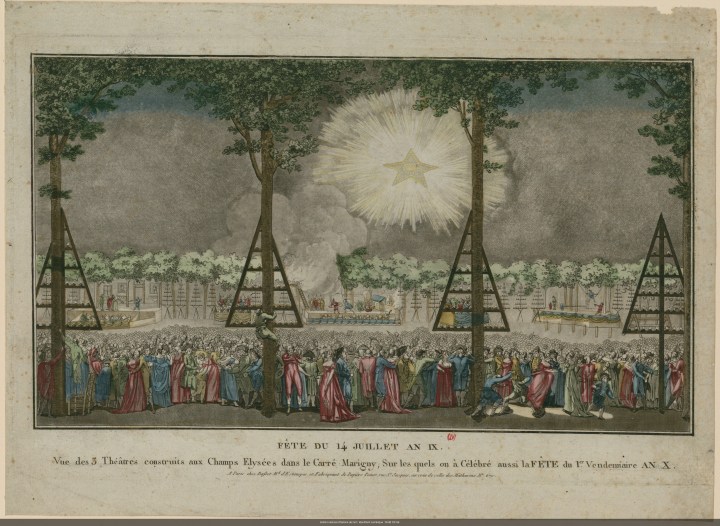
Paul-André Basset, Fête du 14 Juillet An IX, ca. 1801, hand-colored engraving, 28 × 44 cm (Paris: Bibliothèque de l’Institut National d’Histoire de l’Art). The print depicts the national holiday, as celebrated on the Champs-Élysées and organized by Chalgrin, commemorating the storming of the Bastille in 1789.
◊ ◊ ◊ ◊ ◊
All contents from this special issue of Status Quaestionis are available as free downloads:
Here Today, Gone Tomorrow?
The Art of the Ephemeral in Eighteenth-Century France
Status Quaestionis: Language, Text, Culture 28 (2025)
Edited by Elisa Cazzato
This monographic issue of Status Quaestionis explores the notion of ephemerality in French artistic culture during the long eighteenth-century. The volume is highly interdisciplinary, featuring articles from art and theatre history, costume-making, and performance studies, extending the notion of the ephemeral to a wide range of examples. The authors investigate how, in order to exist, ephemerality needs materiality, since any creative process intersects with the material requirement that both artworks and performances need: materials, locations, settings, scripts, costumes, and bodies. This dichotomy enables historians to further analyse the cultural and political meanings of the ephemeral, connecting artworks to social contexts, dance costumes to movements, and public festivals to human reception. Rather than focusing solely on aesthetics, the volume interrogates how the ephemeral was experienced, recorded, and remembered and how its traces persist in artworks, texts, and collective memory. The contributions question the boundary between presence and absence, visibility and oblivion, reflecting on the long-term cultural implications of transience. In seeking what remains of the ephemeral, the volume challenges dominant narratives and reconsiders the politics of cultural memory.
This special issue was inspired by the intellectual discussions that took place during the international conference organised at Ca’ Foscari University of Venice in June 2023. The conference was part of the research project SPECTACLE, funded by the European Union’s Horizion 2020 research and innovation programme under the Marie Skłodowska-Curie grant agreement no. 893106.
t h e m a t i c a r t i c l e s
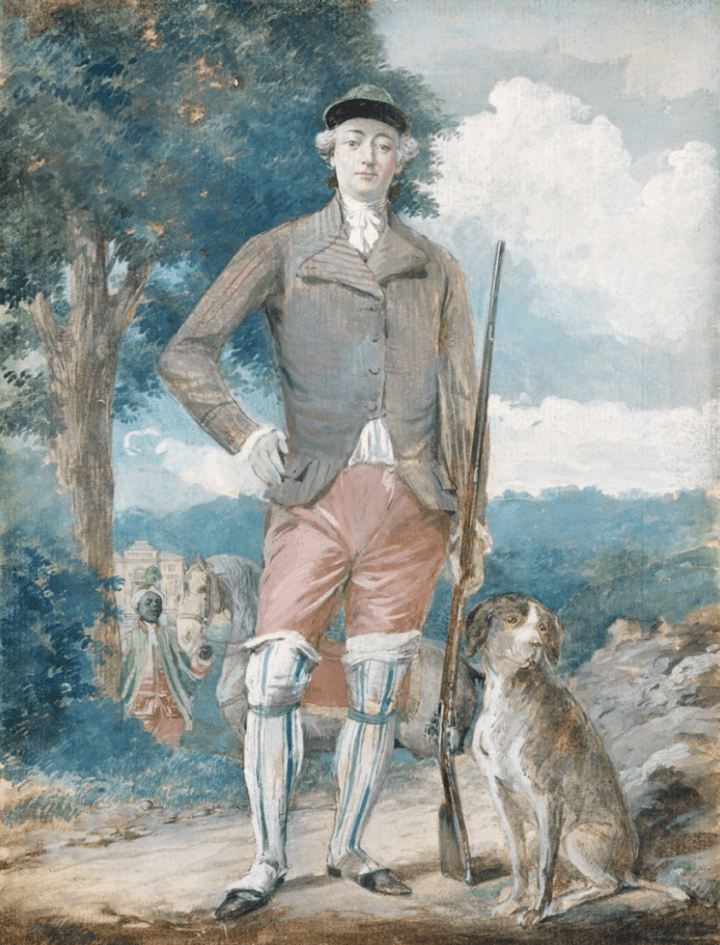
Jean-Baptiste-Philibert Moitte, The Comte d’Artois as a Hunter, ca. 1777, gouache on paper, 22.9 × 30 cm (Amiens, Musée de Picardie). Figure 1 from the article by Noémie Étienne and Meredith Martin.
• Introduction: Here Today, Gone Tomorrow? The Art of the Ephemeral in Eighteenth-Century France — Elisa Cazzato
• ‘Mais, le lendemain matin’: Residues of the Ephemeral in Eighteenth-Century French Art — Mark Ledbury
• Spectacular Blindness: Enslaved Children and African Artifacts in Eighteenth-Century Paris — Noémie Étienne and Meredith Martin
• L’art du comédien au tournant des Lumières: Conscience de l’éphémère et sensibilité mémorielle — Ilaria Lepore
• L’expérience éphémère d’Ériphyle (Voltaire, 1732): Matériaux tangibles et réécritures d’une dramaturgie passagère — Renaud Bret-Vitoz
• Un événement unique: Le théâtre de la Révolution entre surgissement et disparition — Pierre Frantz
• Ephemeral Emblem: Jacques-Louis David and the Making of a Revolutionary Martyr — Daniella Berman
• Les feux d’artifices des frères Ruggieri à l’intérieur d’un théâtre: L’autonomie de l’éphémère dans le Paris du XVIIIe siècle — Emanuele De Luca
• Tra utopia e ricerca del consenso: Fuochi e apparati effimeri di epoca napoleonica a Milano tra il 1801 e il 1803 — Alessandra Mignatti
• Witnesses of the Past: Costumes as Material Evidence of the Ephemeral Performance — Petra Zeller Dotlačilová
• Noverre’s Lament: Inscription, Posterity, and the Ephemeral Art of Dance — Olivia Sabee
• Ephemerality on the Fringe: Exploring the Venues Hosting Power Quadrilles in Brussels on the Eve of Waterloo and Beyond (1814–1816) — Cornelis Vanistendael
Miscellaneous articles and reviews are available here»
◊ ◊ ◊ ◊ ◊
Elisa Cazzato is research fellow at the University of Naples Federico II. She holds a PhD in art history from the University of Sydney, and she is a former Marie Skłodowska-Curie Global Fellow. For her project SPECTACLE she was a visiting scholar at the CELLF of the Université Sorbonne and in the New York University’s Department of Art History. Her publications include articles in the peer-review journals Studi Francesi, Dance Research, Humanities Research Journal, and RIEF. She is currently writing her first book on the life and career of Ignazio Degotti.
Exhibition | Adèle de Romance (1769–1846)
Now on view at the Fragonard Museum in Grasse (with more information available here, pp. 124–27):
Adèle de Romance: A Liberated Painter / Peintre Libre
Musée Fragonard, Grasse, 14 June — 12 October 2025
Curated by Carole Blumenfeld
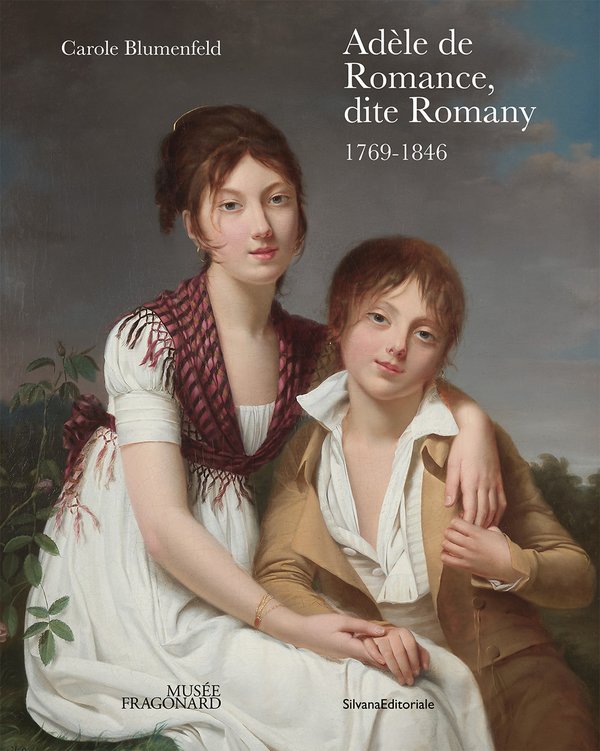 After dedicating the summer 2023 exhibition to the Lemoine sisters and their cousin Jeanne Élisabeth Chaudet, the Jean-Honoré Fragonard Museum will celebrate Adèle de Romance in 2025. This painter, whose life was as brilliant as it was tumultuous, embodies all the opportunities that the end of the 18th century and the beginning of the 19th century offered to talented artists.
Born from an illegitimate union between the Marquis Godefroy de Romance, Adèle de Romance (1769–1846) was eventually recognized and adopted by her father at the age of 8. Her younger half-sister, whose personal life perfectly met their father’s expectations, received many signs of trust from him. Despite this, Adèle de Romance now had a name and enjoyed one of the largest collections of Nordic and French paintings, including many works by Fragonard. Concerned with her education, the Marquis de Romance guided all her personal choices, from her passion for painting to the birth of her first child at the age of 18. Adèle then married the miniaturist François Antoine Romany, a mismatched union whose sole purpose was to give her a status. When her father left France in August 1791 to defend the counter-revolutionary ideas that mattered to him, Adèle de Romance was forced to conceal her partly aristocratic origins and to live… by her brushes.
After a divorce, which she willingly kept her married name, she began a series of small portraits of prominent figures. She took advantage of the fame of her subjects and, for four decades, played with a multitude of surnames, embracing public exposure and presenting dozens of works. Witnessing the upheavals of her time, she made the most of the political and social context that favored portraiture. Better than many other artists, she succeeded in capturing the desire for reinvention of the personalities she painted, presenting a gallery of portraits that reflected France. Adèle de Romance participated in a time when images were about to play an unprecedented role. Portraits, a rather insignificant genre in a monarchy—where only one person matters and everyone else is nothing—acquired a new level of interest in a Republic. It then became a vector of virtues, talents, services, and memories.
Adèle de Romance did not have the privilege of joining the royal collections, the birthplace of today’s national collections. Paying tribute to this painter who managed to live from her art first required finding her works. Thus, with the exception of the rich corpus preserved in the collections of the Comédie-Française, the paintings of Adèle de Romance held in French public collections are not only rare but rarely exhibited. Many of her portraits remained with the descendants of the sitters, who kindly allowed them to be displayed for the Grasse exhibition, thus honoring this woman who, very early on, understood that culture and artistic talents were a remarkable passport to being accepted, regardless of her origins, and having a voice in a world dominated by men.
From Silvana:
Carole Blumenfeld, Adèle de Romance, dite Romany, 1769–1846 (Milan: Silvana Editoriale, 2025), 232 pages, ISBN: 978-8836661121, €35.
Adèle de Romance appartient à cette caste ténue de femmes qui, sans jamais se poser en séditieuses, surent hanter les lisières du monde établi et frayer, dans les anfractuosités d’un ordre contraignant, un sentier d’autonomie patiemment conquis. Douée d’un discernement affûté et d’un sens exquis de la conjoncture, la portraitiste sut, avec adresse et aplomb, tirer parti des ondulations du temps et des vents favorables, pour jouer des équivoques de sa propre identité et en faire un atout, pour ses modèles et pour elle-même. Adèle de Romance devint pleinement maîtresse de son destin en peignant les visages d’autrui, qu’elle signait parfois de son nom de naissance, « de Romance », mais le plus souvent : « Romany », « Rom… », « Romanée », « de Romany » ou « DR »… Ces jeux de recomposition nominale, souples et ductiles, savamment dosés, relèvent d’une poétique du nom propre, où l’identité se dit autant par esquive que par assertion.
c o n t e n t s
Philippe Costamagna — Preface
Carole Blumenfeld — Peindre pour s’appartenir: Marie Jeanne de Romance, Adèle de Romance, dite Romany, Adèle Romanée, Adèle Romany-de-Romance, AR
Carole Blumenfeld — Catalogue des Oeuvres Exposées
Arbre généalogique d’Adèle de Romance
Chronobiographie
Liste des œuvres présentées aux Salons
Annexes
Index
Bibliographie
Exhibition | Traits of Genius
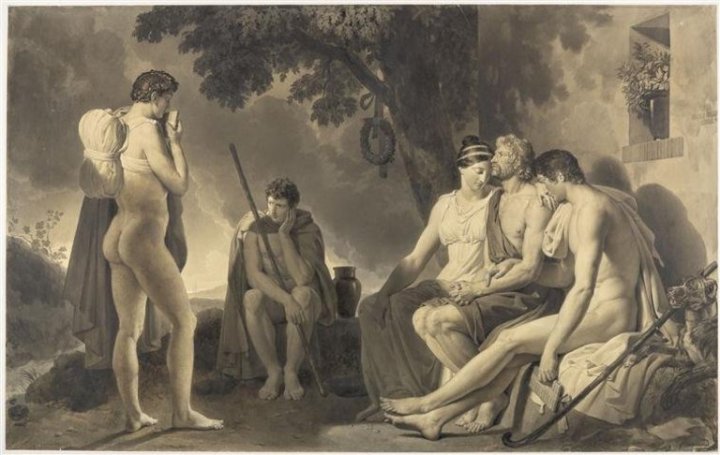
Alexandre-Évariste Fragonard, Pastorale / Homère et les Bergers, 1810; graphite, brown wash, black ink, and white highlights on beige paper; 55 × 88 cm (Louvre, INV 26657).
◊ ◊ ◊ ◊ ◊
The exhibition presents some sixty drawings by Jean-Honoré Fragonard, his wife Marguerite Gérard, and their son Alexandre-Évariste from the collections of the Louvre:
Les Traits du Génie: Dessins du Louvre par Jean-Honoré Fragonard,
Alexandre-Évariste Fragonard, et Marguerite Gérard
Musée International de la Parfumerie, Grasse, 27 June — 26 October 2025
Cet été, le Musée International de la Parfumerie vous invité à découvrir l’œuvre de Jean-Honoré Fragonard, l’un des plus grands peintres du XVIIIe siècle, à travers une exposition exceptionnelle. Né à Grasse en 1732, Fragonard a marqué son époque par son talent unique, tout en restant profondément attaché à sa ville natale. Bien que Paris ait été son principal lieu de vie, son mariage avec Marie-Anne Gérard, issue d’une famille de parfumeurs grassois, ainsi que ses séjours réguliers à Grasse, témoignent de l’attachement de l’artiste à sa ville d’origine.
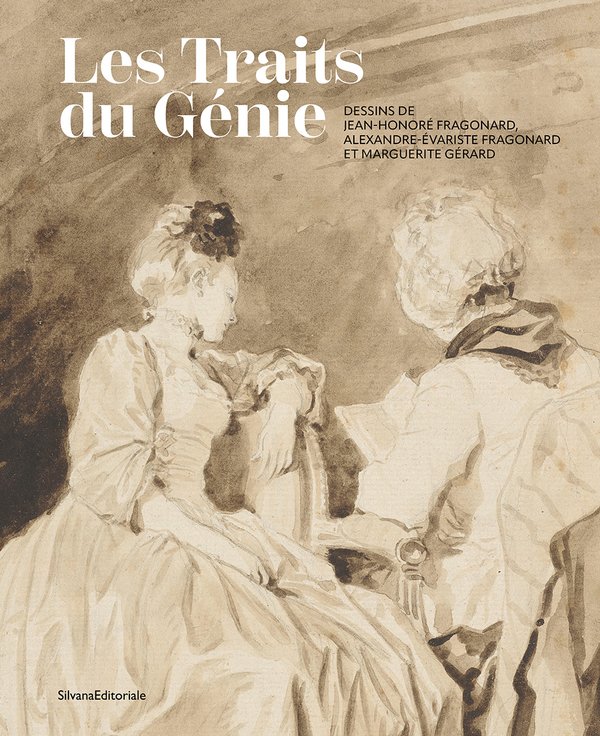 L’exposition propose une sélection de plus de soixante dessins de Fragonard, jamais exposés à Grasse et rarement montrés ailleurs. Ces œuvres, provenant des collections du département des Arts Graphiques du musée du Louvre, offrent un regard privilégié sur le processus créatif de Fragonard. Que ce soit des autoportraits, des souvenirs de voyages, des études de figures ou des projets d’illustration, les dessins de Fragonard nous donnent un aperçu de l’étendue du génie de l’artiste et offrent au visiteur grassois une proximité inédite avec l’essence de son œuvre.
Fragonard n’a pas seulement marqué l’histoire de la peinture. Son influence s’étend également aux arts décoratifs, et notamment à l’univers de la parfumerie, un domaine dans lequel Grasse occupe une place centrale. Pour illustrer ce lien, l’exposition présente une série de flacons de parfum en porcelaine du XVIIIe siècle, prêtés par la société Givaudan. Que vous soyez passionné d’art, d’histoire ou simplement curieux, cette exposition est une occasion unique de plonger dans l’univers de Jean-Honoré Fragonard, de découvrir ses œuvres et d’explorer les liens entre son art et l’univers du parfum.
From Silvana:
Laure Decomble, Olivier Quiquempois, Xavier Salmon, and Martine Uzan, Les Traits du Génie: Dessins de Jean-Honoré Fragonard, Alexandre-Évariste Fragonard et Marguerite Gérard (Milan: Silvana Editoriale, 2025), 200 pages, ISBN: 978-8836661534, €29.
c o n t e n t s
• Grasse et Jean-Honoré Fragonard — Olivier Quiquempois
• Crayonnages et lavis de Fragonard: Quelques considérations sur certains amateurs et collectionneurs — Xavier Salmon
Oeuvres
• Les Fragonard, une famille d’artistes — Laure Decomble
• Voyager et apprendre — Laure Decomble
• Regarder et inventer — Xavier Salmon
• Fragonard, illustrateur — Olivier Quiquempois
• Les Flacons de la Séduction — Martine Uzan
English Texts
Bibliographie
New Book | Les Pierres de la Nation
From Mare et Martin:
Maddalena Napolitani, Les pierres de la Nation: Les collections minéralogiques de l’Ecole des mines de Paris, 1760–1860 (Paris: Les Éditions Mare et Martin, 2025), 362 pages,
ISBN: 978-2362220838, €48.
 Les pierres de la Nation raconte l’histoire des collections de minéralogie de l’Ecole des mines de Paris, les considérant surtout sous le point de vue de leurs caractéristiques esthétiques et artistiques, à un moment clé pour l’histoire du collectionnisme : celui de la naissance des musées et du patrimoine. De leur constitution pendant les années 1760, à la création du musée de minéralogie dans les années 1850–1860, passant par les bouleversements révolutionnaires, ces collections contribuent à bâtir de nouveaux récits historiques au fil des changements socio-politiques, et se lient au territoire national et à la création de ses monuments et musées.
Maddalena Napolitani | Docteure histoire de l’art, ses recherches, à la croisée avec l’histoire des sciences concernent l’histoire des collections, des musées et du patrimoine scientifique, ainsi que les rapports entre esthétique et sciences de la Terre à l’âge moderne (XVIIIe–XIXe siècles). Italienne, elle travaille à présent au Musée Galileo (Florence) et a travaillé en France (ENS de Paris, Université de Grenoble), participant aussi à des expositions sur les collections mixtes des cabinets de curiosités.
New Book | Les Peintures italiennes du musée Napoléon, 1810–1815
As noted at the Art History News blog; from the publisher:
Stéphane Loire, Les Peintures italiennes du musée Napoléon, 1810–1815: Édition illustrée et commentée du volume I de l’inventaire Napoléon (Paris: Les Éditions Mare et Martin, 2025), 760 pages, ISBN: 978-2362221026, €149.
 Ce volume est l’édition illustrée du premier des dix-sept registres manuscrits formant l’Inventaire Napoléon (1810–1815), dont quatre se rapportent aux quelque six mille peintures figurant dans cet inventaire. L’Inventaire Napoléon est le premier inventaire des collections du musée du Louvre après sa création en 1793 sous le nom de Muséum français, devenu en 1803 Musée Napoléon. Comprenant notamment les oeuvres issues des saisies révolutionnaires et napoléoniennes, en France comme à l’étranger, et donnant pour la plupart des estimations financières, il est essentiel pour l’histoire du patrimoine artistique que le Louvre a abrité à l’époque de la Révolution et du Premier Empire. Mais il enregistre aussi la dispersion d’une partie de ce patrimoine dans d’autres institutions publiques françaises à partir de 1798, ainsi que sa restitution partielle à divers pays à partir de 1814 : c’est un document de première importance pour l’histoire de nombreux musées, en France et en Europe.
Stéphane Loire est conservateur général, adjoint au directeur du département des Peintures du musée du Louvre.










 Enfilade
leave a comment