Call for Papers | Late Venetian Fortification
From the Call for Papers:
Late Venetian Fortification
Split, Croatia 4–5 October 2019
Proposals due by 15 January 2019
Until now, research on Venetian fortifications has given considerable more attention to Cinquecento works than to the achievements of the following centuries. This is why the aim of the conference is to focus on the later period. New material and insights are expected on the period starting with the War of Candia (1645–1669). Relevant topics include but are not limited to:
• important fortification sites and projects: Morea, Corfu, Corinto, Dalmatia, etc.
• activities of military engineers
• procedures and institutions involved in the construction of fortifications
• involvement of Johann Matthias von der Schulenburg (1661–1747) in fortification construction
Proposals for 30-minute talks should be submitted to azmegac@ipu.hr no later than 15 January 2019. Applicants will be notified by 15 February 2019. Proposals should include the title of the paper, an abstract (max 1500 characters), a short CV with bibliography, affiliation, and contact information. The conferences languages are English and Italian. Presenters are expected to cover their travel and accommodation expenses. Selected contributions will be published in the conference proceedings.
The conference is part of the research project Antun Jančić and Fortification Architecture of the Venetian Republic funded by the Croatian Science Foundation and conducted at the Institute of Art History in Zagreb.
Getty Research Institute Acquires Rare Gastronomy Collection
Press release (26 November 2018):
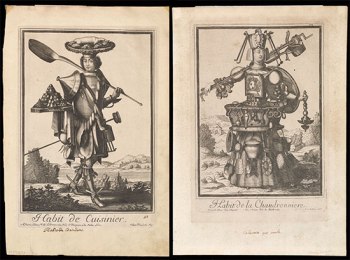
Costume of the Cook (left) and Costume of the Boilermaker (right), Nicolas I de Larmessin, ca. 1690s (Getty Research Institute, 2018.M.15).
The Getty Research Institute announced the acquisition of a collection of hundreds of rare books, prints, and manuscripts related to the culinary arts from the 15th to the 19th centuries assembled by culinary authority Anne Willan and her husband Mark Cherniavsky—the Anne Willan and Mark Cherniavsky Gastronomy Collection. Additionally, a donation from Willan will support ongoing research grants known as the Cherniavsky Library Research Grants.
“Mark had a talent for finding great examples of rare prints and early cookbooks and books about food and has built an exceptional collection,” said Getty Research Institute Chief Curator Marcia Reed. “Over the years Mark and Anne have been wonderful contributors and friends to the GRI, donating important rare books, lending works to our exhibitions, and hosting educational programs. We are grateful to Anne for her generous gift of this collection as well as her support of related scholarship in honor of her late husband, and our friend, Mark.”
Named in honor of Mark Cherniavsky and in celebration of the Anne Willan and Mark Cherniavsky Gastronomy Collection, the Cherniavsky GRI Library Research Grants will support and encourage research relating to antiquarian books, culinary research and other related topics. These grants will be awarded to up to two scholars a year and are made possible by a gift from Anne Willan. Willan is a celebrated author, cooking educator and founder of the prestigious Ecole de Cuisine La Varenne, which operated in Paris and Burgundy, France, from 1975 until 2007.
This extraordinary collection of rare books and prints on gastronomy from the 15th through the 19th century offers unique insight into the visual culture of food. The elaborate art of culinary preparation, consumption, and display reveals food’s status as a symbol of political and social power. Amassed by antiquarian cookbook collectors Anne Willan and Mark Cherniavsky over a period of 50 years, the collection comprises nearly 200 books published before 1830 and hundreds from the 19th and 20th centuries.
Highlights include Johannes Cassianus’s De institutis coenobiorum, Collationes partum (Venice, 1491), which describes fasting and feasting within a monastic order; M. Emy’s L’art de bien faire les glaces d’office (Paris, 1768), which opens with an evocation of cupids making ice cream; and Antonin Carême’s Le Maître d’hôtel francais (Paris, 1823), which contains recipes for dinners given for, among others, Tsar Nicholas I, George IV, and Prince Charles-Maurice de Talleyrand.
The collection’s many early modern books, which illustrate elaborate feasts, celebrations, and processions, complement the Getty Research Institute’s unparalleled festival collection. Also included is Willan’s working library of cookbooks, her professional archives, and the archives of Ecole de Cuisine La Varenne, which she founded.
Exhibition | MONUMENTality
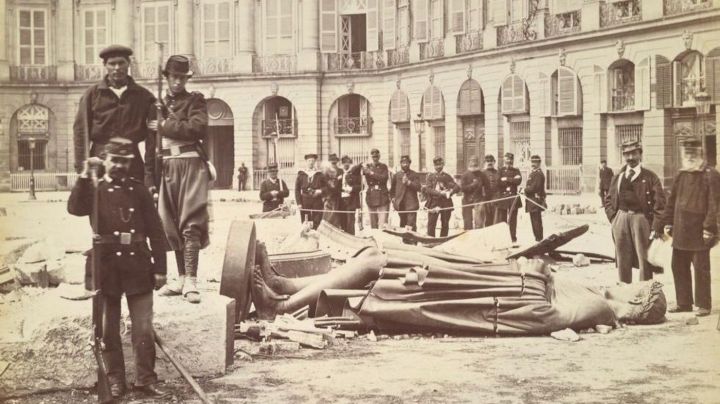
Bruno Braquehais, Statue of Napoleon I after the Toppling of the Vendôme Column, 1871
(Los Angeles: Getty Research Institute)
◊ ◊ ◊ ◊ ◊
Press release (19 November 2018) for the exhibition:
MONUMENTality
Getty Center, Los Angeles, 4 December 2018 — 21 April 2019
Curated by Frances Terpak, Maristella Casciato, and Katherine Rochester
As the role and meaning of monuments in contemporary culture takes on new urgency, the Getty Research Institute is presenting an exhibition that connects these contemporary concerns to the past. MONUMENTality invites viewers to consider how the meanings of monuments can change over time and why some monuments endure while others fall.
“In organizing both this extraordinary exhibition and the current scholar year theme, the Getty Research Institute has focused on an especially timely subject—monuments and monumentality. Here, art history has very contemporary implications as many people, especially in the U.S., are passionately debating and re-examining the roles that monuments play in our communities and cities,” said Andrew Perchuk, acting director of the Getty Research Institute. “The GRI’s special collections are a rich source of archival material that makes it possible to take a broad view of both the varied life of monuments and the concept of the monumental from the classical to the contemporary.”
The exhibition investigates various paradigms of monumentality generated through systems of belief and structures of power, presenting historical rare books, political ephemera, photographs, and contemporary art about or inspired by monuments from antiquity to present day.
Artists in the exhibition include Dennis Adams, Annalisa Alloatti, Lane Barden, Mirella Bentivoglio, Joyce Cutler-Shaw, Tacita Dean, Theaster Gates, Leandro Katz, Michael Light, Benedetta Cappa Marinetti, Edward Ranney, Ed Ruscha, Ursula Schulz-Dornburg, Lebbeus Woods, and more.
Objects in the exhibition date back to the 16th century, depicting early modern as well as classical monuments. For example, the renowned 18th-century printmaker Giovanni Battista Piranesi created grandiose reconstructions of Ancient Rome and a detailed scrolling engraving of Trajan’s column, erected in 113 CE. Rare 19th-century photographs document rebelling citizens during the 1871 Paris commune surrounding the toppled statue of Napoleon Bonaparte in the Place Vendôme, illustrating how the erection and destruction of monuments has been a recurring theme from antiquity to the present.
Among the oldest monuments explored in the exhibition are the Nazca lines, hundreds of ancient geoglyphs drawn into the southern desert of Peru by the Nazca people between 200 BCE and 500 CE. Recorded by photographers in the 20th century these enigmatic monuments are subject to plentiful theories about their meaning and purpose. In the exhibition, they are represented through photographs by Edward Ranney (American, b. 1942) who visited the sites repeatedly throughout the last half of the 20th century.
Juxtaposed with the Nazca images are photographs of earthworks created in the 1960s and 1970s by American artists who drew inspiration from these ancient monuments.
“Just as size and scale have been important in human efforts to mark cosmic and geological time, they are used by artists to invoke the monument and locate meaning. The phenomenology of the monument, the power structures behind monuments, and the meanings of monument, even when lost, are compelling subjects for contemporary artists,” said Frances Terpak exhibition co-curator and curator of photography at the Getty Research Institute. “Monuments are often made by artists but artists also take on the monument as a subject for exploring, deconstructing, and challenging.”
One of the newest objects in the exhibition is a deconstructed monument by Theaster Gates who is currently the artist in residence at the Getty Research Institute. For this exhibition Gates has toppled his own monumental piece Dancing Minstrel, 2016/18. Originally exhibited in 2016 as a larger-than-life bobble head depiction of the racist trope of the black minstrel, the installation at the Getty features the oversized parts of the figure scattered across the floor, a dramatic dismantling of a racist stereotype.
The exhibition also considers monumentality in relation to cities, both real and imagined. Design proposals and plans for the never-built Palace of the Soviets submitted during and after a major international competition in 1931–33 placed alongside a utopian plan to connect East and West Berlin at the height of the Cold War reveal how power is envisioned through the construction of the city and its monuments. The connection between monuments and the built environment is further explored through printed material, photographs, and ephemera. The impulse to document Los Angeles, for example, has spawned projects of enormous scope—such as Ed Ruscha’s extensive photo-documentations of Los Angeles Every Building on the Sunset Strip, 1966 and Hollywood Blvd, 1973 and 2002 and Lane Barden’s Linear City, a monumental tool for envisioning the city at the start of the 21st century by mapping its main arteries: water, rail, and automotive.
“Monuments, though often meant to stand for eternity, can physically change over time—from erosion, looting, war, or iconoclasm—or they can stay intact but change in their meaning, losing context or relevance, or becoming integrated with daily life in new ways. And monuments can form organically, through the ways that people interact with the built environment,” said Maristella Casciato, exhibition co-curator and curator of architecture at the Getty Research Institute. “MONUMENTality investigates the ways that monuments are necessarily dynamic, ultimately reflecting, through their endurance or failure, the world around them.”
The exhibition checklist is available here»
Exhibition | The Art of the Site: Building and Demolishing
Now on view at the Cité de l’architecture et du patrimoine:
The Art of the Site: Building and Demolishing from the 16th to the 21th Century
Cité de l’architecture et du patrimoine, Paris, 9 November 2018 — 11 March 2019
Curated by Valérie Nègre and Marie-Hélène Contal
 The exhibition juxtaposes different viewpoints, bringing together a collection of works and documents produced by artists, journalists, and amateurs, as well as those who work in situ: engineers, architects, contractors, and—what is rarer—labourers, through votive offerings or masterpieces produced by the Compagnons charpentiers des Devoirs du Tour de France. The exhibition ends with the statements of three contemporary architect-engineers: Patrick Bouchain, Marc Mimram, and Martin Rauch, for whom the building site is ever increasingly the space where architecture meets complexity, inventiveness and the aspirations of the modern-day world.
As the result of close collaboration between specialists of art and specialists of techniques, the exhibition offers a diverse interpretation of the theme: it casts a light on the technical dimension, as well as the social, political, and artistic dimensions. The path begins with what you would expect to find on a site: construction processes, machines, and men at work. It then highlights the political and social issues about the place that is being built. Even though the site is a highly technical area, it is also a theatre for those in charge, who like to show themselves there, and for the labourers, who are sometimes viewed as oppressed masses, sometimes viewed as heroes.
L’Art du chantier: Construire et démolir du 16e au 21e siècle (Paris, Snoeck, 2018), 283 pages, ISBN: 978-9461614728, 42€.
New Book | Classical Art: A Life History
From Princeton UP:
Caroline Vout, Classical Art: A Life History from Antiquity to the Present (Princeton: Princeton University Press, 2018), 376 pages, ISBN: 978-0691177038, $40.
 How did the statues of ancient Greece wind up dictating art history in the West? How did the material culture of the Greeks and Romans come to be seen as ‘classical’ and as ‘art’? What does ‘classical art’ mean across time and place? In this ambitious, richly illustrated book, art historian and classicist Caroline Vout provides an original history of how classical art has been continuously redefined over the millennia as it has found itself in new contexts and cultures. All of this raises the question of classical art’s future.
What we call classical art did not simply appear in ancient Rome, or in the Renaissance, or in the eighteenth-century Academy. Endlessly repackaged and revered or rebuked, Greek and Roman artifacts have gathered an amazing array of values, both positive and negative, in each new historical period, even as these objects themselves have reshaped their surroundings. Vout shows how this process began in antiquity, as Greeks of the Hellenistic period transformed the art of fifth-century Greece, and continued through the Roman empire, Constantinople, European court societies, the neoclassical English country house, and the nineteenth century, up to the modern museum. A unique exploration of how each period of Western culture has transformed Greek and Roman antiquities and in turn been transformed by them, this book revolutionizes our understanding of what classical art has meant and continues to mean.
Caroline Vout is Reader in Classics at the University of Cambridge and a Fellow of Christ’s College. Her books include Sex on Show: Seeing the Erotic in Greece and Rome, The Hills of Rome: Signature of an Eternal City, and Power and Eroticism in Imperial Rome.
C O N T E N T S
Preface
Acknowledgments
1 Setting the Agenda, or Putting the Art into Heritage
2 Finding the Classical in Hellenistic Greece
3 Making Greek Culture Roman Culture
4 Roman Art, the Building Blocks of Empire
5 Reviving Antiquity in Renaissance Italy
6 European Court Society and the Shaping of the Canon
7 ‘Neoclassicisms’ and the English Country House
8 Seeing Anew in the Nineteenth Century
9 The Death of Classical Art?
10 And the Moral of the Story . . .
Notes
Bibliography
Index
Conference | Art and Power, the Power of Art, Part III
From H-ArtHist:
Art et pouvoir, le pouvoir de l’art, III
Le séminaire annuel de l’équipe Histara, EA 7347, École Pratique des Hautes Études (EPHE)
Institut national d’histoire de l’art (INHA), Paris, 5 December 2018
P R O G R A M M E
9.30 Sabine Frommel (EPHE) Introduction
9.45 Matin
Présidence: Rachel Lauthelier-Mourier (EPHE)
• Emilie d’Orgeix (EPHE), Dessiner le vide: Vues de villes et matérialisation du pouvoir, XVIIe–XVIIIe siècles
• Marina Viallon (EPHE), Les tournois à la cour de France à la Renaissance
11.15 Pause café
11.30 Matin
Présidence: Rachel Lauthelier-Mourier (EPHE)
• Kristina Deutsch (Westfälische Wilhelms-Universität Münster), Le décor du pouvoir entre la France et l’Allemagne vers 1700: Le pavillon des bains du château de Nymphenburg à Munich
• Jean-Michel Leniaud (EPHE), Les peintures de Delacroix à la bibliothèque du Sénat
13.00 Pause déjeuner
14.15 Après-midi
Présidence: Isabelle Saint-Martin (EPHE)
• Rachel Lauthelier-Mourier (EPHE), Les monarchies de l’âge classique confrontées au dévoilement du site de Persépolis et à l’obsédante question de la décadence
• Emmanuel de Waresquiel (EPHE), La prise de la Bastille et les métamorphoses de la liberté, 1789–1830
• Barbara von Orelli (Université de Zurich), Le préventorium Le Rosaire à Les Sciernes-d’Albeuve (Suisse): Un monument Art déco entre législation, administration et philanthropie
16.30 Pause café
16.45 Après-midi
Présidence: Isabelle Saint-Martin (EPHE)
• Florence Descamps (EPHE), Bercy. Décors ministériels
• Agnès Callu (CNRS), Domination(s): Histoire politique des commandes aux artistes, de 1980 à nos jours
• Jean-Miguel Pire (EPHE), L’histoire de l’art dans le débat public: Une ‘discipline active dans la cité’ (Chastel)?
19.00 Fin des travaux
Print Quarterly, December 2018
The eighteenth century in the current issue of Print Quarterly:
Print Quarterly 35.4 (December 2018)

François Vivares after Samuel Wale, Trade Card of Henry Scott, Gardener and Fruitseller, Weybridge, Surrey, 1754, etching and engraving, 281 × 211 mm (London: The British Museum).
A R T I C L E S
• Bryony Bartlett-Rawlings, “Jonathan Richardson (1667–1745) as Etcher,” pp. 392–406.
On the basis of the 1772 auction catalogue for the sale of Jonathan Richardson Jr’s collection, the article sheds light on Richardson’s activity as a printmaker, his working method, and intended audience. By quoting contemporary correspondence by and on the artist, the article also places Richardson’s etchings within the context of his life and work.
• Martin Hopkinson, “Gardeners’ Trade Cards by William Kilburn and François Vivares,” pp. 420–26.
Deservedly famous for his outstanding textile designs and illustrations to William Curtis’s Flora Londinensis, Kilburn also etched a trade card for the gardener Thomas Greening, an image of great botanical precision. A comparison is drawn with two elaborate trade cards for gardeners by François Vivares.
N O T E S A N D R E V I E W S
• Jean-Gérald Castex, Review of the exhibition catalogue, A Kingdom of Images: French Prints in the Age of Louis XIV, 1660–1715 (Getty Research Institute, 2015; and Bibliothèque National de France, 2015–16), pp. 430–32.
• An Van Camp, Review of Ad Stijnman and Simon Turner, ed., The New Hollstein Dutch & Flemish Etchings, Engravings, and Woodcuts, 1450–1700: Johannes Teyler and Dutch Colour Prints, parts 1–4 (Sound and Vision Publishers, 2017), pp. 432–34.
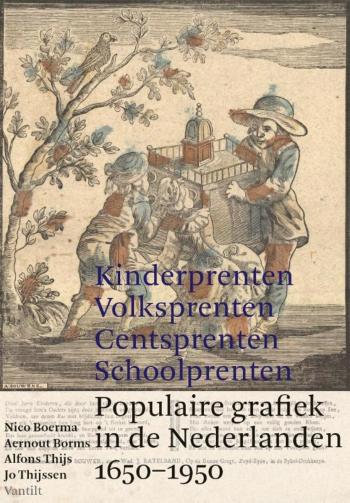 • Ger Luijten, Review of Nico Boerma, Aernout Borms, Alfons Thijs, and Jo Thijssen, eds., Kinderprenten, Volksprenten, Centsprenten, Schoolprenten: Populaire grafiek in de Nederlanden 1650–1950 (Uitgeverij Vantilt, 2014), p. 434.
“At more than a thousand pages,” this volume “is a reference work that deserves a place in any library striving to cover the history of printmaking … Written and compiled by Dutch and Flemish specialists of popular prints over a period of some ten years, it provides a mine of information that is nowhere else to be found … The book has a useful summary in English and German.”
• Anthony Dyson, Review of Richard Goddard, ‘Drawing on Copper’: The Basire Family of Copper-Plate Engravers and Their Works (Maastricht University Press, 2016), pp. 437–39.
• Notice of the exhibition catalogue, Marcela Vondráčková, Norbert Grund (1717–1767): Půvab všedního dne / The Charm of the Everyday, Czech and English (National Gallery in Prague, 2017), p. 459.
“This handsomely-illustrated exhibition catalogue gives a survey of the work of the delightful rococo painter Norbert Grund (1717–1767), who is scarcely known outside Central Europe … We look forward to learning more … in a comprehensive monograph on Grund’s oeuvre, which is due to be published by Marcela Vondráčková.”
• Patricia Emison, Review of Susanna Berger, The Art of Philosophy: Visual Thinking in Europe from the Late Renaissance to the Early Enlightenment (Princeton University Press, 2017), pp. 471–74.
“Berger’s readable and well-illustrated account tackles the topic of logic’s contribution to the history of visualization, and of scholastics’ interest in transmitting knowledge via images … Berger has dug deep in unusual places,” including a mnemonic treatise of 1725 and eighteenth-century student notebooks from Paris and Leuven. “This is fascinating material.”
• Sarah Grant, Review of April Calahan, Fashion Plates: 150 Years of Style (Yale University Press, 2015), pp. 474–78.
Exhibition | Georges Focus: The Madness of a Painter
From the communiqué de presse:
Georges Focus (1644–1708): La folie d’un peintre de Louis XIV
Palais des Beaux-Arts, Paris, 13 October 2018 — 6 January 2019
Curated by Emmanuelle Brugerolles
 La découverte de l’œuvre de Georges Focus produite lors de son enfermement aux Petites Maisons suscite aujourd’hui l’étonnement, pour ne pas dire un choc, qui nous bouleverse. Elle nous inspire le sentiment de l’inédit, du jamais vu, et remet en cause nos idées reçues. Georges Focus, membre de l’Académie royale de peinture et de sculpture sous Louis XIV, eut une double production artistique, académique d’une part, personnelle et intime, d’autre part. L’étonnant corpus réuni en France pour la première fois au Palais des Beaux-Arts, soit environ 80 dessins ainsi que des estampes et des peintures provenant de l’université d’Édimbourg, de collections particulières et d’institutions publiques dont les Beaux-Arts de Paris, rend compte de sa trajectoire unique. Une occasion d’explorer l’oeuvre exceptionnelle et singulière d’un artiste de l’époque de Louis XIV, atteint de folie.
Emmanuelle Brugerolles, ed., Georges Focus: La Folie d’un Peintre de Louis XIV (Paris: Beaux-Arts de Paris Editions, 2018), 447 pages, ISBN: 978-2840565444, $80.
The full press release is available here»
Exhibition | Bed Furnishings in Early America
Now on view at the Wadsworth Atheneum:
Bed Furnishings in Early America: An Intimate Look
Wadsworth Atheneum Museum of Art, Hartford, Connecticut, 26 September 2018 — 27 January 2019
Curated by Brandy Culp

Anna Tuels, Paper Template-pieced Quilt, Hourglass, 1785, New England, various worsteds, silk, and printed cottons, with a wool backing and wool batting (Wadsworth Atheneum, 1967.75).
From birth to death, the bed played a significant role in life’s daily cycles. Almost a room within a room, the bed was a place for sleeping as well as intimate activities, such as sex, childbirth, nursing, convalescence, and even death. From the seventeenth to early nineteenth century there was a bed in almost every room of the home. The ‘best bed’—today we call it the master bed—was usually located in either the distinguished parlor or ‘best’ bedchamber. These were public spaces, where guests were entertained and daily activities took place.
The fully-outfitted bedstead was one of the most expensive household items in Early America, regardless of one’s wealth. Bed hangings, counterpanes, coverlets, bed rugs, and quilts bear witness to the aspirations of their owners and makers. All are exceptional examples of handwork that reflect the skills of talented artisans, whether hired professional or homemaker, and mark the global intersections between people of various cultures. Bed Furnishings in Early America, An Intimate Look explores the evolution of privacy, intimacy, status, and global exchange through the bedstead, its textiles, and their placement within the home into the late nineteenth century.
Exhibition | Bouke de Vries: War and Pieces

Bouke de Vries, War and Pieces, 2012, 18th-, 19th-, and 20th-century porcelain, plastic, sprayed plaster, acrylic, steel, aluminum, gilded brass, and mixed media (installation view at the Wadsworth Atheneum Museum of Art, 2018).
◊ ◊ ◊ ◊ ◊
From the press release, via Art Daily:
Bouke de Vries: War and Pieces
Wadsworth Atheneum Museum of Art, Hartford, Connecticut, 4 October 2018 — 6 January 2019
Montgomery Museum of Fine Arts, Montgomery, Alabama, 2 February — 12 May 2019
For years, the work of celebrated artist Bouke de Vries has been shown all over Europe in museums, galleries, castles, and palaces. America won’t be left behind. Now and through the middle of 2019, several sculptures by Dutch-born de Vries will be making their stateside debut at museums in Hartford, Connecticut; Montgomery, Alabama; and Nashville, Tennessee. Foremost among them is his pièce de résistance: War and Pieces, a 26-foot-long installation inspired by the lavish decorative centerpieces of 18th-century European banqueting tables.
The first venue is the Wadsworth Atheneum, in Hartford, where de Vries is the featured artist in the 180th installment of the museum’s MATRIX contemporary art exhibition series, running from 4 October 2018 until 6 January 2019. “Because the Wadsworth Atheneum possesses such an outstanding collection of the very kind of porcelain figures and centerpieces that Bouke de Vries references in his monumental work,” observes Linda Roth, Senior Curator and Charles C. and Eleanor Lamont Cunningham Curator of European Decorative Arts, “featuring War and Pieces at our museum makes perfect sense.” Adds de Vries: “It is an honor to debut my most ambitious work at America’s first-ever museum of art, the Wadsworth Atheneum, in their longstanding and groundbreaking MATRIX series.”
From Hartford, War and Pieces travels South, to Alabama, where it will be on view at the Montgomery Museum of Fine Arts from 2 February to 12 May 2019.
Employing broken shards of various kinds of porcelain-ancient and modern—from Hummel thru blanc de Chine to IKEA—the artist has arranged them into apocalyptic vignettes of orchestrated destruction. Dead center is a towering nuclear mushroom cloud. Six mano-a-mano battle scenes flank the cloud, fought by armour-clad figures molded from 18th-century embodiments of Mars and Minerva by England’s Derby factory. The sugarcoated warring figures are mutating into cyborgs with colorful bionic limbs and weaponry from Transformer toys. The striking diversity among the sugar, porcelain and plastic underscores the tension between the handmade and the industrial. De Vries’s masterwork is an unforgettable commentary on the follies of war and is perhaps the most startling tablescape since Judy Chicago’s landmark Dinner Party, 1979.
London-based, de Vries first worked in fashion with John Galliano, Stephen Jones, and Zandra Rhodes before switching careers. Since then the 57-year-old artist has worked as a conservator of ceramics and glass, in addition to his pursuits as an artist since 2010. Ironically, the skills he deploys as a restorer went in a totally opposite direction for War and Pieces. Instead of reconstructing shattered porcelain, he deconstructed it, inaugurating a new status while creating new virtues. Says de Vries: “I have dreamed of sharing my approach to art—especially War and Pieces—at such prestigious museums around the United States.”
In addition, from 2 February until 9 June 2019, as part of Derived from the Decorative: Works by Faig Ahmed, Beth Lipman and Bouke de Vries at Nashville’s Cheekwood Estate and Gardens, other works by de Vries will be making their American bow. Peacock 1 and Glass Cloud are also both constructed of broken pieces of historic ceramic and glass. Bouke de Vries is represented in the United States by Ferrin Contemporary in North Adams, Massachusetts.










 Enfilade
leave a comment