Call for Papers | Social Technologies and Global Knowledge Economies
From Lichtenberg-Kolleg, the Göttingen Institute for Advanced Study:
Social Technologies and Global Knowledge Economies, 1750–1850
Lichtenberg-Kolleg, Göttingen, 4–6 April 2019
Proposals due by 15 November 2018
The remarkable density of connections that characterized knowledge production between 1750 and 1850 has long figured in definitions of the ‘rise of modernity’. The commerce of ideas through correspondence networks and print as well as manuscript circulation in salons, learned societies, and other institutions has been celebrated as foundational to modernity’s more conspicuous highlights, from the Scientific Revolution and the Enlightenment to the political articulation of universal human rights. Indeed, the circulation of ‘useful knowledge’—or, in today’s phraseology, the ‘knowledge economy’—remains integral to the modern concept of progress, formulated and adopted during the brief period between 1750 and 1850.
This interdisciplinary workshop, organized by Lichtenberg-Kolleg, the Göttingen Institute for Advanced Study, will focus on interrogating these narratives of modernity in the context of the emergence of an array of ‘social technologies’ that enhanced networks of knowledge production and circulation at the turn of the nineteenth century. From communication, transmission, and circulation, to innovations that enabled, impinged upon, or otherwise shaped social relations, we welcome papers on all aspects of socio-technological change and their relation to the development of global economies of knowledge production and circulation from 1750 to 1850.
Topics of interest include (but are not restricted to) the role of media (including paper, ink), technologies (including manuscript, print, electric impulses), and practices (including translation and taxonomy) in knowledge production; the role of collaboration and infrastructure in the circulation of knowledge; the changing roles of institutions (including schools, hospitals, prisons, universities, libraries, collections and gardens) in the wider knowledge economy; social environments and their relation to bodily technologies; and the development of revolutionary technology and radical media in this period.
We invite proposals for 20-minute presentations in English. To apply please email a title and abstract (no more than 300 words) along with a one-page CV in either MS Word or PDF format to the conference organizers (lichtenbergkolleg@zvw.uni-goettingen.de). Please include ‘Social Technologies’ in the subject line. Applications are due 15 November 2018. Applicants will be notified by 15 December 2018. Accommodation and travel will be provided to all confirmed participants. Please contact the conference organizer with any questions.
New Book | Local Antiquities, Local Identities
From Manchester UP:
Kathleen Christian and Bianca de Divitiis, eds., Local Antiquities, Local Identities: Art, Literature, and Antiquarianism in Europe, c. 1400–1700 (Manchester: Manchester University Press, 2018), 352 pages, ISBN: 978-1526117045, £80.
 This collection investigates the wide array of local antiquarian practices that developed across Europe in the early modern era. Breaking new ground, it explores local concepts of antiquity in a period that has been defined as a uniform ‘Renaissance’. Contributors take a novel approach to the revival of the antique in different parts of Italy, as well as examining other, less widely studied antiquarian traditions in France, the Netherlands, Spain, Portugal, Britain and Poland. They consider how real or fictive ruins, inscriptions and literary works were used to demonstrate a particular idea of local origins, to rewrite history or to vaunt civic pride. In doing so, they tackle such varied subjects as municipal antiquities collections in Southern Italy and France, the antiquarian response to the pagan, Christian and Islamic past on the Iberian Peninsula, and Netherlandish interest in megalithic ruins thought to be traces of a prehistoric race of Giants.
Kathleen Christian is Senior Lecturer in Art History at The Open University. Bianca de Divitiis is Associate Professor in the History of Modern Art at the University of Naples Federico II.
C O N T E N T S
Kathleen Christian and Bianca de Divitiis, Introduction
1 Richard Schofield, A Local Renaissance: Florentine Quattrocento Palaces and all’antica Styles
2 Francesco Benelli, The Arch of Trajan in Ancona and Civic Identity in the Italian Quattrocento from Ciriaco d’Ancona to the Death of Matthias Corvinus
3 Kathleen Christian, Roma Caput Mundi: Rome’s Local Antiquities as Symbol and Source
4 Bianca de Divitiis, A Local Sense of the Past: Spolia, Re-Use, and all’antica Building in Southern Italy, 1400–1600
5 Oren Margolis, The Gaulish Past of Milan and the French Invasion of Italy
6 William Stenhouse, Reusing and Redisplaying Antiquities in Early Modern France
7 Fernando Marías, Local Antiquities in Spain: From Tarragona to Córdoba
8 Katrina Olds, Local Antiquaries and the Expansive Sense of the Past: A Case Study from Counter-Reformation Spain
9 João Figueiredo, Luís de Camões’s The Lusiads and the Paradoxes of Expansion
10 Edward Wouk, Semini and His Progeny: The Construction of Antwerp’s Antique Past
11 Krista De Jonge, Resurrecting Belgica Romana: Peter Ernst von Mansfeld’s Garden of Antiquities in Clausen, Luxemburg, 1563–90
12 Konrad Ottenheym, On Romans, Batavians, and Giants: The Quest for the True Origin of Architecture in the Dutch Republic
13 Barbara Arciszewska, The Role of Ancient Remains in the Sarmatian Culture of Early Modern Poland
14 Jenna Schultz, Inventing England: English Identity and the Scottish ‘Other’, 1586–1625
Index
Call for Articles | Printing Things, 1400–1900
From the Abstract Submission Form:
Printing Things: Blocks, Plates, and Stones, 1400–1900
Edited by Giles Bergel and Elizabeth Savage
Abstracts due by 1 November 2018 (extended from 15 October); completed chapters due by 15 May 2019
In all fields based on historical printed material, research conventionally focuses on the text, images, and other information that was printed. The objects used to produce that information (including cut woodblocks, engraved metal plates, and cast metal sorts) have been neglected. Many hundreds of thousands of these historical printing surfaces survive today. The vast majority are inaccessible to researchers because they are uncatalogued and often considered ‘uncatalogue-able’. However, as individual objects and as an untapped category of cultural heritage, these artefacts of printing offer a great deal of information that the finished prints, books, fabrics, and other printed materials do not.
As relics of historical crafts and industry, these objects fall outside the modern disciplines. This edited volume will respond to the need for a multidisciplinary introduction to what image-based fields calls ‘print matrices’ and text-based fields call ‘printing surfaces’. Following from the conference Blocks Plates Stones (London, 2017), the first facilitated discussion of the use of such objects in research, Printing Things will represent the state of research in this new and developing field. It will bring together object-based research, collection-level surveys, historical printing practices, ethical considerations of their storage and use (or non-use) today, methods for multiplying the originals (e.g. dabs, stereos, electros), and methodological studies. By doing so, it will offer frameworks for describing, conserving, curating, presenting and understanding these objects using new and existing paradigms. It aims to facilitate their introduction into historical research across the disciplines.
Contributions are sought from art historians, book historians, cultural historians, musicologists, science and medicine historians, typographers, and researchers in other fields based on historical printed material; material scientists and conservators; historically informed printers and printmakers; curators, cataloguers, librarians, and printing museum managers who care for these objects; and digital humanities specialists who are creating a new generation of tools for culling information from these objects. The book will focus on handpress work.
In addition to object- and collection-based case studies, theoretical perspectives might include:
• What can print matrices/printing surfaces teach us that printed materials cannot, and vice versa?
• How should they be regarded: as artists’ tools, intermediary states of works of art, or works of art in themselves?
• Is there a value in considering woodblocks, metal plates, and litho stones together as a single category?
• What lies behind the sudden and recent increase in interest in these objects, and how can these objects inform those emerging research trends?
• How are they to be conserved, curated, presented, and understood?
• Does the recent turn to object-centered cultural criticism (‘thing theory’) provide useful paradigms for their study?
• What are the ethical and critical issues around bringing them back into use as printing surfaces?
• What is their place within the systems of digital remediation and knowledge within which art and book history is increasingly practiced?
Abstracts must be submitted by 15 October 2018. Chapters of 4,000–5,000 words (*including notes and captions*) with up to 10 illustrations will be due 15 May 2019 for publication in mid-2020. The book will be peer-reviewed and published in full colour. Contributors will be responsible for sourcing images and copyright for their contributions, but they will qualify for fee waivers from many heritage collections because the publisher is a charitable academic press. Please send queries to Gemma Cornetti at printingcolourproject@gmail.com.
Editors
Giles Bergel (Oxford), Elizabeth Savage (Institute of English Studies)
Advisory Board
Sven Dupré (Utrecht), Caroline Duroselle-Melish (Folger), Maria Goldoni (‘Xilografie modenesi’), Paul Nash (Printing Historical Society), Marco Mozzo (Polo museale della Toscana)
New Book | Painter of Pedigree: Thomas Weaver of Shrewsbury
Published by Unicorn and distributed in the US and Canada by The University of Chicago Press:
Lawrence Trevelyan Weaver, Painter of Pedigree: Thomas Weaver of Shrewsbury, Animal Artist of the Agricultural Revolution (London: Unicorn Publishing Group, 2018), 300 pages, ISBN: 978-1910787670, $45.
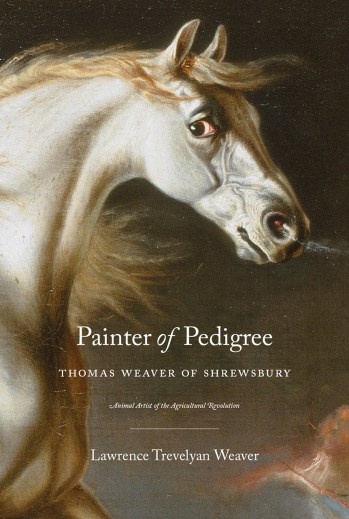 Thomas Weaver of Shrewsbury (1775–1844) is known for his wonderful paintings of animals—prize bulls, pedigreed sheep, and thoroughbred stallions—set against the backdrop of the ever-changing English landscape as the Industrial Revolution gathered steam. Traveling from country house to country house, Weaver with his journeys mapped the networks of kinship, patronage, and aspiration that undergirded the social life of the landed families and gentry of Georgian England.
Drawing on a previously unexamined collection of Weaver’s papers and pictures, including personal and professional correspondence, diaries, contemporary newspaper cuttings, verse, and portraits of his family, Painter of Pedigree brings to life the work of an animal artist in the age of agricultural improvement, revealing the art, artistry, and artifice that went into portraying and promoting these new breeds.
Sweden’s Nationalmuseum Reopens
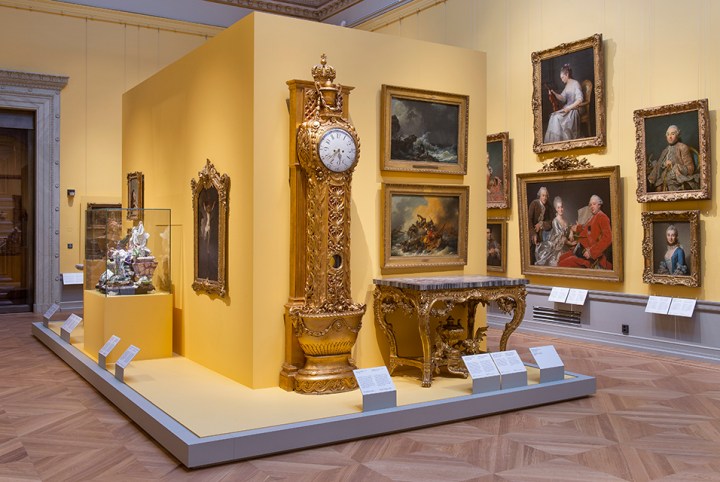
Stockholm: Nationalmuseum
(Photo: Anna Danielsson/Nationalmuseum, 2018)
◊ ◊ ◊ ◊ ◊
After a five-year renovation, Sweden’s Nationalmuseum in Stockholm reopened on Saturday; from the press release, via Art Daily:
In parallel with the renovation of Nationalmuseum, extensive work to create totally new presentations of the museum’s collections has taken place behind the scenes. Among other things, visitors notice that the various art forms are displayed side by side, accompanied by a chronological narrative. In addition to the so-called ‘Timeline’, there are also new spaces such as the Treasury, the Design Depot, Children’s Art World, and the Sculpture Courtyard.
Nationalmuseum has the richest and most extensive collections in the Nordic region, with more than 700,000 objects and works of art. The work with the presentations of the collections began with a desire to be able to display more art and design in the museum building than had previously been possible. It was also important that the collections interacted harmoniously with the building’s original architecture and that daylight was afforded a prominent role, because over 300 big windows were unshuttered. The various art forms—painting, sculpture, art on paper, applied art, and design—would also be integrated.
The largest collection presentation was dubbed the Timeline. Both chronologically and thematically, it traces art and design from 1500 to the present day. Recurring themes include art and politics, nearness to nature, collection history, nationalism and gender. The timeline spirals out through the museum floor plan, and international and Swedish art are displayed side by side, thus encouraging new perspectives and experiences.
Other presentations demonstrate the potential of the collections. In the Treasury, visitors can marvel at the wealth of jewelry, accessories, boxes, and pocket watches, as well as a selection of more than 600 portrait miniatures from the museum’s extensive miniature collection. Many of these objects have never been exhibited before. In the so-called Design Depot on the ground floor, a study collection of ceramics is on display, with more than 1,000 objects from the early 1700s to today. In the depot, the development of the ceramic arts through the ages is depicted, with a focus on materials, technologies and design process. In the Sculpture Garden, visitors can encounter works from the museum’s collection of 19th-century sculpture. Also on the ground floor, a special exhibition called Villa Curiosa is on display in the Children’s Art World. It focuses on our minds and is meant to serve as an introduction to the collections for children and young people. Art from the collections is even on display in the restaurant, where diners can admire Denise Grünstein’s series of photographs entitled 1866, which documents the empty museum building shortly before the renovation was begun.
Dynamism is the guiding principle of the presentation approach. The art will rotate through all or part of the exhibition space, and individual objects will be regularly switched out so that more of the comprehensive collections can be displayed. This also makes it possible to show more light-sensitive art such as drawings and textiles. The collections will also continue to evolve; several large donations received by the museum in recent years, combined with the museum’s own funds, have made it possible to complete a number of acquisitions to complement the collections and fill in some gaps.
Fellowships | Tyson Scholars in American Art
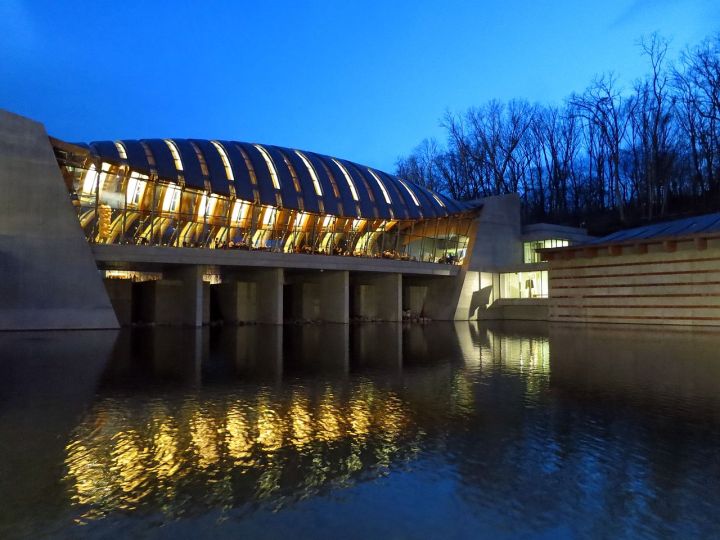
Crystal Bridges Museum of American Art, Bentonville, Arkanasas, designed by Moshe Safdie; it opened in November 2011.
(Photo: Wikimedia Commons, March 2013, Stefan Krasowski)
◊ ◊ ◊ ◊ ◊
From the flyer for the Tyson Scholars Program:
Tyson Scholars Program: Fellowships in American Art
Crystal Bridges Museum of American Art, Bentonville, Arkansas, 2019–20
Applications accepted between 1 November 2018 and 15 January 2019
The Tyson Scholars program, established in 2012, supports scholarship in the full range of subjects related to American art and visual and material culture. Crystal Bridges welcomes ambitious and cross-disciplinary projects in a variety of disciplines, including art history, architecture, visual culture, Indigenous art, American studies, and contemporary art. Applicants with innovative and genre-bending topics are encouraged and both pre- and post-doctoral candidates are eligible.
Crystal Bridges is located in Bentonville, Arkansas, in the beautiful Ozark Mountains. Scholars will be within easy reach of both the lively college-town nightlife of Fayetteville and the rugged natural beauty of the Buffalo National River and other parks. Bentonville is within a 5-hour drive of Dallas, St. Louis, and Memphis; and is 3 hours from Kansas City and Little Rock. The Tyson Scholars Program offers the ideal opportunity to focus on research and writing, with first-hand access to American art and architecture.
The Tyson Scholars Program offers
• Free housing in a quiet, secluded residence near the museum
• Flexible scheduling: from six weeks to an academic year
• Stipends of $15,000 to $30,000 per semester Relocation allowance
• Access to the extensive art reference holdings of the Crystal Bridges Library and the University of Arkansas Libraries
• Access to the Crystal Bridges collection, which spans five centuries of American art
Tyson Scholars are afforded work space in the curatorial wing of the Crystal Bridges Library and work with museum curators and staff, as well as scholars from the University of Arkansas in Fayetteville. The period of residency may be spent in active research or dedicated to the completion of a dissertation or book manuscript. Scholars have opportunities to share their work with one another and with the public through lectures and gallery talks. Apply for the 2019–20 season in November and join a community of scholars at Crystal Bridges Museum of American Art.
Symposium | Les nomenclatures stylistiques
From H-ArtHist:
Les nomenclatures stylistiques à l’épreuve de l’objet:
Construction et déconstruction du langage de l’histoire de l’art
Rome, 24–26 October 2018
2 4 O C T O B R E 2 0 1 8
Institut suisse à Rome
Via Ludovisi 48
9.30 Accueil des participants et Introduction
10.00 Gabriel Batalla-Lagleyre (Université de Bourgogne), L’invention du « Grand Siècle », période et style: La République et l’art français sous Louis XIV, 1871–1958
Pause café
11.30 Laura Moure Cecchini (Colgate University), Can the Baroque Be Classical? The Seicento and the Return-To-Order in 1920s Italian Painting
12.30 Isaline Deléderray-Oguey (Universités de Neuchâtel et d’Aix-Marseille), Le Liberty, entre historicisme et modernisme: la difficile définition d’un style
15.30 Discussions in situ
19.00 Conférence inaugurale — Institut suisse à Rome, avec le Koninklijk Nederlands Instituut Rome
Stijn Bussels (Leiden University) and Bram van Oostveldt (Universiteit van Amsterdam), What Does Style Do? Classification and Impact of Neoclassical Ensembles, 1750–1820
2 5 O C T O B R E 2 0 1 8
Académie de France à Rome – Villa Médicis
Viale Trinità dei Monti 1
9.15 Accueil des participants
9.30 Michèle-Caroline Heck (Université Paul-Valéry-Montpellier), Entre manière et goût: l’émergence de la notion de style
Pause café
11.00 Christian Michel (Université de Lausanne), « Beau comme l’antique », une conception du temps historique
12.00 Maude Bass Krueger (Leiden University), Historicism as a Site of Transfer between Past and Present: Architecture, Decorative Arts, and Fashion
14.30 Sarah Linford (Accademia di Belle Arti di Roma), « Comme si » : rationalité et fiction de la nomenclature stylistique
16.00 Discussions in situ
2 6 O C T O B R E 2 0 1 8
Bibliotheca Hertziana
Via Gregoriana 22
9.00 Accueil des participants
9.15 Olivier Bonfait (Université de Bourgogne), La peinture de réalité: quelle réalité ?
10.15 Giovanna Targia et Karolina Zgraja (Universität Zürich), Le categorie stilistiche wölffliniane in Renaissance und Barock: genealogia e applicazioni
Pause café
11.45 Matthew Critchley (ETH Zürich), Wittkower’s Ricetto and Blunt’s Baroque: Mutual Dependency of Object and Percept in the Rhetoric of Architectural History
14.00 Claudia Conforti (Università degli Studi di Roma « Tor Vergata »), Le parole per dirlo: descrivere l’architettura del secondo Novecento
15.30 Discussions in situ
19.00 Conférence de clôture — Académie de France à Rome – Villa Médicis (Viale Trinità dei Monti 1)
Caroline van Eck (University of Cambridge), Style Formation in the Age of Neo-Classicism: From Animism to Zoomorphy
Atelier de recherche en histoire de l’art organisé par
Istituto svizzero di Roma
Académie de France à Rome – Villa Médici
En collaboration avec
Bibliotheca Hertziana, Max-Planck-Institut für Kunstgeschichte
Koninklijk Nederlands Instituut Rome
Comité scientifique
Simon Baier (Universität Basel), Claudia Conforti (Università degli Studi di Roma « Tor Vergata »), Jérôme Delaplanche (Académie de France à Rome – Villa Médicis), Maarten Delbeke (ETH Zürich), Michèle-Caroline Heck (Université Paul-Valéry-Montpellier), Valérie Kobi (Istituto Svizzero di Roma), Sarah Linford (Accademia di Belle Arti di Roma), Christian Michel (Université de Lausanne), Caroline van Eck (University of Cambridge), Tristan Weddigen (Bibliotheca Hertziana, Max-Planck-Institut für Kunstgeschichte)
Contact
Patrizia Celli, patrizia.celli@villamedici.it
Valérie Kobi, valerie.kobi@istitutosvizzero.it
Display | Eye Contact: Portraits in the Global Age
From the Thoma Foundation:
Eye Contact: Portraits in the Global Age
Thoma Foundation, Art House, Santa Fe, New Mexico, from 10 August 2018
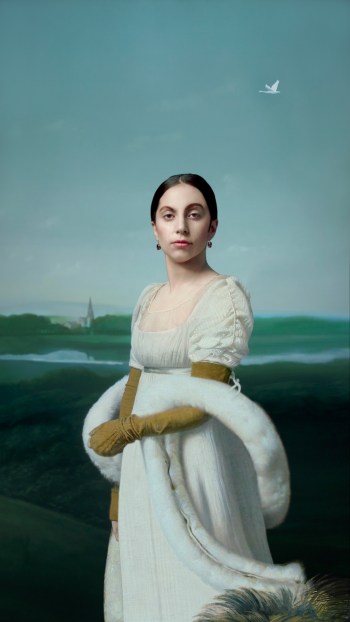
Robert Wilson, ‘Lady Gaga: Mademoiselle Caroline Rivière’, 2013, high-definition video on plasma monitor.
For the first time, Art House will exhibit works from the Thoma Foundation’s diverse collections of Spanish colonial painting and digital art in tandem. Opening August 10, Eye Contact approaches portraiture as a sociological art. While portraits are created to commemorate individual identity, they are also reflections of the economic, political, and cultural forces around them, such as world trade, colonialism, and advances in technology.
The three artworks on view span more than two centuries, from 1776 to 2015, with the recent acquisition Lady Gaga: Mademoiselle Caroline Riviere, 2013 as a centerpiece. Robert Wilson’s video portrait depicts the subject in the guise of an early 19th-century French aristocrat. It is a powerful and ironic meditation on the ability of portraits to denote immortality. Styled in accordance with the famous 1806 painting of Rivière in the Louvre by neoclassical artist Jean Auguste Dominque Ingres, Lady Gaga inhabits the persona of the original sitter, an elegant teenager who died within a year of the work’s completion. Standing in front of a computer-generated landscape, Lady Gaga holds the foreknowledge of Caroline Rivière’s tragic demise, her Gothic pose, intense eye contact, and expression conveying her awareness that even fame fades with time. Wilson is best known for his spectacular, modernist operas, among them the 1976 production Einstein on the Beach, and has been described by The New York Times as “America’s—or even the world’s—foremost avant-garde ‘theater artist.’”
Unlike Lady Gaga and the aristocrat Caroline Rivière, little is known about the woman depicted in Andrés Solano’s Portrait of Ana Josepha de Castañeda y de la Requere from 1776. The inscription on her portrait notes that she was the wife of Juan Lázaro Merino y Zaldo, most likely a sugar planter in the town of Trinidad in central Cuba. While Josepha is forthright and relatively unadorned, the extravagance of her picture frame reflects her position as a wealthy peninsular, a Spanish-born Spaniard residing in the New World or the Spanish East Indies. The gilt rococo embellishments of the frame contrast with Josepha’s frank appearance. Her bloodline is denoted in the painting’s inscription, documenting her caste at a time when cultures, identities, religions, and ideas were mixing in the Spanish colonial world.
Daniel Rozin’s Selfish Gene Mirror, 2015, meanwhile, is a digital mirror in which the viewer temporarily becomes the portrait’s subject. Via a small camera and Rozin’s customized ‘Darwinian’ algorithm, lines of pixels replicate the behavior of human genes, scrambling to assemble a lifelike visage in real time through a process of replication and propagation. Each ‘gene’ is programmed to compete for its ongoing existence. The viewer is reinterpreted within the work of art in a transitory way; once he or she walks away, the pixels die off. The memorializing impulse of portraiture, already imperfect, is abandoned.
About the Collection
Spanning the global history of computer art of the past fifty years, the Foundation’s digital art collection includes some of the first algorithmic plotter drawings on paper, software-driven, generative, and custom-coded artworks, interactive works based on real-time gaming platforms, internet-based or networked art, and works that utilize LED and LCD displays. With more than 130 works from the 17th to 19th centuries, the Spanish Colonial art collection includes religious paintings and portraits from the Viceroyalty of Peru and the Kingdom of Nueva Granada, as well as a selection of portraits fro.m the Spanish Caribbean.
Symposium | Perceiving Processions
Next month at The Courtauld:
Perceiving Processions: Eighth Early Modern Postgraduate Symposium
The Courtauld Institute of Art, London, 24 November 2018
Organised by Talitha Schepers and Alice Zamboni
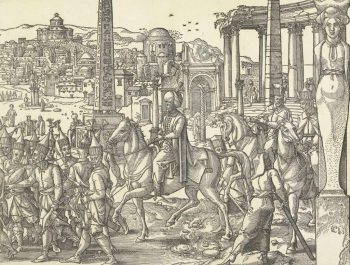
Procession of Süleyman I, from ‘Customs and Fashions of the Turks’, Pieter Coecke van Aelst, woodcut print, 30 × 39 cm, 1553 (Amsterdam: Rijksmuseum, RP-P-OB-2304L).
In recent years, a renewed interest in early modern rituals, festivals, and performances has prompted a reconsideration of ceremonious processions with a particular focus on their impact on social, cultural, artistic, and political structures and practices. Simultaneously, scholars have increasingly acknowledged the mobility of early modern artists across geographical, religious, and cultural borders. Although processions were witnessed by natives and visitors alike and were therefore prime instances of cross-cultural encounters, their depictions by artists both local and foreign remain a lesser-studied body of visual material. This symposium proposes to explore the visual representations of processions that took place within cross-cultural encounters both within and outside of Europe.
A procession was an act of movement that was particularly charged with meaning; an ambulatory mode of celebration, it had a global resonance in the early modern period. Processionals impressed foreign dignitaries, established modes of rule, communicated traditions, and negotiated power balances and were highly sensory occasions—as such they lent themselves readily to visual representation and were enthusiastically recorded in literature. Pageantries, military processions, and Joyous Entries (Blijde Inkomsten) were recorded in a variety of media, as exemplified by the festival books celebrating the ephemeral constructions orchestrated for Cardinal-Infante Ferdinand’s arrival in Antwerp (1635) or the eighteenth-century paintings depicting Venice’s dazzling boat parades in honour of foreign dignitaries. Furthermore, ceremonial processions conceived for births, weddings, circumcision feasts, and funerals occasioned visual representations such as the colourful Mughal miniature Wedding Procession of Dara Shikoh in Presence of Shah Jahan (1740). In addition, the notion of procession can be expanded to encompass various expressions of mobility that could be understood and were often depicted as a procession. Both Jan van Scorel’s frieze-like painting of the knightly brotherhood commemorating their Holy Land pilgrimage (c. 1530) and the depiction of ambassadors travelling with their retinue to foreign courts and cities can be perceived as a form of procession. Thus, the structure of a procession was increasingly adopted in the Early Modern period to depict moments of exchange and motion propelled by the quest for knowledge, as much as diplomatic concerns and religious piety. Well-known examples include The Voyage to Calicut tapestry series (1504) as well as the highly detailed printed frieze of a merchant endeavour by Hans Burgkmair (The King of Cochin, 1508).
Free admission, all welcome. Advance booking requested.
P R O G R A M M E
9.00 Registration
9.30 Welcome
9.45 Session 1: Royal Encounters
• Bianca Schor (Independent Scholar, London), Albert Eckhout’s Tapestry Le Roi Porté in Malta: A Diplomatic Encounter
• Travis Seifman (University of California), Displaying Foreignness for Prestige: Luchuan Embassy Processions in Edo, 1644–1850
• Matthew Gin (Harvard University), Rites of Passage: Re-Tracing Princess Maria Teresa Rafaela’s Entry into France (1745)
11.00 Coffee break
11.35 Session 2: Beyond the Documentary
• Gemma Cornetti (The Warburg Institute, University of London), Stefano della Bella and the Triumphal Entry of the Polish Ambassador in Rome (1633)
• Sabrina Lind (Ghent University), A Book without Readers? Or the Audience and the Importance of the Festival Book(s) of the Joyous Entry into Antwerp in 1635
• Gaylen Vankan (University of Liège), Imagine Orient: A Military Procession by Jan Swart van Groningen
12.50 Lunch break
13.50 Session 3: Performing Processions
• Laila Dandachi (University of Vienna), ‘The Triumphal Exotic from the East’: The Display of Diplomatic Performances of Early Modern Islamic Empires Shaped by the Iconic and Emblematic Nature of Islamic Military Arms and Armour
• Borja Franco Llopis and Francisco Orts-Ruiz (UNED, Madrid), Muslims and Moriscos in the Processions and Royal Entries in Iberia (14–16th Centuries): Beyond Their Visual Representation
• Esther Pramschiefer (University of Cologne), Travelling Theatres in Germany: Audiences and Actors Proceeding outwards of Walled Cities
15.05 Tea and coffee break
15.40 Session 4: Religious Processions
• Ashley Patton (University of Minnesota), St Rose of Lima: Identity, Performance, and Surrogacy
• Massoumeh Assemi (The Courtauld Institute of Art), Muharram Processions
16.30 Short break
16.40 Session 5: Itinerant Processions
• Raoul DuBois (University of Zurich), Temporality and Mediality of the Processions in Travelogues of the 15th and 16th Centuries
• Nicholas Mazer Crummey (Independent Scholar, Budapest), Observing a City in Motion: An Englishman’s Account of the 1675 Ottoman Imperial Circumcision Festival in Edirne
17.30 Closing remarks
18.00 Reception
Exhibition | Tablescapes: Designs for Dining
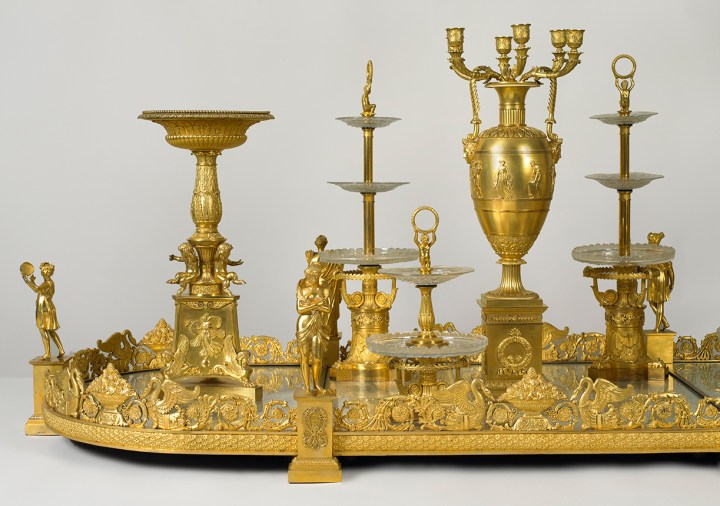
Pierre-Philippe Thomire, Surtout de Table, 1805
(New York: Cooper Hewitt, Smithsonian Design Museum)
◊ ◊ ◊ ◊ ◊
Press release (via Art Daily) for the exhibition:
Tablescapes: Designs for Dining
Cooper Hewitt, Smithsonian Design Museum, New York, 5 October 2018 — 14 April 2019
Cooper Hewitt, Smithsonian Design Museum presents Tablescapes: Designs for Dining, an exhibition that offers a creative timeline of dining experiences through three distinct installations. At the center of the exhibition is Cooper Hewitt’s surtout de table, a magnificent, newly conserved treasure from the museum’s expansive collection of over 210,000 design objects that once ornamented the tables of French nobility at the turn of the 19th century. The exhibition also spotlights the work of the underrecognized but influential textile designer Marguerita Mergentime, active in the 1920s and ’30s, whose work has not received a dedicated museum presentation in 75 years. Pivoting to address 21st-century concerns, the exhibition debuts experimental and collaborative products commissioned from National Design Award-winning designers Joe Doucet and Mary Ping.
“Tablescapes shows how taste and social values are expressed through style, materials and motifs,” said Caroline Baumann, director of the museum. “From awe-inspiring grandeur to vernacular wit to an emphasis on sustainability, the exhibition provokes a spirited conversation around design’s role in the evolution of a universal ritual.”
Surtout de Table
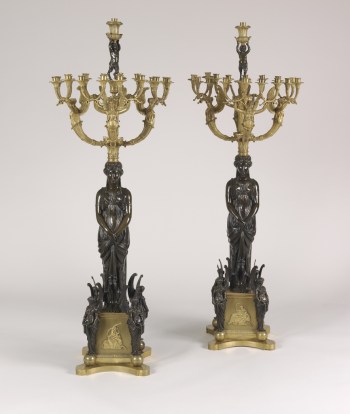
Pierre-Philippe Thomire, Candelabrum, 1815–25, gilt and patinated bronze (New York: Cooper Hewitt, Smithsonian Design Museum).
On view for the first time in 30 years, Cooper Hewitt’s surtout de table was created in Paris around 1805 by Pierre-Philippe Thomire, a French sculptor renowned for creating gilt-bronze objects for the politically and socially powerful. It is believed that Napoleon gave this example as a wedding present to his stepson, Eugène de Beauharnais, whom he often designated to host diplomatic dinners in Paris and Italy.
When placed at the center of a long table, the mirrored plateau and gilt-bronze surfaces of the surtout de table would have reflected the flames of expensive candles. As part of the exhibition’s digital experience, visitors may manipulate an image of the object to view the surtout de table under various lighting conditions. This technology, known as Reflection Transformation Imaging, facilitated the extensive conservation treatment of the surtout de table. As documented in an accompanying gallery video, Cooper Hewitt’s conservationists worked in collaboration with external specialists to restore the surface of the surtout de table, dulled by corrosion, to its original golden lustre. Additionally, the conservationists treated the deteriorating silver-leaf backing of the mirrored plateau, making the surtout de table reflective once again.
To contextualize the surtout de table, it is presented with related objects, including a late 18th-century Italian drawing for a surtout de table design inspired by the ruins of Pompeii and a fire-gilt and blackened bronze clock made by Antoine-Andre Ravrio (French, 1759–1814) with ornaments in the form of a woman playing piano, said to represent Empress Josephine, the mother of Eugène de Beauharnais, at her fashionable residence Malmaison.
Marguerita Mergentime
Marguerita Mergentime (American, 1894–1941) began her design career in New York City in the 1920s, where she made dress fabrics and bath and beach accessories. She belonged to a circle of modernist designers that included Donald Deskey, Gilbert Rohde, Frederick Kiesler, and Ilonka Karasz.
In 1934, Mergentime debuted her first designs for home linens at the Industrial Arts Exposition at Rockerfeller Center. She quickly gained recognition for her bright, modernist textile designs, which retailed at desirable department stores and were highlighted in popular magazines as essential accessories for the hostess seeking to vivify informal dining. Each of the eight napkins in the set Wish Fulfillment (1939) stimulated cocktail hour conversation with a depiction of a mystical or pseudoscientific conduit to the future—for instance, dream books or graphology—accompanied by predictions of wealth, success and happiness. Stylish and imbued with typographical interest, the tablecloth Food Quiz (1939) brought humorous, lighthearted debate to the table with conversation sparkers such as, “Do you dish the dirt before you dish the soup?”
Further illuminating Mergentime’s sensibility, the adjacent Spoon Family Gallery is dedicated to archival materials and the hanging Americana (1939), which entertained visitors at the Golden Gate International Exposition in San Francisco by uniting the names of 360 iconic American phrases, organizations, foods, points of interest, and people.
Joe Doucet and Mary Ping
For this exhibition, Cooper Hewitt commissioned Joe Doucet (American, born 1970), recipient of the 2017 National Design Award for Product Design, and Mary Ping (American, born 1978), recipient of the 2017 National Design Award for Fashion Design and founder of the studio Slow and Steady Wins the Race, to envision the future of dining. The designers address a near future in which users approach dining with greater speed and efficiency, and live in cities that are more densely populated than ever.
The Concentric and Decentric Tables and Seating, designed by Ping and the New York-based architectural firm Bureau V, can fold to seat a small group or expand to accommodate a gathering of up to nine people. Appropriately for a future of increasing material scarcity, its terrazzo-patterned surface is made not from stone, but from recycled food packaging.
Presented on the amoeba-shaped eating surfaces of Ping’s table, Doucet designed multifunctional servingware that can be used to cook, serve and store food and a set of cutlery designed for users who dine on a variety of international cuisines. Doucet fabricated the designs using 3D printing to allow for greater customization.
Tablescapes: Designs for Dining is made possible by Anonymous. Conservation of the surtout de table is made possible by the Smithsonian Women’s Committee. In-kind support is provided by Shapeways and The Abadi Group. Pure+Applied designed the exhibition.
Images and exhibition labels are available here»










 Enfilade
leave a comment