Study Day | Women and Architecture
From the study day flyer:
Genres & Espaces « Pas de politique, pas de chien, pas de femme »
Le Musée du 11 Conti – Monnaie de Paris, 22 March 2019
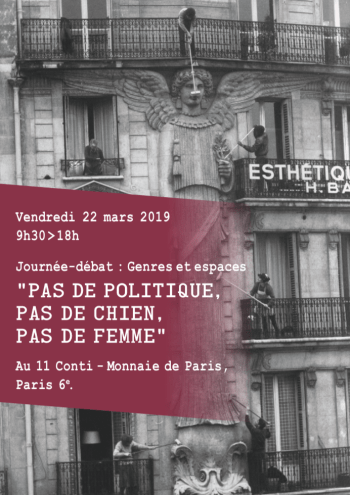 Cette journée-débat proposée par l’ENSA Paris-Malaquais, le 11 Conti-Monnaie de Paris et AWARE (Archives of Women Artists Research & Exhibition), ambitionne de réunir et promouvoir les travaux de chercheur.se.s, mais aussi des associations, collectifs, publications et enseignements dans les ENSA, proposant tout.e.s une réflexion inclusive. De la construction de l’histoire des femmes architectes à une conception féministe de l’espace à toutes ses échelles, la journée propose de s’interroger sur la place actuelle du genre dans l’enseignement de l’architecture et quelle place doit lui être faite demain.
9.30 Accueil
• Camille Morineau (directrice des collections et expositions du 11 Conti – Monnaie de Paris, présidente d’ AWARE)
• Luc Liogier (directeur de l’École nationale supérieure d’architecture Paris-Malaquais)
10.00 Introduction
• Bérénice Gaussuin
10.20 Histoire de femmes architectes
Modération: Anne-Marie Châtelet
• Arlette Auduc (Comité d’histoire du ministère de la Culture) et Anne-Marie Châtelet (ENSA Strasbourg, EA3400 Arche) de la revue Livraisons d’Histoire de l’Architecture, Femme et architecture
• Sarah Feriaux-Rubin (ENSA Belleville), Simone Galpin, femme effacée de Wogenscky
• Dominique Amouroux (Fondation Marta Pan-André Wogenscky), Marta Pan
11.30 Du genre en ville
Modération: Lucile Biarrotte (Université Paris-Est, Lab’Urba)
• Giulia Custodi (École de Géographie de Paris, LAA), Cartographies des approches genrées dans les villes européennes: Entre le mainstreaming et le féminisme diffus
• Chris Blache et Pascale Lapalud (Genre et ville), Pourquoi et comment le genre change l’urbanisme
• Lucile Biarrotte (Université Paris-Est, Lab’Urba), L’infusion d’approches genrées dans l’urbanisme parisien: Métaphore d’une propagation aux échelles organisationnelles et individuelles
Déjeuner
14.30 Projection du film Les dites cariatides, Agnès Varda (1984, 13 minutes).
14.45 Du genre en architecture
Modération: Stéphanie Dadour (ENSA Grenoble, MHA evt, ACS)
• Flore Gustin et Yen Bui (ENSA Marnes-la-Vallée), Présentation de l’intensif sur le genre ENSA Marnes-la-Vallée (Fanny Lopez, enseignante responsable)
• Sophie Orlando (ENSA Villa Arson, situations post), Modernismes saphiques, espaces non-hétéronormés: Subjectivités, sensualité et politiques de la couleur
• Stéphanie Dadour, Architecture et féminisme: De la théorie critique à l’action in Revue Malaquais
16.30 Madame l’architecte
Modération: Olivier Chadoin (ENSAP Bordeaux, PAVE-Centre Émile Durkheim)
• Giulia Zonca et Dorota Slazakowska (ENSA Paris-Malaquais), Who runs the world? Chronologie réflexive d’un intensif féministe
• Rossella Gotti et Anne Labroille (MéMO), Présentation du Mouvement pour l’Équité dans la Maîtrise d’Œuvre (MEMO)
• Stéphanie Bouysses-Mesnages (ENSA Nantes, EA3400 Arche), Les premières femmes inscrites à l’Ordre des architectes d’Ile-de- France
18.30 Fin de la journée-débat
Cantor Art Center Acquires Works by Kaphar and Suh
From the Cantor Arts Center press release, via Art Daily:

Titus Kaphar, Page 4 of Jefferson’s ‘Farm Book’, January 1774, Goliath, Hercules, Jupiter, Gill, Fanny, Ned, Sucky, Frankey, Gill, Nell, Bella, Charles, Jenny, Betty, June, Toby, Duna (sic), Cate, Hannah, Rachael, George, Ursula, George, Bagwell, Archy, Frank, Bett, Scilla, ? , 2, 2018; oil on canvas on support panel (Stanford: Cantor Arts Center / © Titus Kaphar).
With the recent acquisition of the painting, Page 4 of Jefferson’s ‘Farm Book’, January 1774 . . ., by Titus Kaphar, and the monumental hanging sculpture, Cause & Effect, by Do Ho Suh, the Cantor Arts Center at Stanford University has added two significant works to its collection that reference how forced and unforced global migration transform personal and cultural identity.
The acquisition of these works supports the vision of Susan Dackerman, the John and Jill Freidenrich Director of the Cantor, to bring the museum firmly into the 21st century through acquisitions, exhibitions, and programs that feature concerns relevant to the everyday lives of students and other visitors. “I think art, artists, and art history have the potential to challenge a culture’s preconceived notions of itself and enlighten us to other ways of understanding the world,” she said. “Having these art works at the museum will enable us to have conversations about difficult topics from multiple points of view.”
Page 4 is what Kaphar calls a ‘visual reparation’ and belongs to a series of tar portraits imagining enslaved sitters as freed men and women. By representing them in historical dress reflective of a status above the one they lived, Kaphar visually frees his sitter from enslavement. The face of the subject is obscured by the use of tar, which suggests the sitter’s invisibility. “Kaphar’s artistic practice actively engages with art history in order to investigate its representational inequities, with regard to both what is represented, and who is doing the representing,” said Aleesa Alexander, assistant curator of American art.
In the case of Page 4, the painting was created with specific reference to Thomas Jefferson’s ‘Farm Book’, which contains lists of Jefferson’s slaves, many identified only by their first names. The full title of the painting is Page 4 of Jefferson’s ‘Farm Book’, January 1774, Goliath, Hercules, Jupiter, Gill, Fanny, Ned, Sucky, Frankey, Gill, Nell, Bella, Charles, Jenny, Betty, June, Toby, Duna (sic), Cate, Hannah, Rachael, George, Ursula, George, Bagwell, Archy, Frank, Bett, Scilla, ? , 2. While Kaphar’s style references the traditional genre of portraiture, his methods of addressing the canvas’s surface—through cutting, nailing, and covering his figures with tar—is decidedly contemporary. “Given that Stanford was also built on a farm, and that the Stanfords employed Chinese laborers, having this piece in our collection will generate interesting parallels worthy of exploration and discussion,” said Alexander. Page 4 is the first work by Kaphar to enter the Cantor’s collection and will be on display in the exhibition The Medium Is the Message: Art since 1950 February 23–August 18, 2019.

Do Ho Suh, Cause & Effect, with Suh’s Screen in the background, as installed at the Cantor Arts Center.
Cause & Effect is composed of hundreds of small, colorful, acrylic figures, which form a monumentally-scaled, cone-shaped chandelier suspended from the ceiling and reaching almost to the floor. The interconnectedness of the figures, which sit upon each other’s shoulders, suggest the weight and inescapability of one’s history. Suh’s work, which often references domestic architecture and decoration, questions cultural and aesthetic differences between his native Korea and his adopted homes in the United States and Europe. “Adding this visually compelling and complex work to our collection will allow us to continue to have important discussions about transnational identity and how we comprehend the past while living in the present,” Dackerman said.
“Cause & Effect is a bold and important work, signaling the Cantor’s commitment to exhibit more works of contemporary art by artists from Asia,” said Padma D. Maitland, Patrick J. J. Maveety Assistant Curator of Asian Art. This is the first work by Suh to be added to the Cantor’s collection and is on display with two other works by the artist in the exhibition Do Ho Suh: The Spaces in Between.
New Book | L’art et la race
From Les Presses du Réel:
Anne Lafont, L’art et la race: L’Africain (tout) contre l’œil des Lumières (Dijon: Les Presses du Réel, 2019), 476 pages, ISBN: 978-2378960162, 32€.
 L’historienne de l’art Anne Lafont livre une étude inédite sur les relations étroites et paradoxales de l’art et de la race à l’époque des Lumières. Une nouvelle voix dans les travaux actuels sur les questions de race, d’art, d’images et de colonies.
En se fondant sur un corpus d’œuvres d’art connues et moins connues, l’auteure revisite les Beaux-Arts au XVIIIe siècle sous l’angle de la représentation des Noirs, figures qui, non seulement, articulent savoirs anthropologiques et expériences esthétiques, mais aussi histoire du luxe métropolitain et histoire de l’esclavage colonial. Ce livre est fondé sur une recherche de plus de dix ans sur les formes qu’ont prises les figures de l’Africain et de l’Africaine dans l’art continental et colonial français d’avant l’imaginaire abolitionniste. Il couvre les cultures visuelles et artistiques qui vont de la fin du XVIIe siècle—à l’époque de Coypel, Mignard, Largillière… —quand les colonies antillaises commencèrent à percer dans le champ artistique métropolitain, au premier tiers du XIXe siècle—à l’époque de Girodet, Benoist et Léthière jusqu’à Géricault… —quand l’échec de la première abolition de l’esclavage (1802) durcit l’iconographie partisane, mettant la violence des vies dans les plantations à l’ordre du jour de la création artistique.
Publié avec la collaboration de Laurence Bertrand Dorléac – Centre d’Histoire de Sciences Po – et le concours de la Fondation de France.
Anne Lafont est historienne de l’art, directrice d’études à l’École des hautes études en sciences sociales. Elle a étudié au Canada et en France avant d’être pensionnaire de la Villa Médicis. Elle a été ensuite maîtresse de conférences en histoire de l’art moderne à l’université Paris-Est avant de rejoindre l’Institut national d’histoire de l’art où elle a passé dix années. Elle est élue à l’EHESS en 2017 sur un projet intitulé Histoire de l’art et créolités.
Ses travaux ont porté principalement sur l’art des XVIII et XIXe siècles avec un intérêt particulier pour l’œuvre de la Révolution française et l’imagination picturale des nouveaux citoyens, les Noirs, à l’échelle des révolutions atlantiques. En parallèle, elle a initié des recherches sur la question des savoirs naturalistes et anthropologiques en lien avec les cultures visuelles du voyage, de l’expédition scientifique et du cabinet de curiosités (L’artiste savant à la conquête du monde moderne, 2010 ; 1740, L’abrégé du monde, 2012) mais aussi des travaux sur les écrits des femmes sur l’art autour de 1800 (Plumes et pinceaux. Discours de femmes sur l’art en Europe, 2012). Son travail s’oriente désormais vers l’art des Antilles françaises pendant la période coloniale et, d’une manière générale, sur les arts et les cultures de l’Atlantique noir.
New Book | The Georgian London Town House
From Bloomsbury:
Kate Retford and Susanna Avery-Quash, eds., The Georgian London Town House: Building, Collecting, and Display (London: Bloomsbury, 2019), 364 pages, ISBN: 978-1501337291, £90.
 For every great country house of the Georgian period, there was usually also a town house. Chatsworth, for example, the home of the Devonshires, has officially been recognised as one of the country’s favourite national treasures—but most of its visitors know little of Devonshire House, which the family once owned in the capital. In part, this is because town houses were often leased, rather than being passed down through generations as country estates were. But, most crucially, many London town houses, including Devonshire House, no longer exist, having been demolished in the early twentieth century.
This book seeks to place centre-stage the hugely important yet hitherto overlooked town houses of the eighteenth and early nineteenth centuries, exploring the prime position they once occupied in the lives of families and the nation as a whole. It explores the owners, how they furnished and used these properties, and how their houses were judged by the various types of visitor who gained access.
C O N T E N T S
Susanna Avery-Quash and Kate Retford, Introduction
Contexts
1 Joseph Friedman, Town and Country: Patterns of Aristocratic Collecting in Georgian England
2 Matthew Jenkins and Charlotte Newman, London in Pieces: Building Biographies in Georgian Mayfair
Creating the London Town House
3 Neil Bingham, The Regency Transformation of Burlington House, Piccadilly, Documented through the Architectural Drawings of Samuel Ware
4 Adriano Aymonino and Manolo Guerci, Building and Refurbishing the London Town House during the Mid-Eighteenth Century: Francophilia in Interior Decoration
5 Susanna Avery-Quash, John Julius Angerstein’s Collection of Old Masters at Pall Mall: An Eighteenth-Century London Financier and His Circle of Art Advisers
Display in the London Town House
6 Susannah Brooke, The Display and Reception of Private Picture Collections in London Town Houses, 1780–1830
7 Desmond Shawe Taylor, Picture Displays at Carlton House
8 Anne Nellis Richter, Glitter and Fashion in the ‘Louvre of London’: Animating Cleveland House
9 Jeremy Howard, New Light on Norfolk House: The Decoration and Furnishing of Norfolk House for the 9th Duke and Duchess of Norfolk
10 Donato Esposito, Artist in Residence: Joshua Reynolds at 47 Leicester Fields
11 Helen McCormack, Animating Anatomy: 16 Great Windmill Street, Westminster
Bibliography
DMA Names Nicole Myers Senior Curator of European Art
Press release (19 February 2019) from the DMA:
 Dr. Agustín Arteaga, The Eugene McDermott Director of the Dallas Museum of Art, announced today that Dr. Nicole R. Myers has been named The Barbara Thomas Lemmon Senior Curator of European Art. Myers steps into her new role after serving for nearly three years as The Lillian and James H. Clark Curator of European Painting and Sculpture at the DMA. As The Barbara Thomas Lemmon Senior Curator of European Art, Myers will assume official leadership of the department, continuing her work thus far in overseeing the acquisitions, exhibitions, research, and publications related to the DMA’s expansive collection of European art, composed of thousands of paintings, sculptures, and works on paper dating from the 15th century to 1945.
“In her time at the DMA, Nicole has already demonstrated incredible leadership through her significant contributions to scholarship, visionary acquisitions, and compelling exhibitions that highlight the strength and breadth of the DMA’s collection,” said Arteaga. “I am confident that the Museum’s Department of European Art will continue to grow and evolve in meaningful ways under her direction.”
Since joining the DMA in 2016, Myers has curated several noteworthy exhibitions, including the forthcoming critically acclaimed exhibition Berthe Morisot, Woman Impressionist, opening at the DMA on February 24, 2019, for which she is co-curator. Co-organized by the DMA, Musée national des beaux-arts du Québec (Québec City, Canada), the Barnes Foundation (Philadelphia, PA), and the Musée d’Orsay (Paris, France), this is the first dedicated presentation of Morisot’s work held in the United States since 1987.
Myers is also curator of Women Artists in Europe from the Monarchy to Modernism (2018), which highlights the DMA’s exceptional holdings of artwork by female artists working in Europe between the late 18th and mid-20th centuries; Modernity and the City (2018), which brings together prints and drawings by European artists who captured the impact of industrialization on urban life in the early 20th century; and An Enduring Legacy: The Eugene and Margaret McDermott Collection of Impressionist and Modern Art (2018), dedicated to the single largest benefactors in the Museum’s history, the late Margaret and Eugene McDermott, and presenting their magnificent final bequest of 32 19th- and early 20th-century artworks. Myers also served as the curator of the only US presentation of the international touring exhibition Art and Nature in the Middle Ages, organized by the Musée de Cluny, Musée National du Moyen Âge in Paris and presented in Dallas in 2016. She is currently at work on major loan exhibitions dedicated to Juan Gris, Vincent van Gogh, and Pablo Picasso.
Additionally during her tenure at the DMA, Myers has overseen a range of significant acquisitions for the Museum’s collection. In 2018 she was responsible for the DMA’s acquisition of The Descent from the Cross by the German master painter Derick Baegert (c. 1440–c. 1509). This tour-de-force of Northern European painting is the first work of its kind to enter the DMA’s holdings and the first work by this artist to enter a US museum. Myers also acquired French artist Emile Bernard’s masterpiece The Salon (1890), as well as rare paintings by Adélaïde Labille-Guiard (French, 1749–1803), Eva Gonzalès (French, 1849–1883), Oscar Dominguez (Spanish, 1906–1957), and Joaquín Torres-García (Uruguayan, 1874–1949).
“It is both an honor and a privilege to lead the Department of European Art as The Barbara Thomas Lemmon Senior Curator,” said Myers. “I am thrilled to be part of such a dynamic institution as it starts an exciting new chapter under Dr. Arteaga’s direction, and I look forward to sharing groundbreaking exhibitions, research, and programming dedicated to European art in the years to come.”
Prior to the DMA, Myers served as the Associate Curator of European Painting and Sculpture at the Nelson-Atkins Museum of Art, where she curated the exhibitions Rodin: Sculptures from the Iris and B. Gerald Cantor Foundation (2011), Town and Country: French Types in the 19th Century (2012), and Gérôme and the Lure of the Orient (2014). She previously held curatorial positions at the Metropolitan Museum of Art, the Museum of Fine Arts, Boston, and the Saint Louis Art Museum, and served as a Curatorial Consultant to the Denver Art Museum.
Myers earned her master’s and doctorate degrees in art history from the Institute of Fine Arts, New York University, where she wrote her doctoral thesis on the French master Gustave Courbet. She is a summa cum laude graduate of Washington University in St. Louis and a member of Phi Beta Kappa.
Axel Rüger Appointed New Secretary and Chief Executive of RA
Press release (13 February 2019) from the RA:
 The Royal Academy of Arts announced today that Axel Rüger has been appointed as the new Secretary and Chief Executive. He replaces Sir Charles Saumarez Smith who stepped down at the end of 2018. Rüger is currently the Director of the Van Gogh Museum in Amsterdam.
Rüger spent his early career in museums in the US, before becoming curator of Dutch Paintings at the National Gallery, London in 1999. He has been Director of the Van Gogh Museum since 2006 and, during his tenure, has made it one of the most successful museums internationally. Rüger’s appointment has been approved by the Royal Academy’s Council, General Assembly, and Her Majesty The Queen. He will start his new role at the Royal Academy in June 2019.
Axel Rüger said: “It is a great honour for me to have been asked to become the new Secretary and Chief Executive of the Royal Academy. The RA derives its unique character from being independent and artist-led and I greatly look forward to working with the Royal Academicians as well as the dedicated staff to develop further the standing of the RA at home and abroad. Following the 250th anniversary and the RA’s recent expansion, it feels like the Academy is now ready to embark on a new and exhilarating chapter in its rich history. I am excited about the opportunity to join at this critical moment and to work to tell great stories through ambitious and varied exhibitions, innovative programmes and debate and, more generally, to make the RA, its activities and collections ever more accessible to audiences from around the globe.”
Christopher Le Brun, President of the Royal Academy of Arts, said: “I am delighted that Axel Rüger will be joining the Academy as our new Secretary and Chief Executive in June. His appointment coincides with a moment in history when the international reputation of the Academy has never been higher. Axel is the perfect fit. His success at the Van Gogh Museum is highly acclaimed, and he is widely acknowledged as one of the leading directors of his generation. His experience, both in the UK and abroad, makes him ideally suited to work alongside our distinguished Royal Academicians and staff in guiding the RA towards a highly promising future and I am very much looking forward to working with him.”
Rebecca Salter, Keeper of the Royal Academy, said: “Axel Rüger brings with him a wealth of experience, which will enhance the profile and independent character of the Royal Academy. I know my fellow Academicians and all our staff will enjoy working with him as we continue to explore the potential of our new campus and shape the Royal Academy for the future.”
Axel Rüger was born in 1968 in Dortmund, Germany. He studied art history at the Freie Universität in Berlin, the University of Cambridge, and Queen’s University in Kingston, Ontario. Ruger worked in various museums in Atlanta, Detroit, and Washington D.C. before he was appointed Curator of Dutch Paintings, 1600–1800, at the National Gallery in London in 1999. He curated a number of international exhibitions for the National Gallery including Vermeer and the Delft School (2001), Aelbert Cuyp (2002), and Masterpieces of Seventeenth-Century Dutch Portrait Painting (2007).
In 2004, whilst still at the National Gallery, he was selected to take part in the first year of the then newly created Clore Leadership Programme—a high level initiative of the Clore Duffield Foundation, which focuses on the development of leadership in the cultural sector. Part of that programme was a four-month secondment to the Royal Court Theatre in London.
In 2006 Rüger became the Director of the Van Gogh Museum in Amsterdam and The Mesdag Collection in The Hague. At the Van Gogh Museum, he has been primarily responsible for artistic direction and public affairs. He completed various research projects such as the new complete edition of Van Gogh’s letters (2009) and has been responsible for the new display of the collection and numerous exhibitions.
New Book | Stewards of Memory
From The University of Virginia:
Carol Borchert Cadou, with Luke Pecoraro and Thomas Reinhart, eds., Stewards of Memory: The Past, Present, and Future of Historic Preservation at George Washington’s Mount Vernon (Charlottestville: The University of Virginia Press, 2018), 280 pages, ISBN: 978-0813941516 (cloth), $60, ISBN: 978-0813941523 (paper), $30.
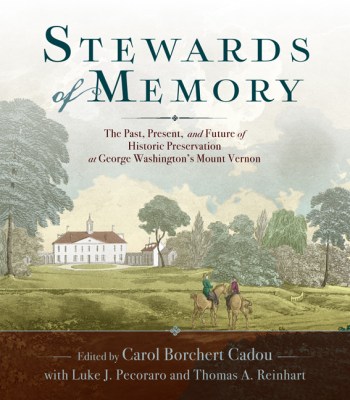 Mount Vernon, despite its importance as the estate of George Washington, is subject to the same threats of time as any property and has required considerable resources and organization to endure as a historic site and house. This book provides a window into the broad scope of preservation work undertaken at Mount Vernon over the course of more than 160 years and places this work within the context of America’s regional and national preservation efforts.
It was at Mount Vernon, beginning with efforts in 1853, that the American tradition of historic preservation truly took hold. As the nation’s oldest historic house museum, Mount Vernon offers a unique opportunity to chronicle preservation challenges and successes over time as well as to forecast those of the future. Stewards of Memory features essays by senior scholars who helped define American historic preservation in the twentieth and early twenty-first centuries, including Carl R. Lounsbury, George W. McDaniel, and Carter L. Hudgins. Their contributions—complemented by those of Scott E. Casper, Lydia Mattice Brandt, and Mount Vernon’s own preservation scholars—offer insights into the changing nature of the field. The multifaceted story told here will be invaluable to students of historic preservation, historic site professionals, specialists in the preservation field, and any reader with an interest in American historic preservation and Mount Vernon.
Support provided by the David Bruce Smith Book Fund and the Fred W. Smith National Library for the Study of George Washington at Mount Vernon.
Carol Borchert Cadou, who spent nineteen years on the collections and preservation staff at Mount Vernon, is Charles F. Montgomery Director and CEO of Winterthur Museum. Luke J. Pecoraro is Assistant Director for Archaeology at George Washington’s Mount Vernon. Thomas A. Reinhart is Director of Architecture at George Washington’s Mount Vernon.
C O N T E N T S
Acknowledgments
Abbreviations
A Chronology of Historic Preservation at Mount Vernon in National Context
• Douglas Bradburn and Carol Borchert Cadou, Introduction
• Carl Lounsbury, New History in Old Buildings: Architectural Research and Public History in the Chesapeake
• Thomas Reinhart and Susan Schoelwer, ‘Distinguished by the Name of the New Room’: Reinvestigation and Reintepretation of George Washington’s Grandest Space
• Luke Pecoraro, ‘We Have Done Very Little Investigation There; There Is a Great Deal Yet to Do’: The Archaeology of Georges Washington’s Mount Vernon
• Robert Fink, Thomas Reinhart, and Alyson Steele, Mount Vernon’s Historic Building Information Management Systerm: Digital Strategies for Preservation in the Twenty-First Century
• George McDaniel, Stepping Up and Saving Places: Case Studies in Whole Place Preservation
• Lydia Mattice Brandt, The Dangers of Preserving while Popular: The Mount Vernon Ladies’ Association’s Image of Mount Vernon versus Contemporary Architecture
• Scott Casper, Saving Mount Vernon, in Black and White: Toward an Alternative History of Historic Preservation
• Carter Hudgins, Mount Vernon and America’s Historic House Museums: Old Roles and New Responsibilities in the Preservation of Place
• Carol Borchert Cadou and Luke Pecoraro, Conclusion
Contributors
Index
Call for Papers | Cardinal Alessandro Albani
From the Call for Papers:
Cardinal Alessandro Albani: Collecting, Dealing, and Diplomacy in Grand Tour Europe
Collezionismo, diplomazia ed il mercato nell’Europa del Grand Tour
British School at Rome / Centro di Studi sulla Cultura e l’Immagine di Roma, 11–13 December 2019
Organised by Clare Hornsby and Mario Bevilacqua
Proposals due by 1 April 2019
This conference aims to bring together an international range of art historians alongside scholars of related humanistic disciplines to open a new chapter on the multifaceted life and career of Cardinal Alessandro Albani (1692–1779), ‘The Father of the Grand Tour’. Albani operated in many different spheres of Roman society in a variety of roles: antiquarian, collector, art dealer, political agent, spy. It is time to make a reassessment of his life and of his activities.
There is a close connection between Britain and the study of Cardinal Albani, reflecting the central role that the British played in the art market in Rome, as entrepreneurs and purchasers. This subject—which casts valuable light on the political and diplomatic networks in mid-eighteenth-century Europe—needs to be revisited, particularly in the light of the many books, conferences, and exhibitions on collecting and the art market that have appeared in the last 25 years. It is appropriate that this conference should have as one of its venues the British School at Rome [BSR], which has, over this period, hosted many scholarly events connected with the Grand Tour.
For many years European scholars have examined aspects of the life of Cardinal Alessandro Albani, particularly in respect of his magnificent collections of ancient sculpture—of central importance in artistic and museological culture in Rome—as well as in the family archives and European correspondence. His relationship with major figures in eighteenth-century European art such as Winckelmann and Piranesi remains a fruitful area of study.
The second venue of the conference—the Centro di Studi sulla Cultura e l’Immagine di Roma [CSCIR—is an institution renowned for its commitment to a deeper understanding and reflection on Roman historical and artistic life. By this British and Italian collaboration we hope not only to build new networks of scholarship but to focus international attention on the Albani collections at a key moment.
The role of Alessandro Albani is key in eighteenth-century Rome, both as a patron of the arts and in the wider political life of the European courts. This conference is designed to be multi-disciplinary and international, reflecting the life and career of Albani himself. Proposals for talks might address the following themes:
Albani in the Grand Tour
The Roman art market
Albani and Vatican diplomacy
His correspondents and social networks
The Stuart court in Rome
Philipp von Stosch, Horace Mann, and spying
Albani the archaeologist
The drawings collection of Cassiano dal Pozzo and their sale to King George III
Winckelmann and Albani
Albani as taste-maker
The collections — sculpture, drawings, and the libraries
Albani and Piranesi
The Albani archives
Villa Albani
The languages of the conference are English and Italian, and the event will be open to the public. We invite doctoral students, postdoctoral researchers, established scholars, and members of the foreign academies in Rome to submit proposals for papers which will fall into two groups:
(1) 15-minute presentations on one event, object, or discrete theme
(2) 30-minute presentations on collections or connected themes
Please send an abstract of either 500 words (for a 15-minute talk) or 1000 words (for a 30-minute talk) with a 200-word CV to albaniconvegno@gmail.com by 1 April 2019.
We plan to publish a volume of essays based on this conference.
Scientific Committee
Mario Bevilacqua (Università degli Studi di Firenze, CSCIR), Amanda Claridge (Royal Holloway University of London, Cassiano del Pozzo project), Clare Hornsby (Research Fellow, BSR), Ian Jenkins (Dept. of Greek and Roman Antiquities, British Museum), Harriet O’Neill (Assistant Director, BSR), Susanna Pasquali (La Sapienza Roma), Jonny Yarker (Libson and Yarker Ltd., London)
The Morgan Announces Restoration
From the press release (14 February 2019) from The Morgan:

Madison Avenue near East 36th Street, New York. J.P. Morgan Library, Wurts Bros., ca. 1905 (Museum of the City of New York, X2010.7.1.197).
The Morgan Library & Museum announced today the exterior restoration of J. Pierpont Morgan’s Library, designed by McKim, Mead & White. The four-year, $12.5 million project, which marks the first preservation of the landmark library’s exterior in its 112-year history, will restore and conserve one of the finest examples of Neoclassical architecture in the United States, enhance the surrounding grounds, improve the exterior lighting of the building, and increase public access to and appreciation of this historic architectural treasure.
J. Pierpont Morgan’s Library is the heart of the Morgan Library & Museum. Commissioned in 1902 by financier John Pierpont Morgan as his private library, the building was completed in 1906 and is considered one of McKim, Mead & White’s finest works, perfectly embodying the Renaissance ideal of the unity of the arts through the integration of architecture, sculpture, and painting with exceptional craftsmanship and materials. The structure reflects its contents: majestic in design, yet intimate in scale.
In 2010 the Morgan restored the interior rooms of J. Pierpont Morgan’s Library. In 2016 the Morgan began planning for the exterior restoration by engaging Integrated Conservation Resources (ICR), a firm specializing in the restoration of historic structures, to provide an initial needs assessment of the Library’s condition. Following the needs assessment, the Morgan engaged ICR to undertake a more detailed analysis of the building, which resulted in a fully articulated restoration approach. ICR, supported by the architecture firm Beyer Blinder Belle, carefully studied and documented existing conditions, installed data loggers to monitor the performance of the exterior envelope, tested proposed remediations, and finalized the restoration’s details.
The forthcoming restoration will be comprehensive and will address issues such as masonry deterioration, masonry joint failure, roof conditions, deterioration of the fence and other metalwork corrosion, and sculpture conservation.
In conjunction with the restoration, exterior lighting on J. Pierpont Morgan’s Library—currently minimal and ineffective—will be improved by enhancing existing light emanating from the interior, using historic fixtures coupled with new technologies. The scheme will create a painterly effect of layered light at dusk and dark. Developed by Tillett Lighting Design Associates, the new lighting design will give the Library a subtle, timeless, and inviting presence.
Restoring J. Pierpont Morgan’s Library presents a unique opportunity to reimagine the natural setting around it and to provide for visitor access to the site’s exterior for the first time in the institution’s history. The current landscaping—comprising a simple lawn and trees—does little to complement the architecture of the Library, nor does it provide accessible pathways or spaces to encourage visitor interaction with the landmark building’s exterior. By creating new spaces and opportunities for engagement, the project will help to reinvigorate this portion of the Morgan’s campus, which has been less visible to visitors since the Morgan’s entrance shifted from 36th Street to Madison Avenue as part of the 2006 Renzo Piano-designed expansion.
After an extensive search, the Morgan has engaged Todd Longstaffe-Gowan Landscape Design to develop designs to address these issues. An accomplished landscape architect, historian, teacher, and author, Todd Longstaffe-Gowan has led notable projects in the United Kingdom, including for Hampton Court Palace, Kensington Palace Gardens, and the Royal College of Art. This is his first appointment in the United States. Longstaffe-Gowan will collaborate with New York–based Future Green Studio to ensure the development of plantings that will flourish in New York City’s dense, challenging environment.
“Restoring the sublime exterior of J. Pierpont Morgan’s Library is far and away our most important capital project for the next decade,” said Director Colin B. Bailey. “This is our responsibility. And, in many respects, it is our privilege. Once the restoration of the Library is complete and the grounds are revitalized, the public will be able to engage more fully with one of McKim, Mead & White’s most important architectural achievements. The enhanced grounds will create a generous new space for outdoor programming and allow visitors to look closely at the exterior architectural and sculptural details of the Library.”
To date, 74 percent of the required $12.5 million is funded. On-site work will commence in February 2019, directed by Sciame and executed by Nicholson & Galloway, longtime partners in the architectural expansion and stewardship of the Morgan. Restoration of J. Pierpont Morgan’s Library will be completed by December 2019, at which point work will commence on the surrounding grounds. The library will still be open to visitors during the restoration process. The entire restoration and rehabilitation of the grounds will be unveiled to the public and accessible in fall 2020. The unveiling will be accompanied by an exhibition chronicling the history of the Library, as well as a scholarly publication.
Exhibition | Heaven and Earth in Chinese Art

Square curiosity box with multiple treasures, Qianlong 1736–95, Qing Dynasty (1644–1911); wood, jade, bronze, amber, agate, and ink on paper; 20 × 25 × 25 cm (Taipei: National Palace Museum).
◊ ◊ ◊ ◊ ◊
Press release (via Art Daily) for the exhibition:
Heaven and Earth in Chinese Art: Treasures from the National Palace Museum, Taipei
Art Gallery of New South Wales, Sydney, 2 February — 5 May 2019
Curated by Cao Yin
The Art Gallery of New South Wales presents Heaven and Earth in Chinese Art: Treasures from the National Palace Museum, Taipei. The exhibition is a rare opportunity to encounter some of the highest artistic achievements in Chinese history. Featuring 87 masterworks, the exhibition explores the extraordinary creativity of Chinese artists over the centuries, with objects dating from 5000 years ago in the Neolithic period to the nineteenth century.
 Director of the Art Gallery of NSW, Dr Michael Brand said the National Palace Museum holds one of the world’s finest collections of Chinese art with the majority of its holdings originating from the imperial collections of the Qing dynasty (1644–1911). “One of the most-visited museums in the world, the National Palace Museum in Taipei has a collection of outstanding beauty and historical importance.”
“Heaven and Earth in Chinese Art presents the ancient Chinese philosophical concept of tian ren he yi, the harmonious coexistence of nature and humans within the cosmos, which holds particular relevance today as we face the environmental challenges of contemporary life,” Dr Brand said. “The Art Gallery of NSW is the first cultural institution to host these extraordinary objects in Australia providing local audiences an exclusive opportunity to see how Chinese art speaks to the modern world,” Dr Brand added.
Dr Chen, Chi-nan, Director of the National Palace Museum, Taipei, said the museum has had a long-term commitment to international cultural exchange and has successfully curated a large number of exhibitions in Europe, America, and Asia from its collection. “Despite this impressive record, the National Palace Museum, Taipei, has not exhibited in the southern hemisphere, until now,” Dr Chen said. “Major highlights from the National Palace Museum collection travelling to Sydney include one of its most popular treasures: the Meat-shaped stone—a Qing dynasty masterpiece. This is only the third time it has been seen outside Taipei,” Dr Chen said.

Meat-shaped stone, Qing dynasty, 1644–1911 (Taipei: National Palace Museum).
The Meat-shaped stone, carved from jasper and set in a decorative gold stand, draws thousands of admirers a day. The stone most closely resembles the dish dongpo rou which is believed to have been invented by Su Dongpo (also known as Su Shi), an 11th-century Chinese poet and artist.
Art Gallery of NSW exhibition curator and curator of Chinese art, Yin Cao said Heaven and Earth in Chinese Art showcases the many ways in which Chinese artists have represented the trinity of heaven, earth, and humanity. “Since the earliest times, the Chinese have created imaginative stories and rich symbols to explain the unfathomable aspects of the world around them. Each work in Heaven and earth in Chinese art tells a unique story of the society in which it is created and bears a broader cultural and philosophical meaning,” Cao said.
“From the miniature carving of an olive pit to one of the longest paintings in Chinese history, this exhibition presents the highest level of artistic skill and advances in technology over the different eras, and shows the aspiration of Chinese artists as they try to capture the essence of nature and the world around them,” Cao added.
Heaven and Earth in Chinese Art presents paintings, calligraphy, illustrated books, bronzes, ceramics, jade, and wood carvings divided into five thematic sections: Heaven and Earth, Seasons, Places, Landscape, and Humanity.
The exhibition is accompanied by a book Heaven & Earth in Chinese Art: Treasures from the National Palace Museum, Taipei edited and written by exhibition curator Yin Cao with Dr Karyn Lai, associate professor of Philosophy in the School of Humanities and Languages at the University of NSW. It includes catalogue entries by National Palace Museum curators.
Cao Yin with Karyn Lai, Heaven & Earth in Chinese Art: Treasures from the National Palace Museum, Taipei (Sydney: Art Gallery of NSW, 2019), 236 pages, ISBN: 978-1741741438, $40.










leave a comment