Call for Papers | The Orléans Collection
From the CFP:
The Orléans Collection: Tastemaking, Networks, and Legacy
New Orleans Museum of Art, 11–13 January 2019
Proposals due by 30 September 2018

Attributed to Guy Noël Aubry, Portrait of Philippe II, Duke of Orléans, 1715–23, oil on canvas, 248 × 160 cm (Orléans: Musée des Beaux Arts d’Orléans, François Lauginie).
The New Orleans Museum of Art and the Frick Center for the History of Collecting will host a
symposium in conjunction with The Orléans Collection exhibition dedicated to the collecting and collection of Philippe II duc d’Orléans (1674–1723) on view at the New Orleans Museum of Art 26 October 2018 through 27 January 2019.
Collecting over just over two decades, Philippe II d’Orléans amassed one of the most important collections of European paintings in the history of art, which he displayed in his Palais-Royal in Paris. This celebrated collection assembled over 500 masterpieces of European Art and this landmark exhibition reunites a representative group of forty works to tell the complex story of the collection’s formation and character and the impact of the sales of the collection in London during the French revolution, a watershed event in the history of collecting.
The Orléans Collection exhibition catalogue essays offer an overview of the collection, Philippe’s relationship with his court painter Antoine Coypel, the refurbishment of the Palais-Royal during the regency, his collecting of Venetian, Dutch and Flemish and Bolognese Art, contemporary artists studying the collection, and a review of the circumstances of the collection’s dispersal. The catalogue’s extensive Appendix transcribes the earliest 1727 publication of the collection tracing picture to their current locations.
The symposium seeks to expand beyond the scope of the catalogue and consider a wider range of relationships concerning Philippe d’Orléans’s taste and the impact the collection had for generations of collectors and artists, and an increasingly wider public throughout the eighteenth century. Subjects of interest might include: Philippe II’s patronage network; fellow collectors and trends in collecting in Paris; dealers and the art market in eighteenth-century Paris; connections with contemporary collections in the German principalities; the ‘Orléans Effect’ in Great Britain and later entrance in public collections.
Travel can be provided to a limited number of applicants. To propose a paper, please submit a message of interest and 300-word abstract by 30 September 2018 to: nomasymposium@noma.org.
Workshop | Heritage Revisited: Objects from Islamic Lands in Europe
As many of you will already know, H-ArtHist has returned from summer break:
Heritage Revisited: Rediscovering Objects from Islamic Lands in Enlightenment Europe
Kunsthistorisches Institut, University of Vienna, 20–21 September 2018
Registration due by 15 September 2018
Organized by Isabelle Dolezalek and Mattia Guidett
For centuries, objects from Islamic lands were unquestioned parts of the material and visual culture of pre-modern Latinate Europe. A textile from Fatimid Egypt, for instance, the so-called ‘Veil of Sainte Anne’, was kept in the cathedral treasury of Apt and venerated as a Christian relic.
The workshop Heritage Revisited: Rediscovering Objects from Islamic Lands in Enlightenment Europe is dedicated to the long eighteenth century, a period in which, so we believe, an important shift in the perception of such objects took place. Islamic provenances were rediscovered, objects were studied, drawn and discussed. Finally, they were subjected to the classificatory scheme of European modernity, which leaves little space for conceptions of a historically entangled heritage.
Object case-studies shed light on the networks of scholars and institutions involved in the rediscoveries and will be framed in the discussions within broader discourses on (European) cultural heritage. Ultimately, we wish to offer new perspectives on the history of scholarship, notably Islamic art history, but also on perceptions of cultural belonging, of ‘Europeanness’ and ‘Otherness’, which deeply resonate with current societal concerns.
Attendance is free. Please register by 15 September 2018, mattia.guidetti@univie.ac.uk. The workshop is kindly supported by the Fritz-Thyssen Foundation, the Chair of Islamic Art History and the Historisch-Kulturwissenschaftliche Fakultät of the University of Vienna.
T H U R S D A Y , 2 0 S E P T E M B E R 2 0 1 8
10:00 Visit to the Dom Museum Wien with Gregor Pirgie (Universität Wien), Pia Razenberger (Tabadul Project), and Markus Ritter (Universität Wien). Places for the visit are limited; please register by 15 September 2018, mattia.guidetti@univie.ac.uk.
13:30 Welcome and Introduction — Isabelle Dolezalek (Technische Universität Berlin/SFB ‘Episteme in Bewegung’ Freie Universität Berlin) and Mattia Guidetti (Universität Wien)
14:00 Collections
Chair: Ebba Koch (Universität Wien)
• Elisabeth Rodini (Johns Hopkins University Baltimore), The Redaldi Inventory: A Prologue to Enlightenment Collecting
• Federica Gigante (Ashmolean Museum Oxford), Objects of a ‘Certain Antiquity’ and the Quest for Their Cultural Context
15:20 Coffee
15.50 Rediscovering Objects from Islamic Lands
Chair: Barbara Karl (Textilmuseum St. Gallen)
• Claire Dillon (Columbia University New York), The Many Dimensions of a Work of Art: The Mantle of Roger II as a Case Study in Imperial Representation, Origin Stories, and the Formation of Specific Others
• Michelina di Cesare (Sapienza Università di Roma), Four Eleventh and Twelfth-Century Islamic Tombstones Discovered in Pozzuoli in the Seventeenth Century
• Carine Juvin (Musée du Louvre Paris), The ‘Baptistère de Saint-Louis’ through the Seventeenth and Eighteenth Centuries: The Making of a ‘Historical Monument’
• Anna Contadini (School of African and Oriental Studies London), Changing Perceptions of the Pisa Griffin and Other Objects
19:00 Dinner
F R I D A Y , 2 1 S E P T E M B E R 2 0 1 8
9:30 Protagonists of the Rediscoveries
Chair: Johannes Wieninger (MAK Österreichisches Museum für angewandte Kunst Wien)
• Mattia Guidetti (Universität Wien), Reading Ottoman Flags in the Marches Region, 1684–1838
• Markus Ritter (Universität Wien), A Documentary Encounter with Medieval (Islamic) Art in Eighteenth-Century Vienna
• Tobias Mörike (Museum für Kunst und Gewerbe Hamburg), Knowledge-Brokers and Object-Interpreters: Maronite Christians and the Redefinition of ‘Islamicate Objects’ by the 1800s
11:30 Coffee
12:00 Discussion Tables
Table 1 with Isabelle Dolezalek (TU/FU, Berlin), On the Concept of Cultural Heritage: What Is European and What Is Not?
Table 2 with Tobias Mörike (Museum für Kunst und Gewerbe Hamburg), Art Market Networks and Their Role in Constituting ‘Islamic Art’ Objects
Table 3 with Barbara Karl (Textilmuseum St. Gallen), Object Biographies and Dynamics of Collecting
12:45 Plenum Discussion
13:30 Lunch
14:30 Classifiying, Framing, Exhibiting
Chair: Markus Ritter (Universität Wien)
• Sabine Du Crest (Université de Bordeaux), Islamic Border Objects in Seventeenth-Century Europe
• Gül Kale (McGill University Montreal), Image as Text: Fischer von Erlach’s Take on Guillaume Grelot’s Drawings of Islamic Monuments in the Eighteenth Century
• Ebba Koch (Universität Wien), Mughal Miniatures at Habsburg Vienna
16:30 Final Discussion
New Book | Romantic Art in Practice
From Cambridge UP:
Thora Brylowe, Romantic Art in Practice: Cultural Work and the Sister Arts, 1760–1820 (New York: Cambridge University Press, 2018), 280 pages, ISBN: 978-1108426404, $105.
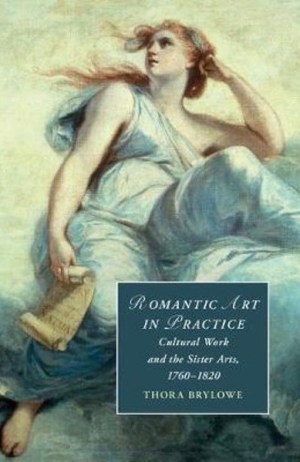 Exploring the relationship between visual art and literature in the Romantic period, this book makes a claim for a sister-arts ‘moment’ when the relationship between painting, sculpture, pottery, and poetry held special potential for visual artists, engravers, and artisans. Elaborating these cultural tensions and associations through a number of case studies, Thora Brylowe sheds light on often untold narratives of English labouring craftsmen and artists as they translated the literary into the visual. Brylowe investigates examples from across the visual spectrum including artefacts, such as Wedgwood’s Portland Vase, antiquarianism through the work of William Blake, the career of engraver John Landseer, and the growing influence of libraries and galleries in the period, particularly Boydell’s Shakespeare Gallery. Brylowe artfully traces the shifting cultural connections between the imaginative word and the image in a period that saw new print technologies deluge Britain with its first mass media. Part of the Cambridge Studies in Romanticism series.
Thora Brylowe is Assistant Professor of English at the University of Colorado, Boulder.
C O N T E N T S
List of Figures
Acknowledgments
Introduction: The Sister-Arts Moment
1 Original Copies: Wedgwood’s Portland Vase in Paint and Poem
2 William Blake, Antiquarians, and the Status of Copy
3 Literary Galleries and the Media Ecology: Painting for Print in the Age of Anthologies
4 Poetry against the Wall: The (Sister) Arts in Crisis
5 Crossing the Line: Engraving, John Landseer, and the Aftermath of the Shakespeare Gallery
6 Ravaged brides: Grecian Urns on Romantic Paper
Notes
Bibliography
Index
New Book | The Invention of Rare Books
McKitterick is especially interested in how the idea of ‘rarity’ emerged as a part of a selection process in the face of the plenitude of print. As a secondary (maybe tertiary) theme, he also considers how books, especially during the eighteenth century, came to be regarded as rare alongside other “material relics of the past,” in part thanks to shared “aspects of connoisseurship both in sculpture and in painting, and even in old buildings” (23). The other crucial text, as noted repeatedly by McKitterick, is Kristian Jensen, Revolution and the Antiquarian Book: Reshaping the Past, 1780–1815 (Cambridge UP, 2011). –CH
From Cambridge UP:
David McKitterick, The Invention of Rare Books: Private Interest and Public Memory, 1600–1840 (New York: Cambridge University Press, 2018), 460 pages, ISBN: 978-1108584265, $63.
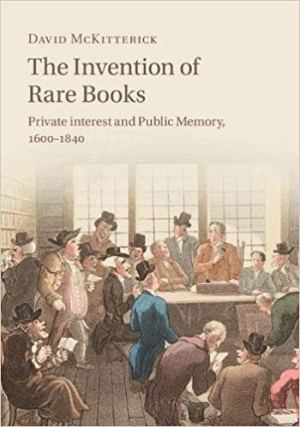 When does a book that is merely old become a rarity and an object of desire? David McKitterick examines, for the first time, the development of the idea of rare books, and why they matter. Studying examples from across Europe, he explores how this idea took shape in the sixteenth and seventeenth centuries, and how collectors, the book trade and libraries gradually came together to identify canons that often remain the same today. In a world that many people found to be over-supplied with books, the invention of rare books was a process of selection. As books are one of the principal means of memory, this process also created particular kinds of remembering. Taking a European perspective, McKitterick looks at these interests as they developed from being matters of largely private concern and curiosity, to the larger public and national responsibilities of the first half of the nineteenth century.
David McKitterick, FBA, was for many years Librarian of Trinity College, Cambridge, and Honorary Professor of Historical Bibliography at Cambridge. His previous publications include the three volume A History of Cambridge University Press (Cambridge, 1992–2004), Cambridge University Library: A History, Volume 2: The Eighteenth and Nineteenth Centuries (Cambridge, 1986), Print, Manuscript and the Search for Order, 1450–1830 (Cambridge, 2003), and most recently Old books, New Technologies (Cambridge, 2013). Professor McKitterick is one of the general editors of the Cambridge History of the Book in Britain.
C O N T E N T S
List of Illustrations
Acknowledgements
List of Abbreviations
Prologue
1 Inventio
2 Books as Objects
3 Survival and Selection
4 Choosing Books in Baroque Europe
5 External Appearances (1)
6 External Appearances (2)
7 Printers and Readers
8 A Seventeenth-century Revolution
9 Concepts of Rarity
10 Developing Measures of Rarity
11 Judging Appearances by Modern Standards
12 The Harleian Sales
13 Authority and Rarity
14 Rarity Established
15 The French Bibliographical Revolution
16 Books in Turmoil
17 Bibliophile Traditions
18 Fresh Foundations
19 Public Faces, Public Responsibilities
20 Conclusion
Notes
Select Bibliography
Index
Display | Bad-boy Adrian Beverland
Now on view at the Rijksmuseum:
Bad-boy Adrian Beverland / Hadriaan Beverland
Rijksmuseum, Amsterdam, 26 April — 17 September 2018

Isaak Beckett, after Simon Dubois, Portrait of Adrian Beverland Drawing a Statue of Venus, ca. 1685–90 (Amsterdam: Rijksmuseum).
On display in Gallery 2.21 is a small exhibition of the work of 17th-century bad-boy Adrian Beverland (1650–1716), a Dutch classicist who devoted his studies exclusively to one subject: sex! The display in this gallery of a selection of fourteen portraits, publications, and erotic prints from Beverland’s collection offers a tantalising glimpse into his intriguing life and his predilection for erotica.
For many years, Beverland worked on an encyclopaedia of eroticism in the ancient world entitled De Prostibulis Veterum (On the Prostitution of the Classics). But it was never published. When another provocative treatise by Beverland appeared in print in 1679, he was banished from the Dutch provinces of Holland, Zeeland and West-Friesland. His reputation as a scholar lay in ruins.
The disgraced classicist moved to London, where he built up a new life, earning a respectable living as an agent in art and literature and hunting out interesting antiquities, shells, and manuscripts for wealthy collectors. But the delights of erotica still beckoned, and Beverland continued his studies in secret. He illustrated his notes with intriguing, erotic collages comprising cut-out fragments of prints, and he was apparently unable to restrain himself from referring to his bad-boy status in curious portraits of himself. In one we see a mischievous Beverland drawing the bare buttocks of a statue of Venus.
Those wishing to find out more about Adrian Beverland will be interested to know that Joyce Zelen, an Andrew W. Mellon Fellow, is currently studying the life of this ostracised eroticist. Her research into Beverland’s portraits will be published in the Rijksmuseum Bulletin later this year, and the complete results of her broader study of Beverland will appear in a year’s time.
Rijksmuseum Acquires Floral Painting by Gerard van Spaendonck
Press release (29 August 2018) from the Rijksmuseum:
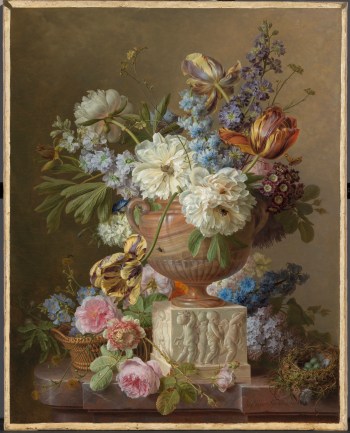
Gerard van Spaendonck, Still Life of Flowers in Alabaster Vase, 1783, oil on canvas, 80 × 64 cm (Amsterdam: Rijksmuseum).
The Rijksmuseum has procured a painting by Gerard van Spaendonck, the most famous painter of floral still lifes of the second half of the 18th century. It was a long-cherished wish of the museum to include in its collection an important work by this Dutch painter of international renown. The Rijksmuseum’s director Taco Dibbits describes this painting as “a radiantly beautiful acquisition.” The purchase of Still Life of Flowers in an Alabaster Vase from a gallery in Paris for €900,000 was made possible in part by participants in the BankGiro Lottery. The painting is now on display in Gallery 1.11.
Gerard van Spaendonck (1746–1822) was born in the southern Dutch city of Tilburg and settled in Paris in the 1760s. He gained fame not only as a painter of floral still lifes, but also as the illustrator of the French king’s botanical collection, a highly prestigious position. He was a leading and active figure in the Parisian art world and a teacher of countless French and foreign artists. Gerard van Spaendonck did not make a great number of paintings, instead devoting much of his time to his watercolours of plants, and to his students. He is nonetheless considered to be his era’s best painter of flowers.
Gerard van Spaendonck exhibited this floral still life at the Salon de 1783 in Paris, and it received great praise from critics, including compliments for his lifelike depictions of insects. The painting shows a bouquet of flowers in an alabaster vase standing atop a marble block on which children are depicted in relief. The painter’s studio window can be seen reflected in the polished surface of the vase. The flowers that feature in this painting include large white and smaller pink peonies, blue delphiniums, purple lilacs, and yellow and purple flamed tulips. Insects can be seen dotted about, and five green blackbird eggs lie in the nest on the right. Even the wicker basket seems almost real enough to touch.
New Book | The Politics of Parody
From Yale UP:
David Francis Taylor, The Politics of Parody: A Literary History of Caricature, 1760–1830 (New Haven: Yale University Press, 2018), 320 pages, ISBN: 978-0300223750, $50.
 This engaging study explores how the works of Shakespeare, Milton, Swift, and others were taken up by caricaturists as a means of helping the eighteenth-century British public make sense of political issues, outrages, and personalities. The first in-depth exploration of the relationship between literature and visual satire in this period, David Taylor’s book explores how great texts, seen through the lens of visual parody, shape how we understand the political world. It offers a fascinating, novel approach to literary history.
David Francis Taylor is associate professor of eighteenth-century literature at the University of Warwick and the award-winning author of Theatres of Opposition: Empire, Revolution, and Richard Brinsley Sheridan.
C O N T E N T S
Preface
Part One: Prints, Parody, and the Political Public
1 The Literariness of Graphic Satire
2 Looking, Literacy, and the Printshop Window
Part Two: Plotting Politics
3 The Tempest; or, The Disenchanted Island
4 Macbeth as Political Comedy
5 Paradise Lost, from the Sublime to the Ridiculous
6 Gulliver Goes to War
7 Harlequin Napoleon; or, What Literature Isn’t
Appendix: Dramatis Personae
Notes
Acknowledgements
Index
Conference | Portraiture and Biography
From the Paul Mellon Centre:
Portraiture and Biography Conference
National Portrait Gallery, London, 29–30 November 2018

Thomas Gainsborough, Self-Portrait, ca. 1758–59 (London: National Portrait Gallery).
An international conference collaborative organised by the Paul Mellon Centre for Studies in British Art and the National Portrait Gallery
Biography has always haunted the study of portraiture. Although in recent decades art-historians may have developed a healthy scepticism for the intuitive practice of interpreting portraits with straightforward reference to what is known about the lives of their subjects, the temptation to do so remains strong. These tendencies often appear in their most untrammelled form in analyses of artists’ likenesses of themselves, or of their most intimate acquaintances. Taking the current major exhibition Gainsborough’s Family Album at the National Portrait Gallery as a starting point, leading academics will explore the how the biographical archive might play in this field of study going forward.
Tickets: £30 General Admission and £25 Concessions and Gallery Supporters. The first day ends with an out-of-hours view of the exhibition and drinks reception. Unlimited entry to the exhibition on the second day of the conference is also included in the ticket price. Tea and coffee are provided on both days. Book online, or visit the National Portrait Gallery in person.
T H U R S D A Y , 2 9 N O V E M B E R 2 0 1 8
13.30 Registration
14.00 Introduction and welcome by Lucy Peltz (National Portrait Gallery) and Sarah Turner (Paul Mellon Centre)
14.15 Session One: Heads and Tales
Chaired by Lucy Peltz
• Meredith Gamer (Columbia University), Of Sitters and Subjects: William Hunter and the Anatomical Portrait
• Lejla Mrgan (University of Copenhagen), The Bewildering Silence of Bertel Thorvaldsen’s Portrait Busts
15.30 Tea Break
16.00 Session Two: Parallel Lives
Chaired by Martin Postle (Paul Mellon Centre)
• Rosemary Keep (University of Birmingham), ‘… masculine in all save her body and her sexe’: Lady Jane Burdett, Portrait and Biography
• Kerstin Maria Pahl (Humboldt University and King’s College London), Back-Ups: Portraiture, Life-Writing, and the Art of Information in Long-Eighteenth-Century England
17.15 Break
17.30 Session Three
• David Solkin (Courtauld Institute of Art) and Mark Hallett (Paul Mellon Centre) in conversation: Gainsborough’s Family Album
18.30 Exhibition view and drinks
F R I D A Y , 3 0 N O V E M B E R 2 0 1 8
10.30 Session Four
Chaired by by Mark Hallett
• Ludmilla Jordanova (Durham University), Portraiture, Biography, and Occupational Identities
11.15 Coffee Break
11.45 Session Five: Love and Likeness
• Marlen Schneider (Université Grenoble Alpes), Portraiture as Cultural Practice: Displaying Social Identity in French ‘Portraits Historiés’
• Katherine Fein (Columbia University), Indexical Portraiture and Embodied Biography in Harriet Hosmer’s ‘Clasped Hands of Robert and Elizabeth Barrett Browning’
13.00 Lunch Break
14.00 Session Six: Circulating Lives
Chaired by David Solkin
• Georgia Haseldine (Queen Mary University of London and National Portrait Gallery), Competing Likenesses: Portraits and Biographies of Radical Reformers
• Claudine van Hensbergen (Northumbria University), Portraits, Mezzotint, and Public Lives: The Image of the Royal Mistress, 1660–1700
15.15 Tea Break
15.45 Session Seven: Space and Status
Chaired by Sarah Turner
• Niharika Dinkar (Boise State University), Portrait of the Artist as a ‘Gifted Highborn’: Ravi Varma and Artistic Personhood in India
• Hannah Williams (Queen Mary University of London), Lived Space: Portraits, Studios, and the Life of the Artist
• Olivia Tait (University College London), ‘Neutralising’ Biography? Georg Baselitz’s Bedroom Portraits
Exhibition | Eighteenth-Century Pastel Portraits

Jean-Étienne Liotard, Portrait of Maria Frederike van Reede-Athlone at Seven Years of Age (detail), 1755–56, pastel on vellum
(Los Angeles: J. Paul Getty Museum)
◊ ◊ ◊ ◊ ◊
Now on view at The Getty Center:
Eighteenth-Century Pastel Portraits
J. Paul Getty Museum, Los Angeles, 28 August — 13 October 2018
Pastels—dry, satiny colors, manufactured in sticks of every hue—enjoyed a surge in popularity during the eighteenth century, becoming, for a time, the medium of choice for European portraiture. This display of pastels from the permanent collection explores the specific physical properties that made this medium so appealing to eighteenth-century portraitists and their patrons.
On Stage | Hogarth’s Progress, A Double Bill

Coming to the Rose Theatre, Kingston:
Hogarth’s Progress: The Art of Success and The Taste of the Town
A Double Bill by Nick Dear, Directed by Anthony Banks
Rose Theatre, Kingston, London, 13 September — 21 October 2018
Written by BAFTA Award-winning playwright Nick Dear and directed by Anthony Banks, Hogarth’s Progress is a highly imaginative and entertaining double bill of comedies. Following one of Britain’s most irreverent and celebrated artists on two monumental pub crawls, the plays explore the extraordinary lives of William Hogarth and his wife Jane at a time when culture escaped from the grasp of the powerful into the hands of the many.
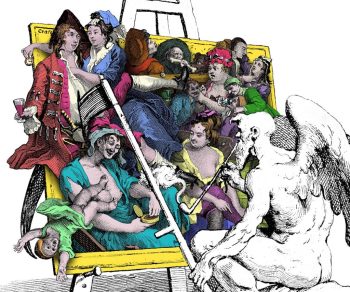 The Olivier Award-nominated comedy The Art of Success, in its first major revival, compresses the newlywed William’s rise to fame into a dizzying and hilarious night out through 18th-century London’s high society and debauched underworld.
A world premiere, The Taste of the Town catches up with the Hogarths in Chiswick some 30 years later. Now hugely successful, William and Jane are still at odds with the world and with each other. Facing public ridicule for what he considers his finest painting, William sets out to confront his fiercest critic, but there’s always time for one more pint on the way.
Bryan Dick (The Art of Success) and Keith Allen (The Taste of the Town) star as the younger and older William Hogarth. . . They are joined on stage by Ruby Bentall, Emma Cunniffe, Ben Deery, Jack Derges, Ian Hallard, Susannah Harker, Jasmine Jones, Sylvestra Le Touzel and Mark Umbers. Each play can be seen as a single performance or enjoyed together, either over different days or as a thrilling all-day theatrical experience.
P R O G R A M M I N G
Hogarth’s World
Wednesday, 26 September, post-show
A fascinating exploration of the uneasy relationship between a new generation of creative power players and the established powers of parliament and the crown. Dr Karen Lipsedge’s teaching focuses on 18th-century literature and culture. Professor Norma Clarke is a literary historian and author, who has recently chronicled of the 18th-century novelist, poet and playwright Oliver Goldsmith and his contemporaries.
Hogarth’s Art
Sunday, 30 September, post-show
An enlightening conversation about William’s subjects, techniques and styles, and how his creative legacy influences our world today. Chaired by Kingston School of Art’s Geoff Grandfield.
Hogarth’s Women
Saturday, 6 October, post-show
Join us for a discussion about the relationship between Jane and William Hogarth, the status of women in 18th-century London, and the emergence of the Blue Stocking Society. Dr Jane Jordan’s research is on literature and history, especially the legal status of British women and of prostitution. Dr Karen Lipsedge’s research focuses on 18th-century domestic spaces and gender roles and their representation in the British novel.










 Enfilade
leave a comment