New Book | The Invention of Rare Books
McKitterick is especially interested in how the idea of ‘rarity’ emerged as a part of a selection process in the face of the plenitude of print. As a secondary (maybe tertiary) theme, he also considers how books, especially during the eighteenth century, came to be regarded as rare alongside other “material relics of the past,” in part thanks to shared “aspects of connoisseurship both in sculpture and in painting, and even in old buildings” (23). The other crucial text, as noted repeatedly by McKitterick, is Kristian Jensen, Revolution and the Antiquarian Book: Reshaping the Past, 1780–1815 (Cambridge UP, 2011). –CH
From Cambridge UP:
David McKitterick, The Invention of Rare Books: Private Interest and Public Memory, 1600–1840 (New York: Cambridge University Press, 2018), 460 pages, ISBN: 978-1108584265, $63.
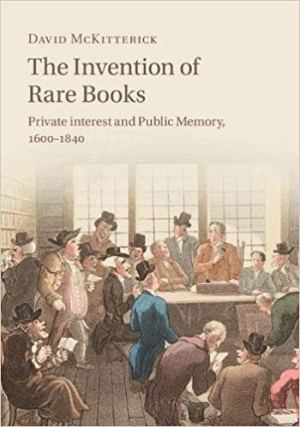 When does a book that is merely old become a rarity and an object of desire? David McKitterick examines, for the first time, the development of the idea of rare books, and why they matter. Studying examples from across Europe, he explores how this idea took shape in the sixteenth and seventeenth centuries, and how collectors, the book trade and libraries gradually came together to identify canons that often remain the same today. In a world that many people found to be over-supplied with books, the invention of rare books was a process of selection. As books are one of the principal means of memory, this process also created particular kinds of remembering. Taking a European perspective, McKitterick looks at these interests as they developed from being matters of largely private concern and curiosity, to the larger public and national responsibilities of the first half of the nineteenth century.
David McKitterick, FBA, was for many years Librarian of Trinity College, Cambridge, and Honorary Professor of Historical Bibliography at Cambridge. His previous publications include the three volume A History of Cambridge University Press (Cambridge, 1992–2004), Cambridge University Library: A History, Volume 2: The Eighteenth and Nineteenth Centuries (Cambridge, 1986), Print, Manuscript and the Search for Order, 1450–1830 (Cambridge, 2003), and most recently Old books, New Technologies (Cambridge, 2013). Professor McKitterick is one of the general editors of the Cambridge History of the Book in Britain.
C O N T E N T S
List of Illustrations
Acknowledgements
List of Abbreviations
Prologue
1 Inventio
2 Books as Objects
3 Survival and Selection
4 Choosing Books in Baroque Europe
5 External Appearances (1)
6 External Appearances (2)
7 Printers and Readers
8 A Seventeenth-century Revolution
9 Concepts of Rarity
10 Developing Measures of Rarity
11 Judging Appearances by Modern Standards
12 The Harleian Sales
13 Authority and Rarity
14 Rarity Established
15 The French Bibliographical Revolution
16 Books in Turmoil
17 Bibliophile Traditions
18 Fresh Foundations
19 Public Faces, Public Responsibilities
20 Conclusion
Notes
Select Bibliography
Index
Display | Bad-boy Adrian Beverland
Now on view at the Rijksmuseum:
Bad-boy Adrian Beverland / Hadriaan Beverland
Rijksmuseum, Amsterdam, 26 April — 17 September 2018

Isaak Beckett, after Simon Dubois, Portrait of Adrian Beverland Drawing a Statue of Venus, ca. 1685–90 (Amsterdam: Rijksmuseum).
On display in Gallery 2.21 is a small exhibition of the work of 17th-century bad-boy Adrian Beverland (1650–1716), a Dutch classicist who devoted his studies exclusively to one subject: sex! The display in this gallery of a selection of fourteen portraits, publications, and erotic prints from Beverland’s collection offers a tantalising glimpse into his intriguing life and his predilection for erotica.
For many years, Beverland worked on an encyclopaedia of eroticism in the ancient world entitled De Prostibulis Veterum (On the Prostitution of the Classics). But it was never published. When another provocative treatise by Beverland appeared in print in 1679, he was banished from the Dutch provinces of Holland, Zeeland and West-Friesland. His reputation as a scholar lay in ruins.
The disgraced classicist moved to London, where he built up a new life, earning a respectable living as an agent in art and literature and hunting out interesting antiquities, shells, and manuscripts for wealthy collectors. But the delights of erotica still beckoned, and Beverland continued his studies in secret. He illustrated his notes with intriguing, erotic collages comprising cut-out fragments of prints, and he was apparently unable to restrain himself from referring to his bad-boy status in curious portraits of himself. In one we see a mischievous Beverland drawing the bare buttocks of a statue of Venus.
Those wishing to find out more about Adrian Beverland will be interested to know that Joyce Zelen, an Andrew W. Mellon Fellow, is currently studying the life of this ostracised eroticist. Her research into Beverland’s portraits will be published in the Rijksmuseum Bulletin later this year, and the complete results of her broader study of Beverland will appear in a year’s time.
Rijksmuseum Acquires Floral Painting by Gerard van Spaendonck
Press release (29 August 2018) from the Rijksmuseum:
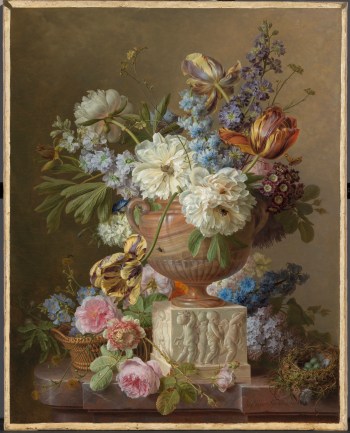
Gerard van Spaendonck, Still Life of Flowers in Alabaster Vase, 1783, oil on canvas, 80 × 64 cm (Amsterdam: Rijksmuseum).
The Rijksmuseum has procured a painting by Gerard van Spaendonck, the most famous painter of floral still lifes of the second half of the 18th century. It was a long-cherished wish of the museum to include in its collection an important work by this Dutch painter of international renown. The Rijksmuseum’s director Taco Dibbits describes this painting as “a radiantly beautiful acquisition.” The purchase of Still Life of Flowers in an Alabaster Vase from a gallery in Paris for €900,000 was made possible in part by participants in the BankGiro Lottery. The painting is now on display in Gallery 1.11.
Gerard van Spaendonck (1746–1822) was born in the southern Dutch city of Tilburg and settled in Paris in the 1760s. He gained fame not only as a painter of floral still lifes, but also as the illustrator of the French king’s botanical collection, a highly prestigious position. He was a leading and active figure in the Parisian art world and a teacher of countless French and foreign artists. Gerard van Spaendonck did not make a great number of paintings, instead devoting much of his time to his watercolours of plants, and to his students. He is nonetheless considered to be his era’s best painter of flowers.
Gerard van Spaendonck exhibited this floral still life at the Salon de 1783 in Paris, and it received great praise from critics, including compliments for his lifelike depictions of insects. The painting shows a bouquet of flowers in an alabaster vase standing atop a marble block on which children are depicted in relief. The painter’s studio window can be seen reflected in the polished surface of the vase. The flowers that feature in this painting include large white and smaller pink peonies, blue delphiniums, purple lilacs, and yellow and purple flamed tulips. Insects can be seen dotted about, and five green blackbird eggs lie in the nest on the right. Even the wicker basket seems almost real enough to touch.
New Book | The Politics of Parody
From Yale UP:
David Francis Taylor, The Politics of Parody: A Literary History of Caricature, 1760–1830 (New Haven: Yale University Press, 2018), 320 pages, ISBN: 978-0300223750, $50.
 This engaging study explores how the works of Shakespeare, Milton, Swift, and others were taken up by caricaturists as a means of helping the eighteenth-century British public make sense of political issues, outrages, and personalities. The first in-depth exploration of the relationship between literature and visual satire in this period, David Taylor’s book explores how great texts, seen through the lens of visual parody, shape how we understand the political world. It offers a fascinating, novel approach to literary history.
David Francis Taylor is associate professor of eighteenth-century literature at the University of Warwick and the award-winning author of Theatres of Opposition: Empire, Revolution, and Richard Brinsley Sheridan.
C O N T E N T S
Preface
Part One: Prints, Parody, and the Political Public
1 The Literariness of Graphic Satire
2 Looking, Literacy, and the Printshop Window
Part Two: Plotting Politics
3 The Tempest; or, The Disenchanted Island
4 Macbeth as Political Comedy
5 Paradise Lost, from the Sublime to the Ridiculous
6 Gulliver Goes to War
7 Harlequin Napoleon; or, What Literature Isn’t
Appendix: Dramatis Personae
Notes
Acknowledgements
Index
Conference | Portraiture and Biography
From the Paul Mellon Centre:
Portraiture and Biography Conference
National Portrait Gallery, London, 29–30 November 2018

Thomas Gainsborough, Self-Portrait, ca. 1758–59 (London: National Portrait Gallery).
An international conference collaborative organised by the Paul Mellon Centre for Studies in British Art and the National Portrait Gallery
Biography has always haunted the study of portraiture. Although in recent decades art-historians may have developed a healthy scepticism for the intuitive practice of interpreting portraits with straightforward reference to what is known about the lives of their subjects, the temptation to do so remains strong. These tendencies often appear in their most untrammelled form in analyses of artists’ likenesses of themselves, or of their most intimate acquaintances. Taking the current major exhibition Gainsborough’s Family Album at the National Portrait Gallery as a starting point, leading academics will explore the how the biographical archive might play in this field of study going forward.
Tickets: £30 General Admission and £25 Concessions and Gallery Supporters. The first day ends with an out-of-hours view of the exhibition and drinks reception. Unlimited entry to the exhibition on the second day of the conference is also included in the ticket price. Tea and coffee are provided on both days. Book online, or visit the National Portrait Gallery in person.
T H U R S D A Y , 2 9 N O V E M B E R 2 0 1 8
13.30 Registration
14.00 Introduction and welcome by Lucy Peltz (National Portrait Gallery) and Sarah Turner (Paul Mellon Centre)
14.15 Session One: Heads and Tales
Chaired by Lucy Peltz
• Meredith Gamer (Columbia University), Of Sitters and Subjects: William Hunter and the Anatomical Portrait
• Lejla Mrgan (University of Copenhagen), The Bewildering Silence of Bertel Thorvaldsen’s Portrait Busts
15.30 Tea Break
16.00 Session Two: Parallel Lives
Chaired by Martin Postle (Paul Mellon Centre)
• Rosemary Keep (University of Birmingham), ‘… masculine in all save her body and her sexe’: Lady Jane Burdett, Portrait and Biography
• Kerstin Maria Pahl (Humboldt University and King’s College London), Back-Ups: Portraiture, Life-Writing, and the Art of Information in Long-Eighteenth-Century England
17.15 Break
17.30 Session Three
• David Solkin (Courtauld Institute of Art) and Mark Hallett (Paul Mellon Centre) in conversation: Gainsborough’s Family Album
18.30 Exhibition view and drinks
F R I D A Y , 3 0 N O V E M B E R 2 0 1 8
10.30 Session Four
Chaired by by Mark Hallett
• Ludmilla Jordanova (Durham University), Portraiture, Biography, and Occupational Identities
11.15 Coffee Break
11.45 Session Five: Love and Likeness
• Marlen Schneider (Université Grenoble Alpes), Portraiture as Cultural Practice: Displaying Social Identity in French ‘Portraits Historiés’
• Katherine Fein (Columbia University), Indexical Portraiture and Embodied Biography in Harriet Hosmer’s ‘Clasped Hands of Robert and Elizabeth Barrett Browning’
13.00 Lunch Break
14.00 Session Six: Circulating Lives
Chaired by David Solkin
• Georgia Haseldine (Queen Mary University of London and National Portrait Gallery), Competing Likenesses: Portraits and Biographies of Radical Reformers
• Claudine van Hensbergen (Northumbria University), Portraits, Mezzotint, and Public Lives: The Image of the Royal Mistress, 1660–1700
15.15 Tea Break
15.45 Session Seven: Space and Status
Chaired by Sarah Turner
• Niharika Dinkar (Boise State University), Portrait of the Artist as a ‘Gifted Highborn’: Ravi Varma and Artistic Personhood in India
• Hannah Williams (Queen Mary University of London), Lived Space: Portraits, Studios, and the Life of the Artist
• Olivia Tait (University College London), ‘Neutralising’ Biography? Georg Baselitz’s Bedroom Portraits
Exhibition | Eighteenth-Century Pastel Portraits

Jean-Étienne Liotard, Portrait of Maria Frederike van Reede-Athlone at Seven Years of Age (detail), 1755–56, pastel on vellum
(Los Angeles: J. Paul Getty Museum)
◊ ◊ ◊ ◊ ◊
Now on view at The Getty Center:
Eighteenth-Century Pastel Portraits
J. Paul Getty Museum, Los Angeles, 28 August — 13 October 2018
Pastels—dry, satiny colors, manufactured in sticks of every hue—enjoyed a surge in popularity during the eighteenth century, becoming, for a time, the medium of choice for European portraiture. This display of pastels from the permanent collection explores the specific physical properties that made this medium so appealing to eighteenth-century portraitists and their patrons.
On Stage | Hogarth’s Progress, A Double Bill

Coming to the Rose Theatre, Kingston:
Hogarth’s Progress: The Art of Success and The Taste of the Town
A Double Bill by Nick Dear, Directed by Anthony Banks
Rose Theatre, Kingston, London, 13 September — 21 October 2018
Written by BAFTA Award-winning playwright Nick Dear and directed by Anthony Banks, Hogarth’s Progress is a highly imaginative and entertaining double bill of comedies. Following one of Britain’s most irreverent and celebrated artists on two monumental pub crawls, the plays explore the extraordinary lives of William Hogarth and his wife Jane at a time when culture escaped from the grasp of the powerful into the hands of the many.
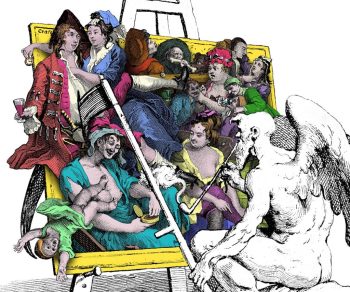 The Olivier Award-nominated comedy The Art of Success, in its first major revival, compresses the newlywed William’s rise to fame into a dizzying and hilarious night out through 18th-century London’s high society and debauched underworld.
A world premiere, The Taste of the Town catches up with the Hogarths in Chiswick some 30 years later. Now hugely successful, William and Jane are still at odds with the world and with each other. Facing public ridicule for what he considers his finest painting, William sets out to confront his fiercest critic, but there’s always time for one more pint on the way.
Bryan Dick (The Art of Success) and Keith Allen (The Taste of the Town) star as the younger and older William Hogarth. . . They are joined on stage by Ruby Bentall, Emma Cunniffe, Ben Deery, Jack Derges, Ian Hallard, Susannah Harker, Jasmine Jones, Sylvestra Le Touzel and Mark Umbers. Each play can be seen as a single performance or enjoyed together, either over different days or as a thrilling all-day theatrical experience.
P R O G R A M M I N G
Hogarth’s World
Wednesday, 26 September, post-show
A fascinating exploration of the uneasy relationship between a new generation of creative power players and the established powers of parliament and the crown. Dr Karen Lipsedge’s teaching focuses on 18th-century literature and culture. Professor Norma Clarke is a literary historian and author, who has recently chronicled of the 18th-century novelist, poet and playwright Oliver Goldsmith and his contemporaries.
Hogarth’s Art
Sunday, 30 September, post-show
An enlightening conversation about William’s subjects, techniques and styles, and how his creative legacy influences our world today. Chaired by Kingston School of Art’s Geoff Grandfield.
Hogarth’s Women
Saturday, 6 October, post-show
Join us for a discussion about the relationship between Jane and William Hogarth, the status of women in 18th-century London, and the emergence of the Blue Stocking Society. Dr Jane Jordan’s research is on literature and history, especially the legal status of British women and of prostitution. Dr Karen Lipsedge’s research focuses on 18th-century domestic spaces and gender roles and their representation in the British novel.
Exhibition | Manufacturing Luxury
Opening next month at the Cognacq-Jay, from the press release:
La Fabrique du Luxe: Les Marchands Merciers Parisiens au XVIIIe Siècle
Musée Cognacq-Jay, Paris, 29 September 2018 — 27 January 2019
Curated by Rose-Marie Herda-Mousseaux
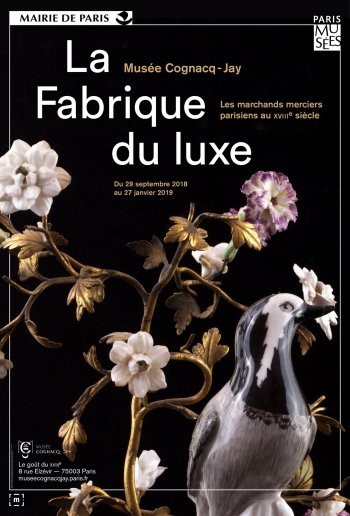 Du 29 septembre 2018 au 27 janvier 2019, le musée Cognacq-Jay organise la toute première exposition consacrée à cette corporation particulièrement codi ée et incontournable dans la diffusion de l’art et du luxe français. À travers les destins de marchands comme Gersaint ou Duvaux, le musée présente une centaine d’œuvres d’art, de documents et d’archives illustrant les origines du luxe à la parisienne.
À la fois négociant, importateur, collecteur, designer et décorateur, le marchand mercier occupe un rôle majeur dans l’essor de l’industrie du luxe à cette époque. Personnage atypique, il entretient des liens dans la haute aristocratie et s’appuie sur un réseau international d’artistes comprenant les meilleures spécialités techniques et artistiques, qu’elles proviennent de Lyon ou de Chine. Les marchands merciers se trouvent au cœur d’un réseau à trois pôles : le commanditaire, l’artisan ou artiste et, phénomène nouveau à la puissance croissante, la « mode ». Aussi, pour se faire connaître et agrandir leurs réseaux, ils développent les mécanismes de la promotion publicitaire, avec le concours de dessinateurs anonymes ou d’artistes comme Boucher ou Watteau.
Dissoute durant la période révolutionnaire, cette corporation suscite encore aujourd’hui l’intérêt des historiens de l’art et d’universitaires qui en font leur sujet de recherches. Le parcours de l’exposition explore le contexte propice à l’épanouissement de ce réseau, les clefs de leur succès et leurs innovations, et s’attache à dépeindre quelques-uns de ses illustres représentants.
Les marchands merciers : une corporation unique
L’appellation “marchand mercier” provient du terme « mercerie » qui, s’il désigne de nos jours les articles liés à l’habillement et à la parure, était synonyme au XVIIIe siècle de « marchandise ». Les statuts de la corporation, codi és en 1613, permettent aux marchands de vendre des objets enjolivés ou assemblés par leurs soins ou de seconde main. Ainsi, au XVIIIe siècle, les marchands merciers deviennent incontournables dans la diffusion des arts et du luxe hors de la cour. Ils acquièrent auprès des manufactures de porcelaine ou des grandes compagnies de transport des objets qu’ils font monter à l’aide d’orfèvres, de bronziers ou d’ébénistes pour créer des pièces décoratives aux formes nouvelles.
Cartographie du luxe parisien
Paris réunit les ingrédients indispensables d’un marché du luxe en plein essor : capitaux, clientèle nombreuse, fournisseurs hautement quali és, large réseau artistique, proximité avec la cour… Il est possible d’identi er des quartiers privilégiés dans l’organisation de ce commerce : la rue Saint-Honoré, bien sûr, mais aussi le Palais de Justice et les rues Saint-Martin et Saint- Denis, où les marchands disposaient d’adresses physiques.
La naissance des stratégies publicitaires
Dans un secteur concurrentiel, les marchands doivent faire preuve d’une stratégie permanente. C’est ainsi que l’émergence des enseignes ou « marques » s’appuient sur des ressorts marketing novateurs : contrats d’exclusivités ou monopoles, identi cation de clients prestigieux dans les réclames ou encore création d’identité visuelle dont témoignent les enseignes et cartes de visite.
L’exemple de Gersaint : un marchand-mercier emblématique
En 1720, Antoine Watteau peint en seulement « huit matins », pour la boutique de son ami Gersaint, une enseigne remarquable qui fait l’admiration du Tout-Paris. Ce coup de publicité fait de Gersaint un des premiers marchands merciers à développer une image publicitaire soignée. Le musée Cognacq-Jay conserve une étude préparatoire de cette œuvre et présente une reconstitution du tableau original à grande échelle.
Commissariat
Rose-Marie Herda-Mousseaux, Conservateur en chef du patrimoine, directrice du musée Cognacq-Jay
La Fabrique du Luxe: Les Marchands Merciers Parisiens au XVIIIe Siècle (Paris-Musées, 2018), 176 pages, ISBN: 978-2759604005, 30€.
Exhibition | What is Europe? Views from Asia
Now on view at The British Museum:
What is Europe? Views from Asia
The British Museum, London, 23 August — 22 October 2018

Painted wooden Hentakoi board, Nicobar Islands, around 1800–1900.
Exploring the interconnected relationships between Asia and Europe from the 18th century to the mid-20th century, the exhibition What is Europe? Views from Asia looks at Europe from the outside. Examining perceptions of Europe through a series of objects from Japan, China and South Asia, this display illustrates how encounters between Asia and Europe are often far more nuanced than has been previously presented. The exhibition includes a wide variety of objects that challenge common preconceptions—from prints, magazines, and paintings to sculptures and protective figures.
Two objects from the Nicobar Islands in the Indian Ocean shed light on the complex artistic response to European trade and power relations. The Islands were colonised by Denmark in 1756, and then sold to Britain in 1869, and are now a union territory of India. A Nicobarese hentakoi (painted board) shows the selective adoption of European practices and goods and the importance of local objects deemed valuable and symbolic. Hentakoi were thought to have protective powers, and this example shows a European ship, a local vessel and a Chinese boat, as well as a deity flanked by a compass and chronometer. A kareau (protective figure) from the Nicobar Islands is also included in the display—portrayed wearing a European pith helmet.
Subtle examples of subversion and dissent are also on display, such as the reception of European religions in Asia—a porcelain figure of the bodhisattva Guanyin and child shows this relationship. Made for hundreds of years for Buddhist devotion in China and Japan, in the 18th century some manufacturers added Christian imagery to these statues in the form of a mantilla—a Christian head-covering. Christianity was forbidden in Japan from 1587 to 1859, so sculptures like this, made for European export markets, allowed ‘hidden’ Christians to worship in secret in Japan.
The ridicule and mocking of Europe is also represented in the exhibition. A 1943 manga magazine mocks Allied wartime leader Winston Churchill, and an earlier print made during the Russo-Japanese war of 1904–05 ridicules the Russian Navy, describing them as ‘aimless boats’.
The display contains examples of the multi-faceted relationship and mutual adoption of Asian and European artistic styles. Instances of Western influence on Asian artists are shown alongside Chinese porcelain made for export to markets in Europe. There are also links between individual artists in the exhibition—German printmaker Käthe Kollwitz and Chinese artist Li Hua.
Together, the objects in this display reveal the nuanced and complex relationships between Asian and European nations from the 1700s to the mid-1900s, presenting narratives from many different backgrounds and encouraging debate about the present.
The Burlington Magazine, August 2018
The eighteenth century in The Burlington:
The Burlington Magazine 160 (August 2018)
 A R T I C L E S
• Alessandro Spila, “Ferdinando Fuga’s Proposals for Displaying Relics in S. Maria Maggiore, Rome,” pp. 646–53. Recently identified drawings show Fuga’s initial design [produced in the 1740s] for a pair of nave platforms in S. Maria Maggiore intended for the display of relics displaced by the recent reorganization of the choir. They were not executed, almost certainly because they conflicted with Benedict XIV’s wish to see a radical simplification of the church’s interior.
R E V I E W S
• Claudia Bodinek, Review of the exhibitions 300 Years of the Vienna Porcelain Manufactory (MAK, 2018) and Eternally Beautiful: 300 Years of Vienna Porcelain (Augarten Porcelain Museum, 2018), pp. 674–75.
• Philippe Bordes, Review of the exhibition Napoleon: Power and Splendor (Virginia Museum of Fine Arts, 2018), pp. 676–78.
• Jonathan Yarker, Review of the exhibition The Great Spectacle: 250 Years of the Summer Exhibition (Royal Academy of Arts, 2018), pp. 678–81.
• Roberto Valeriani, Review of Teresa Leonor M. Vale, ed., The Art of the Valadiers (Umberto Allemandi, 2017), pp. 703–05.










 Enfilade
leave a comment