Exhibition | Japanese Arms and Armor
Now on view at The Met Fifth Avenue:
Japanese Arms and Armor from the Collection of Etsuko and John Morris
The Metropolitan Museum of Art, New York, 25 January 2018 — 6 January 2019

Armor (Gusoku), Helmet signed by Bamen Tomotsugu (Japanese, Eichizan province, Toyohara, active 18th century); iron, lacquer, copper-gold alloy (shakudō), silver, silk, horse hair, ivory (New York: The Metropolitan Museum of Art, 2001.642).
Presenting a wide array of samurai armor, blades, and accoutrements dating from the fifteenth to the nineteenth century, this exhibition celebrates the promised gift of thirty-seven objects from the collection of Etsuko and John Morris, as well as other important gifts made by Mr. and Mrs. Morris to The Met’s Department of Arms and Armor over the past seventeen years.
The collection was originally assembled in the early twentieth century by Dr. Frederick Malling Pedersen (1869–1947) of New York. It later passed by descent to Mr. and Mrs. Morris, who have seen to its care and restoration. Key works include a rare complete armor (gusoku) by Bamen Tomotsugu (active eighteenth century); a blade attributed to Fusamune of Sōshū (active late fifteenth–early sixteenth century) with mounting; and a helmet (kawari-kabuto) in the shape of a wave (seventeenth century, restored 2015). The gift of choice objects from the collection represents a significant addition to the Museum’s holdings of Japanese arms and armor, which are the most comprehensive of their kind outside of Japan.
Grey Room, Recent Issues
Some of the articles addressing the eighteenth century in recent issues of Grey Room:
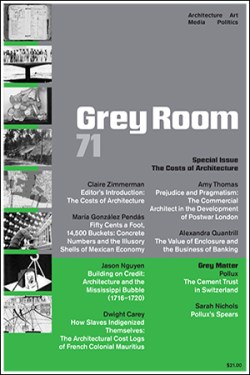 Grey Room
Editors: Zeynep Çelik Alexander, Lucia Allais, Eric C.H. de Bruyn, Noam M. Elcott, Byron Hamann, John Harwood, and Matthew C. Hunter
Grey Room brings together scholarly and theoretical articles from the fields of architecture, art, media, and politics to forge a cross-disciplinary discourse uniquely relevant to contemporary concerns. Publishing some of the most interesting and original work within these disciplines, Grey Room has positioned itself at the forefront of current aesthetic and critical debates. Featuring original articles, translations, interviews, dossiers, and academic exchanges, Grey Room emphasizes aesthetic practice and historical and theoretical discourse that appeals to a wide range of readers, including architects, artists, scholars, students, and critics.
No. 71 (Spring 2018) The Costs of Architecture
• Jason Nguyen, “Building on Credit: Architecture and the Mississippi Bubble (1716–1720),” pp. 40–67.
No. 69 (Fall 2017) Liquid Intelligence
• Jennifer L. Roberts, “The Veins of Pennsylvania: Benjamin Franklin’s Nature-Print Currency,” pp. 50–79
• Matthew C. Hunter, “The Cunning of Sir Sloshua: Reynolds, the Sea, and Risk,” pp. 80–107.
Call for Proposals | History of Collecting Seminars
Seminars in the History of Collecting
The Wallace Collection, London, 2019
Proposals due by 7 September 2018
The seminar series was established as part of the Wallace Collection’s commitment to the research and study of the history of collections and collecting, especially in the eighteenth and nineteenth centuries in Paris and London. In 2019, as in previous years, we plan to organise a series of 10 seminars. We are keen to encourage contributions covering all aspects of the history of collecting, including
• Formation and dispersal of collections
• Dealers, auctioneers, and the art market
• Collectors
• Museums
• Inventory work
• Research resources
The seminars, which are normally held on the last Monday of every month during the calendar year, excluding August and December, act as a forum for the presentation and discussion of new research into the history of collecting. Seminars are open to curators, academics, historians, archivists, and all those with an interest in the subject. Papers are generally 45–60 minutes long, and all the seminars take place at the Wallace Collection between 5.30 and 7pm. If interested, please send a short text (500–750 words), including a brief CV, indicating any months when you would not be available to speak, by Friday 7 September 2018. For more information and to submit a proposal, please contact: collection@wallacecollection.org.
Please note that we are able to contribute up to the following sums towards speakers’ travelling expenses on submission of receipts:
• Speakers within the UK – £80
• Speakers from Continental Europe – £160
• Speakers from outside Europe – £250
New Book | Jean-Baptiste-Pierre LeBrun (1748–1813)
From Rowman & Littlefield and available from Artbooks.com:
Bette Oliver, Jean-Baptiste-Pierre LeBrun (1748–1813): In Pursuit of Art (Hamilton Books, 2018), 108 pages, ISBN: 978-0761870272, $65 / £45
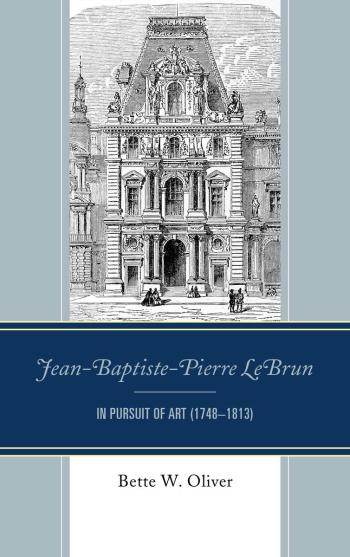 Jean-Baptiste Pierre LeBrun’s life was marked by his intense interest in art, first as an artist, and then from 1770 until his death in 1813, as an art dealer/connoisseur and as a participant in the transformation of the Louvre into a national museum during the French Revolution. He managed to accommodate whichever regime assumed power, from monarchy to republic to empire. He married the artist Elisabeth Vigée in 1776, and together they figured prominently in the pre-revolutionary cultural world of Paris. LeBrun travelled widely, buying art for his gallery and contributing to a number of aristocratic collections. His expertise in attributions of 17th-century Dutch and Flemish paintings was acknowledged internationally, while his reference work on the subject was considered the most comprehensive ever written.
LeBrun, the grand-nephew of the illustrious artist Charles LeBrun, became one of the most successful art dealers in Paris. He played an active role in the politics of art between 1789 and 1802, serving as an expert-commissioner in restoration at the national museum. His inventories of artworks, confiscated from all over Europe by Napoleon’s armies, have provided a valuable record of the development of the French national museum. In addition, his inventories have been useful in the identification and recovery of Nazi confiscations during World War II. LeBrun’s accomplishments during a tumultuous period of political and artistic change present evidence of his contributions to the concept of the modern art museum, notably in the areas of conservation, restoration, and arrangement.
Bette W. Oliver of Austin, Texas, is an independent scholar and editor with a PhD in modern European history from the University of Texas at Austin. A specialist in the period of the French Revolution, she is the author of five books focusing on that pivotal period, as well as eleven volumes of poetry.
2016 Dissertation Listings from CAA
My apologies for not posting this much sooner (the listings used to come out in August, and I wasn’t looking for them in December). –CH
From caa.news (11 December 2017) . . .
Once a year, each institution granting the PhD in art history and/or visual studies submits dissertation titles to CAA for publication. caa.reviews has now published the authors and titles of doctoral dissertations in art history and visual studies—both completed and in progress—from American and Canadian institutions for calendar year 2016. You can browse by listing date or by subject matter. Each entry identifies the student’s name, dissertation title, school, and advisor.
The index for 2016 lists four ‘eighteenth-century art’ dissertations completed:
• Joshua D. Hainy, “John Flaxman: Beyond the Line” (Iowa, D. Johnson)
• Stephanie O’Rourke, “Bodies of Knowledge: Fuseli and Girodet at the Turn of the Nineteenth Century” (Columbia, J. Crary)
• Amanda K. Strasik, “Reconceiving Childhood: Women and Children in French Art, 1750–1814” (Iowa, D. Johnson)
• Aaron Wile, “Painting, Authority, and Experience at the Twilight of the Grand Siècle, 1688–1721” (Harvard, E. Lajer-Burcharth)
◊ ◊ ◊ ◊ ◊
and thirty-six ‘eighteenth-century art’ dissertations in progress, including:
• Daniella Berman, “Aesthetics of Contingency: History and the Unfinished Paintings of the French Revolution” (IFA/NYU, T. Crow)
• Christine Brandner, “Addressing another Body in Jean-Etienne Liotard’s Portraiture” (Yale, N. Suthor)
• Alexandra Cardon, “Circa 1700: Royal Retreats, Academic Unrest and the Roots of Rococo” (CUNY, J. Sund)
• Alicia Caticha, “Étienne-Maurice Falconet and the Matter of Sculpture: Marble, Porcelain, and Sugar in Eighteenth-Century Paris” (Virginia, S. Betzer)
• Elizabeth Gebauer, “The Art of Speech: Flemish Baroque Pulpits, 1627–1794” (Princeton, T. DaCosta Kaufmann)
• Sandra Gomez Todo, “Abandoned Schools of Pleasure: Unmasking Gender and Identity in the Visual Culture of the Georgian Masquerade” (Iowa, D. Johnson)
• Christine Griffiths, “From Garden to Toilette: Cultivating Perfume in Early Modern England” (Bard Graduate Center, D. Krohn)
• Rachel Harmeyer, “After Angelica Kauffman” (Rice, L. Costello)
• Julia K. McHugh, “Dressing Andean Spaces: Textiles, Painting, and Architecture in the Colonial Imagination” (UCLA, C. Villaseñor-Black)
• Isabel Oleas-Mogollón, “Jesuit Missionary and Visionary Experiences in Quito: La Compañía Prophet Paintings” (Delaware, M. Domínguez Torres)
• Emily Spratt, “Byzantium not Forgotten: Constructing the Artistic and Cultural Legacy of an Empire between East and West in the Early Modern Period” (Princeton, P. Brown)
• Amy Torbert, “Dissolving the Bonds: Sayer & Bennett, Print Publishers in an Age of Revolution” (Delaware, W. Bellion)
• Linda Zajac, “Miniature Worlds of Age and Masculinity in the Eighteenth-Century English Domestic Interior” (University of Victoria, E. Campbell)
The Burlington Magazine, June 2018
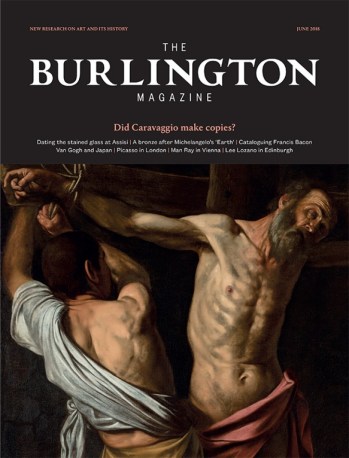
As the June 2018 issue of The Burlington launches a new design (the work of Studio Frank), editor Michael Hall provides a brief overview of the history of the journal’s design in his editorial comments, noting that “many readers now access the magazine in its digital edition and for most people the first sight of the cover is likely to be on the screen of a tablet or smartphone, meaning that it has to work on a small scale” (453).
The eighteenth century in The Burlington:
The Burlington Magazine 160 (June 2018)
 A R T I C L E S
• Tessa Murdoch, “A Set of Silver-Gilt Waiters by Benjamin Pyne for the Courtenay Family of Powderham Castle, Devon,” pp. 478–89.
R E V I E W S
• Xavier F. Salomon, Review of the exhibition Tiepolo Segreto (Vicenza: Palladio Museum, 2017–18), pp. 495–97.
• Sanda Miller, Review of the exhibition Fashioned from Nature (London: V&A, 2018), 497–99.
• Steven Jaron, Review of John Onians, European Art: A Neuroarthistory (Yale UP, 2016), 516–17.
• Antoine Maës, Review of Alexandre Maral, François Girardon (1628–1715): Le Sculpteur de Louis XIV (Arthena, 2015), p. 519.
• Clare Hornsby, Review of Paola Bianchi and Karin Wolfe, eds., Turin and the British in the Age of the Grand Tour (Cambridge UP, 2017), pp. 520–21.
• Jonathan Brown, Review of Elena Santiago Páez, ed., Ceán Bermúdez: Historiador del arte y coleccionista ilustrado (Centro de Estudios Europa Hispánica, 2016), p. 521.
• Timothy Wilcox, Review of Ann Gunn, The Prints of Paul Sandby (1731–1809): A Catalogue Raisonné (Brepols, 2016), pp. 521–23.
• Caroline Finkel, Review of Francis Russell, 123 Places in Turkey: A Private Grand Tour (Bitter Lemon Press, 2017), p. 527.
Exhibition | Fashioned from Nature
Press release for the V&A exhibition:
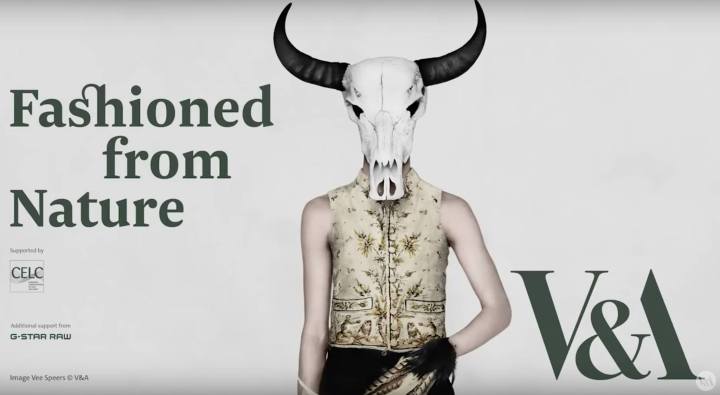
Fashioned from Nature
Victoria and Albert Museum, London, 21 April 2018 — 27 Jan 2019
Curated by Edwina Ehrman
A pineapple fibre clutch-bag, Emma Watson’s Calvin Klein dress made from recycled plastic bottles, and a cape of cockerel feathers are amongst the 300 beautiful, intriguing and unsettling objects from the V&A’s most recent major fashion exhibition. Fashioned from Nature traces the complex relationship between fashion and the natural world since 1600. It shows how fashionable dress recurringly draws on the beauty and power of nature for inspiration, with exquisite garments and accessories from Christian Dior, Dries van Noten, and Philip Treacy. It explores how fashion’s processes and constant demand for raw materials damage the environment, featuring campaigners and protest groups that have effectively highlighted this issue such as Fashion Revolution and Vivienne Westwood. It looks at the role of design in creating a better, more sustainable fashion industry.

Waistcoat, 1780–89, France (London: Victoria and Albert Museum, T.49-1948).
The exhibition showcases contemporary designers of desirable, creative and sustainable popular fashion. Menswear and womenswear from Stella McCartney, known for a commitment to and success in developing new alternative sustainable materials, is displayed alongside an upcycled dress by Christopher Raeburn. At the 2016 Met Gala, actor Emma Watson wore a Calvin Klein look made from recycled plastic bottles. With separate parts, it was intended to be re-worn in different ways. The look was created as part of the ‘Green Carpet Challenge’ with Eco-Age, an initiative to pair sustainability with glamour. It is shown with a floral dress from Erdem’s Green Carpet Challenge collection. Fashioned from Nature draws attention to the use of innovative fabrics. Vegea use grape waste from the wine industry to form a leather-substitute and their Grape gown is on show, as is a Ferragamo ensemble made from ‘Orange Fiber’ derived from waste from the Italian citrus industry and an H&M Conscious dress made from recycled shoreline plastic.
The exhibition looks to the past 400 years of fashion to explore what we can learn from fashion practice in the past, with objects dating to the early 1600s. Items include an 1875 pair of earrings formed from the heads of two real Honeycreeper birds—a hugely popular item sold in enormous volume at the time—and a 1860s muslin dress decorated with the iridescent green wing cases of hundreds of jewel beetles. They are shown alongside natural history specimens to indicate the ways fashion has used animal materials in its designs and production.
The natural world has always provided rich inspiration for beautiful fashion. This is shown in displays of exquisite garments from the historic to the contemporary. They range from a 1780s man’s waistcoat, expertly embroidered with a pattern of playful Macacque monkeys, to Gucci’s contemporary bag decorated with stag beetle motifs. One of the earliest pieces in the exhibition, a women’s jacket from the early 1600s, is intricately embroidered with designs of pea-shoots and flowers. A 2016 Giles Deacon haute-couture dress features a pattern of delicate bird’s eggs, whilst gowns from Jean Paul Gaultier (1997) and Busvine (1933–34) both feature leopard print.
 The exhibition also focuses closely on the raw materials used in the production of fashion. Arranged chronologically, it introduces the main fibres used in the 17th and 18th centuries—silk, flax, wool, and cotton—as well as now controversial materials like whalebone, demonstrated by an x-ray by Nick Veasey of a pair of 1780s stays, and turtle shell, used in a fan from 1700. It goes on to chart the expansion in international trade, import of precious materials, and later introduction of man-made materials, which brought fashionable dress to the masses but also contributed to the air and water pollution to which the textile industry is such a significant contributor.
A bold display of posters, slogan clothes, and artworks show how protest movements have helped draw attention to the harmful side of fashion. Figures like Vivienne Westwood have popularised these issues and a mannequin pays homage to an outfit worn by her whilst protesting against climate change. A man’s outfit from Katharine Hamnett’s 1989 ‘Clean Up or Die’ collection is on show alongside posters from Fashion Revolution, a collective aiming to change the way clothes are sourced, produced and consumed. Customising and re-wearing clothes are highlighted through a vintage outfit and a jacket customised by London designer Katie Jones for fashion writer and editor Susie Lau to wear during Fashion Revolution Week 2015.
The exhibition presents a range of solutions to reducing fashion’s impact on the environment from low water denim and using wild rubber to more conceptual and collaborative projects. These include a dress grown from plant roots by the artist Diana Scherer, who uses seed, soil, and water to train root systems into textile-like material, a bio-luminescent genetically- engineered silk dress created by Sputniko!, the MIT Lab and the National Institute of Agricultural Science (NIAS), South Korea, and a tunic and trousers made from synthetic spider silk from Bolt Threads x Stella McCartney.
Fashioned from Nature is curated by Edwina Ehrman, Curator of Textiles and Fashion at the V&A. She also curated the exhibition The Wedding Dress: 300 Years of Bridal Fashions. She was a co-author of The London Look: Fashion from Street to Catwalk (2004) and a contributor to The Englishness of English Dress (2002).
Centre for Sustainable Fashion (CSF) at London College of Fashion, UAL, present two interactive installations which explore ‘Fashion Now’ and ‘Fashion Future.’ ‘Fashion Now’ takes five iconic contemporary fashion pieces and using sensors, visitors are able to explore the unseen impact on nature of the construction, making, wearing and discarding of each item. ‘Fashion Future’ immerses viewers into the fashion world of the future, inviting us to question what fashion means and show us a future we are yet to imagine. The CSF installations are curated by Professor Dilys Williams, founder and Director of CSF, and Ligaya Salazar, Director, Fashion Space Gallery with help from London College of Fashion MA Fashion Futures students.
Edwina Ehrman, Fashioned From Nature (London: V&A Publishing, 2018), 192 pages, ISBN: 978-1851779451, £25 / $40.

Mantua, 1760s, France (London: Victoria and Albert Museum, T.252 to C-1959).
Exhibition | To Rome and Back
Now on view at LACMA:
To Rome and Back: Individualism and Authority in Art, 1500–1800
Los Angeles County Museum of Art, 24 June 2018 — 17 March 2019

Ludovico Mazzanti, The Death of Lucretia, ca. 1730 (Los Angeles County Museum of Art, gift of The Ahmanson Foundation).
Over the course of its 2,000-year history, Rome has been alternatively held as the epitome of republic, the decadence of empire, the force of Catholicism, the artistic and literary birthplace of naturalism, and above all, the source of classicism. Despite these various, and ostensibly conflicting associations, its classical epithet—the Eternal City—reflects the symbiosis of these qualities and their lasting influence on republics, nations, religions and even continents beyond. For while Rome’s significance waxed and waned through plagues and progress, conflict and collaboration, its political, social, cultural, and religious power remained consistently strong throughout its history.
Assembled entirely from LACMA’s permanent collection, this examination of a significant moment in early Modern Europe reflects the donations and gifts from years of support to the museum’s departments of Costume and Textiles, Decorative Arts and Design, Latin American Art, and Prints and Drawings, in addition to European Paintings and Sculpture. These works reveal the depth of Rome’s impact from the Renaissance to the Enlightenment, before rising individualism, internationalism, and the optimistic equilibrium between secular and religious forces caused the city’s ultimate marginalization.
Exhibition | Sense of Humor
Opening next month at the NGA in Washington:
Sense of Humor
National Gallery of Art, Washington, D.C., 15 July 2018 — 6 January 2019
Curated by Jonathan Bober, Judith Brodie, and Stacey Sell

James Gillray, Midas, Transmuting All into Paper, 1797, etching with hand-coloring in watercolor on laid paper, Wright and Evans 1851, no. 168, National Gallery of Art, Washington, 2015.49.1.
Humor may be fundamental to human experience, but its expression in painting and sculpture has been limited. Instead, prints, as the most widely distributed medium, and drawings, as the most private, have been the natural vehicles for comic content. Drawn from the National Gallery of Art’s collection, Sense of Humor celebrates this incredibly rich though easily overlooked tradition through works including Renaissance caricatures, biting English satires, and 20th-century comics. The exhibition includes major works by Pieter Brueghel the Elder, Jacques Callot, William Hogarth, James Gillray, Francisco Goya, and Honoré Daumier, as well as later examples by Alexander Calder, Red Grooms, Saul Steinberg, Art Spiegelman, and the Guerrilla Girls.
The exhibition is curated by Jonathan Bober, Andrew W. Mellon senior curator of prints and drawings; Judith Brodie, curator and head of the department of American and modern prints and drawings; and Stacey Sell, associate curator, department of old master drawings, all National Gallery of Art, Washington.
Exhibition | Jean Cotelle (1646–1708): Gardens and Gods
From Versailles:
Jean Cotelle (1646–1708): Gardens and Gods
Grand Trianon, Château de Versailles, 12 June — 16 September 2018
Curated by Béatrice Sarrazin with Clara Terreaux
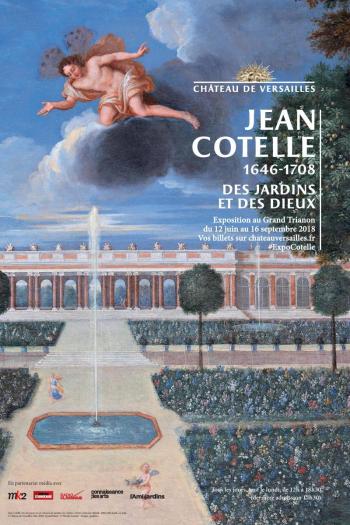 Jean Cotelle (1646–1708): Gardens and Gods, the first exhibition dedicated to the painter, will honour an artist who was very popular in his time, featuring some 120 works: paintings, drawings, engravings, miniatures, and sculptures from public and private collections. Jean Cotelle the Younger belonged to the generation of painters called upon by Louis XIV to decorate the Grand Trianon, a pleasure palace secluded from the hustle and bustle of the court.
For the Trianon Gallery, which overlooks the gardens and connects the Cool Room and the Garden Room, Cotelle was entrusted with the largest portion of the commission: twenty-one paintings. In order to adapt to the setting, he painted in vertical format, rather unusual for landscape painting, to create topographical representations of the Versailles gardens. He adorned the scenes with characters from mythology or fables arranged in two registers (earthly and heavenly), modelled upon the bucolic landscapes of Bolognese painter Albani.
This cycle, completed by three paintings by Jean-Baptiste Martin and Etienne Allegrain, represents a unique ensemble, providing insight into the king’s taste for his gardens which had recently been created by André Le Notre. Hidden by vegetation, the groves served as a backdrop for the portrayal of the loves and pleasures of the gods.
The exhibition will feature the twenty-four restored paintings following a restoration campaign that lasted several years. Along with the large format canvases, the fifteen gouaches created by the artist, masterpieces of miniature painting, will also be displayed. Additionally, a selection of lead sculptures will be included in the exhibition to evoke the decoration of the groves which have since disappeared, in relation to Cotelle’s paintings.
While the Trianon commission represents one of the highlights of Cotelle’s career, retracing the various stages of his work nevertheless reveals different aspects of his talent and his varied career in Saint-Cloud and Versailles as well as in Provence.

Jean Cotelle, Fountain Scene with Alpheus Pursuing Arethusa, 1689–91 (Château de Versailles, Dist. RMN/Jean-Marc Manaï).
Jean Cotelle the Younger was born into a cultured family in Paris in 1646. He grew up in the company of artists, especially painters, including his father Jean Cotelle the Elder, painter to the King, decorator and ornamental painter. He most likely received his early training from the portrait painter Claude Lefèvre. Jean Cotelle the Younger then visited Rome, where he stayed from 1665 until 1670 at his own expense.
His notable works from 1675 and the years which followed include miniatures to illustrate The Campaigns of Louis XIV as well as a large-format May for Notre-Dame in 1681 representing The Marriage at Cana. Cotelle also worked on other decorative commissions, in particular in Saint-Cloud where he created the jewellery cabinet as part of the decoration depicting the story of Venus and Aeneas.
The most important commission he received was a commission in 1688 from Louis XIV to decorate the Trianon gallery also called the Cotelle gallery. Cotelle painted twenty-one topographical representations of the gardens of Versailles, which he adorned with mythological and literary characters. At the same time, he carried out a series of twenty gouaches representing the Trianon Gallery in miniature.
In 1693, he left Paris for Provence, first making a stop in Lyon, where he created the decoration on the ceiling of the great hall for the Château de la Damette. From 1695 to 1700, he lived in Marseille and became the co-director of the opera with Duplessis. He also created ephemeral decorations such as The Entry of the Duke of Burgundy and the Duke of Berry into the City of Avignon. Jean Cotelle the Younger returned to Paris in 1703 where he continued his work for the Academy until his death in 1708.
Beatice Sarazin, ed., Jean Cotelle (1646–1708): Des Jardins et des Dieux (Paris: Liénart, 2018), 240 pages, ISBN: 978-2359062366, 39€ / $68.
◊ ◊ ◊ ◊ ◊
In preparation for the exhibition on Jean Cotelle, the Palace of Versailles launches a research notice for three works attributed to the painter: two gouaches and a drawing. These works disappeared from the public eye in the 1980s for two of them and soon after the year 2000 for the last one. However, reproductions and publications confirm that they exist (see the Château de Versailles website for images).
The works are:
• La Toilette de Vénus, drawing
• Vue du Château de Choisy du côté des parterres et la famille de Louvois, gouache
• Eliezer et Rebecca au Puits, gouache
Once found, their identification would enrich the corpus of the artist and the value of these works, which could be displayed in the exhibition. Internet users are invited to spread this search as far as possible with the hashtag: #ExpoCotelle. People having information about these works can contact the Palace of Versailles through: cotelle@chateauversailles.fr.










 Enfilade
leave a comment