New Book | The Savage and Modern Self
From the University of Toronto Press:
Robbie Richardson, The Savage and Modern Self: North American Indians in Eighteenth-Century British Literature and Culture (Toronto: University of Toronto Press, 2018), 264 pages, ISBN 9781487503444, $70.
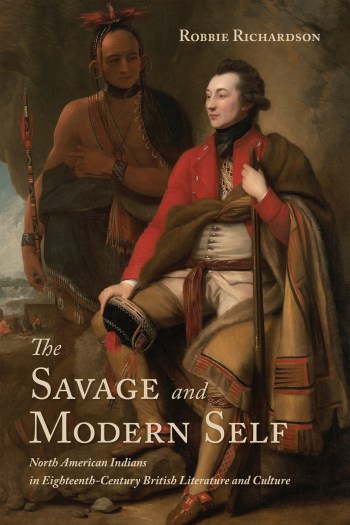 The Savage and Modern Self examines the representations of North American ‘Indians’ in novels, poetry, plays, and material culture from eighteenth-century Britain. Robbie Richardson argues that depictions of ‘Indians’ in British literature were used to critique and articulate evolving ideas about consumerism, colonialism, ‘Britishness’, and, ultimately, the ‘modern self’ over the course of the century.
Considering the ways in which British writers represented contact between Britons and ‘Indians’, both at home and abroad, the author shows how these sites of contact moved from a self-affirmation of British authority earlier in the century, to a mutual corruption, to a desire to appropriate perceived traits of ‘Indianess’. Looking at texts exclusively produced in Britain, The Savage and Modern Self reveals that ‘the modern’ finds definition through imagined scenes of cultural contact. By the end of the century, Richardson concludes, the hybrid Indian-Brition emerging in literature and visual culture exemplifies a form of modern, British masculinity.
Robbie Richardson is a lecturer in Eighteenth-Century Literature at the University of Kent.
C O N T E N T S
1 Indians and the Construction of Britishness in the Early Eighteenth Century
2 The Indian as Cultural Critic: Shaping the British Self
3 Captivity Narratives and Colonialism
4 Novel Indians: Tsonnonthouan and the Commodification of Culture
5 Becoming Indians: Sentiment and the Hybrid British Subject
6 Native North American Material Culture in the British Imaginary
Conclusion: ‘Pen-and-Ink Work’
Display | Publishing at the Paul Mellon Centre
On view at the Mellon Centre:
Publishing at the Paul Mellon Centre: A Brief History
Paul Mellon Centre for Studies in British Art, London, 19 January — 18 May 2018
Organized by Emily Lees
 The new Drawing Room Display and accompanying brochure are designed to give a brief introduction to the beginnings of our publishing history and to highlight the different strands of our list. We begin with the story of our very earliest publications; and then, to showcase the variety of our output, we have asked a selection of colleagues associated with the Centre to tell the stories behind some of our most important books. Inevitably, we only had space for a small selection of our publications in the display itself. However, to see our complete list, the variety of subjects we have covered and the pantheon of authors we have been privileged to work with, you will find a copy of every book we have published in the bookcases in the Drawing Room. All the material in this display is taken from the PMC’s institutional archive and library.
The 36-page brochure accompanying the display includes brief entries by ten contributors and is available online. As Emily Lees writes:
The Paul Mellon Centre’s first fully fledged publications, and the first of its books to be published in association with its long-standing partner, Yale University Press, was Ronald Paulson’s Hogarth: His Life, Art, and Times, which was published in the spring of 1971 (13).
Conference | American Latium
Next month at the Center for American Studies in Rome, from the conference flyer:
American Latium: American Artists and Travellers in and around
Rome in the Age of the Grand Tour
Centro Studi Americani, Palazzo Mattei di Giove, Rome, 7–8 June 2018
Organized by Christopher M.S. Johns, Tommaso Manfredi, and Karin Wolfe
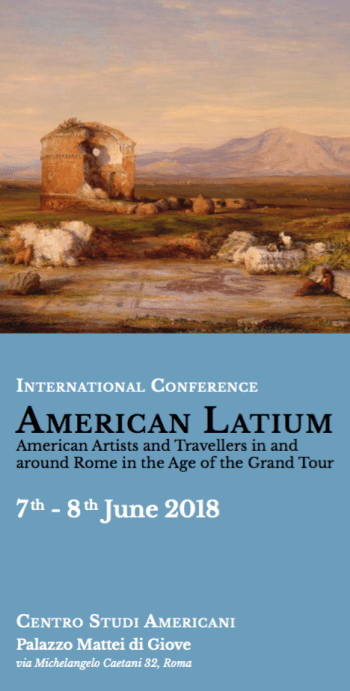 American Latium addresses the pioneering origins of the artistic relations between America, Rome, and its environs from the eighteenth century up until 1870, in order to define the extraordinary impact of the arts of Rome, from antiquity through to the modern period, that in large part resulted in the birth of a national American aesthetic. Interdisciplinary in nature, this conference will put forward new research and new research approaches to the study of cultural travel and cultural exchange, including exploring the reverse side of this story of exchange, foregrounding the experiences and the contributions of the first Italians who travelled to America in search of work opportunities and cultural acclaim.
Organised by Centro Studi Americani, Roma; Accademia Nazionale di San Luca, Roma; Department of History of Art, Vanderbilt University, Nashville; and Dipartimento PAU, Università Mediterranea di Reggio Calabria.
T H U R S D A Y , 7 J U N E 2 0 1 8
9.15 Welcome, Paolo Messa (Centro Studi Americani)
9.30 Francesco Moschini (Accademia Nazionale di San Luca), Il Principe e il Presidente: Riflessioni sull’incontro londinese tra Antonio Canova e Benjamin West
10.00 The American Grand Tour in Europe: Origins and Dynamics
Chair: Christopher M.S. Johns (Vanderbilt University)
• Jonathan Yarker (Lowell Libson & Jonny Yarker, Ltd), Copying Old Masters for the New World: American Eighteenth-Century Painters in Rome
• Sarah Cantor (University of Maryland, Adelphi), James Bowdoin III and Ward Nicholas Boylston in Italy: American Collectors in the Later Eighteenth Century
• Vincent Pham (University of California San Diego), Benjamin West, the American School, and the Remediation of History Painting
• Martin Postle (Paul Mellon Centre for Studies in British Art), London between America and Continental Europe: Art and Academies
• Duccio K. Marignoli (The Marignoli di Montecorona Foundation), Benjamin West’s Portrait of Benjamin Franklin: New Themes and New Approaches for a New Nation
13.00 Lunch Break
14.00 American Rome and Latium: Image, Sites, and Itineraries
Chair: Tommaso Manfredi (Università Mediterranea di Reggio Calabria)
• Fabrizio Di Marco (Sapienza Università di Roma), Luoghi e itinerari statunitensi a Roma dalla ne del Settecento a metà dell’Ottocento
• Nicholas Stanley-Price (Independent Scholar), The Final Destination: Early American Presence at the Protestant Burying- Ground in Rome
• Mary K. McGuigan (Independent Scholar), Scenery Found: John Gadsby Chapman and Open-Air Oil Sketching in and around Rome, 1830–77
• Luca Attenni (Università degli Studi Roma Tre), John Izard Middleton: Un archeologo americano nel Lazio
• Francesco Petrucci (Palazzo Chigi, Ariccia), La ‘Scuola dei Castelli Romani’ e la Locanda Martorelli ad Ariccia: Artisti e intellettuali dall’Europa all’America nel XIX secolo
• Lisa Beaven (LaTrobe University, Bendigo), Sense and Sensibility Part I: American Artists Experiencing the Roman Campagna
• David R. Marshall (University of Melbourne), Sense and Sensibility Part II: American Artists Experiencing the Roman Campagna, The Tor de’ Schiavi
F R I D A Y , 8 J U N E 2 0 1 8
9.00 Americans and the Artistic Culture of Rome: From Old Masters to New
Chair: Karin Wolfe (British School at Rome)
• Wendy Wassyng Roworth (University of Rhode Island), Angelica Kauffman’s Portraits of Americans in Rome and a Self-Portrait in Philadelphia
• Christopher M.S. Johns (Vanderbilt University), John Singleton Copley in Rome: The Challenge of the Old Masters Accepted
• Tommaso Manfredi (Università Mediterranea di Reggio Calabria), La Roma di Charles Bul nch: un itinerario culturale al tempo di Pio VI
• Maria Cristina Loi (Politecnico di Milano), L’idea di Roma di Thomas Jefferson e il suo viaggio in Italia
• Francesca Orestano (Università degli Studi di Milano), John Neal, the Old Masters, and the American Muse
• John F. McGuigan Jr. (Independent Scholar), A Painter and a Diplomat: The Two Careers of James E. Freeman and Their Correspondences
• Pier Paolo Racioppi (Fondazione IES Abroad Italy, Roma), Vivere e creare nell’Antico: Le dimore e gli studi romani degli scultori Crawford, Story ed Ezekiel
• Kevin Salatino (The Art Institute of Chicago), Undressing America: Nineteenth-Century Expatriate Sculptors in Rome and the Question of Nudity
13.30 Lunch Break
14.30 Rome in America: Transpositions of Ideas, Art, and Artists
Chair Francesco Moschini Accademia Nazionale di San Luca
• Mario Bevilacqua (Università degli Studi di Firenze), Piranesi in Eighteenth-Century America: Ancient Models for the New Nation
• Karin Wolfe (British School at Rome), Imagining Liberty: The Roman Sculptor Giuseppe Ceracchi in America
• Giovanna Capitelli (Università della Calabria), An Ecclesiastical Network? Altarpieces Sent from Rome to the United States during the Second Half of the Nineteenth Century in the Papacy of Pius IX
• Tiziano Antognozzi (Independent Scholar), From One Capitol to the Other: Exploring Constantino Brumidi’s Agency across the Atlantic
• Linda Wolk-Simon (Fairfield University Art Museum), ‘In the Beginning There Was the Word’: American Writings on Raphael from the Founding Fathers to the Gilded Age
17.00 Discussion
Image: Thomas Hiram Hotchkiss, Torre di Schiavi, 1865, detail (Smithsonian American Art Museum).
New Book | Emma Hamilton
From Routledge:
Ersy Contogouris, Emma Hamilton and Late Eighteenth-Century European Art: Agency, Performance, and Representation (New York, Routledge, 2018), 172 pages, ISBN: 9780815374237, $150.
 This book uses an art historical and feminist methodology to engage with Emma Hamilton, an eighteenth-century celebrity who appeared in many works of art by important artists including Angelica Kauffmann, George Romney, and Élisabeth Vigée-Le Brun. Ersy Contogouris analyzes works of art in which Hamilton appears, her performances, and writings by her contemporaries to establish her impact on this pivotal moment in European history and art. This pioneering volume shows that Hamilton did not attempt to present a coherent or polished identity, arguing instead that she was a kaleidoscope of different selves that she used to both express herself and present to others what they wanted to see. She was resilient, effectively asserted her agency, and was a powerful inspiration for generations of artists and women.
Ersy Contogouris is Assistant Professor at Université de Montréal.
C O N T E N T S
Introduction: Emma Hamilton, the Most Beautiful Compound Ever Beheld
1 La vie de Lady Hamilton est un roman
2 The Acme of Sir William’s Delights
3 Emma’s Attitudes: Movements and Surprising Transformations
4 The Tarantella
5 Model, Muse, and Artist
Conclusion
New Book | Architecture and Urbanism in the French Atlantic Empire
From McGill Queen’s University Press:
Gauvin Alexander Bailey, Architecture and Urbanism in the French Atlantic Empire: State, Church, and Society, 1604–1830 (Montreal: McGill Queen’s University Press, 2018), 696 pages, ISBN: 978-0773553149, $75.
 Spanning from the West African coast to the Canadian prairies and south to Louisiana, the Caribbean, and Guiana, France’s Atlantic empire was one of the largest political entities in the Western Hemisphere. Yet despite France’s status as a nation at the forefront of architecture and the structures and designs from this period that still remain, its colonial building program has never been considered on a hemispheric scale.
Drawing from hundreds of plans, drawings, photographic field surveys, and extensive archival sources, Architecture and Urbanism in the French Atlantic Empire focuses on the French state’s and the Catholic Church’s ideals and motivations for their urban and architectural projects in the Americas. In vibrant detail, Gauvin Alexander Bailey recreates a world that has been largely destroyed by wars, natural disasters, and fires—from Cap-François (now Cap-Haïtien), which once boasted palaces in the styles of Louis XV and formal gardens patterned after Versailles, to failed utopian cities like Kourou in Guiana. Vividly illustrated with examples of grand buildings, churches, and gardens, as well as simple houses and cottages, this volume also brings to life the architects who built these structures, not only French military engineers and white civilian builders, but also the free people of colour and slaves who contributed so much to the tropical colonies. Taking readers on a historical tour through the striking landmarks of the French colonial landscape, Architecture and Urbanism in the French Atlantic Empire presents a sweeping panorama of an entire hemisphere of architecture and its legacy.
Gauvin Alexander Bailey is professor and Alfred and Isabel Bader Chair in Southern Baroque Art at Queen’s University.
New Book | The Palace of Sans-Souci in Milot, Haiti, ca. 1806–13
From Deutscher Kunstverlag:
Gauvin Alexander Bailey, Der Palast von Sans-Souci in Milot, Haiti (ca. 1806–1813): Das vergessene Potsdam im Regenwald / The Palace of Sans-Souci in Milot, Haiti (ca. 1806–1813): The Untold Story of the Potsdam of the Rainforest (Berlin: Deutscher Kunstverlag, 2017), 200 pages, ISBN: 978-3422074668, 15€. German and English.
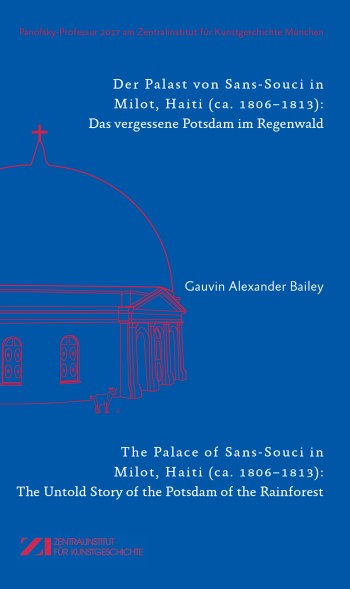 One of the most mysterious buildings in the Western hemisphere, King Henri Christophe’s lavish neoclassical palace in the rain forest, enthrones the small Haitian town of Milot. Begun less than a decade after the Haitian Revolution for independence (1804) by the first black African king in the Americas, this massive monument was built to showcase Haiti’s power and self-confidence. Despite its status as UNESCO World Heritage and a tourist attraction, the unusual building has never before been the subject of a study. On the basis of unpublished archival sources and exact photographic documentation, this book is the first to publish detailed information about the genesis this extraordinary architecture and the story of its builder.
Gauvin Alexander Bailey is professor and Alfred and Isabel Bader Chair in Southern Baroque Art at Queen’s University.
Exhibition | Biting Wit and Brazen Folly: British Satirical Prints
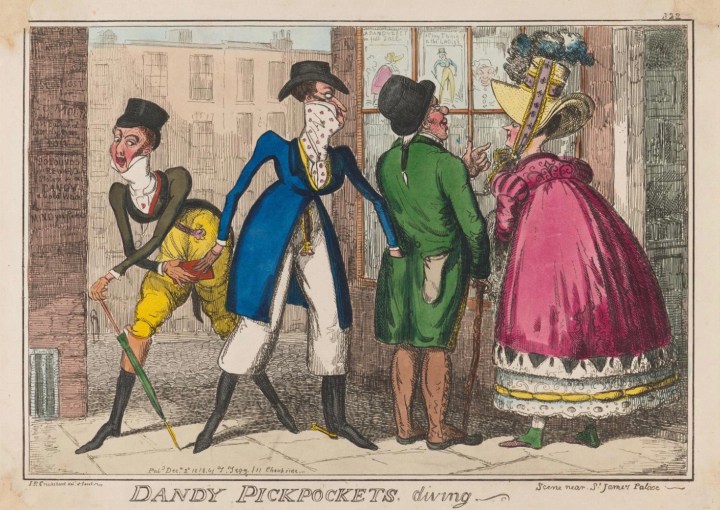
Isaac Robert Cruikshank, Dandy Pickpockets, Diving, 1818 hand-colored etching
(Philadelphia Museum of Art, 1974-179-250)
◊ ◊ ◊ ◊ ◊
Now on view in Philadelphia:
Biting Wit and Brazen Folly: British Satirical Prints, 1780s–1830s
Philadelphia Museum of Art, 4 May — 22 August 2018
Printed satirical caricatures were inescapable in London during the 1700s and 1800s. Often lighthearted and cheeky upon first glance, the images could also be mulled over and picked apart at leisure. A bawdy scene or grotesque facial expression instantly amused, while closer study revealed deeper literary or political references. Whether a fashionable dandy or a poor chimney sweep, no one escaped the scrutiny of caricaturists. This exhibition reveals the widespread appeal of caricature in Georgian England and demonstrates the ways in which such images teased and provoked audiences. Featuring over sixty brightly colored etchings from the Museum’s large collection of British satirical prints, it presents images of the everyday with a riot of color and a roar of laughter.
Browse all the works in the exhibition»
Life in London
London in the late 1700s and early 1800s was a chaotic place marked by social upheaval. People of every class—from the chimney sweep to the Duke of Wellington—witnessed dramatic changes all around them. Their struggles and triumphs did not escape the sharp eye of caricaturists, who were quick to distill their follies and successes into humorous yet arresting images.
Fashion Foibles
In the 1700s and 1800s, innovations in British textile production, along with increased travel between England and France, contributed to a boom in new fashions for both men and women. Caricaturists delighted in exaggerating trendy cinched waists, high collars, and big beards and lampooning the blind following of these fads. In their images, dresses become impossibly large, elaborate headpieces swallow the wearer, and common sense is thrown by the wayside in pursuit of youth and beauty.
Fiendish Ailments & Dubious Doctors
Health and hygiene in London in the late 1700s and early 1800s were dismal. In a city lacking effective medicine and an adequate sewage system, disease was rampant. Because illness was a devastating reality for all classes, it became a fitting subject for satirical artists. Caricatures confronted the corruption of quack doctors and the public’s obsession with cure-all potions. They also made light of common illnesses like gout and colic while showing the darker side of living under physical and mental distress.
Exhibition | Disappear Here: On Perspective
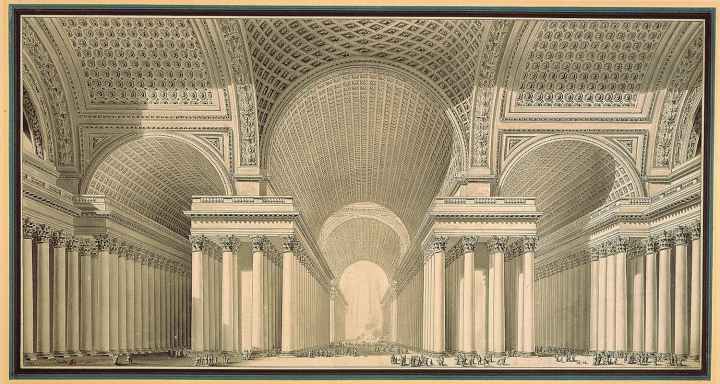
Étienne-Louis Boullée, Project for a Metropolitan Cathedral in the Form of a Greek Cross with a Domed Centre, 1782
(London: RIBA Collections)
◊ ◊ ◊ ◊ ◊
Now on view at RIBA:
Disappear Here
On Perspective and Other Kinds of Space: A Commission by Sam Jacob Studio
RIBA, London, 2 May – 7 October 2018
Proportion, distortion, geometry, distance, power, the infinite, the divine—perspective traverses truth and illusion, linking the disciplines of art, architecture, and mathematics. For this new exhibition, sponsored by Arper and Colt, RIBA has commissioned Sam Jacob Studio to explore how perspective drawing has been applied to the art of building for centuries and used as a tool to evoke illusory architectural spaces.
The Disappear Here installation will include original drawings and early writings by some of the most talented designers in history. Visitors will become active participants within the space where deceptive murals, playful architectural structures, and a newly commissioned film will trace the lineage of perspective from the Renaissance to present day. In a further twist, the system of perspective will dictate how everything in the gallery is arranged.

Unknown designer, Design for a Ceiling with Columns and Coffered Arches, Italy, ca. 1700 (London: RIBA Collections).
Speaking about the commission, Sam Jacob: “Since its invention in the 15th century perspective has been a fundamental tool in the way we imagine space and design architecture. But perspective is also a kind of tyranny too, forcing its own logic onto the worlds we create. This commission gave us the opportunity to explore how perspective has not only been used to illustrate the world but also how it creates and organises the world. This continues the studio’s longstanding interest in how ways of drawing shape the architecture we create. For this installation we wanted to create a space where visitors can experience the essentially illusory nature of perspective and question the making and breaking of rules.”
Sam Jacob Studio was invited by RIBA to draw on RIBA’s historic collections for inspiration to create a site-specific installation. The Studio has selected a diverse range of items, from rare books dating back to the Renaissance to contemporary works. Highlights vary from John Smythson’s early 17th-century Jacobean designs to a colourful modern interior by Max Clendinning and from Sebastiano Serlio’s architectural treatise Seven Books of Architecture to Étienne-Louis Boullée’s intricately drawn perspectives of neo-classical buildings. Other original drawings on display include works by Andrea Palladio, Edwin Lutyens, and William Talman. Additional material on loan from Drawing Matter include modern works from the radical Italian architecture firm Superstudio, French-born American industrial designer Raymond Loewy, and British architect James Gowan.
The material on display represents some of the most distinguished examples of perspectival drawing, depicting vast imaginary spaces and imposing mega structures on a single sheet of paper. Alongside these textbook examples, the show will reveal imperfect versions: drawings that more easily reveal their constructed nature and provide an insight into the strategies employed to achieve an illusory space.
The perspectival system plays an important role in how the collection objects are shown. Spanning two walls in the gallery, the drawings are displayed according to their vanishing points and perspective lines. Geometrical shapes drawn from 16th-century publications, and modern era drawings are used to design new furniture and a quarter of a structural shape will in part be completed by three-sided mirrored panels, referencing the work of Robert Smithson.
To end the exhibition, the specially commissioned film takes the theme of perspective into a contemporary reality. Sam Jacobs Studio has worked with game developer Shedworks to devise an algorithm that places 50 deconstructed architectural assemblies, taken from various architectural treatises, within an endless moving grid. The film, with no beginning or end, challenges ideas around perspectives in a digital age and interrogates notions of space, infinity and vanishing points.
Exhibition | William Birch, Ingenious Artist
From The Library Company of Philadelphia:
William Birch, Ingenious Artist: His Life, His Philadelphia Views, and His Legacy
The Library Company of Philadelphia, 1 May — 19 October 2018
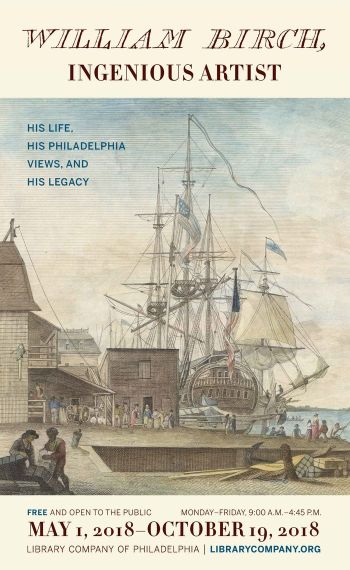 Through watercolors, enamels, manuscripts, books, and prints—some of which have never before been exhibited—we will explore the life and work of one of the most important artists of the Federal period, William Birch (1755–1834).
Birch established himself in London as a miniaturist and a graphic artist before immigrating to Philadelphia, where he published the first two American books of engraved views. The City of Philadelphia in the Year 1800 captures the spirit of the cultural and political capital of the new nation and remains a cornerstone of Philadelphia iconography. His second book, The Country Seats of the United States (1808), brought to America the ideal of the country house in a picturesque landscape, a vision that persists to this day. Join us as we explore Birch’s transatlantic career as an enamellist, landscape architect, and artist of the British and American scene.
◊ ◊ ◊ ◊ ◊
With a symposium scheduled for October:
William Birch and the Complexities of American Visual Culture
The Library Company of Philadelphia, 5 October 2018
“This country is new and flourishing. The mechanical arts are at their highest pitch, but the fine arts are of another complexion. They are the last polish of a refined nation… From an insignificant conceit of merit we have generally no knowledge of or feeling for, our imitations of nature, however beautiful, are mechanical altogether. But [these limitations] may be considered as the first lesson necessary for the fine arts… I do not profess myself a member of the fine arts; I am a copyist only, but from my knowledge of them [I] have been allowed judgment and taste, which is competent to give me a relish for them …” –William Birch
In celebration of the tenth anniversary of the establishment of the Visual Culture Program at the Library Company of Philadelphia (VCP), a one-day symposium on Friday, 5 October 2018 will explore the visual, cultural, and social themes elicited from the work of Philadelphia artist William Russell Birch (1755–1834). Inspired by the Library Company’s 2018 exhibition about Birch and his art, the symposium aims to promote discussions that reflect broadly on the continual resonance in American visual culture of the work of this premier enamel miniaturist, aspiring gentleman, and artist of the first American viewbooks.
While British-born Birch’s Views of Philadelphia (1798–1800) was enormously successful, his second, smaller plate book, The Country Seats of the United States (1808), in essence failed. Yet both—promoted through subscription—remain cornerstones of Philadelphia iconography and American visual culture and its complexities. Birch’s body of work includes some of the earliest American visual records of the new nation’s preeminent city as well as expressions of picturesque landscape crucial to 19th-century American makers of art. At the same time, his work evinces political and cultural propaganda, aesthetics of the ordinary and the everyday, and innovation in design.
Presentations are intended to foster broad and interdisciplinary discussions about the aesthetic, political, social, cultural, economic, material, and technological themes in Birch’s art, in his own time, and in the two centuries that followed. We will ask: What can be learned from works conceived and executed by a non-native artist parallel to constantly (and infinitely) evolving fields and definitions of art, and means of art production, distribution, and appreciation?
London History Day 2018 — 31 May 2018
From Historic England:
 London History Day 2018
31 May 2018
On Thursday 31 May 2018, more than 70 of London’s museums, galleries, and cultural spaces will open their doors to reveal special behind the scenes tours, rarely seen exhibits and one off events, celebrating the capital’s unique identity. 2018 is the year of courage, with many special events for London History Day touching on the pioneering spirit, heroism, initiative, and kindness layered in our history.
An example of programming as presented by the Mellon Centre:
Mark Hallett | The Suffering Soldier: Depictions of Courage in Eighteenth-Century British Art
Paul Mellon Centre, London, 31 May 2018, 12.30–14.00
The Paul Mellon Centre is taking part in London History Day by offering a special talk by the Director of the Centre, Mark Hallett. His lecture will focus on a few especially powerful examples of eighteenth-century British art to explore the ways in which artists dealt with, and depicted, the subject of courage. Mark Hallett, a leading authority on art in the Georgian period, will concentrate in particular on images of the heroic, tragic, and pitiful soldier, produced by artists as varied as John Singleton Copley, Benjamin West, and Joseph Wright of Derby. Doing so will reveal the very different ways in which courage could be conceptualised and represented during a century in which Britain was regularly at war. This talk is free and a light lunch is provided. Booking details are available here.










 Enfilade
leave a comment