Call for Articles | Fall 2019 Issue of J18: Self/Portrait
From J18:
Journal18, Issue #8 (Fall 2019) — Self/Portrait
Edited by Melissa Hyde and Hannah Williams
Proposals due by 21 September 2018; finished articles will be due by 7 April 2019
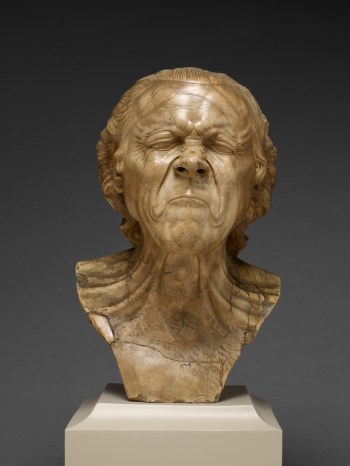
Franz Xaver Messerschmidt, The Vexed Man, 1771–83, alabaster, 39 × 27 × 26 cm (Los Angeles: The J. Paul Getty Museum).
This issue of Journal18 explores artworks, objects, spaces, performances and other visual or material productions that engaged with the self during the long eighteenth century. Rather than a study of ‘self-portraits’ per se, this issue is concerned with expanded definitions of both the ‘self’ and the ‘portrait’, seeking to deepen our sense of how self-expression, self-perception, and self-representation were understood in the long eighteenth century.
Enlightenment philosophy defined modern conceptions of the individual and the self. Not coincidentally, the eighteenth century was also a period in which representations of the self took on a new prominence in artistic practice, becoming sites of innovation and experimentation in a range of visual and material forms. Across the long eighteenth century, self-representation emerged as a crucial space for navigating the individual’s place in society, for pushing the boundaries of artistic convention, and for exploring perceptions of the corporeal self. As institutional restrictions on art were challenged, as new movements redefined who and what the artist was, and as a new emphasis on introspection and subjectivity developed, the eighteenth century witnessed a shift in the artist’s relationship with the self.
We invite proposals for articles that explore artistic engagements with the self in any media, from any cultural context, at any moment across the long eighteenth century. How was art used to explore the self? Beyond mere self-fashioning, how did eighteenth-century artists use portraits (in whatever shape or form) to interrogate, examine, relate, express and communicate? Outside of conventional self-portrayals, how did artists inscribe themselves in their works (e.g. through signatures or self-referential codings)? Of particular interest are proposals that explore unexpected modes or materials of self-portrayal (e.g. architectural self-portraits, porcelain self-portraits, or combinations of word and image) or that take up pertinent issues of methodology (e.g. questions of biography and its problematic place in art-historical writing).
Issue Editors
Melissa Hyde, University of Florida
Hannah Williams, Queen Mary University of London
Proposals for issue #8 Self/Portrait are now being accepted. Deadline for proposals: September 21, 2018. To submit a proposal, send an abstract (250 words) and brief biography to editor@journal18.org and mlhyde@ymail.com. Articles should not exceed 6000 words (including footnotes) and will be due on April 7, 2019. For further details see Information for Authors.
Exhibition | Woven Strands: The Art of Human Hair Work
The exhibition, now on view at The Mütter Museum, presents mainly nineteenth-century objects, though there are several striking eighteenth-century works, too; it’s a fascinating exploration of palette, table work, dissolving hair, and gimp techniques.
Woven Strands: The Art of Human Hair Work
The Mütter Museum, The College of Physicians of Philadelphia, 19 January — 16 September 2018
Curated by Emily Snedden Yates, John Whitenight, and Evan Michelson
 A favored folk art of the 18th and 19th centuries, hair art was a sentimental expression of grief and love, usually created by women whose identities have become anonymous over time. Human hair—from both living and deceased persons—was used to form flower bouquets, wreaths, braided jewelry chains, weeping willows, and painted scenes of mourning. Considered to be a form of portraiture, these were cherished tokens to preserve the memory of a deceased loved one, chart a vibrant family tree of the living, or to be traded as friendship keepsakes. It is rare to view such pieces publicly as they were created in domestic settings, for home display. Drawing from six private collections, the Mutter Museum together with John Whitenight and Evan Michelson has assembled an exquisite group of hair art and jewelry as well as accompanying materials that discuss the social expectations of Victorian-era mourning rituals that ruled 19th-century society with strict standards.
A Brief History of Hair Art as Seen in Woven Strands: The Art of Human Hair Work at the Mütter Museum (Philadelphia: Mütter Museum, 2018), 80 pages, $17.
New Book | Chippendale’s Classic Marquetry Revealed
From Jack Metcalfe’s website, Marquetry Matters:
Jack Metcalfe, Chippendale’s Classic Marquetry Revealed (CreateSpace Independent Publishing Platform, 2018), 304 pages, ISBN: 978-1720881131, $65.
 In this lavishly illustrated, wide-ranging volume, expert marqueteur Jack Metcalfe gives fascinating insights into all aspects of eighteenth-century marquetry, gained from close first-hand examination of Chippendale’s original pieces. Using his insider’s knowledge and skills as a practitioner, he investigates the materials, dyes, tools, and techniques used to create Chippendale’s polychromatic pieces. With its lively, engaging narrative and over 700 colour images, this book is essential reading for marqueteurs, cabinet makers, dyers, furniture historians, and anyone interested in the work of Britain’s supreme furniture maker, Thomas Chippendale.
Separate chapters cover:
• Materials and tools used in Chippendale’s time
• Techniques of eighteenth-century marquetry
• Dyes and dyeing techniques, including the scientific analysis of dyes used on Chippendale’s furniture
• Detailed step-by-step descriptions of the construction of three replica pieces by the author
• A detailed illustrated gallery of all the known marquetry commissions made by Thomas Chippendale.
With over 20 years’ experience as a marqueteur, Jack Metcalfe has devoted himself to uncovering and mastering the techniques of marquetry as practised by Chippendale’s skilled artisans in the eighteenth century. Using equipment, materials, dyes and techniques as close to the original as possible, Jack has created striking replicas of marquetry panels from Chippendale furniture, including the famous Diana and Minerva Commode. His careful research into the use of dyes, including ground-breaking scientific analysis of coloured veneers used, has enabled him to reveal the often startlingly fresh colours that Chippendale’s furniture would have displayed when first constructed.
Exhibition Chippendale: The Man and the Brand
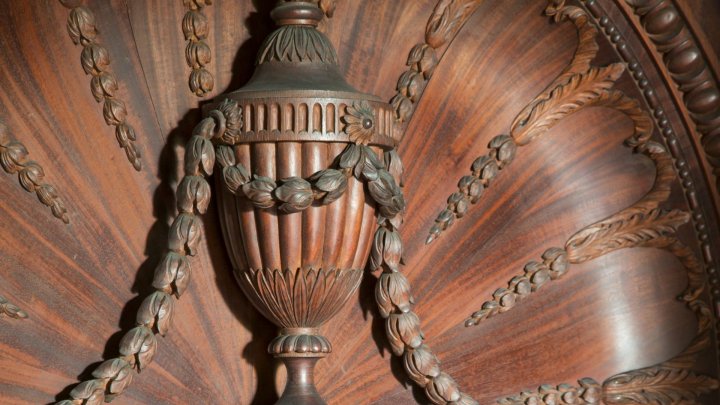
Chippendale firm, Medal Cabinet at Nostell.
◊ ◊ ◊ ◊ ◊
Now on view at Nostell in West, in conjunction with the Chippendale 300 partnership:
Chippendale: The Man and the Brand
Nostell, Wakefield, West Yorkshire, 2 May — 28 October 2018
Nostell is home to a world-class collection of over 100 items supplied by Chippendale and a unique archive of letters, providing an insight into the man behind the famous brand. Visit this new exhibition to discover how a humble cabinet-maker from Otley made a name that has lasted nearly 300 years.
Chippendale is celebrated today by many as the ‘Shakespeare of furniture’; however, he died in relative obscurity. Chippendale: The Man and the Brand tells the story of the 18th-century designer, furniture-maker, and entrepreneur, setting the scene for visitors explore the elaborate showrooms he helped create on Nostell’s first floor.
Born into a Yorkshire family of carpenters and joiners, Thomas Chippendale’s entrepreneurial spirit and talent led him to build a business in London’s St Martins Lane, supplying the 18th-century elite with the most fashionable domestic items. Chippendale’s brand was launched by the publication of The Gentleman and Cabinet-Maker’s Director in 1754, the most luxurious and comprehensive book of furniture designs yet created, covering the full range of objects that an aspiring house owner would want and in all of the on-trend styles of the day. Chippendale had cleverly seen a gap in the market and this must-have catalogue of designs proved a valuable marketing tool to build his business.
Chippendale didn’t just provide high-end design pieces for 18th-century showrooms, his firm also supplied less glamorous items to help with the running of the house. Visitors can explore the full range of products and services supplied for Nostell, from classic Chippendale chairs and elaborate cabinets to a mangle for the domestic quarters as well as dying old fabrics and fixing jammed doors.
Providing a full fit-out service to prestigious clients required a team of skilled employees and a wide range of specialist tools. In the exhibition, you’ll see a selection of 18th-century joiner’s tools from a spokeshave and mortice guage to a veneer hammer and cock bead plane, which were supplied by Christopher Gabriel & Sons, a leading London dealer. A selection of the letters, invoices, and drawings—normally looked after by the West Yorkshire Archives—will also be on display, allowing visitors to discover the challenging relationship Chippendale had with his client, Rowland Winn, including arguments over faulty goods and late payments.
Exhibition | Celebrating 300 Years of Thomas Chippendale
From the Chippendale 300 website:
Celebrating 300 Years of Thomas Chippendale
Nostell, Wakefield, 13 July — 28 October 2018
The Hepworth Wakefield, until 25 February 2019
 To celebrate the 300th anniversary of the birth of Thomas Chippendale, the Hepworth Wakefield in West Yorkshire is working with one of the finest treasure houses in the North of England: Nostell, a National Trust house with over 100 pieces of Chippendale furniture. The role of artists in influencing interiors will be explored through key loans from both collections and special commissions by contemporary artists. Visitors will see modern and contemporary artworks in Nostell’s historic rooms and the most fashionable furniture of the 18th century within the 21st-century gallery spaces of The Hepworth Wakefield. Contemporary responses will be on display at Nostell until 28th October and at The Hepworth Wakefield until 25th February 2019.
Exhibition | From Tiepolo to Canaletto and Guardi
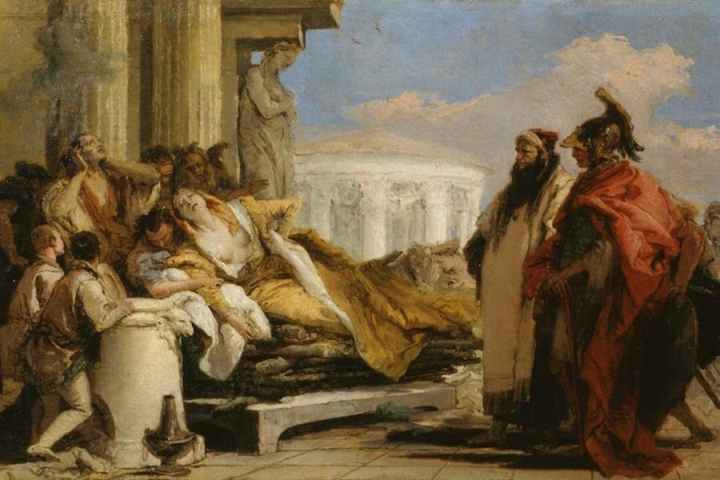
Giambattista Tiepolo, The Death of Dido, detail, 1729
(Moscow: The Pushkin State Museum of Fine Arts)
◊ ◊ ◊ ◊ ◊
Now on view at The Pushkin State Museum of Fine Arts:
From Tiepolo to Canaletto and Guardi
The Pushkin State Museum of Fine Arts, Moscow, 24 July — 14 October 2018
Palazzo Chiericati and Palazzo Leoni Montanari, Vicenza, 23 November 2018 — 10 March 2019
Curated by Victoria Markova and Giovanni Villa
With the exhibition From Tiepolo to Canaletto and Guardi, the Pushkin State Museum of Fine Arts proudly presents paintings by eighteenth-century Venetian masters from the collections of the Museo Civico di Palazzo Chiericati in Vicenza (23 pieces), the Intesa Sanpaolo Collection – Gallerie d’Italia, Palazzo Leoni Montanari in Vicenza (9 pieces), and The Pushkin State Museum of Fine Arts, Moscow (25 pieces). These works of art are shown for the first time together in one space, enabling visitors to see for themselves the full range of Venetian rococo paintings. Artworks on display are by outstanding Italian painters such as Giambattista Tiepolo, Giovanni Battista Pittoni, Luca Carlevarijs, Giovanni Battista Piazzetta, Giovanni Antonio Canal (Canaletto), Francesco Guardi, and Pietro Longhi.
Curators: Victoria E. Markova, Chief Researcher of the Pushkin State Museum of Fine Arts, Custodian of Italian paintings; Giovanni C. F. Villa, Director Emeritus of Vicenza’s civic museums.
◊ ◊ ◊ ◊ ◊
Note (added 13 January 2019)— The posting was updated to include Vicenza as a venue; more information is available here. There, the exhibition is entitled The Triumph of Color: From Tiepolo to Canaletto and Guardi.
Exhibition | Prints of Darkness: Goya and Hogarth

Left: Francisco José de Goya y Lucientes, Bobalicón (Silly Idiot), detail, 1864 (Manchester Art Gallery). Right: William Hogarth, The Enraged Musician, detail, 1741 (The Whitworth, The University of Manchester).
◊ ◊ ◊ ◊ ◊
Now on view at The Whitworth:
Prints of Darkness: Goya and Hogarth in a Time of European Turmoil
The Whitworth, The University of Manchester, 7 July 2018 — August 2019
Curated by Gillian Forrester
Francisco José de Goya y Lucientes (1746–1828) and William Hogarth (1697–1764) were the most remarkable artists of their times. Both were extremely successful portrait and history painters, but arguably their most compelling works were the uncommissioned prints they made with dazzling technical virtuosity, using line-engraving (Hogarth) and a combination of etching and aquatint (Goya). Whilst the artists were not working contemporaneously—Hogarth was fifty years old when Goya was born and died twenty years later—and never met, Goya was almost certainly familiar with Hogarth’s prints, and there are strong affinities between their works. Hogarth and Goya were both outsiders who cast their candid gazes on their dysfunctional societies. Poverty, homelessness, warfare, violence, cruelty, sexual abuse and human trafficking, social inequity, political corruption, racism, superstition, hypocrisy, rampant materialism, nationalism, mental illness, and alcoholism: all were subjected to their forensic scrutiny and no topic was off-limits. Simultaneously attractive and repellent, these challenging prints provoke a spectrum of responses, including shock, discomfort, laughter, and empathy, raising profound questions about the ethics of representation and viewing. The scenarios that they unflinchingly depicted are troublingly familiar to the contemporary viewer, eliciting an embarrassed contemplation of their own society, and themselves.
This exhibition features 100 prints by Goya and Hogarth, selected from the stellar collections at the Whitworth and Manchester Art Gallery. Although both artists are celebrated and represented in museum collections throughout the world, this is the first exhibition to consider Hogarth and Goya in tandem, providing an opportunity to compare their extraordinary graphic work. The exhibition will feature 50 prints by Hogarth, all drawn from the Whitworth’s collection. Bookended by the South Sea Bubble and his final print, the Bathos, which he published the year he died, the selection includes the serial works—The Rake’s Progress, Marriage a-la Mode, the Times of the Day, and the Four Stages of Cruelty—as well as single prints, including his emblems of British national identity, O The Roast Beef of Old England (Calais Gate) and the Enraged Musician. A fine impression of the engraving of Hogarth’s self-portrait with his pug, Trump, has been lent by Andrew Edmunds. Drinking culture was a pervasive theme in Hogarth’s work, and Gin Lane, Beer Street, and A Midnight Modern Conversation will be included, accompanied by a Hogarth-themed punchbowl made in Liverpool in 1748. The exhibition will feature 50 prints by Goya, including impressions from all the four series, as well as two etchings made early in his career in 1778, Margaret of Austria and Moenippus Menipo Filosofo.
The exhibition is timely, as it takes place during the troubled run-up to Britain’s exit from the European Union, scheduled for 29 March 2019, and the accompanying fractious debates currently taking place in Europe and elsewhere regarding national identity. Hogarth and Goya both lived through extended periods of warfare with France, and Hogarth claimed to hate the French, although he was a frequent visitor to Paris and hired French engravers for his print series Marriage a-la Mode. Angry, troubled, and ambivalent, Hogarth seems to embody the tortured mind-set of Britain on the eve of Brexit.
The exhibition is organized by Gillian Forrester, Senior Curator of Historic Fine Art at the Whitworth.
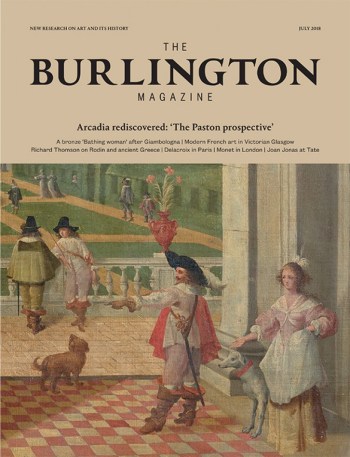
The Burlington Magazine, July 2018
The eighteenth century in The Burlington:
The Burlington Magazine 160 (July 2018)
 E D I T O R I A L
• Michael Hall, “At the Royal Academy of Arts,” p. 535. This is the Royal Academy’s year. The venerable London institution has celebrated its 250th anniversary by unveiling a redevelopment that has added seventy per cent more public space, staging a Summer Exhibition that has garnered five-star reviews, mounting an exhibition, The Great Spectacle, which traces the history of the annual exhibition since its inception in 1768, and publishing a monumental multi-author history of itself and its collections. . . .
A R T I C L E S
• Dorothea Diemer and Linda Hinners, “‘Gerhardt Meyer Made Me in Stockholm’: A Bronze ‘Bathing Woman’ after Giambologna,” pp. 545–53. Spurred by rivalry with French founders working for the Swedish Crown, in 1697 Gerhardt Meyer the Elder cast a bronze figure of a nude woman after a marble by Giambologna that had been in Sweden since 1632. It is inscribed ‘Me fecit Gerhardt Meyer Holmiae’.
R E V I E W S
• Laurel O. Peterson, Review of the exhibition Visitors to Versailles, 1682–1789 (Château de Versailles, 2017–18; The Metropolitan Museum of Art, 2018), pp. 582–84.
• Louis Cellauro and Gilbert Richaud, Review of the exhibition Jacques-François Blondel: An Enlightenment Architect in Metz (The Arsenal, Metz, 2018), pp. 584–86.
• Paul Taylor, Review of Susanna Berger, The Art of Philosophy: Visual Thinking in Europe from the Late Renaissance to the Early Enlightenment (Princeton University Press, 2017), pp. 606–07.
• Gauvin Alexander Bailey, Review of the exhibition catalogue, Ilona Katzew, ed., Painted in Mexico / Pintado en México, 1700–1790: Pinxit Mexici (Prestel, 2017), pp. 607–08.
• Sophie Littlewood, Review of Donald J. La Rocca, How to Read European Armor (Metropolitan Museum of Art and Yale University Press, 2017), p. 613.
O B I T U A R I E S
• Andrew Wilton, Obituary of Malcolm Cormack (1935–2018), p. 617. When the Yale Center for British Art, New Haven, opened in 1977, Malcolm Cormack was its first Curator of Paintings. At Yale, and subsequently at the Virginia Museum of Fine Arts, he staged influential exhibitions on subjects ranging from William Blake to the Camden Town Group.
New Book | St Paul’s outside the Walls
From Cambridge UP:
Nicola Camerlenghi, St Paul’s outside the Walls: A Roman Basilica, from Antiquity to the Modern Era (Cambridge: Cambridge University Press, 2018), 350 pages, ISBN: 9781108429511, $125.
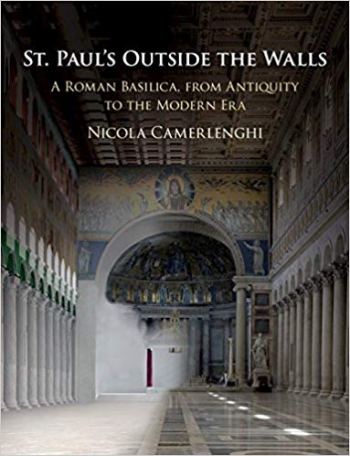 This volume examines one of Rome’s most influential churches: the principal basilica dedicated to St Paul. Nicola Camerlenghi traces nearly two thousand years of physical transformations to the church, from before its construction in the fourth century, to its reconstruction following a fire in 1823. By recounting this long history, he restores the building to its rightful place as a central, active participant in epochal political and religious shifts in Rome and across Christendom, as well as a protagonist in western art and architectural history. Camerlenghi also examines how buildings in general trigger memories and anchor meaning, and how and why buildings endure, evolve and remain relevant in cultural contexts far removed from the moment of their inception. At its core, Saint Paul exemplifies the concept of building as process, not product: a process deeply interlinked with religion, institutions, history, cultural memory and the arts. This study also includes state-of-the-art digital reconstructions synthesizing a wealth of historical evidence to visualize and analyze the earlier (now lost) stages of the building’s history, offering glimpses into heretofore unexamined parts of its long, rich life.
Nicola Camerlenghi is Assistant Professor of Art History at Dartmouth College, New Hampshire. A native of Italy and Switzerland, he has been a fellow at the Bibliotheca Hertziana and the Swiss Institute in Rome. His collaborative projects in the Digital Humanities have been awarded grants from the Kress Foundation.
C O N T E N T S
1 Paul’s Place in Rome: Tomb, Trophy, and the Basilica of the Constantinian Dynasty, ca. 67–386
2 The Basilica of the Theodosian Dynasty, 386–410
3 The Early Transformations, 410–700
4 A Fortress of Faith during the Heart of the Middle Ages, 700–1050
5 The Advent, Apogee, and End of St Paul’s Golden Age, 1050–1423
6 Rebirth and Modernization, 1423–1655
7 Restoring and Reconstructing St Paul’s during the Long Eighteenth Century, 1655–1823
Epilogue: The Basilica Is Dead, Long Live the Basilica!
Appendix A Reconciling the Evidence and Making the Model
Appendix B Carolingian-era Patronage
Exhibition | Herculaneum and Pompeii: Visions of a Discovery
Exhibition formerly in Chiasso, now on view at the National Archaeological Museum in Naples (MANN):
Herculaneum and Pompeii: Visions of a Discovery
m.a.x. Museum, Chiasso, Switzerland, 25 February — 6 May 2018
Museo Archeologico Nazionale di Napoli, 28 June — 30 September 2018
Curated by Pietro Giovanni Guzzo, Maria Rosaria Esposito, and Nicoletta Ossanna Cavadini
 The 280th anniversary of the discovery of Herculaneum and the 270th anniversary of that of Pompeii are here celebrated with a completely original approach, by exploring the media and the methods with which the discoveries of the two sites were communicated through the visionary expressions of those who immediately intuited the implications of the discoveries and sought to promote the progress of the excavations and research into them. From the late eighteenth century to the early twentieth, from Goethe to Stendhal, William Gell, Giovanni Battista and Francesco Piranesi, and many drafters, engravers, and lovers of antiquity down to the Alinari brothers, this is an account of the passion for the excavations and precious archaeological finds and the desire to make known the discoveries through letters, hand-coloured sketchbooks, engravings, lithographs, drawings, reliefs, copperplates and gouaches, the first postcards, and daguerreotype photographs.
Pietro Giovanni Guzzo, et al., Ercolano e Pompei: Visioni di una scoperta / Herculaneum and Pompeii: Visions of a Discovery (Milan: Skira, 2018), 392 pages, ISBN: 978-8857238630 (Italian-English text), €38 / $68.










 Enfilade
leave a comment