Exhibition | Shockingly Mad: Henry Fuseli
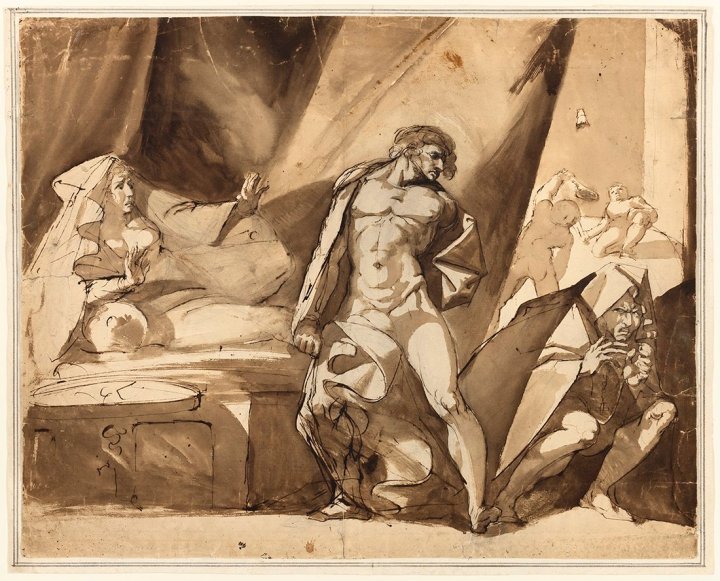
Henry Fuseli, The Discovery, 1767/69, pen and brown ink and brush and brown wash, over graphite with traces of opaque brown paint, on cream laid paper, tipped onto ivory laid paper, 53 × 66 cm (Art Institute of Chicago, 1956.33). From the AIC notes, “This powerful drawing—a bravura exercise in virtuoso line and tonal washes—illustrates a story from Swiss theologian Ludwig Lavater’s book De Spectris (On Ghosts), published in 1569. It describes a priest who, dressed in a sheet, haunts his wealthy niece who is living in his house, in an attempt to rape her and cheat her of her fortune. Terrified, the niece enlists the aid of a friend who exposes the repentant priest. The curious badminton match visible in the background—not in the story, but added by Fuseli as a critical commentary—is a reference to a proverb composed in Latin by the Dutch poet Jacob Cats (1577–1660): ‘Amor ut pila vices exiget’, ‘Love, like a ball, demands reciprocation’.”
◊ ◊ ◊ ◊ ◊
From the AIC:
Shockingly Mad: Henry Fuseli and the Art of Drawing
Art Institute of Chicago, 18 November 2017 — 1 April 2018
Curated by Kevin Salatino
A witness to political revolutions and radical aesthetic shifts, Henry Fuseli (1741–1825) forged a pictorial sensibility of his own, characterized by anatomical, gestural, and psychological extremes. Bizarre, exaggerated, theatrical, and often melodramatic, his drawings embraced obscure literary and historical subjects intended to elicit profound emotional response.
Fuseli was born in Switzerland but traveled to Germany and Italy early in his career, eventually settling in London, where he played a prominent role in the newly established Royal Academy. While he worked in various media, Fuseli excelled at drawing. This medium was central to his practice, evidenced by the extraordinary number of drawings he made—ranging from quick sketches to watercolors that often exceeded the ambitions of his oil paintings.
The Art Institute is home to a remarkably rich collection of Fuseli’s surviving works, including large-scale drawings; smaller, less-finished sketches; and significant paintings and prints. Shockingly Mad: Henry Fuseli and the Art of Drawing considers drawing as an expressive means unto itself, paralleling the broader arc of Fuseli’s career as writer, painter, critic, and teacher. As comparisons to the work of his contemporaries reveal, Fuseli can be said to have forged a radical new drawing style. With roots in Classical antiquity and Renaissance Italy, Fuseli’s passionate, unrestrained approach reflects the revolutionary spirit of his age, which was marked by social and political upheaval. The Art Institute’s holdings are complemented by a number of important local, national, and international loans, and the exhibition itself is accompanied by the adjacent installation Gods and (Super)heroes: Drawing in an Age of Revolution—a selection of drawings by Jacques-Louis David, Théodore Géricault, Francisco Goya, and others that further contextualizes Fuseli as a draftsman.
Lecture Series | Thinking about Exhibitions
This spring’s public lecture course at the Mellon Centre:
Thinking about Exhibitions: Interpretation, Reconstruction, and Curation
Paul Mellon Centre for Studies in British Art, London, Thursdays, 8 March — 12 April 2018 (excluding 29 March)
This five-part lecture course explores an exciting behind-the-scenes look at the research, writing, borrowing, design, and installation processes involved in putting on a major exhibition. Thinking about Exhibitions will use as case studies exhibitions held at major institutions around the world. Viewers can watch the lectures live on our Livestream page. Videos of the lectures will then be made available on our website 24 hours after the lecture.
8 March 2018
Mark Hallett | Looking Back: Three Eighteenth-Century Exhibitions
15 March 2018
Mark Hallett and Christine Riding | Looking Back: Hogarth, 2006–07 (Paris: Musée du Louvre; London: Tate Britain; and Barcelona: Caixa Forum)
22 March 2018
Mark Hallett and Sarah Victoria Turner | Looking Forward: The Great Spectacle: 250 Years of the Summer Exhibition, 2018 (London: Royal Academy)
5 April 2018
Mark Hallett and George Shaw | Looking Forward: George Shaw: A Corner of a Foreign Field, 2018–19 (New Haven: Yale Center for British Art; and Bath: Holburne Museum)
12 April 2018
Looking Back: Curating and Scholarship
The syllabus is available here»
Week One features our Director of Studies, Mark Hallett, discussing the history of exhibitions in Britain and reconstructs three eighteenth-century exhibitions.
Call for Papers | HECAA Session at UAAC, 2018
Thanks to Christina Smylitopoulos, who is again coordinating a HECAA session at this year’s UAAC Conference! Details and a full list of panels (68 in all) are available here»
◊ ◊ ◊ ◊ ◊
Universities Art Association of Canada / l’association d’art des universités du Canada
Department of Fine Arts, University of Waterloo, Ontario, 25–27 October 2018
Proposals due by 1 May 2018

Photo: Wikimedia Commons, Jason Paris, November 2011.
HECAA Open Session
The objective of this society is to stimulate, foster, and disseminate knowledge of all aspects of visual culture in the long eighteenth century. This HECAA open session welcomes papers that examine any aspect of art and visual culture from the 1680s to the 1830s. Special consideration will be given to proposals that demonstrate theoretical or methodological innovations. Please email proposals for 20-minute papers (300 words) and a short biography (150 words) to Dr. Christina Smylitopoulos (University of Guelph), csmylito@uoguelph.ca.
Digital History | Fashion History Timeline
From the Fashion History Timeline, a project by FIT’s History of Art Department:

◊ ◊ ◊ ◊ ◊
The Fashion History Timeline is an open-access source for fashion history knowledge, featuring objects and artworks from over a hundred museums and libraries that span the globe. The Timeline website offers well-researched, accessibly written entries on specific artworks, garments and films for those interested in fashion and dress history. Started as a pilot project by Fashion Institute of Technology art history faculty and students in the Fall of 2015, the Timeline aims to be an important contribution to public knowledge of the history of fashion and to serve as a constantly growing and evolving resource not only for students and faculty, but also for the wider world of those interested in fashion and dress history–from the Renaissance scholar to the simply curious.


Tomasso Brothers Fine Art at TEFAF 2018
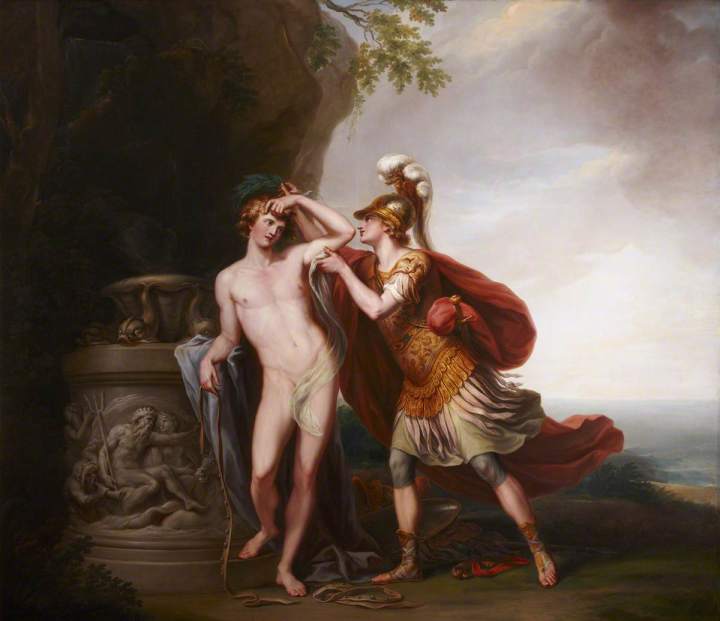
Giovanni Battista Cipriani, Castor and Pollux, 1783, oil on canvas, 275 × 316cm.
◊ ◊ ◊ ◊ ◊
Tomasso Brothers Fine Art at TEFAF
Maastricht, 8–18 March 2018
Tomasso Brothers Fine Art is pleased to report a number of significant sales at the TEFAF early access day, 8 March 2018, including a large oil on canvas by Giovanni Battista Cipriani (1727–1785) depicting Castor and Pollux that sold to a private collector within moments of the Fair’s opening. The asking price was in the region of 425,000€. This impressive neoclassical work was commissioned in 1783 by George Walpole, 3rd Earl of Orford for the Saloon at Houghton Hall along with two further mythological scenes. It remained in situ at Houghton until well in to the 20th century when it was purchased by The Rt. Hon. John Armar Lowry-Corry, 8th Earl Belmore of Castle Coole, Enniskillen and placed on public display.
The gallery also made an important sale to a new buyer, a private European collector, of a pair of monumental marble lion groups attributed to Giovanni Battista Foggini (1652–1725) and his workshop. Depicting a lion attacking a horse and a lion attacking a bull, the pair was offered for a price in the region of 1.75 million€.

Equestrian Monument of Emperor Marcus Aurelius, marble, after the antique bronze now in the Musei Capitolini (Rome, 18th century).
The works featured by Tomasso Brothers Fine Art at this year’s TEFAF Maastricht are inspired by Rome and classical Italy, dating from the ancient to the neoclassical. Other highlights include:
• The Forbes of Pitsligo Vases in white marble with corresponding plinths, attributed to Lorenzo Bartolini (1777–1850) made in Florence, ca. 1815–1830.
• An imposing Equestrian Monument of Emperor Marcus Aurelius in statuary marble, after the antique bronze now in the Musei Capitolini (Rome, 18th century).
• An exquisite Carrara marble sculpture by Cav. Emanuele Caroni (1826–after 1895) L’Amour Vainqueur de la Force, The Triumph of Love over Strength (Florence, ca. 1867).
Tomasso Brothers’ stand features original wallpaper designed by the gallery in-house. The design was inspired by the roman painted walls discovered in the region of the Bay of Naples, but perhaps most specifically, by a particular wall originating from the Villa di Agrippa Postumus at Boscotrecase (ca. 1st century BC – 1st century AD), which was painted in the ‘Third’ or ‘Ornate’ style of ancient wall fresco design, that flourished during the reign of Augustus. The idea of placing old master paintings and sculptures within a beautiful decorative scheme inspired by discoveries made at Pompeii and Herculaneum is essentially neoclassical in spirit, following the tradition established by the great architects and interior designers of the eighteenth century such as James ‘Athenian’ Stuart (1713–1788) for Spencer House, London (1759); Robert Adam (1728–1792) perhaps most notably at London’s Kenwood House, Osterley Park and Syon House; Joseph Bonomi (1739–1808) for Packington Hall, Warwickshire; and Sir John Soane (1753–1837) for the ‘Council Chamber’ at London’s Guildhall (1777).
Time to Renew Your Membership
Here’s a friendly reminder that HECAA 2018 membership dues are now due! The annual membership runs from 1 March 2018 until 28 February 2019. There are terrific reasons for parting with $30 (or just $5 for students) to support the work of HECAA. The lion’s share of the money that we receive helps fund graduate students and junior scholars, and because HECAA is registered as a 501c3, all donations are tax deductible in the United States. As a member you’ll also be able to vote on officers and proposals that will shape the future of HECAA. So, send in a contribution of $100 or $5. We accept PayPal.
–Christina Lindeman
Call for Papers | CSECS 2018, Niagara Falls
While I rarely re-post Call for Papers, I would note with this year’s CSECS that the deadline has been moved to April 15. There’s still time! –CH
SAHGB Architectural History Workshop, 2018
The Society of Architectural Historians of Great Britain
Workshop for Doctoral Students and Early Career Scholars
The Gallery, London, 17 March 2018
The Society is pleased to announce the programme for this year’s Architectural History Workshop on Saturday 17 March 2018 at The Gallery, 70 Cowcross Street, London, EC1 6EL. This is our annual event for Postgraduate Students and Early Career Scholars, convened by the Society’s PhD Scholars, to share and develop their ideas through ‘lightning’ rounds, where contributors are invited to speak for ten minutes either as a short developed paper, discursive ramble, thematic exploration, or any format that explores and presents their PhD research.
The Workshop will also include a Careers in Architectural History Roundtable, featuring Ben Cowell, Director of the Historic Houses Association, and Neal Shasore, Leverhulme Early Career Fellow at Liverpool School of Architecture. The full programme and registration form can be found on our website. As places are limited, booking is essential. Register online until 10 March 2018.
New Book | Piranesi: Studies in Honor of John Wilton-Ely
As noted in Salon, the newsletter of the Society of Antiquaries of London, issue 402 (6 March 2018) . . .
On 31 January John Wilton-Ely FSA was presented with a festschrift at a ceremony at the Instituto Centrale per la Grafica, Palazzo Poli, Rome, in recognition of his services to scholarship on the life and works of Giovanni Battista Piranesi, FSA (elected 1757). The publication is volume 32 of the art historical journal, Studi sul Settecento Romano (Sapienza Università di Roma), entitled Giovanni Battista Piranesi, predecessori, contemporanei e successori: Studi in onore di John Wilton-Ely. The papers were formally delivered in 2016 at a special conference arranged by the Royal Swedish Academy in the Royal Palace at Stockholm, which contains a significant collection of Piranesi’s imaginatively restored classical antiquities, acquired by Gustav III from the artist’s former museo in Rome.
From Arbor Sapientiae:
Francesco Nevola, ed., Giovanni Battista Piranesi, Predecessori, contemporanei e successori: Studi in onore di John Wilton-Ely, Studi sul Settecento Romano, volume 32 (Rome: Sapienza Università di Roma, 2016), 400 pages, ISBN: 978-8871407432, 60€.
 • Francesco Nevola, John Wilton-Ely: Una vita con Piranesi
• Jörg Garms, Il rococò in Italia e la vicenda di Piranesi
• Lola Kantor-Kazovsky, On the Eve of the Graeco-Roman Controversy: Pierre Jean Mariette and Bouchardon’s Fountain of the Four Seasons
• Francesco Nevola, Giovanni Battista Piranesi’s Origins as a Vedutista: The impact of Canaletto and Bellotto
• Myra Nan Rosenfeld, Piranesi’s Grotteschi: A Visual Expression of the Literary Aims of the Accademia degli Arcadi
• Silvia Gavuzzo-Stewart, Irony in Piranesi’s Carceri and Lettere di Giustificazione
• Frank Salmon, Piranesi and the Accademia di San Luca in Rome
• Susanna Pasquali, Piranesi’s Campo Marzio as described in 1757
• Elisa Debenedetti, Piranesi, Marchionni e il mito di Diogene
• Mario Bevilacqua, Piranesi’s Ironies and the Egyptian and Etruscan Dreams of Margherita Gentili Boccapaduli
• Georg Kabierske, Vasi, urne, cinerarie, altari e candelabri: Newly Identified Drawings for Piranesi’s Antiquities and Sculptural Compositions at the Staatliche Kunsthalle Karlsruhe
• Heather Hyde Minor and John Pinto, ‘Marcher sur les traces de son père’: The Piranesi Enterprise between Rome and Paris
• Pier Luigi Panza, Il Museo Piranesi: Un censimento e osservazioni su attribuzioni, vendite e uso dei pezzi in architettura
• Raffaella Bosso, Per un catalogo dei marmi piranesiani del Museo Gustavo III di Stoccolma: Il caso di studio del candelabro con uccelli
• Alvar Gonzalez-Palacios, Il Nilo in bigio del Museo Gregoriano Egizio
• Anne-Marie Leander Touati, Piranesi’s Grande Cheminée, Virtually Recreated for John Wilton-Ely
• Cesare de Seta, Roma al tempo di Giovan Battista Piranesi e i suoi eredi nell’arte del paesaggio nel Settecento europeo
Indice dei nomi
Print Quarterly, March 2018

J. R. Smith after John Francis Rigaud, Group Portrait of Agostino Carlini, Fransescho Bartolozzi, Giovani Battista Cipriani, 1778, mezzotint, 44.4 × 504 cm (London: The British Museum).
◊ ◊ ◊ ◊ ◊
The eighteenth century in the current issue of Print Quarterly:
Print Quarterly 35.1 (March 2018)
 A R T I C L E S
• David Alexander, “A Cosmopolitan Engraver in London: Francesco Bartolozzi’s Studio, 1763–1802,” pp. 6–26.
S H O R T E R N O T I C E S
• Daan van Heesch, “The Graphic Source for Rajput Images of Fools,” pp. 50–53.
N O T E S A N D R E V I E W S
• Ellis Tinios, Review of the exhibition catalogue T. June Li and Suzanne Wright, Gardens, Art, and Commerce in Chinese Woodblock Prints (The Huntington Library, Art Collections, and Botanical Gardens, 2016), pp. 63–65.
• David Pullins, Review of W. McAllister Johnson, The Rise and Fall of the Fine Art Print in Eighteenth-Century France (University of Toronto Press, 2016), pp. 65–66.
• Naomi Lebens, Review of the exhibition catalogue The Royal Game of the Goose: 400 Years of Printed Board Games (Grolier Club, 2016), pp. 66–70.
• Brendan Cassidy, Note on William Woollett’s Ring, pp. 70–71.
• Ellis Tinios, Review of the exhibition catalogue A Third Gender: Beautiful Youths in Japanese Prints (Royal Ontario Museum, 2016), pp. 72–74.
• Martin Hopkinson, Review of Gill Saunders, Eclectic: The Julie and Robert Breckman Collections at the Victoria and Albert Museum (V&A Publishing, 2016), pp. 74–75.
• Jesusa Vega, Review of Juliet Wilson-Bareau and Leah Lehmbeck, Goya in the Norton Simon Museum (Norton Simon Museum, 2016), pp. 75–77.
• Mark McDonald, Review of Antonio G. Moreno Garrido, La Estampa de devoción en la España de los siglos XVIII y XIX (Editorial Universidad de Granada, 2015), pp. 77–78.
• Jean Michel Massing, Review of Juan Pimentel, The Rhinoceros and the Megatherium: An Essay in Natural History, translated by Peter Mason (Harvard University Press, 2017), pp. 78–79.
• Stephan Bann, Review of Antony Griffiths, The Print before Photography: An Introduction to European Printmaking, 1550–1820 (The British Museum Press, 2016), pp. 94–97.
• Bozena Anna Kowalczyk, Review of Michael Matile with Alberto Craievich and Isabelle Scheck, Della Grafica Veneziana: Das Zeitalter Anton Maria Zanettis (1680–1767) (Michael Imhof Verlag, 2016), pp. 98–101.










 Enfilade
leave a comment