New Book | Women and Transnational Cultural Exchange, 1550–1850
From Bloomsbury:
Brianna Robertson-Kirkland and Louise Duckling, eds., Women and Transnational Cultural Exchange, 1550–1850 (London: Bloomsbury Academic, 2026), 256 pages, ISBN: 978-1350512283, $115.
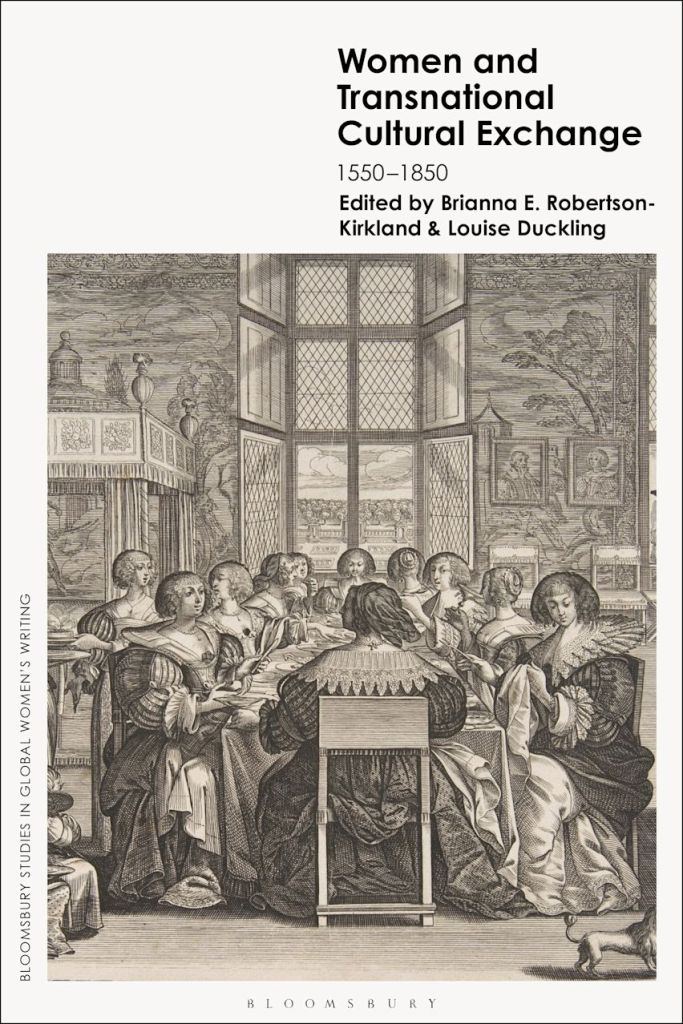 Focusing on the international circulation of culture and ideas by women in the early modern period through the long eighteenth century, this book amplifies their presence in history, finding new ways to explore their transnational encounters and exchanges. Providing a rich introduction to the topic of women’s transnational interactions, the essays build a diverse picture of female engagement with the wider world and consider how women interpreted, influenced, or transferred culture and ideas around the globe. Examining figures such as Aphra Behn, Charlotte Bonaparte, and Marie-Catherine d’Aulnoy, this book looks at novels, memoirs, poetry, translations, travel writing, and plays, as well as considering the ways in which women’s public lives have been ‘written’ in music, portraits, and printed images, and their roles in the international exchange of art and material culture.
Brianna E. Robertson-Kirkland is a Lecturer in Historical Musicology at the Royal Conservatoire of Scotland. Louise Duckling is an independent scholar based in the UK.
c o n t e n t s
List of Illustrations
Acknowledgements
Introduction — Brianna Robertson-Kirkland and Louise Duckling
Prologue | Power
Postcard 1 Queen Mary I and La Peregrina — Valerie Schutte
1 Maria Theresa and Catherine II: Women Rulers Transmitting Unexpected Gender Notions far beyond Their Realms — Ruth Dawson
Part 1 | Culture
Postcard 2 The 188-Page Letter-Memoir: Mary Anne Canning’s Life Writing as a Defense of Her Motherhood — Rachel Bynoth
2 Imagining England: Recovering Marie-Catherine d’Aulnoy’s Memoirs of the Court of England (1707) — Daisy Winter
3 The Racial Politics of the Chilean Family in Maria Graham’s Journal of a Residence in Chile (1824) — Valentina Aparicio
4 ‘Today, Two Vent’rous Females Spread the Sail’: The Presence of Female Travelers in the Works of Mariana Starke — Eva Lippold
Part 2 | Knowledge
Postcard 3 ‘A New World of Ideas’: Knowledge Exchange in Helen Maria Williams’s Translation of Alexander von Humboldt’s Personal Narrative (1814–29) — Louise Duckling
5 Madeleine de Scudéry, Aphra Behn, and Translation: Using the ‘Carte de Tendre’ for Cross-Channel Communication of Women’s Ideas — Amelia Mills
6 ‘Suns, wich to Some other Worlds Give Light’: Transnational Philosophies of the Universe in Margaret Cavendish’s Poems and Letters — Masuda Qureshi
7 Science, Art, and Knowledge: Nancy Anne Kingsbury Wollstonecraft and the Illustration of Cuban Flora — Elisa Garrido
Part 3 | Art
Postcard 4 Collecting Travel Memories: Charlotte Bonaparte’s Family Album — Arlene Leis
8 Aletheia Talbot and the Art of Italy: England’s First Female Collector — Breeze Barrington
9 Back through Time and beyond Britain: Revealing Polytheistic Imagination and British Imperial Resolve in Eleanor Coade’s Artificial Stone Products, 1769–1821 — Miriam al Jamil
Part 4 | Music
Postcard 5 Mrs Macglashan of Jamaica — Andrew Bull
10 ‘Quite Different from What It Is Abroad’: Elizabeth Wynne’s Musical Exchanges — Penelope Cave
11 The Murrays of Warrawang: Scots in Australia — Brianna Robertson-Kirkland
Epilogue
Postcard 6 Felicia Hemans, the Monument of Zalongo, and the ‘Dance’ of a Moment in History — Trijit Acharyya
Selected Bibliography
List of Contributors
Index
Exhibition | Seeds of Exchange
Now on view at the Garden Museum:
Seeds of Exchange: Canton and London in the 1700s
Garden Museum, London, 11 February — 10 May 2026
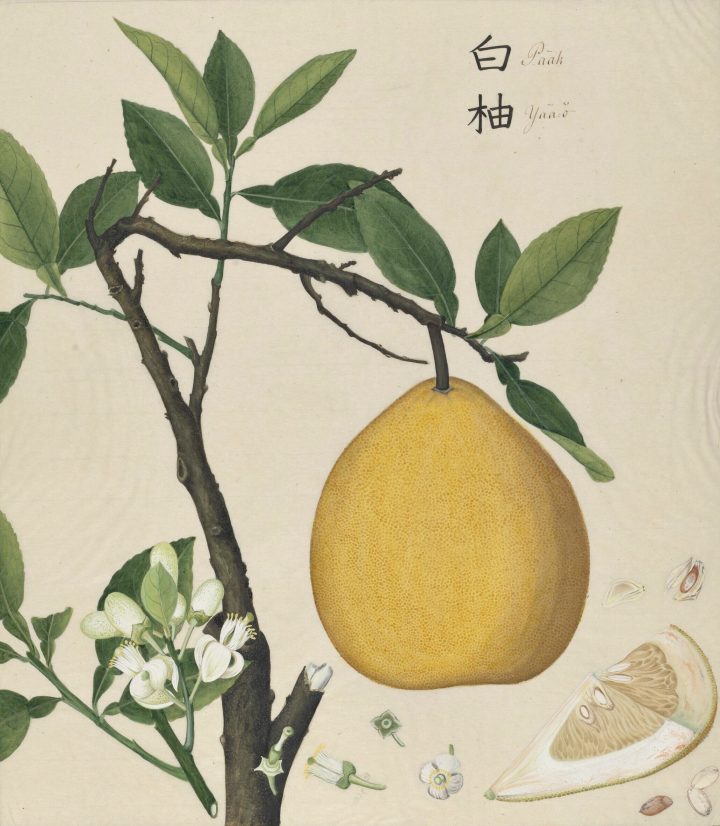
Mak Sau (Mauk-Sow-U) 麥秀, Citrus Maxima, 1771 (Upperville, VA: Oak Spring Garden Foundation).
Discover the relationship between John Bradby Blake (1745–1773), an English botanist who worked as a supercargo for the East India Company in the 1770s, his Chinese interlocutor Whang At Tong 黃遏東, and Mak Sau 麥秀, the botanical artist Bradby Blake commissioned to document plants native to Canton.
The exhibition explores the exchange of botanical knowledge shared between Canton (now Guangzhou) and London between 1766 and 1773, displaying a collection of Chinese botanical art and research for the first time in Britain since it was commissioned 235 years ago. Featuring 30 botanical paintings by the artist Mak Sau together with herbals, maps, models, a portrait of Whang At Tong by Sir Joshua Reynolds (1723–1792), and watercolours and drawings of Canton from the V&A, Seeds of Exchange tells the story of a little-known international botanical collaboration.
Bradby Blake worked in Canton in the late 1760s until his death in 1773, during which time he commissioned more than 150 botanical paintings of Chinese plants, the makings of an unfinished ‘Compleat Chinensis’. In his garden in Canton, he grew local plants such as Camellia japonica, Kumquat (Citrus japonica), and tangerines from seeds and cuttings, documenting and recording information about seed germination and growing conditions and sending seeds and plants to England. The exhibition brings together Bradby Blake’s archive of Chinese herbals and research material, reuniting the botanical paintings they inspired for the first time in 235 years.
The exhibition is produced in collaboration with the Oak Spring Garden Foundation in Virginia, where Bradby Blake’s archive is now held.
New Book | The China Question
From Cambridge UP:
Ho-fung Hung, The China Question: Eight Centuries of Fantasy and Fear (Cambridge: Cambridge University Press, 2026), 336 pages, ISBN: 978-1009559775, £30 / $40.
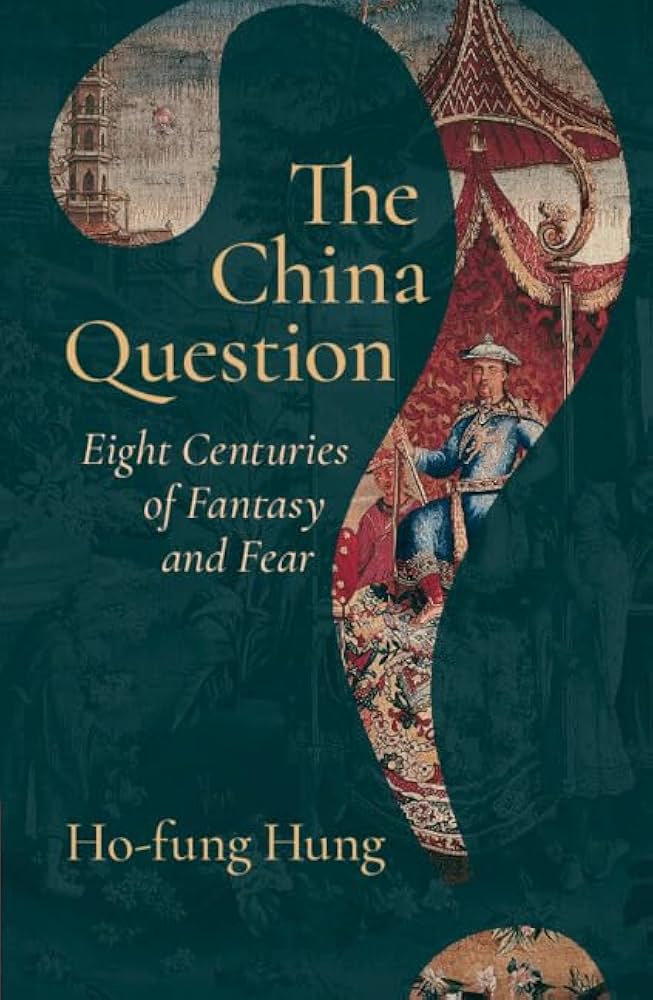 For centuries, Western scholars portrayed China either as a land of superior morality, economy, and governance or as a formidable country of pagans that posed a global threat to Western values. Idealized images of China were used to shame rulers for their incompetence, while China was demonized as an external threat to cover up domestic political failures. In the twentieth century, the geopolitics of global capitalism have facilitated more nuanced perspectives, but the diversifying of knowledge about China is far from complete. In this thought-provoking study, Ho-fung Hung finds that both Western elites and China’s authoritarian regime today continue to promote many Orientalist stereotypes to advance their economic interests and political projects. He shows how big-picture historical, social, and economic changes are inextricably linked to fluctuations in the realm of ideas. Only open debate can overcome extremes of fantasy and fear.
Ho-fung Hung is Henry M. and Elizabeth P. Wiesenfeld Professor in Political Economy in the Department of Sociology and Nitze School of Advanced International Studies, Johns Hopkins University.
c o n t e n t s
Figures
Preface
Introduction: Orientalism in the Longue Durée
I | Catholic Scholarship
1 From Pax Mongolica to the Long Sixteenth Century
2 The Seventeenth-Century Crisis and the Rise of Sinophilia
II | Enlightenment Philosophy
3 Early Enlightenment Sinophilia
4 Late Enlightenment Sinophobia
III | Institutionalized Orientalism
5 Romantic Sinology after the French Revolution
6 Scientific-Racist Sinology in the Age of Empire
IV | Cold War Area Studies
7 From Sinology to China Studies
8 The ‘Asiatic Mode of Production’ Myth
V | Self-Orientalism
9 Self-Orientalizing Nation Building
10 Contested Confucianism
Conclusion: De-Orientalizing Triumph, Re-Orientalizing Perils
References
Index
Exhibition | Philadelphia, China Trade, and the Making of America
From the press release (2 February 2026) for the exhibition . . .
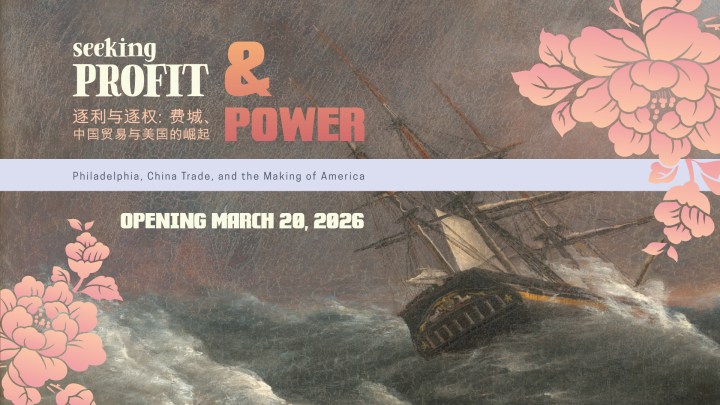
Seeking Profit and Power: Philadelphia, China Trade, and the Making of America
Independence Seaport Museum, Philadelphia, 20 March — 3 January 2028
Curated by Susan Gail Johnson and Brett Palfreyman
Eager to prove itself worthy of trading on the world stage as a newly formed nation 250 years ago, America—and especially Philadelphians—embarked on the risky venture of trading with China by entrusting private citizens with the work of establishing trade and diplomatic relationships with the Chinese. Merchants saw dramatic opportunities to make money, building some of the fortunes that helped expand Philadelphia’s role as a major port and city. To celebrate the country’s 250th anniversary, Independence Seaport Museum presents Seeking Profit and Power: Philadelphia, China Trade, and the Making of America, a new exhibition informed by the latest scholarship and featuring approximately 150 unique, rarely seen objects from its collection ranging from ship logs and cargo manifests to examples of rare Chinese export porcelain, Chinese silks and sample books, to portraits of American and Chinese merchants, some of which will be exhibited for the first time. Additionally, museums and private collections, including George Washington’s Mount Vernon, The Society of The Cincinnati, The Dietrich American Foundation, and Andalusia Historic House and Gardens have also loaned important objects for Seeking Profit and Power. While other institutions can tell different aspects of this story, ISM is uniquely positioned to share it through its mission and location on the Delaware River, where Philadelphia’s China trade vessels launched and their cargo was unloaded.
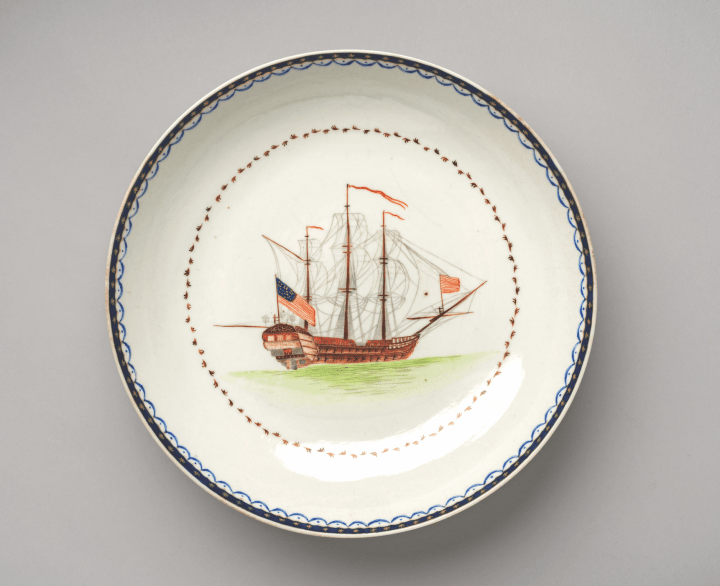
Bowl Depicting a Ship with American Flag, ca. 1790s, porcelain manufactured for the export market in Jingdezhen, decorated in Canton (Philadelphia: Independence Seaport Museum, acquired through exchange, courtesy of Friends of the Museum, 2023.038).
“This exhibition tells the story of a critical moment in the history of our nation,” said Peter Seibert, president and CEO of Independence Seaport Museum. “When the United States declared its independence from Great Britain, we also separated ourselves from the rules and regulations that governed overseas trade. As we came together as a nation 250 years ago, we also stepped out on the world’s stage for the first time. The ISM team, consisting not only of our curatorial, exhibition and education staff and an exceptional panel of outside scholars, have brought together an amazing assemblage of objects that tell the story of our look to the East as a new global trading power.”
Organized by guest curators Susan Gail Johnson and Brett Palfreyman, Seeking Profit and Power will explore five essential themes. “Making a Nation” focuses on why the United States opened direct trade with China. “Making it Work” illustrates the tremendous technical and logistical feat traveling the route from Philadelphia to China. “Making Money” shows the array of commodities the new nation could trade for sought-after Chinese tea, porcelain, and other goods. “Encountering Each Other” explains how the two cultures learned about one another through the goods that they traded. The final section, “The Old China Trade,” explores the end of the era and the place it still holds in American memory.
“Our goal for the exhibition is to show visitors that a teacup is more than just a teacup—it is an object that tells a story about sailing halfway around the world, America’s taste for luxury goods, and how the nation’s founders imagined that trade with China might help establish the newly independent nation as a player on the world stage,” said Susan Gail Johnson. “We hope visitors will never look at a teacup the same way again.”
The full press release with details about specific objects is available here»
Exhibition | The First Salute
From the press release for the exhibition:
The First Salute: An Untold Story of the American Revolution
Weitzman National Museum of American Jewish History, Philadelphia, 23 April 2026 — April 2027
Curated by Josh Perelman, with Jonathan Sarna, Pamela Nadell, and Laura Leibman
“Had it not been for… this infamous island, the American rebellion could not possibly have subsisted.”*
This landmark exhibition marking America’s 250th will take you on an adventure through America’s fight for freedom as you’ve never seen it before—where Jewish faith, courage, and persecution collided on the high seas to change the course of history. The First Salute: An Untold Story of the American Revolution is the first-ever major museum exhibition to explore the little-known story of a small group of Jewish merchants in the Caribbean whose outsized contributions to the cause of American Liberty tipped the scales in the fight for American Independence.
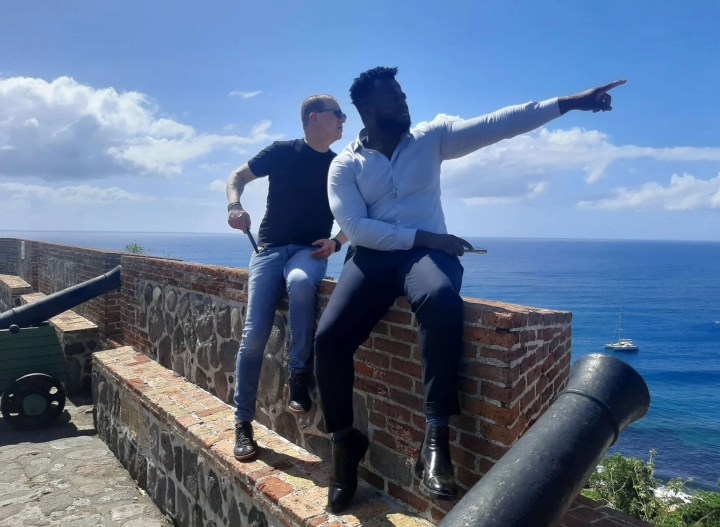
Exhibition curator Josh Perelman (left) with Heritage Inspector Raimie Richardson (right) on St. Eustatius (known locally as ‘Statia’) (Photo by Avida Linvy, November 2025).
The First Salute is the high-stakes, true story sparked by two key moments on the high seas that tipped the scales of the American Revolution and its founding principles. Set against the backdrop of the tiny Caribbean island of St. Eustatius, this riveting tale explores how religious liberty, Jewish trade merchants, and the cruelty toward the Jewish community by a debt-ridden British admiral converged at a pivotal time in world history, and impacted the trajectory of the Revolutionary War.
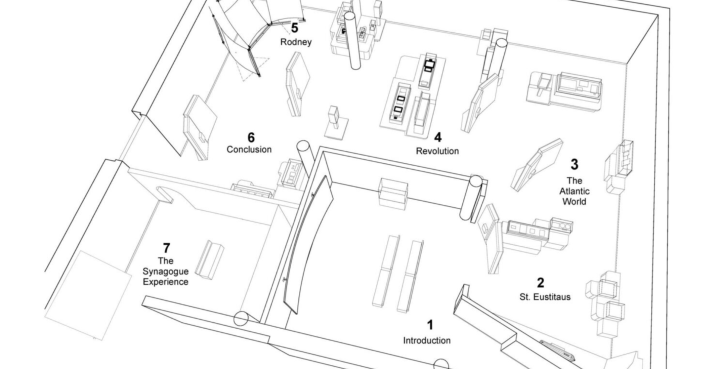
From Jewish expulsion from Spain and Portugal in the 15th century, to secret shipments of gunpowder disguised as tea by a network of Jewish merchants in the Caribbean in the 18th century, this tale of resilience, ingenuity, survival, and the promise of freedom still resonates today. This semiquincentennial exhibition features original films, rarely seen artifacts, storytelling, and an immersive video experience that situates visitors within three of the four original walls of St. Eustatius’s synagogue and Jewish cemetery that still stand today. The exhibition expands the understanding of the American Revolution by including the greater Atlantic World and illustrating the connections between North American and Caribbean Jewish communities, offering new insights into people and events that helped secure America’s independence.
 “The First Salute reminds us that America’s strength lies in its enduring commitment to religious liberty,” said Dan Tadmor, President and CEO of The Weitzman. “Two hundred and fifty years after America’s founding, this exhibition connects historical events to present-day challenges. We hope that visitors walk away considering the roles of faith, community, and discrimination — in both historical and contemporary contexts.”
The First Salute is made possible with financial assistance provided by the Commonwealth of Pennsylvania, Honorable Josh Shapiro, Governor; support from Lilly Endowment Inc. through its Religion and Cultural Institutions Initiative which propelled this exhibition’s development; and The Pew Center for Arts & Heritage. Additional funding has been provided by the Maimonides Fund, Mayor Cherelle L. Parker & the City of Philadelphia, America250PA, Betsy and Philip M. Darivoff, and other generous individuals.
The full press release is available here»
*Header quote: Admiral Sir George Rodney in a letter to Rear Admiral Sir Peter Parker in 1781 that “had it not been for that nest of vipers… this infamous island, the American rebellion could not possibly have subsisted.”
Installation | Tradition and Celebration across the Jewish Calendar
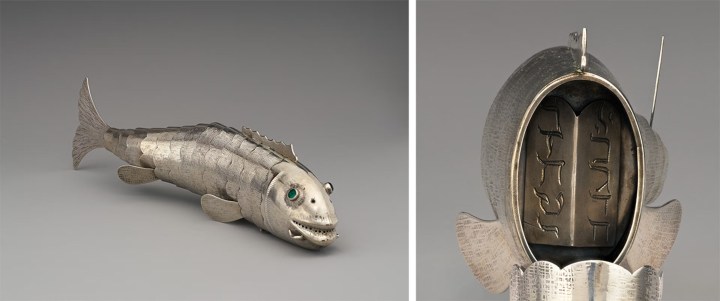
Fish-form Spice Container (Besamim), 1813, Vienna, silver, foil-backed glass, 8 × 34 × 7.6 cm, 450g
(New York: The Metropolitan Museum of Art, New York, 2025.104)
◊ ◊ ◊ ◊ ◊
Riva Arnold describes the seven works in this installation from The Met’s Department of European Sculpture and Decorative Arts:
Tradition and Celebration across the Jewish Calendar
The Metropolitan Museum of Art, New York, on view until 3 March 2026
Tucked within the galleries of the Department of European Sculpture and Decorative Arts (ESDA) is a special display of new acquisitions and objects that have never been on view before. The seven works in this temporary installation are part of a rotating exhibit of case studies organized by the department’s curators, fellows, and researchers. The current selection—on view until March 3, 2026—highlights craftsmanship, materials, and community celebrations from the Jewish populations of Austria, Italy, France, and the Netherlands between the sixteenth and nineteenth centuries.
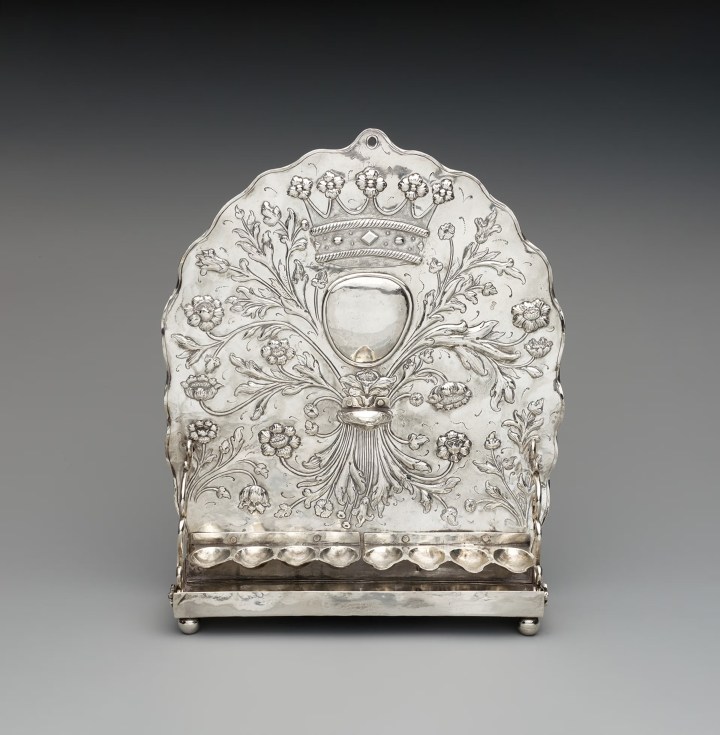
Johannes van der Lely, Hanukkah Lamp, 1706, Leeuwarden, silver, 31 × 26 cm (New York: The Metropolitan Museum of Art, 2025.585).
For over a decade, ESDA has been acquiring Judaica objects connected to Jewish life, culture, and religion. The selected items represent universal themes related to special days in the Jewish calendar, which follows a lunisolar cycle. This means that the days and months are based on the cycles of the moon, with each day beginning at sunset;[1] a leap month is added every few years to ensure that holidays are observed in their correct season. For example, Rosh Hashanah, associated with the new year, is celebrated in the fall, and Passover, associated with renewal, is in the spring.
Joyful holiday traditions and domestic milestones, such as the birth of a new baby or a wedding, kept communities together despite societal upheaval and economic fluctuations. Judaica produced in the Rococo or Baroque periods displayed extravagant decorative motifs typical of that era, with outstanding craftsmanship that evidences a material culture spanning metalwork, porcelain, leather, and enamel. . .
The full essay is available here»
Call for Papers | Imagining Britain
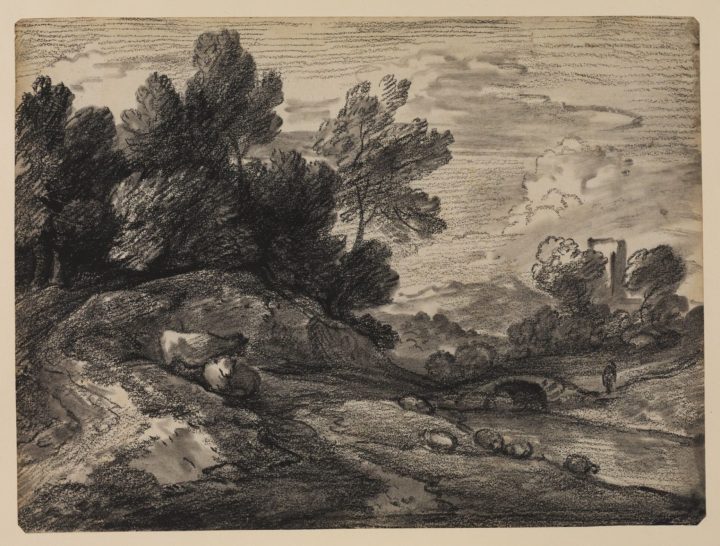
Thomas Gainsborough, Landscape with Sheep and Cattle on the Bank of a Stream, 1780–84, synthetic black chalk with stumping on wove paper, all four corners cut (London: Courtauld Gallery, Robert Clermont Witt, bequest, 1952).
◊ ◊ ◊ ◊ ◊
From The Courtauld:
Imagining Britain: Postgraduate and Early Career Research in British and Irish Art
The Courtauld Institute of Art, London, 9 June 2026
Organized by Claire Ó Nualláin and Clara Shaw
Proposals due by 9 March 2026
In recent decades, a significant aspect of British art studies has involved reflection on the nature and boundaries of the field itself, debated critically and curatorially.
A decade on from the inaugural provocation of British Art Studies volume I, published in November 2015, in which art historians responded to the statement, “There’s No Such Thing as British Art,” the expansion of the field’s geographic and intellectual perspectives has opened new research avenues. Increasingly, scholars have recognised the possibilities afforded to the study of British art when it is brought into dialogue with the arts of regions which have hitherto been marginalised in its discussion, including Ireland and former colonial territories. This introspection has instigated a reexamination of British collections, with major rehangs including at Tate Britain and the Yale Center for British Art, encouraging fresh perspectives on canonical works of art and the emergence of lesser-known artists and histories from the archive. In 2025, the Courtauld Institute of Art announced the opening of the Manton Centre for British Art, a major new initiative in the field providing new contexts in which to explore the definition, scope, and even relevance of the concept of ‘British’ art.
In light of these exciting developments in the study of British and Irish art, we wish to announce a call for papers from postgraduate and early career researchers responding to the theme Imagining Britain. This student-led symposium aims to provide an interdisciplinary, cross-period forum for fruitful discussions interrogating the role of visual and material culture in reinforcing, challenging and complicating the notion of ‘British.’
We welcome proposals for fifteen to twenty-minute papers exploring any aspect of the visual histories of Britain and Ireland from medieval to the present day that address issues including, but not limited to:
• Reflections on the historiography of British and Irish art, and the influence of major collectors and institutions in constructing its canon
• Histories of state or monarchical deployment of art and material culture to construct or shape national identity
• Case studies of the role of art and visual culture in responding to questions of British identity, particularly from underrepresented perspectives
• Longue durée analysis of the development of British art
• Analyses of canonical works of British art from post-colonial and post-Imperial perspectives
Please send paper proposals (250–400 words) and a full CV to Claire Ó Nualláin c2400367@courtauld.ac.uk and Clara Shaw c2101718@courtauld.ac.uk. The deadline for applications is Monday, 9 March. Applicants will be informed about decisions by early April. Successful applicants will be encouraged, where possible, to use institutional funding they have available for travel and accommodation, as only minimal funding from the Courtauld will be available and this will be reserved for early career candidates and those without institutional support.
Supported by the CHASE Doctoral Training Partnership.
Symposium | Diplomatic Gifts
Today and tomorrow at the Villa Medici, from the conference programme:
Diplomatic Gifts in the Modern and Contemporary Periods
L’Académie de France à Rome, 2–3 March 2026
Organized by Alessandro Gallicchio, Valentina Hristova, and Natacha Pernac
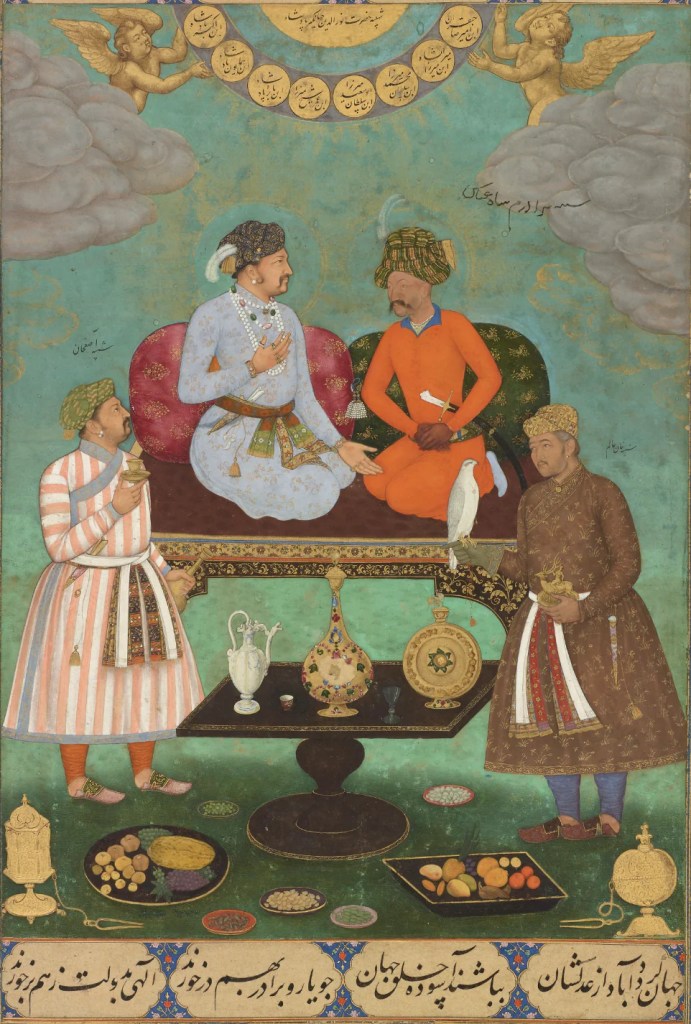
Attributed to Bishandas, Jahangir Entertains Shah Abbas, from the St. Petersburg Album, ca. 1618 (Washington DC, Freer Gallery of Art).
On March 2–3, 2026, the French Academy in Rome – Villa Medici will host an international symposium dedicated to diplomatic gifts in the modern and contemporary periods, examined in terms of their definitions, transformations, and processes of heritage-making on a global scale. These ‘ambassador objects’ will be studied in their material, political, and symbolic dimensions, as well as in their role in shaping international relations and ritualizing exchanges. Adopting polycentric perspectives, the conference encourages cross-views and bilateral or multilateral analysis of the sources.
Organizing Committee
• Alessandro Gallicchio, Director of the Department of Art History, Académie de France à Rome – Villa Médicis
• Valentina Hristova, senior lecturer in History of Modern Art, Université de Picardie Jules Verne, Amiens
• Natacha Pernac, senior lecturer in History of Modern Art, Université Paris-Nanterre
Scientific Committee
• Lucien Bély, professor emeritus of modern history, Paris, Sorbonne University, member of the Institut, Académie des sciences morales et politiques
• Francesco Freddolini, Associate professor of modern art history, Rome, Sapienza – University of Rome
• Serge Gruzinski, Director Emeritus of Historical Research, Paris, CNRS / EHESS
• Guido Guerzoni, historian and economist, Milan, Luigi Bocconi University
• Mei Mei Rado, assistant professor of Textile and Dress History, New York, Bard Graduate Center
m o n d a y , 2 m a r c h
9:00 Accueil
9.30 Ouverture — Sam Stourdzé et Alessandro Gallicchio (Académie de France à Rome – Villa Médicis)
Introduction — Valentina Hristova (Université de Picardie Jules-Verne, Amiens) et Natacha Pernac (Université Paris-Nanterre)
10.00 Les Définitions en Question
Présidence de session: Valentina Hristova
• Sur les dons (réels ou imaginaires) d’Uzun Hasan à l’État vénitien — Matthew Gillman (Columbia University, NY)
• Une collection des tranchées: Les œuvres découvertes par l’Armée française d’Orient au Louvre. Don diplomatique
ou butin de guerre? — Violette Gautier (Université de Picardie Jules-Verne, Amiens)
• Between Transnational Production and Cultural Diplomacy: Making and Managing Chinese Gardens Overseas — Zeming Taro Cai (University of Toronto)
11.30 Pause café
11.45 Récits Croisés, Sources et Représentations en Regard
Présidence de session: Francesco Freddolini
• Les cadeaux diplomatiques entre Empire ottoman et souverains occidentaux au XVIe siècle. Peut-on parler de réciprocité? — Frédéric Hitzel (EHESS, CETOBaC, Paris)
• The Geography of Diplomatic Gifts: Gift Giving and the Diverse Gift Profiles of State Ambassadors in 18th-Century Ottoman Diplomatic Ceremonial — Hümeyra Şahin Oktay (İstanbul Üniversitesi / Tobb Üniversitesi, Ankara)
12.40 Pause déjeuner
14.15 Les Vies de l’Objet: Fabrication, Reception, Display
Présidence de session: Guido Guerzoni
• « Que lui avions-nous apporté ? » : Les déboires des cadeaux diplomatiques du Portugal au souverain éthiopien Lebna Dengel, 1515–20 — Alain Mathilde (Université de Grenoble Alpes)
• Versailles et le monde: Les présents de Louis XV, 1715–74 — Marie-Laure Buku Pongo (Frick Collection, NY)
• Crafting Diplomacy: Extraordinary Embassies’ Visits to the Gobelins Manufacture and the Garde-Meuble de la Couronne, 1662–1789 — Barbara Lasic (Sotheby’s Institute of Art, Londres)
15.45 Pause café
16.00 Les Vies de l’Objet: Patrimonialisation
Présidence de session: Natacha Pernac
• Représentation et patrimonialisation des visites et dons diplomatiques en un haut lieu militaire, de l’Hôtel des Invalides au musée de l’Armée, 1675–2025 — Sylvie Le Ray-Burimi (Musée de l’Armée, Paris)
• The Qing Empire’s Gift to the Permanent Court of Arbitration: Transforming the Logic of Gift-Giving in Late Qing Diplomacy, 1907–11 — Yuxuan Zhou (Université de Genève)
• Le musée Senghor, une vitrine de la diplomatie culturelle du Sénégal, 1960–80 — Mohamadou M. Dieye (Musée d’art africain Théodore Monod, École doctorale ETHOS, Dakar)
17.30 Pause café
17.45 Special Lecture
• French Diplomatic Gifts in the Shaping of Qing Imperial Arts during the Long 18th Century — Mei Mei Rado (Bard Graduate Center, NY)
t u e s d a y , 3 m a r c h
9.00 Accueil
9.30 Stratégies et Politique des Dons Diplomatiques (Temps Long / Sérialité)
Présidence de session: Lucien Bély
• Entre jeux d’échelles et variété des typologies: Les cadeaux diplomatiques des Médicis et des Este au second Cinquecento — André Rocco (Université de Liège)
• Les dons cycliques de « pietra dura » entre l’Inde et l’Italie, 1620–2020: Entre charge historique et enjeux de supériorité — Lola Cindric (EHESS, Paris)
• Giulio Rospigliosi and Pascual de Aragón: The Role of Gifts in Relations between Madrid and Rome and Their American Projection — Carrio Invernizzi Diana (UNED, Madrid)
• Dono Dedimus Sacrum Corpus Christi Martyris, Corpisanti as Diplomatic Gifts from the Holy See to Mexico, 1833–60 — Montserrat A. Báez Hernández (Università di Teramo, KU Leuven)
11:45 Pause café
12:00 Special Lecture
• Du Japon à Madrid via México: Mondialisation, chocs des cultures et dons diplomatiques au sein de la Monarchie catholique, 1580–1640 — Serge Gruzinski (CNRS, EHESS, Paris)
12.45 Pause déjeuner
New Book | The Atlas of World Embroidery
From Princeton UP:
Gillian Vogelsang-Eastwood, The Atlas of World Embroidery: A Global Exploration of Heritage and Styles (Princeton: Princeton University Press, 2026), 400 pages, ISBN: 978-0691261911, £50 / $60.
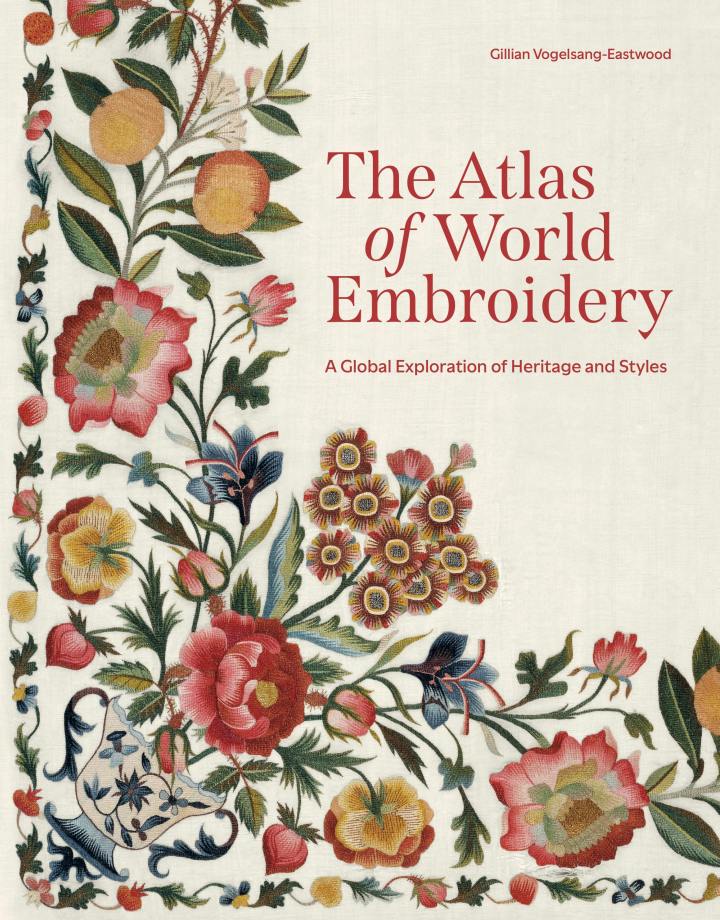 A richly illustrated history of embroidery and needlework, showcasing the glorious range of styles, motifs, and materials used around the world.
Embroidery is one of the world’s most widely shared forms of creative expression—and one of its most varied and diverse. It can be found in every region, yet its visual languages, themes, and techniques vary greatly: some are marked by unique styles and others show influences from neighboring cultures. The Atlas of World Embroidery examines many distinctive embroidery styles and traditions found across the Americas, Europe, Africa, Asia, and Australasia. From the quillwork and birch boxes of Indigenous North America to the decorative matyo style of Hungary, the zardozi embroiderers of India, and the satin stitches of Han Dynasty China, Gillian Vogelsang-Eastwood provides a comprehensive history of embroidery, describing its materials and tools, its designs and symbols, and its uses and makers. Emphasizing the visual aspects of embroidery across cultures, the atlas features an unprecedented array of color images celebrating the art form. Organized geographically by region and country, and focusing on hand needlework with relevant examples of machine forms, The Atlas of World Embroidery is a beautiful and authoritative exploration of this ancient craft.
• Lavishly illustrated throughout in full color with more than 300 images.
• Features full and close-up images of embroidered fabrics, including household items and clothing, along with insightful analysis.
• Includes sections on the Americas; Europe; Sub-Saharan Africa; the Arabic World; Turkey, the Iranian Plateau, and Central Asia; the Indian Subcontinent; East Asia; and Southeast Asia and Australasia—with subsections on individual countries, cultures, and kinds of embroidery.
• Contains a directory of design motifs depicting patterns from around the world.
Gillian Vogelsang-Eastwood is a design historian and textile archaeologist. She is director of the Textile Research Centre in Leiden, the Netherlands, and chief editor of the multivolume Bloomsbury World Encyclopedia of Embroidery. She is the coauthor of Dressed with Distinction: Garments from Ottoman Syria and Covering the Moon: An Introduction to Middle Eastern Face Veils.
Exhibition | French Drawings in Portuguese Collections
Now on view at Portugal’s National Museum Soares dos Reis, with an English summary from the Instagram account of Trois Crayons:
The presence of many French artists in Portugal from the beginning of the 18th century to the beginning of the 20th century—and their impact on the development of Portuguese art, especially the decorative arts—is the great revelation of this selection of works.
◊ ◊ ◊ ◊ ◊
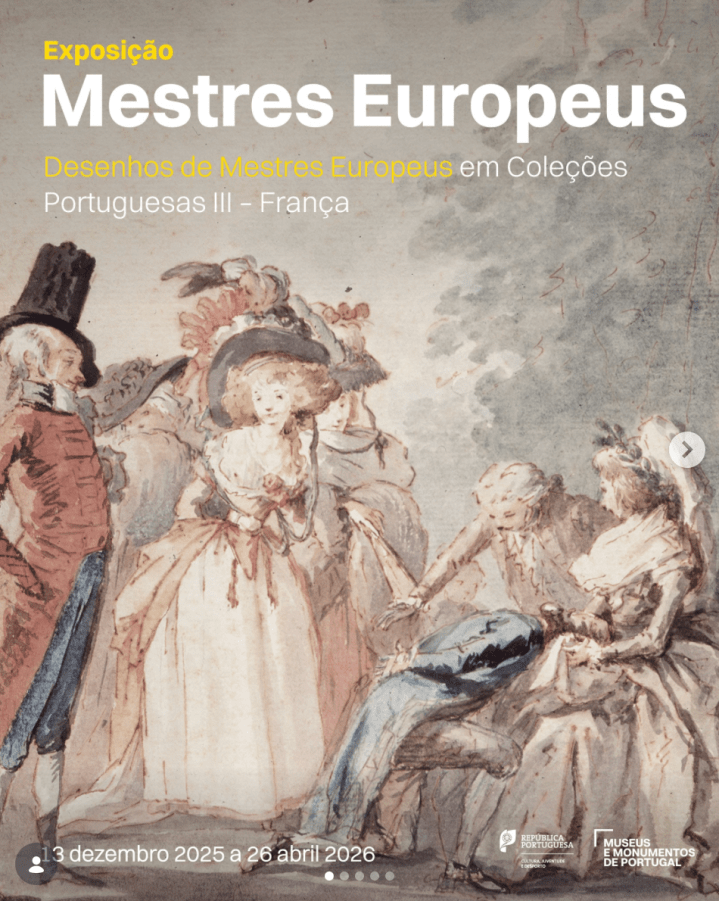
Drawings by European Masters in Portuguese Collections III: France
Desenhos de Mestres Europeus em Coleções Portuguesas III: França
Museu Nacional Soares dos Reis, Porto, 13 December 2025 — 26 April 2026
Curated by Nicholas Turner
Com mecenato do BPI | Fundação La Caixa e apoio das Tintas CIN, esta é a primeira exposição dedicada a desenhos franceses de coleções públicas e privadas portuguesas, e a terceira e última de uma série de exposições organizadas com o intuito de divulgar o pouco conhecido acervo de desenhos de antigos mestres conservado no nosso país.
 A primeira exposição, Desenhos de Mestres Europeus em Coleções Portuguesas (2000–01), apresentou aos visitantes obras de referência de todas as escolas, enquanto a segunda, Desenhos de Mestres Europeus em Coleções Portuguesas II: Itália e Portugal (2021), se centrou na influência da arte italiana no desenvolvimento da arte portuguesa desde o século XVI até ao início do XIX.
Com a exposição Desenhos de Mestres Europeus em Coleções Portuguesas III: França pretende-se mostrar que a história da influência do desenho francês em Portugal é diferente, apesar de acidentada e sujeita a flutuações políticas. De facto, a presença de muitos artistas franceses em solo nacional desde o início do século XVIII até ao início do século XX—e o seu impacto no desenvolvimento da arte portuguesa, especialmente das artes decorativas—é a grande revelação da presente seleção de obras.
Quer fugindo de ambientes políticos difíceis ou evitando a forte concorrência na corte francesa, pelo menos meia dúzia de émigrés franceses, como Pierre-Antoine Quillard, Pierre Massart de Rochefort ou Jean-Baptiste Pillement, representados nesta exposição, deixaram a sua marca—e os seus desenhos—em Portugal. Este legado torna-se claro a partir de uma grande variedade de pinturas, desenhos e obras ilustradas que foram executadas no nosso país.
Com curadoria de Nicholas Turner, um dos mais prestigiados especialistas internacionais na área do desenho, a exposição Desenhos de Mestres Europeus em Coleções Portuguesas III: França, inclui 88 obras, quatro das quais em formato de livro, ficando patente ao público até 26 abril 2026.
Nicholas Turner, Desenhos de Mestres Europeus em Coleções Portuguesas III: França (Porto: Blue Book, 2026), 216 pages, ISBN: 978-9899223318, €40.










 Enfilade
leave a comment