2018–19 James Smithson Fellowship: History, Memory, and Authenticity
2018–19 James Smithson Fellowship: History, Memory, and Authenticity
Applications due by 15 January 2018
The Smithsonian Institution invites applications for the 2018–19 James Smithson Fellowship. The theme for this coming year is “History, Memory, and Authenticity.”
After hearing the Declaration of Independence read aloud on the night of July 9, 1776, a group of American colonists proceeded to Lower Manhattan, tied ropes around an equestrian statue of King George III, and pulled it down. Although debate about public symbols and what they represent is as old as our nation itself, recently the volume of public discourse attempting to reconcile meaning attached to historic people, objects, and places has increased. As discussion about history’s ‘authenticity’ in social media and modern society has surged, so too has dialogue about the meaning of scientific research and its uses in public life.
This public desire for modern life to be better informed by history and science presents an opportunity for researchers to engage in a number of pressing conversations on the national and global level.
The James Smithson Fellowship is open to post-doctoral students in the fields of science, the humanities, and the arts. The James Smithson Fellowship Program was created to offer early career opportunities for post-doctoral researchers interested in gaining a better understanding about the interplay between scholarship and public policy through a Smithsonian lens. While this fellowship provides an immersion experience working with Smithsonian researchers and relevant collections, it also affords fellows a hands-on opportunity to explore relationships between research and public policy through direct interaction with Smithsonian leaders, and with policy leaders throughout the Washington, DC network.
The program is designed for a new generation of leaders, who seek a experience that leverages both scholarly and practical expertise in an environment of innovation like no other. Among the goals of the James Smithson Fellowship are to provide fellows with the opportunity to
• Conduct scholarly research at the Smithsonian
• Strengthen understanding of the interplay between research and public policy
• Gain skills at leveraging research to inform conversations about public policy
To support independent research and study, the fellowship includes a base stipend of $53,000. In addition to this base stipend, allowances may also be provided to help cover relocation, health insurance, and research expenses.
Additional information is available here»
Strawberry Hill Study Day | Portraits, Authenticity, and Copies
From the conference programme and flyer:
Portraits, Authenticity, and Copies in the 17th and 18th Centuries
Strawberry Hill, Twickenham, 2 November 2017
‘Truth is the sole merit of most antiquities; and when we cannot discover the truth, what value is there in dogmatic error about things that have no intrinsic value?—and such were all our pictures before Holbein, and infinitely the greater part of our pictures since!’
–Horace Walpole to Sir John Fenn, in response to a query about a historic portrait, 17 September 1774
 Horace Walpole’s Strawberry Hill was famously full of portraits, many of them collected as part of the broader antiquarian effort to form a narrative of British and European history. In this, as in other fields of painting, there was much less emphasis on the ‘original’ than there is today. But, as a historian, Walpole was greatly exercised by questions of authenticity, although his own collection of portraits included many later copies, both specially commissioned and unrecognized, as well as misdescriptions and deliberate fakes.
This study day will focus on issues and practices around meaning and authenticity in portraits in the 17th and 18th centuries. It is linked to the recent installation in the Holbein Chamber of digital facsimiles, made by Factum Arte, of George Vertue’s accurate copies, made in 1743, of 33 of Holbein’s famous drawings of the court of Henry VIII. Their acquisition in 1758 prompted Walpole to create the Holbein Chamber, inspired by Queen Caroline’s closet at Kensington Palace, where the original drawings were shown.
Refreshments including a light lunch will be provided; price £60.
Booking information is available here»
Queries: please email claire.leighton@strawberryhillhouse.org
P R O G R A M M E
9.30 Coffee
9.50 Welcome
10.00 Morning Session
• Michael Snodin (Strawberry Hill), Copies and Copying at Strawberry Hill
• Charlotte Bolland (National Portrait Gallery), Copying Portraits in the 16th and 17th Centuries
• Victoria Button (V&A), Holbein and Vertue: Materials, Techniques, and the Art of Copying
• Silvia Davoli (Strawberry Hill), Walpole, George Vertue, and Holbein
12.15 Lunch and tours of the house including a curator’s tour of the Holbeins
2.10 Afternoon Session
• Kate Retford (Birkbeck College), Copies and Connections: Portrait Practice in Eighteenth-Century Britain
• Stephen Lloyd (Derby Collection, Knowsley Hall), Copy or Authentic Likeness? Horace Walpole’s Collecting of Portrait Miniatures and Drawings at Strawberry Hill
• David Alexander (Fitzwilliam Museum), The Work of the Harding Family
3.45 Tea
New Book | Highland Retreats
From Rizzoli:
Mary Miers, Highland Retreats: The Architecture and Interiors of Scotland’s Romantic North (New York: Rizzoli, 2017), 288 pages, ISBN: 978 08478 44760, $65.
 Featuring breathtaking photographs of some of Scotland’s most remarkable and little-known houses, this book tells the story of how incomers adopted the North of Scotland as a recreational paradise and left an astonishing legacy of architecture and decoration inspired by the romanticized image of the Highlands. Known as shooting lodges because they were designed principally to accommodate the parties of guests that flocked north for the annual sporting season, these houses range from Picturesque cottages ornées and Scotch Baronial castles to Arts and Crafts mansions and modern eco-lodges. While their designs respond to some of Britain’s wildest and most stirring landscapes, inside many were equipped with the latest domestic technology and boasted opulent decoration and furnishings from the smartest London and Parisian firms. A good number survive little altered in their original state, and some are still owned by descendants of the families that built them.
Images from the famous Country Life Picture Library and specially commissioned photographs evoke the dramatic settings and arresting detail of these houses, making the book as appealing to decorators and architectural historians as it is to travelers and sportsmen.
Mary Miers commutes between her home in the Scottish Highlands and the London offices of Country Life magazine, where she works as fine arts and books editor. Her books include American Houses: The Architecture of Fairfax & Sammons and The English Country House.
Paul Barker was one of England’s premier interior and architectural photographers, whose books included English Country House Interiors, The Drawing Room, and English Ruins.
New Book | Travel and the British Country House
From Oxford UP:
Jon Stobart, ed., Travel and the British Country House: Cultures, Critiques, and Consumption in the Long Eighteenth Century (Manchester: Manchester University Press, 2017), 272 pages, ISBN: 978 15261 10329, $115.
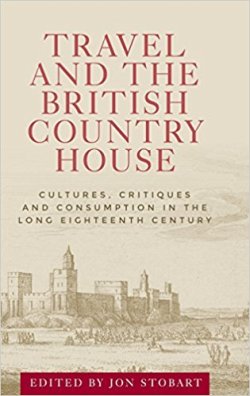 Travel and the British Country House explores the ways in which travel by owners, visitors, and material objects shaped country houses during the long eighteenth century. It provides a richer and more nuanced understanding of this relationship and how it varied according to the identity of the traveller and the geography of their journeys. The essays explore how travel on the Grand Tour, and further afield, formed an inspiration to build or remodel houses and gardens, the importance of country house visiting in shaping taste amongst British and European elites, and the practical aspects of travel, including the expenditure involved. Suitable for a scholarly audience, including postgraduate and undergraduate students, but also accessible to the general reader, Travel and the British Country House offers a series of fascinating studies of the country house that serve to animate the country house with flows of people, goods and ideas.
Jon Stobart is Professor of History at Manchester Metropolitan University.
C O N T E N T S
1 Introduction: Travel and the British Country House, Jon Stobart
2 From Rome to Stourhead and Thence to Rome Again: The Phenomenon of the Eighteenth-Century English Landscape Garden, John Harrison
3 Virtual Travel and Virtuous Objects: Chinoiserie and the Country House, Emile de Bruijn
4 Gentlemen Tourists in the Early Eighteenth Century: The Travel Journals of William Hanbury and John Scattergood, Rosie MacArthur
5 A Foreign Appreciation of English Country Houses and Castles: Dutch Travel Accounts on Proto Museums Visited en Route, 1683–1855, Hanneke Ronnes and Renske Koster
6 ‘Worth Viewing by Travellers’: Arthur Young and Country House Picture Collections in the Late Eighteenth Century, Jocelyn Anderson
7 ‘Enjoying Country Life to the Full—Only the English Know How To Do That!’: Appreciation of the British Country House by Hungarian Aristocratic Travellers, Kristof Fatsar
8 Magnificent and Mundane: Transporting People and Goods to the Country House, c. 1730–1800, Jon Stobart
9 On the Road (and the Thames) with William Cavendish, 1st Earl of Devonshire 1597–1623, Peter Edwards
10 ‘No Lady Could Do This’: Navigating Gender and Collecting Objects in India and Scotland, c. 1810–50, Ellen Filor
Index
Call for Manuscripts | Costume Society of America Book Series
Costume Society of America Book Series
Series Editor: Kimberly Chrisman-Campbell
The Costume Society of America book series has a new home at Kent State University Press. Inquiries and proposals for works on all subjects relating to the history and conservation of costume and adornment are welcome. Books chosen to be published range from scholarly to general interest and vary widely in format, from primarily textual to highly illustrated.
Although all titles must pass a rigorous review in terms of substance, not all must be scholarly. The Series also considers books that address or embrace a general readership. Titles in this category must be well written and focused on their specific subjects as well as carefully researched and substantiated, but they cannot become too deeply entrenched in theory or jargon for the average reader.
To request consideration of your proposed or completed manuscript, please send a query letter or brief prospectus to Series Editor Kimberly Chrisman-Campbell at kchrismancampbell@hotmail.com. Full details and a list of previous books in the series can be found here.
Research Seminar | Greg Smith on Thomas Girtin
From the Paul Mellon Centre:
Gregory Smith | Thomas Girtin: An Online Catalogue, Archive, and Introduction to the Artist
Paul Mellon Centre, London, 8 November 2017

Thomas Girtin, Lindisfarne Castle, Holy Island, Northumberland, 1796–97, watercolor, 38 × 52 cm (The Metropolitan Museum of Art).
I will begin by outlining the scope at the outset of a major project to produce an online catalogue covering the drawings, watercolours, and prints by, and after, the short lived but highly productive artist, Thomas Girtin (1775–1802). There are three categories of his works which pose a particular challenge to any cataloguer: the many hundreds of watercolours that he made in collaboration with fellow practitioners; the numerous copies or creative variations that Girtin produced after the works of contemporary artists, both professional and amateur, and after earlier landscape and topographical prints; and, finally, watercolours where the ostensible topographical subject has been lost or effaced as a result of Girtin’s ambitions to transcend the status of his chosen medium. Each of the three categories of problem works pose different challenges, which I will explore through a series of case studies before concluding that, despite the new research opportunities opened up by online searches and the mass digitisation of works on paper, a Girtin catalogue must, by necessity, admit a healthy degree of uncertainty and a fluidity at its margins. 8 November 2017, 6:00–8:00pm.
Greg Smith is an independent art historian who has published extensively on the history of British watercolours and watercolourists, as well as landscape artists working in Italy. He has also worked as a curator at the Whitworth Art Gallery, Manchester, the Design Museum, London, and the Barber Institute of Fine Art, Birmingham. He has organised exhibitions on the work of Thomas Girtin (Tate Britain), Thomas Jones (National Gallery of Wales), and Thomas Fearnley (Barber Institute of Fine Art). As Senior Research Fellow at the Paul Mellon Centre for Studies in British Art, Greg is developing a major online project: Thomas Girtin (1775–1802): An Online Catalogue, Archive and Introduction to the Artist.
New Book | William Hunter
From Routledge:
Helen McCormack, William Hunter and His Eighteenth-Century Cultural Worlds: The Anatomist and the Fine Arts (New York: Routledge, 2017), 208 pages, ISBN: 978 14724 24426, $150.
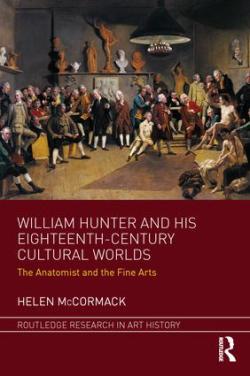 The eminent physician and anatomist Dr William Hunter (1718–1783) made an important and significant contribution to the history of collecting and the promotion of the fine arts in Britain in the eighteenth century. Born at the family home in East Calderwood, he matriculated at the University of Glasgow in 1731 and was greatly influenced by some of the most important philosophers of the Scottish Enlightenment, including Francis Hutcheson (1694–1746). Hunter quickly abandoned his studies in theology for Medicine and, in 1740, left Scotland for London where he steadily acquired a reputation as an energetic and astute practitioner; he combined his working life as an anatomist successfully with a wide range of interests in natural history, including mineralogy, conchology, botany, and ornithology; and in antiquities, books, medals, and artefacts; in the fine arts, he worked with artists and dealers and came to own a number of beautiful oil paintings and volumes of extremely fine prints. He built an impressive school of anatomy and a museum which housed these substantial and important collections. William Hunter’s life and work is the subject of this book, a cultural-anthropological account of his influence and legacy as an anatomist, physician, collector, teacher, and demonstrator. Combining Hunter’s lectures to students of anatomy with his teaching at the St Martin’s Lane Academy, his patronage of artists, such as Robert Edge Pine, George Stubbs, and Johan Zoffany, and his associations with artists at the Royal Academy of Arts, the book positions Hunter at the very centre of artistic, scientific, and cultural life in London during the period, presenting a sustained and critical account of the relationship between anatomy and artists over the course of the long eighteenth century.
Helen McCormack is a Lecturer in Art, Design, History and Theory at Glasgow School of Art. She studied Art History at Birkbeck College, University of London, and the History of Design and Material Culture at the Victoria and Albert Museum and Royal College of Art, London. She was the David Carritt Scholar in the History of Art at the University of Glasgow where she completed her PhD on the subject of William Hunter as a collector of the fine arts.
C O N T E N T S
List of Figures
Acknowledgements
Introduction: Art, Science, Curiosity and Commerce
1 Forming the Museum: Context and Chronology
2 The Great Windmill Street Anatomy School and Museum
3 Patronage and Patriots: Hunter and a National School of Artists
4 Collecting Ambitions (1770–83) The Grand Tour Paintings
5 Pursuing the Imitation of Nature in and beyond the Royal Academy of Arts
Conclusion
Bibliography
Index
New Book | Empire of Ruin: Black Classicism
From Oxford UP:
John Levi Barnard, Empire of Ruin: Black Classicism and American Imperial Culture (Oxford: Oxford University Press, 2017), 248 pages, ISBN: 978 019066 3599, $75.
 From the US Capitol to the Lincoln Memorial and the 9/11 Memorial Museum, classical forms and ideas have been central to an American nationalist aesthetic. Beginning with an understanding of this centrality of the classical tradition to the construction of American national identity and the projection of American power, Empire of Ruin describes a mode of black classicism that has been integral to the larger critique of American politics, aesthetics, and historiography that African American cultural production has more generally advanced. While the classical tradition has provided a repository of ideas and images that have allowed white American elites to conceive of the nation as an ideal Republic and the vanguard of the idea of civilization, African American writers, artists, and activists have characterized this dominant mode of classical appropriation as emblematic of a national commitment to an economy of enslavement and a geopolitical project of empire. If the dominant forms of American classicism and monumental culture have asserted the ascendancy of what Thomas Jefferson called an “empire for liberty,” for African American writers and artists it has suggested that the nation is nothing exceptional, but rather another iteration of what the radical abolitionist Henry Highland Garnet identified as an “empire of slavery,” inexorably devolving into an “empire of ruin.” Washington architecture.
John Levi Barnard is an Assistant Professor of English at The College of Wooster.
Introduction
1 Phillis Wheatley and the Affairs of State
2 In Plain Sight: Slavery and the Architecture of Democracy
3 Ancient History, American Time: Charles Chesnutt and the Sites of Memory
4 Crumbling into Dust: Conjure and the Ruins of Empire
5 National Monuments and the Residue of History
Call for Papers | The Cultural Heritage of Europe @ 2018
From H-ArtHist:
The Cultural Heritage of Europe @ 2018: Re-Assessing a Concept, Re-Defining Its Challenges
Institut national d’histoire de l’art (INHA), Paris, 4–5 June 2018
Proposals due by 10 November 2017
Today’s globalized concept of cultural heritage is often understood as a product of European modernity with its 19th-century emergence of territorially fixed nation-states and collective identity constructions. Within the theoretical overlap of the disciplines of history (of art), archaeology and architecture cultural properties and built monuments were identified and embedded into gradually institutionalized protection systems. In the colonial context up to the mid-20th century this specific conception of cultural heritage was transferred to non-European contexts, internationalized in the following decades after the WWII and taken as universal.
Postcolonial, postmodern, and ethnically pluralistic viewpoints did rightly question the supposed prerogative of a European Leitkultur. Only rather recently did critical heritage studies engage with the conflicting implications of progressively globalized standards of cultural heritage being applied in very local, non-European and so-called ‘traditional’ contexts. However, in order to bridge what academia often tends to essentialize as a ‘Western’ and ‘non-Western’ divide of opposing heritage conceptions, a more balanced viewpoint is also needed in order to update the conceptual foundations of what ‘cultural heritage of/in Europe’ means today.
The European Cultural Heritage Year 2018 — A Campaign with Unquestioned Assumptions?
Right at the peak of an identity crisis of Europe with financial fiascos of whole nation states, military confrontations, and refortified state borders at its continental peripheries with inflows of refugees from the Near East and the Global South did the European Council and Parliament representatives reach a provisional agreement to establish a European Year of Cultural Heritage in 2018. With affirmative slogans such as “We Europeans” and “Our common European heritage”, the campaign intends to “raise awareness of European history and values, and strengthen a sense of European identity” (Press release of the European Council, 9 February 2017). However, with its unquestioned core assumption of the validity of Europe’s territorial status with simply interconnected borderlines of its affiliated member states and of a given collective ‘we’-identity within the European Union, this cultural-political campaign risks to miss the unique chance of a critical re-assessment of how a ‘European’ dimension of cultural heritage can be conceptualized in today’s globalized and inter-connected reality.
The ‘Cultural Heritage of Europe’ @ 2018 — Towards a Global and Transcultural Approach
The global and transcultural turn in the disciplines of art and architectural history and cultural heritage studies helps to question the supposed fixity of territorial, aesthetic, and artistic entity called Europe, more precisely the taxonomies, values and explanatory modes that have been built into the ‘European’ concept of cultural heritage and that have taken as universal.
By taking into consideration the recent processes of the accelerated exchange and global circulation of people, goods and ideas, the conference aims to reconstitute the old-fashioned units of analysis of what ‘European cultural heritage’ could be by locating the European and the non-European in a reciprocal relationship in order to evolve a non-hierarchical and broader conceptual framework. With a focus on cultural properties (artefacts), built cultural heritage (from single architectures, ensembles and sites to whole city- and cultural landscapes etc.), and their forms of heritagization (from archives, museums, collections to cultural reserves), case-studies for the conference can address the various forms of the ‘cultural’ within heritage: its ‘social’ level (actors, stakeholders, institutions etc.), its ‘mental’ level (concepts, terms, theories, norms, categories), and, most obviously, its ‘physical’ level with a view on manipulative strategies (such as transfer and translation, reuse and mimicry, replication and substitution etc.).
Grouped along four panels in two days, cases-studies should question the concept of cultural heritage with its supposedly ‘European’ connotations and dimensions within artefacts and monuments by destabilizing at least one of its four constitutive core dimensions:
1) Place and Space – from stable sites to multi-sited, transborder contact zones and ambivalent third spaces
2) Substance and Materiality – from the monumental, homogeneous and unique of the artefact and listed monument to the transient, multiple, visual, digital, commemorated etc.
3) Time and Temporality – from objects of permanence and stability to the temporal, ephemeral, fugitive, processual
4) Identity – from the collective and cohesive to the ambivalent, contested, plural, and/or partial and fragmentary
The Host and the Network, Dates, and Deadlines
This international two-day conference in French and English will take place on 4 and 5 June 2018 at the Institut national d’histoire de l’art (INHA) and is embedded into the Laboratory of Excellence (LabEx) ‘Writing a New History of Europe—Ècrire une Histoire Nouvelle de l’Europe’ at Sorbonne University. One of its seven thematic axes—entitled ‘National Traditions, Circulation and Identities in European Art’—acts as the principle host of the event: with a special focus on geography, historiography and cultural heritage, it looks at art history in the Labex perspective of finding both elements of explanations and answers to the crisis Europe is currently going through. Is conducted by the Centre André Chastel (the Research Laboratory of Art History under the tutelage of the National Center for Scientific Research/CNRS, Sorbonne University and the Ministry of Culture) as the co-sponsor of the conference. Finally, the conference is situated within the new Observatoire des Patrimoines (OPUS) of the united Sorbonne Universities.
The conference is conceived by Michael Falser, Visiting Professor for Architectural History and Cultural Heritage Studies at Paris-Sorbonne (2018), in association with Dany Sandron, Professor of Art History at Sorbonne University/Centre Chastel and speaker of LabEx, axis 7.
Abstracts with name and affiliation of the speaker, title and 200 words abstract of the presentation are due with the deadline of 10 November. Candidates will be notified on 30 November 2017. The proposals for papers should be sent to patrimoine.europe2018@gmail.com.
Le Patrimoine Culturel de l’Europe @ 2018: Réexaminer un concept – redéfinir ses enjeux
Lecture | Iris Moon on the Late Shipwrecks of Jean Pillement
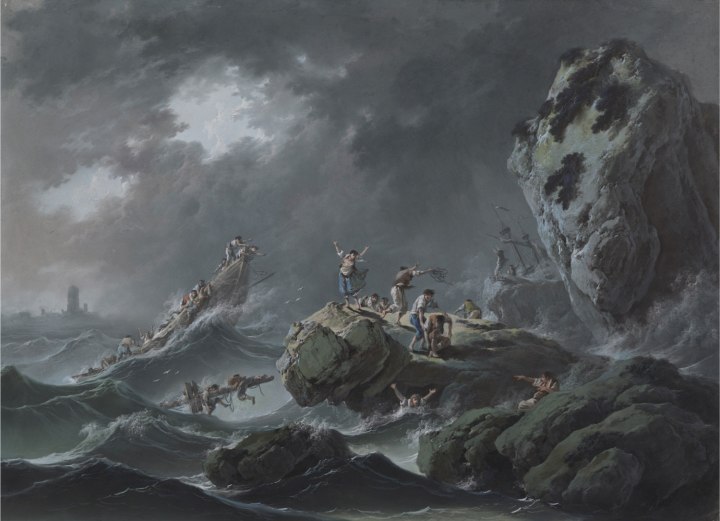
Jean Pillement, A Shipwreck, 1782, pastel on paper (Philadelphia Museum of Art).
◊ ◊ ◊ ◊ ◊
Iris Moon | Rococo Adrift: The Late Shipwrecks of Jean Pillement
University College London, 18 October 2017
Dr. Iris Moon (European Sculpture and Decorative Arts, Metropolitan Museum of Art, New York)
The lecture is part of UCL’s visual culture research seminar Past Imperfect, which aims to explore recent concerns with time: the unfinished past, the future present, the over investment in the contemporary. This year’s theme is Destruction and Demolition.
Seminar Room 6, 21 Gordon Square, London, 6:00–8:00pm










 Enfilade
leave a comment