New Book | Neighbours and Rivals
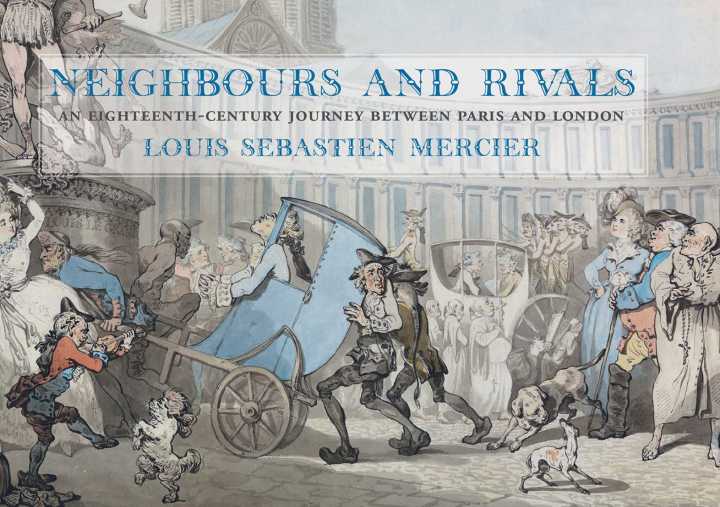
Published by Pallas Athene and distributed by Simon & Schuster:
Louis-Sébastian Mercier, Neighbours and Rivals: An Eighteenth-Century Journey between Paris and London, translated by Laurent Turcot and Jonathan Conlin (London: Pallas Athene, 2025), 284 pages, ISBN: 978-1843682707, £25 / $33.
The great French journalist Louis-Sébastien Mercier’s descriptions of an optimistic, utopian 18th-century London, translated by Laurent Turcot and Jonathan Conlin.
Louis-Sébastien Mercier (1740–1814) first traveled to London and began recording his impressions in 1780. An exemplar of a new form of journalistic, reflective literature, his account presents emotive representations of the city as collections of experiences, habits, and personalities. And differently from Dickens’s London or Baudelaire’s Paris, with their contrasts of opulence and misery, Mercier describes a less familiar urban environment—more optimistic, perhaps even utopian. His version of London is, in fact, a projection of his philosophical imagination—not simply a rounded portrait but also a reflection of what he hoped Paris could become. For this first publication in English, Laurent Turcot and Jonathan Conlin’s translation preserves the life and humor of Mercier’s text. It is illustrated with contemporary images, with an emphasis on Thomas Rowlandson and Gabriel-Jacques de Saint-Aubin, the first Parisian flâneur-artist.
Jonathan Conlin, a senior lecturer at the University of Southampton, specializes in modern British cultural history from the 18th century to the present, with a focus on urban history. His previous books include The Nation’s Mantelpiece, Evolution and the Victorians, and Civilisation. Laurent Turcot is a professor of history at l’Université du Québec à Trois-Rivières, specializing in the 16th to the 19th century, particularly urban culture and leisure.
Study Day | C. F. R. Lisiewsky on His 300th Birthday
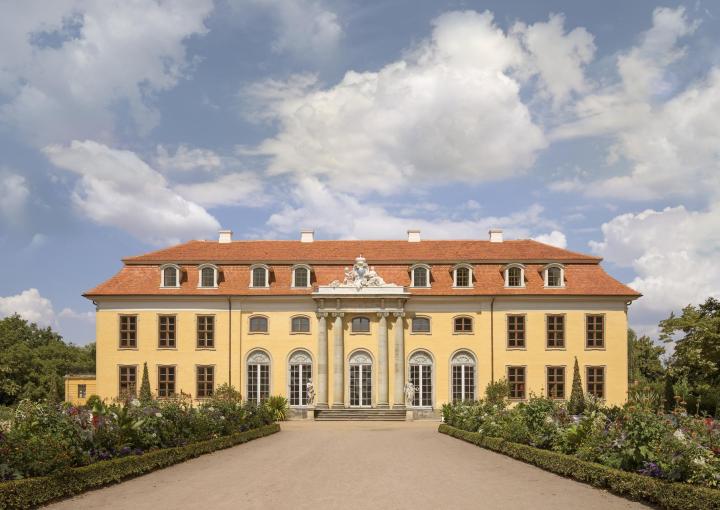
Located near Dessau, Schloss Mosigkau, was built by Princess Anna Wilhelmine of Anhalt-Dessau in the 1750s.
◊ ◊ ◊ ◊ ◊
From ArtHist.net:
Auf einen Blick mit … C. F. R. Lisiewsky. Matinée zum 300. Geburtstag
Schloss Mosigkau, Dessau-Rosslau, 15 June 2025
Registration due by 13 June 2025
2025 jährt sich der Geburtstag des Malers Christoph Friedrich Reinhold Lisiewsky (1725–1794) zum 300. Mal—Anlass, um diesen (nicht nur) für Anhalt-Dessau bedeutsamen Künstler mit einer Veranstaltung zu würdigen. Lisiewsky, der meist im Schatten von Künstlerkollegen wie Anton Graff oder Antoine Pesne steht, hat zwanzig Jahre als Hofmaler in Anhalt-Dessau gewirkt und hier zahlreiche Spuren hinter lassen. Im Schloss Mosigkau, wo im Jahr 2010 die erste Retrospektive zu Lisiewsky unter dem Titel „Teure Köpfe“ gezeigt wurde und wo sich heute eine umfangreiche Sammlung von Gemälden des Malers befindet, will die Matinee mit Fachvorträgen und einer Führung neue Blicke auf Lisiewsky und dessen Umfeld eröffnen.
Bitte melden Sie sich bis zum 13.6.2025 bei Jana Kittelmann an: jana.kittelmann@gartenreich.de. Aktuelle Informationen zur Veranstaltung finden sich unter: https://www.gartenreich.de/de/aktuelles/veranstaltungen?y=2025&m=6
p r o g r a m m
13.00 Begrüßung — Jana Kittelmann und Maria Zielke (Kulturstiftung Dessau-Wörlitz)
13.05 Grußwort — Wolfgang Savelsberg (Dessau)
13.15 Zur Einführung oder Blicken, Sichten, Sehen im Zeitalter Lisiewskys — Jana Kittelmann (KsDW)
13.30 Falten, Warzen und Triefnasen. Hässlichkeit als Programm bei den Herrenbildnissen von C.F.R. Lisiewsky — Kilian Heck (Universität Greifswald)
14.00 Pause
14.15 Lisiewsky und das ‚veristische‘ Porträt — Reimar F. Lacher (Gleimhaus Halberstadt)
14.45 Beobachtungen zur Maltechnik C.F.R. Lisiewskys als Hofmaler, Alchemist und Restaurator — Maria Zielke (KsDW)
15.00 Führung zu Gemälden Lisiewskys — Andreas Mehnert (KsDW)
ab 15.30 Ausklang auf der Schlossterrasse
Call for Papers | England in Thuringia: Art, Sports, Gardens, Architecture
From ArtHist.net:
England in Thüringen: Kunst, Sport, Gärten, Architektur
Friedenstein Stiftung Gotha, 7–9 May 2026
Proposals due by 6 June 2025
Die historischen Verbindungen Englands nach Thüringen sind vielfältig und reichen weit in die Geschichte zurück. Ein Fundament dieser Beziehungen liegt in den dynastischen Allianzen des Thüringer Adels zum englischen Königshaus: 1736 heiratete Augusta von Sachsen-Gotha-Altenburg den englischen Prinzen Friedrich Ludwig von Wales. Ihr gemeinsamer Sohn bestieg als König George III. den englischen Thron. Adelheid von Sachsen-Meiningen wurde 1818 durch ihre Heirat mit Prinz William, Herzog von Clarence, dem späteren König William IV., Königin von Großbritannien und Irland. Weil das Paar keine überlebenden Kinder hatte, fiel die britische Krone 1837 an Adelheids Nichte Victoria, die 1840 ihren Cousin Albert von Sachsen-Coburg und Gotha heiratete. Mit deren Sohn Alfred und dem Neffen Carl Eduard regierten später ‘Engländer’ das Herzogtum Sachsen-Coburg und Gotha.
All diese dynastischen Verbindungen stärkten die politischen und kulturellen Beziehungen zwischen Großbritannien und Thüringen. Bislang kaum betrachtet wurde jedoch, wie weitreichend die damit einhergehenden kulturellen Impulse nach Thüringen waren, insbesondere im Bereich der Gärten, der Kunst, des Sports, und der Architektur. So inspirierten im 18. und 19. Jahrhundert englische Gärten maßgeblich die Gestaltung von Parks und Landschaften in Thüringen, zudem brachte die Industrialisierung englische Technologien und Geschäftsmodelle nach Thüringen, wodurch sich die Region wirtschaftlich weiterentwickelte. Literarisch und kulturell wirkten die Werke von William Shakespeare, sowie die Ideen der Aufklärung aus England auf deutsche Schriftsteller und Denker, insbesondere in Weimar.
Mit Schwerpunkt auf der Zeit zwischen der Mitte des 18. Jahrhunderts bis zum Ausgang des viktorianischen Zeitalters Anfang des 20. Jahrhunderts sollen in der Tagung die kulturellen Einflüsse Englands auf Thüringen wissenschaftlich beleuchtet werden. Inwiefern beförderten die dynastischen Beziehungen zwischen den beiden Ländern den kulturellen Transfer? Welche Persönlichkeiten traten besonders als Vermittler:innen der englischen Kultur hervor? Welche Objekte, Phänomene und Ideen wurden übernommen oder als nachahmenswert erachtet? Wie nahmen englische Gäste die Region und ihre Bevölkerung wahr? An welchen Orten in Thüringen lassen sich noch heute die Verbindungen der beiden Länder nachvollziehen?
Diesen und weiteren Fragen will die interdisziplinär angelegte Tagung nachgehen, um neue Erkenntnisse über die Spuren Englands in Thüringen zu gewinnen. Für die Tagung werden Beiträge der Fachrichtungen Geschichte, Kunstgeschichte, Sportgeschichte, Kultur- und Literaturwissenschaft sowie verwandter Fächer erbeten, die sich mit dem Thema befassen, wobei der Fokus der Tagung auf Thüringen, und nicht allgemein auf englisch-deutschen Kulturbeziehungen, liegt.
Die Ausschreibung richtet sich an etablierte Wissenschaftler:innen ebenso wie an Nachwuchswissenschaftler:innen. Die Vortragsdauer beträgt 30 Minuten (plus anschließende Diskussion von zirka 10 Minuten). Eine Publikation der Tagungsergebnisse wird angestrebt. Die Konferenzsprachen sind Deutsch und Englisch. Die Tagungsgebühr beträgt 50 Euro, für Nachwuchswissenschaftler:innen 25 Euro.
Die Tagung wird am Abend des 7. Mai 2026 mit einem Eröffnungsvortrag beginnen, die weiteren Vorträge sind für den 8. und 9. Mai vorgesehen. Geplant ist zudem ein vielseitiges Begleitprogramm mit Besichtigungen bedeutender Thüringer Kulturstätten, das optional wahrgenommen werden kann. Bitte senden Sie Ihren Beitragsvorschlag (1.500 – 2000 Zeichen inkl. Leerzeichen) sowie ihre Kurzbiografie (max. 500 Zeichen) an die Programmkoordinatorin, Frau Angelika Eder, unter: angelika.eder@friedenstein-stiftung.de. Bewerbungsschluss ist der 6. Juni 2025. Fragen richten Sie bitte an angelika.eder@friedenstein-stiftung.de.
Kontakt
Friedenstein Stiftung Gotha
Schlossplatz 1
D-99867 Gotha
angelika.eder@friedenstein-stiftung.de
Conference | The Global Baroque, 1600–1750

Japanese, Arrival of the Europeans, first quarter of the 17th century, one of a pair of folding screens, 105 × 261 cm
(New York: The Metropolitan Museum of Art, 2015.300.109.1, .2).
◊ ◊ ◊ ◊ ◊
From ArtHist.net and the University of York:
The Global Baroque
European Material Culture between Conquest, Trade, and Mission, 1600–1750
King’s Manor, University of York, 10–11 July 2025
Organized by Adam Sammut and Tomasz Grusiecki
Registration due by 1 July 2025
The period of Western art history known as ‘the Baroque’ has traditionally been interpreted as a stylistic phenomenon. However, artistic production in Europe from around 1600 to 1750 was enabled by a proto-industrial world system dominated by Spain and Portugal, the Netherlands, and later Britain. As a result, material culture became entangled in networks of trade, colonial rule, and Catholic global mission stretching from Naples to Nagasaki. This conference will broaden perspectives on the Baroque, embracing its transcontinental and multi-media character. By culturally decentring Europe and with materiality a special focus, the programme will recast the continent as a constituent part of an expanding artistic world driven by war, the exploitation of ecosystems, and the first information technology revolution. Bringing together scholars and museum curators from the UK and internationally, the conference will demonstrate how objects can offer intimate insights into global histories often characterised by vast, impersonal economic forces.
Part of The British Academy Conferences 2025/26
t h u r s d a y , 1 0 j u l y
9.00 Registration with coffee, tea, and pastries
9.40 Opening Remarks — Adam Sammut (University of York) and Tomasz Grusiecki (Boise State University)
10.00 Session 1 | Baroque Aesthetics
Chair: Adam Sammut (University of York)
• Black Beauty and the Canon: Nicolas Cordier’s Borghese Moor — Lorenzo Pericolo (Florida State University)
• Ancient Greece and the English Baroque — Matthew Walker (Queen Mary University of London)
11.20 Coffee and tea
11.50 Session 2 | New Geographies of the Low Countries
Chair: Cordula van Wyhe (University of York)
• Global Conversions: Peter Paul Rubens, King Philip IV of Spain, and the Coiners of Antwerp — Christine Göttler (University of Bern)
• Biting lines: Baroque Violence in Rembrandt’s Small Lion Hunt (1629) — Thomas Balfe (The Warburg Institute)
• A Taste for Blackness: Ebony in the Dutch Republic — Claudia Swan (Washington University in St. Louis)
13.20 Lunch break
14.20 Session 3 | Ottoman Worlds
Chair: Richard McClary (University of York)
• Style, Society, and the State: Ottoman Baroque Identities in 18th-Century Istanbul — Ünver Rüstem (Johns Hopkins University)
• Object Circulation and Networks on the Periphery of Eastern Central Europe: The Case Studies of the Ottoman Tributary States of Transylvania and Moldavia — Robert Born (Bundesinstitut für Kultur und Geschichte des östlichen Europa)
15.30 Coffee and tea
16.00 Keynote Address
• Necropastoral Worldscapes in Dutch-occupied Brazil — Angela Vanhaelen (McGill University)
18.00 Dinner at Ambiente Fossgate, by invitation
f r i d a y , 1 1 j u l y
9.30 Coffee, tea, and pastries
10.00 Session 4 | Where is Central and Eastern Europe?
Chair: Tomasz Grusiecki (Boise State University)
• Corpisanti between Rome and the Fringes of Catholicism: A Case Study in a Centripetal Approach to Material Culture of the Late Global Baroque — Ruth Sargent Noyes (Estonian Academy of Arts)
• Black Bodies as Baroque Decorations: Objectification of Africans in the Self-Representation of Polish-Lithuanian Elites — Vital Byl (University of Bonn)
11.00 Coffee and tea
11.30 Session 5 | The Asia-Pacific and the Indian Ocean
Chair: Tara Alberts (University of York)
• Objects and Empire on the Portuguese India Run — Elsje van Kessel (University of St Andrews)
• Indian Oceanic Travels of Coco-de-mer: Mythology and Materiality — Peyvand Firouzeh (University of Sydney)
• The Transcultural Body of the Mermaid — Anna Grasskamp (University of Oslo)
13.00 Lunch break
14.00 Session 6 | Atlantic Crossings
Chair: Simon Ditchfield (University of York)
• What’s in a Name? The Low Countries and the Global Turn — Stephanie Porras (Tulane University)
• A Counter-Baroque? Iroquois Town Planning and the Early Modern Imagination — Lorenzo Gatta (University College London)
• Emptied Orbs, or, A Case Against the Global — Aaron Hyman (University of Basel)
15.30 Coffee and tea
16.00 Roundtable discussion
17.30 Wine reception
Conference | Gardens and Empires
◊ ◊ ◊ ◊ ◊
Next month at the British Library:
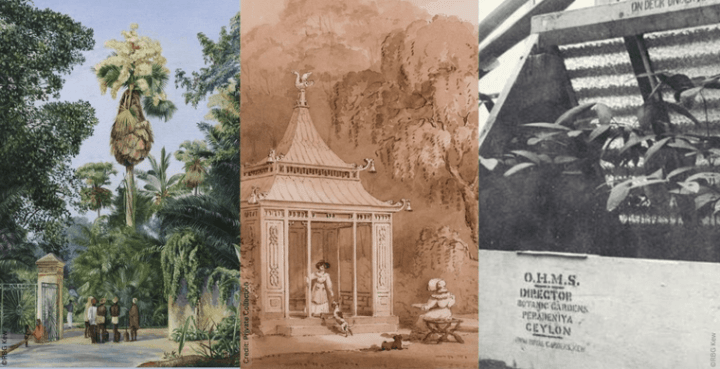
Gardens and Empires
British Library, London, 27–28 June 2025
The histories of plants and gardens are deeply entangled with the histories of empires. This two-day conference investigates the impacts of these global connections on gardens around the world. It investigates the influence of global networks of science, commerce, and horticulture on the plants, designs, and practices found in the gardens of European and non-European empires, at home and abroad. The conference includes talks about the impact and influence of empires in gardens all over the world including East Asia, India, North America, South America, Australia, the Caribbean, and Europe. The speakers share the stories of the plants, people, and powers that shaped the gardens of empires. A keynote lecture will be delivered by Advolly Richmond (BBC Gardener’s World), and a roundtable discussion on the legacies of empire will be chaired by Sathnam Sanghera (author of Empireland and Empireworld).
Tickets include an exclusive visit to the British Library exhibition Unearthed: The Power of Gardening. Also included are refreshments each day and an evening reception on Friday, 27 June in the wonderful surroundings of The Story Garden, a dynamic community garden created by Global Generation, hidden behind the British Library.
f r i d a y , 2 7 j u n e
10.00 Opening Remarks
10.05 Welcome — Gerard Lemos (Chair of Trustees, English Heritage)
10.15 Keynote Lecture
• Guns and Roses: Humphry Repton at the Warley Estate — Advolly Richmond (Independent Researcher)
10.45 Coffee/Tea Break
11.10 Session 1 | The Circulation of Ideas around and between Empires
Chair: Mark Nesbitt (Royal Botanic Gardens, Kew)
• Where Empires Meet: Power, Identity, and Cultural Negotiation in Huế (Vietnam) Gardens — Tami Banh (University of Pennsylvania)
• Traveling Plants: Taiwanese Garden Spaces under Japanese Rule — Jing-Wen Chien (National Taiwan University)
• Transnational Influences on Urban Greenspace Development: The Role of Kew Gardens in Shaping Modern Greenspace Systems in Shanghai, Hong Kong, and Singapore — Minqian Zheng (Academic Researcher), Fei Mo* (Shanghai Jiao Tong University), and Xinyuan Yu (Academic Researcher)
12.30 Lunch Break
13.30 Session 2 | The Circulation of Ideas around and between Empires
Chair: Gerard Lemos (English Heritage)
• Mughal Garden or English Park? The Genesis of the Victoria Memorial Gardens, Kolkata — Caroline Cornish (Royal Botanic Gardens, Kew)
• From the Shores of Empire: Shells and Coral in the Grottos of 18th-Century Gardens — Emily Parker (English Heritage)
• Forced Plants and Displaced People: The British Empire’s Impact on North American Botany — Kimberly Glassman (Queen Mary University of London and Royal Botanic Gardens, Kew)
14:50 Coffee/Tea Break
15.15 Session 3 | The Circulation of Ideas around and between Empires
Chair: Romita Ray (Syracuse University)
• Paleis Het Loo: From Royal Showcase towards a Decolonized Botanical Garden — Renske Ek (Paleis Het Loo)
• The Race for American Trees and the Prince’s Garden at Aranjuez, 1797–1809: A Story of Rivalry, Emulation, and Oblivion among the Gardens of the Atlantic Colonial Powers — Francisco Javier Giron Sierra (Universidad Politécnica de Madrid, Escuela Técnica Superior de Arquitetura)
• Augusta of Saxe-Gotha’s ‘World in Microcosm’: Political Gardening at Kew, 1750–1770 — Joanna Marschner (Historic Royal Palaces)
16.35 Introduction to Unearthed: The Power of Gardening — British Library Curators
16:50 Exhibition View — Unearthed: The Power of Gardening
18:00 Evening Reception at The Story Garden (pizza and canapés provided)
s a t u r d a y , 2 8 j u n e
9.30 Session 4 | People and Economics
Chair: Advolly Richmond (Independent Researcher)
• Horticulture, Empire, and Race: Thomas Dawodu and Ferdinand Leigh in Lagos, Jamaica, and Kew — Kate Teltscher (University of Roehampton and Royal Botanic Gardens, Kew)
• Pineapples, Prestige, and Imperial Politics: The 3rd Duke of Portland’s Gardening Practice at Welbeck Abbey, Nottinghamshire, Britain — Susanne Seymour (University of Nottingham)
• The Links between Scottish Country Estates and the Profits of Transatlantic Slavery, 1707–1850 — Catherine Middleton (Historic Environment Scotland)
11.00 Coffee/Tea Break
11.30 Session 5 | Plant Mobilities
Chair: Felix Driver (Royal Holloway, University of London)
• On ‘Exotics’ and ‘Civilisation’: The 19th-Century Transatlantic Exchange of Ornamental Plants — Diego Molina (Royal Holloway, University of London)
• Palms, Rubber, and Orchids: Introduced and Created Plants in the Singapore Botanic Gardens — Timothy Barnard (National University of Singapore)
12.30 Lunch Break
13.30 Session 6 | Legacies of Empire and Colonialism
Chair: Judy Ling Wong (Black Environment Network)
• Creole Gardens as Decolonial Practice, Regrowth, Resistance, Recycling, and Repair — Ananya Jahanara Kabir (King’s College London) and Rosa Beunel-Fogarty (King’s College London)
• A Private Empire: Interpreting European Gardens Funded by Leopold II’s Personal Ownership of the ‘Congo Free State’ — Jill Sinclair (Independent Researcher)
• Converting the ‘Wilderness’ in Colonial Western Australia — Lisa Williams (Independent Researcher) and Emma-Clare Bussell (Independent Researcher)
15.00 Coffee/Tea Break
15:30 Session 7 | Roundtable: Legacies of Empire and Colonialism
Chair: Sathnam Sanghera (Journalist and Writer)
• Fiona Davidson (Royal Horticultural Society)
• Corinne Fowler (University of Leicester)
• Akiko Tashiro (Hokkaido University)
• Juliet Sargeant (Garden Designer)
Exhibition | Unearthed: The Power of Gardening

◊ ◊ ◊ ◊ ◊
Now on view at the BL:
Unearthed: The Power of Gardening
British Library, London, 2 May — 10 August 2025
Curated by Maddy Smith
From beautiful botanical illustrations to the world’s oldest mechanised lawnmower, ancient herbals to guerrilla gardening zines, Unearthed reveals how gardeners have cultivated more than just plants—they’ve sown the seeds of change. Dive into gardening’s role in our health and wellbeing, see how people have reimagined our homes, towns and cities to create green spaces, and uproot the tangled histories of the plants that grow in our gardens today.
Among an incredible collection of books, manuscripts, photographs, artworks and historical tools, highlights include:
• the first English gardening manual: Thomas Hill’s 1558 guide on how to tend a garden
• Charles Darwin’s vasculum, for collecting plant specimens on the Beagle voyage
• the only surviving illustrated Old English herbal
• an oil portrait of John Ystumllyn, one of Britain’s earliest documented Black gardeners
• Gertrude Jekyll’s boots: a trailblazing gardener, writer, artist, and one of the 20th century’s most influential garden designers
• striking botanical art by European, Indian, Chinese, and Caribbean artists
• four short films following Coco Collective, an Afro-diaspora led community garden that opened as a response to the Covid-19 pandemic
• a Victorian Wardian case, the mini travelling greenhouse that enabled thousands of living plant specimens to be moved around the world.
Unearthed celebrates gardening as a force for creativity, resilience, and community through the remarkable stories of the people and plants that shape our gardens.
Exhibition | Picturing Nature: British Landscapes
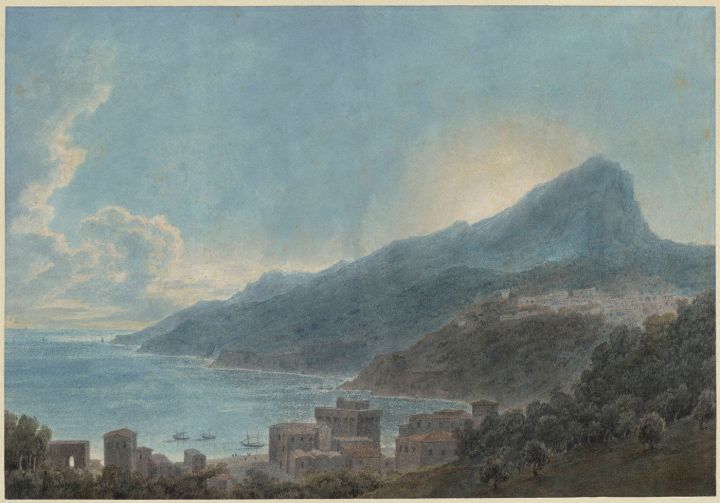
John Robert Cozens, View of Vietri and Raito, Italy, ca. 1783, watercolor over graphite on cream laid paper (The Museum of Fine Arts, Houston, The Stuart Collection, museum purchase funded by Francita Stuart Koelsch Ulmer in honor of Dena M. Woodall).
◊ ◊ ◊ ◊ ◊
Now on view at the MFAH:
Picturing Nature: The Stuart Collection
of 18th- and 19th-Century British Landscapes and Beyond
The Museum of Fine Arts Houston, 12 January — 6 July 2025
Featuring more than 70 works of art in a variety of media, Picturing Nature: The Stuart Collection of 18th- and 19th-Century British Landscapes and Beyond explores how the genre of landscape evolved during an era of immense transformation in Britain. This diverse collection of watercolors, drawings, prints, and oil sketches traces the shift from topographical and picturesque depictions of the natural world to intensely personal ones that align with Romantic poetry of the period. The exhibition spotlights the Stuart Collection, built over the past decade in collaboration with Houstonian Francita Stuart Koelsch Ulmer. This exceptional collection includes standout works by notable artists such as John Constable, John Robert Cozens, Thomas Gainsborough, J.M.W. Turner, and Richard Wilson, whose innovative approaches to watercolor raised its status as an art form and heralded a golden age for the medium.
Through the work of these luminaries and their contemporaries, Picturing Nature reveals how landscape emerged as a distinct artistic genre in England in the late 1700s, then reached its greatest heights the following century, attracting international response and inspiring both artists and collectors at home and abroad. Period publications and artist’s supplies, including drawing manuals and a mid-19th-century Winsor & Newton watercolor box, further illustrate the flowering of the landscape tradition.
Dena M. Woodall, Picturing Nature: The Stuart Collection of 18th- and 19th-Century British Landscapes and Beyond, $35. The online catalogue of the Stuart Collection is available here.
New Book | The Education of Things
From the University of Massachusetts Press:
Elizabeth Massa Hoiem, The Education of Things: Mechanical Literacy in British Children’s Literature, 1762–1860 (Amherst: University of Massachusetts Press, 2024), 328 pages, ISBN: 978-1625347565 (hardback), $99 / ISBN: 978-1625347558 (paperback), $31.
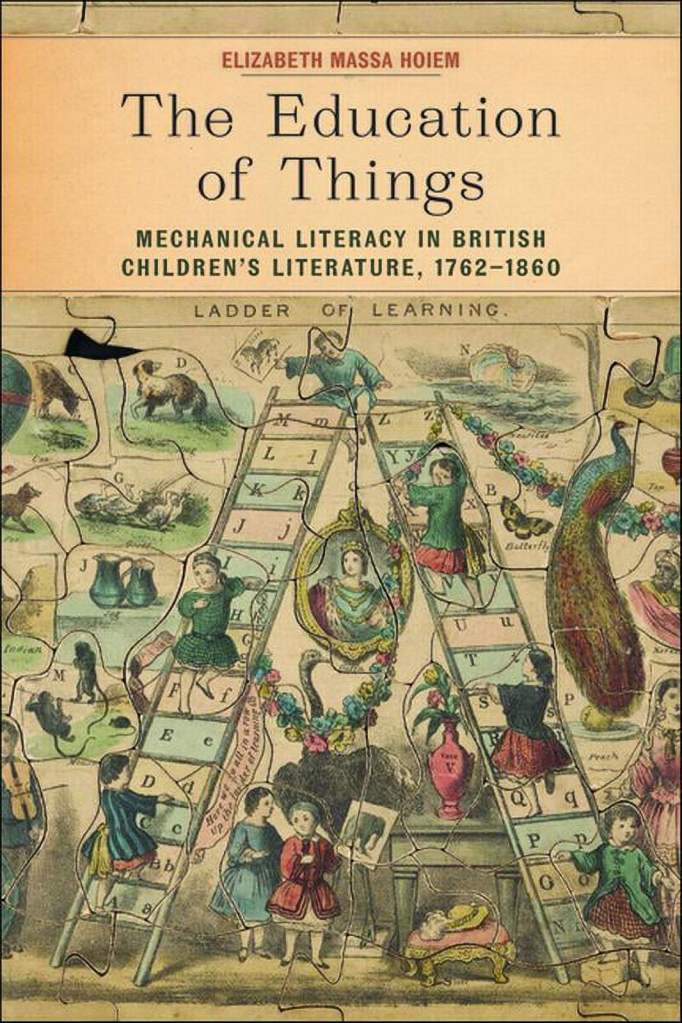 Winner of the 2025 Justin G. Schiller Prize for Bibliographical Work on Children’s Books from The Bibliographical Society of America
By the close of the eighteenth century, learning to read and write became closely associated with learning about the material world, and a vast array of games and books from the era taught children how to comprehend the physical world of ‘things’. Examining a diverse archive of popular science books, primers, grammars, toys, manufacturing books, automata, and literature from Maria Edgeworth, Jean-Jacques Rousseau, and Anna Letitia Barbauld, The Education of Things attests that material culture has long been central to children’s literature. Elizabeth Massa Hoiem argues that the combination of reading and writing with manual tinkering and scientific observation promoted in late eighteenth- and early nineteenth-century Britain produced new forms of ‘mechanical literacy’, competencies that were essential in an industrial era. As work was repositioned as play, wealthy children were encouraged to do tasks in the classroom that poor children performed for wages, while working-class children honed skills that would be crucial to their social advancement as adults.
Elizabeth Massa Hoiem is assistant professor in the School of Information Sciences at University of Illinois Urbana-Champaign.
c o n t e n t s
List of Illustrations
Preface
Introduction
1 What Children Grasp: The Tangible Properties of Objects
2 Moving Bodies: Manual Labor and Children’s Play in Mechanical Philosophy Books
3 ‘The Empire of Man over Material Things’: Children’s Books on Manufacturing and Trade
4 Self-Governing Machines: Automata and Autonomy in Maria Edgeworth’s Fiction
5 ‘Knowledge That Shall Be Power in Their Hands’: Radical Grammars for Working-Class Readers
Conclusion: William Lovett’s Case of Moveable Type
Notes
Index
London’s Treasure House Fair, 2025

Edmund Joy, ‘Mr. Joy’s Surprise’ (child’s wardrobe in the form of a doll’s house), 1709, 66 × 58 × 26 inches (Thomas Coulborn & Sons Ltd, UK). A similar piece, also made by Edmund Joy and dated 1712, is part of the V&A collection. The façades of both houses bear a considerable resemblance to Kew Palace in West London, a building formerly known as ‘The Dutch House’.
◊ ◊ ◊ ◊ ◊
From the press release:
The Treasure House Fair
Royal Hospital Chelsea, London, 26 June — 1 July 2025
Next month, Treasure House Fair returns to the historic Royal Hospital Chelsea for a festival of art and culture. Taking place from 26th June until 1st July, London’s much anticipated summer art fair will bring together 70 internationally renowned exhibitors in the fields of fine art, furniture, jewellery, watches, design, and classic cars. From a 50,000-year-old mammoth tusk and a childhood drawing by His Majesty King Charles III to one of the last surviving Union flags of the Battle of Trafalgar and masterpieces by titans of art history, Treasure House Fair reflects the new eclecticism of today’s collectors.
A ‘treasure house’ of the rare and the beautiful, the historic and the cutting-edge, the handpicked works and objects to go on view—all vetted by independent experts—also boasts prestigious provenance, from John Paul Getty to legendary Parisian art dealer Ambroise Vollard. Alongside the exhibitors’ presentations, the fair will stage a series of talks and special displays, including a landmark exhibition on the Bugatti family, a thought-provoking Sculpture Walk and a room at London’s annual showhouse WOW!house, in collaboration with acclaimed British decorator Daniel Slowik.

Thomas Hudson, Portrait of a Finely Dressed Gentleman, ca. 1750, oil on canvas, 50 × 40 inches (Philip Mould & Company, London).
Harry Van der Hoorn, co-founder of the Treasure House Fair and owner of the leading stand building company Stabilo said: “We are proud to carry the baton of our forebears and be part of the long tradition of summer fairs in London. With over a third of international exhibitors and a quarter of newcomers, this third edition corroborates the importance of London for the global trade and the strength of its local market.”
Thomas Woodham-Smith, director and co-founder said: “We like to think of ourselves as a festival rather than an art fair. People come to enjoy the art, meet up and spend time at the restaurant and the bar. It is altogether a social, sybaritic and scholarly experience which in just two years, has become integral to the London Summer social season. A bit like Prince Albert’s 1851 Great Exhibition and the 1951 Festival of Britain, the fair is a celebration of the greatest art and craftsmanship gathered from all four corners of the world.”
From the jewellery house that crafted Their Majesties King Charles and Queen Camilla’s wedding rings to Wahei Aoyama, the young Tokyo gallerist breaking new ground in the international art sphere, the fair will showcase galleries, working at the apex of their disciplines. The fair will see the return of some of the world’s leading antique dealers, including Ronald Phillips, Richard Green, Osborne Samuel, Wartski, Adrian Sassoon, Butchoff Antiques, MacConnal-Mason, Godson & Coles, Koopman Rare Art, Frank Partridge, S.J. Phillips, Adrian Alan, and Frank Partridge. Together, these galleries will present a spectacular selection of furniture, silver, decorative arts and jewellery, boasting extraordinary provenance and the aura of the greatest makers of their time.
They will be joined by internationally renowned galleries, including three New York institutions: the antique jewellerÀ La Vieille Russie, silver specialists S.J. Shrubsole, and the leading authority in antique porcelain Michele Beiny. Bringing her curatorial flair for merging treasures of the past with contemporary pieces, celebrated interior and furniture designer Rose Uniacke will also unveil her most recent antique and vintage finds.
As per last year, Fine Art will feature strongly, showcased by a roster of internationally renowned specialists in the fields of painting and sculpture. Fourth-generation Mayfair specialists in Old Masters, Impressionist, and Modern art, Richard Green and MacConnal-Mason will be present alongside Sladmore Gallery, specialists in animalier and monumental sculptures, the eminent art dealer and BBC ‘art detective’, Philip Mould, and Willow Gallery, London-based specialists in 15th- and 20th-century European paintings. They will be accompanied by an impressive contingent of modern British art experts, notably Osborne Samuel, Piano Nobile, and Christopher Kingzett.
Also returning are American galleries, such as Bernard Goldberg Fine Arts, specialists in early-20th-century art and Rhonda Long-Sharp, a former US attorney turned art dealer who represents young British sculptors. They will be joined by SmithDavidson whose galleries in Amsterdam and Miami renowned for their offering of Australian First Nations Art.
The full press release is available here»
John Deare’s ‘Edward and Eleanor’ (1790) Acquired by the V&A
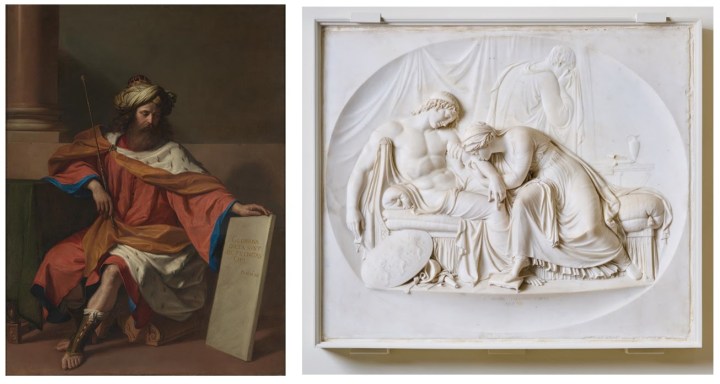
Left: Guercino, King David, 1651, oil on canvas, 224 × 170 cm (Accepted in lieu of Inheritance Tax by HM Government and allocated to the National Gallery). Right: John Deare, Edward and Eleanor, 1790, marble (Accepted in Lieu of Inheritance Tax from the Estate of Jacob, 4th Baron Rothschild and allocated to the Victoria and Albert Museum).
◊ ◊ ◊ ◊ ◊
From the press release:
The legacy of UK cultural luminary Jacob, 4th Baron Rothschild (1936–2024) is being celebrated by two of his artworks joining the collections of the National Gallery and the V&A, through the Acceptance in Lieu scheme. The National Gallery—where Jacob, 4th Baron Rothschild served as Chair of Trustees between 1985 and 1998—will receive King David (1651) by renowned Bolognese painter Giovanni Francesco Barbieri (1591–1666), known as Guercino, reuniting it with the two works both created to be its pendant, already part of the Trafalgar Square collection. The V&A will receive the marble relief Edward and Eleanor (1790) by John Deare (1759–1798), one of the most talented neoclassical sculptors working at the end of the 18th century.
Jacob, 4th Baron Rothschild, in addition to chairing the National Gallery, led the National Lottery Heritage Fund and the family’s flagship, Waddesdon Manor. He supported many causes, some close to his home in Buckinghamshire, others as far afield as Albania, Greece, Israel, and the United States. He was committed to helping communities, the environment, education and above all, the arts. His exemplary service to his country was recognised on several occasions, with a GBE, a CVO and as a member of the Order of Merit.
His daughter, Dame Hannah Rothschild—who also served as Chair of the National Gallery—said, “My father, Jacob, was a devoted patron of the arts and a steadfast champion of the National Gallery. He regarded Guercino’s King David, a masterwork of the Italian Baroque, as one of the crowning acquisitions of his lifetime. It was his wish to see King David reunited with its two Sibyls at the National Gallery and his family is grateful to the AIL Panel and to the National Gallery for giving it a distinguished home amongst such illustrious company. The exquisite marble relief by John Deare is of such rarity and importance that my father, Jacob, felt it must find its home in a national institution. Our family is delighted that the AIL Panel and the V&A have accepted this bequest, fulfilling his vision with such care and distinction.”
◊ ◊ ◊ ◊ ◊
Celebrated as one of the most innovative and gifted British neoclassical sculptors, John Deare (1759–1798) spent most of his career in Rome, where the relief of Edward and Eleanor was carved in 1790. Due to his early death at age 38, his production was limited to around fifty documented works, though very few of these are known today. The majority were reliefs of classical and allegorical subjects or related to English history, commissioned by British Grand Tourists to decorate their country houses.
Until now, only two other marble sculptures by Deare were held in British public collections: Cupid and Psyche (1791) at the Bradford District Museums & Galleries and Julius Caesar Invading Britain (1796) acquired by the V&A in 2011 (on display in the Hintze Gallery, G22). Plaster versions of the Edward and Eleanor composition are held at Wimpole Hall and at the Walker Art Gallery.
The relief depicting Eleanor of Castile sucking poison from the wound of Prince Edward (later Edward I) will be installed in the British Galleries (G119) at V&A South Kensington later this year—the first time it has been on public display. In this exceptional relief, which demonstrates Deare’s virtuoso technique in carving marble with great subtlety, the sculptor has adapted an episode of medieval British history into a depiction of Greek history, in a refined neoclassical style.
The work is of particular interest to the V&A, as it predates the Caesar Invading Britain relief and shows various sources of inspiration in the composition, including the paintings of Angelika Kauffman. The V&A also holds several albums of drawings by John Deare, including a study of a woman (E.260-1968) believed to be preparatory for the figure of Eleanor.
Much remains to be discovered about Deare’s production. The V&A is hosting an international conference on 16 and 17 May 2025 on the theme of sculptural exchanges between Italy and Britain in the 18th and 19th centuries, where the relief will be the focus of a spotlight presentation, marking the start of a new line of research into the artist’s work.
Tristram Hunt, Director of the V&A, said: “These remarkable acquisitions, made possible by the Acceptance in Lieu scheme, will forever represent Lord Rothschild’s legacy as a great connoisseur, champion of the arts and relentless supporter of British cultural institutions.”
John Deare (1759–1798) Edward and Eleanor: Accepted in Lieu of Inheritance Tax from the Estate of Jacob, 4th Baron Rothschild and allocated to the Victoria and Albert Museum. The acceptance of this sculpture settled £1,120,000 in tax.
Additional information about Guercino’s King David is available from the full press release»










 Enfilade
leave a comment