New Book | The Cinematic Eighteenth Century
From Routledge:
Srividhya Swaminathan and Steven Thomas, eds., The Cinematic Eighteenth Century: History, Culture, and Adaptation (New York: Routledge, 2018), 196 pages, ISBN: 978 11386 33995, $150.
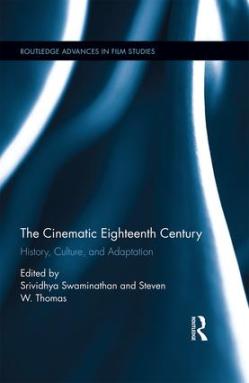 This collection explores how film and television depict the complex and diverse milieu of the eighteenth century as a literary, historical, and cultural space. Topics range from adaptations of Austen’s Sense and Sensibility and Defoe’s Robinson Crusoe (The Martian) to historical fiction on the subjects of slavery (Belle), piracy (Crossbones and Black Sails), monarchy (The Madness of King George and The Libertine), print culture (Blackadder and National Treasure), and the role of women (Marie Antoinette, The Duchess, and Outlander). This interdisciplinary collection draws from film theory and literary theory to discuss how film and television allows for critical re-visioning as well as revising of the cultural concepts in literary and extra-literary writing about the historical period.
Srividhya Swaminathan is Professor of English at LIU Brooklyn in New York. Her primary field of research is the rhetoric of eighteenth-century slavery studies and social movements. Her monograph, Debating the Slave Trade (Ashgate 2009), and co-edited collection, Invoking Slavery in the Eighteenth-Century British Imagination (Ashgate 2013), engage with slavery in a transatlantic context.
Steven W. Thomas is Associate Professor of English at Wagner College in New York, where he teaches American literature, theory, and film studies. He has published several scholarly essays about the transatlantic eighteenth century and in 2016, he was a Fulbright Scholar in the graduate film program at Addis Ababa University in Ethiopia.
C O N T E N T S
List of Figures
Acknowledgments
Srividhya Swaminathan and Steven Thomas, Introduction: Representing and Repositioning the Eighteenth Century on Screen
1 Ula Lukszo Klein, Fashionable Failures: Ghosting Female Desires on the Big Screen
2 Dorothée Polanz, Portrait of the Queen as a Celebrity: Marie Antoinette on Screen, a Disappearing Act, 1934–2012
3 Elizabeth Kraft, The King on the Screen
4 Jennifer Preston Wilson, ‘I Have You in My Eye, Sir’: The Spectacle of Kingship in The Madness of King George
5 Sarah B. Stein and Robert Vork, Blackadder: Satirizing the Century of Satire
6 Colin Ramsey, Disney’s National Treasure, the Declaration of Independence, and the Erasure of Print from the American Revolution
7 Courtney A. Hoffman, How to Be a Woman in the Highlands: A Feminist Portrayal of Scotland in Outlander
8 Kyle Pivetti, The King of Mars: The Martian’s Scientific Empire and Robinson Crusoe
9 Srividhya Swaminathan, The New Cinematic Piracy: Crossbones and Black Sails
10 Jodi L. Wyett, Sex, Sisterhood, and the Cinema: Sense and Sensibility(s) in Conversation
11 Steven W. Thomas, Cinematic Slavery and the Romance of Belle
List of Contributors
Index
Exhibition | The World Turned Upside Down

Benjamin West, Death on the Pale Horse, 1796, oil on canvas, 128.5 × 59.5 cm
(Detroit Institute of Arts)
◊ ◊ ◊ ◊ ◊
Now on view at the Haggerty Museum of Art:
The World Turned Upside Down: Apocalyptic Imagery in England, 1750–1850
Haggerty Museum of Art, Marquette University, Milwaukee, 6 October 2017 — 14 January 2018
All that can be annihilated must be annihilated
That the Children of Jerusalem may be saved from slavery.
–William Blake, Milton, ca. 1804–11
The threat of apocalyptic destruction loomed large in eighteenth- and nineteenth-century England, which stood as one of the most powerful nations in the world. Cataclysmic change occurred frequently within and beyond its borders. Political upheavals, natural disasters, and new foreign adversaries led many to believe that the end was at hand. The French Revolution of 1789 in particular was widely seen as the spark of the oncoming apocalypse—whether this was a source of celebration or fear was a matter of significant debate.
At the same time, England’s artistic activity was growing significantly. The Royal Academy of Arts was founded in 1768, and London’s art market saw exponential expansion. In this political and cultural climate, audiences were eager for subjects of destruction and terror. The rise of Romanticism, with its emphasis on the supernatural, grotesque, and terrifying, led artists to explore apocalyptic sources from the Bible to John Milton. Caricaturists couched contemporary events in the language of the apocalypse. Despite their satirical nature, these images often seem prophetic in light of the political changes to come.
The World Turned Upside Down explores the myriad ways that artists in England visualized the apocalypse in a period fraught with political, religious, economic, and cultural change. From political prints to monumental paintings, lavishly illustrated books to cheap pamphlets, apocalyptic imagery pervaded every aspect of English visual culture in this period. The diversity of artistic responses to the dramatic events of the time makes one thing clear: anxiety about the future—of one’s soul and of the English nation as a whole—was inescapable.

William Hogarth, Tailpiece, or The Bathos (detail), 1764, etching and engraving, 31.8 × 33.3 cm
(New York: The Metropolitan Museum of Art)
New Book | The Building Site in Eighteenth-Century Ireland
From Four Courts Press:
Arthur Gibney, The Building Site in Eighteenth-Century Ireland, edited by Livia Hurley and Edward McParland (Dublin: Four Courts Press, 2017), 368 pages, ISBN: 978 184682 6382, €35.
 This study by the late Arthur Gibney takes you among labourers, craftspeople, contractors, builders, and designers as they populate the building sites of eighteenth-century Ireland. Gibney tells a story that has never been told so comprehensively before. What kind of contracts bound those involved? How much did it cost to bring a cargo of oak to the Dublin docks from Riga or Shillelagh—or of fir from Trondheim—and what kind of roof trusses or floor framing was it used for? What was distinctively Irish about these structural features? What did plumbers do? How did roofers choose between slates and shingles and pantiles, and how did this choice affect the profile of a roof? Based on extensive documentary research and on a lifetime of experience of building and conservation, Gibney takes the interested layperson, the student, the architect, and the conservationist behind the facades to give us an understanding of paint colours such as Venetian red and Spanish brown, the manufacture of stucco, the variations of Irish, English, and French glass, the composition of masonry walls, and much more, in our great legacy of Georgian buildings.
Arthur Gibney was one of Ireland’s most notable twentieth-century architects. Livia Hurley is an architect and architectural historian in private practice in Dublin. She is one of five editors and principal authors of Architecture, 1600–2000, volume IV of Art and Architecture of Ireland (2014), and she teaches at the School of Architecture, UCD. Edward McParland is a fellow emeritus of TCD. His publications include James Gandon, Vitruvius Hibernicus (1985) and Public Architecture in Ireland, 1680–1760 (2001).
Exhibition | Global Encounters and the Archives: Britain’s Empire
Opening this month at the Lewis Walpole Library:
Global Encounters and the Archives: Britain’s Empire in the Age of Horace Walpole
The Lewis Walpole Library, Farmington, CT, 20 October 2017 — 2 March 2018
Curated by Justin Brooks, Heather Vermeulen, Steve Pincus, and Cynthia Roman
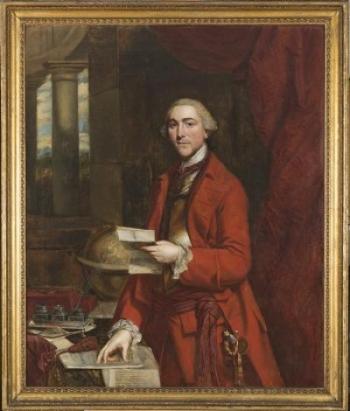
Barrett Ranelagh, Portrait of General Henry Seymour Conway (The Lewis Walpole Library, Yale University).
As part of the year-long celebrations of the 300th anniversary of Horace Walpole’s birth, Global Encounters and the Archives: Britain’s Empire in the Age of Horace Walpole draws on the Lewis Walpole Library’s rich collections to bring Walpole’s global interests to light. As befitting the son of a prime minister (Sir Robert Walpole), the nephew of the auditor-general of the Revenue of America (Horatio Walpole), and the close friend of a secretary of state (Henry Seymour Conway) who oversaw important imperial affairs, Horace Walpole well understood the partisan conflicts that helped shape the British Empires. A lively collaboration between the Lewis Walpole Library and Yale faculty and graduate students, this exhibition takes full advantage of the diverse range of archival resources and special collections held by the Library, including manuscripts, printed texts, and graphic images in presenting conflicting visions of empire through the domains of political economy, diplomacy, slavery, and indigenous peoples.
In association with this exhibition, the library will sponsor a two-day conference in New Haven on 9-10 February 2018. The conference papers will present new archival-based research on Britain’s global empire in the long eighteenth century.
Curated by Justin Brooks (Doctoral Candidate in History, Yale University), Heather V. Vermeulen, (Ph.D., Lecturer in African American Studies, Yale University), Steve Pincus (Bradford Durfee Professor of History, Yale University), and Cynthia Roman (Curator of Prints, Drawings, and Paintings, The Lewis Walpole Library).
◊ ◊ ◊ ◊ ◊
George Haggerty, The Many Lives of Horace Walpole
Yale Center for British Art, New Haven, 26 October 2017
In his charming biography of Horace Walpole, R.W. Ketton-Cremer makes the point that “one of the difficulties which confront a biographer of Walpole is his remarkable versatility. He was active in many fields—in politics, social life, literature, architecture, antiquarianism, printing, virtú; and it is not easy to include them all in the compass of a single volume.” George Haggerty, who is currently writing a new biography of Horace Walpole, will take up this challenge in his lecture with and through Walpole’s letters. Haggerty asserts that Walpole writes himself into his experience by means of his epistolary imagination. George E. Haggerty is the Distinguished Professor and Chair of the Department of English at the University of California, Riverside. Yale Center for British Art Lecture Hall, Thursday, 26 October 26 2017, 5:30pm.
Queer Biography and the Archives: A Roundtable with George Haggerty
Beinecke Rare Book and Manuscript Library, New Haven, 27 October 2017
Discussants include Abby Coykendall, Jason Farr, Caroline Gonda, Paul Kelleher, Ellen Malenas Ledoux, Susan Lanser, and Timothy Young. Friday, 27 October 2017, 2:30–4:45pm. Registration is required. For questions and further information, please contact Cynthia Roman cynthia.roman@yale.edu.
◊ ◊ ◊ ◊ ◊
Justin Brooks, Global Encounters in the Archives: Britain’s Empire in the Age of Horace Walpole
The Lewis Walpole Library, Farmington, CT, 1 November 2017
Justin Brooks, Doctoral Candidate in History, Yale University, will speak on the the Lewis Walpole Library’s exhibition Global Encounters in the Archives: Britain’s Empire in the Age of Horace Walpole. The exhibition, which looks at aspects of the global British Empire in the long eighteenth century, takes full advantage of the diverse range of archival resources held by the Library and which Mr. Brooks co-curated, including manuscripts, printed texts, graphic images, and objects. Interrelated themes include political economy, diplomacy, indigeneity, and slavery. The talk, exhibition, and other related programs celebrate the broad pre-disciplinary collecting activities of Horace Walpole (1717–1797) and W.S. Lewis (1895–1979) and will explore how current multi-disciplinary methodologies invite creative research in the Library’s archival collections. Mr. Brooks’s talk is offered as part of a year’s worth of events celebrating the 300th anniversary of Horace Walpole’s birth. This Lewis Walpole Library lecture is held in partnership with the Farmington Libraries. Wednesday, 1 November 2017, 7:00pm. Space is limited, and registration is required.
Symposium | The Greenwich and Foundling Hospitals

From The Foundling Museum:
Art, Charity, and the Navy: The Greenwich and Foundling Hospitals
Greenwich and London, 30 October 2017
In this one-day symposium explore similarities in the origins, artistic involvement, and philanthropic purpose of the Foundling Hospital and the Greenwich Royal Hospital for Seamen.
The Foundling Hospital and the Greenwich Royal Hospital are eighteenth-century institutions with many similarities, both charitable hospitals with strong ties to maritime Britain. The Foundling Hospital was the first children’s charity in Britain, established by Royal Charter in 1739 by Captain Thomas Coram, a shipwright in the American colonies. The Royal Hospital for Seamen, Greenwich, was established by Royal Charter in 1694 and from 1712 also incorporated a naval school.
Along with presentations and discussion with expert speakers, the day includes:
• A tour of the Chapel at the Old Royal Naval College, formerly the place of worship for the inhabitants of the Royal Hospital for Seamen
• The opportunity to see the Foundling Museum’s historic Court Room and Picture Gallery, displaying works of art by Hogarth, Gainsborough, Highmore, Ramsay, and many others
• A visit to the exhibition Basic Instincts
• Lunch, tea and coffee, and early evening drinks reception
Speakers include Will Palin (Director of Conservation, Old Royal Naval College), Christine Riding (Head of Arts and Curator of the Queen’s House), Caro Howell (Director of the Foundling Museum), and Jacqueline Riding (Honorary Research Fellow at Birkbeck, University of London, and Curator of the exhibition Basic Instincts).
Morning, Queen’s House, Royal Museums Greenwich and the Old Royal Naval College; afternoon, Foundling Museum. Participants will make their own way between the two sites. Tickets £50, £40 concessions and Foundling Friends.
The programme is available here»
Images: Left, Samuel Wale, Greenwich Hospital, ca. 1748 (London: The Foundling Museum) and right, Richard Wilson, The Foundling Hospital, ca. 1746–50 (London: The Foundling Museum).
Call for Papers | Feminist Art History Conference
Feminist Art History Conference
American University, Washington, D.C., 28–30 September 2018
Proposals due by 1 December 2017
This conference builds on the legacy of feminist art-historical scholarship and pedagogy initiated by Norma Broude and Mary D. Garrard at American University. With the goal of fostering a broad dialogue on feminist art-historical practice, the event will feature papers spanning a range of chronological, geographic, and intersectional topics.
Papers may address such topics as: artists, movements, and works of art and architecture; cultural institutions and critical discourses; practices of collecting, patronage, and display; the gendering of objects, spaces, and media; the reception of images; and issues of power, agency, gender, and sexuality within visual cultures. Submissions on under-represented art-historical fields, national traditions, and issues of race and ethnicity are encouraged. We welcome submissions from established and emerging scholars of art history as well as advanced graduate students.
To be considered for participation, please provide a single document in Microsoft Word. It should consist of a one-page, single-spaced proposal of unpublished work up to 500 words for a 20-minute presentation, followed by a curriculum vitae of no more than two pages. Please name the document “[last name]-proposal” and submit with the subject line “[last name]-proposal” to feminist.ahconference@gmail.com.
Invitations to participate will be sent by 1 February 2018.
Keynote Speaker
Amelia Jones, Robert A. Day Professor in Art and Design and Vice-Dean of Critical Studies at the Roski School of Art and Design, University of Southern California
Organizing Committee
Joanne Allen, Juliet Bellow, Norma Broude, Kim Butler Wingfield, Nika Elder, Mary D. Garrard, Helen Langa, Andrea Pearson, and Ying-chen Peng
Sponsored by the Art History Program and the Department of Art, College of Arts and Sciences, American University
Lecture Series | L’art de l’Ancien Régime
From H-ArtHist:
Lecture Series: L’art de l’Ancien Régime
Deutsches Forum für Kunstgeschichte / Centre allemand d’histoire de l‘art, Hôtel Lully, Paris, 11 October — 4 December 2017
Le Centre allemand d’histoire de l’art organise des conférences publiques dans le cadre de son sujet annuel 2017/18 L’art de l’Ancien Régime – centres, acteurs, objets (Die Kunst des Ancien Régime – Zentren, Akteure, Objekte). Nous avons le plaisir d’accueillir au premier semestre:
11 October 2017, 18.00
Sophie Raux (Université Lumière Lyon 2), Explorer virtuellement un haut lieu du commerce d’art, à Paris, sous la Régence: Gersaint, Watteau et le Pont Notre-Dame
24 October 2017, 18.00
Hannah Williams (Queen Mary University of London), Inside a Parish Church: Art and Religion in 18th-Century Paris
7 November 2017, 18.00
Ulrike Gehring (Universität Trier), Land in Sicht. Verfahren der Landkartierung bei küstennaher Fahrt um 1600
4 December 2017, 18.00
Olivier Bonfait (Université de Bourgogne), Un enjeu national pour la peinture française aux XVIIe et XVIIIe siècles : le grand format
Exhibition | Monochrome: Painting in Black and White
Press release (August 2017) from The National Gallery:
Monochrome: Painting in Black and White
The National Gallery, London, 30 October 2017 – 18 February 2018
Museum Kunstpalast, Düsseldorf, 21 March — 15 July 2018
Curated by Lelia Packer and Jennifer Sliwka
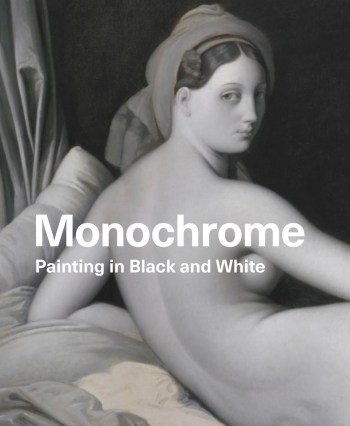 At the National Gallery this autumn, journey through a world of shadow and light. With more than fifty painted objects created over 700 years, Monochrome: Painting in Black and White is a radical new look at what happens when artists cast aside the colour spectrum and focus on the visual power of black, white, and everything in between.
Paintings by Old Masters such as Jan van Eyck, Albrecht Dürer, Rembrandt van Rijn, and Jean-Auguste-Dominique Ingres appear alongside works by some of the most exciting contemporary artists working today including Gerhard Richter, Chuck Close, and Bridget Riley. Olafur Eliasson‘s immersive light installation Room for One Colour (1997) brings a suitably mind-altering coda to the exhibition. With major loans from around the world and works from the National Gallery’s Collection, Monochrome reveals fresh insights into the use of colour as a choice rather than a necessity.
As Lelia Packer and Jennifer Sliwka, curators of Monochrome: Painting in Black and White, explain: “Painters reduce their colour palette for many reasons but mainly as a way of focusing the viewer’s attention on a particular subject, concept, or technique. It can be very freeing—without the complexities of working in colour, you can experiment with form, texture, mark making, and symbolic meaning.”
Monochrome: Painting in Black and White guides visitors through seven rooms, each addressing a different aspect of painting in black, white and grey, also known as grisaille.
Sacred Subjects
The earliest surviving works of Western art made in grisaille were created in the Middle Ages for devotional purposes, to eliminate distractions and focus the mind. As colour pervades daily life, black and white can signal a shift to an otherworldly or spiritual context. For some, colour was the forbidden fruit and prohibited by religious orders practising a form of aesthetic asceticism. Grisaille stained glass, for example, was created by Cistercian monks in the 12th century as an alternative to vibrant church windows, with its translucent greyish panels sometimes painted with images in black and yellow. Light and elegant in appearance, grisaille glass such as this window panel made for the Royal Abbey of Saint-Denis, Paris (1320–24, Victoria and Albert Museum, London) gained popularity outside the order and eventually became de rigueur in many French churches.
Studies in Light and Shadow
From the 15th century onward artists made painted studies in black and white to work through challenges posed by their subjects and compositions. Eliminating colour allows artists to concentrate on the way light and shadow fall across the surface of a figure, object or scene before committing to a full-colour canvas. The beautiful Drapery Study (possibly study for Saint Matthew and an Angel), (about 1477, Kupferstichkabinett, Staatliche Museen zu Berlin) attributed to Domenico Ghirlandaio is a template work which an artist could reuse in multiple finished colour paintings. This particular motif for example reappeared in a frescoed vault in San Gimignano, Italy.
Independent Paintings in Grisaille
Increasingly, paintings in grisaille were made as independent works of art, complete unto themselves. This section explores the inspiration and desire for such paintings, prized for their demonstration of artistic skill, for the insights they provide into the artist’s craft, and for their profound consideration of a particular subject.
Jan van Eyck’s Saint Barbara (1437, Royal Museum of Fine Arts Antwerp) is the earliest known example of a monochrome work on panel, drawn in metalpoint, India ink, and oil on a prepared ground. Although there has been ongoing debate as to whether a master colourist such as van Eyck intended Saint Barbara as a sketch in preparation for a painting in colour or a as a finished drawing, the panel was admired and collected as early as the 16th century suggesting that a taste for independent monochrome pictures existed from an early date.
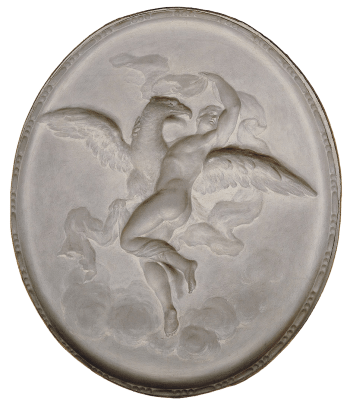
Jacob de Wit, Jupiter and Ganymede, 1739 (Hull: Ferens Art Gallery).
Monochrome Painting and Sculpture
For centuries artists have challenged themselves to mimic the appearance of stone sculpture in painting. In Northern Europe, a taste for illusionistic decorative elements—such as decorative wall painting and sculpted stucco—may have helped give rise to stunning works of trompe l’oeil painted on panel or canvas. Jacob de Wit excelled at this practice and his Jupiter and Ganymede (1739, Ferens Art Gallery, Hull) could easily be mistaken for a three-dimensional wall relief.
Monochrome Painting and Printmaking
Beginning in the 16th century, painters developed ingenious ways to compete with new developments in printmaking. An exceptionally rare grisaille work by Hendrik Goltzius, Without Ceres and Bacchus, Venus Would Freeze (1606, the State Hermitage Museum, St Petersburg) for example, dazzled viewers who could not fathom how it was made, as it very much looks like a print but was drawn by hand on prepared canvas.
Black-and-White Painting in the Age of Photography and Film
Similarly, the invention of photography in 1839, and that of film much later, prompted painters to imitate the effects of these media, in order to respond to, or compete with their particular qualities. Gerhard Richter employed a press photograph of a prostitute who had been brutally murdered as the foundation of his painting Helga Matura with Her Fiancé (1966, Museum Kunstpalast, Düsseldorf). The grey palette—for Richter, “the ideal colour for indifference”—removes any sentimentality about Helga’s murder. By deliberately blurring the photograph, the artist makes the viewer aware that this is an altered image, contrasting with the crispness and apparent objectivity of the original.
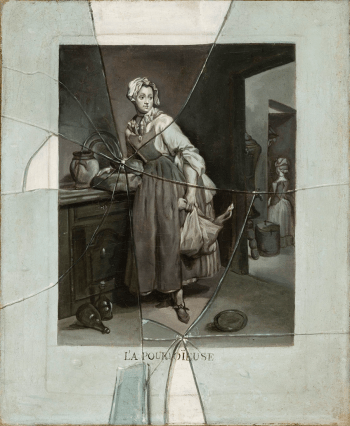
Étienne Moulinneuf, after Jean-Siméon Chardin, Back from the Market (La Pourvoyeuse), ca. 1770, oil on canvas, 46 × 38 cm (Los Angeles: LACMA).
Abstraction
Abstract and installation artists have often been drawn to black and white. When artists have ready access to every possible hue, the absence of colour can be all the more shocking or thought-provoking. In 1915, Kiev-born artist Kazimir Malevich painted the first version of his revolutionary work, Black Square (in the exhibition is the 1929 version from the State Tretyakov Gallery, Moscow)—an eponymous black square floating within a white painted frame—and declared it to be the beginning of a new kind of non-representational art. Works by Josef Albers, Ellsworth Kelly, Frank Stella, and Cy Twombly all exemplify the use of minimal colour for maximum impact.
Artists intrigued by colour theory and the psychological effects of colour (or its absence) manipulate light, space, and hue to trigger a particular response from the viewer. In this way, Olafur Eliasson brings the exhibition to a close with his large-scale, immersive light installation, Room for One Colour (1997). In a room illuminated with sodium yellow monofrequency lamps, all other light frequencies are suppressed and visitors are transported to a monochrome world.
National Gallery Director, Dr Gabriele Finaldi, says: “Artists choose to use black and white for aesthetic, emotional, and sometimes even for moral reasons. The historical continuity and diversity of monochrome from the Middle Ages to today demonstrate how crucial a theme it is in Western art.”
Exhibition organised by The National Gallery in collaboration with Museum Kunstpalast, Dusseldorf.
Lelia Packer and Jennifer Sliwka, Monochrome: Painting in Black and White (London: The National Gallery, 2017), 240 pages, ISBN: 978 18570 96132 (hardback), £35 / ISBN: 978 18570 96132 (paperback), £20.
Lelia Packer is Acting Curator of Paintings, Watercolours, Miniatures, and Manuscripts (excluding France) at the Wallace Collection, London. She was formerly McCrindle Curatorial Assistant at The National Gallery.
Jennifer Sliwka is Deputy Director of the Visual Commentary on Scripture Project and Senior Research Fellow, King’s College London. She was formerly Ahmanson Curator of Art and Religion at The National Gallery.
Call for Essays | Dix-huitième Siècle No 51: La Couleur des Lumières
From H-ArtHist:
Dix-huitième Siècle No 51: La Couleur des Lumières
Edited by Aurélia Gaillard and Catherine Lanoë
Proposals due by 30 November 2017; with final articles due by June 2018
Le dossier thématique de la revue DHS n° 51 sera consacré au thème de la « couleur des Lumières » et l’envisage comme suit : d’abord, qu’en est-il de la place de la couleur au 18e siècle ? Peut-on parler de ce siècle comme d’un univers coloré ? Et si oui, quelle en serait la couleur ou quelles en seraient les couleurs ? N’y aurait-il pas alors un siècle clivé en deux, l’un coloré (couleur de rose, couleur du rococo), l’autre blanc hygiénique (traités de blanchiment, blancheur des marbres classiques) ? Enfin, qu’en est-il de la couleur dans les textes littéraires ? À quel moment, dans quels textes, dans quels genres, chez quels auteurs passe-t-on de l’évocation abstraite des somptueux « ornements » et subtiles « grâces » à des descriptions colorées ? Y a-t-il par exemple des auteurs, des genres coloristes et d’autres non ? Et comment, pour des textes, des mots, penser une poétique de la couleur qui ne soit pas une rhétorique des images ?
Ainsi, si la subjectivité de l’être percevant conçu comme homme sensible à l’âge des Lumières a été une question majeure des recherches depuis ces dernières décennies, la valorisation corollaire des sensations chromatiques a été un peu délaissée. Il s’agit donc de mettre en évidence l’importance de la couleur dans le monde des Lumières : théories, débats, inventions, expériences, synesthésies, discours, représentations, poétique.
Les contributions pourront alors aborder les axes suivants relevant principalement de 4 paradigmes :
1) Un paradigme scientifique, la science de la couleur : de Newton (Opticks, 1704) à Goethe (Traité des couleurs, 1808).
2) Un paradigme médical et philosophique, sensualisme, sens et sensations colorés.
3) Un paradigme historique et anthropologique :
• Histoire matérielle de la couleur et des teintures : art de la peinture, de l’émail, du verre, de la porcelaine, des tissus, teintures, chimie, manuels d’art tinctorial, de blanchiment etc.
• « Les couleurs du corps » (Michel Delon dans Angelica Gooden dir., The Eighteenth-Century Body, Peter Lang, 2002) : la « couleur de chair », incarnat, rougeurs/blancheurs d’où surgit tout à coup par exemple le bleu des veines etc.
• La cosmétique, le fard rouge et le blanc de céruse (C. Lanoë, « La céruse dans la fabrication des cosmétiques… », Techniques et Culture, n°38, 2002 ; « le rouge des Lumières… », Sociétés et représentations, n°25, 2008), les encres bleues (Solange Simon-Mazoyer, « Le conflit entre les excès de la mode et de la santé au XVIIIe siècle : ‘l’habillage’ du visage », dans V. Barras et M. Louis-Courvoisier dir., La médecine des Lumières, Georg Éd., 2001)
4) Un paradigme esthétique, un visuel coloré : à la suite de la Querelle du Coloris (de Piles), on assiste à une apologie de la couleur, du stuc, de l’illusion (J. Lichtenstein, La couleur éloquente, Flammarion, 1989). Le coloriste Charles La Fosse devient recteur de l’Académie royale de Peinture et Sculpture en 1702. Diderot développe ses « Petites idées sur la couleur » (Essais sur la peinture, 1765). Mais le 18e siècle est aussi celui de l’invention de la couleur « rose », qui reste nommée pendant tout le siècle par le nom de la fleur (couleur de rose).
Pour recevoir l’appel à contribution complet, contacter Aurélia Gaillard. Les propositions de contributions uniquement en français sont à adresser simultanément à Aurélia Gaillard (aurelia.gaillard@gmail.com) et Catherine Lanoë (catherine_lanoe@hotmail.com) sous forme d’un titre et d’un résumé d’une quinzaine de lignes avant le 30 novembre 2017. Les articles définitifs seront à rendre pour juin 2018.
Call for Papers | Interior Design and Style Cohabitation
From H-ArtHist:
Interior Design and Style Cohabitation from the Eighteenth to the Twentieth Century
Institut National d’Histoire de l’Art, Paris, 19 March 2018
Proposals due by 6 November 2017
This study day will question the adaptation in domestic spaces, as a common and pragmatic custom, of objects that originally were not destined to meet, playing despite or with their differences. This theme was recently addressed by the Galerie des Gobelins with the exhibition À table avec le mobilier national, where eighteenth-century paintings, paperboards, and wall hangings from the royal manufacture oversaw fifty years of furniture creation by the Atelier de Recherche et de Création (1964–2014).
While it is common in the field of art history to encounter examples of interiors where the decorative harmony was conceived according to the ideal of a ‘total work of art’, the opposite will be examined. The assortment in a common space of objects from different periods and the ensuing reflections brought up by these unexpected, sometimes surprising, convergences will be our object of interest. When, for example, was it intended for eighteenth-0century furniture to be associated and fit in with an Impressionist painting? Was this type of seemingly insignificant practice theorized ahead of time or retrospectively?
This subject is linked to the history of taste. While a few publications devoted to collectors’ arrangements of domestic spaces have pointed out some individuals who wished to harmonize old furniture to a modern art collection, on the contrary, examples of modern furniture confronted with old works of art could be discussed during this study day.
Far from the historically based mechanism, already well studied for the nineteenth century for example (Antiquity, neo-gothic or neo-Renaissance decor and furniture), the debate here will focus on the practical necessity for a collector, dealer, or individual to design an interior with modern paintings and old furniture—or inversely—that is elements apparently disparate by their age, forms, and uses.
This thematic raises questions relating to the flexibility of fine arts and decorative arts and confronts the values and/or practices associated with the work of art, considered as a decorative element, as well as a utilitarian object of art, equally appreciated for its plastic qualities.
While composing an interior can extend to the private space, the artist’s studio, or demonstrations of domestic spaces in art galleries and department stores, the study can even include how these spaces were spread to the public by images. We will aim to define what type of media participated in this transmission. The literature and the press play for example a significant role in the circulation of these interior views and the values to which they are linked.
The study day suggests—but is not limited to—several topics:
• Paintings’ or art objects’ adaptability, flexibility or modular nature
• Migration or confusion of values and contemplative behaviors and practices when faced with paintings and furniture
• Authorship and collectors’ and decorators’ creative and recreational motivations
Proposals that extend their analysis to other types of objects and collections, particularly to sculpture, will also be reviewed with the greatest interest. Please submit an individual proposal of no more than 500 words and a CV to barbara.jouves@univ-paris1.fr and hadrien.viraben@gmail.com by 30 November 2017.
Organization: Claire Hendren (Ph.D. candidate, Université Paris-Nanterre), Barbara Jouves (Ph.D. candidate, Université Paris 1 Panthéon-Sorbonne), and Hadrien Viraben (Ph.D. candidate, Université de Rouen and Université Paris-Nanterre)










leave a comment