The Bilbao Fine Arts Museum Acquires Paret’s ‘View of Bermeo’
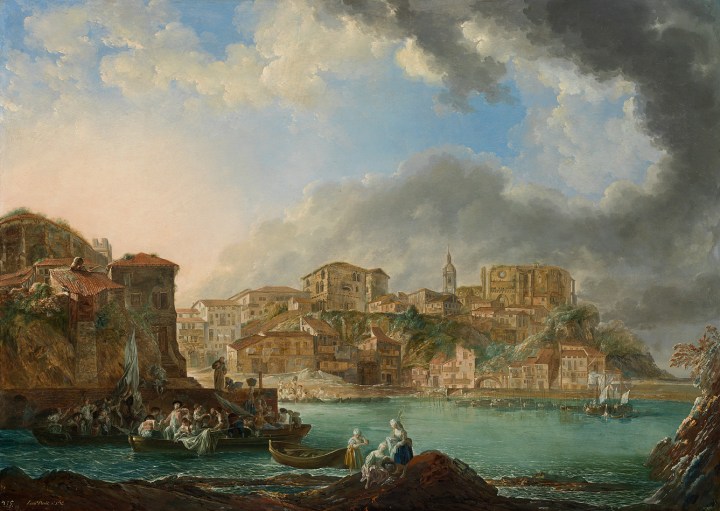
Luis Paret y Alcázar, View of Bermeo, 1783
(Bilbao: El Museo de Bellas Artes)
◊ ◊ ◊ ◊ ◊
The Bilbao Fine Arts Museum presents View of Bermeo of 1783 by Luis Paret y Alcázar (1746–1799), acquired from the heirs of José Luis Várez Fisa. The painting has been obtained with an interest-free loan thanks to the sponsorship of BBK, to be repaid over the following years with the contribution from the Friends of the Museum.
In addition to its undoubted artistic value, View of Bermeo of 1783 is of enormous historical interest given that it is considered the first work in a series of paintings depicting the ports of Cantabria and is the first view of the Basque Country painted by this artist from Madrid. Born in the same year as Goya, Paret led a storied life, resulting in his banishment, first to Puerto Rico and then to Bilbao, which prevented him from maintaining his prominent position at Court, a fact that to some extent favoured Goya’s professional success. At that point the Basque Country had almost no artistic tradition, for which reason the presence of a painter of Paret’s importance can be considered a remarkable artistic event and one that was decisive for its artistic and cultural evolution.
View of Bermeo is one of the most outstanding works of 18th-century Spanish painting and can be considered the first surviving modern and purely artistic image of a location in the Basque Country. This oil, which is in excellent condition despite its delicate copper support, perfectly combines a carefully devised composition and setting with an exquisite, detailed finish. Paret presented the scene as a social encounter in which he dignified local people and customs, offering an unprecedented visual record in the context of the Basque Country. The panel was painted in 1783 for the future Charles IV, son of Charles III and at that date Prince of Asturias, possibly with the aim of facilitating the end of Paret’s banishment which was imposed on him in 1775 due to his involvement in the dissolute life of the Infante don Luis, younger brother of Charles III. Paret’s imposed exile was finally repealed in 1785. The artist conceived the work as a pair to another view of Bermeo (present whereabouts unknown) in which he depicted the port during a squall.
The Bilbao Fine Arts Museum has thus increased its holdings of the work of Luis Paret y Alcázar, and its collection now includes View of El Arenal in Bilbao, 1783–84; Scene of Villagers (fragment), 1786; View of Fuenterrabía (fragment), 1786; The Triumph of Love over War, 1784; The Virgin with the Christ Child and Saint James the Greater, 1786; The Holy Shepherd, 1782; and the recently acquired View of Bermeo, 1783.
More information about the painting and the artist are available here»
New Book | A World Trimmed with Fur
From Stanford UP:
Jonathan Schlesinger, A World Trimmed with Fur: Wild Things, Pristine Places, and the Natural Fringes of Qing Rule (Stanford: Stanford University Press, 2017), 288 pages, ISBN: 978 080479 9966, $65.
 In the eighteenth and nineteenth centuries, booming demand for natural resources transformed China and its frontiers. Historians of China have described this process in stark terms: pristine borderlands became breadbaskets. Yet Manchu and Mongolian archives reveal a different story. Well before homesteaders arrived, wild objects from the far north became part of elite fashion, and unprecedented consumption had exhausted the region’s most precious resources.
In A World Trimmed with Fur, Jonathan Schlesinger uses these diverse archives to reveal how Qing rule witnessed not the destruction of unspoiled environments, but their invention. Qing frontiers were never pristine in the nineteenth century—pearlers had stripped riverbeds of mussels, mushroom pickers had uprooted the steppe, and fur-bearing animals had disappeared from the forest. In response, the court turned to ‘purification’; it registered and arrested poachers, reformed territorial rule, and redefined the boundary between the pristine and the corrupted. Schlesinger’s resulting analysis provides a framework for rethinking the global invention of nature.
Jonathan Schlesinger is Assistant Professor of History at Indiana University.
C O N T E N T S
Introduction
1 The View from Beijing
2 Pearl Thieves and Perfect Order
3 The Mushroom Crisis
4 The Nature in the Land of Fur
Conclusion
Exhibition | Fragonard: The Fantasy Figures

Jean Honoré Fragonard, Sketches of Portraits, ca. 1769, drawing, 23 × 35 cm
(Private Collection, Paris)
◊ ◊ ◊ ◊ ◊
From the press release (11 July 2017) for the exhibition:
Fragonard: The Fantasy Figures
National Gallery of Art, Washington, D.C., 8 October — 3 December 2017
Curated by Yuriko Jackall
Combining art, fashion, science, and conservation, the revelatory exhibition Fragonard: The Fantasy Figures brings together—for the first time—a newly discovered drawing by Jean Honoré Fragonard (1732–1806) and some 14 of his paintings that have been identified with it including the Gallery’s own Young Girl Reading (c. 1769). Fragonard is considered among the most characteristic and important French painters of his era, and this series casts light on the development of his career, the identity of his sitters and patrons, and the significance of his innovative imagery. Fragonard: The Fantasy Figures and the fully illustrated catalog that accompanies it not only present new art-historical and scientific research into this series but also examine the 18th-century Parisian world in which these paintings were created. The exhibition may be seen only at the National Gallery of Art, Washington, in the West Building, from October 8 through December 3, 2017.

Jean Honoré Fragonard, Young Girl Reading, ca. 1769, oil on canvas, framed: 104.9 × 89.5 cm (National Gallery of Art, Washington, D.C., Gift of Mrs. Mellon Bruce in memory of her father, Andrew W. Mellon).
Covered with 18 thumbnail-sized sketches and apparently annotated in the rococo artist’s own hand, the drawing now known as Sketches of Portraits emerged at a Paris auction in 2012 and upended several long-held assumptions about the fantasy figures—a series of rapidly executed, brightly colored paintings of lavishly costumed individuals.
“The first exhibition to unite the fantasy figures with the recently discovered drawing focuses on this aspect of Fragonard’s production in a powerful and intimate way,” said Earl A. Powell III, director, National Gallery of Art, Washington. “We are grateful to the public and private collections, both here and abroad, that have generously lent to this exhibition, as well as to Lionel and Ariane Sauvage whose gift supported the catalog’s publication.”
Fragonard: The Fantasy Figures explores the many interpretations of this series in the context of the artist’s career. Fragonard strove to create a specific portrait type that showcased the painterly skill for which he was renowned. The fantasy figures also enabled him to experiment and to refine his ideas of artistic reference and emulation. Created within the competitive atmosphere of the Parisian art world, these works were influenced by a range of events, artworks, and visitors to his studio.
The fantasy figures depict men and women posed at leisure or employed in various pursuits, such as acting, reading, writing, playing instruments, or singing. Wearing extravagant attire, these figures are dressed in what was known in 18th-century France as à l’espagnole (Spanish style)—plumed hats, slashed sleeves, ribbons, rosettes, ruffs, capes, and accents of red and black. Shaped by artistic imagination, these paintings pushed the boundaries of accepted figure painting at the time.

Jean Honoré Fragonard, The Writer, ca. 1769, oil on canvas, framed: 115 x 91 cm (Paris: Musée du Louvre, Département des Peintures).
Exhibited for the first time is the newly discovered Sketches of Portraits (c. 1769), a thin sheet of paper with three rows of 18 small sketches—all but one are annotated with a name, 14 have been identified with one of Fragonard’s painted fantasy figures, and four remain unknown. The emergence of Sketches of Portraits prompted a two-year investigation of Young Girl Reading, conducted as a collaborative effort by the Gallery’s Yuriko Jackall, assistant curator of French paintings, John K. Delaney, senior imaging scientist, and Michael Swicklik, senior conservator of paintings. Published in the April 2015 issue of The Burlington Magazine, the findings established Young Girl Reading as a part of the fantasy figure series and shed light upon Fragonard’s approach to the ensemble as a whole.
Other works in the exhibition include the rarely lent, privately held portraits of the Harcourt brothers François-Henri, duc d’Harcourt (c. 1770) and Anne-François d’Harcourt, duc de Beuvron (c. 1770)—which are on view together for the first time since the 1987 exhibition Fragonard at The Metropolitan Museum of Art and the Musée du Louvre—as well as The Vestal (c. 1769–71), The Actor (c. 1769), and The Singer (c. 1769). Also on view is the Louvre’s M. de La Bretèche (c. 1769), which depicts the wealthy brother of one of Fragonard’s most devoted patrons, Jean-Claude Richard, abbé de Saint-Non.
The exhibition is curated by Yuriko Jackall, assistant curator, department of French paintings, National Gallery of Art.
Yuriko Jackall ed., with essays by Carole Blumenfeld, Kimberly Chrisman-Campbell, Jean-Pierre Cuzin, John Delaney, Elodie Kong, Satish Padiyar, and Michael Swicklik, Fragonard: The Fantasy Figures (London: Lund Humphries, 2017), 160 pages, ISBN: 978 184822 2489, £40 / $50.
 The fully illustrated catalog includes an overview and technical examination by Yuriko Jackall with John K. Delaney and Michael Swicklik, all at the National Gallery of Art, and essays by Carole Blumenfeld, research associate at the Palais Fesch-Musée des Beaux-Arts d’Ajaccio; Kimberly Chrisman-Campbell, fashion historian; Jean-Pierre Cuzin, former director of the department of paintings at the Musée du Louvre, Paris; Elodie Kong, an art historian specializing in the collecting habits of financiers in 18th-century Paris; and Satish Padiyar, senior lecturer in 19th-century European art at The Courtauld Institute of Art, London.
P R O G R A M M I N G
Lecture and Book Signing
An Introduction to the Exhibition—Fragonard: The Fantasy Figures
October 8, 2:00pm
East Building Auditorium
Yuriko Jackall, assistant curator, department of French paintings, National Gallery of Art
Lecture
Fashion à la Figaro: Spanish Style on the French Stage
November 26, 2:00pm
Kimberly Chrisman-Campbell, fashion historian
Concert
New York Opera Society
November 26, 3:30pm
West Building, East Garden Court
New York Opera Society performs The Three Lives of Rosina Almaviva
Exhibition | Alexandre-Évariste Fragonard
Now on view in Grasse:
Alexandre-Évariste Fragonard: Une Collection Grassoise
Villa-Musée Jean-Honoré Fragonard, Grasse, 1 July — 1 October 2017
Curated by Rébecca Duffeix with Côme Fabre
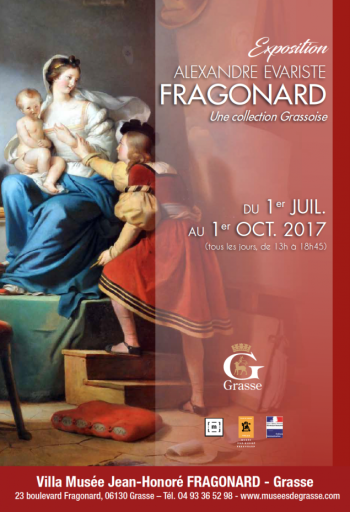 Né à Grasse le 26 octobre 1780 et mort le 11 novembre 1850 à Paris, Alexandre-Evariste Fragonard est le fils de Jean-Honoré. Considéré comme un enfant prodige, il expose au Salon à Paris dès 13 ans et est placé par son père dans l’atelier de David. Ses deux influences, néoclassique avec David et celle de la peinture amande et hollandaise qui lui vient de son père, vont être présentes dans ses œuvres tout au long de sa longue et proli que carrière de peintre, de sculpteur et de décorateur. Artiste of ciel très actif, il accepte de nombreuses commandes pour la manufacture de Sèvres et participe à plusieurs réalisations pour l’État sous l’Empire et la Restauration. Rattaché au courant Troubadour, son style demeure tout de même très enlevé et tumultueux. Il va également travailler dans le domaine de la gravure et participer notamment à l’édition des Voyages pittoresques et romantiques dans l’ancienne France du baron Taylor.
Injustement oublié aujourd’hui, Alexandre-Évariste Fragonard et son œuvre méritent largement d’être remis en lumière. Cette exposition estivale, du 1er juillet au 1er octobre 2017, a l’ambition de faire découvrir plus largement sa carrière à travers ses dessins et ses tableaux conservés dans notre collection grassoise.
Depuis la création des musées de Grasse dans les années 20 et l’ouverture de la Villa-musée Jean- Honoré Fragonard en 1977, les collections n’ont cessé de s’enrichir de dessins et de peintures de cet artiste pour constituer aujourd’hui une des collections publiques les plus importantes en France qui lui soit consacrée. Nous aurons ainsi le plaisir de présenter plusieurs dessins inédits, notamment des feuilles préparatoires à ses plafonds peints du Louvre, toujours en place, commande prestigieuse sous la Restauration pour le musée Charles X.
Le commissariat de l’exposition est assuré par Rebecca Duffeix, Docteur en Histoire de l’art et spécialiste de l’artiste, et nous avons eu l’honneur de béné cier également de la contribution de Côme Fabre, conservateur des peintures au Musée du Louvre.
The press release is available here»
The catalogue is available from ArtBooks.com:
Rebecca Duffeix and Olivier Quiquempois, Alexandre-Évariste Fragonard: Une Collection Grassoise (Milan: Silvana, 2017) 48 pages, ISBN: 978-8836636303, $23.
Exhibition | Caroline, Sister of Napoleon, Queen of the Arts
Now on view at the Palais Fesch (as noted at Napoleon.org). . .
Caroline, Sister of Napoleon, Queen of the Arts
Palais Fesch, Musée des Beaux-Arts, Ajaccio, Corsica, 30 June — 2 October 2017
Curated by Jehanne Lazaj and Maria Teresa Caracciolo with Laëtitia Giannechini
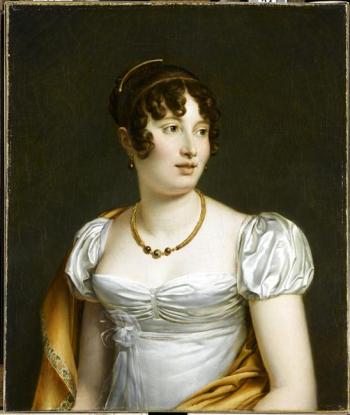
François Gérard, Portrait of Caroline Murat, Queen of Naples (Ajaccio: Palais Fesch, Musée des Beaux-Arts / Gérard Blot).
Caroline Bonaparte (1782–1839) was a woman of a complex and difficult temperament, yet she won over hearts by her beauty, culture, and spirit, along with a deep political intelligence that reflected her ambition. Napoleon affirmed in this respect: “Of all my family, she is the one that resembles me the most.” And while her political strategy has been much criticized, her keen intelligence, her great literary culture, her relationship with the artistic sphere, and her talents as a patron and collector have long been hidden.
If this exhibition intends to honour the younger sister of Napoleon, who has often been considered the ‘capricious’ one, its primary aim is to offer the widest possible panorama of the taste of an era and to give back to Caroline Murat the place which she deserves, that of a sovereign from both a political and artistic point of view. As a princess and later a dazzling queen, despite her almost tragic destiny, she embodied the giddy era in which she lived and which allowed her to encourage artistic creation as well as to enjoy the luxury, refinement, and strategies that power allowed her.
The exhibition is divided into five thematic sections presenting works and objects from the collections of the Palais Fesch and the Mobilier National, as well as loans from private collectors and large institutions including the Musée du Louvre, the Palace of Versailles, and the Museum of Capodimonte of Naples.
The press release is available here»
The catalogue is available from ArtBooks.com:
Maria Teresa Caracciolo and Jehanne Lazaj, Caroline, Soeur de Napoléon, Reine des Arts (Milan: Silvana, 2017), 300 pages, ISBN: 978 88366 36426, $45.
Call for Papers | The 1790s, CAA 2018, Los Angeles
Along with the sessions previously announced from the 2018 Call for Participation, next year’s CAA conference will include this ASECS-affiliated panel chaired by Julia Sienkewicz:
The 1790s (American Society for Eighteenth-Century Studies)
College Art Association, Los Angeles Convention Center, 21–24 February 2018
Proposals due by 14 August 2017
An eventful decade in the ‘Age of Revolutions,’ the 1790s were a time of ‘commotion’ (so-characterized by Benjamin Henry Latrobe) that shifted national boundaries, transformed structures of power, and cast individuals of all ranks from one end of the globe to the other. Many travelers sought to escape misfortune, others voyaged in the service of their political ideals, and still others merely hoped to peacefully continue with routine trade and other activities. As a transitional decade, the culture of the 1790s is rich with both ideas that do not survive the eighteenth century and those that flourish in the nineteenth. In the production and consumption of art and architecture, these years brought pronounced changes. Neoclassicism flourished in a variety of forms and in the service of (sometimes subtly) differing ideologies or ideals. The medium of transparent watercolor rose to new heights, particularly in Britain, where it also began to take on a patriotic valence. In both France and the United States, artists and their publics struggled to give visual form to the idea of the ‘Republic,’ in light of the long tradition of art in the service of monarchy.
This panel seeks to bring together new perspectives on the art and architecture of the 1790s. Scholarship that traces the chaos, innovation, and creative aspirations of this period, in lieu of pursuing long-established artistic canons or national schools is particularly desirable. Papers may consider artists from, or working in, any geographic location, and in any medium. To submit a proposed paper, please send a 250-word abstract, your College Art Association Member number, and a brief CV to Julia Sienkewicz (Duquesne University), julia.a.sienkewicz@gmail.com.
New Book | Arachné: Un regard critique sur l’histoire de la tapisserie
Published by PUR and available from ArtBooks.com:
Pascal-François Bertrand and Audrey Nassieu Maupas, eds., Arachné: Un regard critique sur l’histoire de la tapisserie (Rennes: Presses Universitaires de Rennes, 2017), 304 pages, ISBN: 978 27535 53927, 39€ / $68.
 Médium polysémique, la tapisserie touche des domaines variés comme l’histoire politique, économique ou sociale. Médium complexe dans son élaboration, elle permet, en histoire de l’art à proprement parler, d’aborder des questions essentielles, comme celles de l’invention, de la reproduction ou de la réception, à travers notamment l’étude toujours renouvelée des rôles respectifs des différents intervenants dans son processus de création.
Avec le soutien du programme ANR Arachné de l’université Bordeaux Montaigne, de la région Aquitaine et de l’École pratique des hautes études.
T A B L E D E S M A T I È R E S
• Elsa Karsallah, Stéphanie Trouvé, Audrey Nassieu Maupas, et Pascal-François Bertrand, Introduction: Replacer la tapisserie au sein de l’histoire de la création artistique
I. Sens et politique
• Katherine Sowley, La femme, symbole de l’homme: La tenture de la Dame à la licorne et le rôle de la figure féminine dans la représentation du statut social
• Cindy Kang, Georges Rochegrosse, La Conquête de l’Afrique: Interweaving Technology and Colonialism
• Élisabeth Pillet, Les joies et les fêtes de Paris: Cartons de tapisseries d’Émile Gaudissard pour l’Hôtel de Ville, 1941–45
II. La France et l’étranger: diffusions et échanges
• Elizabeth Cleland, Cupid and Psyche from Brussels to Paris: Questions of Attribution and Augmentation of Sixteenth-Century Flemish Designs Repurposed in Seventeenth-Century French Tapestries
• Anne Rivoallan, L’art des lices et la Casa Raggi aux XVIIe et XVIIIe siècles
• Mei Mei Rado, Qing Imperial Encounters with European Tapestries: The Tenture chinoise and Beyond
III. Tapisserie et technique
• Astrid Castres, La tapisserie à l’aiguille au XVIe siècle: Pratique domestique ou œuvre de professionnels?
• Grace Chuang, Artisans, Chemists, and Administrators: Interactions at the Dyeing Workshop of the Manufacture Royale des Gobelins, 1665–1792
IV. Les manufactures royales au XVIIIe siècle: choix esthétiques
• Charissa Bremer-David, Rare Comedy: Oudry’s Molière for Beauvais
• Jean Vittet, Charles Coypel et la tenture des Fragments d’opéra, 1733–41
• Akiko Kobayashi, François Boucher et les tapisseries de Beauvais: Une approche dans le contexte de la rivalité avec la manufacture des Gobelins
• Marie-Hélène De Ribou, Une tapisserie de Thétis reçoit Apollon de Lagrenée retrouvée au Louvre: Compléments d’informations sur la tenture des Sujets mythologiques
• Florence Patrizi, Tapisseries néoclassiques: La tenture de Beauvais à bordures de grotesques
V. Tapisseries des XIXe et XXe siècles : la question de la modernité
• Zané Purmale, De la tapisserie-peinture à la tapisserie-décoration: Rapprocher la tapisserie et l’architecture au début de la IIIe République
• Agathe Le Drogoff, « Remonter aux sources de l’art vrai du passé »: Jules Diéterle, peintre et administrateur de la manufacture de Beauvais, 1876–82
• Sophie Guérin Gasc, Genèse de L’Été, première tapisserie de Dom Robert, 1941–42, à partir de la correspondance croisée entre ce dernier, Jean Lurçat et Paul Tabard
• Audrey Nassieu Maupas et Pascal-François Bertrand, Conclusion
Les auteurs
Crédits iconographiques
New Book | Höfische Bäder in der Frühen Neuzeit
From De Gruyter:
Kristina Deutsch, Claudia Echinger-Maurach, and Eva-Bettina Krems, eds., Höfische Bäder in der Frühen Neuzeit: Gestalt und Funktion (Berlin: De Gruyter, 2017), 360 pages, ISBN: 978 311050 1681, 80€.
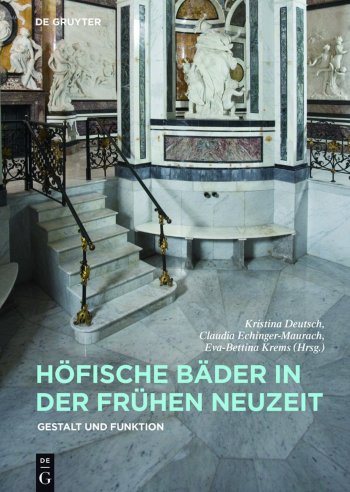 Despite the dread of miasmas and puritanical beliefs, the bath was always an integral element of early modern courtly culture, but it has been insufficiently researched until now. The essays in this volume [Courtly Baths in the Early Modern Period: Design and Function] cover the architecture, equipment, functions, and the culture of the court bath as reflected in the visual arts. The focus is on the importance of the bath for representing a specific understanding of dominance and aristocratic life.
Trotz Angst vor Miasmen und Sittenstrenge war das Bad stets ein fester Bestandteil der frühneuzeitlichen Hofkultur. Bislang wurde er jedoch nicht umfassend untersucht. Die Beiträge widmen sich der Architektur, Ausstattung und Funktion von Schlossbädern seit der italienischen Renaissance bis zur Französischen Revolution. Komplexe ikonographische Deutungen und vielfältige Antikenbezüge in Architektur und Ausstattung veranschaulichen den hohen Anspruch des höfischen Bades. Neben noch bestehenden oder rekonstruierbaren Räumen geht es auch um Darstellungen in den Bildkünsten, wie etwa in den Gemälden der Dames au bain. Im Fokus steht die Rolle des Bades als Ausdruck des höfischen und adeligen Lebens, eines Herrschafts- und Machtanspruchs und von dessen Legitimierung.
I N H A L T S V E R Z E I C H N I S
Kristina Deutsch, Claudia Echinger-Maurach, Eva-Bettina Krems, Baden im Schloss? Eine Einführung in die Kunstgeschichte des höfischen Bades
Teil I: Zwischen Therme, Hamam und stufetta: Die Entstehung des frühmodernen Bades
• Hubertus Günther, Badekultur in der italienischen Renaissance
• Jens Niebaum, „I bagni così son da ordenare“: Vitruv, die balnea und die Architekten der Renaissance
• Sabine Frommel, Sebastiano Serlios „padiglione al costume di Franza“ in Fontainebleau und sein Beitrag für die Entwicklung der Badekultur am französischen Hof
• Stephanie Hanke, Zwischen Orient und Okzident: Bäder und Badekultur in Genua im 16. und 17. Jahrhundert
Teil II: Von der Kinderstube zum Alterssitz: Die Inszenierung fürstlicher Macht im Bad
• Anne Bloemacher, Das erste Bad Maximilians I. in der Historia Friderici et Maximiliani
• Kristina Deutsch, „Balnea, vina, Venus corrumpunt corpora nostra“? Die Badstube der Burg Trausnitz in Landshut
• Sophie Mouquin, „Cet appartement est dédié à la magnificence, & fait une des sept merveilles de Versailles“: Das Appartement des bains Ludwigs XIV. in Versailles
• Jan Pieper, Das Fürstenbad im Palazzo Ducale von Sabbioneta (1554–1591)
Teil III: Heimliche Blicke und dynastische Quellen: Die Symbolik höfischer Frauen- und Männerbäder
• Margot Thun-Rauch, Die Badewanne der Philippine Welser: Gesundheit und Genuss
• Sigrid Ruby, Macht und Ohnmacht des Privaten: Die Gemälde der dames au bain
• Ilaria Hoppe, Baden in Florenz: Kunst, Körper und Medizin
• Vera Herzog, Baden für die Dynastie: Die Symbolik des fürstlichen Badepavillons am Beispiel der Łazienka in Warschau und der Münchner Badenburg
Teil IV: Schaubäder? Funktionen des Schlossbades zwischen Rekreation und Politik
• Claudia Echinger-Maurach, „Mona Lisa im Bade“: Das Appartement des bains in Schloss Fontainebleau
• Antje Scherner, Ein Bad ohne Wasser? Das Marmorbad in Kassel und die Kasseler Bäder der Frühen Neuzeit
• Guillaume Nicoud, Le bain de Catherine II au Palais d’hiver de Saint-Pétersbourg
• Ralf Richard Wagner, Die „Maison de bain“ des Kurfürsten Carl Theodor von der Pfalz
Abbildungsnachweise
Tafelteil
Exhibition | Epic Tales from Ancient India
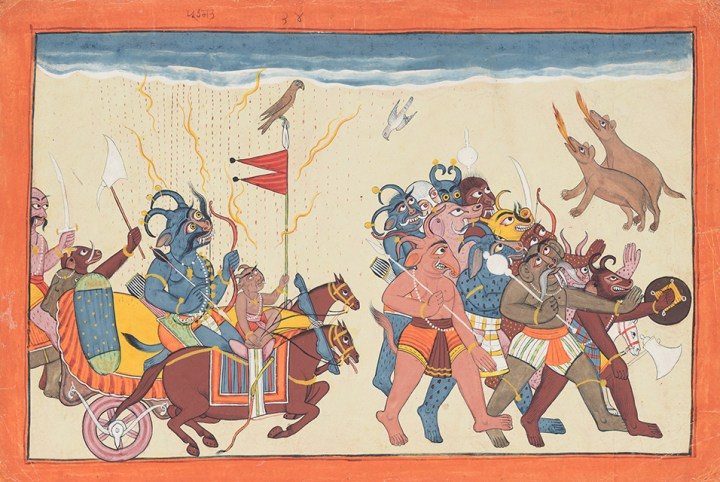
The Demon Dhumraksha Leads His Army, North India, Kulu or Bahu, ca. 1700–10; opaque watercolor on paper (The San Diego Museum of Art, Edwin Binney 3rd Collection, 1990.1107).
◊ ◊ ◊ ◊ ◊
Press release from the Blanton:
Epic Tales from Ancient India: Paintings from The San Diego Museum of Art
Princeton University Art Museum, 19 November 2016 — 5 February 2017
Blanton Museum of Art, The University of Texas at Austin, 9 July — 1 October 2017
The San Diego Museum of Art, 3 March — 12 June 2018
One of the most comprehensive collections of South Asian paintings outside of India will be on display at the Blanton Museum of Art at the University of Texas at Austin from July 9 to October 1, 2017. These dynamic images were originally associated with important literary and religious texts and will be organized according to thematic narratives. Museum visitors will be introduced to the epic stories that continue to hold great cultural value in India and beyond.

Rama and Sita Enthroned, ca. 1800; opaque watercolor and gold on paper, 24.7 × 18.5 cm (The San Diego Museum of Art, Edwin Binney 3rd Collection).
“The Blanton is honored to partner with The San Diego Museum of Art to bring this remarkable collection to Austin,” said Blanton director Simone Wicha. “The epic stories have much to say about courage, loyalty, love and friendship, and the paintings themselves impress with the delicacy of their technique, the boldness of their design, and the humanity of the stories they convey. This exhibition is sure to delight audiences of all ages.”
Epic Tales from Ancient India: Paintings from The San Diego Museum of Art represents the highest achievement of court paintings from several regions of the Indian subcontinent from the 16th to the 19th centuries and have been selected from the renowned Edwin Binney 3rd Collection of The San Diego Museum of Art. This exhibition depicts stories that have been integral to South Asian culture for hundreds of years and provides a compelling introduction to classic Indian and Persian texts, including Bhagavata Purana, a Sanskrit text about the Hindu god Vishnu and his different incarnations; Ramayana, the adventures of Prince Rama of Ayodhya; Ragamala, a text that explores various modes in Indian classical music; and works of Persian literature, including Shahnameh, an epic poem about the legendary kings of Iran. The colorful manuscripts depict dutiful heroes, loyal friends, and strong-willed women, and each character serves as an instructive model in. Dangerous beasts, cunning adversaries, and assorted demons must be confronted and subdued. Battle scenes teeming with combatants give way to quieter moments, such as lovers meeting for a secret tryst. Many of the stories have religious significance and show the intervention of various divinities in maintaining cosmic order.
Complementing the paintings will be examples of Chola-period processional bronze images, Vishnu and Hanuman, on loan from the Kimbell Art Museum and the Cleveland Museum of Art, respectively. These works hint at Hindu ritual practices and highlight the religious significance of the narratives.
Ray Williams, who leads the Blanton’s education efforts and serves as the managing curator for this exhibition, has a deep appreciation for India’s cultural expressions through story and image. “The struggle for cosmic order in the face of dark forces and fulfilling one’s duty with courage and integrity, are ongoing human concerns. The paintings invite us to plunge into Rama’s world, for example, and readily join in the quest to rescue Sita from the ten-headed, mustachioed, demon king and his frightful army,” said Williams.
A series of public programs will complement the exhibition, featuring gallery talks, musical demonstrations, classical Indian dance, and storytelling performances.
◊ ◊ ◊ ◊ ◊
The catalogue is distributed by Yale UP:
Marika Sardar, with contributions by Neeraja Poddar, Qamar Adamjee, and Alka Patel, Epic Tales from Ancient India: Paintings from The San Diego Museum of Art (New Haven: Yale University Press, 2017), 164 pages, ISBN: 978 03002 23729, $45.
 Exploring the topic of narrativity in Indian art, this beautiful and deeply researched book considers illustrations to the Bhagavata Purana, the Ramayana, the Ragamala, and a range of texts in the Persian language, notably the Shahnama. Featuring stunning reproductions of paintings made between the sixteenth and nineteenth centuries from the Edwin Binney 3rd Collection at The San Diego Museum of Art, the publication includes thorough and fascinating explanations of the narrative of each text, including how that narrative is visually conveyed. Essays examine why these particular stories are so enduring, why patrons may have chosen to have a copy of a particular text made for their own collections, and how artists responded to the challenge of creating new versions of venerable classics.
Marika Sardar is Associate Curator of Southern Asian and Islamic art at The San Diego Museum of Art. Neeraja Poddar is the Mellon Fellow at the Philadelphia Museum of Art. Qamar Adamjee is Associate Curator of South Asian and Islamic art at the Asian Art Museum, San Francisco. Alka Patel is Associate Professor of South Asian and Islamic Art at the University of California at Irvine.
New Book | The Anatomy of Color (or Colour)
From Thames & Hudson:
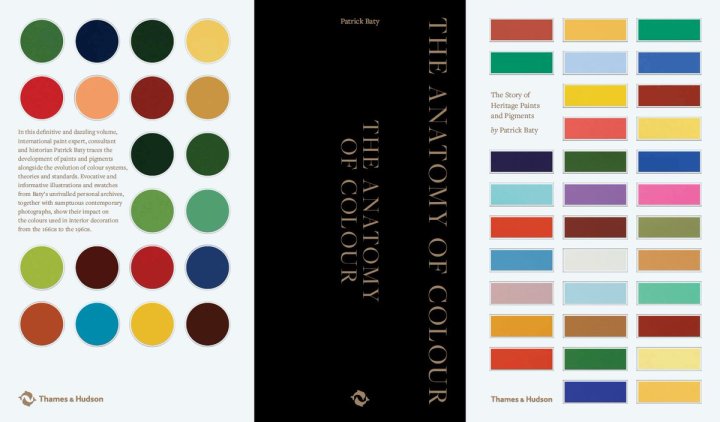
Patrick Baty, The Anatomy of Colour: The Story of Heritage Paints and Pigments (London: Thames & Hudson, 2017), 352 pages, ISBN: 978 05005 19332, $50.
Why were primary colors popular in postwar kitchens? Why did the Art Deco era prefer clean lines and pastel shades? This comprehensive illustrated history of the use of color and paint in interior decoration answers these questions and many more.
 Drawing on his huge specialist archive, historian and paint expert Patrick Baty traces the evolution of pigments and paint colors together with color systems and standards, and he examines their impact on the color palettes used in interiors from the 1650s to the 1960s. He charts the creation in paint of the common and expensive colors made from traditional earth pigments between 1650 and 1799. He then explores the emergence of color systems and standards and their influence on paint colors together with the effect of industrialized production on the texture and durability of paints. Finally, Baty turns his attention to twentieth-century color standards. Woven throughout the authoritative and revealing text are specially commissioned photographs of pages from rare color reference books. Reproductions of interiors from home decor books, dating from every era, are included throughout, highlighting the distinctive color trends and styles of painting particular to each period.
Patrick Baty is a historian of architectural paint and color. He works as a consultant in the decoration of historic buildings and runs the family paint business Papers and Paints in London. He lectures and contributes regularly to magazines and journals.










leave a comment