New Book | Gainsborough: A Portrait
From Weidenfeld & Nicolson:
James Hamilton, Gainsborough: A Portrait (London: W&N, 2017), 448 pages, ISBN: 978 147460 0521, £25.
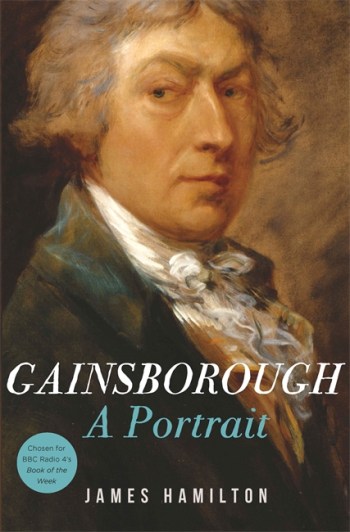 Frank, lucid and modern, this is a fresh portrait of Thomas Gainsborough, the most sensuous artist of the eighteenth century. Thomas Gainsborough (1727–1788) lived as if electricity shot through his sinews and crackled at his finger ends. He was a gentle and empathetic family man but had a volatility that could lead him to slash his paintings and a loose libidinous way of speaking, writing, and behaving that shocked many deeply. He would be dynamite in polite society today.
In this exhilarating new biography—the first in decades—James Hamilton reveals Gainsborough in his many contexts: the easy-going Suffolk lad, transported to the heights of fashion by a natural talent; the rake-on-the-make in London, learning his art in the shadow of Hogarth; falling on his feet when he married a duke’s daughter with a handsome private income; the top society-portrait painter in Bath and London who earned huge sums by bringing the right people into his studio; the charming and amusing friend of George III and Queen Charlotte who nevertheless kept clear of the aristocratic embrace.
There has been much art history written about this chameleon of art, but with fresh insights into original sources, Gainsborough: A Portrait transforms our understanding of this fascinating man and enlightens the century that bore him.
James Hamilton is an art and cultural historian. His books include Turner: A Life; Faraday: The Life, shortlisted for the James Tait Black Memorial Prize; and A Strange Business: Making Art and Money in Nineteenth-Century Britain, which in 2014 was named Art Book of the Year by The Sunday Times. Hamilton was, until retirement in 2013, curator of art collections and projects in Portsmouth, Wakefield, Sheffield, Leeds, and the University of Birmingham, where he is a Fellow of the Barber Institute of Fine Arts.
Early Gainsborough Drawings Discovered at Windsor
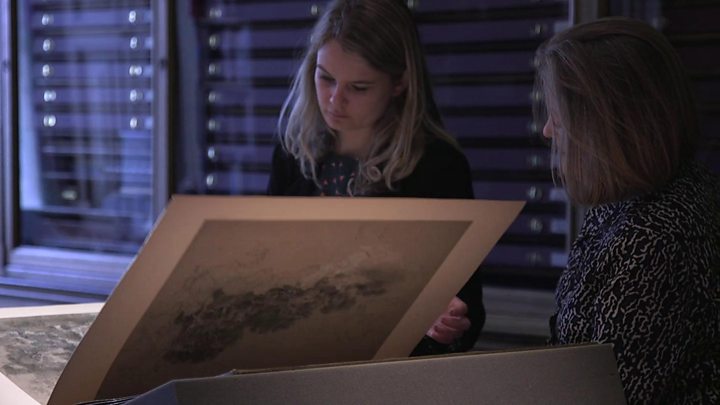
Rosie Razzall (left) and Lindsay Stainton (right) in the Print Room at Windsor Castle. Still from the BBC video describing the discovery (102 seconds), by video journalist Alex Stanger.
◊ ◊ ◊ ◊ ◊
As Rebecca Jones reports for the BBC (10 July 2017). . .
An album of drawings by 18th-century painter Thomas Gainsborough has been discovered in the Royal Collection at Windsor Castle. The drawings had been misattributed to another artist, Sir Edwin Landseer, since the reign of Queen Victoria. But after studying the 25 black-and-white chalk sketches, historian Lindsay Stainton confirmed they are actually early works by one of Britain’s most famous painters.
“It’s thrilling,” she told the BBC. “It’s the very best collection of Gainsborough’s early drawings in existence.” . . .
“We’re very much convinced that these are an important group of early drawings by Thomas Gainsborough,” agrees Rosie Razzall, curator of prints and drawings at the Royal Library. “It’s an extremely significant discovery. It means we are able to re-appraise the early work of Gainsborough.” . . .
The full article and video are available here»
Small Token from Carriera’s ‘Winter’ Recently Discovered
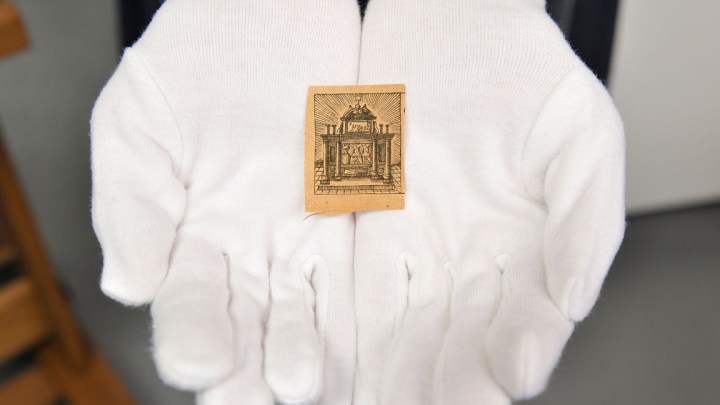
The Three Magi, print, 4.2 cm × 3.3 cm; this small print was sealed inside the frame of Rosalba Carriera’s Personification of Winter (ca. 1726), between the pastel’s wooden support and canvas liner (The Royal Collection Trust).
◊ ◊ ◊ ◊ ◊
From the press release (9 May 2017) describing an extraordinary item discovered as a result of research for the Royal Collection Trust’s exhibition Canaletto and the Art of Venice, now on view at The Queen’s Gallery:
An 18th-century good-luck token has been found hidden inside Rosalba Carriera’s pastel A Personification of Winter by Royal Collection Trust’s conservators. One of the artist’s finest works, Winter was produced around 1726 for Joseph Smith, a British merchant, art collector, and dealer who lived in Venice and acted as agent to many artists, including Carriera and, most famously, Canaletto. Sealed inside the frame between the pastel’s wooden support and canvas liner, the token came to light during conservation of Winter for display in Royal Collection Trust’s exhibition Canaletto & the Art of Venice, which opened at The Queen’s Gallery, Buckingham Palace on 19 May.
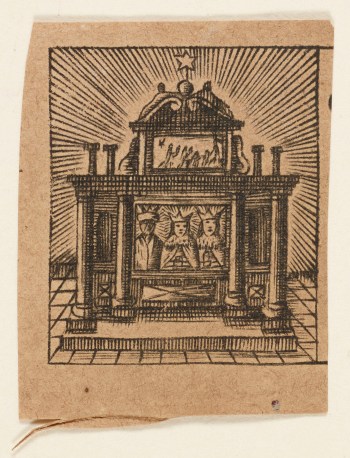 Just 4.2 cm × 3.3 cm in size, the token is in the form of a print of the three Magi and was clearly placed there by Carriera to protect the fragile pastel on its journey to its new owner. In the 18th century these tiny prints, known as santini (‘little saints’), were kept in prayer books or clothing as affordable and portable devotional objects. Rosalba Carriera, a very devout woman, is known to have been particularly fond of images of the three Magi, whose association with arduous journeys made them appropriate guardians for her works. Similar tokens have been found attached to other pastels by the artist.
In a letter to a friend in Florence on 3 December 1729, the Venetian nobleman Pier Caterino Zeno described Carriera’s devotion to the Magi: “Once she gave me a certain portrait to send to my brother in Vienna, and she gave me a little card of the three aforementioned adoring Magi; and said that to these she entrusted the safe outward journey of the portrait; adding that whenever such little images had accompanied her pictures, they had always arrived safely.”
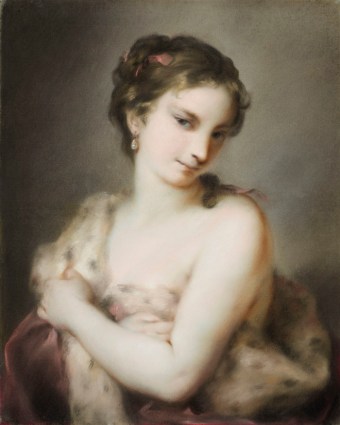
Rosalba Giovanna Carriera, A Personification of Winter, ca. 1726, pastel on paper (London: Royal Collection Trust, 400647).
Rosalba Carriera was one of the most celebrated women artists of her day. Her pastels were highly admired by 18th-century European collectors, and prominent foreign visitors to Venice and Grand Tourists were eager to sit for portraits by her. The soft, velvety texture of pastel was particularly suited to Carriera’s sensual personifications such as Winter, portrayed as a young woman with a fur wrap slipping from her shoulders.
In 1762 the young monarch George III purchased virtually the entire collection of Joseph Smith, including Winter, which was among Smith’s most prized possessions. Thanks to this single acquisition, the Royal Collection contains one of the finest groups of 18th-century Venetian art in the world, including the largest collection of works by Canaletto. Winter hung in George III’s bedchamber at Buckingham House (later Buckingham Palace) alongside Carriera’s pastel of Summer.
Clara de la Peña McTigue, Royal Collection Trust’s Head of Paper Conservation, said, “The conservation of pastels is a very delicate operation, as the pigment surface of these works is so fragile. When we carefully removed the frame, we became very excited when we noticed a small piece of paper in the narrow space between the pastel’s support and the canvas, and suspected it might be one of Carriera’s tokens.”
Rosie Razzall, Royal Collection Trust’s Curator of Prints and Drawings and the exhibition’s co-curator, said, “It was only during conservation treatment that the print came to light. It’s incredible to think that it was put there by Carriera herself nearly 300 years ago to protect the work from ill fortune and has remained undiscovered until now.”
AHRC-funded Workshops | Architecture and Society, 1760–1840

After Jenkinson, View of Liverpool, 1813.
◊ ◊ ◊ ◊ ◊
From H-ArtHist:
Architecture and Society in an Age of Reform, 1760–1840
Liverpool, 19–20 September 2017; Bristol, 16–17 March 2018; and Birmingham, June 2018
Proposals due by 31 July 2017
We are delighted to announce the launch of a new AHRC-funded international research network on Architecture and Society in an Age of Reform, which aims to establish a dynamic, long-lasting, multi- and interdisciplinary research forum to investigate the relationship between architecture and society in the period 1760–1840. As part of the project we will be holding three workshops:
Liverpool, 19–20 September 2017
Bristol, 16–17 March 2018
Birmingham, date TBC June 2018
Each workshop will focus on the same broad set of research questions, with site visits on the first day designed to stimulate discussion on the second day. The broad sets of questions we will be exploring include:
User experience
• How can we reimagine the experience of building users?
• What can diaries, letters and literary evidence tell us?
• (How) can we use digital methods to recreate experience?
Patronage and knowledge
• How were buildings funded and what is the relationship between funding and form?
• How can we use the archival evidence resulting from patterns of patronage (legislation, subscription lists, contracts etc)?
Radical and conservative architecture
• How could and did architecture offer ways to contest, reform and reimagine society and/or maintain and strengthen existing structures?
• How can we use treatises, pattern books and other sources to identify different architectural discourses and different approaches to the use of space?
New and reimagined building types
• What do building forms tell us about contemporary understanding of their functions?
• How did architecture shape knowledge?
• How can we use surviving buildings and other non-textual sources as evidence?
• What are the most effective ways of engaging the wider public in this research?
Site Visits
The first day of each workshop will be dedicated to site visits, which are designed to stimulate new insights about the relationship between architecture and society in an Age of Reform. All travel will be arranged in advance, and network organisers will provide fact sheets for each site so that we can think about the buildings with the basic information at our fingertips.
Panel Formats
The second day of each workshop will be dedicated to focussed discussion designed to respond to the venue visits, to share ideas about the network’s key research questions, build research collaborations and identify potential research themes for future research. We will adopted a blended format designed to stimulate discussion, including the following formats:
• 5-minute speed-dating introductions to research
• spotlight sessions on local research institutions and heritage partners
• keynote papers
• roundtable discussion
• breakout
The project team invites initial expressions of interest from scholars interested in any element of the Architecture and Society research programme. If you feel you can make a significant contribution to any or all of our workshops, please send a brief summary of your research interests and career stage to the Principal Investigator (Alexandrina.Buchanan@liverpool.ac.uk) by 31 July 2017. The AHRC has generously provided funding to support a limited number of participants’ UK travel and accommodation expenses.
New Acquisition | View of Charleston, ca. 1774
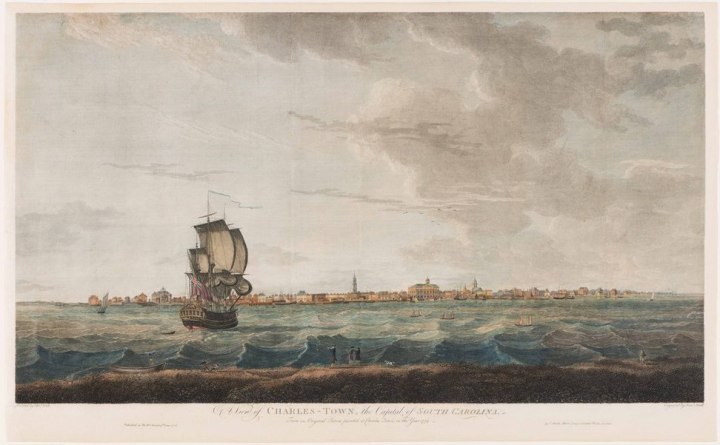
Engraved by Samuel Smith, after Thomas Leitch, A View of CHARLES-TOWN, in the Capital of SOUTH CAROLINA, published in London, 3 June 1776, hand-colored line engraving (Art Museums of Colonial Williamsburg, The Friends of Colonial Williamsburg Collections Fund, 2017-287)
◊ ◊ ◊ ◊ ◊
Press release (11 July 2017) from Colonial Williamsburg:
A rare, historically important view of Charleston, South Carolina, showing its appearance at the time of the American Revolution was recently purchased by the Colonial Williamsburg Foundation for its collection. A View of CHARLES-TOWN, in the Capital of SOUTH CAROLINA, engraved in London by Samuel Smith after a painting by Thomas Leitch, depicts recognizable Charleston landmarks during its peak of prosperity prior to the outbreak of the war.
“Acquisition of this exceptional, pre-Revolutionary view perfectly addresses the Foundation’s core mission, particularly since it furthers our understanding of early America and its Southern colonies,” said Mitchell B. Reiss, president and CEO of Colonial Williamsburg. “I applaud our generous donors for making the purchase a reality.”

“Eighteenth-century views of American cities are relatively rare, and those of southern centers even more so,” said Ronald L. Hurst, the Foundation’s Carlisle Humelsine chief curator and vice president for collections, conservation, and museums. “At nearly three feet in width and retaining its original water coloring, this outstanding view of one of the South’s great seaports is exceptionally rare and important.”
This print, in its full original color, was engraved in 1774 after Leitch painted his scene within a year of his arrival in Charleston from London in 1773 and arranged for it to be shipped back there to be engraved for printing. Although little is known about Leitch, an advertisement that he placed in the South Carolina Gazette soliciting subscribers to assist with the cost of producing the print, and noting that he was sending the painting ‘home’ to have it engraved, confirms he came from London.
The artist rendered his painting in the Dutch panoramic style that enhanced the expanse of the coastline by increasing its width in relation to its height, forcing the viewer’s eye to move back and forth across the canvas. The image is curious, however; while earlier versions of Charleston show calm seas and dozens of merchant ships in the harbor, in this one, Leitch included only one British trading ship in the harbor. Only about six months earlier, Massachusetts traveler Josiah Quincy noted of the Charleston harbor that “the number of shipping far surpassed all I had ever seen in Boston….”
As Colonial Williamsburg’s Deputy Chief Curator Margaret Pritchard speculates, “It is possible that the notable absence of trading vessels venturing into the choppy waters of the Cooper River, under stormy skies, was intended to suggest the political tension between Charlestonians and the Mother country.” In 1773, just months before Leitch painted his view, Britain passed the Tea Act, and Charleston’s outraged citizens left the British-imported tea on the docks to rot. It was the following year in which townspeople elected delegates to the Continental Congress.
Although the print was engraved in 1774, it was not issued until 1776. Other known copies are held at the Yale University Art Gallery, the New York Public Library, and the Gibbes Museum of Art in Charleston. The original painting is in the collection of the Museum of Early Southern Decorative Arts (MESDA). The print was acquired through The Friends of Colonial Williamsburg Collections Fund, which restricts its funds for object purchases.
Display | Hyacinthus by Tiepolo
Now on view at the Museo Thyssen-Bornemisza:
Hyacinthus by Tiepolo
Museo Thyssen-Bornemisza, Madrid, 23 June — 17 December 2017
In conjunction with the celebration of the Museum’s 25th anniversary and to coincide with World Pride 2017 in Madrid, the Museo Thyssen-Bornemisza is now presenting the results of the restoration and technical study of one of the most important and fascinating works in its collection and probably its greatest gay icon: The Death of Hyacinthus by Giovanni Battista Tiepolo.
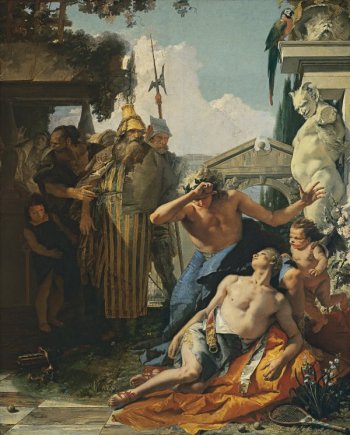
Giambattista Tiepolo, The Death of Hyacinthus, ca. 1752–53 (Madrid: Museo Thyssen-Bornemisza).
Following its restoration in the Museum’s studios, the painting has now returned to its habitual location in Room 17, accompanied by a special display organised by the departments of Restoration and Old Master painting. This installation includes X-radiographs and infra-red reflectographs that show the most interesting aspects of the work undertaken, explain the methodology applied, and reveal the outstanding quality of the painting. These images are accompanied by two preparatory drawings loaned by the Staatsgalerie in Stuttgart and a video of the entire restoration process, which also explains the most important discoveries made during this restoration and study project and features interesting details from the painting.
Given the widespread interest in restoration projects of this type, with this new display the Museum is aiming to introduce visitors to the working methods used by restorers, which are essential for determining the appropriate treatments to be applied in each case and which also provide art historians with important information. Knowledge of the techniques and materials employed by artists is fundamental for deciding on the procedures to be adopted when halting the deterioration of a work of art. Furthermore, focusing on the most detailed aspects of the creation of a work also allows us to enter into the artist’s mind to some extent and that of his or her period and to understand the creative act and its context on the basis of more solid arguments.
The Death of Hyacinthus (ca.1752–53) was commissioned by Baron Wilhelm Friedrich Schaumburg-Lippe, who lived in a town near Würzburg (Germany) where Tiepolo was employed with his sons Giovanni Domenico and Lorenzo from 1750 onwards on the decoration of the residence of the new Prince-Bishop, Carl Philipp von Greiffenclau. The painting seems to have an elegiac nature as a homage to the Baron’s lover, a young Spanish musician with whom he had lived in Venice and who had died in 1751.
The painting is inspired by an episode from Ovid’s Metamorphoses (Book X, 162–219): Apollo and his lover, the young and beautiful Hyacinthus, Prince of Sparta, were competing at throwing the discus when the latter was mortally wounded when struck on the head by the discus. In the classical account Hyacinthus was killed by his own clumsiness as he threw the discus during the competition, but another version recounts that as it was thrown by Apollo, it was blown off course by Zephyrus, god of the west wind, who had been spurned by Hyacinthus in favour of Apollo. Unable to return him to life, Apollo immortalised the youth by making the hyacinth flower sprout from his blood on the ground.
Tiepolo depicts the scene on the basis of the Italian translation of Ovid’s text by Giovanni Andrea dell’Anguillara (Venice, 1561), in which the discus throwing is replaced by a tennis match, a fashionable sport among the nobility of the time. In the foreground we see the racquet and some balls cast on the ground and in the background a net that indicates the tennis court. Hyacinthus lies dying in front of the despairing Apollo, who feels responsible for the accident and whose gestures indicate the fateful outcome. Apollo had neglected his duties as a god to devote his time to his lover and Tiepolo reminds us of this by including two of his attributes: the lyre and the quiver with arrows, abandoned on the ground on the left while he shows Apollo himself as a youthful athlete with blonde hair and a laurel wreath. Behind them Hyacinthus’s father King Amyclas and his retinue watch the scene with sombre expressions. Numerous iconographical details emphasize the painting’s symbolic language, from the figure of the macaw, a symbol of courtship, to the mocking expression of the statue of Pan, protector of male sexuality, with Apollo’s hand covering his genitals and his thumb imitating the shape of an erection.
The composition of the central group was tried out in numerous preparatory sketches by both the artist and his son and assistant Giovanni Domenico. These studies play with the different positions adopted by the two principal figures, bringing them closer together or changing the poses. Other studies feature specific details that were subsequently carefully reproduced in the final version, like the figure of Hyacinthus and the depiction of the small putto in the drawings from the Staatsgalerie in Stuttgart on display in the exhibition.
The restoration of The Death of Hyacinthus has essentially focused on the complex elimination of the superimposed layers of oxidised and yellowed varnishes which had accumulated over time. Cleaning the painting has recovered its visual unity and the richness of the original palette with its vibrant, subtly nuanced colours. The architectural features and figures are now also easier to read and the original pictorial depth can once again be properly appreciated. Taking micro-samples of the pigments has provided new information on them and allowed for the materials used by the artist and their state of conservation to be analysed, while gigapixel images and macrophotographs have revealed the tiniest alterations and details of the painting. Ultraviolet and infra-red images have similarly provided valuable information on the creation of the work and the artist’s methods.
An X-radiograph of a painting shows the modifications introduced by the artist during the process of its creation. In The Death of Hyacinthus it can be seen that Tiepolo changed the position of the king, turning him to face the principal scene directly, which resulted in a modification of the folds of his clothing and the position of his arm. Behind this figure Tiepolo added a soldier and also changed the size and shape of both figures’ headwear. In the lower part of the composition it is evident that the straps of the quiver were originally longer. Unlike the other figures, the putto is not visible in the X-radiograph as it was painted with a type of pigment that can be easily penetrated by X-rays.
Tiepolo worked more confidently on the right part of the painting, locating the principal figures in a more emphatic manner and with hardly any changes. There are small modifications to the position of Hyacinthus’s arm and Apollo’s thumb, the position of which has been interpreted as an erotic reference. His knee, on which Cupid is leaning, was slightly moved, with the result that the latter’s left hand is suspended in the air. Tiepolo also changed the background motifs as the X-radiograph reveals what might be the sketch of a mountain as well as different architectural structures which he ultimately covered over with clouds or vegetation in order to create a greater sense of space.
This image reveals the preparatory drawing or study concealed by the paint layers and thus the changes introduced into the composition by the artist, some of them also visible on the Xradiograph. In this case it can be seen that the figure of Amyclas originally had a cloth headdress which was then replaced with a hat, while his right hand also reveals some corrections or changes with regard to the final position. The god Apollo appears in the preparatory drawing with some ornamental accessories such as an earring and a belt decorated with a pearl, which were subsequently covered over with brushstrokes of pigment. In addition, his left thumb was not originally superimposed over the figure of Pan as we see in the final painting and some lines of under-drawing are visible that locate Apollo’s knee in a more elevated position and in contact with Cupid’s left hand. Finally, Tiepolo made a slight change to the position of the drapery over Hyacinthus’s leg.
New Book | Idols and Museum Pieces: The Nature of Sculpture
Published by De Gruyter and available from ArtBooks.com:
Caroline van Eck, ed., Idols and Museum Pieces: The Nature of Sculpture, Its Historiography, and Exhibition History, 1640–1880 (Berlin: De Gruyter, 2017), ISBN: 978 31104 06917, 50€ / $58 / £41.
 The publication of Winckelmann’s Geschichte der Kunst des Altertums in 1764 is considered as the defining moment in the genesis of the modern, scientific study of sculpture. It was a formalist and secular history, concentrating on the statue as a work of art, and studying sculpture in a museum setting, abstracting from its original religious, social or political functions. Other 17th- and 18th-century authors tried to understand those functions and why statues so often excited violent reactions ranging from adoration to abuse. The collection of essays aims to be a first investigation of the questions that arise out of an awareness that the origins of the Western historiography are much more complex than may appear from the perspective of Winckelmann’s vision of the Graeco-Roman tradition.
C O N T E N T S
• Erin Downey, Sculptures in Print, The Galleria Giustiniana as Exemplar and Agent of Taste
• Frits Scholten, The Amsterdam Ivories of Francis van Bossuit: Reception and Transformation in the Eighteenth Century
• Anne Ritz-Guilbert, La sculpture comme source historique: Les dessins de la collection de François-Roger de Gaignières (1642–1715)
• Anna C. Knaap, Sculpture in Pieces: Peter Paul Rubens’s Miracles of Francis Xavier and the Visual Tradition of Broken Idols
• Stijn Bussels, Medusa’s Terror in the Amsterdam Town Hall: How to Look at Sculptures in the Dutch Golden Age
• Ruurd Halbertsma, ‘Admirari vel deridere’: Calvinistic Approaches to Classical Sculpture in the Netherlands
• Hans Christian Hönes, Allegory, Ornament, and Prehistory’s ‘Secret Influence’: D’Hancarville versus Winckelmann
• Tomas Macsotay, Baron D’Hancarville’s Recherches on the Evolution of Sculpture: Submerged Emblems and the Collective Self
• Bram van Oostveldt, ‘Ut Sculptura Theatrum’: On the Relation between Theatre and Sculpture in the Late Eighteenth Century
• Pascal Griener, Plaster versus Marble: Wilhelm and Caroline von Humboldt and the Agency of Antique Sculpture
• Caroline van Eck, How Does an Idol enter a Museum? Immersion and Aesthetic Autonomy at the Musée Charles X in the Louvre
• Cecilia Hurley, La présentation du ‘paragone’ dans les dispositifs muséaux au XIXe siècle
• Thomas Beaufils, Idoles de l’Île de Nias: Origines d’un Entichement Musèal
Exhibition | Homage to the Grand Duke
◊ ◊ ◊ ◊ ◊
Now on view at the Pitti Palace, with a catalogue published by Sillabe and available from ArtBooks.com:
Homage to the Grand Duke: Memories of Silver Plates for the Feast of St. John
Omaggio al Granduca: Memorie dei piatti d’argento per la festa di San Giovanni
Palazzo Pitti, Florence, 24 June — 24 September 2017
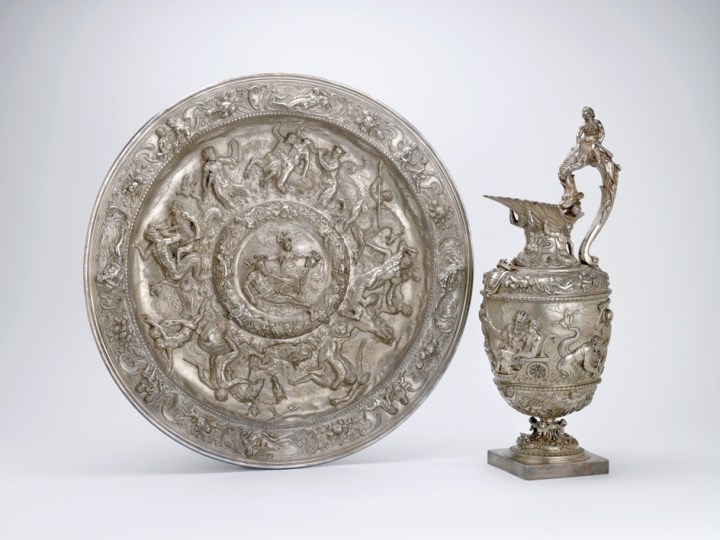
The precious items in the Tesoro dei Granduchi include a number of 18th-century moulds of the now lost ‘St. John’s plates’, a nostalgic echo of masterpieces of the Roman silversmith’s art in the age of the Baroque. The fifty-eight magnificent silver ewers were intended as a gift for Grand Duke Cosimo III (1642–1723) and, after him, for Gian Gastone (1671–1737), his successor on the throne of Tuscany. One ewer was presented every year on 24 June, the feast of St. John, from 1680 until the Medici dynasty became extinct in 1737.
 The silver ewers—weighing some fifteen pounds (or five kg) and worth 300 Roman scudi each—were meticulously embossed and chased with scenes celebrating the most illustrious members of the House of Medici from Lorenzo the Magnificent down to the reigning Grand Dukes. It was probably the fact that the ewers depicted the unusual subject of her family’s history that prompted the Electress Palatine Anna Maria Luisa (1667–1743) to do everything in her power to safeguard them from the threat of destruction at the hands of the House of Lorraine, who succeeded the Medici on the throne of Tuscany and whose military expenditure meant that they were regularly strapped for cash.
The ewers were jealously guarded in the Wardrobe in Palazzo Vecchio, leaving the premises only from 1789 to 1791 for display in the ‘Medal Room’ in the Galleria degli Uffizi. Sent back to the Wardrobe as their popularity declined, they set off down the path to oblivion. It is only thanks to casts commissioned by the Marchese Carlo Ginori and made in his Manufactory in Doccia between 1746 and 1748 that we can appreciate at least a pale reflection of their splendour today.
Rita Balleri and Maria Sframeli, eds., Omaggio al Granduca: Memorie dei piatti d’argento per la festa di San Giovanni (Livorno: Sillabe, 2017), 328 pages, ISBN: 978 8883 479595, 35€ / $60.
New Book | Representing Duchess Anna Amalia’s Bildung
From Routledge:
Christina Lindeman, Representing Duchess Anna Amalia’s Bildung: A Visual Metamorphosis in Portraiture from Political to Personal in Eighteenth-Century Germany (New York: Routledge, 2017), 210 pages, ISBN: 978 147246 7386, $150.
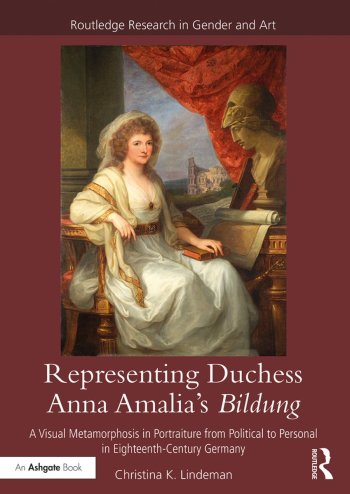 The cultural milieu in the ‘Age of Goethe’ of eighteenth-century Germany is given fresh context in this art historical study of the noted writers’ patroness: Anna Amalia, Duchess of Weimar-Sachsen-Eisenach. An important noblewoman and patron of the arts, Anna Amalia transformed her court into one of the most intellectually and culturally brilliant in Europe; this book reveals the full scope of her impact on the history of art of this time and place. More than just biography or a patronage study, this book closely examines the art produced by German-speaking artists and the figure of Anna Amalia herself. Her portraits demonstrate the importance of social networks that enabled her to construct scholarly, intellectual identities not only for herself, but for the region she represented. By investigating ways in which the duchess navigated within male-dominated institutions as a means of advancing her own self-cultivation—or Bildung—this book demonstrates the role accorded to women in the public sphere, cultural politics, and historical memory. Cumulatively, Christina Lindeman traces how Anna Amalia, a woman from a small German principality, was represented as an active participant in enlightened discourses. The author presents a novel and original argument concerned with how a powerful woman used art to shape her identity, how that identity changed over time, and how people around her shaped it—an approach that elucidates the power of portraiture in eighteenth- and early nineteenth-century Europe.
Christina K. Lindeman is Assistant Professor of Art History at the University of South Alabama. A scholar of eighteenth-century art and material culture, she has contributed essays to edited volumes and Source.
C O N T E N T S
List of illustrations
Acknowledgments
Introduction
1 Setting the Stage
2 Composing a Musical Portrait
3 Representing the Female Grand Tourist
4 The Scientific Lady in Naples
5 Materializing Anna Amalia’s Bildung
6 Anna Amalia’s Gedenktafel: The Making of an Icon
Conclusion
Appendix A
Appendix B
Bibliography
Index
At Sotheby’s | Canaletto Drawing Sells for £2.6million
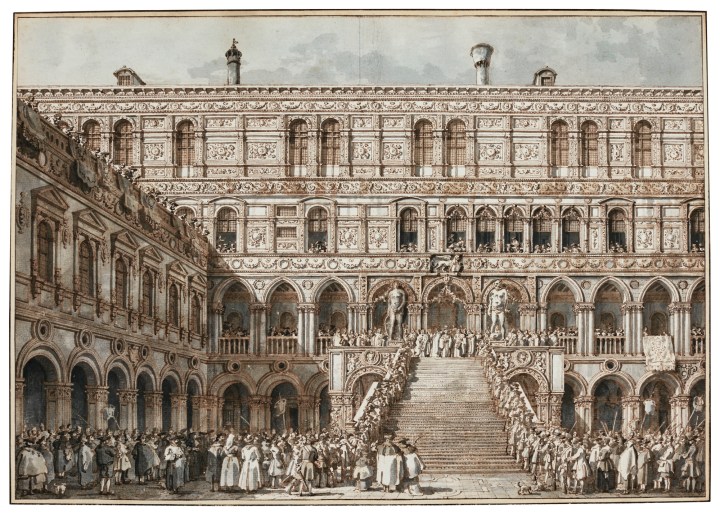
Canaletto, The Coronation of the Doge on the Scala dei Giganti, ca. 1763–66; pen and brown ink and three shades of grey wash, heightened with touches of white over black chalk, within original brown ink framing lines, 39 × 55 cm. The drawing sold on 5 July 2017 for £2,633,750 / $3,404,385 / €2,999,591 (meeting the low end of its presale estimate of £2,500,000–3,500,000).
◊ ◊ ◊ ◊ ◊
Via Art Daily (6 July 2017) . . .
Old Master and British Works on Paper, L17040
Sotheby’s, London, 5 July 2017
A superbly preserved drawing ranking among the greatest ever made by Canaletto sold for a record £2,633,750 / $3,404,385 / €2,999,591 this week at Sotheby’s London [L17040, Lot #44 ]. The price eclipsed the previous record for a work on paper by the artist (£1.9 million achieved for Campo San Giacomo di Rialto, Venice, sold at Sotheby’s in London in July 2012).
Greg Rubinstein, Worldwide Head of Old Master Drawings at Sotheby’s, said: “The record price realised today for Canaletto’s superb drawing is a fitting testimony to its importance and its quality. Nothing like it has been seen at auction. A more total expression of the essence of Canaletto’s genius as a draughtsman than this extraordinary drawing, which transports us to the very heart of 18th-century Venice, in all its glory, wit and mystery, is hard to imagine. That it was loved and cherished for so long by one of the greatest families of English cognoscenti is the final piece in the jigsaw of elements that together make this by far the most important drawing by Canaletto to have come to the market in recent decades, and one of the most illuminating and enlightening, as well as one of the most visually exciting and satisfying, that he ever made.”
Both in scale and in compositional complexity, The Coronation of the Doge on the Scala dei Giganti is one of the most ambitious of all Canaletto’s drawings. It belongs to a highly original series of twelve depictions of the ceremonies and festivals of the Doges, the Feste Ducali, conceived in the first instance as drawings, but made specifically to be engraved. Though the artist’s drawings and paintings are often very accurate renderings of specific locations, images like these of actual historical events are relatively rare in his work. In this composition, the third in the series, the Doge is being crowned at the top of the Scala dei Giganti, the grand, ceremonial staircase that forms the focus of the courtyard of the Doge’s Palace. The principal subject, though, is Venice, her life and her people.










leave a comment