Call for Papers | The Tools of the Architect
From the conference website:
European Architectural History Network: The Tools of the Architect
Delft and Rotterdam, 22–24 November 2017
Proposals due by 15 May 2017
The European Architectural History Network (EAHN) is pleased to announce the EAHN’s fifth thematic conference The Tools of the Architect, to be held at Delft University of Technology and Het Nieuwe Instituut HNI (Delft and Rotterdam, The Netherlands) 22–24 November 2017.
Architects have for their activities of drawing, writing, and building always depended upon the potential of particular tools—ranging from practical instruments such as straight edges, French curves, compasses, rulers, and pencils to conceptual tools such as working drawings, collages, photographic surveys, infographics, diagrams, casts, and mass models.
As technologies advanced, the toolbox of architects has changed and expanded. Today architects have an extraordinary array of sophisticated tools at their disposal but also rely on many of same tools as their 18th- and 19th-century peers. Working drawings, pencils, and tracing paper continue to appear in the designer’s studio while their role and potential is being redefined.
Time and time again, architects have engaged with new tools. The quest to find the most appropriate and adequate tools to articulate, test and communicate design ideas has never ended, and in this pursuit architects have appropriated tools from other disciplines, such as art, historiography, sociology, philosophy, computer sciences and engineering. Out of this perspective the tools of the architect have become a field of intense exploration of the encounter of architecture with other disciplinary perspectives.
Inventions and innovations of tools throughout history have not only provided better answers to questions of analyzing and representing the built environment, but they have also pointed to new ways of conceiving and intervening. Ellipsographs made it possible to precisely draw an elliptical space in the 19th century and computer-aided drafting software has allowed for a new conception and construction of complex geometries in the 20th and 21st century. New tools have continuously affected the imagination, character and qualities of architectural projects.
This conference wants to focus on the changing practical and conceptual tools of the architect and their effect on the logos and praxis of architecture. The conference will be structured along three thematic lines:
• The Instruments of the Architect (i.e. the apparata and equipment of the architect)
• The Tools of Analysis (i.e. the devices to study architecture and the built environment in general)
• The Tools of Intervention (i.e. the devices to intervene in the built environment)
We welcome papers that consider the tools of the architect from this threefold perspective. Papers should be based on well-documented research that is primarily analytical and interpretative rather than descriptive in nature. Abstracts (of 500 words) can be registered and uploaded. Please click here to register.
Time Frame
15 May 2017: Deadline Submission of abstracts
15 June 2017: Notification of Acceptance
1 September 2017: Full papers
Keynote Speakers
Mari Lending (Professor of architectural theory and history, Oslo School of Architecture and Design/ OCCAS: the Oslo Center for Critical Architectural Studies)
Michiel Riedijk (Professor at Chair of Public Building, Delft University of Technology/ Neutelings Riedijk Architects, Rotterdam)
Conference Chairs
Tom Avermaete, Delft University of Technology
Merlijn Hurx, Utrecht University
Organising Committee
Carola Hein, Delft University of Technology
Marie-Terese van Thoor, Delft University of Technology
Koen Ottenheym, Utrecht University
Petra Brouwer, University of Amsterdam
Dirk van den Heuvel, Jaap Bakema Study Centre/ Het Nieuwe Instituut
Scientific Committee
Tom Avermaete, Delft University of Technology
Merlijn Hurx, Utrecht University
Alona Nitzan-Shiftan, Technion – Israel Institute of Technology, Haifa
Maristella Casciatio, Getty Research Institute, Los Angeles
Anthony Gerbino, University of Manchester
Sebastian Fitzner, Freie Universität Berlin
Wolfgang Lefevre, Max Planck Institute, Berlin
Discovered: New Parchment Copy of the Declaration of Independence
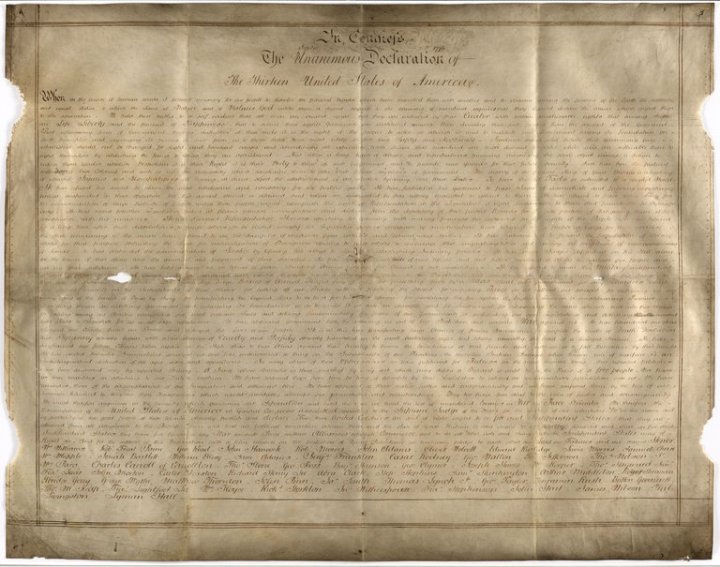
A parchment manuscript of the Declaration of Independence, believed to date from the 1780s and held in the West Sussex Record Office in England
(West Sussex Record Office Add Mss 8981)
◊ ◊ ◊ ◊ ◊
For me, this discovery is particularly interesting in terms of the process: knowledge of the Sussex copy grew out of Dr. Danielle Allen’s creation in 2015 of the online resource the Declaration Resource Project. Allen was, incidentally, awarded a MacArthur ‘Genius’ Grant in 2001, when she was part of the Department of Classical Languages & Literatures at The University of Chicago. –CH
From The New York Times:
Jennifer Schuessler, “A New Parchment Declaration of Independence Surfaces. Head-Scratching Ensues,” The New York Times (21 April 2017).
In a bit of real-life archival drama, a pair of scholars [Danielle Allen and Emily Sneff] are announcing a surprising discovery: a previously unknown early handwritten parchment of the Declaration, buried in a provincial archive in Britain. The document is the only other 18th-century handwritten parchment Declaration known to exist besides the one from 1776 now displayed at the National Archives in Washington. It isn’t an official government document, like the 1776 parchment, but a display copy created in the mid-1780s, the researchers argue, by someone who wanted to influence debate over the Constitution. . . .
Its subtle details, the scholars argue, illuminate an enduring puzzle at the heart of American politics: Was the country founded by a unitary national people, or by a collection of states? “That is really the key riddle of the American system,” said Danielle Allen, a professor of government at Harvard, who discovered the document with a colleague, Emily Sneff. . . .
The new discovery grew out of the Declaration Resources Project, which Ms. Allen, the author of the book Our Declaration, created in 2015 as a clearinghouse for information about the myriad versions—newspaper printings, broadsides, ornamental engravings—that circulated in the decades after independence. So far, the project’s database counts some 306 made between July 4, 1776, when Congress commissioned a broadside from the Philadelphia printer John Dunlap, and 1800. (The parchment ‘original’ at the National Archives was in fact signed in early August 1776, nearly a month after independence.) . . .
The full NY Times article is available here»
An article by Allen and Sneff describing the Sussex copy and addressing its significance is in preparation for publication in Papers of the Bibliographic Society of America; the article is available for download from the Declaration Resources Project.
From the Declaration Resources Project:
 Danielle Allen is a political theorist who has published broadly in democratic theory, political sociology, and the history of political thought. Widely known for her work on justice and citizenship in both ancient Athens and modern America, Allen is the author of The World of Prometheus: The Politics of Punishing in Democratic Athens (2000), Talking to Strangers: Anxieties of Citizenship since Brown v. Broad of Education (2004), Why Plato Wrote (2010), and Our Declaration (2014), and co-editor with Rob Reich of Education, Justice, and Democracy (2013) and with Jennifer Light of From Voice to Influence: Understanding Citizenship in a Digital Age (2015). She is a Chair of the Mellon Foundation Board, past Chair of the Pulitzer Prize Broad, and a member of the American Academy of Arts and Sciences and American Philosophical Society.
 Emily Sneff is a graduate of Johns Hopkins University with a passion for historical research, content development, and curation. Before joining the Declaration Resources Project, Emily was a member of the curatorial team at the American Philosophical Society Museum for two exhibitions on Thomas Jefferson: Jefferson, Philadelphia, and the Founding of a Nation in 2014, and Jefferson, Science, and Exploration in 2015.
◊ ◊ ◊ ◊ ◊
Note (added 3 May 2017) — Danielle Allen, in an OpEd for The Washington Post, offers a compelling defense of the National Endowment for the Humanities in connection with the discovery of the Sussex copy of the Declaration of Independence. The essay is available here»
New Book | Eighteenth-Century Women Artists
Distributed in the USA and Canada by The University of Chicago Press:
Caroline Chapman, Eighteenth-Century Women Artists: Their Trials, Tribulations, and Triumphs (London: Unicorn Press, 2017), 176 pages, ISBN: 978 191078 7502, £20 / $35.
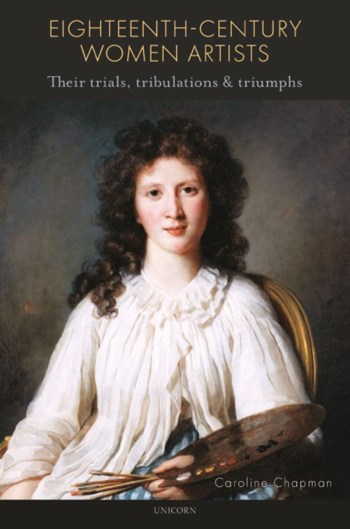 The eighteenth century was an age when not only the aristocracy, but a burgeoning middle class, had the opportunity to pursue their interest in the arts. But these opportunities were generally open only to men; any woman who wished to succeed as an artist still had to overcome numerous obstacles. In a society in which women were expected to marry, become mothers, and conform to rigid social conventions, becoming a professional artist was a controversial choice. Nevertheless, if a woman possessed charm and ambition, and united her talent with hard work, success was possible.
Eighteenth-Century Women Artists celebrates the work of women who had the tenacity and skill (and sometimes the necessary dash of luck) to succeed against the odds. Caroline Chapman examines the careers and working lives of celebrated artists like Angelica Kauffman and Elisabeth Vigée Le Brun as well as the equally interesting work of artists who have now mostly been forgotten. In addition to discussing their varied artworks, Chapman considers artists’ studios, the functioning of the print market, how art was sold, the role of patrons, and the rise of the lady amateur. It is enriched by over fifty color images, which offer a rich selection of art from the time.
Caroline Chapman is a writer, editor, and picture researcher. She has worked for both the Arthur Tooth and Son Art Gallery and the Crane Kalman Gallery as well as working as a freelance picture researcher for 30 years for Times Books, Dorling Kindersley, Phaidon, and Weidenfeld. She is the author of Elizabeth and Georgiana: The Duke of Devonshire and his Two Duchesses for John Murray and John and Joséphine: The Creation of The Bowes Museum for The Bowes Museum and has written an number of travel articles for the Times Education Supplement and Cosmopolitan.
Williamsburg Acquires Wooldridge Collection of Virginia Maps
Press release (19 April 2017) from the Colonial Williamsburg Foundation:
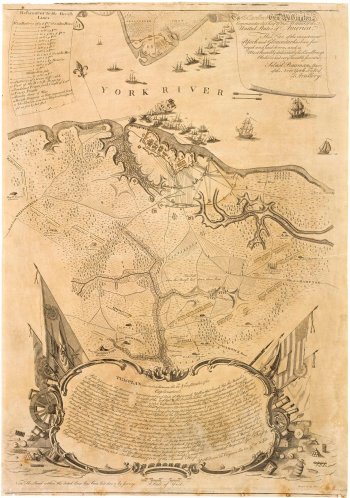
Sebastian Bauman, Plan of the Investment of York and Gloucester, 1781 (Colonial Williamsburg Foundation).
The Colonial Williamsburg Foundation has acquired one of the finest collections of early Virginia-related maps ever assembled. Through a part gift/part purchase agreement, the Foundation has added more than 220 maps, charts, atlases and documents to its collection, all dating between 1540 and 1835. Collected over four decades by William C. Wooldridge of Suffolk, Virginia, the maps were until recently owned by the Virginia Cartographical Society, a private, Norfolk, Virginia-based consortium. The addition of the Wooldridge Collection gives Colonial Williamsburg the most comprehensive assemblage of Virginia maps outside of the Library of Congress. These objects will be displayed in multiple future exhibitions at the Art Museums of Colonial Williamsburg and will be made available this spring through the Foundation’s online database.
“We are thrilled to announce this landmark acquisition, which represents a critical investment in the Foundation’s core mission to advance the public’s understanding of early America and its inhabitants,” said Mitchell B. Reiss, president and CEO of Colonial Williamsburg. “The maps contained in the Wooldridge Collection—in addition to being true works of art in their own right—offer extraordinary insight into the exploration, settlement and development of Virginia.”
“Maps are among the most illuminating of artifacts because they reveal the interests, aspirations, and even biases of those who made and used them,” said Ronald Hurst, Colonial Williamsburg’s Carlisle Humelsine chief curator and vice president for collections, conservation, and museums. “When paired with the Foundation’s early Virginia maps, the Wooldridge Collection gives us an unparalleled ability to understand and share Virginia’s role in our national story.”
Maps were made for a variety of reasons: to document new discoveries, facilitate travel, claim land and record military activity. This collection contains numerous examples of each type. One visually unique map in the Wooldridge collection was made to facilitate travel. Carta particolare dela Virginia Vecchia e Nuova by Sir Robert Dudley was published in Florence, Italy, in 1647, and was the first map to depict the region using Mercator’s projection (to flatten the spherical shape of the Earth on paper required increasingly distorting the lines of longitude the farther they were from the equator so that lines of longitude and latitude were at 90° angles. Although the land formations were altered, navigators could draw a straight line between any two points), which provided a practical aid for navigators.
Also in the Wooldridge Collection is a rare copy of Thomas Harriot’s 1590 publication, Admiranda Narratio fida tamen, de Commodis et Incolarum Ritibus Virginiae, with engravings by Theodore de Bry after John White in original color. De Bry’s engravings portray Virginia as a latter-day Eden, perhaps to stimulate interest in settlement. The Native American “Town of Secota” depicts such a scene, showing an abundance of thriving crops in neatly ordered gardens carefully manicured by a Native population. The map of Americae Pars, Nume Virginia drawn by John White and engraved by de Bry provides the first printed English record of Sir Walter Raleigh’s attempts to plant a colony in the New World. Although described in the title as Virginia, it delineates the region between the mouth of the Chesapeake Bay and Cape Lookout, North Carolina.
Another highlight among the new acquisitions dates to the close of the American Revolution in 1781. Immediately after the British surrender at Yorktown, each of the generals enlisted their engineers to create surveys of the battlefield. The most engaging of these, Plan of the Investment of York and Gloucester, was produced by George Washington’s engineer, Major Sebastian Bauman (who served as artillery commander at West Point in 1779 after emigrating from Austria). In addition to providing substantial, detailed military information, this map is interesting for its artistic composition. Yorktown, Gloucester Point, and troop positions are confined primarily to the top half of the map. The lower half is dominated by an explanation embellished with ornaments of war. The shape of the scrollwork cartouche surrounding the explanation, with flags and banners that thrust upward from both sides, forces the eye to the center of the image. Here, in an open space, is the very heart of the map: “The Field where the British laid down their Arms.”
Map aficionados, American history scholars and students in addition to anyone interested in early Virginia will find this newly combined collection a must-see resource. The addition of the Wooldridge Collection to Colonial Williamsburg’s existing holdings cements the significance of the Art Museums of Colonial Williamsburg as the premier destination for the study and appreciation of early American artifacts.
Print Quarterly, March 2017
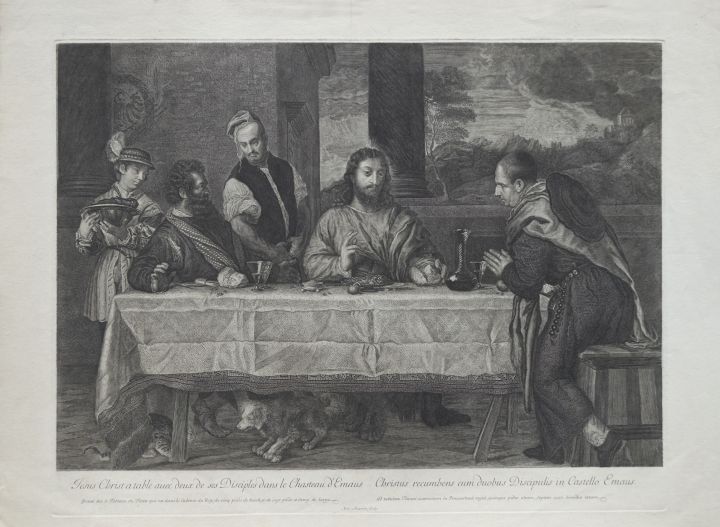
Antoine Masson, after Titian, Supper at Emmaus, second half of the seventeenth century, engraving, 452 x 586 mm
(London: The British Museum).
◊ ◊ ◊ ◊ ◊
Foremost among the several items in the current issue of Print Quarterly relevant to the eighteenth century is an article by Thomas Frangenberg addressing Franz Christoph von Scheyb (1704–77) on the art of engraving. Von Scheyb’s unusual detailed discussion of a print by Antoine Masson (1636–1700) after Titian demonstrates the sophistication with which aspects of reproductive prints could be articulated during this period, revealing prints’ merits and shortcomings, both as sources of art history and works of art in their own right. The issue also includes shorter reviews on books about Tiepolo, Piazzetta, and Novelli in the context of the eighteenth-century Venetian illustrated book; drawings and prints after the antique; and prints by Luigi Rossini (1790–1857).
Print Quarterly 34.1 (March 2017)
A R T I C L E S
• Thomas Frangenberg, “Franz Christoph von Scheyb on the Art of Engraving,” pp. 32–41
N O T E S
• Viccy Coltman, “Drawn from the Antique: Artists & the Classical Ideal,” pp. 70–72.
• Giorgio Marini, “Book Illustration in Eighteenth-Century Venice (Tiepolo, Piazzetta, Novelli: L’incanto del libro illustrato nel Settecento Veneto), pp. 73–76.
• David R. Marshall, “Luigi Rossini 1790–1857,” pp. 76–77.
A full contents list is available here»
Master Class | Graphic Satire and Anglo-American History Painting
From The Lewis Walpole Library:
Master Class: A Contest of Two Genres: Graphic Satire and
Anglo-American History Painting in the Long Eighteenth Century
The Lewis Walpole Library, Farmington, CT, 15–18 May 2017
Mark Salber Phillips, Professor of History at Carleton University, Ottawa
Cynthia Roman, Curator of Prints, Drawings, and Paintings at the Lewis Walpole Library
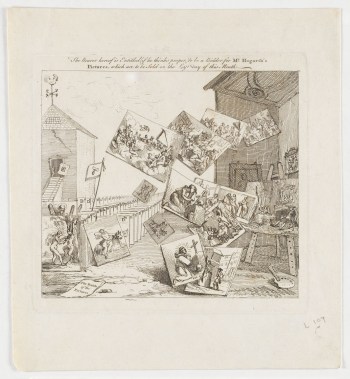
William Hogarth, The Battle of the Pictures, 1745 (Farmington: The Lewis Walpole Library, lwlpr22633).
Centuries-old hierarchies of the visual arts have placed history painting and graphic satire at opposite ends of the spectrum. ‘History painting’—high-minded narrative art depicting exemplary heroes and events—carried enormous prestige, bringing fame to the individual artist as well as to the national school. In contrast, graphic satire was viewed as the lowest form of visual expression—more closely connected to political prints than to high-minded ‘histories’.
This residential seminar is intended to give doctoral students in a variety of disciplines the opportunity to consider issues and overlaps between these two narrative genres. Making use of visual material and textual resources from the collections of the Lewis Walpole Library’s at Yale, we will examine the often-embattled efforts of artists to construct new modes of visual representation as well as of narrative and history. Through a multidisciplinary approach, we will take note of a variety of key issues, including the theoretical context of Enlightenment intellectual history, the more focused discourse of art treatises, and direct encounters with the formal and aesthetic qualities of works of art. Among history painters we will give our attention to the works of William Hogarth, Gavin Hamilton, Benjamin West, and John Trumbull, while among the satirists we will focus on James Gillray, Thomas Rowlandson, and Isaac and George Cruikshank.
The class will be taught as a combination of seminars, small group discussions, and visits to the Yale Center for British Art, the Yale University Art Gallery, and the Wadsworth Atheneum Museum of Art. Most of the teaching will take place in the Lewis Walpole Library in Farmington. For more information about this class and to apply, please visit our Master Class page.
Exhibition | The Luther Effect
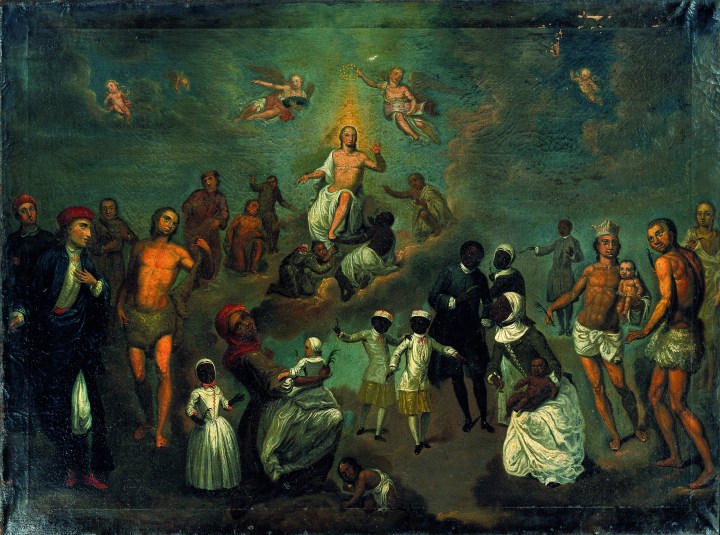
Johann Valentin Haidt, First Fruits (Erstlingsbild),1748
(Herrnhut: Unitätsarchiv der Evangelischen Brüder-Unität, GS 463)
◊ ◊ ◊ ◊ ◊
From the exhibition website:
The Luther Effect: Protestantism—500 Years in the World
Der Luthereffekt 500 Jahre Protestantismus in der Welt
Deutsches Historisches Museum at Martin-Gropius-Bau, Berlin, 12 April — 5 November 2017
The German Historical Museum (DHM) welcomes Martin-Gropius-Bau visitors on a trip through five centuries and across four continents. Marking the Reformation’s 500th anniversary, The Luther Effect shows the diversity and history, as well as the conflict potentials of Protestantism in the world. What impact has Protestantism had on other denominations and religions? How did Protestantism change through these encounters? And not least, how have people of different cultures adopted, shaped, and lived Protestant doctrine? Starting with Reformations in the 16th century, the exhibition highlights a global history of effect and counter-effect as seen in the examples of Sweden, the United States, South Korea, and Tanzania.
 An impressive display of around 500 original exhibits in an exhibition space measuring some 3,000 square meters (32,000 square feet), the exhibition includes exceptional artworks and compelling, meaningful everyday objects from the era. Many of these extraordinary exhibits are being shown in Germany for the first time, to mark the occasion of the 500th anniversary of the Reformation. Modern media is used to give background information, enriching the exhibition.
Reformations, 1450–1600
The Reformation was a European event. Since the 16th century, various paths of reform had been leading to a renewal of the Church and life in general. Martin Luther’s Reformation was one of these. However, from a global perspective, other paths such as the Reformed Church or the Anglican Church in England were more influential. The Catholic Church also underwent a process of reform.
Undisputed beliefs and centuries-old practices were called into question. Soon proponents and opponents of reform were fighting not only against each another but also among themselves. The more radical movements like the Anabaptists were persecuted and marginalised not only by Catholics, but by Lutherans and the Reformed as well. The competition forced Luther, the Reformed, Anabaptists, Anglicans, and Catholics to clarify their own positions and to set themselves apart from others. The different reform paths developed into denominations that continue to evolve dynamically to this day.
One Land, One Religion: Sweden as a Lutheran Great Power, 1500–1750
King Gustav Vasa of Sweden, influenced by the Lutheran Reformation, broke with the Pope in Rome in 1527. This contributed to the spread of various reformist ideas in the Swedish Empire. But it was the Synod and the Parliament of Uppsala in 1593 that first established the Lutheran Church as the binding confession of Sweden, resulting in a Lutheran State Church and a confessionally unified state in Sweden.
The Swedish State Church brought the evolution of a new religious culture. The community that emerged saw itself as the protective power of Lutheranism. Swedish rulers and their armies fought on Europe’s battlefields for Sweden’s great power status and Luther’s doctrines. At home in Sweden, the State Church became increasingly restrictive. Church discipline, and the conversion of the Sámi who lived in the north of the country, were intended to consolidate the Lutheran faith and foster a common identity.
The United States of America: The Promised Land?, 1600–1900
Protestantism was brought to the British colonies of North America, later the United States, through the immigration of various groups, churches, and confessions, which accounts for the diversity of American Protestantism. A state church does not exist in the United States; instead, there is a vast landscape of independent churches. Protestantism in the USA developed its unique profile under the influence of charismatic revivalist preachers beginning in the 18th century. This gave rise to new confessions and numerous social reform movements. The so-called Black Churches of African Americans also emerged in the course of this development. Protestantism contributed significantly to the creation of the American nation and the formation of its self-understanding. It shaped the notion of America as the Promised Land, and of Americans as the Chosen People. These concepts gave rise to ideas that continue to influence American society to the present day.
Korea: Boom Land of Protestantism, 1850–2000
In the Republic of Korea (South Korea), numerous religions lead a relatively peaceful coexistence. Almost 30 percent of South Koreans consider themselves Christian, and slightly fewer than two-thirds of them are Protestant. This makes South Korea the only East Asian country where a significant proportion of the population is Protestant.
Protestant missionaries could not settle permanently in Korea until the mid-1880s. At this time, the first Protestant communities, founded by Korean laypeople, already existed. Using the Korean alphabetic script Han’gul to translate the Bible proved to be an important instrument for the missions. After the division of the land and the Korean War 1950–53, most Christians fled the Democratic People’s Republic of Korea (North Korea) to the South. Since the 1960s, South Korea has developed rapidly into an industrialised state. At the same time, the religious landscape has changed drastically: in 1950, three percent of South Koreans were Protestant, and by 1995 the number had already risen to around 20 percent. The relation to North Korea, including the possible reunification of the country, is a key issue in South Korea, and for the Protestant churches as well. On such questions the churches take very diverse positions.
Tanzania: Mission and Self-Reliance Today
The country of Tanzania has been shaped by migration and by the more than 130 ethnic groups who coexist there in a largely peaceful atmosphere. Among the many forms of Tanzanian Protestantism, the Evangelical Lutheran Church in Tanzania (ELCT) plays a major role. With more than 6 million members in 24 dioceses, the ELCT is now the largest Lutheran Church in Africa and the second largest in the world. It traces its origins back to German, Scandinavian, and American missionary societies that were active in the region which had become the colony known as German East Africa (then encompassing today’s Tanzania, Burundi, Rwanda, and part of Mozambique). In addition, the Moravian Brethren, the Anglican Church, and charismatic movements were instrumental in the spread of Protestant faith communities.
A variety of Protestant churches rapidly developed, driven forward by devout Tanzanians. From the outset, the missions aimed to establish financially independent churches and parishes. Today, their influence extends beyond Tanzania’s borders. Missionaries from Tanzania work throughout the continent. With a heedful view of the European churches, they see themselves as preserving the original Lutheran ideals.
Transformation and Schism: Installation by Hans Peter Kuhn
Exclusively for the exhibition, the Berlin artist Hans Peter Kuhn transforms the atrium of the Martin-Gropius-Bau into a gigantic artwork out of aluminum tubing, light, and sound. The installation Transition approaches the worldwide effects of the Reformation from an artistic perspective and makes the processes of the transformation of the relationship of Man to God and the schism of the Church doctrines triggered by the Reformation palpable and perceptible.
◊ ◊ ◊ ◊ ◊
Published by Hirmer, the catalogue is distributed in North America and Japan by The University of Chicago Press:
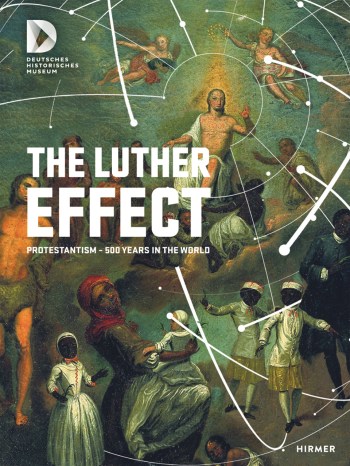
The Luther Effect: Protestantism—500 Years in the World (Munich: Hirmer Verlag, 2017), 400 pages, ISBN: 978 37774 27225, $54.
To mark the occasion of the five-hundredth anniversary of the Protestant Reformation in 2017, The Luther Effect offers a vivid and rich journey across five centuries and four continents, detailing the visual history of the growth of Protestantism around the world. The book examines how Protestantism has affected—and been affected by—encounters with diverse denominations, cultures, and lifestyles throughout the centuries. It explores how Protestantism has adapted and transformed and how different people around the world have adopted, modified, and followed its doctrine. Including two hundred and fifty stunning color plates and looking specifically at the art and cultural objects created in response to and in celebration of the religious movement, The Luther Effect presents the first comprehensive global history of Protestantism’s influence, reverberations, and reception.
The British Library Set To Expand
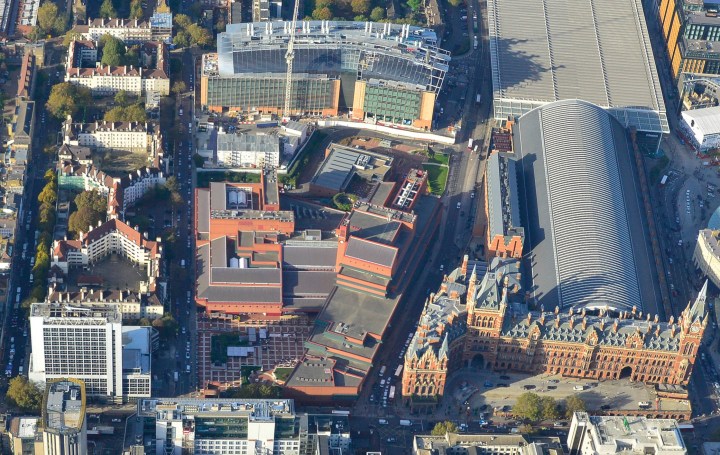
British Library at St Pancras site and surroundings, including (center) the British Library, (right) St Pancras Station, and (top) the Francis Crick Institute (Photo by Ian Hay).
◊ ◊ ◊ ◊ ◊
Press release (11 April 2017) from the BL:
The British Library has selected a consortium led by property developer Stanhope, working with architects Rogers Stirk Harbour + Partners, as preferred partner for a project to develop a 2.8 acre site to the north of its Grade I Listed building at St Pancras in London as a major new centre for commerce, knowledge, and research.
At the heart of the development will be 100,000 sq ft of new British Library spaces for learning, exhibitions, and public use, including a new northern entrance and a bespoke headquarters for the Alan Turing Institute, the national centre for data science research. The development will also include new commercial space for organisations and companies that wish to be located at the heart of London’s Knowledge Quarter, close to the Francis Crick Institute and the other knowledge-based companies, research organisations, amenities, and transport links located at King’s Cross and St Pancras.
The Stanhope consortium was appointed following a Competitive Dialogue procurement process that began in late 2015. Stanhope have 30 years’ experience of developing complex central London projects, including Broadgate, Paternoster Square, and the Tate Modern Switch House building. Stanhope are backed by strong financial partners and current projects include the regeneration of Television Centre, White City. Rogers Stirk Harbour + Partners are well-known for buildings such as the Grade I Listed Lloyds Building and the recent British Museum extension.
Secretary of State for Culture, Media and Sport, Karen Bradley said: “The British Library is one of our finest cultural institutions, housing an unparalleled collection of knowledge. This innovative project will increase access to the Library’s first-class collections, providing new exhibition spaces, learning opportunities, and facilities for visitors from Britain and around the world to enjoy. It is a significant commitment to digital research and data science, and I am pleased the expansion will provide a bespoke headquarters for the Alan Turing Institute.”
Universities and Science Minister Jo Johnson said: “This new development alongside the Francis Crick Institute will be another gem in the crown of London’s Knowledge Quarter and an ideal location for commercial and life-sciences investment in an area already synonymous with pioneering thinking and Britain’s leadership in research. Our Industrial Strategy will support the development of projects like this to ensure the UK has the environment and skills we need to maintain our position at the forefront of innovation.”
Deputy Mayor for Business, Greater London Authority, Rajesh Agrawal, said: “This is another exciting development for London’s flourishing Knowledge Quarter, our world-leading life sciences sector and our rapidly growing reputation for data science. It is a huge vote of confidence in the capital post-Brexit. London is one of the greatest scientific cities on the planet. We are internationally renowned as a bastion of research and innovation and one of the most attractive places in the world for life and data science companies to do business. This new investment, just a stone’s throw from the Francis Crick Institute, is another huge boost to London’s role as a global capital of science and innovation. As well as leading to world-changing discoveries, products, and services, it will deliver new jobs and demonstrate that London is open to the world’s greatest scientific minds.”
The development project is a key part of the British Library’s Living Knowledge vision to become ever more open, creative, and innovative in the delivery of its purposes. The objectives of this development include:
• More exhibition spaces, increasing public access to the Library’s vast world-class collections
• New facilities for learners of all ages, with expanded programmes for schools, colleges, families, adult learners, and local communities
• Improved public areas and accessibility, with more places to sit and study
• An enhanced offering for business users, building on the success of the Library’s Business & IP Centre
• A new northern entrance close to the Francis Crick Institute and the main St Pancras Station concourse
• A permanent home for the Alan Turing Institute, the UK national centre for data science
• Flexible accommodation for third-party companies, institutions, and research organisations seeking to work at the heart of the Knowledge Quarter
• Environmental improvements including enhanced East-West connectivity for local people walking between Somers Town and St Pancras
HM Treasury and the Library’s sponsor department, the Department for Culture, Media and Sport have approved the Full Business Case for the project. The Development Agreement with Stanhope is to be finalised this summer, with the design and planning process—including close working with Camden Council, local communities and other neighbours and stakeholders, and an agreed solution to accommodating Crossrail 2 requirements into the development—taking place over the next eighteen months.
Roly Keating, Chief Executive of the British Library, said: “We are delighted to have secured such high-calibre partners to help realise our vision of the British Library’s London campus as a truly open, creative centre for knowledge. Sir Colin St John Wilson’s Grade I Listed building was one of the great public projects of the last century, and this new partnership will help us to preserve and respect its unique character while creating much-needed extra space both for our growing public audiences and the dynamic research communities in London’s Knowledge Quarter.”
Opening Wednesday: Museum of the American Revolution
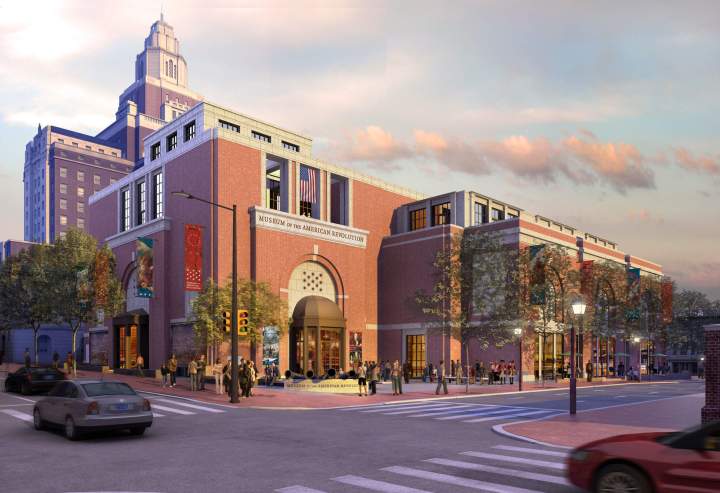
Museum of the American Revolution, Philadelphia. Robert A.M. Stern Architects LLP
◊ ◊ ◊ ◊ ◊
From the Museum:
The Museum of the American Revolution, which opens in the heart of historic Philadelphia on April 19, 2017, will explore the dynamic story of the American Revolution using its rich collection of Revolutionary-era weapons, personal items, letters, diaries, and works of art. Immersive galleries, theater experiences, and recreated historical environments will bring to life the events, people, and ideals of our nation’s founding and engage people in the history and continuing relevance of the American Revolution. The Museum is a private, non-profit, and non-partisan organization.
The Museum of the American Revolution will bring to life the events, people, and ideals of the founding of the United States and inspire a deep appreciation of the importance of the struggle that established a nation. With original artifacts, immersive galleries, dynamic theaters, and recreated historical environments, the experience will take visitors on a chronological journey from the roots of conflict in the 1760s through the creation of the American republic. Along the way, visitors will learn about the rise of the armed resistance to British taxation, the creation of the Declaration of Independence, the long years of warfare that achieved victory, and the Revolution’s continuing relevance.
The Museum rises three stories above the street, encompassing 118,000 total square feet, including permanent and temporary exhibit galleries, theaters, education spaces, collection storage, a café, a retail store, offices, and a welcoming rotunda. Located at the corner of Third and Chestnut Streets, the state-of-the-art building was designed by Robert A.M. Stern Architects. Visitors enter the Museum through a domed bronze-cladded entrance on Third Street into the rotunda, which features a dramatic window looking out to the activity on Chestnut Street. The cross-vaulted ceiling features an illuminated laylight representing the six-pointed star from Washington’s Standard flag, which is in the Museum’s collection.
The ground floor interior is organized around a skylit central interior court featuring terrazzo floors and an elliptical staircase, which provides a dramatic pathway to the Museum’s second floor exhibition galleries. Serving as the crossroads of the Museum, the Main Court also provides access to a 190-seat theater where visitors will view the Museum’s orientation film; 5,000 square feet of temporary exhibition and program space; a retail shop; and a café with seating on a terrace that opens to the sidewalk on Third Street.
At the top of the sweeping Grand Staircase, the second floor features 18,000 square feet of galleries and a 100-seat theater dedicated to George Washington’s Headquarters Tent. The third floor includes staff offices and an elegant special event and programs space with views of Carpenters’ Hall, the First Bank of the United States, and Independence Hall through nearly floor-to-ceiling windows and an open-air balcony.
The Museum’s lower level includes classrooms for students and other groups, collection storage, and will later include a discovery center, where children can explore their own role in making history.
Now Open: American Revolution Museum at Yorktown
From the Jamestown-Yorktown Foundation:
 2017 is a pivotal year at Jamestown Settlement and the American Revolution Museum at Yorktown, two premier living-history museums in two corners of America’s Historic Triangle that offer year-round experiences, compelling special exhibitions, events, and programs that immerse visitors into the story of America’s beginnings.
The Grand Opening Celebration of the American Revolution Museum at Yorktown March 23–April 4 culminates the museum’s 10-year transformation from the Yorktown Victory Center. The American Revolution Museum at Yorktown presents a renewed national perspective on the meaning and impact of the Revolution through introductory film, timeline, expansive gallery exhibits with nearly 500 artifacts, interactive displays and experiential theaters, and new settings for hands-on interpretive experiences in expanded re-creations of a Continental Army encampment and Revolution-era farm. The celebration launches the new museum with daily highlights of one of America’s 13 original states in the order that they ratified the Constitution, with a dedication ceremony on April 1. Patriotic festivities include gallery tours, living-history programs, artillery firings, flag-raising ceremonies, military musical performances, military re-enactments, lectures, and children’s activities.
 Located next to Yorktown National Battlefield, the Yorktown Victory Center opened in 1976 as one of three Virginia visitor centers for the Bicentennial of the American Revolution. Structural and exhibit improvements were implemented in the 1990s, broadening the museum’s focus to encompass the entire Revolution. The American Revolution Museum at Yorktown is the realization of a master plan adopted in 2007. The plan called for replacing the 1976 facility, with the new building positioned on the 22-acre site to allow for continued operation throughout construction, and repositioning and reconstructing the encampment and farm. A new 80,000-square-foot building opened in March 2015, with a theater for showings of Revolution-theme films, an illustrated timeline spanning the second half of the 18th century, and a gift shop and cafe. An important element of the new building is an education center, with five classrooms and a separate entrance, to serve student groups and the general public with dynamic, interactive learning experiences.
The museum’s inaugural special exhibition—AfterWARd: The Revolutionary Veterans Who Built America—debuts June 10 and follows the post-war stories of veterans of the Siege of Yorktown and how they went on after the war to shape the America we know today. A series of plays, performances and public lectures June through November feature Revolutionary War veterans James Lafayette, Alexander Hamilton, the Marquis de Lafayette and Henry Knox as well as issues facing modern-day veterans.
At Jamestown Settlement, a museum of 17th-century Virginia history and culture, visitors this spring can experience new interactive gallery exhibits exploring the Powhatan Indian, English and west central African cultures that converged in the 1600s. As part of a phased gallery enhancement, touch-screen panels allow visitors to compare and contrast each culture’s language, religion, government, economy and family structure. Jamestown Settlement’s expansive gallery exhibits debuted in 2006 in time for America’s 400th Anniversary commemoration in 2007, and are now being refreshed a decade later with new technology.
Four hundred years after the 1617 death of Pocahontas in England, her image and legend live on. Using depictions of Pocahontas from across the centuries, Jamestown Settlement presents Pocahontas Imagined, a special exhibition opening July 15 that illuminates the reasons behind her enduring legacy as well as her impression on popular culture and art. The six-month exhibition features Pocahontas memorabilia, advertisements, and interactive experiences.
Outdoors, visitors can examine artistic patterns, lines, and colors in objects found in Jamestown Settlement’s re-created Powhatan Indian village, ships and fort. Public lectures in partnership with the Virginia Museum of Fine Arts take place September 5, September 13, and October 3.
Jamestown Settlement is located on Route 31 at the Colonial Parkway next to Historic Jamestowne, administered by the National Park Service and Jamestown Rediscovery (on behalf of Preservation Virginia). The American Revolution Museum at Yorktown is located on Route 1020 in Yorktown near Yorktown Battlefield, administered by the National Park Service.










 Enfilade
leave a comment