V&A Opens New Courtyard and Entrance

The V&A’s Aston Webb screen from 1909, modified with five new openings on either side of the central arch, now connects the courtyard to Exhibition Road. Photograph: Hufton+Crow.
◊ ◊ ◊ ◊ ◊
Press release from the Victoria & Albert Museum:
The V&A Exhibition Road Quarter opened to the public on the evening of Friday 30 June 2017, creating a beautiful and unique new civic space for London and a world-class gallery space for the V&A’s internationally acclaimed exhibition programme. The project is designed by Stirling Prize-winning architect Amanda Levete and her practice, AL_A. The launch of the V&A Exhibition Road Quarter marks the beginning of a new era for the Museum as it prepares to expand its UK and international presence. The project is the Museum’s largest architectural intervention in over 100 years and offers a 21st-century interpretation of the V&A’s founding principles: to make works of art and design available to all, to educate, and to inspire designers and manufacturers today and in the future.
 The V&A Exhibition Road Quarter took six years to realise and transforms the V&A’s former boilerhouse yard on London’s great cultural artery, Exhibition Road. This new entrance connects the Museum with its neighbours, reinforcing the Albertopolis vision of intellectual ambition and innovation and creates a sequence of major new spaces:
• The Sainsbury Gallery: a flexible, 1,100sq m column-free exhibition gallery that provides the V&A with a purpose-built space for its world-leading programme of temporary exhibitions
• The Sackler Courtyard: the world’s first porcelain public courtyard, paved in 11,000 handmade tiles that were inspired by the rich tradition of ceramics at the V&A
• The Blavatnik Hall: a new entrance into the V&A from Exhibition Road, which transforms how visitors experience and discover the Museum and its collections
• The Aston Webb Screen: visitors will now enter the V&A from the street through the 11 openings of newly created colonnade formed from the 1909 Aston Webb Screen.
REVEAL, a free, week-long public festival (30 June–7 July) celebrates the opening of the V&A Exhibition Road Quarter and offers a unique opportunity for the public to explore the Museum’s newly designed spaces before exhibition programming begins in the autumn. Art, performance, fashion, and family activities will bring the architecture and collections to life, reflecting on the V&A’s unique combination of heritage, modernity, and technology.
Tristram Hunt, Director of the V&A said: “This is a landmark moment in our history. The V&A Exhibition Road Quarter is both the Museum’s largest architectural intervention in over one hundred years and the start of a new chapter of expansion, returning to our original mission at the same time as opening up the V&A for the future. With its mix of ingenuity and imagination, the V&A has always been a meeting point for historicism and modernity. The V&A Exhibition Road Quarter bridges the two by offering fresh insights into our historic building with pioneering new architecture, creating London’s leading exhibition space.”
The Sackler Courtyard is the world’s first all-porcelain public courtyard and comprises over 11,000 handmade porcelain tiles, inspired by the rich tradition of ceramics at the V&A. This new public space for London also houses a café with furniture designed for the space by AL_A and manufactured by Moroso. The Sackler Courtyard reveals architecturally significant façades and details that have never previously been seen by the public. These include sgraffito decoration on the side of the Henry Cole Wing—a decorative Renaissance technique using multiple layers of coloured plaster created by the first art students at the Museum in the late 19th century. The stonework of the Aston Webb Screen retains the damage that World War II inflicted on the Museum, which is reflected in 11 sets of new metal gates, designed by AL_A. The gates have been manufactured with a pattern of perforations tracing the imprint of the shrapnel damage on the stonework as well as the Royal Crest in the central gate.
The Blavatnik Hall is a new space that will transform how visitors experience and discover the Museum and collections. Connecting the newly displayed Robert H. N. Ho Family Foundation Galleries of Buddhist Art and the Dorothy and Michael Hintze Sculpture Galleries, The Blavatnik Hall gives views through to The John Madejski Garden, leads to a new shop, and connects to the historic Ceramic Staircase as well as the Sackler Centre for arts education, which reopens featuring the new John Lyon’s Charity Community Gallery.
The versatile, 1,100m sq column-free Sainsbury Gallery is one of the largest temporary exhibition galleries in the UK. This flexible exhibition space sits above a floor dedicated to art handling, conservation and preparation space. The new spaces reach as far as 18 metres below ground, directly beneath the Western Range of the V&A’s Grade I listed buildings: a daring engineering and construction challenge that is made visible to the public by steel columns and a beam painted in vivid international orange that are literally holding the weight of history and the Museum’s priceless collections above.
Amanda Levete said: “The V&A Exhibition Road Quarter is a reflection of the pioneering identity of the V&A and continues its mission of innovation into the twenty-first century. The Quarter reimagines the museum as an urban project, creating an exceptional place for London that will redefine the V&A’s relationship with the street and the public.”
Celebrating its 165th anniversary this summer, the V&A is the world’s leading museum of art, design and performance. The completion of this major project marks an exciting moment of evolution for the V&A, a year after winning the Art Fund Museum of the Year 2016, and looking ahead to the opening of the V&A Gallery, Shekou as part of Design Society, in China this autumn and the V&A Museum of Design, Dundee next year.
The V&A Exhibition Road Quarter is the largest construction project undertaken by the V&A since its main buildings in South Kensington were completed in 1909. 22,500 cubic metres of earth were removed from the site and clay from the deepest excavations was carbon-dated to 50 million years old. At the height of construction, up to 60 truckloads of earth were removed from site per day, 99% of which was recycled. The new spaces have created more than 6,000sq m out of 2,200sq m of underused space. AL_A was commissioned to design the V&A Exhibition Road Quarter in 2011 following an international competition. Wates are the lead contractors delivering the project and Arup are the Structural and Building Services engineers.
Over £48 million has been raised for the V&A Exhibition Road Quarter thanks to the generosity of The Monument Trust, The Dr Mortimer and Theresa Sackler Foundation, The Headley Trust, The Blavatnik Family Foundation, the Garfield Weston Foundation, the Heritage Lottery Fund and other donors including Peter Williams and Heather Acton and the Friends of the V&A.
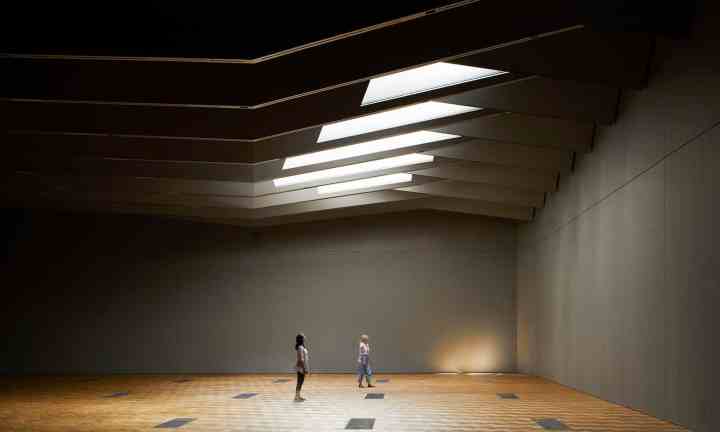
The V&A’s new Sainsbury Gallery, a flexible, 1100sq m column-free gallery for temporary exhibitions. The inaugural exhibition Opera: Passion, Power and Politics opens September 30. Photograph: Hufton+Crow.
◊ ◊ ◊ ◊ ◊
Writing in The Guardian, Oliver Wainwright provides a review of the new space along with context for the expansion, including description of the 1997 proposal by Daniel Liebeskind to build a tower (Spiral) on the site—an idea which, failing to secure funding, was abandoned in 2004. In Wainwright’s words, “Having been drawn, Icarus-like, to the shining promise of starchitecture, and had its wings thoroughly scorched, the V&A decided to opt for the more modest option of going underground.”
Display | Desire, Love, Identity: Exploring LGBTQ Histories
Now on view at The British Museum:
Desire, Love, Identity: Exploring LGBTQ Histories
The British Museum, London, 11 May — 15 October 2017
Ashmolean Museum, Oxford, 25 September — 2 December 2018
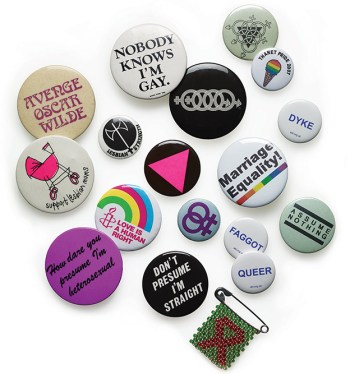 This display provides glimpses into LGBTQ (Lesbian Gay Bisexual Transgender Queer) experience across time and around the world through the British Museum’s collection. The objects offer insights into to what the novelist E. M. Forster described as “a great unrecorded history.” Ranging chronologically from ancient history to the present day the objects often prompt questions, challenging the contemporary viewer to question the assumptions that they bring to objects from other cultures and the more distant past. The display draws on material from across the breadth of the Museum’s collection including coins, medals, and prints. As well as highlighting famous figures such as the poetess Sappho, and the emperor Hadrian and his lover Antinous, the display looks beyond Europe’s classical past to explore less familiar themes and stories.
This exhibition coincides with the 50th anniversary of the passing of the Sexual Offences Act in July 1967. This legislation partially decriminalised homosexuality in England and Wales and marks an important milestone in the campaign for equality.
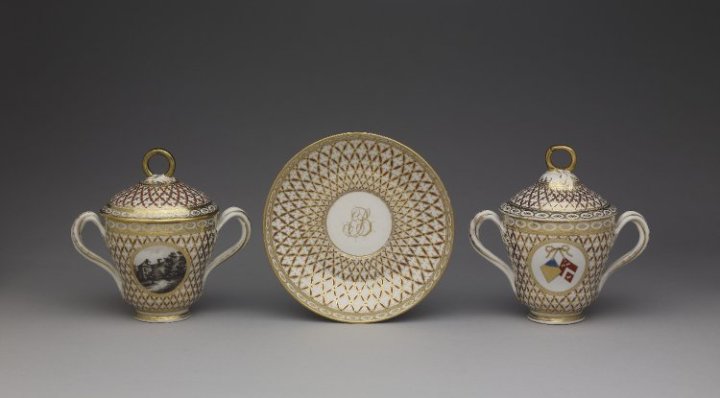
The Ladies of Llangollen Chocolate Cups and Saucers, porcelain from Bristol China Manufactory, 1779–81, and Derby Porcelain Factory (replacements), 1790 (London: The British Museum, 1887,0307,VIII.34).
◊ ◊ ◊ ◊ ◊
The exhibition includes Chocolate Cups and Saucers that belonged to the Ladies of Llangollen:
Sarah Ponsonby (1755–1831) and Eleanor Butler (1739–1829), known popularly as the Ladies of Llangollen, ran away in 1780 to set up home together, leaving their old aristocratic lives in Ireland behind them. They lived happily for 50 years in North Wales, challenging the conventions of their era and acquiring a celebrity-like status. These chocolate-cups are decorated with a view of their house on one side and their coats of arms on the other. The centre of each saucer is decorated with their entwined monograms. During the 1700s the concept of romantic friendships between women became common. Friends often wrote to one another using passionate language that to modern readers would imply a sexual relationship, but largely reflected social convention.
◊ ◊ ◊ ◊ ◊
Note (added 4 September 2018) — The posting was updated to include the Ashmolean as a venue, where the exhibition is entitled No Offence: Exploring LGBTQ+ Histories.
New Book | The Collector’s Cabinet and Miniature Pharmacy
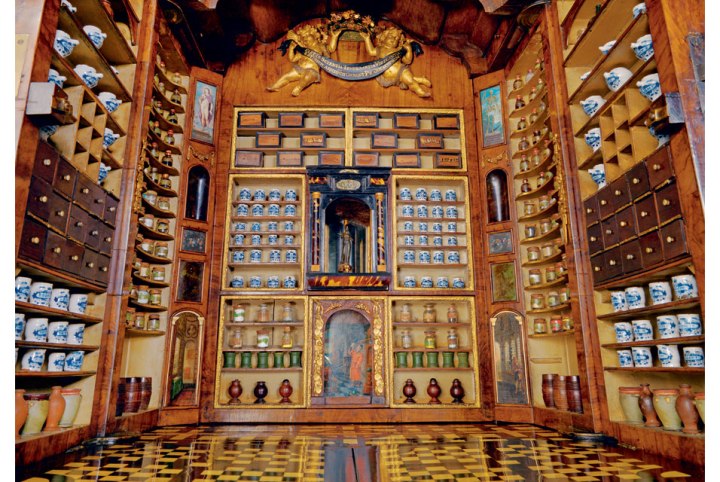
Collector’s Cabinet with Miniature Apothecary’s Shop, 1730
(Amsterdam: Rijksmuseum)
◊ ◊ ◊ ◊ ◊
Press release (23 June 2017) from the Rijksmuseum. The English edition of the book should be be available from Distributed Art Publishers (DAP) in August.
Paul van Duin, ed., The Collector’s Cabinet and Miniature Pharmacy / Verzamelaarskast met miniatuurapotheek (Amsterdam: Rijksmuseum, 2017), 184 pages, ISBN: 978 949171 4610 (Dutch edition) / ISBN: 978 949171 4726 (English edition), 40€ / $60. Essays by Reinier Baarsen, Annette Bierman, Judith van der Brugge-Mulder, Gerhard Cadée, Roelof van Gelder, and Dave van Gompel.
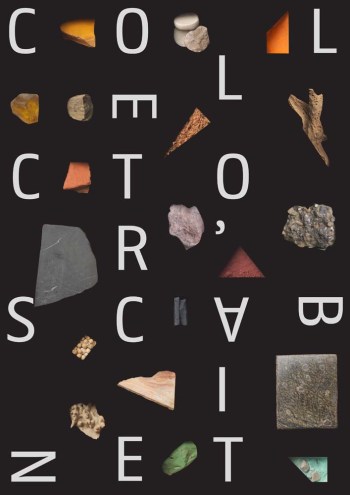 In the last few years no fewer than 50 experts have been involved in conducting research on the only eighteenth-century miniature apothecary’s shop in the Netherlands. The Rijksmuseum is now presenting the results of this research and conservation project in an extensive publication, designed by Irma Boom and showing the miniature pharmacy and 56 secret drawers for the first time, at almost actual size.
This rare collector’s cabinet houses an abundance of curiosities including a fully fitted miniature apothecary’s shop containing more than three hundred Delftware pots, glass bottles, tiny wooden drawers, paintings, and gilded ornaments. Concealed beside and behind the miniature pharmacy are no fewer than 56 secret drawers, all but five of which contain the collection of nearly 2000 varieties of naturalia, including seeds, flowers, roots, animal parts, rocks, minerals, and fossils.
The research has now been completed, providing a far deeper understanding of the cabinet’s origins, its purpose, the exceptional naturalia it contains, and the collectors’ world it inhabited. We can now be fairly certain that the cabinet was made in Amsterdam in 1730 for a wealthy doctor or apothecary, as a curiosity for the entertainment of a select group of friends and fellow collectors. The study also revealed that most of the naturalia items form the original contents of the cabinet. The naturalia even include uraninite and two other minerals containing uranium—for safety reasons, these materials are now safely stored in lead caskets in the Rijksmuseum’s depot, in accordance with the regulations and permit issued under the Dutch Nuclear Energy Act.
The conservation and restoration work have for a large part returned the cabinet and miniature apothecary’s shop to their former glory, and this object is now one of the highlights of the eighteenth-century galleries in the Rijksmuseum.
With thanks to the Cultural Heritage Agency of the Netherlands, Naturalis Biodiversity Center, Leiden University, and the Royal Netherlands Institute of Sea Research. The research, conservation, and publication were made possible by the Bank of America Merrill Lynch Art Conservation Project.
New Book | The Paper Zoo: 500 Years of Animals in Art
From The University of Chicago Press:
Charlotte Sleigh, The Paper Zoo: 500 Years of Animals in Art (Chicago: The University of Chicago Press, 2017), 256 pages, ISBN: 978 022644 7124, $45.
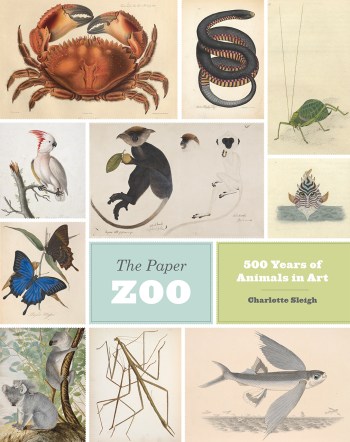 As children, our first encounters with the world’s animals do not arise during expeditions through faraway jungles or on perilous mountain treks. Instead, we meet these creatures between the pages of a book, on the floor of an obliging library. Down through the centuries, illustrated books have served as our paper zoos, both documenting the world’s extraordinary wildlife in exquisite detail and revealing, in hindsight, how our relationship to and understanding of these animals have evolved over time.
In this stunning book, historian of science Charlotte Sleigh draws on the ultimate bibliophile’s menagerie—the collections of the British Library—to present a lavishly illustrated homage to this historical collaboration between art and science. Gathering together a breathtaking range of nature illustrations from manuscripts, prints, drawings, and rare printed books from across the world, Sleigh brings us face to face (or face to tentacle) with images of butterflies, beetles, and spiders, of shells, fish, and coral polyps. Organized into four themed sections—exotic, native, domestic, and paradoxical—the images introduce us to some of the world’s most renowned natural history illustrators, from John James Audubon to Mark Catesby and Ernst Haeckel, as well as to lesser-known artists. In her accompanying text, Sleigh traces the story of the art of natural history from the Renaissance through the great age of exploration and into the nineteenth century, offering insight into the changing connections between the natural and human worlds.
But the story does not end there. From caterpillars to crabs, langurs to dugongs, stick insects to Old English pigs; from the sinuous tail feathers of birds of paradise to the lime-green wings of New Zealand’s enormous flightless parrot, the kakapo; from the crenellated plates of a tortoise’s shell to imagined likenesses of unicorns, mermaids, and dinosaurs, the story continues in this book. It is a Paper Zoo for all time.
Charlotte Sleigh is a reader in history at the University of Kent. She is the author of Ant, Six Legs Better: A Cultural History of Myrmecology, Literature and Science, and Frog.
New NGA Online Edition: French Paintings of the Eighteenth Century
◊ ◊ ◊ ◊ ◊
This new online component from the NGA in Washington, D.C. includes convenient access to lots of interesting material, including videos (under ‘related content’). It might be particularly useful for teachers looking to enrich course materials with digital offerings (and plenty of other things). –CH
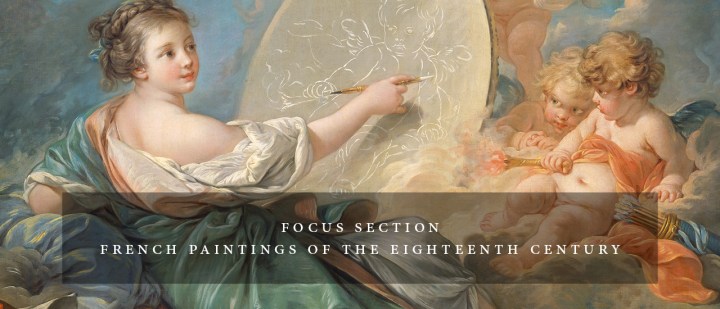
In conjunction with the recently opened exhibition, America Collects Eighteenth-Century French Painting, the National Gallery has released a new offering in its NGA Online Editions series, Focus Section—French Paintings of the Eighteenth Century.
The web-based Online Editions series is part of an ongoing effort to digitize and provide open access to the Gallery’s permanent collection catalogs and will eventually document more than 5,000 works of painting, sculpture, and decorative arts. Focus Section—French Paintings of the Eighteenth Century includes essays devoted to 20 paintings and their four related artists’ biographies. Like other Online Editions, this iteration provides free and open access to illustrated scholarly entries, biographies of the artists, and technical summaries.
Other highlights of the features available to researchers include
• A customized reading environment: An adjustable split-screen ‘reader mode’ allows users to view scholarly text alongside images, notes, and comparative figures or to view them in line with the text.
• Compare and explore images: An image-comparison tool enables users to view primary and comparative images side by side or to explore technical images via overlay and cross-fading techniques.
• Ease of research: The Online Editions toolbar provides preformatted citations for an object or biography, easy export, and quick access to archived pages.
• Archived versions and permanent URLs: Immediate access to PDFs of earlier versions and the assurance of permanent web addresses are a convenience to students and scholars alike.
• Enhanced search capabilities: An interactive search index is driven by an evolving list of terms particular to each area of the collection.
The NGA Online Editions series presents the same authoritative, peer-reviewed scholarship found within the Gallery’s bound volumes but enriched with customized tools for a more dynamic research experience.
Frick Pittsburgh Unveils New Strategic Plan and Acquisitions Program
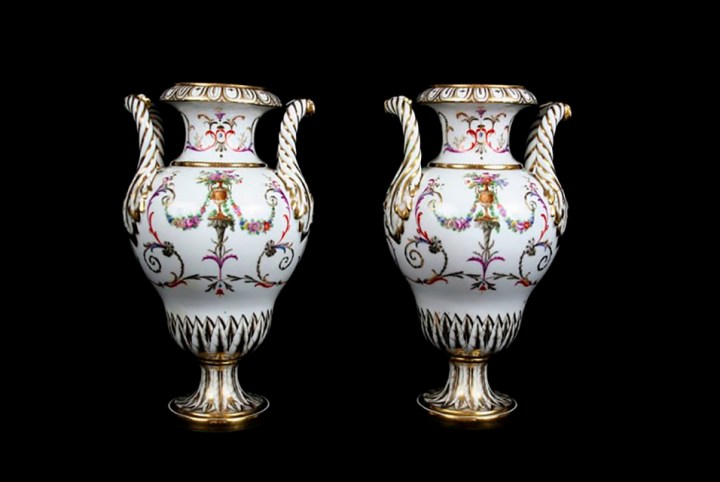
Manufacture de Monsieur le duc d’Angoulême, Paris, Pair of Vases, ca. 1785, porcelain with enamel and gilded decoration; each 9 × 5.5 × 5.25 inches (The Frick Pittsburgh Collection).
◊ ◊ ◊ ◊ ◊
Press release from The Frick Pittsburgh (via Art Daily) . . .
The Board of Trustees of The Frick Pittsburgh announces the adoption of a new five-year strategic plan, 2017–22 and Beyond, and the activation of a new acquisition program, resulting in the recent acquisition of new collection objects.
Strategic Plan
On Tuesday, June 20, Frick Board of Trustees Chair Charles R. (‘Chip’) Burke, Jr. and Executive Director Robin Nicholson presented the museum’s recently adopted strategic plan to more than 20 representatives from regional foundations assembled at The Duquesne Club in Downtown Pittsburgh. 2017–22 and Beyond is the result of a two-year planning process which began shortly after the late 2014 appointment of Mr. Nicholson as the institution’s third executive director. The process was led by the Board’s Strategic Planning Task Force, under the leadership of Chair, Trustee Louis L. Testoni. The new strategic plan features a revised ideology for the organization, encompassing new vision, values, and mission statements. These new guiding principles provide the foundation for three overarching institutional goals: audience growth, organizational efficiency, and long-term planning.
Mr. Burke, Chair of the Board of Trustees says, “We are excited about the clearly defined vision and direction articulated in the new strategic plan. In addition to laying the groundwork for the next 25 years, the plan reflects the commitment of The Frick’s board and staff to leverage and enhance the museum’s assets for the benefit of all visitors and program participants.”
The plan identifies three equal and interwoven components to the unique experience offered by The Frick: art, history, and nature—all of which, in turn, underpin the museum’s core ideology, or three ‘powers’: the power of art to inspire and educate, the power of the past to inform the future, and the power of beauty and place. Five strategies build on these principles with specific calls to action: to define and refine the many experiences that The Frick offers, invest in marketing to build audience and revenue, increase efficiency, acquire better information and data, and to think realistically about the future. The museum’s new mission statement aligns with the newly defined institutional ideology: “Continuing the legacy of Helen Clay Frick, we will offer one of the best experiences of art, history, and nature, in a welcoming environment that inspires and delights.”
Executive Director Nicholson comments, “Planning for the future provides an extraordinary opportunity for innovative and aspirational thinking about the role of museums and culture for future generations. The Frick’s new strategic plan thoughtfully addresses both the short- and long-term challenges faced by all cultural organizations in the United States. At the same time, it recognizes that nothing we do has any value unless it helps to ‘inspire and delight.'”
The complete strategic plan is available on The Frick’s website.
New Acquisition Program
Museum benefactress Helen Clay Frick envisioned The Frick to be a vital, growing museum that continues to acquire items that build on the strength of its collection. Building on the strategic goal of “defining and refining the Frick experience,” the museum recently activated a new acquisition program by holding its inaugural Collectors Dinner on April 25, 2017. Fifty members of The Frick Societies, a recognition group for individuals who support The Frick by contributing $1,000 or more annually, attended a black-tie event at The Frick Art Museum, during which three works of art were presented for potential acquisition. Guests were invited to vote for the objects of their choice. Receiving the most votes were a pair of late-18th-century Angoulême porcelain vases and Cream (2015), a color photographic print by Dutch artist Hendrik Kerstens. At its June 14, 2017 meeting, The Frick’s Board of Trustees approved these two objects for purchase.
Produced around 1785 by Manufacture de Monsieur le duc d’Angoulême, Paris, which operated from 1781 to 1793, the pair of exquisite porcelain vases feature enamel and gilded decoration. The vases are an extraordinary example of Parisian porcelain produced at the end of the ancien régime in France. The Manufacture le duc d’Angoulême was one of the few factories at the end of the 18th century to rival Sèvres in the quality of its porcelain and the technical excellence of its decoration. The vases enhance the museum’s collection of 18th-century French decorative art, complementing the fabulous examples of French furniture and paintings collected by Helen Clay Frick. The Frick owns two examples of furniture by Martin Carlin, which incorporate Sèvres porcelain plaques. Angoulême works are in the collections of other major museums: a vase related to the pair acquired by The Frick is in the collection of The British Museum. Tableware by Angoulême is also part of the collections of museums such as The Metropolitan Museum of Art, the Victoria & Albert Museum, and Winterthur. Mount Vernon owns a service by Angoulême purchased by George Washington in 1790.
Contemporary Dutch artist Hendrik Kerstens creates a dialogue between past and present through an almost hyper-conscious homage to the history of Dutch art combined with a slightly playful subversity. The artist began studying photography at age 40 and quickly became known for his interest in creating large-scale painterly photographs with an emphasis on light effects and the use of poses and props that echo the conventions found in Old Master painting, particularly of the 17th century. He began working with his daughter Paula as his subject in 1994. His 2007 photograph, Bag, in which she is posed with a plastic grocery bag on her head caused a sensation, winning the prestigious Taylor Wessing Photographic Portrait Prize awarded by the National Portrait Gallery, London. Bag also attracted the attention of fashion designer Alexander McQueen, who based his 2009 collection on the image. In Cream, Paula is posed against a dark background and beautifully lit, allowing for a painterly, Baroque sense of chiaroscuro and an emphasis on luminous skin tones. Kerstens typically injects his work with humor and disrupts his emulation of Old Masters through the interjection of unexpected materials or props—in this case, a coiffure of shaving cream. Cream is a compelling photograph that serves as a catalyst for conversation about painting and photography, past and present. Acquisition of this work enables The Frick to further explore ideas of portraiture and representation by providing a contemporary counterpoint to works in the collection, such as the Rubens Portrait of the Princess of Condé, as well as other examples of portraiture in the collection by Nattier, de Troy, Hogarth, Gainsborough, and Reynolds. Since gaining public attention through his Paula pictures, Kerstens has been commissioned to create commercial portraits for Vanity Fair and The New York Times Magazine. His work is widely represented in public and private collections in the Netherlands as well as the Santa Barbara Museum of Art, the Museum of Photographic Art in San Diego, the Pilara Family Foundation Collection in San Francisco, the Elton John Collection, the Alexander McQueen Collection, and others.
Excavating the Burial Ground at St James’ Gardens in London

◊ ◊ ◊ ◊ ◊
With thanks to Nick Grindle for noting this work:
St James’ Gardens—the former site of a late 18th- and 19th-century burial ground—will be excavated this summer in connection with the construction of Britain’s ‘High Speed 2′ (HS2) rail link from Euston to Birmingham, Manchester, and Leeds. The burial ground was used by the parish of St James’ Piccadilly, with the first recorded burial taking place in 1790. The burial ground was closed in 1853 and turned into public gardens in August 1887. Notable internees in St James’ Gardens include Lord George Gordon, Matthew Flinders, and the painter George Morland.
Wired reported on the project in September 2015.
More information on the archaeological work is available here»
Conference Session | Water, Gods, and the Iconography of Power
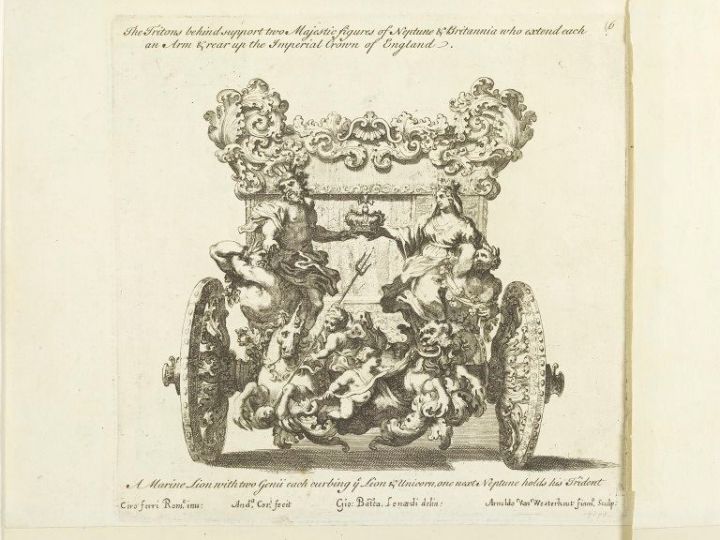
Design for a Carriage Built by Andrea Cornely after a design by Ciro Ferri, engraving published in An Account of His Excellence, Roger Earl of Castelmaine’s Embassy from His Sacred Majesty James the II King of England, Scotland, France and Ireland &c. To His Holiness Innocent XI (London, ca. 1687). London: V&A 19393. Inscriptions read: “The Tritons behind support two Majestic figures of Neptune & Britannia who extend each / an Arm & rear up the Imperial Crown of England’ and in the lower center of the plate, “A Marine Lion with two Genii each curbing ye Lion & Unicorn, one next Neptune holds his Trident.”
◊ ◊ ◊ ◊ ◊
From the programme:
A donde Neptuno reina: Water, Gods and the Iconography
of Early Modern Power (16th–18th Centuries)
CHAM Conference—Oceans and Shores: Heritage, People, and Environments
Lisbon, 13 July 2017
Organized by Pilar Diez del Corral
Since Antiquity, the personification of water—rivers or seas—has been a recurrent elements in the iconography related to power. From the Tigris to the Ganges, from the Mare Nostrum to the Atlantic Sea, water seems to have been an essential element in the visual display of powerful monarchies and empires. After the European discovery of the Americas, oceans started also to play an extraordinary role in allegorical representations, especially in Spain and Portugal, though elsewhere, too. This panel approaches water iconography, especially as related to oceans, as a mode of representation of power during the early modern period, addressing its role in politics and culture.
Universidade Nova de Lisboa, Faculdade de Ciências Sociais e Humanas
Room 2, Edificio I+D, Avenida de Berna, 26-C
P R O G R A M M E
9.30 Welcome by Pilar Diez del Corral (Technische Universität, Berlin)
9.40 Morning Session, Part I
• Liana De Girolami Cheney (University of Massachusetts, Lowell), Giorgio Vasari’s Neptune as Cosimo I de’ Medici: Element of Water as a Political Symbolism
• Ilaria Bernocchi (University of Cambridge), Heroic Portraiture and Political Supremacy: ‘Andrea Doria as Neptune’ in Medals, Plaquettes, and the Heroic Portrait by Agnolo Bronzino
• Linda Briggs (University of Manchester), Gods and Monsters: Representations of Water in the Royal Entries of Henri II and Charles IX of France
11.00 Coffee break
11.30 Morning Session, Part II
• Jeremy Roe (Universidade Nova de Lisboa), From Image to Allegory: Faria e Sousa on Camoes’ Poetic Images of Neptune
• Carla Alferes Pinto and Cristina Brito (Universidade Nova de Lisboa), About Gods, Neptunian Man, and Horse Mackerels: The Ocean in the Representation of Power in Infanta Beatrice’s Wedding Theatre Play (1521)
• Christopher Kreutchen (Technische Universität, Dortmund), Moved by the Elementary Power of Neptune
13:00 Lunch break
14:00 Afternoon Session, Part I
• Laura García Sánchez (Universidad de Barcelona), The Vision of the New World through the Literature and Theatre of the Golden Age: Oceans and Seas, Myths and Gods
• Diego Solá (Universidad de Barcelona), ‘Iberi Imperii finis limes et orbis erit’: China, Spain, and the Ocean through Propagandistic and Cartographic Representations (XVI–XVII Centuries)
• Filipa Araujo (Universidade de Coimbra), Reis d’ Aquém e d’Além-Mar: Emblematic Representations of Water in Portuguese Royal Festivities (17th Century)
• Álvaro Pascual Chenel (Universidad de Valladolid), Rivers and Oceans in Royal Iconography and Spanish Monarchy Representation during the Modern Age
15:40 Coffee break
16:00 Afternoon Session, Part II
• Giacomo Montanari (Università degli Studi di Genova), The Neptune’s Palace: Iconographies of the Power into the House of Stefano Durazzo in Genova
• Fernando Miguel Jalôto (Universidade Nova de Lisboa), ‘Il gran Monarca è questi, che sempre dominò su’l Gange e’l Tago’: Aquatic Metaphors and Allegories to the Reign of John V in Contemporary Musical Works
• Fernando Morato (Ohio State University), Mar Portuguez: The Atlantic Ocean as Stage for Portuguese Domination of the Americas
17:00 Concluding discussion
Symposium | Full Circle: The Medal in Art History
◊ ◊ ◊ ◊ ◊
From the symposium flyer:
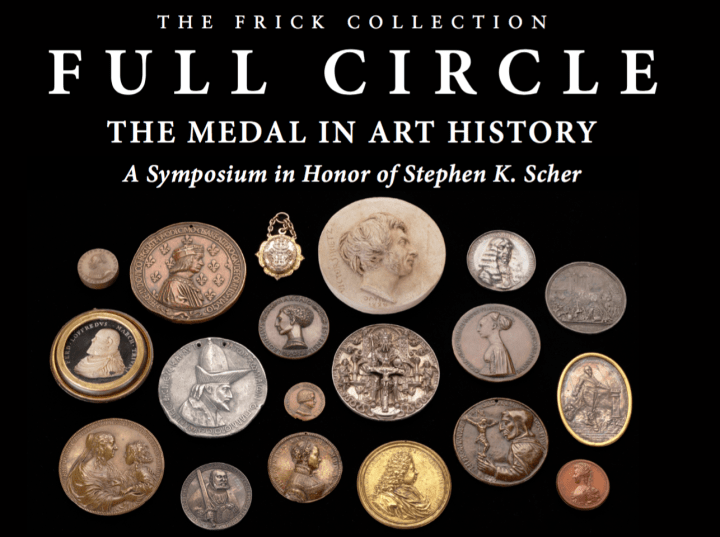
Full Circle: The Medal in Art History — A Symposium in Honor of Stephen K. Scher
The Frick Collection, New York, 8 September 2017
On the occasion of the exhibition The Pursuit of Immortality: Masterpieces from the Scher Collection of Portrait Medals, The Frick Collection will hold a symposium on Friday, September 8, 2017, in honor of Stephen K. Scher’s many contributions to the study of medals. This symposium builds on the work of Scher and others who have sought to re-center the medal in art-historical discourse, and aims to bring this important class of object to the attention of the broader scholarly community and the public. The symposium is free, but registration is required.
• Susan Dackerman (Visiting Scholar, Getty Research Institute), Making Prints, Making Medals
• Ilaria Bernocchi (Doctoral Candidate, University of Cambridge), ‘Inventing’ Identity: Medals and Heroic Portraits in the Italian Renaissance
• Emily Fenichel (Assistant Professor, Florida Atlantic University), Michelangelo’s Portrait Medal: Thee Penitent Artist in His Final Years
• Jeffrey Collins (Professor, Bard Graduate Center), Egentium Votis: Francesco Riccardi, Giovacchino Fortini, and the Art of Self-Promotion
• Martin Hirsch (Curator, Staatliche Münzsammlung, Munich), Papal Medals and the Interplay of Prints, Paintings, and Numismatics
• Hannah Williams (Leverhulme Early Career Research Fellow, Queen Mary University of London), Portrayal and Commemoration: Medal Engravers at the French Academy of Painting and Sculpture
• Iris Moon (Visiting Professor, Pratt Institute), Kneeling Man in Chains: Recasting Invisibility and Absence in the Wedgwood Anti-Slavery Medallion
• Anna Seidel (Researcher, Hamburger Kunsthalle), ‘The Revival of the Medal’: Medals and Plaquettes at the Origin of Alfred Lichtwark’s Sculpture Collection at the Hamburger Kunsthalle
• Emerson Bowyer (Searle Associate Curator of European Painting and Sculpture, Art Institute of Chicago), History in Relief
The above order of speakers is provisional.
Conference | A Manorial World
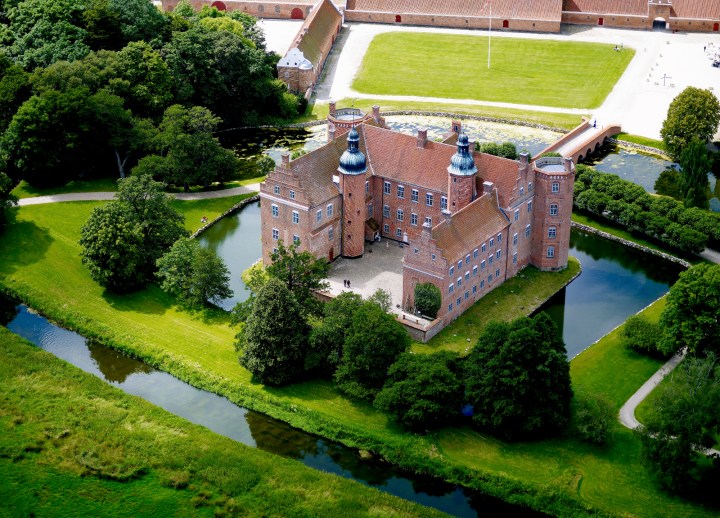
Gammel Estrup Manor, a Renaissance manor house 12 miles east of Randers in Jutland, Denmark.
◊ ◊ ◊ ◊ ◊
From the conference programme:
A Manorial World
Gammel Estrup Manor (near Randers, Denmark), 21–23 September 2017
Registration due by 1 September 2017
Manors and country houses were for centuries a fundamental characteristic of European societies. Notwithstanding national and regional differences across Europe, manors and country houses were in most countries an economic, administrative, and political cornerstone in society. Historical processes towards democratization have pushed the manors and country houses towards the periphery, but still manors and country houses occupy an important position in society, not least in the public memory and the heritage sector. They continue to capture the imagination of tourists and visitors, as well as the scholarly interest from researchers from a wide range of academic fields such as history, architecture, archaeology, art history, anthropology, geography, and heritage studies.
 The conference will examine transnational similarities and differences in the historic role, the management and the functions of manors and country houses, as well as the present-day influence and use of estate landscapes. Not just the grand estates but all manors and country houses, large and small, have had a notable influence, and they still play an important role in the physical outline as well as the identity of place in contemporary European rural communities.
The conference will bring together curators and academics with an ambition to expand and nuance the notion of manors and country houses as European cultural heritage. In order to encourage the interdisciplinary discussion among participants, the conference does not schedule parallel sessions—all presentations will be addressed to the assembled conference audience.
The programme includes two conference days and one excursion day with visits to outstanding country houses in Jutland. The conference is held 21–23 September at Gammel Estrup – The Manor Museum, Denmark and it is organized by the Danish Research Centre for Manorial Studies at Gammel Estrup. The conference fee is 195€; the fee includes two conference days and an excursion day, catering during the conference, and a conference dinner on Thursday. The closing date for registration is 1 September 2017. To register, please send an e-mail to mf@gammelestrup.dk. More information about the programme, excursion, and how to register is available here.
◊ ◊ ◊ ◊ ◊
T H U R S D A Y , 2 1 S E P T E M B E R 2 0 1 7
8.15 Bus from Randers to Gammel Estrup
8.45 Coffee and registration
9.15 Welcome (Mette Bock, Danish Minister of Culture), Else Søjmark (Chair for Culture Municipality of Norddjurs), and Britta Andersen (Gammel Estrup – the Manor Museum)
10.00 Keynote
• Carsten Porskrog Rasmussen (Museum Sønderjylland, DK), The Creation of a Manorial Landscape in Schleswig
11.00 Dutch Landscapes and Country Houses
Chair: Yme Kuiper (University of Groningen, NL)
• Yme Kuiper (NL), The Invention of the Dutch Landscape in the Golden Age?
• Gerrit van Oosterom (NL), The Danish Connection: How Dutch-Danish Oxen Trade Influenced the Development of the Manorial Landscape South of Amsterdam
• Lenneke Berkhout (NL), Joseph Dinant: Fontanier-grottier to the Prince of Orange, Successful Client, and Transnational Broker
• Martin van den Broeke (NL), Trying a New Research Model: Country House Culture on the Island of Walcheren
12.20 Lunch
13.30 Keynote
• Arne Bugge Amundsen (University of Oslo, N), Manorial Landscape of Norway
14.30 The House and the Family
Chair: Mikkel Venborg Pedersen (The National Museum of Denmark, DK)
• Stefanie Schuldt (D), Christina Piper’s Manorial World in Skåne
• Kristine Dyrmann (DK), The Social World of Funens Country Houses: The Pocket Books of Sybille Reventlow, Countess at Brahetrolleborg, 1779–1787
• Jon Stobart (UK), Ancient and Modern, English Country House, ca. 1700–1830
• Tora Holmberg (S), Choosing a Manor Dwelling? Class, Gender, and Housing Choices in Contemporary Sweden
16.15 Bus from Gammel Estrup to Hotel Randers
18.15 Bus from Hotel Randers to Clausholm
19.00 Conference dinner at Clausholm
F R I D A Y , 2 2 S E P T E M B E R 2 0 1 7
8.15 Bus from Randers to Gammel Estrup
9.00 Keynote
• Heike Düselder (Museum Lüneburg, D), Heritage Management, Museums, and Manors
10.00 Gardens and Landscapes
Chair: Jonathan Finch (University of York, UK)
• Ismo Häkkinen (SF), Kultaranta: Three Lives of a Garden
• Lars Jacob Hvinden-Haug/Aina Aske (N), Reconstructing Historical Gardens: Negotiations and Debates, the Larvik Case
• Annegreth Dietze-Schirdewahn/Lei Gao (N), New Knowledge about the Manorial Austrått Landscape in Ørland, Norway
11.00 Coffee
11.30 Sustainability in the Country House Landscape
Chair: TBC
• Gerdy Verschuure-Stuip (NL), The Regional Country House Landscape
• Els van der Laan (NL), Gardens and the Green Heritage Landscape
• Rodrigo Dias (P), The Tagus Estuary Quintas: Lisbon Estate Landscape
12.30 Lunch
13.30 Managing the Manorial Landscape
Chair: Paul Zalewski (Europa-Universität Viadrina, D)
• Elyze Storm-Smeets (NL), Heritage Lost and Found
• Garry Keyes (DK), To Be or Not to Be a Manor House?
• Willemieke Ottens (NL), Who Is Better in Landscape Management? Private Owners vs. Heritage Organisations?
• Janneke van Dijk (NL), Private Heritage and Public Functions
15.00 Keynote
• Fred Vogelzang (Kenniscentrum voor kasteel en buitenplats, NL), New Functions for Castles and County Houses: The Fall and Rise of Heritage?
15.00 Coffee
16.15 Discussion
16.45 Guided tour at Gammel Estrup – the Manor Museum
18.15 Bus from Gammel Estrup to Randers
S A T U R D A Y , 2 3 S E P T E M B E R 2 0 1 7
8.15 Bus leaves Randers
8.45 Visit to Rosenholm (tbc)
10.30 Guided tour and lunch at Bidstrup
13.00 Arrival at Randers railway station
14.00 Arrival at Aarhus airport
15.10 SAS flight to Copenhagen
Details are subject to change.
◊ ◊ ◊ ◊ ◊
In October 2015 the European Network for Country House and Estate Research (ENCOUNTER) was founded at Gammel Estrup – the Manor Museum, Denmark, by a group of European researchers, curators, professionals in the heritage sector and others with an academic interest in the field.
The aim of the network is to form European partnerships between scholars and cultural institutions who share a professional interest in research and interpretation of manor and country house history. It aims to explore and highlight regional variations and notable similarities in the history of castles and manors across Europe from 1500 to the present and will discuss how estates and estate landscapes are preserved and interpreted as cultural heritage today.
Members of the network wish to cross traditional boundaries between history, archaeology, art history, architecture and heritage management and to further international transdisciplinary partnerships between researchers and professionals in universities and museums.










leave a comment