Exhibition | America Collects Eighteenth-Century French Painting
From the NGA:
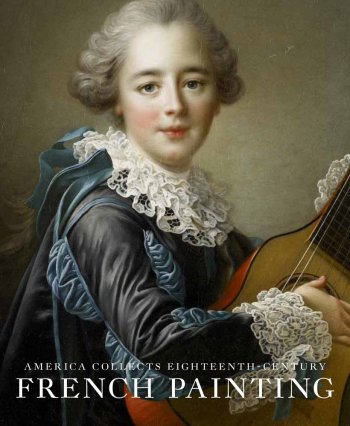
America Collects Eighteenth-Century French Painting
National Gallery of Art, Washington, D.C., 21 May — 20 August 2017

When Joseph Bonaparte, elder brother of Napoleon, arrived in the United States in 1815, he brought with him his exquisite collection of eighteenth-century French paintings. Put on public view, the works caused a sensation, and a new American taste for French art was born. Over the decades, appreciation of French eighteenth-century art has fluctuated between preference for the alluring decorative canvases of rococo artists such as François Boucher and Jean Honoré Fragonard to admiration for the sober neoclassicism championed by Jacques Louis David and his pupils. This exhibition brings together sixty-eight paintings that represent some of the best and most unusual examples of French art of that era held by American museums and tells their stories on a national stage: Who were the collectors, curators, museum directors and dealers responsible for bringing eighteenth-century French painting to America? Where are the paintings now?
The exhibition highlights smaller museum collections, less well-known paintings, and diverse locations across the United States, from Pittsburgh and Indianapolis to Birmingham and Phoenix. It considers eighteenth-century America’s very real fascination with France—a staunch ally in the American Revolution, an intellectual model for Benjamin Franklin, Thomas Jefferson, and other Americans abroad—and how the cultural ideal of eighteenth-century France has continued to endure in the American imagination to this day.
Image: Joseph Ducreux, Le Discret, ca. 1791, oil on aluminum, transferred from canvas (Lawrence: Spencer Museum of Art, University of Kansas).
◊ ◊ ◊ ◊ ◊
Note (added 28 May 2017) — A checklist for the exhibition is available here. Online, there’s also a useful chronology (condensed from the catalogue), establishing larger contexts and tracing the history of selected works in the exhibition.
Note (added 30 May 2017) — The catalogue is published by Lund Humphries:
Yuriko Jackall, Philippe Bordes, Jack Hinton, Melissa Hyde, Joseph Rishel, and Pierre Rosenberg, with Joseph Baillio, Susan Earle, Christophe Leribault, Robert Schindler, and D. Dodge Thompson, America Collects Eighteenth-Century French Painting (London: Lund Humphries, 2017), 304 pages, ISBN: 978 18482 22342, £50 / $70.
 C O N T E N T S
Director’s Foreword
Acknowledgments
Lenders to the Exhibition
Essays
• Pierre Rosenberg, Only in America
• Yuriko Jackall, American Visions of Eighteenth-Century France
• Joseph Bailliom, Wildenstein in America
• Jack Hinton, Fiske Kimball and French Period Rooms in America
• Christophe Leribault, The Tuck Donation to the Petit Palais: A Mirror of American Taste
• Melissa Hyde, Femmes-Artistes and America from the Early Republic to the Gilded Age
• Robert Schindler, Eugenia Woodward Hitt Collects
• Philippe Bordes, Buying against the Grain: American Collections and French Neoclassical Paintings
• Susan Earle, Joseph Ducreux, John Maxon, and the Spencer Museum of Art
• D. Dodge Thompson, When the Eighteenth Century Was New: Joseph Bonaparte in America
• Joseph Rishel, Notes on the American Reception of Eighteenth-Century French Painting
Plates
Yuriko Jackall
• Collector’s Century: From the King’s Mistress to the Shores of San Francisco
• Sensual Century: Pursuit of Love
• Opulent Century: Douceur de Vivre
• Playful Century: Games and Pastimes
• Fanciful Century: Masquerade and the Pleasures of the Imagination
• Inspired Century: Artists and Artistic Practice
• Virtuous Century: Institutional Taste
• Enlightened Century: Science, Nature, and the Passage of Time
Checklist of the Exhibition
Chronology
Bibliography
Index
Symposium | The Royal Palace in the Europe of Revolutions
From the conference programme:
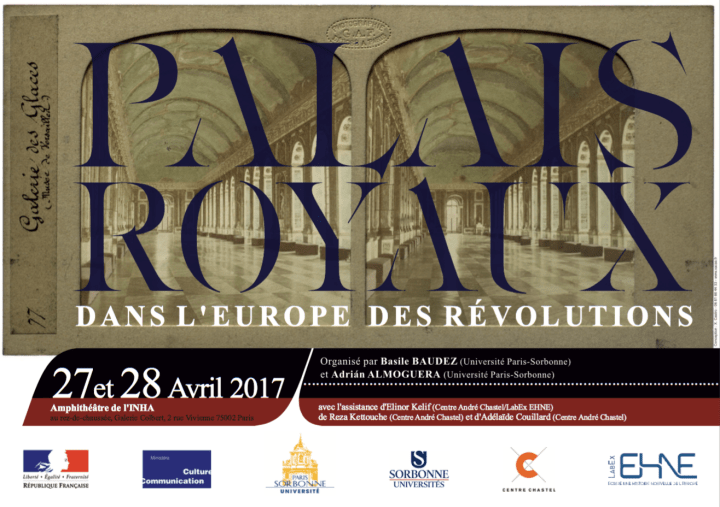
The Royal Palace in the Europe of Revolutions, 1750–1850
Palais Royaux dans l’Europe des Révolutions
Institut national d’histoire de l’art, Paris, 27–28 April 2017
Organized by Basile Baudez and Adrián Almoguera
Since the publication of Nikolaus Pevsner’s History of Building Types in 1976, architectural historians have been alert to the importance of typologies for rethinking their discipline. As analyzed by Werner Szambien or Jacques Lucan, thinking through types allowed for the articulation of concepts of convenance, character and composition in both public and private commissions. Along with metropolitan churches and royal basilicas, in ancien régime Europe princely palaces represented the most prestigious program an architect could expect. For a period in which the divine right of kings was being called into question, however, what happened to the physical structures of royal or princely power, symbol of political authority and dynastic seats? Did the national models of the Escorial, Versailles, Het Loo, or Saint James palaces still hold, even in light of new models made available through the publication of archeological discoveries in Rome or Split? The second half of the eighteenth and first half of the nineteenth century represent a moment of intense construction or reconstruction of the principal European palaces, from Caserta to Buckingham Palace, Saint-Petersburg to Lisbon, Versailles to Coblenz. This trend, addressed by Percier and Fontaine in their Résidences des souverains de France, d’Allemagne, de Russie, etc. (1833), took place in a Europe that was undergoing political developments that altogether changed the nature and symbolic structure of princely power.
This symposium, focused on Europe from roughly 1750 to 1850, aims to interrogate the manner in which architects and their patrons integrated the changing concepts of character in architecture and symbolic place of dynastic palaces, reconciling them with theory and/or practice through rethinking issues of distribution, construction, environmental situation, décor, function, reuse of interpretations of printed or drawn sources.
T H U R S D A Y , 2 7 A P R I L 2 0 1 7
9.30 Introduction
10.00 Basile Baudez (Université Paris-Sorbonne), Reconstruire Versailles, de Louis XV à Louis-Philippe
10.30 Francesco Guidoboni (Université Paris 1 Panthéon-Sorbonne) et Pierre Geoffroy (Université Paris-Sorbonne), Napoléon Ier empereur ou citoyen? Du choix de la résidence privée du souverain
11.15 Fabien Passavy (architecte du patrimoine, Versailles), Au service de la nouvelle élite au tournant du siècle: les cas des hôtels de Bourrienne et de Beauharnais
12.00 Mathieu Caron (Université Paris-Sorbonne), La France en ses meubles: Une symbolique du décor dans les palais du Domaine étranger (Italie, Belgique, Hollande) de l’an X à 1815
14.00 Guillaume Nicoud (Archivio del Moderno, Accademia di Architettura Università della Svizzera italiana), Fastes, étiquette et collection: regard croisé sur la nécessaire transformation des complexes palatiaux des Tuileries et du Louvre, du palais d’Hiver et de l’Ermitage vers 1800
14.30 Elizaveta Renne (Musée de l’Ermitage, Saint-Pétersbourg), The Chesma Palace in St. Petersburg and Catherine II’s Shifting Political Ambitions
15.30 Delfín Rodríguez (Universidad Complutense de Madrid), Théories et typologies de l’idée de palais royal dans la culture espagnole du XVIIIe siècle: histoire d’un conflit artistique et politique
16.15 Adrián Almoguera (Université Paris-Sorbonne), Le Palais du roi au temps de l’empereur: réflexions sur le Palacio Nuevo de Madrid
F R I D A Y , 2 8 A P R I L 2 0 1 7
10.00 Susanna Pasquali (Università di Roma La Sapienza), Nouvelles façades pour un palais trop sévère: projets inédits de Raffaele Stern pour le Palais Impérial de Rome, 1811–14
10.30 Ludovica Cappelletti (Politecnico di Milano), Towards a Modern Imperial Palace: The Ducal Palace of Mantua in the Eighteenth Century
11.15 Paolo Cornaglia (Politecnico di Torino), La forteresse et le palais: Plusieurs projets pour la dynastie de Savoie dans une ville juste annexée et hostile après la tempête napoléonienne 1818–25
12.00 Alba Irollo (chercheur indépendant), Changements de goût et d’étiquette: les souverains français et les palais royaux des Bourbons de Naples
14.00 Pablo Vázquez Gestal (Université Paris-Sorbonne), Pour le roi, pour l’État: Caserte et Charles de Bourbon
14.30 Dirk Van de Vijver (Université d’Utrecht), Le projet de Barnabbé Guimard pour un palais à Bruxelles vers 1768
15.00 Nilay Ozlu (Bogazici University, Istanboul), Showcases of Modernity in the Age of Reforms: Nineteenth-Century Ottoman Palaces of Istanbul
Call for Papers | Celebrating Female Agency in the Arts
From H-ArtHist:
Celebrating Female Agency in the Arts
Christie’s Education New York, 26–27 June 2018
Proposals due by 15 July 2017
Following the success of the 250-anniversary conference held in London in July 2016, Christie’s Education is organizing its second academic conference on the theme of women in the arts. The conference will take place at Christie’s, 20 Rockefeller Plaza in New York on Tuesday June 26th and Wednesday June 27th 2018.
From Antiquity to today, women have always played a significant role in the arts and their markets. With this call for sessions, we welcome proposals coming from a wide range of disciplines that would consider women’s diverse contributions to the arts from a transnational and transhistorical perspective. We hope that the sessions will reflect the global and historical diversity of the issues at stake.
This conference is not advocating for a separate history nor an alternative history of art and its markets, but rather we want to look at the central role played by women in the creation, development, support and preservation of the arts and, also how their contribution has changed over time. Sessions should consider globally and throughout history women as artists, patrons and collectors of art and architecture, dealers and brokers, art historians and art critics as well as curators and preservers of culture. From the presence of women in emerging and established art centers to historical aristocratic patronage and back in time to the medieval period and antiquity we hope that the sessions will investigate a diverse range of topics.
We encourage academics across disciplines and art professionals to submit proposals for individual sessions. Sessions will be 115 (4 x 20 minute papers) or 90 minutes (3 x 20 minute papers) in length. Please send a 250/300-word abstract to Dr. Cecily Hennessy (chennessy@christies.com) and Dr. Véronique Chagnon-Burke (vchagnon-burke@christies.edu) by July 15th 2017. We look forward to receiving your proposal.
New Book | Body Narratives: Motion and Emotion
This collection of essays grew out of the 2015 conference; from Brepols:
Susanna Caviglia, ed., Body Narratives: Motion and Emotion in the French Enlightenment (Turnhout: Brepols, 2017), 291 pages, ISBN: 978 2503 574745, 100€ / $125.
 The first art historical interrogation of the body as an object and discursive ensemble that questions the power and limits of visual representation, this book explores, in broad terms, the representations and understandings of the body’s physical and psychological movement’s meanings during the French Enlightenment in its many guises—artistic, esthetic, social, and erotic. It is centered on the fundamental tension between stasis and movement, which is both constitutive of art historical reflection and embedded in the body’s existence. Stasis and movement not only correspond to the potential modalities of the body’s visual representations, but they are also the conditions which govern the relationship between the viewer and the artwork as well as that between the viewers and the spaces in which they encounter the represented body. Based on this dialectic, the present book proposes a dynamic approach of the body considered as a focus of composition, an object of interrogation, and a site of meaning during a time when the body became the focus of an increasing number of artistic, technical, scientific, and philosophical inquiries directly connected to larger historical forces and discourses. During this time, the body’s stasis and movement became the vehicles for recording cultural and social transformations but also the producers of new meanings inherent to the body itself and unveiled by the development of the new scientific and philosophical approaches of it.
C O N T E N T S
Susanna Caviglia (University of Chicago), Introduction
I Body Language: Narrative Stasis
• Dorothy Johnson (University of Iowa), The Body Speaks: Anatomical Narratives in French Enlightenment Sculptures
• Étienne Jollet (Université Paris 1 Panthéon-Sorbonne), Anti-Pygmalion: Jean-Baptiste Restout’s Diogenes and Materiality as Truth
II The Mobile Body: Social Identity and Visual Dynamics
• Mimi Hellman (Skidmore College), Engaging Tapestries at the Hôtel de Soubise: Attention, Mobility, Intercorporeality
• Melissa Hyde (University of Florida), Watching Her Step: Women and the Art of Walking after Marie-Antoinette
III Body Temporality: Aesthetics of Walking
• Mary Sheriff (University of North Carolina at Chapel Hill), Movement and Stasis: Mapping Cythera
• Ewa Lajer-Burcharth (Harvard University), Strolling Time
Exhibition | Francisco de Goya: Los Caprichos
Press release from the Riga Bourse:
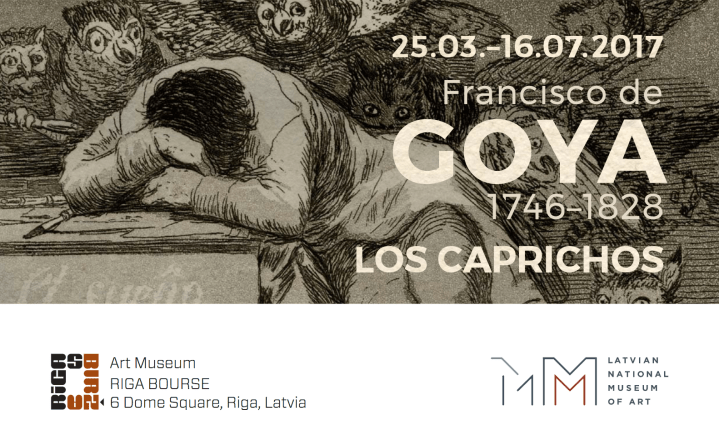
Francisco de Goya: Los Caprichos / Fransisko Goija: Kaprīzes
Art Museum Riga Bourse, 25 March — 16 July 2017
Curated by Daiga Upeniece
The exhibition introduces us to one of the world’s most famous art masterpieces by the brilliant Spanish artist Francisco José de Goya y Lucientes (1746–1828) Los Caprichos series of graphics. The album, containing 80 pages of graphics compiled and published by the artist himself in 1799, gained popularity in Spain and elsewhere soon after its publication and captured the quintessence of Goya’s style, reflecting a new, freer, and much more expressive approach to reality’s portrayal. Los Caprichos reverberated in 19th-century art and ended the dominance of Neo-Classicist academic style graphics.
There are many unsolved riddles hidden within the series. It has been assumed that the artist was influenced by various works of philosophy and art. However, Goya himself—disregarding references to some well-known poets, for example, Gaspar Melchor de Jovellanos, or parallels with the plays of Goya’s friend Leandro Fernández de Moratín—has categorically denied any kind of influence.
Goya was already focusing on the everyday life of his time and, in particular, on the position of women in society in the voluminous selection of drawings in his Madrid album (1796–97). La Celestina, a traditional image in Spanish literature who takes on particularly symbolic importance in Goya’s art, appears there for the first time. Her image reminds us of the temporality of youth and beauty and the inescapable approach of decrepitude. Like La Celestina, the often-utilized image of the prostitute and a focus on the theme of magic personify the dark aspects of society.
The blending of fantasy and reality forms the uniqueness of Goya’s vision. The dream motif was a traditional element that was used by Spanish artists and writers and those of other European countries, to tell of fantastic, philosophically tangible or surreal creatures. Initially, Goya’s series was also called Sueños—that is, dreams, instead of whims.
Some of Goya’s compositions are like theatrical scenes—others, like a parade of eccentric images. The mood in most of the works has similar qualities to Dante’s Inferno—every imaginable mischief rages within them: hypocrisy, lies, cruelty and the collapse of morality. The subjects tell of the church, the nation, the court, laws, physicians, art and science, the streets of Madrid, rural life, the poetry and philosophy of the time, about the needy, the rich, the sick, the young and the old, combining all of these images in a unified mirror of society. Goya’s self-portrait, found on the first page, explains his attitude to what is portrayed in Los Caprichos. The artist, in a way, identifies with the new, modern Enlightenment period; and looked at from these positions, his gaze slides obliquely to the graphics which he himself has created.
Goya used a complex and innovative graphic technique. At its foundations was traditional etching, which Goya combined with a comparatively new invention—aquatint. In this way, clean lines, engraved with acid were supplemented with pale, sort of washed-out tones, which were created with fine dots, obtained, by processing the graphic plate with crushed resin. Of equal importance were the very delicate lines that were engraved with a blade, directly onto the surface of the plates. In graphic art, etching with drypoint on a black background or creating delicate lines and subtle shading around the eyes and hands of the images created the equivalent of airy brushstrokes in painting.
There are 78 works from the second impression in the collection at the Art Museum Riga Bourse. The works’ annotative texts consist of Goya’s comments, explanations about Goya’s works by art historians, as well as informative materials about people and events in Spain in the late 18th century. The exhibition is curated by Daiga Upeniece, Head of the Art Museum RIGA BOURSE / Latvian National Museum of Art.
Monographs used in the notes: Sarah Simmons, Goya (London: Phaidon Press, 1998), pp. 139–84; Xavier de Salas, “Light on the Origin of Los Caprichos,” The Burlington Magazine 121 (1979): 711–16; В. Прокофьев. Капричос Гойи. 2 т., Искусство, Москва, 1969.
Exhibition | British Art: Ancient Landscapes
Opening next month at The Salisbury Museum:
British Art: Ancient Landscapes
The Salisbury Museum, 8 April — 3 September 2017
Curated by Sam Smiles
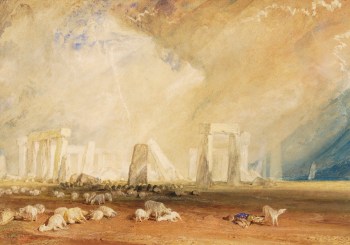
J.M.W. Turner, Stonehenge, ca. 1827–28, watercolour (The Salisbury Museum).
The British landscape has been a continual inspiration to artists across the centuries and particularly the landscapes shaped and marked by our distant ancestors. The megaliths, stone circles, and chalk-cut hill figures that survive from Neolithic and Bronze Age times have stimulated many artists to make a response. In this major new exhibition curated by Professor Sam Smiles, these unique artistic responses have been brought together to create a new discussion. Featuring the work of some of the greatest names in British art from the last 250 years—including John Constable, J.M.W. Turner, Eric Ravilious, John Piper, Barbara Hepworth, Henry Moore, Paul Nash, Richard Long, and Derek Jarman—the exhibition explores how this work records and reflects on some of Britain’s most treasured ancient landscapes.
The catalogue is published by Paul Holberton:
Sam Smiles, British Art: Ancient Landscapes (London: Paul Holberton Publishing, 2017), 120 pages, ISBN: 978 19113 00144, £25.
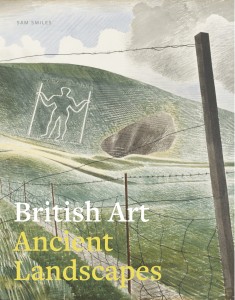 Published to accompany an exhibition at The Salisbury Museum and Art Gallery, this volume explores the most significant works of art engaged with prehistoric moments across Britain from the 18th century to the 21st. While some of the works in the earlier period may be familiar to readers—especially Turner and Constable’s famous watercolours of Stonehenge—the varied responses to British Antiquity since 1900 are much less well known and have never been grouped together.
The author aims to show the significance of antiquity for 20th-century artists, demonstrating how they responded to the observable features of prehistoric Britain and exploited their potential for imaginative re-interpretation. The classic phase of modernist interest in these sites and monuments was the 1930s, but a number of artists working after WWII developed this legacy or were stimulated to explore that landscape in new ways. Indeed, it continues to stimulate responses and the book concludes with an examination of works made within the last few years.
An introductory essay looks at the changing artistic approach to British prehistoric remains over the last 250 years, emphasizing the artistic significance of this body of work and examining the very different contexts that brought it into being. The cultural intersections between the prehistoric landscape, its representation by fine artists and the emergence of its most famous sites as familiar locations in public consciousness will also be examined. For example, engraved topographical illustrations from the 18th and 19th centuries and Shell advertising posters from the 20th century will be considered.
Artists represented include: J.M.W. Turner, John Constable, Thomas Hearne, William Blake, Samuel Prout, William Geller, Richard Tongue, Thomas Guest, John William Inchbold, George Shepherd, William Andrews Nesfield, Copley Fielding, Yoshijiro (Mokuchu) Urushibara, Alan Sorrell, Edward McKnight Kauffer, Frank Dobson, Paul Nash, Eric Ravilious, John Piper, Henry Moore, Barbara Hepworth, Ithell Colquhoun, Gertrude Hermes, Norman Stevens, Norman Ackroyd, Bill Brandt, Derek Jarman, Richard Long, Joe Tilson, David Inshaw and Jeremy Deller.
Sam Smiles is the author of The Image of Antiquity: Ancient Britain and the Romantic Imagination (1994), Flight and the Artistic Imagination (2012), and West Country to World’s End: The South West in the Tudor Age (2013).
Exhibition | Pugin, Prisons, and the Plight of the Poor
Now on view at The Huntington:
A. W. N. Pugin, Prisons, and the Plight of the Poor: British Prints,
Drawings, and Illustrated Books from The Huntington’s Collections
The Huntington Art Gallery, San Marino, CA, 11 March — 26 June 2017
Curated by Courtney Long
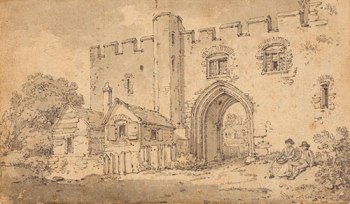
William Alexander, Prison at St. Albans, undated, late 18th–early 19th century, graphite and ink wash on board (San Marino: The Huntington).
This exhibition examines the history of British prisons and how artists and architects documented the social, political, and legal tensions surrounding prison reform and Poor Law debates in Parliament during the 19th century. Drawn from the rich holdings of British material in The Huntington’s library and art collections, the works in A.W. N. Pugin, Prisons, and the Plight of the Poor depict a range of prison styles and highlight the role that these spaces served in containing and punishing criminals, debtors, drunks, gamblers, and paupers. Through a variety of visual materials, the exhibition examines the belief that the style and treatment of architecture has a direct correlation to the manner and behavior of society, an idea which had been promoted by prominent 19th-century architect and designer Augustus Welby Northmore Pugin. Fifteen thought-provoking drawings, watercolors, prints, and rare books by artists such as Thomas Rowlandson, George Romney, Henry Rushbury, and Edward Dalziel present images of the fortress-like prisons, criminal acts, and zealous reformers that sparked imaginations from the mid-18th to the early 20th centuries.
Courtney Skipton Long is guest curator for A.W.N. Pugin, Prisons, and the Plight of the Poor. She received her Ph.D. in the history of art and architecture from the University of Pittsburgh in 2016 and is currently the Zvi Grunberg Postdoctoral Fellow at the Bruce Museum in Greenwich, Connecticut.
Also, see the posting at Verso, the blog for The Huntington Library, Art Collections, and Botanical Gardens.
Call for Papers | Enlightened Princesses: Britain and Europe, 1700–1820
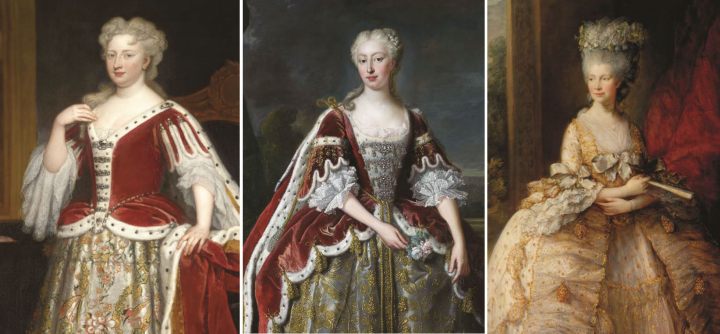
Left to right: Sir Godfrey Kneller, Queen Caroline of Ansbach, when Princess of Wales, 1716, oil on canvas, Royal Collection Trust; Jean-Baptiste van Loo, Augusta, Princess of Wales, 1742, oil on canvas, Royal Collection Trust; Thomas Gainsborough, Queen Charlotte, 1781, oil on canvas, Royal Collection Trust.
◊ ◊ ◊ ◊ ◊
From the Yale Center for British Art:
Enlightened Princesses: Britain and Europe, 1700–1820
Kensington Palace, Hampton Court Palace, and the Tower of London, 29–31 October 2017
Proposals due by 15 May 2017
Co-organized by Historic Royal Palaces, the Yale Center for British Art, and the Paul Mellon Centre for Studies in British Art, London, in association with the exhibition Enlightened Princesses: Caroline, Augusta, Charlotte, and the Shaping of the Modern World, on view at Kensington Palace, June 22–November 12, 2017
Caroline of Ansbach (1683–1737), Augusta of Saxe Gotha (1719–1772), and Charlotte of Mecklenburg-Strelitz (1744–1818), three Protestant German princesses, became variously Princess of Wales, Queen Consort, and Princess Dowager of Great Britain. Recent research has explored how in fulfilling these roles they made major contributions to the arts; the development of new models of philanthropy and social welfare; the promotion and support of advances in science and medicine, as well as trade and industry; and the furthering of imperial ambition. While local contexts may have conditioned the forms such initiatives took, their objectives were rooted in a European tradition of elite female empowerment.
This symposium, Enlightened Princesses: Britain and Europe, 1700–1820, seeks to investigate the role played by royal women—electresses, princesses, queens consort, reigning queens, and empresses—in the shaping of court culture and politics in Europe of the long eighteenth century. Papers that explore some of the following themes are invited:
• Royal women as political agents
• Royal women: networks and conversations
• Royal women: education, charity, and health
• Royal women as patrons of art and architecture
• Royal women and science
• Royal women: mercantile culture and the wider world
• Royal women as political gardeners
The conference will take place October 29–31, 2017, at Kensington Palace, Hampton Court Palace, and the Tower of London. Please send proposals of 400 words maximum, for papers of 25 minutes, together with a short biography of 100 words maximum to samantha.howard@hrp.org.uk.
Journal18, #3 Lifelike (Spring 2017)
The third issue of J18 is now available.
Journal18, Issue #3: Lifelike (Spring 2017)
Issue Editors: Noémie Etienne and Meredith Martin
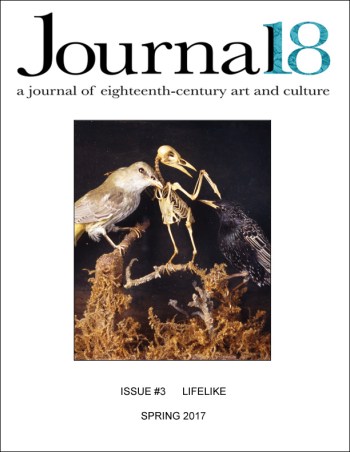 During the eighteenth century, a range of artistic productions sought to simulate motion and life in new ways. At the same time, individuals became ever more preoccupied with performing or embodying static works of art. Echoing contemporary discussions in artistic and literary discourses around vraisemblance and verisimilitude, as well as mimesis and imitation, these preoccupations also tapped in to larger social and intellectual debates about matter, mankind, and machines at a global level.
This issue of Journal18 explores these fundamental tensions between art and life, movement and permanence that obsessed the worlds of art, science, and entertainment during the eighteenth century. What was considered ‘lifelike’ in this period? How did artworks—among them taxidermy tableaux, moving statues, nautilus cups, and automaton clocks—engage with this notion and participate in redefining it? What was at stake in staging a convincing simulation of life, and what purpose—political, pedagogical, or otherwise—did it serve? What role did ephemeral performances or spectacles play in generating such illusions and in shaping their significance? And how might we interpret these acts historically today?
In addition to full-length articles, we have assembled a series of shorter essays on the theme of ‘Waxworks’. More than any other material in the eighteenth century, wax seems to have provoked debates about the permeable boundaries between illusion and imitation, art and science, absence and presence. At the same time, objects made of wax—from La Specola’s famous anatomical Venus to busts portraying victims of the French Revolution modeled from life by Marie Tussaud—have the potential to disrupt traditional categories and hierarchies of art history, which is perhaps one reason why wax has emerged in recent years as such an exciting and provocative field of study.
A R T I C L E S
• Valérie Kobi, Staging Life: Natural History Tableaux in Eighteenth-Century Europe
• Amelia Rauser, Vitalist Statues and the Belly Pad of 1793
• Eugenia Zuroski, Nautilus Cups and Unstill Life
• Lihong Liu, Pyrotechnic Profusion: Fireworks, Spectacles, and Automata in Time
W A X W O R K S
• David Mark Mitchell, Vividness without Vitality: The Specola Venus’s Intersecting Afterlives
• Robert Wellington, Antoine Benoist’s Wax Portraits of Louis XIV
• Charles Kang, Anatomy of the Bel Effet: Wax between Science and Art
• Paris Amanda Spies-Gans, ‘The Fullest Imitation of Life’: Reconsidering Marie Tussaud, Artist-Historian of the French Revolution
Cover image: Detail of stuffed Starling, Oriole and Bird’s Skeleton from Goethe’s Collection, before 1790 (Goethe-Nationalmuseum, Weimar ©Klassik Stiftung Weimar/Thomas Korn)
Call for Papers | Plaster as an Art Material
From H-ArtHist:
Uniqueness and Multiplication: Plaster as an Art Material
Royal Institute for Cultural Heritage, Brussels, 10–11 October 2017
Proposals due by 5 May 2017
The study of plaster objects is experiencing a true revival, amongst others attested by the scientific conferences of the past years. Plaster, a material of low value often used for reproductions, has been part of sculpture practice for centuries. The conferences and publications of the past years have discussed a wide range of subjects related to plasters, from the restoration and valorisation of plaster collections to the study and possible implementation of conservation and restoration campaigns.
The Royal Institute for Cultural Heritage (KIK-IRPA, Brussels), is the Belgian federal institution committed to the inventory, scientific study, conservation and promotion of the country’s cultural heritage. The Institute, whose chief mission is research and public service, represents a unique instrument for the Belgian heritage, both movable and immovable. Amongst others active in the historical study, conservation and restoration of these objects, KIK-IRPA has partnered up with Epitaaf. Since 1989, this non-profit volunteer organization manages the former sculptor’s and mason’s studio of the Ernest Salu dynasty, active in Laeken (near Brussels) between 1872 and 1983. As a funerary art museum they have a substantial collection of plaster moulds and models that were manufactured in the studio. The wide range of approaches presented on this international conference will allow us to study different aspects of plaster objects.
The conference will take place at the KIK-IRPA in Brussels 10–11 October 2017 and consists of three sessions:
Session 1 Plaster (and plaster moulds), their role and signification within the studio
This session will focus on the role of plaster (as a material for sculpture or architecture), plaster moulds (casts) and plaster models in art history. The following topics could be addressed: plaster for which use, the use and or role of plaster in the artist’s training, in an institutional context (academy, art education) or in that of the studio? The authenticity and position (status) of plaster in the artistic process (design, intermediary state, model, art work)? The added value of plasters, prints and photos in the artist’s studio? The representation or the role of plasters in the practice of the artist’s studio, and more particularly their position within an artist’s oeuvre and its diffusion? The significance or status of plasters as autonomous objects?
Session 2 Plaster collections, their origins, aim, and future
The aim of this session is to put together a survey of existing plaster collections as museum collections, not in the form of an exhaustive inventory, but in order to get a broad and general view of the wide range of differences (and significations) of the collections to get insight in the collection building and composition of the different plaster collections. The lines of approach are the collections’ history and objective. How should one go about their presentation (museology) and what is the status of plaster collections within a public (museum), semi-public (university, academy) or private context (artist’s collection).
Session 3 Conservation and restoration of plasters (and plaster moulds)
This session is the logical continuation of session 2. Due to a renewed interest in plaster objects, regardless of their context, repairing them has once again become a priority. Which conservation and restoration techniques are best suited for plaster and plaster objects? Should a different approach be adopted with regards to their presentation and status (within art history or as an educational tool)? Can the material or technique used tell us more about the period, place of origin or author of the plaster? These topics are preferably evoked through case studies and examples of best practices, by choice concerning so-called masterpieces. The official language of the conference is English (submissions in French or Dutch are also accepted).
Candidates are invited to submit their proposals to Géraldine Patigny (geraldine.patigny@kikirpa.be) by May 5th 2017. This should include an abstract (up to 300 words) and a brief CV (max. 1 page). The conference organizers are unable to cover travel and accommodation costs for speakers. Interested parties are encouraged to apply for aid from their respective institutions. The Scientific Committee will inform all the applicants of the final selection on June 16th 2017.
Scientific direction
Géraldine Patigny (KIK-IRPA)
Tom Verhofstadt (vzw Epitaaf)










 Enfilade
leave a comment