New Book | Making Magnificence
Scheduled for May release from Yale UP:
Christine Casey, Making Magnificence: Architects, Stuccatori, and the Eighteenth-Century Interior (New Haven: Yale University Press, 2017), 320 pages, ISBN: 978 03002 25778, $75.
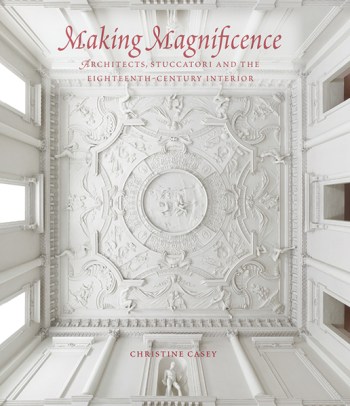 This book tells the remarkable story of the craftsmen of Ticino, in Italian-speaking Switzerland, who took their prodigious skills as specialist decorative plasterworkers throughout Northern Europe in the 18th century, adorning classical architecture with their rich and fluent décor. Their names are not widely known—Giuseppi Artari (c.1690–1771), Giovanni Battista Bagutti (1681–1755), and Francesco Vassalli (1701–1771) are a few—but their work transformed the interiors of magnificent buildings in Italy, Austria, Germany, the Netherlands, Britain, and Ireland. Among the interiors highlighted in this deeply researched, beautifully illustrated volume are Palazzo Reale in Turin, Upper Belvedere in Vienna, St. Martin in the Fields in London, the Radcliffe Camera in Oxford, Houghton Hall in Norfolk, and Carton House in Ireland.
Christine Casey is associate professor in architectural history, and the head of the Art Department, at Trinity College Dublin.
Conference | The Queen’s House and Court Culture, 1500–1750

Adriaen van Stalbemt, A View of Greenwich, ca 1632; oil on canvas, 83.5 × 107 cm (Royal Collection Trust, 405291). More information is available here
◊ ◊ ◊ ◊ ◊
From Royal Museums Greenwich and the conference programme:
Queen’s House Conference 2017: European Court Culture and Greenwich Palace, 1500–1750
National Maritime Museum and the Queen’s House, Greenwich, 20–22 April 2017
Royal Museums Greenwich and the Society for Court Studies are pleased to announce a major international conference to mark the 400th anniversary year of the Queen’s House, Greenwich. Designed by Inigo Jones in 1616 and completed in 1639, this royal villa is an acknowledged masterpiece of British architecture and the only remaining building of the 16th- and 17th-century palace complex. Today the Queen’s House lies at the centre of the World Heritage Site of Maritime Greenwich.
The site as a whole is often celebrated as quintessentially ‘British’—historically, culturally and artistically. Yet the sequence of queens associated with the Queen’s House and Greenwich more generally reflect a wider orientation towards Europe—from Anne of Denmark, who commissioned the House, to Henrietta Maria of France, Catherine of Braganza and Mary of Modena—in addition to Greenwich’s transformation under the patronage of Tudor and Stuart monarchs. Located on the River Thames at the gateway to London and to England, royal residences at Greenwich served an important function in the early modern period as a cultural link with the continent, and in particular, with England’s nearest neighbours in the Low Countries and France.
Conference themes include: Royal portraiture; ‘Princely magnificence’ and the design of royal spaces (such as the division between a King’s and Queen’s sides); dynastic links between the houses of Stuart, Orange, Bourbon, Wittelsbach (Palatinate), and Portugal; the history of Greenwich Palace as a royal residence and centre of power and culture; other areas patronized by the court, such as maritime exploration, scientific advances, prints, as represented by the Royal Observatory Greenwich.
Conference organisers: Janet Dickinson (University of Oxford), Christine Riding (Royal Museums Greenwich), and Jonathan Spangler (Manchester Metropolitan University). With support from the Society for Court Studies.
For queries about the programme, please e-mail janet.dickinson@conted.ox.ac.uk. For bookings, e-mail research@rmg.co.uk. Booking information is available here.
◊ ◊ ◊ ◊ ◊
T H U R S D A Y , 2 0 A P R I L 2 0 1 7
12.30 Registration
13.00 Introduction
• Jemma Field, Brunel University: Greenwich Palace and Anna of Denmark: Royal Precedence, Royal Rituals, and Political Ambition
• Karen Hearn, University College London: “‘The Queenes Picture therein’: Henrietta Maria amid Architectural Magnificence”
• Anna Whitelock, Royal Holloway, University of London: Title to be confirmed
15.00 Coffee and tea
15.30
• Christine Riding, Royal Museums Greenwich: Private Patronage, Public Display: The Armada Portraits and Tapestries, and Representations of Queenship
• Natalie Mears, Durham University: Tapestries and Paintings of the Spanish Armada: Culture and Horticulture in Elizabethan and Jacobean England
• Charlotte Bolland, National Portrait Gallery: The Armada Portrait of Elizabeth I
17.00 Keynote Lecture
• Simon Thurley, Institute of Historical Research: Defining Tudor Greenwich: Landscape, Religion, and Industry
18.00 Wine reception in the Queen’s House
F R I D A Y , 2 1 A P R I L 2 0 1 7
9.30
• Catriona Murray, University of Edinburgh: Raising Royal Bodies: Stuart Authority and the Monumental Image
• Hannah Woodward, University of Glasgow: An Embroidered Truth? The Painted Brocades in Sixteenth-Century Portraits of Marie Of Guise
• Jessica Malay, University of Huddersfield: Building the Palaces of the North: Anne Clifford’s Antiquarian Impulse
11.00 Coffee and tea
11.30
• Maureen Meikle, Leeds Trinity University: Queen Anna and Her Architects: A Tale of Two Queen’s Houses
• Jane Spooner, Historic Royal Palaces: Framing Rubens: The Architectural Polychromy of the Banqueting House Ceiling in Context
• Anya Matthews, Old Royal Naval College: Queens, Patronesses and Goddesses: Royal Women and the Painted Hall at Greenwich, 1707–26
13.00 Lunch and tours of the site. Scaffold tours of the ceiling at the Painted Hall are available during the conference.
14.30
• Wendy Hitchmough, Historic Royal Palaces: Anna of Denmark, Inigo Jones, and the Performance of Monarchy
• Gilly Lehmann: Henry VIII’s Great Feast at Greenwich in May 1527
15.30 Refreshments
16.00
• Janet Dickinson, University of Oxford: The Tudors and the Tiltyard: Constructing Royal Authority at Greenwich
• Sara Ayres, National Portrait Gallery: Paul van Somer’s Portrait of Anne of Denmark in Hunting Costume (1617)
• 17.30 Keynote Lecture
Susan Foister, National Gallery: Holbein and Greenwich
S A T U R D A Y , 2 2 A P R I L 2 0 1 7
9.30
• Birgitte Dedenroth-Schou: The Danish / German Influence on Anne of Denmark’s Cultural Interests
• Fabian Persson, Linnaeus University: Protestant Prize? Princess Elizabeth, Marriage Negotiations, and Dynastic Networking
• Ineke Huysman, Huygens Institute: Epistolary Power: Anglo-Dutch Affairs in the Correspondence of the Dutch and Frisian Stadtholders’ Wives, 1605–1725
11.00 Coffee and tea
11.30
• Laura-Maria Popoviciu, Government Art Collection: ‘Great Britain’s New Solomon’? A Portrait of William III by Jan van Orley
• David Taylor, National Trust: ‘Her Majesty’s Painter’: Jacob Huysmans and Catherine of Braganza
12.30 Lunch
13.30
• Michele Frederick, University of Delaware: ‘Crossing the Sea’: Gerrit van Honthorst and Portraiture at the Stuart Courts
• Julie Farguson, University of Oxford: ‘Glorious Successes at Sea’: The Artistic Patronage of Prince George of Denmark as Lord High Admiral, 1702–08
• J. D. Davies: Greenwich, the Sovereignty of the Seas, and Naval Ideology in the Restoration
15.00 Coffee and tea
15.30
• José Eloy Hortal Muñoz, Universidad Rey Juan Carlos, Madrid: The Shape of the Courtly Space at the European Royal Sites of the Seventeenth Century: Merging Court, Household, and Territory
• Jacqueline Riding, Birkbeck College, University of London: A Stuart Court at the Palace of Holyroodhouse in 1745
• Barbara Arciszewska, University of Warsaw: Claiming Grunnewitsch: Architecture of Inigo Jones and Dynastic Identity of the Hanoverians, ca. 1700
At Christie’s | Collection of Boniface de Castellane and Anna Gould
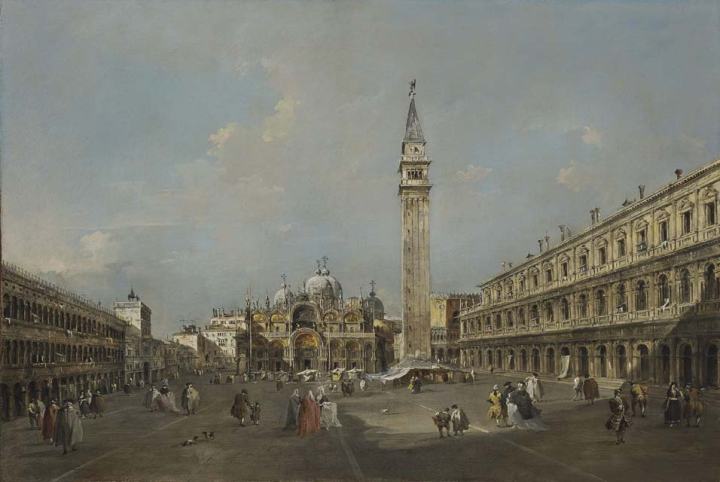
Francesco Guardi, Piazza San Marco with the Basilica and the Campanile, ca. 1770–80, oil on canvas, 70 × 102 cm. The painting sold for $7.1million.
◊ ◊ ◊ ◊ ◊
Press release from Christie’s:
Boniface de Castellane and Anna Gould: ‘A Way of Life’, Sale 14636
Christie’s, Paris, 7 March 2017
On 7 March 2017, Christie’s Boniface de Castellane and Anna Gould: ‘A Way of Life’ auction [Sale 14636] realised a total of €14,266,563 / £12,342,004 / $15,155,370. These exceptional results reflect the relevant choices Boni made when furbishing his legendary Palais Rose with the most exquisite works of art.

Interior of Diane de Castellane’s Apartment (Christie’s Images Ltd, 2017).
Lionel Gosset, Head of Collection sales, Christie’s France: “Continuing Christie’s long history of offering prestigious collections at auction, we are honoured to have paid such a beautiful tribute to this important collection. Its celebrated provenance and the pristine quality of its works have attracted bidders from nineteen countries across five continents, establishing once again Christie’s France’s leadership in selling collections with success.”
Connoisseurs, collectors, and institutions, such as the Sèvres Museum (lot 145) and Lyndhurst—Anna Gould’s childhood home in the state of New York (lots 2, 6, 10, and 16)—have acquired 96% of the sale, demonstrating continued interest in high quality 18th-century pieces. The Palais Rose’s famous Boulle furniture achieved strong prices, as illustrated by the Louis XVI pair of meubles-à-hauteur-d’appui by Etienne Levasseur and Adam Weisweiler that sold for €818,500 (lot 132) and the Louis XIV console attributed to André-Charles Boulle that sold for €506,500 (lot 140). Important decorative art from the period also performed very well, as shown by the Sèvres porcelain ‘vases’ that realised €206,500 against a presale estimate of €80,000–120,000 (lot 52) and a George III clock attributed to James Cox that achieved €290,500 (lot 89). Art Déco works by Cartier where among the highlights of the sale, as the Mystery Clock achieved €686,500 against a presale estimate of €150,000–200,000 (lot 18) and the Jardin Japonais desk set achieved €1.118.500 (lot 19), a new record for an object by Cartier sold at auction. Finally, leading the sale was the magnificent View of Piazza San Marco with the Basilica and the Campanile by Francesco Guardi (lot 46), for which determined bidding resulted in a total of €6,738,500 / £5,829,476 / $7,158,309, making it the highest price achieved by far for an Old Master painting sold at auction in France over the past two decades.
The pre-sale press release from Christie’s is available here»
Emily Selter provided a brief preview of the auction and profile of the “Ultimate Paris ‘It Couple’,” for Town & Country (21 February 2017).
Exhibition | The First Jewish Americans
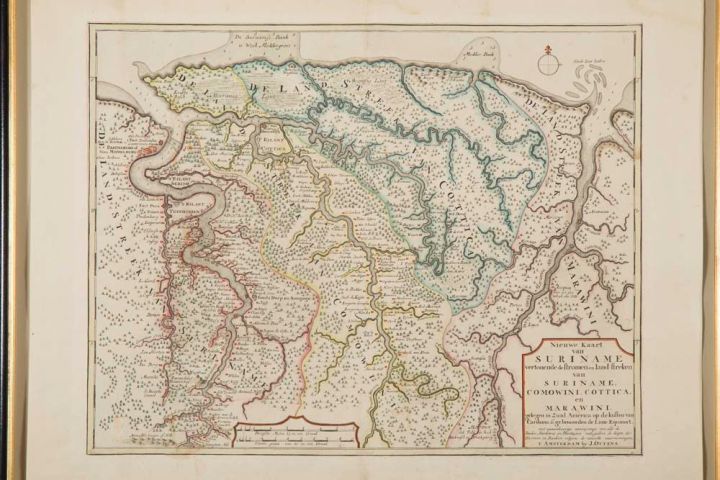
Suriname map, 1718. Nieuwe Kaart van Suriname vertonende de stromen en land-streken van Suriname, Comowini, Cottica, en Marawini; Amsterdam, 1718 (Collection of Leonard L. Milberg).
◊ ◊ ◊ ◊ ◊
Closing on Sunday at the New-York Historical Society (the exhibition was shown at Princeton in 2016 under the title By Dawn’s Early Light: Jewish Contributions to American Culture from the Nation’s Founding to the Civil War); from the press release:
The First Jewish Americans: Freedom and Culture in the New World
Princeton University Art Museum, 13 February — 12 June 2016
New-York Historical Society, 28 October 2016 — 12 March 2017
How did Jewish settlers come to inhabit—and change—the New World? Jews in colonial America and the young United States, while only a tiny fraction of the population, significantly negotiated the freedoms offered by the new nation and contributed to the flowering of American culture. The First Jewish Americans: Freedom and Culture in the New World follows the trajectory of a people forced from their ancestral lands in Europe, as well as their homes in South America and the Caribbean, to their controversial arrival in New Amsterdam in 1654 to the unprecedented political freedoms they gained in early 19th-century New York, Philadelphia, and Charleston. In this ground-breaking exhibition, rare portraits, drawings, maps, documents, and ritual objects illuminate how 18th- and 19th-century artists, writers, activists, and more adopted American ideals while struggling to remain distinct and socially cohesive amidst the birth of a new Jewish American tradition.

Gerardus Duyckinck I, Portrait of Jacob Franks (1688–1769), oil on canvas (Bentonville, Arkansas: Crystal Bridges Museum of American Art).
The exhibition explores the origins of the Jewish diaspora and paths to the New World, Jewish life in American port cities, and the birth of American Judaism in the 18th and early 19th centuries, as well as profile prominent Jewish Americans who made an impact on early American life.
European Jews fleeing persecution and seeking ports of refuge were propelled westward to the distant shores of New World colonies, which offered hope for a new beginning until the infamous Holy Inquisition followed them across the ocean. The exhibition powerfully illustrates this experience through the 1595 autobiography of Luis de Carvajal, a ‘converso’ Jew in Mexico and the nephew of a prominent governor, who was tried by the Inquisition and denounced more than 120 other secretly practicing Jews before he was burned at the stake in 1596. The recently rediscovered documents, which had gone missing from the National Archives of Mexico more than 75 years ago, will be on view at New-York Historical by special arrangement with the Mexican government before returning to Mexico.
The Jewish community in the New World dispersed throughout the colonies in the Caribbean, creating a network built on trade, family, and religious connections. Examples of these island communities and influences featured in the exhibition include a 1718 map of the Jewish settlement in Suriname, 18th-century texts of religious services for the circumcision of slaves, and Jamaican legal documents from 1823 that argued for Jewish voting rights.
During the colonial period, Jews clustered in the cosmopolitan and commercially minded port cities of New York, Philadelphia, and Charleston, and within each city, an elaborate communal infrastructure grew that supported all aspects of Jewish life. Shearith Israel, the first Jewish congregation in colonial North America, built its home in Lower Manhattan in 1730. The congregation has loaned significant objects to the exhibition, such as a Torah scroll that was burned by British soldiers during the Revolutionary War and a rare set of Torah bells (or rimonim) designed by Myer Myers—one of colonial America’s preeminent silversmiths and an active congregation member. Also on view are six oil paintings circa 1735 of the prominent Levy-Franks family of New York, also members of the congregation. On loan from the Crystal Bridges Museum of American Art, they emulate paintings of the British aristocracy.
The Philadelphia Jewish community grew during and after the Revolutionary War, with the city serving as a refuge for patriots fleeing British-occupied New York. Some Philadelphia Jews opposed Britain’s harsh restrictions on American trade by signing the Resolution of Non-Importation made by the Citizens of Philadelphia in 1765—one of the first official protests against British mercantile policy, which is on view in the exhibit. Also featured are portrait paintings of Philadelphia merchant Barnard Gratz, a signer of the resolution who supplied American militias; and of his niece Rebecca Gratz, who in 1819 established the Female Hebrew Benevolent Society, the first Jewish lay charity in the country.
In the first decades of the 19th century, Charleston was home to more Jews than any other place in North America and became a site of cultural and religious ferment. Congregation K.K. Beth Elohim—whose elegant synagogue is depicted in an 1838 oil painting on view—was the birthplace of the Reform movement in 1824, when a group of 47 members petitioned to make worship more accessible by introducing innovations that included prayers in English. The leadership refused, so the petitioners seceded and established the Reformed Society of Israelites for Promoting True Principles of Judaism According to Its Purity and Spirit. The exhibition features the group’s 1825 prayer book and speeches promoting their initially radical position, which soon became main stream. Also on view are earlier examples of revolutions in American Judaism, such as an English translation of a Hebrew prayer book from 1766, Samuel Johnson’s English and Hebrew Grammar book from 1771, and a lunar calendar of Jewish festivals and Sabbath observance from 1806.
The exhibition also features profiles of prominent Jewish Americans of the 18th and early 19th centuries, whose writing, activism, and artistic achievements provide a window into an era of cultural vitality and change in the new Republic. Among the highlighted figures are renown artist Camille Pissarro (1830–1903), a Caribbean Jew born in St. Thomas whose 1856 landscape paintings on view capture waterfront scenes of his island home; and Louis Moreau Gottschalk (1829–1860), a New Orleans-born piano prodigy and composer who became the first classically trained American pianist to achieve international fame. Science and medicine were remarkably open to Jewish men during the 19th century. On display are books written by Jewish Americans that made major contributions to American science and medicine as those fields were developing during this period. The exhibition concludes with views of newly flourishing cities, including Cincinnati, Los Angeles, and San Francisco that became home to American Jews as they ventured westward.
The exhibit is based primarily upon loans from the Princeton University Jewish American Collection, gift of Mr. Leonard L. Milberg, Class of 1953, and Mr. Leonard L. Milberg’s personal collection.
Adam Mendelsohn, By Dawn’s Early: Light Jewish Contributions to American Culture from the Nation’s Founding to the Civil War (Princeton: Princeton University Library, 2016), 352 pages, ISBN: 978 08781 10593.
Terrific installation photographs are available at Arts Summary.
Exhibition | Saving Washington
From the press release from the New-York Historical Society:
Saving Washington
New-York Historical Society, 8 March — 30 July 2017
Curated by Valerie Paley
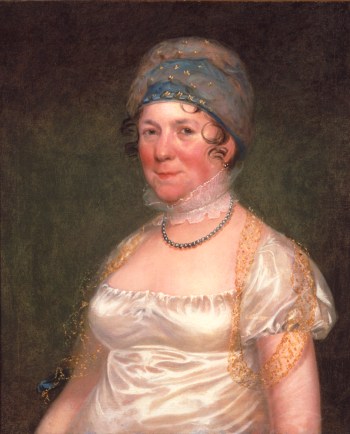
Bass Otis, Portrait of Dolley Madison, ca. 1817, oil on canvas (New-York Historical Society).
Opening on International Women’s Day, March 8, and remaining on view through July 30, 2017, in the Joyce B. Cowin Women’s History Gallery, Saving Washington will explore the tenuousness of American democracy from the aftermath of the Revolutionary War through the War of 1812 and beyond, addressing women’s roles as citizens of a new republic by focusing on the political and social significance of First Lady Dolley Madison and other women of the era. Curated by Valerie Paley, New-York Historical vice president, chief historian, and director of the Center for Women’s History, the exhibition will illustrate the mission of the Center for Women’s History: to reveal the often-overlooked stories of women who shaped American history.
Saving Washington recasts the traditional Founding Fathers narrative to focus on the less-examined contributions of women whose behind-the-scenes and largely unrecognized efforts helped develop the young nation and realize the Constitution ‘on the ground’. Among those who expertly navigated the political world of the early republic, Dolley Madison (1768–1849) was more than an example of what a woman could be in America; she was the embodiment of American strength, virtue, and honor. As the wife of the fourth U.S. president, she is sometimes remembered merely as the hostess who saved the White House portrait of George Washington from British vandalism during the War of 1812. But in fact, she was one of the most influential women in America during the nation’s formative years and a powerful force during a time when women were excluded from affairs of state.
Saving Washington will feature more than 150 objects—including artwork, books, documents, clothing, jewelry, and housewares—within immersive, interactive installations evoking Dolley Madison’s famous ‘Wednesday night squeezes’, her popular social gatherings that drew a wide range of people to ‘squeeze’ into the president’s mansion and encouraged informal diplomacy.
Saving Washington will inaugurate the Joyce B. Cowin Women’s History Gallery within the Center for Women’s History on New-York Historical’s renovated fourth floor. Other programming highlights for Women’s History Month will include a conference on the history of reproductive rights; an evening with tennis icon and social justice pioneer Billie Jean King, who will unveil select items from her personal archives, recently donated to New-York Historical; a reading series with Girls Write Now featuring young women sharing their creative works; and a panel discussion about “Women and the White House,” moderated by 60 Minutes correspondent Lesley Stahl.
Lead support for Saving Washington has been provided by Joyce B. Cowin and the Robert David Lion Gardiner Foundation, with additional support provided by Susan Klein. Educational programming was made possible by Deutsche Bank.
Exhibition | Winckelmann: Modern Antiquity

Henry Fuseli (Johann Heinrich Füssli), Woman before the Laocoön, ca. 1801–05, ink on paper
(Kunsthaus Zürich).
◊ ◊ ◊ ◊ ◊
Opening next month in Weimar:
Winckelmann: Modern Antiquity / Moderne Antike
Neues Museum Weimar, 7 April — 2 July 2017
Johann Joachim Winckelmann (1717–1768) is widely regarded as the founder of modern archaeology and aesthetics. With his view of ancient art as possessing “noble simplicity and solemn greatness,” he was a pioneer of European aesthetics during the Classical period. In commemoration of Winckelmann’s 300th anniversary, the Klassik Stiftung Weimar and the German Studies Department of the Martin Luther University Halle-Wittenberg present the first comprehensive exhibition on this influential researcher, writer, and critic who strongly shaped our modern view of antiquity.
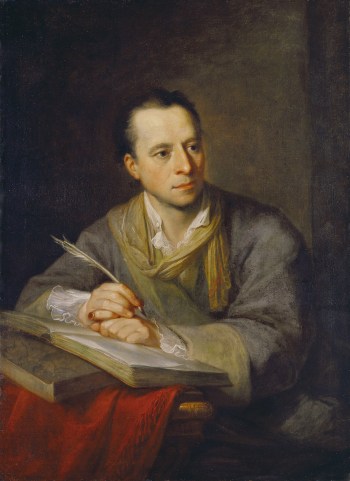
Angelika Kauffmann, Portrait of Johann Joachim Winckelmann, 1764 (Kunsthaus Zürich).
Winckelmann grew up in poverty. His path in life led him to Halle, Jena, and Dresden, and finally to Italy where he gained international fame in papal Rome. Winckelmann was many things: a passionate visionary, a learned enthusiast, and an intellectual adventurer who put everything on the line to achieve his life’s dream. His violent death, which stunned Goethe and his contemporaries like a “clap of thunder,” played no small role in making him a revered and eminent figure throughout Europe within a few short years.
Like a kaleidoscope, the exhibition demonstrates the fascinating power of Winckelmann’s extraordinary life and his revolutionary works in which antiquity and modernity commune. Exquisite items from German and international collections illustrate the impact of his aesthetic, anthropological, and political ideas from the end of the eighteenth century to the present day. It will be the first time that three portrait paintings of Winckelmann from collections in Weimar, Zurich, and New York are presented together in one exhibition.
The exhibition is part of a joint research project, conducted by the Klassik Stiftung Weimar and the German Studies Department of the Martin Luther University Halle-Wittenberg. The project director at the Klassik Stiftung Weimar is Dr. Bettina Werche. Funded by the Cultural Foundation of German States, the Ernst von Siemens Kunststiftung, and Alexander von Humboldt Foundation.
The catalogue is published by Hirmer:
W. Holler, E. Décultot, M. Dönike, C. Keller, T. Valk, and B. Werche, eds., Winckelmann: Moderne Antike (Munich: Hirmer Verlag, 2017), 352 pages, ISBN: 978 37774 27560, 45€.
 Johann Joachim Winckelmann (1717–1768) gilt als Begründer der Archäologie und Kunstgeschichte. Mit seiner Formel von der »edlen Einfalt und stillen Größe« antiker Kunst war er ein Wegbereiter der klassizistischen Ästhetik in Europa. Winckelmanns revolutionäres Werk, in dem Antike und Moderne einander begegnen, wird anlässlich seines 300. Geburtstages neu beleuchtet.
Winckelmann wuchs in ärmlichen Verhältnissen auf. Sein Weg führte ihn über Halle, Jena und Dresden nach Italien, wo er im päpstlichen Rom zu einer internationalen Berühmtheit wurde. Winckelmann war vieles: ein schwärmerischer Visionär, ein gelehrter Enthusiast und ein geistiger Abenteurer, der für seinen Lebenstraum alles auf eine Karte setzte. Nicht zuletzt sein gewaltsamer Tod, der auf Goethe und andere Zeitgenossen wie ein »Donnerschlag« wirkte, ließ ihn binnen weniger Jahre zu einem in ganz Europa verehrten Klassiker aufsteigen. Als einflussreicher Forscher, Schriftsteller und Kritiker hat Winckelmann unseren Blick auf die Antike wesentlich geprägt, wie das reich bebilderte Grundlagenwerk anschaulich vor Augen führt.
Note (added 16 March 2017) — The original posting omitted information about the catalogue.
◊ ◊ ◊ ◊ ◊
Note (added 8 March 2017) — Klaus-Werner Haupt draws readers’ attention to his 2014 book on Winckelmman:
Klaus-Werner Haupt, Johann Winckelmann: Begründer der klassischen Archäologie und modernen Kunstwissenschaft (Weimar: Weimarer Verlagsgesellschaft, 2014), 296 pages, ISBN: 978 386539 7188, 28€.
 Johann Joachim Winckelmann, Sohn eines Schuhmachermeisters, rastloser Autodidakt und der Begründer der klassischen Archäologie und modernen Kunstwissenschaften, gilt als Beispiel, wie ein einfacher Bürger mit Glück und Verstand alle mit seiner niederen Herkunft verbundenen Schranken zu überwinden wusste. Seine literarischen Kunstbeschreibungen sowie sein Hauptwerk—die Geschichte der Kunst des Altertums (1764)—revolutionierten die Kunstrezeption und beeinflussten neben Ästhetik und Kunstkritik die Literatur in ganz Europa. Der Autor Klaus-Werner Haupt schafft es, Winkelmanns kämpferische Vitalität und die poetische Bildhaftigkeit seiner Sprache vor biografischem Hintergrund und seinen wissenschaftlichen Leistungen lehrreich und unterhaltend für ein breites Publikum darzustellen.
Exhibition | Goethe and France
Now on view at the Bodmer Foundation, just outside of Geneva:
Goethe et la France
Fondation Martin Bodmer, Cologny, 12 November 2016 — 23 April 2017
Curated by Jacques Berchtold

Heinrich Christoph Kolbe, Portrait of Goethe (detail), oil on canvas, ca. 1826 (Cologny: Fondation Martin Bodmer).
Martin Bodmer (1899–1971) placed Johann Wolfgang von Goethe (1749–1832) high in his personal hall of fame and at the center of his collection, one of the most important in the world. In many ways he owed the very concept of Weltliteratur to this towering figure. Goethe was familiar with French culture from very early on. Like many of his contemporaries of feudal and aristocratic Europe, he too felt the shock of the French Revolution, and his participation in the failed campaign against the Revolutionary forces (the Battle of Valmy in 1792) was a trauma that marked him for the rest of his days.
From his affinities for Rousseau, Goethe changed directions, and the work he did in Weimar, the new capital of the Aufklärung, established a uniquely German classicism. In the process, the ideologues of classicism at court drew on antiquity but also fostered a competitive relationship with their predecessors at Versailles. Goethe—who managed the library, theater, and opera—introduced Germans to the masterworks of French geniuses in literature, theater, music, and painting. Odd writers of the French canon were rehabilitated (Rabelais), and innovative authors of the period were discovered (Diderot).
The social, ethical, and political thinking that resulted from the shock of the French Revolution was crystallized in Goethe’s play The Natural Daughter (Die natürliche Tochter). Under the protectorate of the Confederation of the Rhine, Goethe met Napoleon—a great reader of Werther—in October 1808, and contemplated creating a portrait of him as Julius Caesar in homage to this genius of visionary and decisive action. And Faust, which Goethe pursued from 1808 on, had a special resonance in France. Taking off from the many Goethean gems in the Bodmer Collection, the exhibition shows the extent to which a complex and ambivalent ‘French question’ deeply influenced Goethe’s output for some sixty years.
Call for Proposals | Swiss Art and the Grand Tour
From H-ArtHist:
Special Issue of the Zeitschrift für Schweizerische Archäologie und Kunst (ZAK) for 2018
Travelling People, Travelling Objects: The Reception of Swiss Art in the Context of the Eighteenth-Century European Grand Tour
Menschen und Objekte auf Reisen: Die Rezeption Schweizer Kunst im Kontext der europäischen Grand Tour des 18. Jahrhunderts
Proposals due by 1 May 2017; finished articles are due by 31 January 2018
In 2018, a special issue of the Zeitschrift für Schweizerische Archäologie und Kunst (ZAK) will be dedicated to Swiss art in the eighteenth century. Focusing on the context of European travel culture, the issue will address the various ways in which Grand Tourists perceived, purchased, and collected Swiss art objects during and after their travels. This perspective will help to gain new insight into the distribution and reception of Swiss art in eighteenth-century Europe.
It has often been claimed that the so-called Swiss Kleinmeister, printmakers of small genre and landscape scenes between 1750 and 1850, sold their artworks to Grand Tour travellers, thus contributing to the construction and popularization of a new ‘image of Switzerland’ in Europe. However, little is known about the travelling art buyers and the specific ways in which these small Swiss art objects were distributed, collected, and displayed abroad. Taking this question as a starting point, we welcome contributions which investigate the reception and distribution of these traveling images of Switzerland. Special priority will be given to topics which focus on the materiality of specific objects as well as topics which centre on the role and the meaning of Swiss artworks at their places of destination.
Proposals might address the following issues, among others:
1 Images, media, materialities
It is a widespread opinion that the small format and low price of the graphic art of the Swiss Kleinmeister contributed to the medium’s popularity among European travellers. Does a close view on European collections allow another, more complex perspective on the reception and distribution of Swiss art and the related role of its specific medial and material characteristics? What can be said about the collection-specific relations of graphics, watercolors, paintings, and decorative art objects of Switzerland?
2 Paths and destinations of Swiss graphic art
Kleinmeister graphic art was traded in single sheets, within illustrated books but also in literary works such as travel descriptions. Can individual trade routes be traced within this context of travel culture? Which European collections (libraries, print rooms etc.) owned (Kleinmeister) graphic art works, in which forms were they held and what role did they play within the formation of a specific
collection?
3 Swiss landscape images—identities and memories
The graphic images of the Swiss Kleinmeister are often said to have played an important role in shaping the identity of Switzerland by constructing a typical image of the country’s ‘national landscape’. What was the meaning and function of these graphic landscapes in European collections? Which role did Swiss landscapes play in other objects, for example decorative art, that were purchased by travellers?
4 Switzerland—Italy—Europe
Grand Tour travellers often purchased a great number of art objects which can be considered as conventionalized souvenirs of the places of their production along the travel routes. How were these imaginary sites of memory perceived and represented in European collections? What kinds of medial, material, and semantic relations are constructed between these collection objects on a transregional level, and which position did the objects from Switzerland occupy?
This call addresses art historians and researchers from related disciplines. Please send your proposal (max. 300 words in English, German, French, or Italian), a short CV, and a short list of keywords (max 6) no later than May 1st, 2017 to Danijela Bucher (danijela.bucher@uzh.ch) and Miriam Volmert (miriam.volmert@khist.uzh.ch). Final selection and notification to authors will be announced no later than July 31st, 2017. Finished articles (ca. 30,000–40,000 characters including spaces and ca. 12–15 illustrations) should be submitted by 31st January 2018. No royalty will be paid for any article. Authors are responsible for all reproduction right fees.
Call for Papers | The Unique Copy: Extra-Illustration

First page of text in an illustrated edition of A Midsummer Night’s Dream, 1908 (Folger Digital Image 81266), exhibited in the Folger’s 2010 exhibition Extending the Book: the Art of Extra-Illustration.
◊ ◊ ◊ ◊ ◊
From the Call for Papers:
The Unique Copy: Extra-Illustration, Word and Image, and Print Culture
Herzog August Library, Wolfenbüttel, Germany, 24–25 May 2018
Proposals due by 30 May 2017
Organized by Christina Ionescu and Sandro Jung
Is extra-illustration an ornamental art or does it add layers of significance and nuance to the accompanying text? How does it shed light on authorship, the act of reading, book history, and print culture? How does text-image interaction manifest itself in the extra-illustrated book-object? Is extra-illustration the equivalent of grangerising or are there other means of materially expanding the text? Is it a creative act or a form of customised reproduction or reuse of print matter? Who are the artists, readers, collectors, publishers, and curators who are responsible for the creation of extra-illustrated objects?
In his study of the history, symptoms, and cure of a fatal disease caused by the unrestrained desire to possess printed works, Thomas Frognall Dibdin (1776–1847) observes that “[a] passion for a book which has any peculiarity about it,” as a result of grangerising by means of collected prints, transcriptions, or various cutouts, “or which is remarkable for its size, beauty, and condition—is indicative of a rage for unique copies, and is unquestionably a strong prevailing symptom of the Bibliomania.” Extra-illustration as a practice did not emerge during bibliomaniac Dibdin’s birth century, which witnessed the publication of James Granger’s Biographical History of England (1769) and a widespread rage for unique copies of books, nor has it been extinguished in our digital era by modern technology. Whether it manifests materially as a published work that is supplemented verbally (with interleaved or pasted autograph letters, handwritten notes, or print matter either directly or tangentially linked to its content), or visually (with additional drawings, prints, maps, watercolours, photographs, or other forms of artwork that are similarly connected to a variable degree of closeness to the text), an extra-illustrated copy is important not only for its uniqueness as an original artefact and its commercial value as a desired commodity. As emblematic of an artistic, bibliographic, and cultural practice, it sheds light on its creator, the context of its production, and the reception of a text. As a form of personalised book design, it is moreover significant as a means of creative expression, an outlet of reader empowerment, and an archival repository of historical or cultural insight. Some of the popular targets of extra-illustration through time have been the Bible, biographies, historical treatises, topographical surveys, travel narratives, and popular plays.
A plethora of monographs and special journal issues dealing with book illustration from various theoretical and (inter)disciplinary perspectives have been published in recent years, but the subfield of extra-illustration remains largely unstudied. It is important to note, however, the contribution to the field by Luisa Calè, Lucy Peltz, and Stuart Sillars, who have proposed useful in-depth reflections on extra-illustration and grangerising as a practice. To address this gap in current scholarship, we invite papers that engage with extra-illustration through the conceptual lenses of book history, print and visual culture studies, and word and image theory. Contributions that focus on original artwork contained in extra-illustrated copies from the perspective of word and image studies are of particular interest to the co-editors, as are studies of extra-illustration as a link between text, book-object, and context, as approached through the prism of the book arts and reception theory. Other possibilities include contributions investigating extra-illustration diachronically or cross-culturally, and case studies dealing with a special copy, a collection of extra-illustrated books, or an individual collector, publisher, curator, or artist responsible for the creation of such unique artefacts.
Possible themes include but are not limited to:
· grangerising as a biblio-cultural practice
· grangerising as a form of material repurposing in relation to print culture
· grangerising as a fashionable and biblioclastic pastime
· grangerising as an act of authorship
· the Grangerite, bookscrapping, and collecting practices
· illustrative responses to the text in the form of unique infra-textual images
· marginal illustration and text-image interaction
· extra-illustration as interactive and engaged reading
· extra-illustration as emblematic of institutional/curatorial collecting practices
· extra-illustration as personalised book design
· extra-illustration as a window into history and intellectual thought
· extra-illustration as a book customisation response to mass production
· digital imports of extra-illustration as a means of expression
500-word abstracts, along with the author’s contact information and bio-bibliographical note, should be sent to the co-editors (cionescu@mta.ca / prof.s.jung@gmail.com) by 30 May 2017. A publication on the topic, either a journal issue or a collection of essays, is envisaged.
New Book | Facing the Text: Extra-illustration
Distributed by Manchester University Press:
Lucy Peltz, Facing the Text: Extra-illustration, Print Culture, and Society in Britain, 1769–1840 (San Marino, Huntington Library Press, 2017), 424 pages, ISBN: 978 08732 82611, $150 / £115.
 During the eighteenth and nineteenth centuries, thousands of books were customized with prints and drawings in a practice called extra-illustration. These books were often massively extended, lavishly bound, and prized by their owners as objects of display, status, and exchange. The scale of these compilations as well their interdisciplinary nature—at once literary texts, printed books, art collections, and indexes of visual culture—have typically excluded them from histories of art and literature. In this book, Lucy Peltz maps a history of extra-illustration and its social and cultural meanings, providing a fascinating account of the practice itself and the often colourful personalities who engaged in it. The remarkable contents of key extra-illustrated books are explored, along with the broader historical and commercial contexts in which they were produced and enjoyed.
Lucy Peltz is Senior Curator of Eighteenth-Century Collections and Head of Collections Displays (Tudor to Regency) at the National Portrait Gallery, London.
◊ ◊ ◊ ◊ ◊
C O N T E N T S
Introduction: A Long History of Extra-Illustration
Part I: Getting Your Heads in Order: Engraved Portrait Collecting and the Origins of Extra-Illustration
1 ‘Of Collectors of English Portrait Prints’
2 Genteel Authorship, the Community of the Antiquarian Text, and the Invention of Extra-Illustration
3 Portraiture, Order, and Meaning
4 John, Lord Mountstuart and the Ends of the Bull Granger
Part II: From Domestic Retirement to a Commercial Marketplace: Amateurs, Antiquaries, and Entrepreneurs
5 ‘Retirement, Rural Quiet, Friendship, Books’: Amateurism and Its Trophies
6 Charting the Craze: Anthony Storer and Richard Bull
7 The Strawberry Hill Press and the Rituals of Bibliographic Exchange
8 Antiquarian Topography or Armchair Tourism: Thomas Pennant’s “Labors”
9 Popularizing Pennant’s London: How the Art World Sold Extra-Illustration
Part III: The Sutherland Clarendon: Gender, the Print Market, and National Heritage
10 ‘Buried under Its Own Grandeur’: Understanding the Sutherland Clarendon
12 The Cut and Thrust of the Print Market in the Early Nineteenth Century
13 Women, Widowhood, and Collecting: Charlotte Sutherland’s Inheritance
14 Monumentalizing the Sutherland Clarendon: Between Rhetoric and Content, 1820–1839
15 The Female Connoisseur and the Private Catalogue
16 A ‘National Work’ Completed: The Sutherland Clarendon and Cultural Heritage
Epilogue: Rethinking the Past, Securing the Future
Select Bibliography
Index










 Enfilade
leave a comment