Symposium | Visualising Learning in France, 1500–1830
From the Centre for French History and Culture at St Andrews:
Visualising Learning in France, 1500–1830
St Andrews, 24–25 May 2017
 Generously supported by the British Society for Eighteenth-Century Studies, the Society for French Studies, The Centre for French History and Culture, School of Art History, and School of History, University of St Andrews
The event is free but places are limited. Please register by emailing ljg21@st-andrews.ac.uk (Linda Goddard) by 15 May, indicating day 1, 2, or both.
New Seminar Room, School of History, South Street, St Andrews
W E D N E S D A Y , 2 4 M A Y 2 0 1 7
9.30 Tea/coffee and welcome
10.00 Susanna Berger (University of Southern California / Villa I Tatti), Siegmund Jacob Apin on Visual Learning in Sixteenth- and Seventeenth-Century Europe
11.00 David Pullins (Massachusetts Institute of Technology / The Frick Collection), Visualizing Drawing: Cochin, the Encyclopédie and the livres à dessiner Tradition
12.00 Lunch
1.00 Katie Scott (The Courtauld Institute of Art) and Hannah Williams (Queen Mary University of London), Objects of Learning: Houdon’s Écorché and Oppenord’s Ripa
2.00 Stephanie O’Rourke (University of St Andrews), Histories of the Self in the Trioson Portrait Series
3.00 Coffee
3.30 Charles Kang (Columbia University), Trees of Blood: Injection and Representation
4.30 General discussion
5.00 Reception
T H U R S D A Y , 2 5 M A Y 20 1 7
9.30 Sarah Easterby-Smith (University of St Andrews), Cultivating Utility: Amateur Botany, Taste, and Floriculture in Late-Eighteenth-Century France
10.30 Richard Taws (University College London), The Echo Chamber of the French Revolution
11.30 Coffee
11.45 Mary Orr (University of St Andrews), Colouring the Science of the Past: The Arts of Learning for the Present?
Poster image: Jean-Baptiste Greuze, A Boy with a Lesson-Book (detail), exhibited 1757 (National Galleries Scotland).
Call for Papers | HECAA Session at UAAC, 2017
Thanks to Christina Smylitopoulos, who is again coordinating a HECAA session at this year’s UAAC Conference! Details and a full list of panels (57 in all) are available here»
◊ ◊ ◊ ◊ ◊
Universities Art Association of Canada / l’association d’art des universités du Canada
Banff Centre for Arts and Creativity, Banff, Alberta, 12–15 October 2017
Proposals due by 12 May 2017
 HECAA Open Session
The objective of this society is to stimulate, foster, and disseminate knowledge of all aspects of visual culture in the long eighteenth century. This HECAA open session welcomes papers that examine any aspect of art and visual culture from the 1680s to the 1830s. Special consideration will be given to proposals that demonstrate theoretical or methodological innovations. Please email proposals for 20-minute papers to Dr. Christina Smylitopoulos (University of Guelph), csmylito@uoguelph.ca.
Study Day Results | Fonder les institutions artistiques

PDF files for each presentation are available at the ACA-RES website:
Fonder les institutions artistiques : l’individu, la communauté et leurs réseaux en question
Centre Allemand d’Histoire de l’Art, Paris, 8–9 December 2016
Les premières journées d’étude du programme ACA-RES (Les académies d’art et leurs réseaux dans la France préindustrielle) se sont tenues les 8–9 décembre 2016 au Centre allemand d’histoire de l’art Paris, autour du thème : Fonder les institutions artistiques : l’individu, la communauté et leurs réseaux en question.
L’objectif de la rencontre était d’interroger la genèse des institutions académiques au XVIIIe siècle, en mettant l’accent sur l’articulation entre actions individuelles et logiques collectives; initiatives personnelles et cadres structurels; histoire locale, régionale, et mouvement d’entraînement à l’échelle française. Il s’agissait de revenir aux sources du phénomène de fondation d’écoles de dessin et d’académies d’art, qui pointe à partir des années 1740 à Rouen et à Toulouse et s’étend ensuite sur tout le territoire du royaume.
Première rencontre d’une série de trois préparant la tenue d’un colloque de synthèse en 2019, les discussions font aujourd’hui l’objet d’une diffusion sur la page Hypothèses du programme de recherche, dans la rubrique Les papiers d’ACA-RES. Ces actes sont un point d’étape dans la réflexion : ils rendent compte des questionnements soulevés et offrent un matériel documentaire qui pourra être complété et réinterrogé par la suite. Au présent compte-rendu s’adjoignent donc les « Brefs historiques » des écoles de chaque ville traitée, et les articles issus des communications. Laissés volontairement in progress, ils sont une invitation à rejoindre et prolonger la discussion.
◊ ◊ ◊ ◊ ◊
Anne Perrin Khelissa et Émilie Roffidal, Fonder les institutions artistiques : l’individu, la communauté et leurs réseaux en question
Séance de travail 1 : Les hommes et leurs réseaux
• Mikaël Bougenieres, L’École de dessin de Cambrai : les hommes et leurs réseaux
• Marjorie Guillin, L’Académie royale de peinture, sculpture et architecture de Toulouse : les hommes et leurs réseaux
• Ariane James-Sarazin, Les écoles de dessin à Angers : les hommes et leurs réseaux
• Gaëtane Maës, L’École de dessin de Lille : les hommes et leurs réseaux
• Gaëtane Maës, L’Académie de peinture et de sculpture de Valenciennes : les hommes et leurs réseaux
• Elsa Trani, De la Société des beaux-arts à l’École centrale de Montpellier : les hommes et leurs réseaux
• Nelly Vi-Tong, L’École de dessin de Dijon : les hommes et leurs réseaux
Séance de travail 2 : Les statuts et règlements
• Mikaël Bougenieres, L’École de dessin de Cambrai : les statuts et règlements
• Marjorie Guillin, L’Académie royale de peinture, sculpture et architecture de Toulouse : les statuts et règlements
• Ariane James-Sarazin, Les écoles de dessin à Angers : les statuts et règlements
• Gaëtane Maës, L’École de dessin de Lille : les statuts et règlements
• Gaëtane Maës, L’Académie de peinture et de sculpture de Valenciennes : les statuts et règlements
• Elsa Trani, De la Société des beaux-arts à l’École centrale de Montpellier : les statuts et règlements
• Nelly Vi-Tong, L’École de dessin de Dijon : les statuts et règlements
Workshop | Printed Stone: Sculpture and Its Images
From the workshop registration page:
Printed Stone: Sculpture and Its Images
Institute of Advanced Studies, University College London, 12 June 2017
Organized by by Brigid von Preussen and Cora Gilroy-Ware
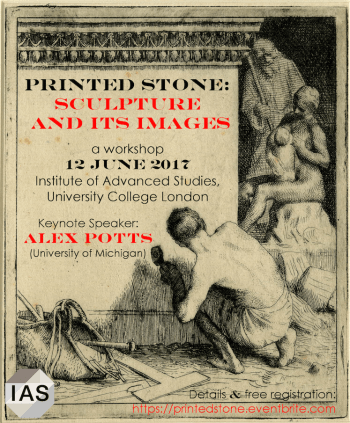 This interdisciplinary workshop will explore the relationship between sculpture and its printed images, whether produced for reasons of commerce or conservation, public edification or private gain. Our participants will interrogate the process of translation and mediation between two and three dimensions, asking how the materiality of different forms of sculpture has been rendered using various technologies of print-making, from the creation of an intaglio plate to advanced digital mapping techniques and 3D printing. We welcome the attendance and contribution of anyone interested in larger questions of representation, reproduction, materiality, media, technology, and process. Monday, 12 June 2017, 9:30–3:30; Common Ground, South Wing, Wilkins Building, Institute of Advanced Studies, University College London.
Keynote Speaker: Alex Potts (University of Michigan).
Participants include: Malcolm Baker (University of California, Riverside), Allison Stielau (University College London), Richard Taws (University College London), Danielle Thom (Museum of London), Emma Payne (University College London), and Cora Gilroy-Ware (Institute of Advanced Studies).
Organised by Cora Gilroy-Ware (Institute of Advanced Studies) and Brigid von Preussen (Columbia University) with the generous support of the Institute of Advanced Studies, University of London.
For further information, please contact Cora or Brigid: c.gilroy-ware@ucl.ac.uk and bev2105@columbia.edu. For free registration, please see printedstone.eventbrite.com.
PhD Studentship | 18th-Century British Women Printmakers
From Birkbeck College:
PhD Studentship | Making an Impression: British Women Printmakers in the Eighteenth Century
V&A / Birkbeck College, University of London, starting October 2017
Applications due by 23 May 2017
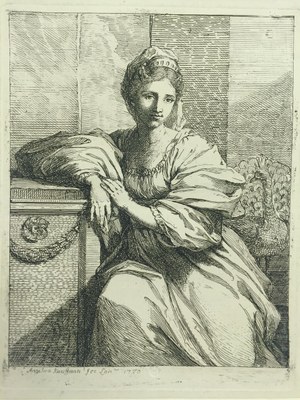
Angelica Kauffman, Juno, etching, London, 1770 (London: V&A, E.350-1890).
Applications are invited for an AHRC-funded PhD studentship researching the role, status and output of amateur and professional women printmakers in Britain during the long eighteenth century, drawing on the Victoria & Albert Museum’s strong collections of work by women printmakers of this period. The project will reconstruct and investigate the work of a number of women artists who have long been overlooked, thereby making a significant contribution to the history of art, design and the print.
This project will be supervised by Dr Kate Retford, Senior Lecturer in History of Art (Birkbeck College, University of London), who specialises in eighteenth-century British art, particularly gender and portraiture, and Dr Sarah Grant, Curator of Prints at the V&A, whose research interests encompass eighteenth-century prints, women artists, and female patronage.
Deadline: 5pm, Tuesday, 23 May 2017
More information is available here»
The British Library Launches ‘Picturing Places’
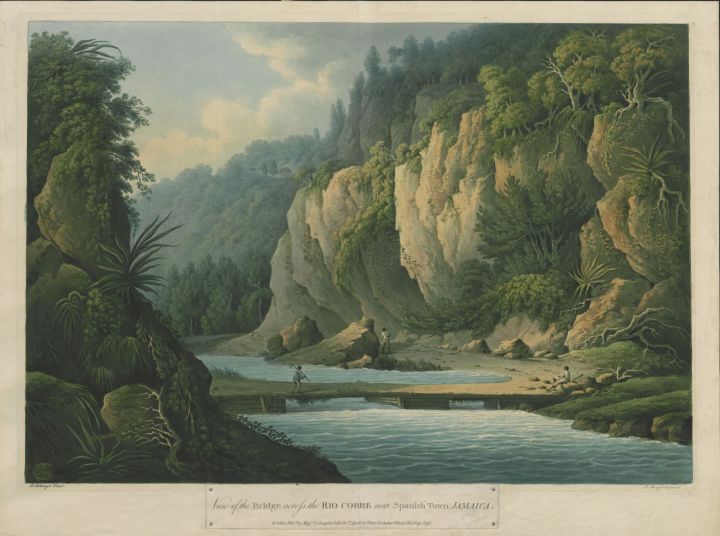
J. Mérigot after Louis Bélanger, View of the Bridge across the Rio Cobre near Spanish Town, Jamaica; etching, aquatint, hand colouring; published in London, 20 April 1800 (London: British Library, Maps K.Top.123.55.b). This sublime aquatint of the River Cobre in Jamaica is after a design by Louis Bélanger. It is part of a series of six. There is no record of Bélanger ever visiting Jamaica. It appears that he adapted his designs for this work and another view in the series from George Robertson’s paintings of the island, available in print from the 1770s (see BL Maps K.Top.123.54.f.). The image is included in Miles Ogborn’s article for Picturing Places: “Slavery, Freedom and the Jamaican Landscape.”
◊ ◊ ◊ ◊ ◊
Felicity Myrone of the British Library shares this exciting news:
The British Library is delighted to announce the launch of Picturing Places, a new free online resource which explores the Library’s extensive holdings of landscape imagery. The British Library’s huge collection of historic prints and drawings is a treasure trove waiting to be discovered. Picturing Places showcases works of art by well-known artists such as Thomas Gainsborough and J.M.W. Turner alongside images by a multitude of lesser-known figures. Only a few have ever been seen or published before.
Historically, the British Library’s prints and drawings have been overlooked by scholars. This is the first time that a large and important body of such materials from the Library are being brought to light. While landscape images have often been treated as accurate records of place, this website reveals the many different stories involved—about travel and empire, science and exploration, the imagination, history, and observation.
As well as over 500 newly-digitised works of art from the collection, this growing site will feature over 100 articles by both emerging and established scholars from many disciplines. Part of the British Library’s ongoing Transforming Topography research project, films from the Library’s 2016 conference exploring the depiction of place are also accessible, providing revelatory insights about the history of landscape imagery.
Additional information is available here»
Symposium | Freemasonry and the Visual Arts
From the symposium programme:
Freemasonry and the Visual Arts
Bibliothèque nationale de France, Paris, 26 May 2017
Co-chaired by Reva Wolf and Alisa Luxenberg
 The Freemasonry and the Visual Arts symposium is a program of the second World Conference on Fraternalism, Freemasonry, and History.
It brings together a series of original case studies to reveal the wide variety, international scope, social complexity, and fundamental historical significance of the intersections of Masonry and the arts from the eighteenth century forward.
Registration is free through this link.
14:00 Part 1: Freemasonry and the Exploration of Architecture
• David Martín López (University of Granada), Freemasonry in Eighteenth-Century Portugal and the Architectural Projects of the Marquis de Pombal
• Alisa Luxenberg (University of Georgia, Athens), Building Codes: New Light on f … baron Taylor and Les Voyages pittoresques et romantiques dans l’ancienne France
• Talinn Grigor (University of California, Davis), Reveil de l’Iran: Freemasonry and Artistic Revivalism from Parsi Bombay to Qajar Tehran
15:15 Coffee break
15:30 Part 2: Art, Freemasonry, and Social and Political Upheaval
• Cordula Bischoff (independent scholar), Meissen Porcelain and the Order of the Pug
• Reva Wolf (State University of New York at New Paltz), Goya’s Art and Freemasonry in Spain
• Katherine Marie Smith (New York University), Masonic Imagery in Haitian Vodou
16:45 Part 3: Transformations in the Art of Freemasonry in the United States
• Nan Wolverton (American Antiquarian Society), ‘Within the Compass of Good Citizens’: The Visual Arts of Freemasonry as Practiced by Paul Revere
• William D. Moore (Boston University), ‘To Consummate the Plan’: Solomon’s Temple in Masonic Art, Architecture, and Popular Culture, 1865–1930
• Cheryl Finley (Cornell University) and Deborah Willis (New York University), ‘A Change Is Gonna Come’: Imaging Black Freemasons from Emancipation to the 1960s
Conference | Heritage and Revolution: First as Tragedy, Then as Farce
From H-ArtHist, with more information available at the conference website:
Heritage and Revolution: First as Tragedy, Then as Farce
McDonald Institute for Archaeological Research, Cambridge, 6 May 2017
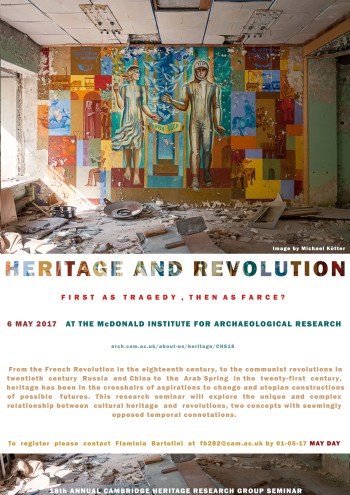 From the French Revolution in the eighteenth century, to the communist revolutions in twentieth-century Russia and China, to the Arab Spring in the twenty-first century, heritage has been in the cross-hairs of aspirations to change and utopian constructions of possible futures. This research seminar will explore the unique and complex relationship between cultural heritage and revolutions, two concepts with seemingly opposed temporal connotations.
9:00 Introduction
Chair: Mathilde LeLoup
Dominique Poulot – The French Revolution and the Democratization of Heritage: Or the Parallel Inventions of Vandalism and Heritage
9:30 Session 1: Revolutionary Vanguards in Retrospect
Chair: Tom Crowley
• Astrid Swenson – Out with the Old? The Role of Revolution in the Rise of Heritage
• Julie Deschepper – Between Past and Future: The ‘Heritage Revolution’ in Russia
• Heonik Kwon – Shrine for Displaced Spirits: A Heritage of the Vietnamese Revolution
• Tom Stammers – The Homeless Heritage of the French Revolution
11:00 Coffee break
11:20 Session 2: Building and Destroying Socialist Pasts
Chair: Margaret Comer
• Francesco Iacono – Counter-Revolution or Why It Is Impossible to Have a Heritage of Communism and What Can We Do about It
• Myroslava Hartmond – Where The Bodies Are Buried: A Comparative Study of Lenin Disposal in Post-Communist States
• Laura Demeter – Regime Change and Cultural Heritage Protection, a Matter of State Security
12:30 Artist Talk
• Martha McGuinn – authentic.obj
1:00 Lunch
2:00 Session 3: Materiality and Immateriality of Revolution
Chair: Marie Louise Stig Sørensen
• Lila Janik – Materiality of Praxis and Substance: A Tangible Witnesses to the Russian Revolution and the Subsequent Oppression
• John Carman – Anarchist Ambiguity: The Past and Creating a Free Society
• Michael Falser – From Maoist Revolution to the Mimicking of UNESCO’s Cold War Diplomacy: The Khmer Rouge and the (Un)Making of Angkor/Cambodia as Cultural Heritage, 1975–90
3:00 Session 4: Exhibition Revolution
Chair: Johanna Zetterstrom-Sharp
• Jennifer E. Altehenger – Industrial Chinoiserie: China’s Pavilion at the Leipzig Trade Fairs in the 1950s
• Flaminia Bartolini – Entertaining Italy with Propaganda: The Exhibition of the Fascist Revolution in Rome
4:15 Session 5: The Arab Spring: Reconciling Competing Visions
Chair: Dacia Viejo Rose
• Shadia Mahmoud – Museums and Cultural Heritage in Post-Revolution Egypt: Transformation and Transmission
• Dena Qaddumi – Confronting the Past for the sake of the Future: Cultural Heritage in Tunis
5:00 Discussion
5:30 Wine reception
7:00 Dinner
Call for Papers | The Histories of Loans
From H-ArtHist:
The Histories of Loans: Memories and Challenges of Museum Loans
Histoires de prêts, mémoire et enjeux des prêts dans les musées
École du Louvre, Paris, 28-29 September 2017
Proposals due by 5 June 2017
Since the end of the 19th century, the expansion of temporary exhibitions has determined the emergence of an international system for museums, based on the circulation of artworks and objects. For museums, sharing pieces from their collection has become crucial to ensure that they in turn get the loans they need to organise their own exhibitions. Lending artworks to prestigious institutions, particularly foreign ones, also enables curators to guarantee a heightened visibility to their own collections. Where to exhibit, how often, and which pieces can be obtained from which partners: nowadays, these are the fundamental criteria of a museum’s positioning within the international hierarchy of cultural heritage prestige. But loan policy does simply affect an institution’s image: it acts directly on the definition of the objects. The acceptation or refusal of a loan is the result of complex transactions, formulated or not, during which the value of an artwork is negotiated and reviewed. It also reflects the importance and rank of institutions, sometimes even of towns and nations. This international symposium intends to question the policy for loaning works of art, both from the angle of the mobility of museum artworks and objects, and that of the reconfigurations of their status. The aim of this colloquium will be to explore the ways in which, historically, loan procedure has defined itself to the point of becoming a crucial challenge for museums.
The economic, political and legal dimensions are also at the heart of this discussion. The suggested themes, which are not meant as limitations but as possible avenues for reflection, include the following:
• The History of loans
• The memory of loans
• The museographical constraints of loans
• Loans and restorations
• Loans as tools for art history
• The geopolitics of loans
• The temporality of loans
• The economy of loans
• The principle of free admission in museums and its exceptions
• Loans and their legal framework
• Notions of public and private in museum loans
The field of study for this symposium also covers the pre-history of loans (such as the translation of relics in the Middle Ages). Alongside artworks and objects, all artefacts are liable to be retained, as long as they shed more light on the theme. The very contemporary period acts as the opposite time limit for the symposium, and can be addressed from a historical viewpoint or as an anthropology of scholarly practices. While it is often difficult to distinguish both notions, the symposium will focus on the question of loans, excluding the question of long-term deposits, which has been studied specifically in the past few years.
Researchers who wish to take part in the symposium must send their paper proposals as well as a CV (one page) to the organisers (colloques@ecoledulouvre.fr) before Monday 5 June 2017. Proposals must be no longer than 2000 characters or 300 words and can be written in French, English, German, or Italian. The organisers will establish the definitive programme along with the members of the scientific committee. The final selection of participants will be announced on 15 June 2017.
Scientific Direction
François-René Martin, ENSBA et Ecole du Louvre
Michela Passini, CNRS (IHMC-ENS) et Ecole du Louvre
Neville Rowley, Staatliche Museen zu Berlin
Scientific Committee
Claire Barbillon, Université de Poitiers, Ecole du Louvre
Françoise Blanc, Ecole du Louvre
Cécilia Griener-Hurley, Ecole du Louvre et Université de Neuchâtel
Violaine Jeammet, Musée du Louvre et Ecole du Louvre
François-René Martin, ENSBA et Ecole du Louvre
Sophie Mouquin, Université Charles-de-Gaulle, Lille
Michela Passini, CNRS (IHMC-ENS) et Ecole du Louvre
Natacha Pernac, Ecole du Louvre et Université Paris-Nanterre
Neville Rowley, Staatliche Museen zu Berlin
Conference | Rococo in Scandinavia
From H-ArtHist (with an updated schedule available here). . .
Rococo in Scandinavia
Palais Thott, Copenhagen, 30 May 2017
Registration due by 29 May 2017
Organized by Corinne Thépaut-Cabasset
 Rococo in Scandinavia will explore the many ways in which the history of style affected the arts and the culture of Scandinavia over the course of the long eighteenth century by exploring the Rococo stream.
The past years in Copenhagen have shown an interest for rococo culture: the fashion exhibition Rokoko Mania was on view at the Designmuseum Denmark in 2012; Danish art historian Charlotte Christensen published the first monograph on Carl Gustaf Pilo, the most eminent eighteenth-century painter in Scandinavia, in 2016; and the Statens Museum for Kunst presented the exhibition William Hogarth: A Harlot’s Progress and Other Stories, also in 2016. These events demonstrate the potential for developing the topic in Denmark.
The study of the dissemination of Rococo in Scandinavia has never been addressed in a public forum. This is why and how the idea of having a conference in Copenhagen emerged and was developed and ought to happen in Scandinavia under the auspices of the French Embassy in Denmark. This conference will convene for the first time eighteenth-century experts from Denmark, Germany, Finland, France, Sweden, and America in a public forum about the Rococo in Scandinavia.
Participation is free, based on the number of available places, but registration is compulsory; please email Corinne Thépaut-Cabasset, ctc16@hum.ku.dk.
T U E S D A Y , 3 0 M A Y 2 0 1 7
13:30 Welcome by H. E. François Zimeray (French Ambassador in Denmark)
13:40 Charlotte Christensen (Former Curator at the Designmuseum, Denmark), Fatal Fires: How Copenhagen Lost Its Rococo
14:00 Jørgen Hein (Senior Curator at Rosenborg Palace, Denmark), Saved from the Fire and Sent to the Garden: Rococo from the First Christiansborg at Rosenborg
14:20 Merit Laine (Associate Professor, Department of Art History, Uppsala University, Sweden), Coexistence or Transition? Rococo and Classicism in Queen Louisa Ulrika’s Museum at Drottningholm
14:40 Pascal Bertrand (Professor of the History of Art, University of Bordeaux-Montaigne, France), The Color of the Rococo: French Tapestries after Oudry and Boucher in Scandinavia
15:00 Corinne Thepaut-Cabasset (Marie Sklodowska-Curie Research Fellow, SAXO Institute, University of Copenhagen), Fashioning the Rococo: Looking for a Rococo Wardrobe
15:20 Viveka Hansen (Independent Textile Historian, The IK Foundation, UK), Rococo and East India Influences at a Swedish Manor House in 1758
15:40 Michael Yonan (Associate Professor of Art History, University of Missouri, USA), Print Culture and the Dissemination of French Rococo Design in Eighteenth-Century Europe
16:00 Barbara Lasic (Professor of Art History, University of Buckingham, UK), ‘Une exquise expression artistique’: Spectacularising the Rococo at the 1935 Exhibition or Eighteenth-Century French Art in Copenhagen
16:20 Discussion
16:45 Piano Concert
17:00 Tour of the Palais Thott
W E D N E S D A Y , 3 1 M A Y 2 0 1 7
The conference will be followed by a tour on Wednesday of additional rococo spaces in Copenhagen (museums and palaces), concluding with a reception at Christian’s VIII palace in Amalienborg, at 4:00pm.
◊ ◊ ◊ ◊ ◊
Note (added 17 May 2017) — The original posting included Krista Vajanto (Researcher, Archaeologist, Aalto University, Finland) on the schedule, presenting a paper entiled, “Shipwrecks Findings: a Rococo Petticoat and Luxury Textiles from Sankt Mikael Shipwreck (1747).” Vivika Hansen’s paper has been added in its place.










leave a comment