At Sotheby’s | Important Judaica

Lot 53: Hanukah Lamp, Polish or German, late 18th or early 19th century, bronze, 85 cm. With baluster stem and scroll and bud branches, pricket sconces linked by a brass plate. Sale price (with buyer’s premium): $3,250 (estimate $4,000–6,000).
◊ ◊ ◊ ◊ ◊
From Sotheby’s:
Important Judaica Including Property from the Estate of Shlomo Moussaieff Sale N09589 (286 lots)
Sotheby’s, New York, 15 December 2016
The Important Judaica sale began with a significant selection of property from the estate of Shlomo Moussaieff. The group was led by Simeon Solomon’s Carrying the Scrolls of Law, which set a new world auction record for the artist selling for $492,500—nearly double its high estimate of $250,000. Other highlights included a copy of the first English translation of the Jewish liturgy issued for a Jewish audience (1761), which sold—to applause—for $468,500, a record for a work of American Judaica at auction.
 The late Shlomo Moussaieff was a renowned collector whose home was a meeting place for connoisseurs from all over the world. Mr. Moussaieff delighted in sharing his treasures with others, and he gave generously of his time and knowledge. Highlights from his collection include a remarkable selection of Kabbalistic manuscripts and a magnificent array of menorahs and Hanukah lamps—mostly of substantial size—featuring examples from Europe and the Middle East. The second part of the auction presented silver and books from various owners. Highlights include two outstanding 18th-century silver Sabbath lamps, a magnificent Italian silver-gilt Torah crown, and important American Judaica, including the earliest Jewish prayer book printed in America (New York, 1761), as well as splendid textiles and paintings.
Lot 270: Large Torah Crown, Venice, early 18th century, parcel-gilt silver, 23 × 22 cm.
Boldly embossed with baroque foliage, fruit and flowers, applied with five urns of flowers within recesses with cut-sheet petals, between cartouches and emblems of the Ark of the Covenant, Priest’s hat, hands of Cohen, priestly garment, and flaming altar, base band with cartouches, all on matted grounds, marked near base with Venice city mark twice and assay master’s mark ZC with tower between twice, the interior fitted with a later bar centered by a ring. Sale price (with buyer’s premium): $225,000 (estimate $180,000–220,000).
Rijksmuseum Acquires Painting by Liotard
Press release (21 December 2016) from the Rijskmuseum (as announced by The Burlington Magazine via Twitter, the magazine will publish an article on the painting in February).

Jean-Etienne Liotard, A Dutch Girl at Breakfast, ca. 1756–57, oil on canvas, 47 × 39 cm (Amsterdam: Rijksmuseum).
The British government today granted an export license for the painting A Dutch Girl at Breakfast by Jean-Etienne Liotard, which the Rijksmuseum has recently purchased from a private collection in which it had remained for more than 240 years. The painting is an intimate ode to Dutch Golden Age painting. The peripatetic Genevan pastellist Jean-Etienne Liotard (1702–1789) created the work in the style of Dutch seventeenth-century masters during a long sojourn in Holland around 1756. As one of his few oil-paintings, A Dutch Girl at Breakfast is an important addition to the famous group of pastels by Liotard that have been in the Rijksmuseum since 1885. This stunning new acquisition will be shown in the Rijksmuseum’s Gallery of Honour from mid-January.
Taco Dibbits, General Director of the Rijksmuseum, states: “A Dutch Girl at Breakfast radiates the same atmosphere of peace and simplicity as Vermeer’s Milkmaid. In this sensitive representation, the painter allows us to get very close to his subject. As the girl carefully opens the tap of the coffee-pot, she won’t allow herself to be disturbed by the millions of visitors who will come to see her. We are extremely grateful to the funds and private donors who made it possible to acquire this masterpiece for The Netherlands.”
With the support of the BankGiro Loterij, Rembrandt Association through its ‘Nationaal Fonds Kunstbezit’, Mondriaan Fund, VSBfonds, Rijksmuseum Fonds, and many private donors, the Rijksmuseum was able to purchase this work at auction in London for nearly €5.2 million (commission included) [Sotheby’s London, Old Masters Evening Sale (6 July 2016), Sale L16033, Lot #36].
A Dutch Girl at Breakfast is one of Jean-Etienne Liotard’s most beautiful works. In it, he reveals himself as one of the earliest eighteenth-century artists from abroad to put his fascination with Dutch painting of the seventeenth century into practice. On this small canvas (47 × 39 cm) he portrays a young woman sitting in a typically Dutch interior. All the characteristics of Dutch seventeenth-century ‘genre’ are present: the everyday scene, the intimate ambiance, the sober colours, the sophisticated rendering of textures, and the painted church-interior in the background. Nevertheless the furnishings and tableware are all from Liotard’s own time. The mise-en-scène is strongly reminiscent of the well-known interiors of his predecessors Johannes Vermeer, Gerard Dou, and Frans van Mieris.
After long sojourns in Vienna, Paris, and London—where he enjoyed great success as a portraitist—Liotard travelled to Holland in 1755 to pursue this lucrative career. A Dutch Girl at Breakfast was clearly inspired by his experiences in the country. As a connoisseur of Dutch Golden Age painting, he also managed to assemble a collection of over 60 works by Old Masters. In 1756 at Amsterdam he married Marie Fargues, born and bred in Holland but a Huguenot like himself. His splendid pastel portrait of her is in the Rijksmuseum’s collection. Their eldest son later settled in Amsterdam, bringing many of this father’s works with him.
Eighteenth-century European painting is not particularly well represented in the Netherlands. The subject of this painting, the way it is presented, and the work’s close historical connection with the Netherlands will give iconic status to A Dutch Girl at Breakfast within the Dutch national collections. After its presentation in the Gallery of Honour it will take pride of place in the Rijksmuseum galleries for the arts of the eighteenth century. It will also be reunited there with the remarkable group of Liotard’s pastels donated by his Dutch descendants at the end of the nineteenth century. Only some 30 oil paintings by Liotard are known—as opposed to 540 pastels. Genre pieces by him are even scarcer, though this is a type of art for which he is well known, especially in works such as The Belle Chocolatière at Dresden. With this acquisition, the Rijksmuseum’s representation of Liotard’s oeuvre has been considerably strengthened.
Liotard appears to have kept the A Dutch Girl at Breakfast for himself until 1774, when he included it in a sale of his collection in London. It was bought there by his principal British patron, the 2nd Earl of Bessborough (1704–1793), with whose descendants it has remained until now.
◊ ◊ ◊ ◊ ◊
And if the acquisition weren’t enough reason by itself to visit the Rijksmuseum, there’s also the news that RIJKS, the Rijksmuseum restaurant led by chef Joris Bijdendijk, has just been awarded a Michelin star, as announced during the launch of the Dutch edition of Michelin’s 2017 hotel-and-restaurant guide in Amsterdam.

Publication Grant, Historians of British Art
HBA Publication Grant
Each year HBA awards a grant to offset publication costs for a book manuscript or peer-reviewed journal article in the field of British art or visual culture that has been accepted for publication. To be eligible for the $600 award, applicants must be current members of HBA who can demonstrate that the HBA subvention will replace their out of pocket costs. Applications are not accepted from institutions. To apply, send a 500-word project description, publication information (correspondence from press or journal confirming commitment to publish and projected publication date), budget, and CV to Kimberly Rhodes, HBA Prize Committee Chair, krhodes@drew.edu by 15 January 2017.
PhD Studentship | Digital Humanities and Sloane’s Catalogues
PhD Studentship in Digital Humanities: Sir Hans Sloane’s Catalogues of His Collections
Department of Information Studies, University College London, January 2017 — December 2019
Applications due by 16 January 2017
We are delighted to be able to announce a Doctoral Studentship in Digital Humanities at University College London as part of the larger Leverhulme Trust funded research project Enlightenment Architectures: Sir Hans Sloane’s Catalogues of his Collections (Principal Investigator, Dr Kim Sloan, British Museum; Co-Investigator, Dr Julianne Nyhan, University College London Centre for Digital Humanities). This is a three-year studentship open to UK and EU applicants, beginning in January 2017. The studentship includes fees as well as a stipend of £16,296 per annum. The deadline for application is 16 January 2017.
The aim of the studentship will be to use Sloane’s catalogues as a test bed on which to conduct research on how digital interrogation, inferencing and analysis techniques can allow new knowledge to be created about the information architectures of manuscript catalogues such as those of Sloane. The proposed research must also have a strong critical and analytical dimension so that it can be set within our wider framework of academic inquiry that is concerned with understanding how collections and their documentation together formed a cornerstone of the ‘laboratories’ of the emergent Enlightenment. . .
More information is available here»
Barbara Jatta Appointed Director of the Vatican Museums

As reported by Lorena Muñoz-Alonso for ArtNet News (21 December 2016) . . .
On Tuesday, Pope Francis announced that the new director of the Vatican Museums will be the Italian art historian Barbara Jatta. This is a momentous occasion as it marks the first time in history that a woman will helm the art institution, one of the most important in the art world. The new director will take up the post in January 1, 2017, succeeding Antonio Paolucci, an art historian and former Italian culture minister who’s held the position since 2007. Previously to this appointment, Jatta worked at the Vatican Library, overseeing its collection of prints . . .
The full article is available here»
◊ ◊ ◊ ◊ ◊
Hannah McGivern and Arianna Antoniutti report on Jatta’s appointment for The Art Newspaper (21 December 2016)
Born in Rome, Jatta worked as conservator and cataloguer for Italy’s Istituto Nazionale per la Grafica (national institute for graphic arts) from 1981 to 1996. She has been in charge of the Vatican Library’s works on paper since 1996, with responsibility for its exhibitions, acquisitions and archives. Jatta has also published extensively on the Vatican’s prints and drawings collections, including the first catalogue of drawings by Bernini and his school in 2015.
Her appointment anticipates the reopening of the Vatican Museums’ New Wing (Braccio Nuovo) on 22 December. Commissioned by Pope Pius VII, the 19th-century gallery was designed by the sculptor Antonio Canova to house the repatriated papal collections of classical sculpture, which had been plundered by Napoleon during his Italian campaign . . .
The full article is available here»
Eighteenth-Century Research Seminars, Jan–Apr 2017
From the ECRS website:
Eighteenth-Century Research Seminars
Institute for Advanced Studies in the Humanities, Edinburgh, January–April 2017
 The Eighteenth-Century Research Seminars (ECRS) series presents papers addressing varying aspects of eighteenth-century history, culture, literature, education, art, music, geography, religion, science, and philosophy. The series seeks to provide a regular inter-disciplinary forum for postgraduate and early-career researchers working on the eighteenth century to meet and discuss their research. Seminars will be held on a fortnightly basis on Wednesdays at the Institute for Advanced Studies in the Humanities, University of Edinburgh, from 4:30 to 6:00pm. Each will consist of two papers followed by a drinks reception. ECRS is supported by the Eighteenth-Century and Enlightenment Studies Network (ECENS) of the University of Edinburgh.
25 January 2017
• Ben Rogers (University of Edinburgh), ‘An Unexpected Solution or a Political Imposition?’: Scottish Episcopalian Toleration, 1702–12
• Carys Brown (University of Cambridge), ‘A Dissembling Harlot for a Leacherous Wolf’: Sexual Reputation and Religious Coexistence in England, c. 1689–1750
8 February 2017
• Nicola Martin (University of Stirling), Improvement, Stadial Theory, and the Pacification of the Highlands in the Mid-Eighteenth Century
• Thomas Archambaud (Independent), The Highland Bard and the Prime Minister: James Macpherson, Lord Bute, and the Politics of Scottish Patronage in the Age of Enlightenment
22 February 2017
• Sydney Ayers (University of Edinburgh), Representing Robert Adam: Biography, Portraiture, and Memory
• Nel Whiting (University of Dundee), ‘If They Hang Not in Proper Places, They Will Not Have a Good Effect’: Portraiture, Place, and Position
1 March 2017
• Elizabeth Ford (University of Glasgow), ‘I Can Think of Nothing But That Flute’: General John Reid (1721–1807)
• Alice Little (University of Oxford), Categorising ‘National Music’ in Eighteenth-Century Oxford
15 March 2017
• William Swain (University of Edinburgh), Adam Ferguson, Freidrich von Gentz, and the Decline of the Martial Spirit
• John Stone (Universitat de Barcelona), The Cultural Work of the Royal Scots College (Valladolid), 1770–1808: Cosmopolitanism, Diaspora, the ‘National Feeling’, and Library Formation
22 March 2017
• Catherine Ellis (Durham University), How To Understand the Sex Worker at the Table: Gastrocritical Approaches to Eighteenth-Century French Prostitution’
• Jessica Hamel-Akré (University of Montreal), ‘Oh, When Shall I Be Holy?: Reading and Writing Women’s Eighteenth-Century Self-Starvation
12 April 2017
• Hannah Lund (University of Edinburgh), Enthroned: The Sitter’s Chair of Sir Joshua Reynolds, 1760–1879
• Suchitra Choudhury (University of Glasgow), Fashion and Textiles: A Postcolonial Reading of Sir Walter Scott
26 April 2017
• Charlotte Bassett (University of Edinburgh), Lady Margaret Hamilton: Patroness of Hopetoun
• Amy Boyington (University of Cambridge), Elite Wives and Architecture in Eighteenth-Century Britain
The Burlington Magazine, December 2016
The eighteenth century in The Burlington (the issue is dedicated to ‘Art in Britain’):
 The Burlington Magazine 158 (December 2016)
A R T I C L E S
• Lydia Hamlett, “Pandora at Petworth House: New Light on the Work and Patronage of Louis Laguerre,” pp. 950–55.
• Jennifer Melville, “Lady Forbes of Monymusk: A Rediscovered Portrait by Joshua Reynolds,” pp. 956–60.
• Brendan Cassidy, “A Portrait by Gavin Hamilton: Sir John Henderson of Fordell,” pp. 961–63.
• Alex Kidson, “David Solkin’s Art in Britain, 1660–1815 (Paul Mellon Centre for Studies in British Art, 2015),” pp. 964–67.
L E T T E R S
• Peter Lindfield, “A Further Allusion to Strawberry Hill at Lee Priory, Kent,” p. 979.
• Nicholas Penny, “Hugh Honour,” p. 979.
R E V I E W S
• Susanna Avery-Quash, Review of Lucilla Burn, The Fitzwilliam Museum: A History (Philip Wilson Publishers, 2016), p. 980.
• Greg Smith, Review of the exhibition catalogue, Tim Barringer and Oliver Fairclough, Pastures Green & Dark Satanic Mills: The British Passion for Landscape (Giles, 2014), pp. 981–82.
• Barry Bergdoll, Review of Stefan Koppelkamm, The Imaginary Orient: Exotic Buildings of the 18th and 19th Centuries in Europe (Axel Munges, 2015), p. 982.
• Giles Waterfield, Review of the exhibition catalogue, Victoria Avery, Melissa Calaresu, and Mary Laven, eds., Treasured Possessions from the Renaissance to the Enlightenment (Philip Wilson Publishers, 2015), p. 988.
• Malcolm Bull, Review of the exhibition In the Light of Naples: The Art of Francesco de Mura (Cornell Fine Arts Museum, Rollins College, Winter Park, 2016; Chazen Museum, University of Wisconsin-Madison, 2017; The Frances Lehman Loeb Art Center, Vassar College, Poughkeepsie, 2017), pp. 1006–07.
S U P P L E M E N T
• Tim Knox, “Recent Acquisitions (2012–16) at the Fitzwilliam Museum, Cambridge,” pp. 1017–28.
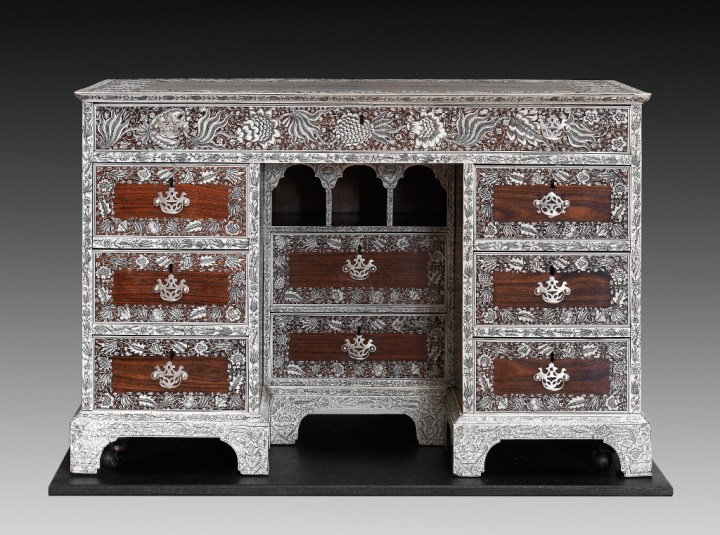
The Rumbold Desk, by an unknown craftsman from Vizagapatam, Southern India, ca. 1750–60, rosewood inlaid with ivory, silver handles, 76 × 113 × 62 cm. Accepted in Lieu of Inheritance Tax by HM Government and allocated to the Fitzwilliam Museum, 2016 (M.3–2016). This Anglo-Indian desk has been on loan to the Fitzwilliam Museum in Cambridge since 2012 and is one of the finest of a very small group of similar desks made for British patrons in India at Vizagapatam (near Madras), a centre for the manufacture of such luxurious ivory-inlaid furniture. It belonged to Sir Thomas Rumbold, 1st baronet (1736–91), a British administrator in India, who amassed a great fortune in the service of the East India Company and served as Governor of Madras from 1777 to 1780.
Conference | HECAA Sessions at UAAC, 2016
This posting is three months late, but in wrapping up year-end business, I think it’s important to note that HECAA has been represented at UAAC since 2013. Again, thanks so much to Christina Smylitopoulos for organizing this year’s session (actually two panels this year as a result of lots of strong proposals)! Next year’s conference meets October 12–15. –CH
Universities Art Association of Canada / l’association d’art des universités du Canada
Université du Québec, Montréal, 27–30 October 2016
HECAA Open Sessions (Historians of Eighteenth-Century Art and Architecture)
Chaired by Dr Christina Smylitopoulos, University of Guelph
David Mitchell (PhD candidate, McGill), The Colour of Death: Polychrome Anatomies in Print and Wax
While it was a convention of early modern art theory that colour was evocative of animate life, my paper focuses on eighteenth-century anatomical models in order to investigate an alternate set of implications for polychrome effect. In such works, dead flesh served as reference for investigation of the animating force of physiological mechanism. Documentation of protracted legal battles in France over technological patent for both coloured mezzotint and anatomical waxwork offers, I argue, a discourse of colour plotted in counterpoint to art theory’s promotion of the animate force of coloris. And the elaboration of this other colouristic semantics related pigmented substance, craft, and authority in shifted configuration.
Ersy Contogouris (Adjunct Professor, Université du Québec à Montréal), James Gillray’s Preparatory Drawings for Connoisseurs Examining a Collection of George Morland’s
In 1807, James Gillray published a satire on the phenomenal success of George Morland, painter of rustic genre scenes, whose early death three years earlier had led to a great increase in the demand for his works and to the circulation of countless forgeries. This paper will examine the ten preparatory drawings—a uniquely large number—that survive for his Connoisseurs Examining a Collection of George Morland’s. Their analysis enriches our understanding both of the caricature itself and of the nature of Gillray’s recurring criticism of the late eighteenth/early nineteenth-century art market, and provides us with an unprecedented view into Gilray’s creative process, revealing the many steps involved in developing an idea into a caricature, the role of writing in Gillray’s thought process, and the struggle to find the perfect title. Taken together, these drawings invite us to rethink some of the accepted notions regarding caricature.
Catherine Girard (Visiting Assistant Professor, Williams College), Mirrored Surfaces: Painting and Reflexivity in French Royal Interiors
The addition of mirrors alongside paintings was a major transformation of eighteenth-century interiors that enhanced the reflexivity of richly decorated spaces. French aristocratic hunters were at the heart of this intensified dialogue between interiors and interiority, as large mirrors and genre paintings showing figures that looked and behaved like them adorned the increasingly specialized rooms that were conceived and built for their after-hunt parties in royal residences. This paper explores the reflexive quality of such spaces created in France during the Rococo moment. While the meals taken outdoors by royal hunters reenacted a concomitant architectural quest for intimacy, the pictures painted for hunting dining rooms allowed the same participants to extend the corporeal sensations imprinted by the pursuit and kill to the in situ experience of paintings. The role of illusion in representation was thus expanded to entire rooms, telescoping the outdoors into newly articulated, intimate, and proto-immersive interiors.
Ryan Whyte (Assistant Professor, OCAD University), En sens contraire: Paradoxes of Reversal in French Reproductive Prints of the Ancien Régime
In French printmaking in the Ancien Régime, the reversal of the image inherent in the printmaking process was so rarely remarked on that modern scholarship has responded with corresponding silence on the subject. This paper addresses those lacunae by examining exceptional cases where the printmaker corrected reversed images in reproduction because the reversal rendered some aspect of the composition strange, usually right-handed subjects made left-handed. Such correction occurred within multiple and contradictory artistic and social contexts, including period notions of handedness, at a time when progressive educational discourse, bound up in neoclassical conceptions of virtue and social reform rejected traditional prejudices against left-handedness and promoted the teaching of ambidexterity. Yet the perception of the inherent reversibility of the composition, in which the ‘corrected’ representation of handedness was the exception that proved the rule, was reinforced both by printmaking processes and by the predominance of dematerialized, literary conceptions of composition.
Stéphane Roy (Associate Professor, Carleton University), Révolution et marché de l’art : transformations et continuité
« Quand la guillotine fonctionne […] il est rare que l’art s’épanouisse ». Ainsi s’exprimait l’auteur anonyme de la notice « Beaux-arts » de l’Histoire et dictionnaire de la Révolution française (1987), faisant écho à une longue tradition historiographique selon laquelle la production artistique de la période révolutionnaire a marqué une rupture complète avec les modèles académique et philanthropique d’Ancien Régime. Les historiens ont montré, depuis, que la situation des arts était plus complexe et que la période révolutionnaire avait produit un corpus d’œuvres appréciable. Mais qu’en est-il du marché de l’art ancien au cours de cette même période? Les fluctuations du politique ont-elles eu une influence sur les goûts? Un nouveau public a-t-il pris le relais des collectionneurs d’Ancien Régime? Peut-on parler d’une transformation radicale ou d’une continuité des goûts? Un examen des catalogues de vente mettra au jour une culture visuelle peu connue de cette période charnière.
Cette étude s’inscrit dans le cadre d’une enquête sur l’évolution des goûts en France à la fin du 18e siècle, saisie plus particulièrement à travers l’inventaire et l’analyse des ventes publiques d’œuvres d’art pendant la période révolutionnaire.
Alena Robin (Associate Professor, The University of Western Ontario), Carmelite Preaching in Guadalajara
Signed and dated in 1747 by Antonio Enríquez, a painter active in the second half of the eighteenth century in Nueva Galicia (now Mexico), a huge painting recently appeared in the collection of the Museo Regional de Guadalajara. The painting was registered in the 1931 inventory without a photograph, as was the rest of the collection, and it was most likely forgotten until now. The painting is currently kept in a corner of the storage room of the museum, sectioned in two, and rolled up. The purpose of this presentation is to uncover the complex composition of this painting in relation to the settling of the male Carmelite order in Guadalajara. Issues of the reality of painting in the so-called periphery will be addressed through the figure of Antonio Enríquez. Questions of patronage will also be raised as an inscription on the canvas points towards the benefactor of the painting.
Isabelle Masse (PhD Candidate, McGill University), Entre pastel et photographie : les portraits de Gerrit Schipper au Bas-Canada, 1808–10
Le pastelliste néerlandais Gerrit Schipper (1775 – c.1825) débarque à Philadelphie en 1802, à l’endroit et au moment où l’inventeur John Isaac Hawkins (1772–1855) brevète un nouveau modèle de physionotrace, un appareil reproduisant mécaniquement les visages de profil. Shipper qui travaille avec une semblable « machine à dessiner » se déplace de ville en ville annonçant dans les journaux locaux que sa « nouvelle méthode pour peindre au pastel » produit des « ressemblances exactes ». Le physionotrace suscite en effet des prétentions de vérité qui le font souvent considérer dans la littérature comme étant protophotographique. Ainsi, les rigoureuses effigies en miniature réalisées par l’artiste se situent à la frontière de deux médiums, le pastel et la photographie. À l’aide d’un corpus créé au Bas-Canada entre 1808 et 1810, cette communication fait valoir que la double médialité des portraits est révélatrice des profondes transformations que subit le médium du pastel à l’aube du XIXe siècle.
Paul Holmquist (Independent Scholar; Carleton University, Contract Instructor), ‘Elle fond les Villes’: The Physiognomy of Reconnaissance in Claude-Nicolas Ledoux’s Ideal City of Chaux
This presentation examines the conception of reconnaissance in eighteenth-century France as a central principle of Claude-Nicolas Ledoux’s theory of architectural expression. Connoting ‘gratitude’ as well as ‘recognition’, reconnaissance is asserted by Ledoux as part of the moral effect of his architecture parlante with respect to nature as a providential order, and society as embodying the common good. I argue that the significance of reconnaissance for Ledoux can best be understood in light of Rousseau’s conception of gratitude as the love for what in turn loves and preserves one’s self, and the origin of conscience. Through an analysis of key projects of Ledoux’s ideal city of Chaux I will show how the evocation of reconnaissance in the spectator underlies Ledoux’s ambition to inculcate civic and personal virtue, and entails an essential reciprocity with the expressivity of architecture that challenges any reduction of his character theory to one of mere affect or signification.
New Book | Claudio Francesco Beaumont
From ArtBooks.com:
Luca Fiorentino, Claudio Francesco Beaumont: L’Album di Disegni del Museo Civico d’Arte Antica di Palazzo Madama a Torino (Florence: Centro Di, 2016), 288 pages, ISBN: 978 8870 385380, €40 / $75.
 Questo studio di Luca Fiorentino analizza L’Album di Disegni di Claudio Francesco Beaumont (1694–1766), artista piemontese che divenne primo pittore della corte sabauda. L’Album, composto da 309 disegni (non tutti di mano di Beaumont), entro nelle collezioni comunali del Museo Civico d’Arte Antica di Torino nel 1931, dopo essere stato conservato dall’autore stesso e in seguito dalla sua famiglia. La ricerca è suddivisa in due sezioni: il saggio critico e il catalogo, composto da schede dettagliate e redatte secondo i moderni parametri scientifici.
Exhibition | The Variable Line: Master Drawings
Press release (via Art Daily). . .
The Variable Line: Master Drawings from Renaissance to Contemporary
Redwood Library & Athenæum, Newport, 1 December 2016 — 5 March 2017
Curated by Benedict Leca
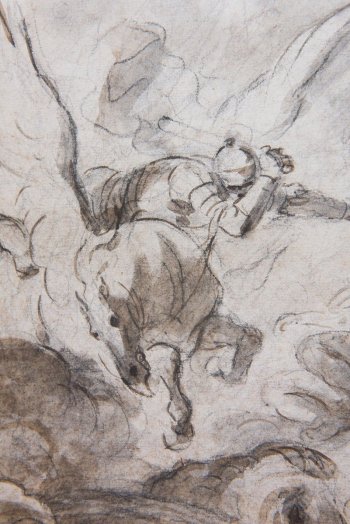
Jean-Honoré Fragonard, Ruggiero Attacks the Orc (illustration for Ariosto, Orlando Furioso), pencil and wash on paper.
Departing from the appreciation that drawing not only remains foundational to art theory and pedagogy, but that it is also undergoing a discernible resurgence in current artistic practice, the Redwood Library and Athenaeum presents The Variable Line: Master Drawings, Renaissance to Contemporary. Organized by the Redwood Library, the sole U.S. venue, and featuring forty-five works, the exhibition is arranged as a survey featuring many types of drawings, rendered in a rich variety of styles and techniques, and treating a broad range of themes.
“Artists have always relied on drawing to put down ideas quickly—it serves this purpose perhaps even more now as the medium on-the-go appropriate to today’s global art world. In that sense drawing has always attached to the conceptual. Certainly drawing is integral to the larger turn towards conceptual thinking in contemporary art, from Sol Lewitt to Julie Mehretu,” explains Benedict Leca, Redwood Executive Director and exhibition curator. “That said, it is interesting to note how the works by contemporary women artists on view are at once visibly painstaking in their technique and contrary to traditional notions of skill.”
The presentation is arranged into seven sections—Académies and the Centrality of the Figure, Line and the ‘Grand Manner,’ Fragonard and Ariosto, The Light of Italy and the Lure of the Antique, Drawing the Pastoral, Landscape and the Bucolic, and Master/Mistress: the Gendered Line—enabling visitors to identify both continuities and ruptures in theme and technique across 500 years of drawing practice in Western Europe and America. Upending the now conventional dominance accorded to digital media or even painting, the selection of drawings on display crossing five centuries—from Renaissance to contemporary—speaks to drawing’s eternal relevance as consonant to art making in any medium, be it painting, sculpture, or video. It is for this reason that drawing’s ubiquity has stretched unbroken to this day, routinely entering our own lives as doodle or sketch. From the most pervasive to the most individual, drawing, like handwriting, thus offers historical perspectives through the continuities inherent to the medium, as well as insights into the stylistic idiosyncrasies of its adaptation by individual artists. The immutable simplicity of a line drawn across paper, parchment, or mylar makes the drawings exhibited here among those rare objects that enable visitors to ride along on the creative journey of both Renaissance and contemporary artists.










 Enfilade
leave a comment