Restoration of the Williamsburg Bray School Completed
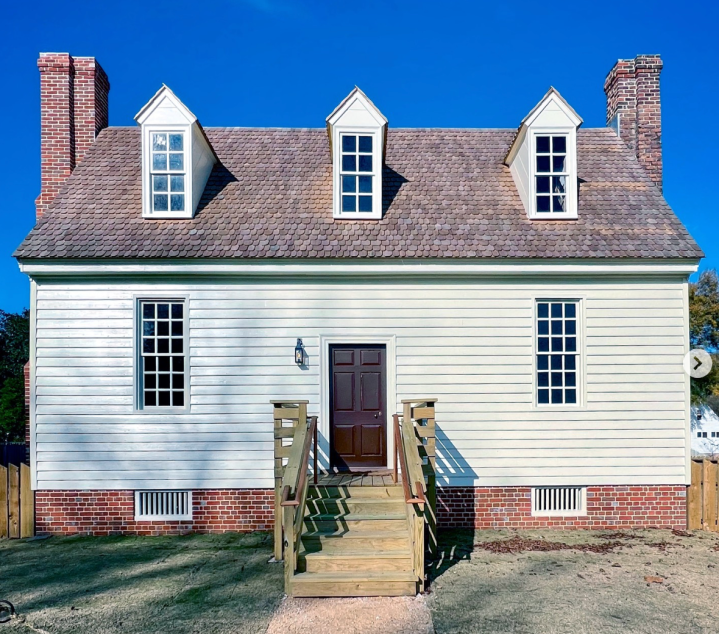
Opened in 1760, the Bray School is believed to be the oldest surviving building in the United States for the education of Black children. As noted by Lauren Walser in her Preservation article, the school “taught a pro-slavery, faith-based curriculum based on the teachings of the Church of England.” Photo from the Instagram account of Bruce A. deArmond, which foregrounds historic architecture.
◊ ◊ ◊ ◊ ◊
The story of the recovery of the Bray School at Colonial Williamsburg is recounted in the latest issue of Preservation (Spring 2025). The formal dedication of the restored building took place on 1 November 2024. It opens to the public this spring. From Colonial Williamsburg:
The Williamsburg Bray School was one of the earliest institutions dedicated to Black education in North America. From 1760 to 1774, teacher Ann Wager likely taught hundreds of students between the ages of three and ten. Students learned the tenets of the Anglican Church and subjects including reading, and for girls, sewing. The Bray School’s deeply flawed purpose was to convince enslaved students to accept their circumstances as divinely ordained. Hidden in plain sight on the William & Mary campus for over 200 years, the Williamsburg Bray School now stands in Colonial Williamsburg’s Historic Area as the Foundation’s 89th original structure. . . .
The Bray School will be used as a focal point for research, scholarship, and dialogue regarding the complicated story of race, religion, and education in Williamsburg and in America.
◊ ◊ ◊ ◊ ◊
From Colonial Williamsburg:
Maureen Elgersman Lee and Nicole Brown, eds., The Williamsburg Bray School: A History through Records, Reflections, and Rediscovery (Williamsburg: Colonial Williamsburg, 2024), 176 pages, ISBN: 978-0879353032, $20.
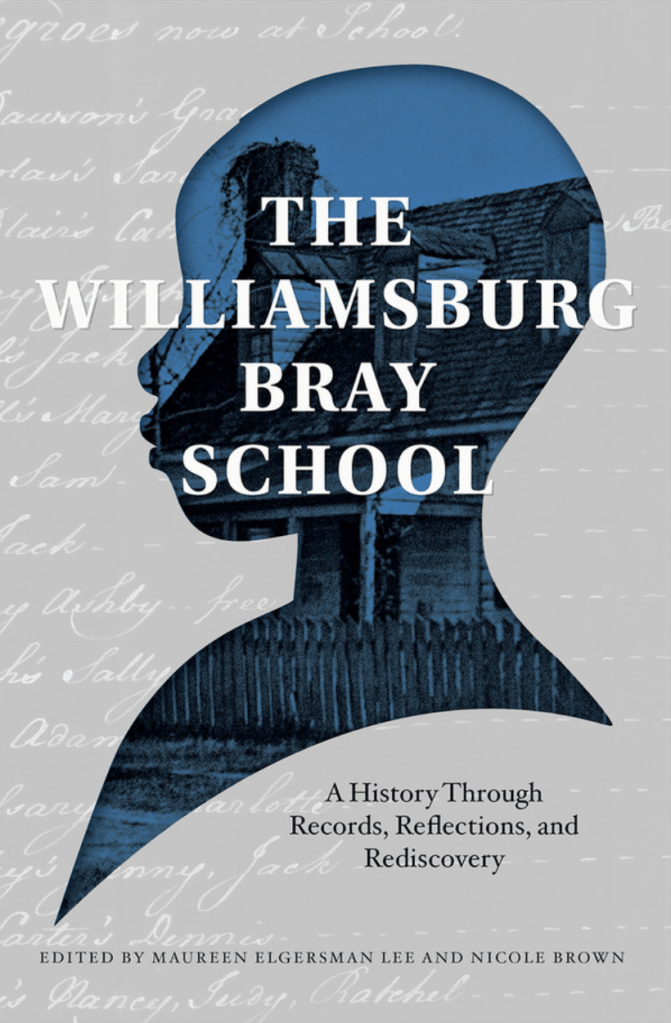 Seven letters tracing the arc of the Williamsburg Bray School—from its founding in 1760 to its closing in 1774—provide the foundation for a collection of essays that explore the school’s history and its implications for the enslaved and free Black children who attended. These letters are some of the surviving correspondence between the Williamsburg school’s administrators and the Associates of Dr. Thomas Bray, a London-based Anglican charity whose charge was to minister to what it saw as the spiritual needs of African Americans. The essayists reflect on the evolution of the Williamsburg Bray School, offering a variety of perspectives on the school and the children who attended it. Some pieces reflect years of research and writing on the establishment of the school. Others, including writings from some of the descendants of these students, represent more recent opportunities to reflect on the school and its historical context. In addition to a short history of the school, a map that pinpoints where the children resided in Virginia’s colonial capital, and photographs of the historic letters, the book delves into the 21st-century discovery of the Williamsburg Bray School building, its subsequent move from the William & Mary campus to Colonial Williamsburg’s Historic Area, and the restoration of the structure that can help tell the complicated story of race, religion, and education in Williamsburg and early America. Author Antonio Bly also shares the poignant story of Isaac Bee, a student at the school who broke the bonds of his enslavement to a Williamsburg planter and rose up from slavery to freedom.
Maureen Elgersman Lee, director of the William & Mary Bray School Lab, holds both a master’s degree and a doctorate in African American Studies. She is an award-winning professor and author of numerous books and articles on the history of Blacks in the Americas.
Nicole Brown is Graduate Assistant for the William & Mary Bray School Lab and a PhD Candidate in American Studies at William & Mary; she was previously a Program Design Manager at The Colonial Williamsburg Foundation. As a first-person historical interpreter, Brown portrays a variety of women including Ann Wager, the 18th-century white teacher at the Williamsburg Bray School, and Monticello’s Martha Wayles Skelton Jefferson. Brown’s ongoing academic research centers Black literacy in the Atlantic World via interdisciplinary and descendant-engaged scholarship.
Exhibition | Silver from Modest to Majestic

Daniel Garnier, Silver Chandelier, made in London, 1691–97, silver and iron (Colonial Williamsburg Foundation, Museum Purchase, 1938-42). Fashioned for King William III of England sometime between 1691 and 1697, this chandelier hung at St. James’s Palace in London. It is believed to have been sold for its silver value by King George III when it was seen as outdated. After remaining in private hands for more than a century, it was auctioned in 1924 to William Randolph Hearst, the prominent American newspaperman. Colonial Williamsburg acquired the chandelier shortly before WWII.
◊ ◊ ◊ ◊ ◊
From the press release (3 April 2025) for the exhibition:
Silver from Modest to Majestic
DeWitt Wallace Decorative Arts Museum, Colonial Williamsburg, 24 May 2025 — 24 May 2028
Work is currently underway at the Art Museums of Colonial Williamsburg on a new exhibition featuring more than 120 objects from the museum’s extensive collection of 17th- to 19th-century silver. Silver from Modest to Majestic will be on view in the museum’s newly relocated Mary Jewett Gaiser Silver Gallery, on the main floor of the museum until 24 May 2028.
The exhibition’s scope is wide-ranging, from a 49-lb chandelier made for a monarch to a simple spoon made by a Williamsburg silversmith, all displayed in brilliantly lit cases against dark blue backgrounds. While silver has long been associated with wealth and aristocracy, the items featured in this exhibition were crafted for use in nearly every setting imaginable ranging from churches, classrooms, and kitchens to businesses, battlefields, and bedrooms. One thing that every piece on display has in common is a powerful story. Some are objects of great beauty created with the highest level of skill, while others have lengthy pedigrees. Knowing who made a piece and who used it lets Colonial Williamsburg curators pinpoint that object in a time and a place, and then bring it forward through history, allowing it to tell its tale.
“Collecting objects where we know the ‘who, when, and where’ of their manufacture, plus their provenance, allows us to exhibit silver items which transcend the differences between artistic, historical, and functional,” said Erik Goldstein, Colonial Williamsburg’s senior curator of mechanical arts, metals and numismatics. “These particular objects are the pinnacle of early silver, no matter how humble they may be.”
This new exhibition replaces the museum’s previous silver exhibition, Silver from Mine to Masterpiece, which was on view from 2015 to 2023. While the former exhibition had a larger percentage of British silver, nearly half of the objects on display in the new exhibition are examples of early American-made silver, many of which were created for everyday use by ordinary people. Early colonists originally relied on imported British silver wares, but over time, the innovation, skill, and entrepreneurship of those early American tradespeople resulted in the establishment of a robust and exciting cohort of American silversmiths producing items that were touched by everyone from elite to enslaved individuals.
“Our collection of British silver is justly famous, but our decision to build a collection of American silver terrifically advances the museums’ goal of telling the varied stories of so many different craftspeople and consumers, each of whom influenced the tastes and styles of colonial America,” said Grahame Long, executive director of collections and deputy chief curator.

Punch Ladle, possibly made in Williamsburg, ca.1740–70, silver and wood (Colonial Williamsburg Foundation, Gift of A. Jefferson Lewis III in memory of Elizabeth Neville Miller and Margaret Prentis Miller Conner, 2023-101; photo by Jason Copes). This worn and lovingly preserved ladle, believed to have been made locally, descended in the Prentis family of Williamsburg.
◊ ◊ ◊ ◊ ◊
Visitors to Colonial Williamsburg will experience firsthand how the pieces featured in Silver from Modest to Majestic connect to the lives of Williamsburg’s 18th-century residents. One item in the exhibition—a silver punch ladle, owned by the Prentis family of Williamsburg and passed down in the family for 250 years—served as the model for a reproduction punch ladle created by Williamsburg’s silversmiths that visitors will find in the corner cupboard at the Williamsburg Bray School after it opens to the public in June 2025. Archaeological records show that Ann Wager, headmistress of the Williamsburg Bray School, had punch wares.
“Having the Prentis family’s original ladle gave us a wonderful opportunity to reproduce a piece that we know was used by an 18th-century Williamsburg family and put it in the context of the Bray School where it helps to tell that story,” said Goldstein.
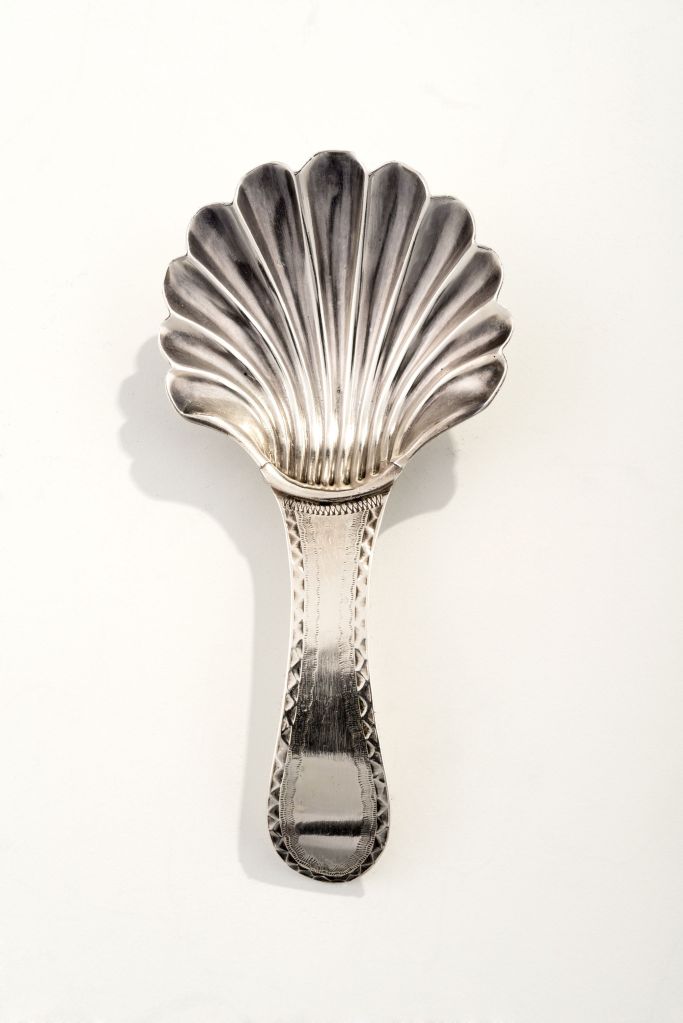
Caddy Spoon, marked by Hester Bateman (1708–1794), London, 1789–90, silver (Colonial Williamsburg Foundation, Gift of Mr. E. Palmer Taylor, 1998-92; photo by Jason Copes). Many now-anonymous British women worked in the silversmithing trade, producing small items like buttons or finishing and polishing larger wares. Standing out is Hester Bateman, who ran a thriving silversmith business after the death of her husband. She specialized in affordable items aimed at the rising middle class. When Bateman retired in 1790, the business was carried on by her sons and one of her daughters-in-law.
Other recently acquired highlights of the silver exhibition include the earliest-known Virginia-made horse racing trophy awarded to a horse named Madison in 1810; an Indian Peace medal struck by the U.S Mint during Thomas Jefferson’s presidency as a diplomatic gift for a Native American chief; and a church communion cup made in Massachusetts around 1670, the earliest piece of American silver in the Foundation’s collection. These pieces will join some of the extraordinary older items from the collection including a cache of British silver made between 1765 and 1771, which was discovered in 1961 in a field near Suffolk, Virginia. While the origins of the buried treasure, and the reason that no one ever returned to retrieve it, remain unknown to this day, this collection is a reminder of the high monetary—and not just aesthetic―value of silver in early America.
The objects on display in Silver from Modest to Majestic represent the work of a few dozen known silversmiths including Paul Revere (1735–1818), a hero of the American Revolution who learned the trade of silversmithing from his father; Myer Myers (1723–1795), the son of a Jewish refugee who became known as the leading silversmith of New York; and Hester Bateman (1708–1794), a female silversmith in London who ran a thriving business after the death of her husband, specializing in affordable items aimed at the rising middle class. Many items in the exhibition are unmarked, made by unknown makers including enslaved silversmiths. Even the items that are credited to known makers could have been made by smiths employed, apprenticed, or enslaved to the master of the shop. To learn exactly how the items in Silver from Modest to Majestic were created, visitors to the Art Museums of Colonial Williamsburg can visit the Silversmith shop in Colonial Williamsburg’s Historic Area where artisan historians preserve the trade by practicing it as their 18th-century counterparts would have.
This exhibition is generously funded by The Mary Jewett Gaiser Silver Study Gallery Endowment. Admission to the Art Museums of Colonial Williamsburg is free.
The Decorative Arts Trust Launches Collecting250

From the press release:
Collecting250
The Decorative Arts Trust
New Online Resource Commemorates the Semiquincentennial through 250 Objects from across America.
The Decorative Arts Trust is pleased to share Collecting250.org, an interactive online resource that celebrates the importance of objects in narrating the history and evolution of the United States and the communities contained within. To commemorate America’s 250th, the United States Semiquincentennial, the Trust asked museums and historical societies to submit images and information about objects in their collections that tell powerful stories about national, state, or local identity. Collecting250 showcases 250 objects from over 140 institutions, and the release is timed in conjunction with the commencement of festivities honoring the 250th anniversary of the American Revolution’s first salvos in Massachusetts in 1775.
“We sought objects that are attached to a specific place, time, and people,” shares Trust Executive Director Matthew A. Thurlow. “Our aim was to present 250 objects from public collections across the country, thereby drawing attention to the broad swath of institutions that steward decorative arts of historical significance. This project aligns beautifully with the Trust’s mission to promote and foster an interest in decorative arts and material culture through our role as a community foundation elevating curatorial efforts to steward and study objects.”
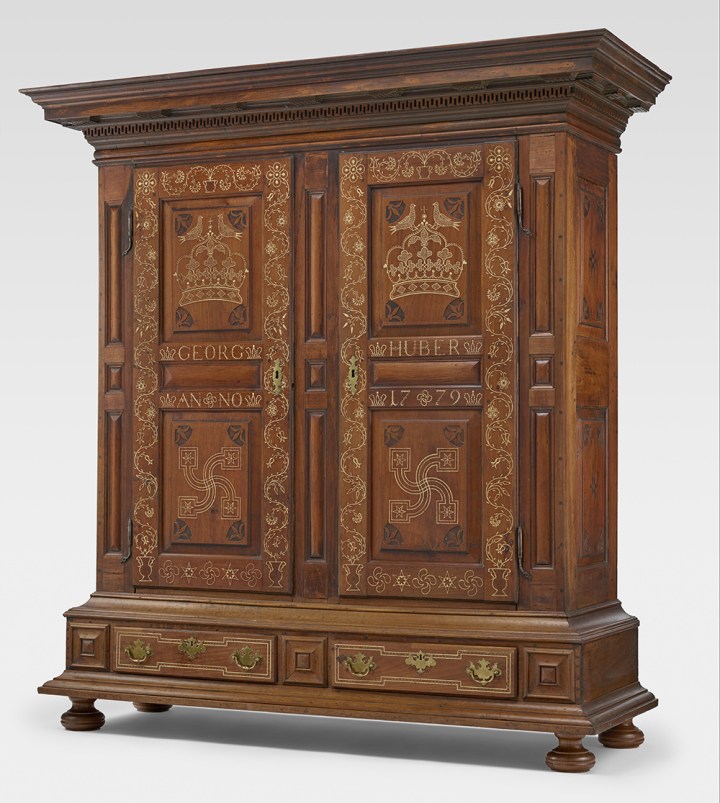
Kleiderschrank (Clothes Press), 1779, Lancaster County, Pennsylvania; walnut, yellow pine, oak, sulfur, iron; 6 feet 10 inches × 6 feet 6 inches × 27 inches (Philadelphia Museum of Art, 1957-30-1).
All 50 states and the District of Columbia are represented, and each record contains an image, tombstone information, and a description of the object’s importance. The ability to search for entries based on location, category, and keyword provides the chance to make exciting and enlightening discoveries in unexpected places. The Trust developed connections with museums and historical societies beyond our traditional network, allowing them to highlight extraordinary artistic achievements in the west, including a mid-19th-century bed covering (New Mexico History Museum) featuring churro wool yarn and colcha embroidery introduced by early Spanish settlers.
There is an interplay between objects that are isolated from one another by time, location, maker, and function. For example, two disparate entries associated with the care and storage of textiles: a humble, late-19th-century pressing iron (Illinois State Museum) that Mississippian Bettye Kelly brought to Joliet, IL, in the 1960s; and a stunning sulfur-inlaid kleiderschrank (Philadelphia Museum of Art) made in Manheim, Pennsylvania, in 1779 for Georg Huber. The former speaks to the Great Migration of African Americans northward in the 20th century; the latter to the Germanic communities that were thriving on the eastern seaboard during the American Revolution.
The tradition of basket weaving has been practiced and perfected by various cultures over the past 10,000 years. Two entries separated by a century and the entire continent of North America illustrate the cultural convergences and impulses behind the production of basketry. In 1905, Aleksandra Kudrin Reinken, the daughter of a Unangax̂ (Aleut) mother and Russian father used her community’s traditional weaving techniques to create a basket (Hood Museum of Art) for a tourist clientele that incorporates ornamentation from prints, magazines, and perhaps even a Whitman’s Chocolate Sampler box. In 2007, Mary Jackson, an internationally recognized master of sweetgrass basketry, completed Never Again (Gibbes Museum of Art), inspired by the traditional Gullah rice fanner baskets that she learned to create from her mother and grandmother and that were once made and used on Lowcountry plantations.
Collecting250 is free and open to the public. Visit Collecting250.org to start exploring. The Decorative Arts Trust, founded in 1977, is a nonprofit organization that promotes and fosters the appreciation and study of the decorative arts through programs, partnerships, and grants. Learn more at decorativeartstrust.org.
Four Educator Guides, designed specifically for the Collecting250 project, are also available.
◊ ◊ ◊ ◊ ◊
Note (added 20 December 2025) — The post was updated to include the link for the educator guides.
Call for Applications | Associate Editor, J. of the History of Collections
From Oxford UP:
Journal of the History of Collections
Associate Editor applications invited
Applications due by 19 May 2025
Oxford University Press (OUP) invites applications for the position of Associate Editor for the Journal of the History of Collections. We are particularly seeking candidates with expertise in Eastern European, Asian, 18th–21st-century Western art histories, and Classical art more broadly. We are not looking to expand our expertise in early modern or Renaissance art at this time. Ideally, the candidate will take up the position in mid-2025.
The journal is dedicated to the investigation and exploration of all aspects of collecting activity, with no limits on time period or subject matter. From its inception in 1989, the journal has sought to provide a platform from which researchers can speak to each other across disciplinary boundaries. The journal appeals to those with an interest in ethnography, natural sciences, archaeology, the history of medicine, decorative arts, the social history of museums and galleries, the collecting and display of painting and sculpture, and related fields.
Candidates should have a broad base of knowledge in the field of the journal; considerable experience in peer-reviewing; a strong record of recognised scholarship; time to devote to the journal; a strong grasp of the English language (particularly in written form); an interest in reading and publishing in the field of the history of collecting; the ability to undertake critical review of manuscripts; good communication skills; an appreciation of publication ethics; and good networks in the field. Previous journal editor experience is beneficial but not required.
Applicants can be based in any country. We particularly welcome applications from groups traditionally under-represented in academic publishing, including but not limited to women, Black and minority ethnic candidates, and those with disabilities. If you are interested in the role but unsure whether it is appropriate for you, please don’t hesitate to reach out to the Publisher for the Journal of the History of Collections at Oxford University Press, Sharmin Islam: sharmin.islam@oup.com.
Call for Papers | Legacies: Why Museum Histories Matter
From ArtHist.net:
Legacies: Why Museum Histories Matter
Leiden, 13–15 January 2026
Organized by Laurie Kalb Cosmo, Marika Keblusek, and Susanne Boersma
Proposals due by 1 June 2025
The 21st century is a particularly engaging moment to study the history of museums. Due to pressing concerns about new ways to make old art accessible, global art, decolonization, and the social, ecological, and political responsibilities of culture, museums are sustaining great periods of self-reflection and debate. One could argue that museums are renewing their 18th-century Enlightenment origins as institutions of civility and hope, although these values are also undergoing reevaluation and change, in a global world.
Amidst such profound and urgent topics, what about the ideas of museums themselves? How do their storied origins—as private palace collections and Wunderkammern, houses of worship, monuments to the nation, sites of commemoration, or new archistar containers for art—relate to their significance in contemporary life? How do their physical structures, be it cabinets, palaces, white cubes, temples, churches or mausolea, and their collections reflect the museums’ histories, wherever they may be in the contemporary world? How do we navigate the idea of the museum as an inherited construct, within the context of its many debates? What is it about a museum’s past that keeps us curious, and how does it inform what it does in the present?
This international conference invites papers that focus on museums with significant founding histories—broadly defined by their buildings, collections, commemorative functions, collectors, or founders—that are currently engaged in some manner of institutional introspection, by way of exhibitions, acquisitions, restitutions, or renovations. We invite papers that address, but are not limited to, the following questions:
Museums and Buildings
How does architecture shape a museum’s legacy and/or how does legacy shape a museum’s architecture?
Museums and Geopolitics
How do museums respond to war, vis-à-vis their collections, provenance, and national identities of the artists, whose work they exhibit or collect?
Museums and Social Responsibility
As museums take on ownership of their pasts, what do they owe the visiting public, and what do visitors owe them?
Museums and Their Pasts
How can a museum’s history be reconstructed through its collections, exhibitions and building?
Museum Founders and Their Legacies
How do founders’ stipulations inform contemporary museum practices?
Museums in the World
How are the legacies of Western museums realized and/or revised across the globe?
Please submit your abstract (200 words) and author biography (100 words) to Dr. Susanne Boersma via s.w.boersma@hum.leidenuniv.nl by Sunday, 1 June 2025. We welcome applications from the broadest range of researchers, scholars, and museum professionals. You will be notified about the acceptance of your proposal by 1 July 2025.
This in-person conference is organized by Dr. Laurie Kalb Cosmo, Dr. Marika Keblusek and Dr. Susanne Boersma, Leiden University Centre for the Arts in Society.
Call for Papers | Exhibition Catalogues beyond the Visual Arts
From ArtHist.net:
Autres objets, autres enjeux ?
Les catalogues d’exposition hors du champ des arts visuels
Université Grenoble Alpes and Musée dauphinois, 6–7 November 2025
Proposals due by 2 June 2025
Après plusieurs journées d’études appréhendant le catalogue d’exposition d’arts visuels comme un objet d’étude en soi (Paris 2023 et 2024, Bordeaux 2025), ce titre sous forme de question est volontairement provocateur. Il reprend en effet, pour évidemment le questionner, un partage entre musées des Beaux-arts et musées autres qui a structuré la vision des musées du point de vue de l’action publique, et qui a renvoyé dans une catégorie définie par défaut des musées extrêmement divers et hétérogènes. Il s’agit ici d’interroger les formes, les pratiques et les enjeux liés aux catalogues d’expositions et aux publications liées à celles-ci, dans les musées de société, les écomusées ou les musées de science, mais aussi les catalogues dédiés à des œuvres d’art de nature essentiellement allographique, c’est-à-dire qui ne se matérialisent pas dans un objet unique ou en un nombre limité d’exemplaires, mais qui s’incarnent sur le temps long dans des objets dont la diversité ne modifie pas l’œuvre idéale, comme le livre, la partition, et/ou qui s’interprètent sous des formes immatérielles, comme le concert, le spectacle de danse, la représentation théâtrale, etc.
Alors que la mise en exposition de tels artefacts a elle-même déjà fait l’objet de plusieurs travaux dans chacun de ces domaines, le catalogue qui l’accompagne n’a pas encore été vraiment interrogé, pas plus que ces différents domaines n’ont été traités ensemble. La réunion de ces différents domaines, très hétérogènes, doit d’ailleurs être immédiatement interrogée : y a-t-il réellement des différences essentielles entre le catalogue d’une exposition réunissant des œuvres autographiques (peinture, sculpture, etc.) et celui d’une exposition d’œuvres allographiques (littérature, musique, danse, etc.) ? Peut-on considérer les ouvrages édités à l’occasion d’expositions reliées à des problématiques en sciences humaines et sociales, comme des « catalogues », définis plutôt dans ce cas à partir d’un usage lié à la visite d’exposition ?
Existe-t-il vraiment des catalogues « autres », comme on a voulu désigner des musées « autres », ceux qui n’étaient pas des beaux-arts ? Y aurait-il d’un côté les catalogues d’exposition réunissant des artefacts d’abord considérés comme des œuvres d’art, de l’autre des catalogues réunissant des artefacts d’abord compris comme documents ? En retour, dans quelle mesure le choix même de la forme catalogue d’exposition témoigne-t-il du statut que l’on souhaite donner aux artefacts exposés ?
Cette journée d’étude propose de réfléchir à la fois aux similitudes et aux différences, aux enjeux communs et aux spécificités de chaque forme éditoriale, aux passages comme aux rejets, avec l’idée que cette réflexion peut permettre en retour d’éclairer le rôle des différents lieux d’exposition et d’interroger le statut des artefacts comme l’articulation entre le document et l’œuvre d’art. L’appel est donc ouvert aussi bien aux chercheur·euses qu’aux professionnel·les des musées, de l’exposition, de l’édition et de la médiation.
Les propositions pourront s’inscrire dans différents axes, qui ne sont néanmoins en rien exclusifs :
La diversité des formes, des auteur·trices et des échelles
Travailler sur les catalogues d’exposition hors du champ des arts visuels suppose de prendre en compte leur hétérogénéité, en ne se contentant pas d’une définition en creux. Une diversité thématique, d’abord, qui pose la question de la multiplicité des catalogues : peut-on penser de la même manière un catalogue portant sur la littérature ou sur les sciences, sur l’ethnologie ou sur la musique ? Une diversité d’auteur·trices, ensuite. Qui écrit dans des catalogues si divers ? S’agit-il de spécialistes de chacune de ces questions, de professionnel·les des musées ou de la médiation ? Une place peut-elle être faite aux historien·nes de l’art et des images ? Une diversité d’échelles, enfin : si certaines expositions thématiques sont de très grandes manifestations à la fréquentation exceptionnelle, nombre de musées de société sont au contraire de très petites structures. Cela pose donc la question de la possibilité même d’accompagner l’exposition d’un catalogue, et des formes d’édition choisies ou imposées, y compris par le recours à l’auto-édition.
La forme du catalogue
Le catalogue d’exposition artistique a longtemps été défini d’une part par les listes d’œuvres, d’autre part par la présence de notices pour chacune de ces œuvres, enfin par les reproductions. Dans le cadre d’expositions où les objets sont présentés plutôt pour leur valeur d’usage que pour leur valeur esthétique—ou pour leur intérêt tout à la fois documentaire et artistique—comment la forme catalogue d’exposition est-elle investie ? La question de la place des images, et de l’articulation entre texte et image paraît particulièrement pertinente, et participe du statut accordé à chacun des artefacts exposés. Par ailleurs, comment, par le catalogue, rendre compte de mises en exposition spécifiques ? Là où les musées de science misent souvent sur l’interactivité, où les musées de société ont une attention particulière à la participation des publics, l’objet catalogue ne pourrait-il pas sembler dépassé ou désuet ? Le catalogue d’exposition serait-il devenu dans ce cas un livre d’histoire ou un ouvrage accompagnant le thème de l’exposition mais sans faire catalogue ? Enfin, quand la distinction entre beau livre ou monographie d’art et catalogue d’exposition repose souvent sur l’apport heuristique du rapprochement physique des œuvres d’art en un lieu, quelle est la place de catalogues d’exposition de musées de science ou de société par rapport à des ouvrages thématiques sur les mêmes questions ?
Enjeux de médiation
L’un des enjeux principaux des catalogues d’exposition est celle de la médiation auprès des publics, lecteur·rices et spectateur·rices. Quels sont les points communs et les différences avec les catalogues d’expositions artistiques ? Dans quelle mesure les enjeux d’articulation entre science et société sont-ils portés par les catalogues d’exposition et quel public/lectorat est ici visé ? Comment s’emparer de ces enjeux dans un format historiquement et socialement situé ? Alors même que les musées de société mettent l’accent sur un activisme muséal et l’ancrage culturel dans la cité, donnant la parole aux publics, la question est ici double : les catalogues d’exposition peuvent-ils être le support de mémoires et d’histoires jusque-là non racontées, au même titre que les expositions elles-mêmes, et peuvent-ils s’adresser à des publics divers ? Dans quelle mesure ces catalogues peuvent-ils s’appuyer sur une co-construction avec les publics et sur une narration participative ? Enfin, alors même que le catalogue centré sur les arts visuels participe de la construction de la valeur des œuvres d’art, et a donc aussi une fonction économique, quelles fonctions remplissent d’autres formes de catalogues ?
Les propositions de communication (5 000 signes maximum), rédigées en français ou en anglais, seront accompagnées d’une courte bibliographie et de quelques lignes de présentation bio-bibliographique de l’auteur·ice. Elles sont à envoyer par mail jusqu’au 2 juin 2025 aux membres du comité d’organisation :
• Marie Gispert, professeure d’histoire de l’art contemporain, Université Grenoble Alpes, LARHRA : marie.gispert@univ-grenoble-alpes.fr
• Hélène Trespeuch, professeure d’histoire de l’art contemporain, Université Bordeaux Montaigne, CRHA – F.-G. Pariset : helene.trespeuch@u-bordeaux-montaigne.fr
Comité scientifique
Marie-Christine Bordeaux (Université Grenoble Alpes), Alice Buffet (Musée de la Résistance et de la Déportation de l’Isère), Marie-Charlotte Calafat (MUCEM), Olivier Cogne (Musée dauphinois), Marie Gispert (Université Grenoble Alpes), Aziza Gril-Mariotte (Musée des Tissus et des Arts Décoratifs de Lyon / Aix Marseille Université), Joëlle Le Marec (Museum National d’Histoire naturelle), Federica Tamarozzi (MEG, Genève), Hélène Trespeuch (Université Bordeaux Montaigne), Erika Wicky (Université Grenoble Alpes)
Exhibition | Pleasures Houses in the Paris Countryside
Now on view at the Museum of the Royal Estate of Marly:
Maisons de Plaisance des Environs de Paris de Louis XIV à Napoléon III
Musée du Domaine royal de Marly, Marly-le-Roi, 11 April — 31 August 2025
Curated by Anaïs Bornet
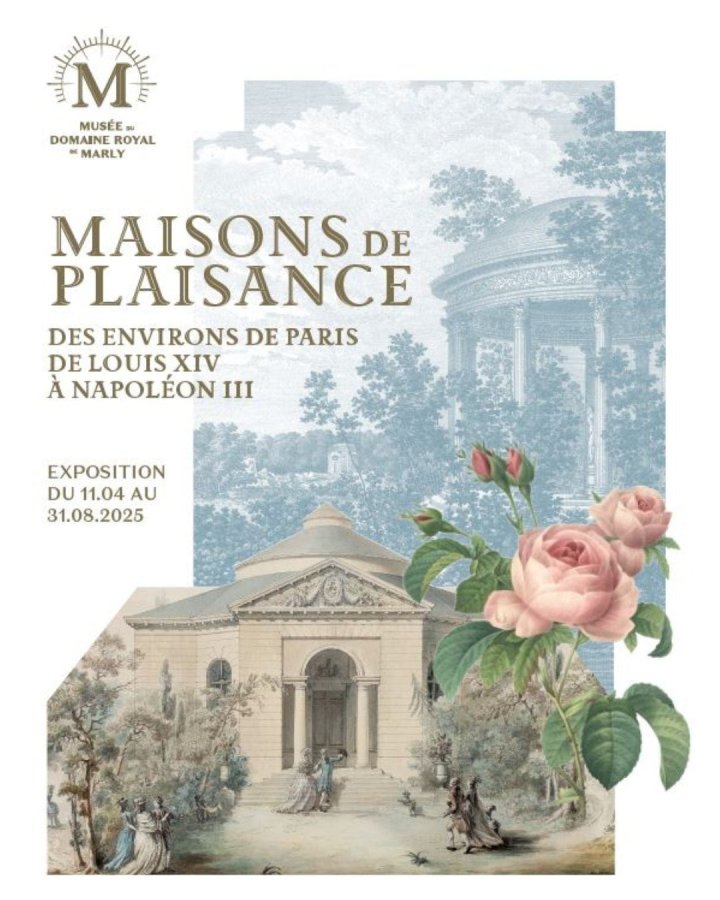 Dès la Renaissance, en Ile-de-France, une élite fortunée quitte la ville à la belle saison et s’installe dans de somptueuses résidences « aux champs » pour s’y détendre et s’y divertir. La maison de plaisance est un lieu de représentation autant que de détente. Elle incarne la richesse et le goût de son propriétaire. Estampes, peintures et objets décoratifs des XVIIe, XVIIIe et XIXe siècles témoignent de cette histoire qui a contribué à façonner le paysage francilien. Ces œuvres illustrent un art de vivre et les transformations sociales de la fin de l’Ancien Régime et du XIXe siècle : divertissements en vogue, désir d’intimité et de confort, place des femmes et développement de la bourgeoisie, lien avec la nature… Environ soixante-dix œuvres empruntées à des collections publiques et privées prennent place au sein du parcours permanent du musée du Domaine royal de Marly pour dialoguer avec ses collections.
Also, see the recent publication:
Anaïs Bornet and Francesco Guidoboni, eds., Maisons de plaisance des environs de Paris (Rome: Edizioni Artemide, 2023), 232 pages, ISBN: 978-8875754402, €30.
New Book | Maisons de plaisance des environs de Paris
Co-editor Anaïs Bornet has curated an exhibition on the same topic, which recently opened at the Musée du Domaine royal de Marly. From Edizioni Artemide:
Anaïs Bornet and Francesco Guidoboni, eds., Maisons de plaisance des environs de Paris (Rome: Edizioni Artemide, 2023), 232 pages, ISBN: 978-8875754402, €30.
Texts by Janine Barrier, Andrea Baserga, David Beaurain, Hervé Bennezon, Karine Berthier, Anaïs Bornet, Françoise Brissard, Roselyne Bussière, Ekaterina Bulgakova, Bernard Chevallier, Jérémie David, François de Vergnette, François Gilles, Francesco Guidoboni, Laetitia Jacquey-Achir, Desmond-Bryan Kraege, Louis-Joseph Lamborot, Marianne Mercier, Alexandra Michaud, Lucie Nottin, Claire Ollagnier, Camilla Pietrabissa, Jean Potel, Daniel Rabreau, Gabriel Wick.
 Autrefois situées « aux champs », les demeures de plaisance franciliennes—châteaux, maisons, pavillons aux dimensions variées—permettaient à une élite fortunée de quitter Paris lors de la belle saison, et de se détendre dans un environnement champêtre loin du tumulte de la ville. Avec l’annexion à la capitale de nombreuses anciennes résidences de villégiature, et le développement continu de la métropole parisienne menant au Grand Paris d’aujourd’hui, s’ouvrent de nouveaux questionnements sur les liens existants entre la ville et ce patrimoine autrefois éloigné.
Cet ouvrage collectif s’intéresse particulièrement aux maisons de plaisance bâties entre la moitié du XVIIe siècle et la fin du XIXe siècle, au sein des limites actuelles de l’Ile-de-France. Souvent méconnus et peu valorisés, les vestiges de la villégiature francilienne (non royale) de cette période se trouvent au cœur de l’actualité; ces bâtiments, pour certains encore préservés, se trouvent aujourd’hui face à diverses problématiques de conservation, d’adaptation aux nouveaux besoins, d’accueil du public, etc., mais sont également souvent menacés par les transformations urbaines qui répondent aux évolutions de la société du XXIe siècle.
Dans l’espoir de permettre aux franciliens de se réapproprier leur patrimoine, les textes réunis dans le présent volume s’attachent à offrir aux lecteurs un aperçu du phénomène de la villégiature en Ile-de-France, en retranscrivant l’histoire d’anciennes maisons de plaisance, certaines disparues, d’autres réhabilitées ou encore à l’avenir incertain, entre art de vivre, décors raffinés, jardins sophistiqués, réceptions et promenades dans des sites naturels aux vues panoramiques spectaculaires…
The table of contents can be seen here»
Exhibition | Biedermeier: The Rise of an Era
Now on view at the Leopold Museum, with the full press release available at Art Daily . . .
Biedermeier: The Rise of an Era / Eine Epoche im Aufbruch
Leopold Museum, Vienna, 10 April — 27 July 2025
Curated by Johann Kräftner with Lili-Vienne Debus
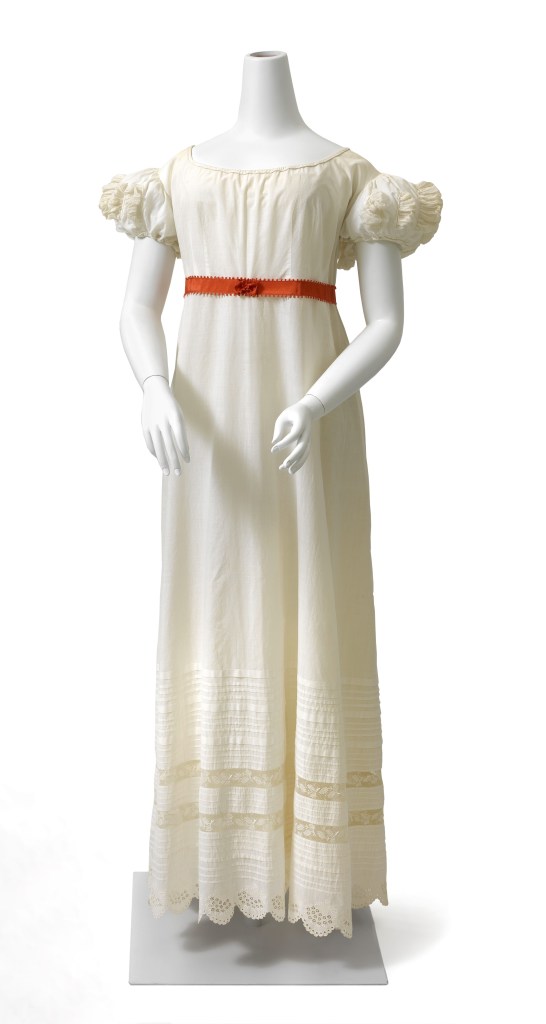
Day Dress, ca. 1816 (Wien Museum; photo by Birgit and Peter Kainz).
The fascinating era of the Biedermeier, which lasted from around the time of the Congress of Vienna in 1814/15 to the revolutions of 1848, delineates a period in Europe that was shaped by political upheaval and social revolts, which profoundly changed society. The congress resulted in the restitution of absolutism and princely rule, heralding a long phase of political restoration founded on a suppression of democratic aspirations. The resigned population turned away from politics and revolutionary ideals for fear of reprisals, seeking refuge in the private sphere. Themes of longing for security and harmony in everyday life entered the pictorial worlds of the Biedermeier.
Aside from all the political friction, the Biedermeier was also an era of great innovation and esthetical changes. The most important driving force was the industrial progress, which led to the construction of the first railway lines and spectacular suspension bridges, like the one connecting Buda and Pest. These technological revolutions resulted in decisive changes in the development of art. Many of these innovations did not emanate from Vienna as the center of the Habsburg Monarchy, but rather from the splendid cities of the crown lands, such as Budapest, Prague, Ljubljana, Trieste, Venice, and Milan.
The art of the monarchy was shaped by international exchange. Thus, the exhibition showcases not only the Viennese masters, including Ferdinand Georg Waldmüller and Friedrich von Amerling, but also Miklós Barabás and József Borsos from Budapest, Antonín Machek and František Tkadlík from Prague, as well as the artists active in Lombardy-Venetia Francesco Hayez and Jožef Tominc (Giuseppe Tominz).

Secretary, Bohemia, ca. 1820 (Prague: The Museum of Decorative Arts; photo by Gabriel Urbánek and Ondřej Kocourek).
Despite the severe poverty of the time, which affected large segments of the population, the simultaneous economic upturn yielded a bourgeoisie whose members wanted to be depicted in confident portraits. Alongside portraits celebrating realistic likenesses of the depicted and the documentation of their social status, the pictorial worlds were dominated by themes from everyday life: family portraits, genre paintings, and renderings of the artists’ own surroundings. Despite the Biedermeier’s typical restrictions to the microcosm of the everyday and one’s immediate surroundings, artists of the period also looked further afield to far-flung countries and cities in order to satisfy people’s curiosity and interest in foreign cultures. Featuring around 190 works from Austrian and international collections, ranging from paintings and graphic works to furnishings, glassware and dresses, the exhibition presents a varied picture of this era.
Curator: Johann Kräftner
Curatorial Assistance and Project Coordination: Lili-Vienne Debus
Johann Kräftner and Hans-Peter Wipplinger, eds., Biedermeier: Eine Epoche im Aufbruch / The Rise of an Era (Cologne: Walther König, 2025), 328 pages, ISBN: 978-3753308159, €40.
The catalogue, in German and English, includes essays by Lili-Vienne Debus, Sabine Grabner, Johann Kräftner, Stefan Kutzenberger, Michaela Lindinger, Fernando Mazzocca, Juliane Mikoletzky, Adrienn Prágai and Radim Vondráček, as well as a prologue by Hans-Peter Wipplinger.
◊ ◊ ◊ ◊ ◊
Note (added 23 April 2025) — This posting originally appeared April 22; it was moved back to April 21st for improved continuity with other posts.
Call for Papers | 18th-C. Painting between Italy and the Hapsburg Empire
From ArtHist.net:
Settecento Malerei: Cultural Transfer between Italy and the Habsburg Territories
Department of Art History of the University of Vienna, 23–24 October 2025
Organized by Eleonora Gaudieri and Erika Meneghini
Proposals due by 30 May 2025
This two-day workshop aims to explore 18th-century Italian painting as the focus of transfer phenomena between the Italian peninsula and the territories of the then Habsburg Empire, with Vienna at its centre. The high quality and renowned tradition of Italian painting, fostered by a dense network of international connections, enabled numerous artists of Italian origin or Italians by adoption to pursue successful careers at the Habsburg imperial court in Vienna. This phenomenon must be understood within the context of broader diplomatic and artistic networks that connected Vienna with key centres on the Italian peninsula such as Venice, Bologna, Rome, and Naples.
The beginning of the Settecento was characterised by a considerable expansion of the transalpine art market, driven by a strong interest in collecting Italian artworks. This phenomenon attracted numerous Italian artists, including many painters, to Vienna and to the allied courts of the German prince-electors, such as the Schönborn and Wittelsbach Houses. At the same time, a number of Austrian painters were encouraged to further their training in Italy, where they were profoundly influenced by the local visual language.
The workshop will address two main currents. First, it will investigate the meanings and functions of Italian painting within the socio-political and cultural context of the Habsburg imperial court in Vienna and its allied courts. Second, it seeks to explore the various dynamics that fostered the transfer of Italian painting and Italian artistic knowledge to Vienna and the territories of the then Habsburg Empire. We welcome innovative proposals that address the following topics:
• The reception of Italian painting in Vienna and allied territories, and the role of workshops and art academies in this process
• Italian painting as a medium of Habsburg representation
• The role of regional schools of Italian painting in the context of Viennese and Central European art collections
• Grand Tour and Kavalierstour
• The reconstruction of networks of diplomatic, artistic, and patronage relations
Contributions addressing other topics relevant to the workshop’s main focus are also welcome.
Please send your proposal—in English, German, or Italian—including the title of your presentation, an abstract (approx. 300 words), and a short CV to settecentomalerei@gmail.com by 30 May 2025. Speakers will have 20 minutes for their presentations. Applicants will be informed about the acceptance of their proposals by 30 June 2025. The conference languages are English, German, and Italian. The conditions and procedures for reimbursement of travel and accommodation costs will be communicated following confirmation of participation.
If you have any questions, please contact the organisers:
Dr. Eleonora Gaudieri, eleonora.gaudieri@univie.ac.at
Project assistant (APART-GSK funding programme)
Department of Art History, University of Vienna
Erika Meneghini, erika.meneghini@univie.ac.at
PhD Candidate
Department of Art History, University of Vienna










 Enfilade
leave a comment