The Burlington Magazine, December 2016
The eighteenth century in The Burlington (the issue is dedicated to ‘Art in Britain’):
 The Burlington Magazine 158 (December 2016)
A R T I C L E S
• Lydia Hamlett, “Pandora at Petworth House: New Light on the Work and Patronage of Louis Laguerre,” pp. 950–55.
• Jennifer Melville, “Lady Forbes of Monymusk: A Rediscovered Portrait by Joshua Reynolds,” pp. 956–60.
• Brendan Cassidy, “A Portrait by Gavin Hamilton: Sir John Henderson of Fordell,” pp. 961–63.
• Alex Kidson, “David Solkin’s Art in Britain, 1660–1815 (Paul Mellon Centre for Studies in British Art, 2015),” pp. 964–67.
L E T T E R S
• Peter Lindfield, “A Further Allusion to Strawberry Hill at Lee Priory, Kent,” p. 979.
• Nicholas Penny, “Hugh Honour,” p. 979.
R E V I E W S
• Susanna Avery-Quash, Review of Lucilla Burn, The Fitzwilliam Museum: A History (Philip Wilson Publishers, 2016), p. 980.
• Greg Smith, Review of the exhibition catalogue, Tim Barringer and Oliver Fairclough, Pastures Green & Dark Satanic Mills: The British Passion for Landscape (Giles, 2014), pp. 981–82.
• Barry Bergdoll, Review of Stefan Koppelkamm, The Imaginary Orient: Exotic Buildings of the 18th and 19th Centuries in Europe (Axel Munges, 2015), p. 982.
• Giles Waterfield, Review of the exhibition catalogue, Victoria Avery, Melissa Calaresu, and Mary Laven, eds., Treasured Possessions from the Renaissance to the Enlightenment (Philip Wilson Publishers, 2015), p. 988.
• Malcolm Bull, Review of the exhibition In the Light of Naples: The Art of Francesco de Mura (Cornell Fine Arts Museum, Rollins College, Winter Park, 2016; Chazen Museum, University of Wisconsin-Madison, 2017; The Frances Lehman Loeb Art Center, Vassar College, Poughkeepsie, 2017), pp. 1006–07.
S U P P L E M E N T
• Tim Knox, “Recent Acquisitions (2012–16) at the Fitzwilliam Museum, Cambridge,” pp. 1017–28.
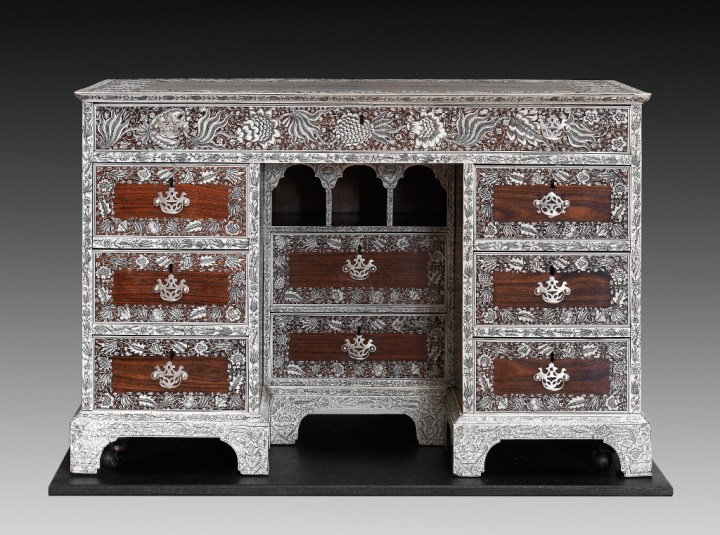
The Rumbold Desk, by an unknown craftsman from Vizagapatam, Southern India, ca. 1750–60, rosewood inlaid with ivory, silver handles, 76 × 113 × 62 cm. Accepted in Lieu of Inheritance Tax by HM Government and allocated to the Fitzwilliam Museum, 2016 (M.3–2016). This Anglo-Indian desk has been on loan to the Fitzwilliam Museum in Cambridge since 2012 and is one of the finest of a very small group of similar desks made for British patrons in India at Vizagapatam (near Madras), a centre for the manufacture of such luxurious ivory-inlaid furniture. It belonged to Sir Thomas Rumbold, 1st baronet (1736–91), a British administrator in India, who amassed a great fortune in the service of the East India Company and served as Governor of Madras from 1777 to 1780.
Conference | HECAA Sessions at UAAC, 2016
This posting is three months late, but in wrapping up year-end business, I think it’s important to note that HECAA has been represented at UAAC since 2013. Again, thanks so much to Christina Smylitopoulos for organizing this year’s session (actually two panels this year as a result of lots of strong proposals)! Next year’s conference meets October 12–15. –CH
Universities Art Association of Canada / l’association d’art des universités du Canada
Université du Québec, Montréal, 27–30 October 2016
HECAA Open Sessions (Historians of Eighteenth-Century Art and Architecture)
Chaired by Dr Christina Smylitopoulos, University of Guelph
David Mitchell (PhD candidate, McGill), The Colour of Death: Polychrome Anatomies in Print and Wax
While it was a convention of early modern art theory that colour was evocative of animate life, my paper focuses on eighteenth-century anatomical models in order to investigate an alternate set of implications for polychrome effect. In such works, dead flesh served as reference for investigation of the animating force of physiological mechanism. Documentation of protracted legal battles in France over technological patent for both coloured mezzotint and anatomical waxwork offers, I argue, a discourse of colour plotted in counterpoint to art theory’s promotion of the animate force of coloris. And the elaboration of this other colouristic semantics related pigmented substance, craft, and authority in shifted configuration.
Ersy Contogouris (Adjunct Professor, Université du Québec à Montréal), James Gillray’s Preparatory Drawings for Connoisseurs Examining a Collection of George Morland’s
In 1807, James Gillray published a satire on the phenomenal success of George Morland, painter of rustic genre scenes, whose early death three years earlier had led to a great increase in the demand for his works and to the circulation of countless forgeries. This paper will examine the ten preparatory drawings—a uniquely large number—that survive for his Connoisseurs Examining a Collection of George Morland’s. Their analysis enriches our understanding both of the caricature itself and of the nature of Gillray’s recurring criticism of the late eighteenth/early nineteenth-century art market, and provides us with an unprecedented view into Gilray’s creative process, revealing the many steps involved in developing an idea into a caricature, the role of writing in Gillray’s thought process, and the struggle to find the perfect title. Taken together, these drawings invite us to rethink some of the accepted notions regarding caricature.
Catherine Girard (Visiting Assistant Professor, Williams College), Mirrored Surfaces: Painting and Reflexivity in French Royal Interiors
The addition of mirrors alongside paintings was a major transformation of eighteenth-century interiors that enhanced the reflexivity of richly decorated spaces. French aristocratic hunters were at the heart of this intensified dialogue between interiors and interiority, as large mirrors and genre paintings showing figures that looked and behaved like them adorned the increasingly specialized rooms that were conceived and built for their after-hunt parties in royal residences. This paper explores the reflexive quality of such spaces created in France during the Rococo moment. While the meals taken outdoors by royal hunters reenacted a concomitant architectural quest for intimacy, the pictures painted for hunting dining rooms allowed the same participants to extend the corporeal sensations imprinted by the pursuit and kill to the in situ experience of paintings. The role of illusion in representation was thus expanded to entire rooms, telescoping the outdoors into newly articulated, intimate, and proto-immersive interiors.
Ryan Whyte (Assistant Professor, OCAD University), En sens contraire: Paradoxes of Reversal in French Reproductive Prints of the Ancien Régime
In French printmaking in the Ancien Régime, the reversal of the image inherent in the printmaking process was so rarely remarked on that modern scholarship has responded with corresponding silence on the subject. This paper addresses those lacunae by examining exceptional cases where the printmaker corrected reversed images in reproduction because the reversal rendered some aspect of the composition strange, usually right-handed subjects made left-handed. Such correction occurred within multiple and contradictory artistic and social contexts, including period notions of handedness, at a time when progressive educational discourse, bound up in neoclassical conceptions of virtue and social reform rejected traditional prejudices against left-handedness and promoted the teaching of ambidexterity. Yet the perception of the inherent reversibility of the composition, in which the ‘corrected’ representation of handedness was the exception that proved the rule, was reinforced both by printmaking processes and by the predominance of dematerialized, literary conceptions of composition.
Stéphane Roy (Associate Professor, Carleton University), Révolution et marché de l’art : transformations et continuité
« Quand la guillotine fonctionne […] il est rare que l’art s’épanouisse ». Ainsi s’exprimait l’auteur anonyme de la notice « Beaux-arts » de l’Histoire et dictionnaire de la Révolution française (1987), faisant écho à une longue tradition historiographique selon laquelle la production artistique de la période révolutionnaire a marqué une rupture complète avec les modèles académique et philanthropique d’Ancien Régime. Les historiens ont montré, depuis, que la situation des arts était plus complexe et que la période révolutionnaire avait produit un corpus d’œuvres appréciable. Mais qu’en est-il du marché de l’art ancien au cours de cette même période? Les fluctuations du politique ont-elles eu une influence sur les goûts? Un nouveau public a-t-il pris le relais des collectionneurs d’Ancien Régime? Peut-on parler d’une transformation radicale ou d’une continuité des goûts? Un examen des catalogues de vente mettra au jour une culture visuelle peu connue de cette période charnière.
Cette étude s’inscrit dans le cadre d’une enquête sur l’évolution des goûts en France à la fin du 18e siècle, saisie plus particulièrement à travers l’inventaire et l’analyse des ventes publiques d’œuvres d’art pendant la période révolutionnaire.
Alena Robin (Associate Professor, The University of Western Ontario), Carmelite Preaching in Guadalajara
Signed and dated in 1747 by Antonio Enríquez, a painter active in the second half of the eighteenth century in Nueva Galicia (now Mexico), a huge painting recently appeared in the collection of the Museo Regional de Guadalajara. The painting was registered in the 1931 inventory without a photograph, as was the rest of the collection, and it was most likely forgotten until now. The painting is currently kept in a corner of the storage room of the museum, sectioned in two, and rolled up. The purpose of this presentation is to uncover the complex composition of this painting in relation to the settling of the male Carmelite order in Guadalajara. Issues of the reality of painting in the so-called periphery will be addressed through the figure of Antonio Enríquez. Questions of patronage will also be raised as an inscription on the canvas points towards the benefactor of the painting.
Isabelle Masse (PhD Candidate, McGill University), Entre pastel et photographie : les portraits de Gerrit Schipper au Bas-Canada, 1808–10
Le pastelliste néerlandais Gerrit Schipper (1775 – c.1825) débarque à Philadelphie en 1802, à l’endroit et au moment où l’inventeur John Isaac Hawkins (1772–1855) brevète un nouveau modèle de physionotrace, un appareil reproduisant mécaniquement les visages de profil. Shipper qui travaille avec une semblable « machine à dessiner » se déplace de ville en ville annonçant dans les journaux locaux que sa « nouvelle méthode pour peindre au pastel » produit des « ressemblances exactes ». Le physionotrace suscite en effet des prétentions de vérité qui le font souvent considérer dans la littérature comme étant protophotographique. Ainsi, les rigoureuses effigies en miniature réalisées par l’artiste se situent à la frontière de deux médiums, le pastel et la photographie. À l’aide d’un corpus créé au Bas-Canada entre 1808 et 1810, cette communication fait valoir que la double médialité des portraits est révélatrice des profondes transformations que subit le médium du pastel à l’aube du XIXe siècle.
Paul Holmquist (Independent Scholar; Carleton University, Contract Instructor), ‘Elle fond les Villes’: The Physiognomy of Reconnaissance in Claude-Nicolas Ledoux’s Ideal City of Chaux
This presentation examines the conception of reconnaissance in eighteenth-century France as a central principle of Claude-Nicolas Ledoux’s theory of architectural expression. Connoting ‘gratitude’ as well as ‘recognition’, reconnaissance is asserted by Ledoux as part of the moral effect of his architecture parlante with respect to nature as a providential order, and society as embodying the common good. I argue that the significance of reconnaissance for Ledoux can best be understood in light of Rousseau’s conception of gratitude as the love for what in turn loves and preserves one’s self, and the origin of conscience. Through an analysis of key projects of Ledoux’s ideal city of Chaux I will show how the evocation of reconnaissance in the spectator underlies Ledoux’s ambition to inculcate civic and personal virtue, and entails an essential reciprocity with the expressivity of architecture that challenges any reduction of his character theory to one of mere affect or signification.
New Book | Claudio Francesco Beaumont
From ArtBooks.com:
Luca Fiorentino, Claudio Francesco Beaumont: L’Album di Disegni del Museo Civico d’Arte Antica di Palazzo Madama a Torino (Florence: Centro Di, 2016), 288 pages, ISBN: 978 8870 385380, €40 / $75.
 Questo studio di Luca Fiorentino analizza L’Album di Disegni di Claudio Francesco Beaumont (1694–1766), artista piemontese che divenne primo pittore della corte sabauda. L’Album, composto da 309 disegni (non tutti di mano di Beaumont), entro nelle collezioni comunali del Museo Civico d’Arte Antica di Torino nel 1931, dopo essere stato conservato dall’autore stesso e in seguito dalla sua famiglia. La ricerca è suddivisa in due sezioni: il saggio critico e il catalogo, composto da schede dettagliate e redatte secondo i moderni parametri scientifici.
Exhibition | The Variable Line: Master Drawings
Press release (via Art Daily). . .
The Variable Line: Master Drawings from Renaissance to Contemporary
Redwood Library & Athenæum, Newport, 1 December 2016 — 5 March 2017
Curated by Benedict Leca
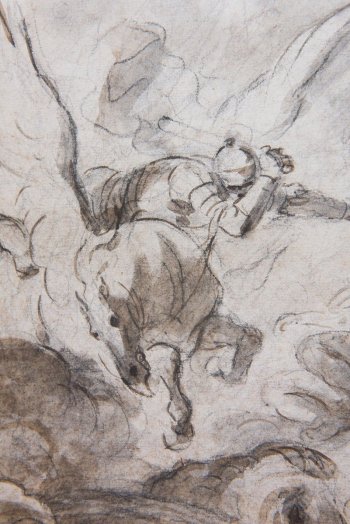
Jean-Honoré Fragonard, Ruggiero Attacks the Orc (illustration for Ariosto, Orlando Furioso), pencil and wash on paper.
Departing from the appreciation that drawing not only remains foundational to art theory and pedagogy, but that it is also undergoing a discernible resurgence in current artistic practice, the Redwood Library and Athenaeum presents The Variable Line: Master Drawings, Renaissance to Contemporary. Organized by the Redwood Library, the sole U.S. venue, and featuring forty-five works, the exhibition is arranged as a survey featuring many types of drawings, rendered in a rich variety of styles and techniques, and treating a broad range of themes.
“Artists have always relied on drawing to put down ideas quickly—it serves this purpose perhaps even more now as the medium on-the-go appropriate to today’s global art world. In that sense drawing has always attached to the conceptual. Certainly drawing is integral to the larger turn towards conceptual thinking in contemporary art, from Sol Lewitt to Julie Mehretu,” explains Benedict Leca, Redwood Executive Director and exhibition curator. “That said, it is interesting to note how the works by contemporary women artists on view are at once visibly painstaking in their technique and contrary to traditional notions of skill.”
The presentation is arranged into seven sections—Académies and the Centrality of the Figure, Line and the ‘Grand Manner,’ Fragonard and Ariosto, The Light of Italy and the Lure of the Antique, Drawing the Pastoral, Landscape and the Bucolic, and Master/Mistress: the Gendered Line—enabling visitors to identify both continuities and ruptures in theme and technique across 500 years of drawing practice in Western Europe and America. Upending the now conventional dominance accorded to digital media or even painting, the selection of drawings on display crossing five centuries—from Renaissance to contemporary—speaks to drawing’s eternal relevance as consonant to art making in any medium, be it painting, sculpture, or video. It is for this reason that drawing’s ubiquity has stretched unbroken to this day, routinely entering our own lives as doodle or sketch. From the most pervasive to the most individual, drawing, like handwriting, thus offers historical perspectives through the continuities inherent to the medium, as well as insights into the stylistic idiosyncrasies of its adaptation by individual artists. The immutable simplicity of a line drawn across paper, parchment, or mylar makes the drawings exhibited here among those rare objects that enable visitors to ride along on the creative journey of both Renaissance and contemporary artists.
Sculpture from Tomasso Brothers on View in New York

Massimiliano Soldani-Benzi, Ganymede and the Eagle,
ca. 1714, bronze, 31.5cm high, 38.5cm wide.
◊ ◊ ◊ ◊ ◊
Important European Sculpture from Tomasso Brothers Fine Art
Carlton Hobbs LLC, New York, 19–28 January 2017
Tomasso Brothers Fine Art returns to Manhattan soon after their participation in the inaugural TEFAF New York Fall to present their now well-established and much-anticipated annual catalogued exhibition of Important European Sculpture, at Carlton Hobbs LLC on the Upper East Side from 19th to 28th January 2017. The gallery will bring together examples of the finest antique sculptural works in terracotta, marble, and bronze—many of them rarities and new discoveries—from the Renaissance to the Neoclassical periods. Highlights include a pair of terracotta relief panels depicting Bacchanalian scenes from Pompeii created by the great English sculptor John Bacon the Elder, circa 1770; a rare bronze mythological group by Massimiliano Soldani-Benzi; a newly-discovered portrait bust by the prominent Roman Neoclassical sculptor Domenico Cardelli; and a superb and previously unpublished bronze by Gian Francesco Susini of The Borghese Satyr.

John Bacon the Elder, A Female Centaur with a Bacchante and A Male Centaur with a Bacchante, circa 1770, after Roman frescoes discovered in the Villa of Cicero at Pompeii (Naples), 1st century BC – 1st century AD, terracotta, each 34cm diameter.
A series of frescoes were uncovered at the so-called Villa of Cicero at Pompeii in January 1749 illustrating, among other subjects, the revelries of Centaurs and Bacchantes, followers of the god Bacchus. Josiah Wedgwood (1730–1795) had access to the Pompeiian models through the Marquess of Lansdowne (1737–1805). It would seem Wedgwood had the present terracotta roundels faithfully produced after the ancient prototypes around 1770 by John Bacon the Elder, one of the most prominent English sculptors of the period, who collaborated on a number of other occasions with Wedgwood. Highly finished, the roundels are the models from which Wedgwood’s white stoneware and black basalt versions of the Centaur reliefs were derived. They display a confident handling of anatomies and a sense of movement that fully does justice to the lithe dynamism of the original Pompeiian frescoes. The roundels constitute a rare and beautiful example of the early resonance of Pompeii’s influence. Formerly in the collection of Dr. Terry Friedman (b. Terence Friedman in Detroit, Michigan), a leading art historian and authority on 18th-century architecture, keeper of decorative arts at Temple Newsam historic house (1969–93), and later principal keeper at Leeds City Art Gallery.
Another mythological subject, Ganymede and the Eagle, circa 1714, by Massimiliano Soldani-Benzi (1656–1740) is a wonderful example of the dramatic and pictorial style of Soldani’s compositions and a rare model by the artist. The only other known version is held by the Fitzwilliam Museum, Cambridge. Soldani-Benzi became the finest bronze caster in late 17th- and early 18th-century Europe and, along with Giovanni Battista Foggini, is considered the most significant proponent of the Florentine late Baroque style in sculpture. In 1682 Soldani-Benzi became Director of the Grand-Ducal Mint, and his large workshop in the Galleria degli Uffizi enjoyed the patronage of kings, princes, and dukes. The present work is probably one of the four bronzes ordered by the Earl of Burlington (1694–1753) after seeing terracotta models at Soldani’s studio on his Grand Tour.
A rediscovered portrait bust by Domenico Cardelli (1767–1797) of Prince Francis Xavier of Saxony (1730–1806) is a highlight among works in marble to be presented. Cardelli displayed remarkable talent from a young age, enjoying early patronage from members of the Polish court and Grand Tourists in Rome. By 1793 his work was compared to that of Canova by the art historian Georg Zoega. In 1797 Cardelli was summoned to Naples to complete a commission for the Riario-Sforza family but fell gravely ill during the journey and died, at only 30 years of age. This untimely death shortened a most brilliant career and makes the present marble portrait bust—a recent rediscovery by Tomasso Brothers Fine Art—a major addition to Cardelli’s oeuvre.
An unpublished and newly-discovered bronze statuette of The Borghese Satyr by Gian Francesco Susini (1585–1653) is a beautifully finished reduction of one of the most impressive and admired ancient marble statues in the Borghese Collection, Rome—currently displayed in the Entrance Hall of the Villa Borghese. The statuette, immaculately modelled after its ancient prototype, displays the characteristic traits of Susini’s oeuvre. These include the remarkably high and detailed quality of the casting, the silky-smooth polished texture of the surface, the use of a warm cherry red lacquer, and the size of the bronze.
Works to be offered at the exhibition range in price from $50,000 to $1,500,000 US, and a fully-illustrated catalogue will be available.
Fellowships | The Rijksmuseum, 2017–18
Fellowship Programme
The Rijksmuseum, Amsterdam, 2017–18
Applications due by 12 March 2017
The Rijksmuseum operates a research Fellowship Programme for outstanding candidates working on the art and history of the Low Countries whose principal concern is object-based research. The aim of the programme is to train a new generation of museum professionals: inquisitive object-based specialists who will further develop understanding of art and history for the future. The focus of research should relate to the Rijksmuseum’s collection and may encompass any of its varied holdings, including Netherlandish paintings, sculpture, decorative arts, prints, drawings, photography, and historical artefacts. The purpose of the programme is to enable applicants to base part of their research at the Rijksmuseum, to strengthen the bonds between the universities and the Rijksmuseum, and to encourage the understanding of Netherlandish art and history. The programme offers students and academic scholars access to the museum’s collections, library, conservation laboratories and curatorial expertise.
Please review the eligibility, funding and application requirements by visiting the Rijksmuseum website. For the 2017–2018 academic year, candidates can apply for
• Andrew W. Mellon Fellowship for art historical research
• Johan Huizinga Fellowship for historical research
• Migelien Gerritzen Fellowship for conservation research
• Manfred & Hanna Heiting Fellowship for photo-historical research
• Dr. Anton C.R. Dreesmann Fellowship for art historical research
The closing date for all applications is 12 March 2017, at 6:00pm (Amsterdam time/CET). No applications will be accepted after this deadline. All applications must be submitted online and in English. Applications or related materials delivered via email, postal mail, or in person will not be accepted. Selection will be made by an international committee in April 2017. The committee consists of eminent scholars in the relevant fields of study from European universities and institutions and members of the curatorial staff of the Rijksmuseum. Applicants will be notified by 1 May 2017. All Fellowships will start in September 2017. Further information and application forms are available here.
Early Career Fellowships | Göttingen Institute for Advanced Study
Early Career Fellowships
The Lichtenberg-Kolleg, the Göttingen Institute for Advanced Study, October 2017 — July 2019
The Lichtenberg-Kolleg, the Göttingen Institute for Advanced Study in the Humanities and Social Sciences, invites applications for up to 10 Early Career Fellowships. For the period October 2017 to July 2019, we are inviting early career scholars to join one of the research groups for the study of
• Globalising the Enlightenment: Knowledge, Culture, Travel, Exchange, and Collections
• Human Rights, Constitutional Politics, and Religious Diversity
• Moritz Stern Fellowships in Modern Jewish Studies: Cultural, Intellectual, and Literary History (in cooperation with the Göttingen Academy of Sciences and Humanities)
Please find more information here.
Call for Papers | Beyond Reproductive Printmaking, 1500–1810
From H-ArtHist:
Beyond Reproductive Printmaking: Prints and the Canon of European Painting, ca. 1500–1810
Diesseits und jenseits von Reproduktion: Druckgrafik und der Kanon der europäischen Malerei
Kupferstich-Kabinett, Staatliche Kunstsammlungen Dresden, 18–19 September 2017
Proposals due by 15 February 2017
Conference for Ph.D. students, postgraduates and researchers at museums and universities in the Kupferstich-Kabinett (Museum of Prints, Drawings and Photographs) of the Staatliche Kunstsammlungen Dresden (Dresden State Art Collections) in collaboration with the TU Dresden Institute of Art and Music, Dresden, 18–19 September 2017.
Are paintings reproduced because they are famous, or have they become famous because they have been reproduced over and over again in the past centuries? The aim of this conference is to throw light on the status of reproductive prints in the process of the formation of (an) artistic canon(s). It aims at exploring artistic and technical aspects of the creative and innovative making process, including the printmakers’ ability to translate the original work into a new pictorial language and to the history of both reception and transmission of works of art.
The conference will cover the period running from the early 16th century to the introduction of the first lithographic press in the early 19th century. Geographically, the focus is on Europe. No restrictions are imposed concerning printing techniques—on the contrary, the characteristics of each technique as well as its ability and uses for reproducing original paintings constitute an important topic. We invite submissions of papers drawing from current research on specific prints or series of prints as well as on new theoretical approaches and methodologically promising developments in the study of interpretative prints, also exploring their potential as a source and as a subject matter of art history.
In particular we welcome submissions in (but not limited to) the following areas:
• Yet again: The original and its graphic interpretation(s): How are collaboration and competition amongst the printmakers themselves, and between the engravers and the painters represented in the prints? To what extent did the engravers take liberties with the paintings’ details? Did printmakers even perhaps hide critical or satirical messages in their interpretations?
• Questions of style: How is the painterly style of the original expressed in the graphic medium? What is the relationship between the printmaker’s technique and the pictorial style or the genre of the original? Is there experimental ground for innovations in new printmaking techniques? What role do special printmaking techniques—e.g. outline etching, aquatint, or colour(ed) print—play in the processes of translation and interpretation?
• Reception: How were differences in style and in composition between the original and its reproduction perceived by the contemporary viewer? Is it possible to identify links between prints and theoretical writings on certain paintings or painting in general? Which influence do captions have in the process of reception?
• Reproductive prints as a source for new approaches in scholarship: What potential do reproductive prints have as a source for the study of canon formation and for (art) historical network research? How can the pictorial and textual information contained in those prints be gathered, and how can this be made accessible for practical use?
An important objective of the conference is to encourage networking between academic researchers and museum professionals. Proposals by both doctoral candidates in art history and aesthetics as well as students aiming at a Ph.D. in the field of the graphic arts are welcome. We also invite applications from curators and postgraduate researchers at museums and other research institutions, and we are pleased to receive papers from colleagues working in media studies, philosophy, and history.
Please submit your proposal in the form of a 400-word abstract and a short CV and send it in English or German as a PDF file to beyond-reproduction-2017@gmx.de by 15 February 2017. Please indicate in your proposal those prints that you wish to discuss in the original; we will be happy to check if they are available in the Kupferstich-Kabinett.
Exhibition | Lafayette and the Antislavery Movement
Now on view at The Grolier Club:
‘A True Friend of the Cause’: Lafayette and the Antislavery Movement
The Grolier Club, New York, 7 December 2016 — 4 February 2017
Curated by Olga Anna Duhl and Diane Windham Shaw
 Although the Marquis de Lafayette is popularly known as ‘America’s Favorite Fighting Frenchman’ in the current Broadway musical Hamilton, his role as an ardent abolitionist has not received the same kind of attention as his contributions to the American Revolution. The groundbreaking exhibition A True Friend of the Cause: Lafayette and the Antislavery Movement, on view at the Grolier Club from December 7, 2016 to February 4, 2017, is designed to offer a more comprehensive look at the man who was a ‘hero of two worlds’. While Lafayette’s contributions in the areas of politics, diplomacy, and the military have received renewed scholarly and public recognition, his abolitionist activities are not widely known, nor have they been adequately explored in any major exhibition or publication in the last twenty-five years. This exhibition brings into focus Lafayette’s sustained efforts in France, the United States, and South America on behalf of the abolition of slavery.
Co-curators Olga Anna Duhl, Oliver Edwin Williams Professor of Languages, and Diane Windham Shaw, Director of Special Collections and College Archivist, Skillman Library, Lafayette College, offer a comprehensive view of Lafayette’s activities. Drawn from Lafayette College’s rich collections of 18th- and 19th-century rare books, manuscripts, paintings, prints, and objects—some of which are on public view for the first time—the approximately 130 works in the exhibition also include loans from Cornell University and the New-York Historical Society.
The Marquis de Lafayette (1757–1834) fought in the American War of Independence; was a friend to the Native Americans; defended the rights of French Protestants and Jews during the French Revolution; supported the national emancipation movements of the people of Poland, Ireland, Italy, Greece, and South America; and promoted the ideas and causes of women. Most significantly, he remained throughout his life a fervent advocate of the abolition of slavery and the African slave trade, earning the recognition of prominent British abolitionist, Thomas Clarkson, as “a true friend of the cause.” Early on, Lafayette learned that the ideals of liberty and equality during the revolutionary era hardly benefited all members of society. In fact, one of the most daunting paradoxes of that era, which became a source of reflection and action for him, was the incompatibility between the national independence of the newly formed United States and the practice of slavery and slave trade.
The exhibition traces Lafayette’s first encounters with slaves on the South Carolina coast upon his arrival in America in 1777. Highlights of his role in service with the Continental Army are revealed in his letters to his mentor, George Washington, written from Valley Forge, Newport, and Virginia during the Yorktown Campaign, where Lafayette writes of the intelligence gathered by one of his spies, James, an enslaved African American. On view is a highly significant letter written by Lafayette to Washington requesting his partnership in a venture to free slaves. Stunning French prints of the American Revolution are included, as is an influential portrait, Lafayette at Yorktown, by Jean-Baptiste Le Paon.
The impact of abolitionist ideas on Lafayette is represented by the Marquis de Condorcet’s seminal work of 1781, Réflexions sur l’esclavage des nègres, and writings of British abolitionists Thomas Clarkson and Granville Sharp. Lafayette’s decision to move forward on his own by purchasing property in French Guiana to carry out his experiment in gradual emancipation is documented by an extraordinary group of documents on loan from the Cornell University Library. Included among them is a list of the enslaved who were selected to work on the property. Maps, prints, and early travel volumes recreate the image of this South American colony.
Lafayette’s complicated story during the French Revolution includes his membership in the French Society of the Friends of Blacks. Publications of the Society are on view, as are printed versions of landmark French documents— the Declaration of the Rights of Man (1789), the French Constitution (1791), and the decree abolishing slavery in the French colonies (1794). Lafayette’s hasty departure from France in 1792 to avoid the guillotine is documented by the beautiful sword that was taken from him when he was arrested and imprisoned by the Austrians, which stands as a symbol of his personal experience with captivity. Lafayette’s return to a quiet life in France in 1800 found him still passionately committed to the antislavery movement, rejoicing when England outlawed the slave trade in 1807. Commemorative volumes and prints celebrate that milestone.
Lafayette’s last visit to America in 1824–25 was an extravagant moment in the nation’s history. The exhibition includes some of the spectacular souvenirs that were made to commemorate his visit—china, textiles, and even a clothes brush with the bristles dyed to spell “Lafayette 1825.” Lafayette’s emphasis on greeting all Americans is highlighted, including his visit to the African Free School in New York City, where he received a welcome address by an eleven-year-old student. Calligraphed and delivered by the student himself, James McCune Smith, who went on to become one of America’s first black physicians and a noted abolitionist, this text is a loan from the New-York Historical Society Library. The Farewell Tour section also documents Lafayette’s friendship with fellow antislavery advocate, Frances Wright, and his support of her gradual emancipation project “Nashoba” near Memphis, Tennessee.
Also included are letters from James Madison, Thomas Jefferson, and John Marshall, and letters from Lafayette to Albert Gallatin, William H. Crawford, Joel Poincett, and others. Even after his death in 1834, his influence continued, particularly in America, where abolitionists, both black and white, continued to cite his example. Finally, the exhibit includes special items chosen to remind us of the human face of slavery—manumission papers of a woman and a man freed by their Quaker owners; the pension records of an African American Revolutionary soldier from Connecticut; and the first American printing of the Brooks engraving of slaves tightly packed on board a slave ship. Despite the changing fortunes and conflicting reviews of his career, Lafayette has remained a compelling figure in world history, and the interest in his contributions shows no sign of diminishing.
Lunchtime Guided Tours with the Curators
December 7 and 14, January 11 and 18, and February 1, 1–2pm
Roundtable Discussion: Lafayette and the Antislavery Movement
24 January 2017, 2–3:30pm
With co-curators and moderators Olga Anna Duhl and Diane Windham Shaw and featuring panelists Laura Auricchio (The New School), François Furstenberg (Johns Hopkins University), and John Stauffer (Harvard University). Reception to follow.
◊ ◊ ◊ ◊ ◊
The catalogue is available from Oak Knoll Press:
Olga Ann Duhl and Diane Windham Shaw, ‘A True Friend of the Cause’: Lafayette and the Antislavery Movement (New York: The Grolier Club and Lafayette College, 2016), 76 pages, ISBN: 978 160583 0650, $40.
Call for Papers | The Art of Revolutions
From H-ArtHist:
The Art of Revolutions
Philadelphia, 19–21 October 2017
Proposals due by 15 March 2017
The tumult and transformations resulting from the Age of Revolutions (1770s–1840s) created a trans-Atlantic body of art and material culture that reflected and inspired new ideas and actions. Inspired by the American Philosophical Society’s 2017 exhibition on the legacy of the patriot portraitist Charles Willson Peale and his artistic family from the eighteenth century until the middle of the nineteenth, and the Philadelphia Museum of Art (PMA)’s forthcoming publication of The Art of the Peales: Adaptations and Innovations, along with a series of other Peale-centric events happening in Philadelphia, the APS and PMA will co-sponsor a scholarly conference, 19–21 October 2017, that explores the role of imagery in influencing and giving meaning to the political revolutions that defined the late eighteenth and early nineteenth centuries. The conference is especially interested in papers covering the American Revolution, the French Revolution, the Circum-Caribbean Revolutions, and the Revolutions of 1848.
Potential topics include
• the work of individual artists or artistic movements
• the role and influence of those who reproduced artwork for the public, such as printers or engravers
• the ways in which works were received by audiences
• the function of art in shaping public perceptions both at the time of revolutionary events and through historic memory
We hope the chronological scope and transatlantic breadth of the conference will stimulate an interdisciplinary dialogue that crosses traditional geographic barriers and transcends the limitations of strict periodization.
Applicants should submit a title and 250-word proposal along with a CV by March 15, 2017 to conferences@amphilsoc.org. Decisions will be made by the summer of 2017. All presenters will receive travel subsidies and hotel accommodations. Accepted papers will be due a month before the conference and pre-circulated to registered attendees. Papers should be no longer than 15-double spaced pages. Presenters may also have the opportunity to publish revised papers in the APS’s Proceedings, one of the longest running scholarly journals in America.










leave a comment