New Book | Silver for Entertaining: The Ickworth Collection
From Philip Wilson:
James Rothwell, Silver for Entertaining: The Ickworth Collection (London: Philip Wilson Publishers, 2016), 304 pages, ISBN: 978 1781 300428, £50 / $90.
 This book is a comprehensive, well illustrated guide to one of the most important collections of 18th-century silver in Europe, extending to nearly a thousand individual pieces, being of the highest quality, style, and exuberance of form and surviving virtually intact along with extensive and previously untapped archival evidence of its commissioning and use. The book analyses the silver from stylistic and technical perspectives and uses it to shed light on the patronage, fashion, and diplomatic, political and social history of the period. It also casts new light on the Herveys, one of England’s most famous and eccentric aristocratic families.
James Rothwell studied art history at Warwick University and gained a master’s degree at the Courtauld Institute of Art. He has worked for the National Trust since 1995 and is the organisation’s adviser on silver, carrying out extensive research on the collections and guiding displays, interpretation, and acquisitions. He has published numerous articles on the subject and is the co-author of Country House Silver from Dunham Massey (2006). In collaboration with the Goldsmiths’ Company, he has overseen a ground-breaking series of exhibitions of works by contemporary silversmiths in National Trust houses.
New Book | Ceramics: 400 Years of British Collecting
From Philip Wilson:
Patricia Ferguson, Ceramics: 400 Years of British Collecting in 100 Masterpieces (London: Philip Wilson Publishers, 2016), 192 pages, ISBN: 978 1781 300435, £45 / $75.
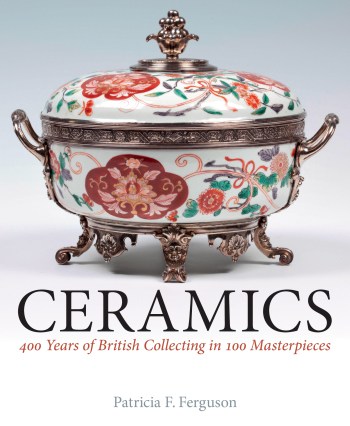 The aim of this publication is to introduce the rich and varied ceramics in the National Trust’s vast and encyclopaedic collection, numbering approximately 75,000 artefacts, housed in 250 historic properties in England, Wales, and Northern Ireland. One hundred key pieces have been selected from this rich treasure trove, each contributing to our knowledge of ceramic patronage and history, revealing the very personal stories of ownership, display, taste, and consumption. The selection includes the following Continental wares: ‘Red-figure’ wares, Italian armorial tablewares, Dutch Delft from the Greek A factory (owned by Adrianus Kocx), Chinese Kraak ware and Dehua ware, Japanese Kakiemon-style and Imari-style tablewares and garnitures, Meissen table sculpture by Johann Joachim Kandler and tablewares attributed to Adam Friedrich von Lowenfinck, along with Castelli fayence from the Grue workshop. There are wares from the following porcelain manufactories: Doccia, Vienna, Vincennes, Sevres, Dihl, and Feulliet. English pottery and porcelain includes delftware, salt-glazed stoneware, creamware, Wedgwood Black Basalt and Etruscan ware, Chelsea, Bow, Worcester and Derby porcelain, Minton China, De Morgan, and Martin ware. And from the Americas, Pueblo ware. Many pieces are published for the first time, sometimes illustrated in their original interiors. Collectively, the selection surveys patterns of ceramic collecting by the British aristocracy and gentry over a four-hundred-year period.
Patricia F. Ferguson is an external adviser on ceramics to The National Trust, having researched their collections since 2003, and is a consulting curator at the Victoria & Albert Museum, London. She has an MA from SOAS, University of London, where she studied Chinese, Japanese, and Safavid ceramics. At the George R. Gardiner Museum of Ceramic Art in Toronto, she re-displayed the European galleries, curated Containers of Beauty: The Art of Floral Display and Your Presence Is Requested: The Art of Dining in Eighteenth-Century Europe, and was author of Cobalt Treasures: The Robert Murray Bell and Ann Walker Bell Collection of Chinese Blue and White Porcelain (2003).
MFA, Boston Displays Newly Acquired Altarpiece by Benjamin West
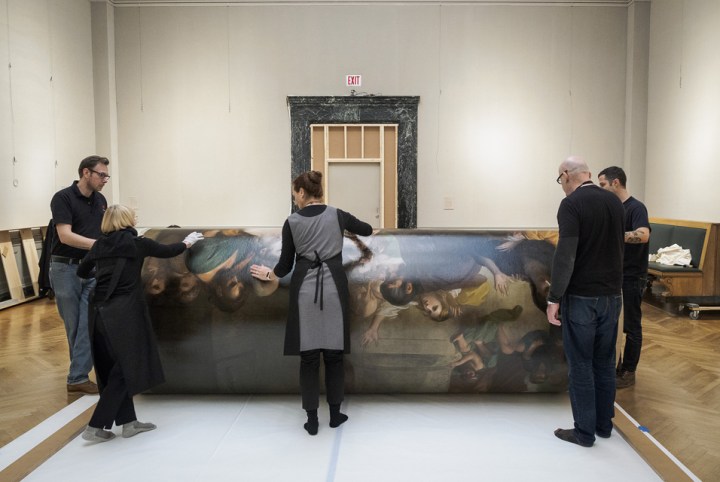
MFA staff members install Benjamin West’s large painting Devout Men Taking the Body of Saint Stephen (1776) in the Ruth and Carl J. Shapiro Gallery. Fidelity Investments chairman Edward ‘Ned’ Johnson III acquired the painting in 2014 for $2.9million from St. Stephen Walbrook (the export license was issued in March of that year). He donated it, anonymously, to the MFA in 2015 in honor of Malcolm Rogers to celebrate the museum director’s twenty years of leadership. Details and more on Johnson’s collections are available from Beth Healy’s article, “The Quiet Man of Boston’s Art Scene,” in The Boston Globe (22 August 2015).
◊ ◊ ◊ ◊ ◊
From the Museum of Fine Arts, Boston (via Art Daily), and good timing: it’s St Stephen’s Day! . . .
The recently acquired Devout Men Taking the Body of Saint Stephen (1776) by Benjamin West (1738–1820) is one of the largest paintings in the MFA’s collection—together with its towering frame, it measures more than 18 1/2 feet tall. Over the past two years, the monumental altarpiece was treated in the Conservation in Action studio, where Museum visitors were able to witness the gradual process of cleaning and restoring the work. The painting and its original gilded wood frame, which was also conserved, are now reunited as the dramatic centerpiece of a new installation that explores how 18th-century artworks and artists traveled across both intellectual and geographical borders.

Thomas Malton (1748–1804), St Stephen Walbrook, London, watercolour over pencil, 26 × 18 inches (London: Lowell Libson LTD). West’s painting is visible at the altar.
West was the first American-born painter to study abroad, second president of the Royal Academy of Arts, and painter to the English king. Devout Men Taking Away the Body of Saint Stephen, among the largest works he ever produced, was commissioned for London’s St. Stephen’s Walbrook, a church designed by Christopher Wren, and showcases West’s profound understanding of Italian Renaissance art. Italy likewise held special allure for well-to-do travelers on the Grand Tour, such as the American couple in John Singleton Copley’s portrait of Mr. and Mrs. Ralph Izard (1775), painted in Rome. Meanwhile, Italian painters ventured abroad as well—the gallery includes Canaletto’s Bacino di San Marco, Venice (about 1738), a trademark view of his home city, and Capriccio: A Sluice on a River with a Chapel (1754), painted in England, where he spent nine years catering to an enthusiastic clientele. Adding to the rich mix of works by American, English, and Italian painters are sculpture and decorative arts by French and German artists.
The 18th century was a cosmopolitan age. Artists and patrons traveled widely: in pursuit of artistic training or opportunity, political service, or social refinement. And as people moved, so too did ideas, styles, and tastes, in art and beyond. Across Europe (and America), Italy held special allure: artists traveled there to absorb its millennia of artistic traditions, as did well-heeled visitors on the Grand Tour. The fashion for Italian art was especially strong in England, where American-born painter Benjamin West created this towering altarpiece, influenced by his study of Renaissance masters Titian and Raphael. Italian artists also often ventured abroad. Canaletto, famous for his view paintings of his home city of Venice, spent nearly a decade in England, catering to an enthusiastic clientele.
Exhibition | Wooden Sculptures, Busts, Reliquaries, and Shrines
Now on view at Pinacoteca Giovanni Züst:
Sculptures, Busts, Reliquaries, and Shrines from the Middle Ages to the Eighteenth Century
Legni Preziosi: Sculture, Busti, Reliquiari e Tabernacoli dal Medioevo al Settecento
Pinacoteca Giovanni Züst, Rancate, Switzerland, 16 October 2016 — 22 January 2017
Curated by Edoardo Villata
 La mostra presenta una carrellata di sculture in legno dal XII al XVIII secolo— Madonne, Crocifissi, Compianti, busti, polittici scolpiti e persino un Presepe—provenienti da musei, chiese e monasteri del territorio ticinese, dove questi autentici capolavori sono stati oggetto di devozione e ammirazione per secoli. L’allestimento è stato curato da Mario Botta, che ha studiato, a titolo completamente gratuito, ogni dettaglio, affinché il visitatore sia immerso in un’atmosfera suggestiva e solenne, in cui la sacralità delle immagini esposte risulta pienamente valorizzata.
Edoardo Villata, Legni Preziosi: Sculture, busti, reliquiari e tabernacoli dal Medioevo al Settecento nel Cantone Ticino (Milan: Silvana, 2016), 208 pages, ISBN: 978 8836 634767, $55.
At Sotheby’s | Important Judaica

Lot 53: Hanukah Lamp, Polish or German, late 18th or early 19th century, bronze, 85 cm. With baluster stem and scroll and bud branches, pricket sconces linked by a brass plate. Sale price (with buyer’s premium): $3,250 (estimate $4,000–6,000).
◊ ◊ ◊ ◊ ◊
From Sotheby’s:
Important Judaica Including Property from the Estate of Shlomo Moussaieff Sale N09589 (286 lots)
Sotheby’s, New York, 15 December 2016
The Important Judaica sale began with a significant selection of property from the estate of Shlomo Moussaieff. The group was led by Simeon Solomon’s Carrying the Scrolls of Law, which set a new world auction record for the artist selling for $492,500—nearly double its high estimate of $250,000. Other highlights included a copy of the first English translation of the Jewish liturgy issued for a Jewish audience (1761), which sold—to applause—for $468,500, a record for a work of American Judaica at auction.
 The late Shlomo Moussaieff was a renowned collector whose home was a meeting place for connoisseurs from all over the world. Mr. Moussaieff delighted in sharing his treasures with others, and he gave generously of his time and knowledge. Highlights from his collection include a remarkable selection of Kabbalistic manuscripts and a magnificent array of menorahs and Hanukah lamps—mostly of substantial size—featuring examples from Europe and the Middle East. The second part of the auction presented silver and books from various owners. Highlights include two outstanding 18th-century silver Sabbath lamps, a magnificent Italian silver-gilt Torah crown, and important American Judaica, including the earliest Jewish prayer book printed in America (New York, 1761), as well as splendid textiles and paintings.
Lot 270: Large Torah Crown, Venice, early 18th century, parcel-gilt silver, 23 × 22 cm.
Boldly embossed with baroque foliage, fruit and flowers, applied with five urns of flowers within recesses with cut-sheet petals, between cartouches and emblems of the Ark of the Covenant, Priest’s hat, hands of Cohen, priestly garment, and flaming altar, base band with cartouches, all on matted grounds, marked near base with Venice city mark twice and assay master’s mark ZC with tower between twice, the interior fitted with a later bar centered by a ring. Sale price (with buyer’s premium): $225,000 (estimate $180,000–220,000).
Rijksmuseum Acquires Painting by Liotard
Press release (21 December 2016) from the Rijskmuseum (as announced by The Burlington Magazine via Twitter, the magazine will publish an article on the painting in February).

Jean-Etienne Liotard, A Dutch Girl at Breakfast, ca. 1756–57, oil on canvas, 47 × 39 cm (Amsterdam: Rijksmuseum).
The British government today granted an export license for the painting A Dutch Girl at Breakfast by Jean-Etienne Liotard, which the Rijksmuseum has recently purchased from a private collection in which it had remained for more than 240 years. The painting is an intimate ode to Dutch Golden Age painting. The peripatetic Genevan pastellist Jean-Etienne Liotard (1702–1789) created the work in the style of Dutch seventeenth-century masters during a long sojourn in Holland around 1756. As one of his few oil-paintings, A Dutch Girl at Breakfast is an important addition to the famous group of pastels by Liotard that have been in the Rijksmuseum since 1885. This stunning new acquisition will be shown in the Rijksmuseum’s Gallery of Honour from mid-January.
Taco Dibbits, General Director of the Rijksmuseum, states: “A Dutch Girl at Breakfast radiates the same atmosphere of peace and simplicity as Vermeer’s Milkmaid. In this sensitive representation, the painter allows us to get very close to his subject. As the girl carefully opens the tap of the coffee-pot, she won’t allow herself to be disturbed by the millions of visitors who will come to see her. We are extremely grateful to the funds and private donors who made it possible to acquire this masterpiece for The Netherlands.”
With the support of the BankGiro Loterij, Rembrandt Association through its ‘Nationaal Fonds Kunstbezit’, Mondriaan Fund, VSBfonds, Rijksmuseum Fonds, and many private donors, the Rijksmuseum was able to purchase this work at auction in London for nearly €5.2 million (commission included) [Sotheby’s London, Old Masters Evening Sale (6 July 2016), Sale L16033, Lot #36].
A Dutch Girl at Breakfast is one of Jean-Etienne Liotard’s most beautiful works. In it, he reveals himself as one of the earliest eighteenth-century artists from abroad to put his fascination with Dutch painting of the seventeenth century into practice. On this small canvas (47 × 39 cm) he portrays a young woman sitting in a typically Dutch interior. All the characteristics of Dutch seventeenth-century ‘genre’ are present: the everyday scene, the intimate ambiance, the sober colours, the sophisticated rendering of textures, and the painted church-interior in the background. Nevertheless the furnishings and tableware are all from Liotard’s own time. The mise-en-scène is strongly reminiscent of the well-known interiors of his predecessors Johannes Vermeer, Gerard Dou, and Frans van Mieris.
After long sojourns in Vienna, Paris, and London—where he enjoyed great success as a portraitist—Liotard travelled to Holland in 1755 to pursue this lucrative career. A Dutch Girl at Breakfast was clearly inspired by his experiences in the country. As a connoisseur of Dutch Golden Age painting, he also managed to assemble a collection of over 60 works by Old Masters. In 1756 at Amsterdam he married Marie Fargues, born and bred in Holland but a Huguenot like himself. His splendid pastel portrait of her is in the Rijksmuseum’s collection. Their eldest son later settled in Amsterdam, bringing many of this father’s works with him.
Eighteenth-century European painting is not particularly well represented in the Netherlands. The subject of this painting, the way it is presented, and the work’s close historical connection with the Netherlands will give iconic status to A Dutch Girl at Breakfast within the Dutch national collections. After its presentation in the Gallery of Honour it will take pride of place in the Rijksmuseum galleries for the arts of the eighteenth century. It will also be reunited there with the remarkable group of Liotard’s pastels donated by his Dutch descendants at the end of the nineteenth century. Only some 30 oil paintings by Liotard are known—as opposed to 540 pastels. Genre pieces by him are even scarcer, though this is a type of art for which he is well known, especially in works such as The Belle Chocolatière at Dresden. With this acquisition, the Rijksmuseum’s representation of Liotard’s oeuvre has been considerably strengthened.
Liotard appears to have kept the A Dutch Girl at Breakfast for himself until 1774, when he included it in a sale of his collection in London. It was bought there by his principal British patron, the 2nd Earl of Bessborough (1704–1793), with whose descendants it has remained until now.
◊ ◊ ◊ ◊ ◊
And if the acquisition weren’t enough reason by itself to visit the Rijksmuseum, there’s also the news that RIJKS, the Rijksmuseum restaurant led by chef Joris Bijdendijk, has just been awarded a Michelin star, as announced during the launch of the Dutch edition of Michelin’s 2017 hotel-and-restaurant guide in Amsterdam.

Publication Grant, Historians of British Art
HBA Publication Grant
Each year HBA awards a grant to offset publication costs for a book manuscript or peer-reviewed journal article in the field of British art or visual culture that has been accepted for publication. To be eligible for the $600 award, applicants must be current members of HBA who can demonstrate that the HBA subvention will replace their out of pocket costs. Applications are not accepted from institutions. To apply, send a 500-word project description, publication information (correspondence from press or journal confirming commitment to publish and projected publication date), budget, and CV to Kimberly Rhodes, HBA Prize Committee Chair, krhodes@drew.edu by 15 January 2017.
PhD Studentship | Digital Humanities and Sloane’s Catalogues
PhD Studentship in Digital Humanities: Sir Hans Sloane’s Catalogues of His Collections
Department of Information Studies, University College London, January 2017 — December 2019
Applications due by 16 January 2017
We are delighted to be able to announce a Doctoral Studentship in Digital Humanities at University College London as part of the larger Leverhulme Trust funded research project Enlightenment Architectures: Sir Hans Sloane’s Catalogues of his Collections (Principal Investigator, Dr Kim Sloan, British Museum; Co-Investigator, Dr Julianne Nyhan, University College London Centre for Digital Humanities). This is a three-year studentship open to UK and EU applicants, beginning in January 2017. The studentship includes fees as well as a stipend of £16,296 per annum. The deadline for application is 16 January 2017.
The aim of the studentship will be to use Sloane’s catalogues as a test bed on which to conduct research on how digital interrogation, inferencing and analysis techniques can allow new knowledge to be created about the information architectures of manuscript catalogues such as those of Sloane. The proposed research must also have a strong critical and analytical dimension so that it can be set within our wider framework of academic inquiry that is concerned with understanding how collections and their documentation together formed a cornerstone of the ‘laboratories’ of the emergent Enlightenment. . .
More information is available here»
Barbara Jatta Appointed Director of the Vatican Museums

As reported by Lorena Muñoz-Alonso for ArtNet News (21 December 2016) . . .
On Tuesday, Pope Francis announced that the new director of the Vatican Museums will be the Italian art historian Barbara Jatta. This is a momentous occasion as it marks the first time in history that a woman will helm the art institution, one of the most important in the art world. The new director will take up the post in January 1, 2017, succeeding Antonio Paolucci, an art historian and former Italian culture minister who’s held the position since 2007. Previously to this appointment, Jatta worked at the Vatican Library, overseeing its collection of prints . . .
The full article is available here»
◊ ◊ ◊ ◊ ◊
Hannah McGivern and Arianna Antoniutti report on Jatta’s appointment for The Art Newspaper (21 December 2016)
Born in Rome, Jatta worked as conservator and cataloguer for Italy’s Istituto Nazionale per la Grafica (national institute for graphic arts) from 1981 to 1996. She has been in charge of the Vatican Library’s works on paper since 1996, with responsibility for its exhibitions, acquisitions and archives. Jatta has also published extensively on the Vatican’s prints and drawings collections, including the first catalogue of drawings by Bernini and his school in 2015.
Her appointment anticipates the reopening of the Vatican Museums’ New Wing (Braccio Nuovo) on 22 December. Commissioned by Pope Pius VII, the 19th-century gallery was designed by the sculptor Antonio Canova to house the repatriated papal collections of classical sculpture, which had been plundered by Napoleon during his Italian campaign . . .
The full article is available here»
Eighteenth-Century Research Seminars, Jan–Apr 2017
From the ECRS website:
Eighteenth-Century Research Seminars
Institute for Advanced Studies in the Humanities, Edinburgh, January–April 2017
 The Eighteenth-Century Research Seminars (ECRS) series presents papers addressing varying aspects of eighteenth-century history, culture, literature, education, art, music, geography, religion, science, and philosophy. The series seeks to provide a regular inter-disciplinary forum for postgraduate and early-career researchers working on the eighteenth century to meet and discuss their research. Seminars will be held on a fortnightly basis on Wednesdays at the Institute for Advanced Studies in the Humanities, University of Edinburgh, from 4:30 to 6:00pm. Each will consist of two papers followed by a drinks reception. ECRS is supported by the Eighteenth-Century and Enlightenment Studies Network (ECENS) of the University of Edinburgh.
25 January 2017
• Ben Rogers (University of Edinburgh), ‘An Unexpected Solution or a Political Imposition?’: Scottish Episcopalian Toleration, 1702–12
• Carys Brown (University of Cambridge), ‘A Dissembling Harlot for a Leacherous Wolf’: Sexual Reputation and Religious Coexistence in England, c. 1689–1750
8 February 2017
• Nicola Martin (University of Stirling), Improvement, Stadial Theory, and the Pacification of the Highlands in the Mid-Eighteenth Century
• Thomas Archambaud (Independent), The Highland Bard and the Prime Minister: James Macpherson, Lord Bute, and the Politics of Scottish Patronage in the Age of Enlightenment
22 February 2017
• Sydney Ayers (University of Edinburgh), Representing Robert Adam: Biography, Portraiture, and Memory
• Nel Whiting (University of Dundee), ‘If They Hang Not in Proper Places, They Will Not Have a Good Effect’: Portraiture, Place, and Position
1 March 2017
• Elizabeth Ford (University of Glasgow), ‘I Can Think of Nothing But That Flute’: General John Reid (1721–1807)
• Alice Little (University of Oxford), Categorising ‘National Music’ in Eighteenth-Century Oxford
15 March 2017
• William Swain (University of Edinburgh), Adam Ferguson, Freidrich von Gentz, and the Decline of the Martial Spirit
• John Stone (Universitat de Barcelona), The Cultural Work of the Royal Scots College (Valladolid), 1770–1808: Cosmopolitanism, Diaspora, the ‘National Feeling’, and Library Formation
22 March 2017
• Catherine Ellis (Durham University), How To Understand the Sex Worker at the Table: Gastrocritical Approaches to Eighteenth-Century French Prostitution’
• Jessica Hamel-Akré (University of Montreal), ‘Oh, When Shall I Be Holy?: Reading and Writing Women’s Eighteenth-Century Self-Starvation
12 April 2017
• Hannah Lund (University of Edinburgh), Enthroned: The Sitter’s Chair of Sir Joshua Reynolds, 1760–1879
• Suchitra Choudhury (University of Glasgow), Fashion and Textiles: A Postcolonial Reading of Sir Walter Scott
26 April 2017
• Charlotte Bassett (University of Edinburgh), Lady Margaret Hamilton: Patroness of Hopetoun
• Amy Boyington (University of Cambridge), Elite Wives and Architecture in Eighteenth-Century Britain










leave a comment