Exhibition | The British Landscape Tradition
Press release from Pallant House:
The British Landscape Tradition: From Gainsborough to Nash
Pallant House Gallery, Chichester, 11 May – 26 June 2016

Thomas Gainsborough, A Suffolk Lane, 1750–60 (Chichester: Pallant House Gallery)
A new exhibition at Pallant House Gallery showcases the Gallery’s significant but rarely-seen collection of historic works on paper from the 18th to 20th centuries. The exhibition forms a representative overview of depictions of the British landscape, beginning with early watercolours and drawings by Alexander Cozens, Thomas Gainsborough, and John Sell Cotman, to watercolours by 20th-century artists associated with ‘Neo-Romanticism’ in Britain in particular Ivon Hitchens, Paul Nash and Graham Sutherland. The exhibition will go on display in the De’Longhi Print Room at Pallant House Gallery from 11 May until 26 June 2016.
The majority of the Gallery’s collection of historic works on paper were donated by Walter Hussey, Dean of Chichester Cathedral from 1956 to 1978. Best known for commissioning and collecting the work of modern artists such as Moore, Piper, and Sutherland, which formed the founding collection of the Gallery in 1982, Hussey also collected exquisite Old Master watercolours and drawings that are represented in this exhibition.
Although heavily influenced by Dutch landscape paintings, Thomas Gainsborough often travelled into the English countryside, sketching directly from nature in order to record scenes that he thought to be particularly picturesque, such as his drawing A Suffolk Lane (ca. 1750–60). For Gainsborough, landscapes were a relief from painting grand portraits and he wished “to take my viola da gamba and walk off to some sweet village where I can paint landskips and enjoy the fag end of life in quietness and ease.”
Born in Russia, Alexander Cozens is thought to have been the first English artist to work entirely with landscape subjects. Cozens was famous for inventing a ‘blot’ technique in the 1750s, which he developed as a teaching aid to liberate the mind of students, whom he felt spent too much time copying the work of others. His son John Robert Cozens was considered by John Constable to be “the greatest genius that ever touched landscape,” describing his work as “all poetry.” Cozens worked extensively in Italy but concentrated on English subjects in the last decade of his life.
A brilliant watercolourist, John Sell Cotman was one of the leading members of the Norwich School of Artists in the early 19th century. Born in Norwich, Cotman moved to London then toured widely in England and Wales before settling again in Norwich. His watercolour of Capel Curig (ca. 1802) was probably created during his second tour of Wales.
The Welsh countryside was also an inspiration for John Varley who made numerous sketching trips to Wales between 1798 and 1802. His sketches and memories of these trips were used in works he created until the end of his life and include Snowdon (With Lyn Padorn) (ca. 1809), which features in the exhibition.
Artists such as Varley and Cotman were an important point of reference for artists in the early 20th-century such as Paul Nash. Art historian John Rothenstein noted in 1957 that Nash “was too personal an artist to imitate an Old Master, but what he did was to assimilate something of the spirit of Girtin, Cotman and others, and to evolve a free contemporary version of traditional idioms.” In 1929 the critic R. H. Wilenski went so far as to call Nash ‘the John Sell Cotman’ of today.
At the outbreak of the Second World War Graham Sutherland produced a number of paintings based on the view of Sandy Lane in Pembrokeshire. The preliminary studies in the Gallery’s collection for the celebrated completed oil known as Entrance to a Lane in the Tate collection, reveal Sutherland’s process of ‘paraphrasing nature’, drawing on continental abstraction as a way of representing the Welsh landscape in a poetic and modern way.
Also included in the exhibition are several views of the Sussex landscape around Chichester. These include George Romney’s ink and wash view of Eartham Park, the home of his patron William Hayley—a rare example of landscape in his oeuvre. Also featured are watercolours of the South Downs by George Catt (1869–1920), who taught the young Eric Gill at Chichester College, and one of Ivon Hitchens’s earliest known works: Didling on the Downs (ca. 1920) featuring a pastoral scene before he had developed his abstract style of the 1930s onwards.
New Book | Marie-Antoinette
From The Getty:
Hélène Delalex, Alexandre Maral, and Nicolas Milovanovic, Marie-Antoinette (Los Angeles: J. Paul Getty Museum, 2016), 216 pages, ISBN 978-1606064832, $50.
 Marie-Antoinette (1755–1793) continues to fascinate historians, writers, and filmmakers more than two centuries after her death. She became a symbol of the excesses of France’s aristocracy in the eighteenth century that helped pave the way to dissolution of the country’s monarchy. The great material privileges she enjoyed and her glamorous role as an arbiter of fashion and a patron of the arts in the French court, set against her tragic death on the scaffold, still spark the popular imagination.
In this gorgeously illustrated volume, the authors find a fresh and nuanced approach to Marie-Antoinette’s much-told story through the objects and locations that made up the fabric of her world. They trace the major events of her life, from her upbringing in Vienna as the archduchess of Austria, to her ascension to the French throne, to her execution at the hands of the revolutionary tribunal. The exquisite objects that populated Marie-Antoinette’s rarefied surroundings—beautiful gowns, gilt-mounted furniture, chinoiserie porcelains, and opulent tableware—are depicted. But so too are possessions representing her personal pursuits and private world, including her sewing kit, her harp, her children’s toys, and even the simple cotton chemise she wore as a condemned prisoner. The narrative is sprinkled with excerpts from her correspondence, which offer a glimpse into her personality and daily life.
Hélène Delalex is curator attaché at the Palace of Versailles, where Alexandre Maral is curator. Nicolas Milovanovic is curator at the Louvre Museum.
New Book | Carl Gustaf Pilo
Available from Nyt Nordisk Forlag (New Nordic Publishing) . . .
Charlotte Christensen, Drømmebilleder: Carl Gustaf Pilos Portrætkunst (Copenhagen: Nyt Nordisk Forlag, 2016), 448 pages, ISBN 978-8717044999, 400KR.
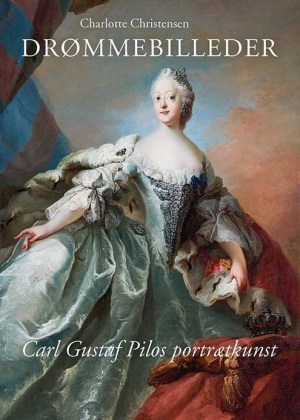 Carl Gustaf Pilo (1711–1793), der var rokokoens fremmeste hofmaler i Norden, fødtes i Sverige, men levede i Danmark i størstedelen af sin tid som kunstner. Skæbnen bragte ham fra en periode som adelens portrættør i Skåne til hofmalerposten i Danmark, hvor han særligt kom til at definere den gyldne tid for de danske riger under Frederik V til de turbulente år med Christian VII og Struensee. Han blev i 1772 udvist af Danmark, og skabte sig derefter i Gustaf IIIs Sverige sin alderdoms fremragende og helt særegne mesterværk, maleriet af den svenske konges kroning.
Som kongernes kunstner var Pilos liv afhængigt af de skiftende magtkonstellationer i Danmark, og han var med til at forme kunstakademiet i København. Bogen sætter Pilos kunstnergerning ind i den kulturhistoriske ramme, den hører til i, foruden at den redegør for de politiske og idehistoriske omvæltninger i de nordiske lande, der var med til at forme hans til tider dramatiske livsløb.
Bogen præsenterer et rigt udvalg af Carl Gustav Pilos kunstværker, der i dag er spredt på herregårde og slotte, i privatsamlinger og museer, med nyoptagelser af de ofte kolossal store malerier og detaljer, der er karakteristiske for hans malemåde.
Charlotte Christensen har været vidt omkring i det danske kunstliv. Samtidens billedkunst og teaterliv har haft en vigtig plads i hendes arbejde inden for museumsverdenen og som direktør for Kunstforeningen i København. Hun har undervist på universiteterne i Aarhus og København og på Statens Teaterskole. Formidlingen af ældre kunst har haft lige så stor prioritet, og 1600-tallet var i centrum, da hun var generalsekretær for Christian IV-året 1988. Christensen har skrevet monografier om Jens Juel og Nicolai Abildgaard og bidraget med artikler om Vigilius Eriksen og Laurits Tuxen til kataloget for Frederiksborgmuseets udstilling Danmark og zarernes Rusland, 1600–1900. Hun er også kendt som forfatter til Gyldendals bog om engle. Seneste har Christensen været tilknyttet Designmuseum Danmark og publiceret museets art nouveau-samling og udgivet … At give af et godt Hjerte og et glad Sind: Kunstindustrimuseets Venner, 1910–2010.
National Gallery of Denmark’s Plans for Digitizing Its Collection
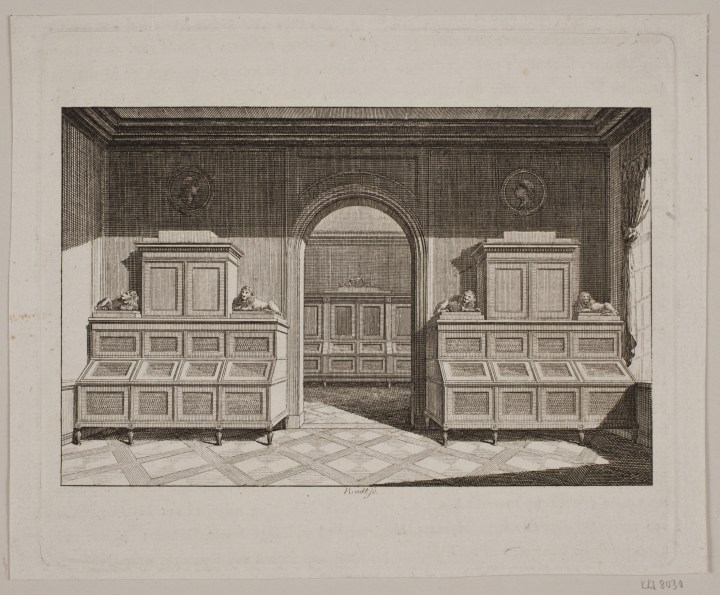
Frederik Ludvig Bradt (1747–1829), Coin Cabinet at Rosenborg, etching, 1791
(Copenhagen: SMK / The National Gallery of Denmark, KKS8030)
◊ ◊ ◊ ◊ ◊
As of today, a search of the SMK collection with the filter for 1700 to 1800 turns up 8204 works. From the press release (2 May 2016). . .
The SMK, The National Gallery of Denmark, launches a digital project that will, over the course of the next four years, make the National Gallery’s art collection freely available to everyone—for any purpose, ranging from fun to serious production. The objective is to make art relevant to more people. The project is made possible by a generous donation from the Nordea Foundation of DKK 11.7 million (EUR 1.6 million).
In countries such as The Netherlands, the USA and the UK, large museums have digitised their collections and made them available to everyone for years now, thereby endeavouring to meet the demands of present and future consumers of art and culture who are no longer satisfied with being spectators. They want to participate actively, and they want to put culture to use in their own lives. The lessons learned from these efforts are clear: being able to actively select, re-purpose, remix, and share works means that far more people access and use the collections. Including people who would not usually have visited or used the museum.
The SMK collection comprises more than 250,000 works of art. Approximately one per cent of that collection is on display and can be accessed by visitors to the museum in Copenhagen. In recent years the SMK has launched a range of pilot projects to explore how the museum’s digital treasures can be used in new ways, in new contexts and by all users. These initiatives have progressed by increments and been modest in scale, but the results have shown that there is demand for such activities. In fact, the findings proved so promising that the SMK will now, thanks to a generous donation of DKK 11.7 million (EUR 1.6 million) from the Nordea Foundation, embark on a new project: SMK Open. Scheduled to run until 2020, the SMK Open project will pave the way for truly democratic use of the museum’s art collections.
The history and many stories of art will continue to be explored and presented by the museum’s in-house experts. At the same time the SMK will open up its collection in digital form, offering a huge toolbox full of building blocks in the form of high-quality image files that can be used by anyone for any purpose—for example for books, education materials, online blogs, Wikipedia articles, film and TV productions, interior design and outdoor decoration—the only limit is the users’ imagination.
“SMK Open makes the National Gallery of Denmark’s art collection—which belongs to us all—available to anyone at all times. There will be no admission fee, but plenty of excellent and informative presentation materials and a warm invitation to have fun, play around and explore the wondrous world of art. The project will make even more people co-owners and co-producers of our shared art heritage,” says Henrik Lehmann Andersen, director of the Nordea Foundation, which aims to support and enhance ‘the good life’ for everyone.
The SMK Open project gives each work its own digital webpage that can also contain materials such as film footage, articles, audio tracks, x-rays of the work, and information on any future events or exhibitions at the museum which feature that work. In addition to this, thousands of photographs of art works will be made available in the highest possible resolution and quality. All works on which no copyright restrictions apply can be used by anyone for any purpose.
Users can also comment on each work, contribute their own information and insights or enter into a dialogue with the museum staff. Users are also invited to take part in the project’s development and will be involved in shaping and defining the end result right from the outset.
“In recent years we at the SMK have worked to offer many different gateways to the world of art. Our experience tells us that art becomes relevant to more people when they can approach it in their own way. Many wish to actively use art in their own lives. SMK Open will make it possible to download and use a wealth of information from the SMK toolbox—and at the same time we want to incorporate the users’ insights and information about the collection in that toolbox. This is because we want to forge closer links between our collection—which belongs to public—and the greatest possible number of people we can—of any age, gender, level of education and social or cultural background,” says Mikkel Bogh, director of the SMK.
Exhibition | William Hogarth: A Harlot’s Progress and Other Stories
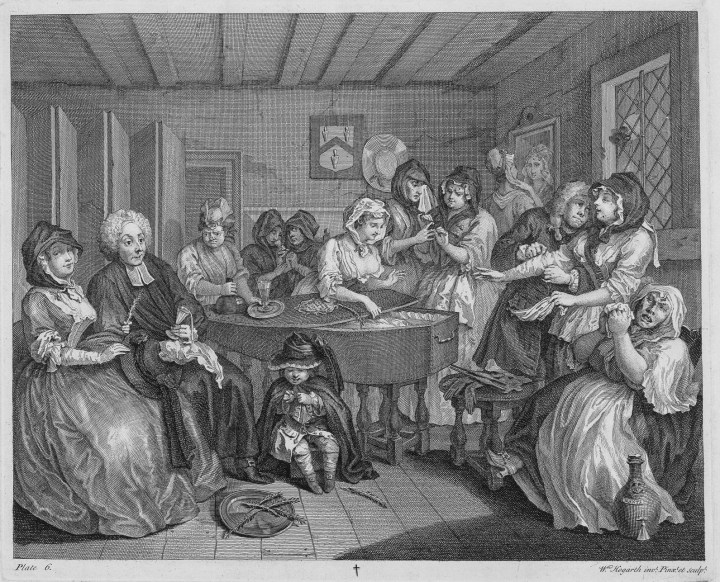
William Hogarth, A Harlot’s Progress, Plate 6, 1732, 364 × 440 mm
(Copenhagen: SMK – The National Gallery of Denmark)
◊ ◊ ◊ ◊ ◊
Press release (22 February 2016) from the National Gallery of Denmark:
William Hogarth: A Harlot’s Progress and Other Stories
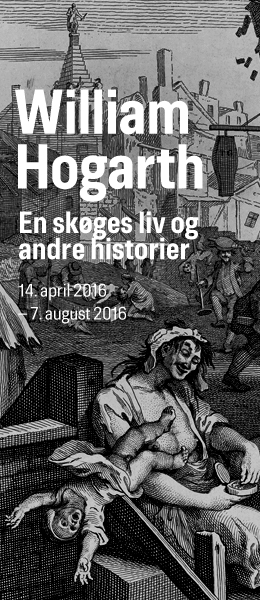
William Hogarth: En skøges liv og andre historier
Statens Museum for Kunst, Copenhagen, 14 April — 7 August 2016
Curated by Vibeke Vibolt Knudsen
A young country girl arrives in London in search of work. Instead she ends up a prostitute, and her life spirals steadily downwards, bringing stints in prison and venereal disease. With the exhibition William Hogarth: A Harlot’s Progress and Other Stories, the SMK turns back time to visit eighteenth-century city life in London. The exhibition presents work by the British artist and satirist William Hogarth (1697–1764), who invented a new kind of narrative picture series that served up satirical and moral points with acerbic wit. His style of social critique was unique for the time, focusing on many highly topical subjects: Prostitution, poverty, violence, drunkenness, deceit, self-aggrandisement and desire.
 Three series hold a particularly prominent position in Hogarth’s oeuvre: A Harlot’s Progress (1732), A Rake’s Progress (1735), and Marriage à-la-mode (1745). Each series describes a main protagonist who strives to climb the rungs of the class ladder, but loses their way in debauchery, heading directly for self-destruction and death.
In his autobiographical notes Hogarth states that his pictures are scenes from a play and his subjects are actors strutting soundlessly on the stage. His stories became highly successful, attracting a large audience that included the lower echelons of society as well as the elite. Hogarth insisted that a picture must capture the viewer’s attention by entertaining and pleasing the eye, thereby allowing the serious aspects of its subject to gradually sink in as the narrative progresses towards its tragic climax.
Hogarth’s art is closely linked to London and city life. Around the year 1700 the city had swelled to a population of 600,000, making it the largest city in Europe. He made daily records of the chaotic urban crowds, of all the many and varied forms of life unfolding in the city’s streets and houses; he had a particularly keen eye for the contrasts between different social strata and how they met and clashed.
William Hogarth: A Harlot’s Progress and Other Stories is an exhibition of works from The Royal Collection of Graphic Arts, which is one of the oldest collections of prints and drawings in the world. Housing more than 240,000 works, the collection has roots that date back to the sixteenth century. In 1843 the collection was opened to the public, and in 1896 it was relocated to the new National Gallery of Denmark alongside The Royal Collection of Paintings and The Royal Cast Collection.
The catalogue is available from Arnold Busck:
Vibeke Vibolt Knudsen, William Hogarth: En skøges liv og andre historier (Odder: Narayana Press, 2016), 96 pages, ISBN 978-8792023971, 128KR.
New Book | The Shining Inheritance: Italian Painters at the Qing Court
From The Getty:
Marco Musillo, The Shining Inheritance: Italian Painters at the Qing Court, 1699–1812 (Los Angeles: Getty Research Institute, 2016), 192 pages, ISBN 978-1606064740, $60.
 During Qing dynasty China, Italian artists were hired through Jesuit missionaries by the imperial workshops in Beijing. In The Shining Inheritance: Italian Painters at the Qing Court, 1699–1812, Marco Musillo considers the professional adaptations and pictorial modifications to Chinese traditions that allowed three of these Italian painters—Giovanni Gherardini (1655– ca. 1729), Giuseppe Castiglione (1688–1766), and Giuseppe Panzi (1734–1812)—to work within the Chinese cultural sphere from 1699, when Gherardini arrived in China, to 1812, the year of Panzi’s death. Musillo focuses especially on the long career and influence of Castiglione (whose Chinese name was Lang Shining), who worked in Beijing for more than fifty years. Serving three Qing emperors, he was actively engaged in the pictorial discussions at court.
The Shining Inheritance perceptively explores how each painter’s level of professional artistic training affected his understanding, selection, and translation of the Chinese pictorial traditions. Musillo further demonstrates how this East-West artistic exchange challenged the dogma of European universality through a professional dialogue that became part of established workshop routines. The cultural elements, procedures, and artistic languages of both China and Italy were strategically played against each other in negotiating the successes and failures of the Italian painters in Beijing. Musillo’s subtle analysis offers a compelling methodological model for an increasingly global field of art history.
Marco Musillo is a research fellow at the Kunsthistorisches Institut in Florence.
Lecture | Tobias Locker on ‘Rococo for the Spanish Court’
Tomorrow at the BGC:
Tobias Locker, Rococo for the Spanish Court:
The Interiors of Mattia Gasparini in the European Context
Bard Graduate Center, New York, 4 May 2016

Mattia Gasparini (design), José Canops (execution): (one of two) Chest of drawers (with secret compartments), HWD 94.5 x 95.3 x 45.3 cm, 1760/65, different exotic marquetry woods (partly sculpted) and engraved brass marquetry on mahogany, gilt bronze mounts and marble top (Palacio Real Madrid).
The presentation focuses on the person and the production of Mattia Gasparini, who worked for Charles III of Spain in Madrid. Its research follows three axis. A first focus is set on Gasparini and the creation of his Spanish Rococo interiors, that is the reconstruction of workshops and working practice on the basis of written sources and selected furniture—as objects as well as documents show manifold connection to the French capital (French workforce, technical and stylistic aspects). A second is set on distinguishing the French influence of the furniture by way of comparison with Parisian examples. Finally, the presentation contextualizes the interiors through comparison of the above mentioned aspects (style, technique, knowledge and provenance of workforce, quality) with the interiors at Potsdam/Prussia and Schönbrunn/Austria.
Tobias Locker is Adjunct Lecturer of Art History, Pompeu Fabra University and Visiting Fellow, Bard Graduate Center.
Coffee and tea will be served; attendees are welcome to bring their own lunch. RSVP is required. Please click on the registration link or contact academicevents@bgc.bard.edu. The event will also be live-streamed.
Wednesday, May 4, 2016, 12:00–1:30pm
Bard Graduate Center (38 West 86th Street)
New Book | Exuberant Apotheoses
From Brill:
Daniel Fulco, Exuberant Apotheoses—Italian Frescoes in the Holy Roman Empire: Visual Culture and Princely Power in the Age of Enlightenment (Leiden: Brill, 2016), 600 pages, ISBN: 978-9004308046, €181 / $234.
 From the late seventeenth through the mid-eighteenth centuries, large-scale Italian frescoes soared in popularity as nobles in the German principalities of the Holy Roman Empire constructed new palaces at an unprecedented rate. They competed with one another to produce lavish decorative schemes that expressed their claim to princely power and political authority. Whereas previous art historians have primarily focused on iconographic and stylistic issues and generally treated these programs as individual commissions of regional courts, this book places the works of art within their broad cultural and historical contexts during the Enlightenment. This monograph explains how rulers gradually shifted from emphasizing military heroism to stressing their cultivation of the arts and sciences, and addresses how expressing membership in a specifically European civilization emerged as an integral visual theme and a key ambition of the German nobility.
Daniel Fulco, Ph.D. (2014), University of Illinois at Urbana-Champaign, is an independent scholar of 17th- and 18th-century European art. His research also engages with 19th-century painting and the exhibition of Islamic art in fin-de-siècle Europe.
◊ ◊ ◊ ◊ ◊
C O N T E N T S
Acknowledgements
List of Illustrations
Abbreviations
Introduction
1 The Aftermath of Military Conflict: A Rise in Princely Visual Culture (1648–1710)
2 War and International Politics: The Staircase Frescoes of Schloss Bensberg (1710–1714)
3 Dynasticism and Cultural Philanthropy: The Pictorial Program of Schloss Bensberg’s State Rooms (1710–1714)
4 The Blue Elector’s Aeneas: Jacopo Amigoni’s Images of War and Triumph at Schloss Schleissheim (1724–1726)
5 Ducal Power and Munificence: Carlo Innocenzo Carlone’s Frescoes in Schloss Ludwigsburg (1731–1733)
6 Prince-Episcopal Patronage and World Civilization: Giovanni Battista Tiepolo’s Apollo and the Four Continents in the Würzburg Residenz (1751–1753)
Excursus: Italo-Germanic Artistic Exchange and Collaboration
Epilogue
Bibliography
Index
Conference | Imagining Apocalypse
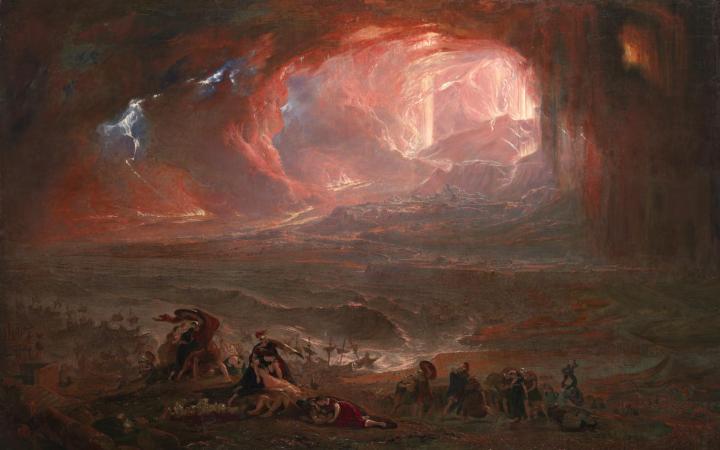
John Martin, The Destruction of Pompeii and Herculaneum, 1822
(London: Tate)
◊ ◊ ◊ ◊ ◊
From the conference website:
Imagining Apocalypse
Radcliffe Humanities Building, University of Oxford, 18 June 2016
Organised in collaboration with Dr Catherine Redford, the theme of this year’s RECSO conference is Imagining Apocalypse and will be held on 18th June. 2016 is a key anniversary for scholars studying long eighteenth-century depictions of apocalypse as it marks two hundred years since the famous ‘year without a summer’ of 1816, when the skies went dark and there was widespread speculation that the end of the world was nigh. This conference will allow a varied group of scholars working in the field of long eighteenth-century apocalypse studies to share their current research, giving them the chance to consider collaboratively current trends and research in apocalypse studies and to look forward to future projects. The project will ultimately encourage a more interdisciplinary approach to apocalypse studies.
Bringing together academics from across English, History, History of Art, Modern Languages, and Theology, the conference will introduce participants to the richness of apocalypse studies across a range of disciplines, both enhancing their research and laying the foundations for future projects, publications, and collaborations. A plenary lecture will be given by Professor Fiona Stafford (Professor of English Language and Literature, University of Oxford). Following the conference, a showcase of musical and literary performances will take place at St George’s Crypt, Oxford Castle. Registration is now open; see the conference website for further details.
Romanticism and Eighteenth-Century Studies Oxford (RECSO) is a graduate-led initiative for scholars across the Humanities Division. Our aim is to provide a platform for graduates and academics from various disciplines to discuss and share their research into the long eighteenth century. It also facilitates the development of projects, workshops and larger events, as well as providing a physical meeting space for RECSO’s growing body of members.
◊ ◊ ◊ ◊ ◊
P R O G R A M M E
9.30 Registration
10.15 Welcome and introduction by Catherine Redford and Emily Knight, University of Oxford
10.30 Morning Session
Panel A: The Eighteenth-Century Apocalyptic Imagination: The Interpretative Landscape
Chair: Amelia Greene
• Jonathan Downing, University of Bristol: ‘The Commentators’ Apocalypse: The Interpretation of Biblical Eschatology in Eighteenth-Century Popular Commentaries’
• Stephen Bygrave, University of Southampton: ‘Improvement and Apocalypse: Joseph Priestley’s Rhetoric in the 1790s’
Panel B: The Last Man
Chair: Eva-Charlotta Mebius
• Claire Sheridan, University of Greenwich: ‘Apocalypse as Domestic Melodrama: Dibdin Pitt’s The Last Man; or, the Miser of Eltham Green’
• Audrey Borowski, University of Oxford: ‘The Strange Indetermination of Cousin de Grainville’s “Last Man”’
• Adrian Tait, Independent Scholar: ‘Intimations of Apocalypse: From Mary Shelley’s The Last Man to M. P. Shiel’s The Purple Cloud’
12.00 Lunch
12.45 Afternoon Session, Part I
Panel A: Revelation/Revelations
Chair: Christian Zolles
• Natasha O’Hear, University of St Andrews: ‘Four Become One: The Preoccupation with the Fourth Horseman of the Apocalypse in the Eighteenth Century’
• Joanna Raisbeck, University of Oxford: ‘The Post-Kantian Apocalypse: Revelatory Visions in Jean Paul and Karoline von Günderrode’
• Randall Reinhard, University of Edinburgh: ‘The Revelation of Edward Irving: The Apocalypse as Social Criticism’
Panel B: Secular Apocalypse: Nature and the Human
Chair: TBC
• Amelia Greene, City University of New York: ‘Uncovered Earth: Scaled Apocalypse in John Clare’
• Lucia Scigliano, Durham University: ‘“What faith is crushed, what empires bleed”: Apocalypse and Nature in Percy Bysshe Shelley’s Hellas’
• Adam D. J. Laity, University of the West of England: ‘The Last Man, the Rückenfigur and Mad Max: Romantic Subjectivism and “the human” within the Apocalyptic Sublime Landscape’
2.15 Tea and coffee
2.45 Afternoon Session, Part II
Panel A: Ruin and Catastrophe
Chair: Audrey Borowski
• Jessica Stacey, King’s College London: ‘Apocalypse of Meaning: Catastrophes of Language in Eighteenth-Century France’
• Thomas Moynihan, University of Oxford: ‘Human Extinction and Romanticism: The Intellectual Discovery of the End of Thought’
• Helen Slaney, University of Oxford: ‘Original Ruins’
Panel B: Apocalyptic Afterlives
Chair: TBC
• Christian Zolles, University of Vienna: ‘Modern Apocalypse in Reverse: Edgar Allan Poe’s Dialogue The Conversation of Eiros and Charmion (1839)’
• Tom Bromwell, University of York: ‘A Sublime Armageddon: First World War Artists and the Burkean Sublime’
• Catherine Redford, University of Oxford: ‘From Mary Shelley to H. G. Wells: The Romantic Last Man Reimagined’
4.15 Plenary lecture
• Fiona Stafford, University of Oxford: ‘Barkless, branchless, blighted: Alpine Apocalypse in 1816’
5.15 Closing remarks; walk to Oxford Castle
6.15 Showcase in St. George’s Crypt, Oxford Castle: A selection of musical and literary imaginings of the Last Man on earth from the Romantic period.
7.00 Dinner
Exhibition | Classical Splendor: Painted Furniture
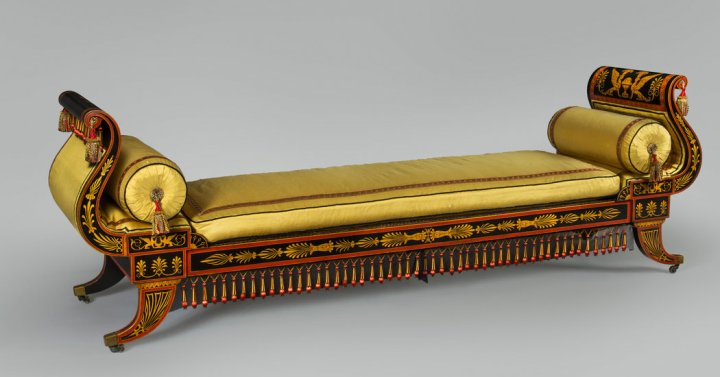
Sofa, designed by Benjamin Henry Latrobe, decorated by George Bridport
(Philadelphia Museum of Art, 1986-126-2a-c).
◊ ◊ ◊ ◊ ◊
Writing for The Magazine Antiques, Alexandra Kirtley previews the exhibition Classical Splendor: Painted Furniture for a Grand Philadelphia House, which opens this fall in Philadelphia.
Alexandra Alevizatos Kirtley, “Superfluity & Excess: Quaker Philadelphia Falls for Classical Splendor,” The Magazine Antiques (March/April 2016).
The fruits of extensive research on Benjamin Henry Latrobe’s 1808 house and furniture for William and Mary Waln begin with their impact on the aesthetic of the city itself.
 By the middle of the eighteenth century the “greene Country Towne” founded by William Penn in 1682 was bustling with commercial and social activity. Colonists from Europe and the British Isles who spoke a variety of languages and practiced a number of religions filled the city. Although the aura of the British and European Quakers who had followed Penn to Philadelphia was still palpable, ambitious merchants had begun to create New World versions of aristocratic styles and customs quite at odds with Quaker comportment . . .
Despite this atmosphere of admonishment against hierarchical social customs and “Superfluity & Excess in Buildings and Furniture,” many Philadelphia Quaker and non-Quaker artisans and their patrons did embrace the luxury of contemporary European and Asian styles. . . . The taste for aristocratic style persisted in the city’s public and private spheres even after the Revolution. . . .
By 1805 the city was no longer the nation’s capital, but it was about to witness the creation of its most innovative, resplendent, and potent interior—the work of a team of artisans commissioned by a Quaker merchant and his socially adept Episcopalian wife. British-born architect Benjamin Henry Latrobe—known as Henry—had arrived in the city in early spring 1798 and had already completed several commissions: the Bank of Pennsylvania in the plain Greek revival style; the domed Pump House for the Centre Square Water Works (completed in 1801, demolished in 1829);4 and a Gothic-style country house in Fairmount Park for the merchant William Cramond called Sedgeley (completed in 1802, demolished around 1857). Latrobe had also established himself in Philadelphia society by marrying Mary Elizabeth Hazlehurst (1771–1841), the daughter of Isaac and Johanna Purviance Hazlehurst—a prominent couple with family, commercial, and political ties in Philadelphia, Baltimore, and Salem, New Jersey.
Philadelphia merchant William Waln, the son of the Quaker preacher Nicholas Waln (1742–1813), had made a bold departure from his faith when he was married by Episcopal Bishop William White to Mary Wilcocks on March 14, 1805, at Christ Church, Philadelphia. But what the couple did next in commissioning Henry Latrobe to design and oversee the building of their magnificent house and its furnishings was even bolder: they unleashed Latrobe to design for them furniture that directly imitated ancient furniture, moving once and for all beyond the restrained bounds of mere references to classical art, and transforming Philadelphia’s—and indeed America’s—interpretation of classical art . . . .
The full article is available here»
◊ ◊ ◊ ◊ ◊
Press Release from the Philadelphia Museum of Art:
Classical Splendor: Painted Furniture for a Grand Philadelphia House
Philadelphia Museum of Art, 3 September 2016 — 1 January 2017
Curated by Alexandra Alevizatos Kirtley and Peggy Olley

Card Table, designed by Benjamin Henry Latrobe, decorated by George Bridport (Philadelphia Museum of Art, photograph by Gavin Ashworth)
This exhibition will showcase a set of furniture designed by architect Benjamin Henry Latrobe (1764–1820) and made in Philadelphia in 1808 for William and Mary Wilcocks Waln. The Museum’s ten surviving pieces of furniture from the Walns’ original set will be shown in a new light, reimagined after a comprehensive five-year curatorial study and conservation treatment.The exhibition will highlight the team of makers—the designer (Latrobe), the maker (John Aitken, d. 1839), the painter (George Bridport, 1783–1819), and the upholsterer (John Rea, 1774–1871)—and the fashion for classical art that the furniture ushered into American interiors. The Walns’ drawing rooms and their furniture provided a setting imitating the art and culture of ancient Greece. The exhibition will consider Latrobe’s groundbreaking ‘Klismos’ chair design, and reveal the London-trained Bridport as the visionary artist who translated Latrobe’s design for the walls into classical designs for the painted furniture and whose work is represented today only by the surviving Waln furniture. The Walns’ extraordinary house, which stood at the southeast corner of Seventh and Chestnut Streets in Philadelphia, was torn down in 1847. Through the use of large-scale computer renderings and various other interactive technologies, visitors will be able to explore the way the two drawing rooms were furnished how they interacted with the rest of the house and the gardens, which were also designed by Latrobe.
◊ ◊ ◊ ◊ ◊
From Yale UP:
Alexandra Alevizatos Kirtley and Peggy Olley, with an essay by Jeffrey Cohen, Classical Splendor: Painted Furniture for a Grand Philadelphia House (New Haven: Yale University Press, 2016), 160 pages, ISBN: 978-0300221718, $35.
 This handsome book explores in depth a group of stunning painted and gilded furniture designed by the architect Benjamin Henry Latrobe (1764–1820), best known for originating the plans for the United States Capitol. The furniture was made in Philadelphia for one of the city’s finest houses—the home of William and Mary Wilcocks Waln, which Latrobe also designed. Drawing on a multiyear conservation and research project, Classical Splendor reveals new insights into the patrons, makers, and history behind these extraordinary pieces. In addition to extensively documenting each item, the book attests to Latrobe’s significant contributions to American furniture design—his pieces for the Waln house introduced, and served as exemplars of, a classical style rooted in ancient Greek and Roman design.
Alexandra Alevizatos Kirtley is the Montgomery-Garvan Curator of American Decorative Arts and Peggy A. Olley is the associate conservator of furniture and woodwork, both at the Philadelphia Museum of Art. Jeffrey A. Cohen is senior lecturer and chair of the Growth and Structure of Cities Program at Bryn Mawr College.










 Enfilade
leave a comment