Conference | Traveling Marble, 18th–20th Centuries
From ArtHist.net:
Traveling Marble: Agents, Networks, Technologies, 18th–20th Centuries
Thorvaldsen’s Museum, Copenhagen, 10 April 2025
Organized by Amalie Skovmøller and Ariane Varela Braga
Through thousands of years, white marble stones have been quarried and circulated to be consumed for architectural and artistic purposes worldwide. The stones are known from ancient Greek and Roman cultures, but during the 18th, 19th, and 20th centuries, white marble assumed a central role in the formation of European and Western art- and cultural history reaching far beyond the boundaries of antiquity. As a material signifying cultural prestige, white marble became a popular material for building and decorative projects, and the Imperial powers of Europe established new quarry facilities all over the world. These growing marble networks circulated white stones in far-reaching patterns of distribution from central Europe to the USA and from the Mediterranean to Scandinavia. Moving large quantities of solid stone requires a complex infrastructure, developed and maintained to support the increasing consumption. Yet scholars of art history and architectural studies have traditionally addressed white marble through the lens of aesthetics, leaving its omnipresence and global condition largely unexplored.
This seminar explores the distribution patterns of white marble, with particular emphasis on the 18th, 19th, and 20th centuries, but with perspectives on antiquity. Framing white marble as both a local and global phenomenon, the seminar shifts focus from the traditional emphasis on artists and their materials towards unseen networks of quarry owners, extractors and trading agents. In doing so, the seminar probes questions related to how quarries have been organized through time and the role played by marble consortiums, associations and federations, who have regulated labour, transportation, and distribution over time. The seminar thus targets patterns of distribution, such as trading routes by land and sea, and the technical improvements realized over time, bringing scholars together to discuss how to gather and share data on the extraction and circulation of marble to lay the first foundations for a future global archive of white marble distribution for this period. Please note that registration is required for attendance.
Organized by Institut for Kunst- og Kulturvidenskab / Amalie Skovmøller. In collaboration with Ariane Varela Braga / UNED, Madrid
p r o g r a m m e
9.30 Registration and coffee
10.00 Welcome by Amalie Skovmøller and Ariane Varela Braga
10:15 Morning Talks
• A World in Marble — Amalie Skovmøller
• Materials That Connect: The Circulation of White Marble in the Ancient Mediterranean — Alessandro Poggio
• Ancient Naxian Marble Quarries and Dedications: Documentation and Study from the 18th Century to Today — Rebecca Levitan
13.15 Afternoon Talks
• 18th-Century Norwegian Marble in Copenhagen — Kent Alstrup
• The Workshop of Antonio Caniparoli & Figli in Carrara 1850 to 1930 — Sandra Beresford
• Reading into Greenland Marble: ‘A Noble Danish Material’ — Jonathan Foote
• Marble for the Duce: The Networks of Agents, Merchants, and Marble Workers at Foro Mussolini — Ariane Varela Braga
• The ‘Archivi del Marmor Project (AMP)’ — Cristiana Barandoni and Luca Borghini
16.15 Final discussion
The Burlington Magazine, March 2025
The long 18th century in the March issue of The Burlington:
The Burlington Magazine 167 (March 2025)
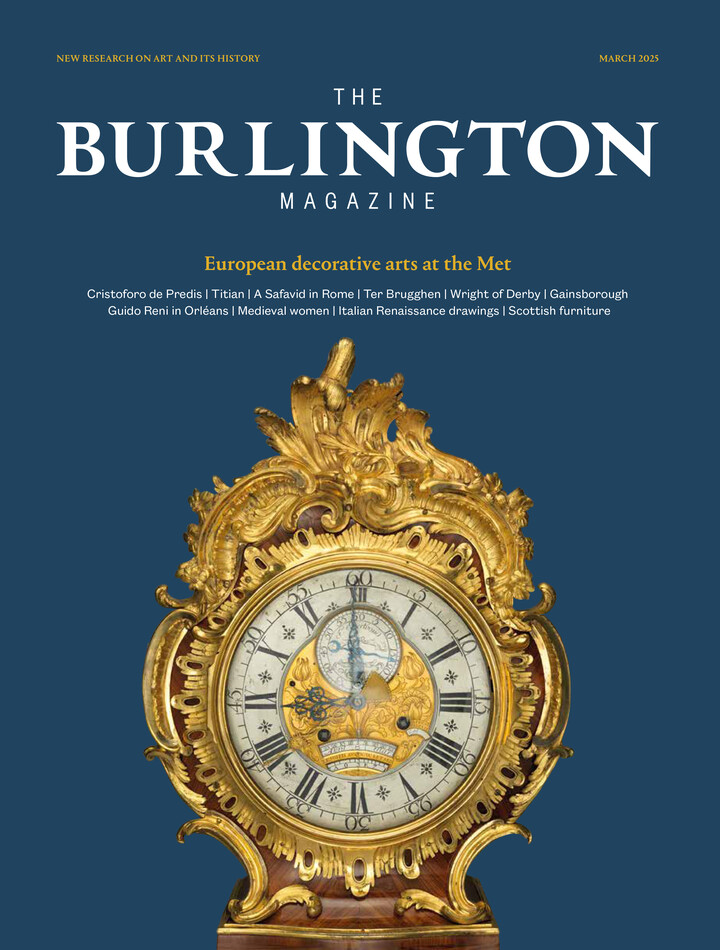
Cover of The Burlington Magazine with a recent acquisition at The Met: Longcase equation regulator, clockmaker: Ferdinand Berthoud, case maker: Balthazar Lieutaud, ca. 1752 (New York: The Metropolitan Museum of Art, 2016.28a–e).
e d i t o r i a l
• “A Frick Renaissance,” p. 203–05.
On 17th April 2025 the Frick Collection on Fifth Avenue re-opens after a long period of redevelopment. When an old friend has a face lift, the results can be disconcerting. Happily, the impact here is, however, reassuringly subtle—as the splendid Gilded-age character of one of New York’s iconic cultural institutions has been retained, while elegant new facilities have been deftly integrated.
a r t i c l e s
• Julia Seimon, “Two Boys with a Bladder in the J. Paul Getty Museum and Joseph Wright of Derby’s Early Candlelights,” pp. 242–57.
A careful re-assessment of Joseph Wright of Derby’s painting of Two Boys with a Bladder in the Getty’s collection, supported by documentary discoveries, clarifies the circumstances of the painting’s creation and first exhibition and has significant implications for dating several of the artist’s other painted and drawn works.
s h o r t e r n o t i c e s
• Oliver Fairclough, “Paul Sandby and Sir Watkin Williams-Wynn Revisited,” pp. 258–61.
• Christina Milton O’Connell, “Observations about the Abandoned Portrait beneath Gainsborough’s Blue Boy,” pp. 26–65.
r e v i e w s
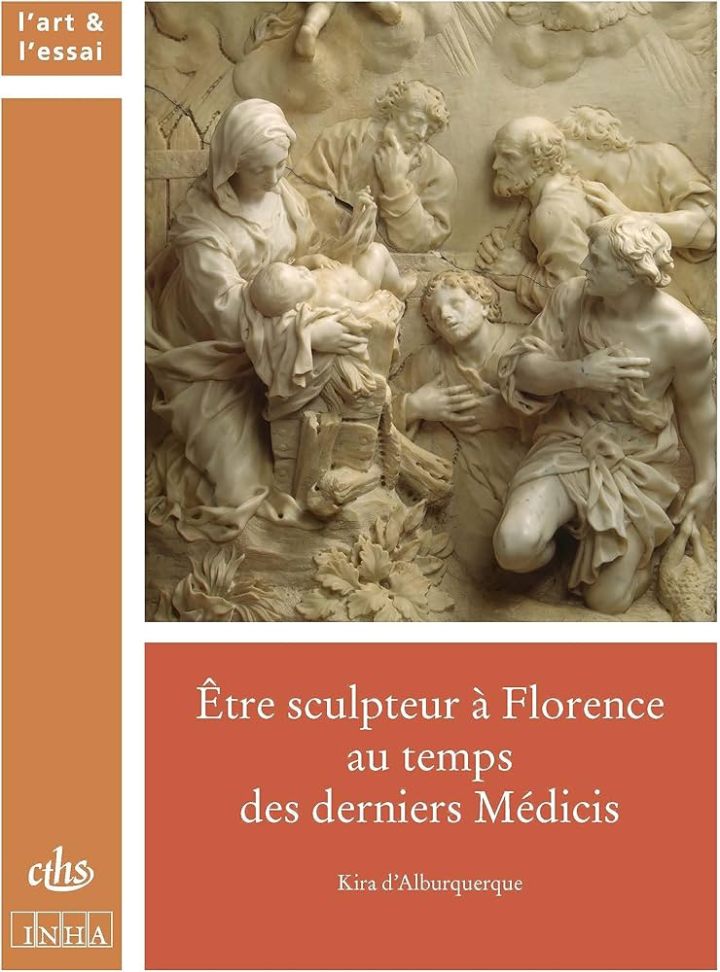
Cover of Être sculpteur à Florence au temps des derniers Médicis, featuring a photograph of Giovanni Battista Foggini’s Adoration of the Shepherds, ca. 1675, marble (Saint Petersburg: Hermitage).
• Nicola Ciarlo, Review of Kira d’Alburquerque, Être sculpteur à Florence au temps des derniers Médicis (CTHS, 2023), pp. 292–94.
• Adam Bowett, Review of Stephen Jackson, Scottish Furniture 1500–1914 (NMS Publishing, 2024), pp. 296–98.
• Penelope Curtis, Review of the exhibition catalogue Souvenirs de jeunesse: Entrer aux Beaux-Arts de Paris 1780–1980, edited by Alice Thomine-Berrada (Beaux-Arts de Paris, 2024), pp. 298–99.
• Alan Powers, Review of Edward McParland, The Language of Architectural Classicism: From Looking to Seeing (Lund Humphries Publishers, 2025), pp. 299–300.
• Max Marmor, Review of Julius von Schlosser, The Literature of Art: A Manual for Source Work in the History of Early Modern European Art Theory, translated by Karl Johns (Ariadne Press, 2023), p. 303.
s u p p l e m e n t
• Sarah Lawrence, “Recent Acquisitions (2014–24) of European Decorative Arts at The Metropolitan Museum of Art,” pp. 305–24.
New Book | Giovanni Battista Maini (1690–1752)
Distributed by Yale UP:
Jennifer Montagu, Giovanni Battista Maini (1690–1752) and Roman Sculpture of His Time (London: Burlington Press, 2025), 302 pages, ISBN: 978-1916237858, $125.
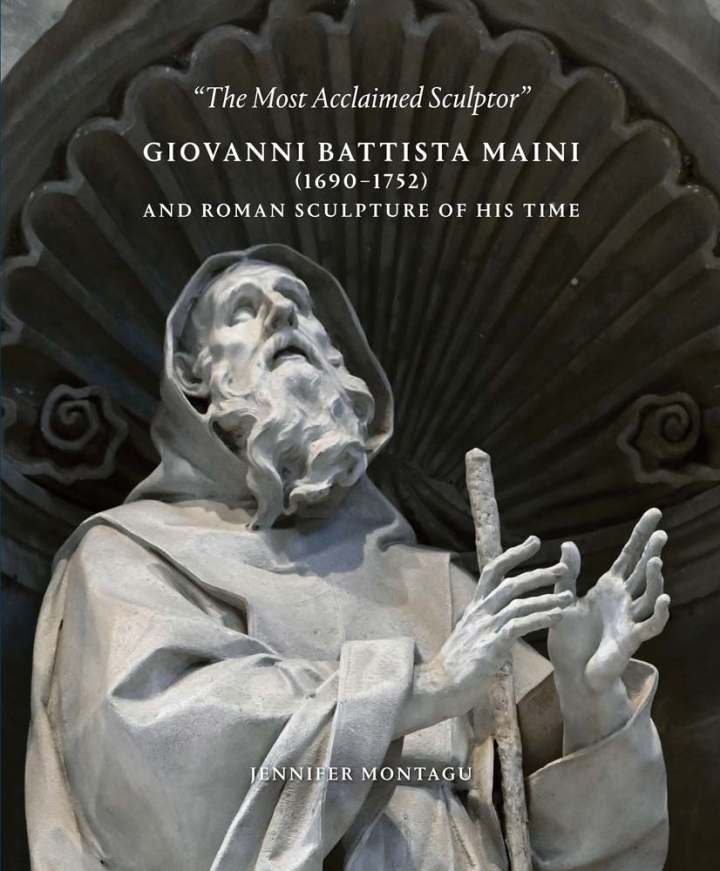 Giovanni Battista Maini is one of the most important and accomplished—although least known and appreciated—of late Baroque sculptors. This new monograph provides an authoritative, scholarly, and beautifully illustrated survey of all his principal commissions. Maini was born in Lombardy and had moved to Rome by 1710. His prestigious projects in the city included the funerary monument for Pope Innocent X in Sant’Agnese in Agone and the two majestic tombs in the family chapel of Pope Clement XII in San Giovanni in Laterano. Maini also worked in Santa Maria Maggiore and was involved in the design for the iconic Fontana di Trevi. These works are set in the context of the Roman art scene: the struggle for commissions, payment, and reputation.
Jennifer Montagu is a distinguished art historian who specialises in Roman Baroque sculpture. Her monograph on Alessandro Algardi was published in 1985 to great acclaim. Montagu worked as Curator of the Photographic Collection of the Warburg Institute, London, and has been both the Slade Professor of Fine Art at Oxford and the Andrew W. Mellon Lecturer at the National Gallery of Art, Washington. She has also served as a Trustee of the Wallace Collection and British Museum, London, and is an Officer of the Order of Merit of the Italian Republic.
Call for Papers | The Future of the Antique
From the Call for Papers:
The Future of the Antique: Interpreting the Sculptural Canon
Warburg Institute and Institute of Classical Studies, London, 10–12 December 2025
Organized by Adriano Aymonino and Kathleen Christian
Proposals due by 15 May 2025
The University of Buckingham, the Census of Antique Works of Art and Architecture Known in the Renaissance (Humboldt-Universität zu Berlin), the Warburg Institute, and the Institute of Classical Studies (University of London) are organising an interdisciplinary conference to celebrate the publication of the new edition of Francis Haskell and Nicholas Penny’s seminal work Taste and the Antique (Harvey Miller/Brepols, December 2024).
 This landmark publication provides an opportunity to review and coordinate recent achievements and new initiatives in the study and interpretation of the Greek and Roman sculptural legacy. The original 1981 Yale University Press edition of Taste and the Antique significantly shaped the field’s direction over four decades, influencing both academic research and curatorial practices. The revised and expanded three-volume edition, featuring numerous newly commissioned photographs, substantially updates the scholarship with research from recent decades. It broadens the exploration of these works’ reception and influence, from Renaissance collectors to contemporary artists. The edition particularly examines how classical statues impacted European imagery beyond direct replication, including:
• Their adaptation across diverse media
• Their impact on art and architectural theory and pedagogy
• Their influence on anatomical study and proportional theory
• Their role in modernist culture and modern / postmodern popular culture
• Their enduring presence in contemporary imagery and conceptions of the human body
The conference aims to assess the current state of research, rethinking established methodologies and exploring possible future directions in the field. Its primary goal is to foster discussion among different generations of scholars whose research outputs are often separated by language and methodological barriers. We invite proposals for twenty-minute papers on interrelated topics such as the following, outlined by the book or extending beyond it. Priority will be given to innovative papers focusing on the legacy of antique sculptural models in European/Colonial art and culture since the Renaissance:
Academy and Canon — examining their establishment, radical alteration, and dissolution in the modern era.
New Canons — the antique in modern and postmodern theoretical frameworks and practices.
Antique / Modern Bodies — classical statuary’s influence on human anatomical study; proportioned and disproportioned body concepts; the representation of the male and female body; physiognomy; conceptions of race and ethnicity.
Empire and its Enemies — political and racial implications of the antique.
Priorities and Display — the antique within modern museum contexts.
Restorations and Forgery — reconfigurations of the antique and notions of authenticity.
Narrative Patterns — the classical language of gesture, story-telling/narrative.
Please submit your title and abstract of no more than 200 words, along with a short biography (about 100 words—please do not send CVs) to Mattia Ciani (m.ciani8@student.unisi.it) by noon (BST), 15 May 2025. The abstract and biography should be combined in a single Word document and submitted as an email attachment. Incomplete or late submissions will not be considered. Notification of the outcome will be communicated via email by 1 July 2025. We intend to publish the proceedings of the conference.
New Book | The Language of Architectural Classicism
From Lund Humphries:
Edward McParland, The Language of Architectural Classicism: From Looking to Seeing (London: Lund Humphries Publishers, 2025), 288 pages, ISBN: 978-1848226593, £35 / $70.
 Classicism is ubiquitous, from the facade of Selfridges to the letterhead of The Times, to the pedimented porches of neo-Georgian housing estates. This book invites readers to discover in their surroundings a rich language of form which is there to be revealed. It discusses the pleasures and problems of post-medieval architectural classicism, both its rigour and flexibility, its perfections and incompleteness, its continuities and innovations, and its expressiveness—from the camp to the sublime, and from originality to plagiarism. Abandoning conventional chronological, biographical, or stylistic arrangements, the book makes connections between familiar art historical periods, focusing on looking closely at the buildings and their details, from which useful generalisations emerge.
The book discusses how Renaissance architects, when faced with the bewildering variety of classical antiquity, produced canonical versions of the orders and thus a systematic method of designing in the antique manner. It asks how the highly regulated language of classicism can sustain the originality of a Michelangelo, a Soane or a John Simpson and looks at the human body in relation to classical architecture. It examines the various treatments of the wall and of lettering on classical buildings, before concluding with a chapter on architectural backgrounds in Quattrocento art, revealing how this can lead to a different kind of looking at painting and sculpture.
Edward McParland is an Irish architectural historian and author of several books, including James Gandon (1985) and Public Art in Ireland, 1680–1760 (2001). He was elected as Pro-Chancellor of University of Dublin, Trinity College in 2013. McParland is the co-founder of the Irish Architectural Archive which was established in 1976, and he has contributed extensively to architectural conservation in Ireland.
c o n t e n t s
Introduction
1 The Canon
2 Imitation
3 Body and Building
4 The Wall
5 Discord
6 Lettering
7 Architectural Backgrounds, Mostly Quattrocento
Conclusion
Select Bibliography
Index
Call for Articles | Sculpture and the Non-Normative Body
From ArtHist.net:
Sculpture and the Non-Normative Body
Thematic issue of Sculpture Journal
Proposals due by 1 June 2025; completed articles will be due 1 September 2025
The normative body has been the traditional subject of sculpture since antiquity. Its ubiquity, however, has led to the invisibility of the diversity of bodies in the history of art: from the disabled body of Aesop and the ‘hermaphrodite’ from antiquity to the ‘grotesque’ or ‘monstrous’ from the Renaissance garden to the polychrome ‘ethnographic’ portrait busts from the nineteenth century. We want to question these categories and address bodies that have been under-represented in sculpture, either through representational strategies, materials that reflect on lived experience, and/or sculptural practice itself.
In the first of a series of recurring themed issues around sculpture and the body, the Editors of the Sculpture Journal encourage abstracts that rethink the traditional methods of sculpture in art history in relation to gender, sexuality, race, class and/or disability. We invite proposals for contributions that stem from but are not limited to the following: fragmentation and decay; queer and trans perspectives; health and disability; processes of othering; materiality; redefinitions/responses to normativity/the normative body; artists engaging in their work via lived experience or through materiality. We are looking at this issue transhistorically and globally, across a range of sculpture practices, from the figurative to the abstract.
We invite abstracts of up to 250 words to be submitted to Teresa Kittler (teresa.kittler@york.ac.uk) and Natasha Ruiz-Gómez (natashar@essex.ac.uk) by 1st June 2025. Final submission of full-length articles of 6000–8000 words including endnotes will be requested by 1st September 2025.
Sculpture Journal is the foremost scholarly journal devoted to sculpture in all its aspects across the globe. It provides an international forum for writers and scholars in the wider field of sculpture, including all three-dimensional art and monuments. Published by Liverpool University Press, the journal offers a keen critical overview and a sound historical base, encouraging contributions of fresh research from new and established names in the field.
Symposium | Balkan and Aegean Artistic Identities in the 18th Century

◊ ◊ ◊ ◊ ◊
From ArtHist.net and the conference programme:
Balkan and Aegean Artistic Identities in the 18th Century: Between East and West
Online and in-person, Athens, 8–9 April 2025
Organized by Maria Georgopoulou and Alper Metin
This symposium aims to shed light on the intricate artistic and cultural identities that flourished in the eighteenth-century Ottoman Balkans and Aegean, regions positioned at the confluence of ‘Eastern’ and ‘Western’ historiographical conventions. The event encourages scholars to engage in a comprehensive examination of artistic production, architectural development, and socio-political dynamics during this transformative period.
Central to the symposium is the reassessment of the historiographical terms post-Byzantine art and Ottoman Baroque. Are these designations still relevant? If post-Byzantine art predominantly refers to religious works, how should we classify secular creations, such as the richly decorated interiors of Balkan and Anatolian mansions? How authentically Baroque was the so-called Ottoman Baroque, and does this term effectively convey the unique synthesis embodied in Ottoman architecture? Furthermore, how should we approach the non-Baroque elements within this period—features rooted in Byzantine, Western medieval, and Renaissance traditions—that complicate the conventional understanding of the Ottoman Baroque? The aim is to explore how these varied influences merged into hybrid forms that challenge conventional categorization.
The symposium will address the following themes:
1 The impact of political and cultural rivalries between the Ottomans and Venice in the Aegean and the Habsburgs in the Balkans, which not only redefined power structures but also shaped cross-cultural artistic and architectural identities. The manifestation of these rivalries in the built environment and material culture, such as building that bear testimony to shifts of power, conflict, and transformation.
2 The rich network of technical expertise of itinerant artists, architects, master builders, naval builders and artisans that fostered the exchange of knowledge and artistry. The fusion of local traditions in crafts (woodcarving, silverwork, textiles etc.) in areas such as Mount Athos and the Peloponnese. The influential interactions between the Archipelago and the coastal cities of mainland Greece and Anatolia, including Constantinople/Istanbul.
3 The interactions between Catholic, Orthodox, and Muslim communities in centers such as Crete, Chios, Constantinople/Istanbul, and Smyrna/Izmir, that shaped and transformed urban and architectural spaces.
4 The role of Orthodox merchants, whose economic influence and cultural mediation bridged the Ottoman Empire and Western Europe, fostering significant cross-cultural exchanges.
5 The mediation of Greek communities between the Venetian and Ottoman realms. The dual status of Greeks, as subjects of Venice and the Porte, in shaping of the artistic and architectural heritage they cultivated, with its broader implications for the region’s cultural fabric.
t u e s d a y , 8 a p r i l
16.00 Registration and coffee
16.15 Introduction — Maria Georgopoulou (Director of the Gennadius Library) and Alper Metin (University of Bologna and 2024–25 Cotsen Traveling Fellow at the Gennadius Library)
16.30 Session 1 | Mapping Architectural Connections
• Nikos Magouliotis (Institute for the History and Theory of Architecture, ETH Zurich) — The Printed Page and the Painted Column: An Architectural Microhistory of a Church in Ottoman Thessaly, ca. 1800
• Alper Metin (Department of the Arts, University of Bologna) — Warming Up to Change: Heating Appliances in the Gradual Transformation of Eighteenth-Century Ottoman Interiors
• Deniz Türker (Department of Art History, Rutgers University) — ‘Carvers of Chios’: Imperial Patrons, Ottoman Greek Kalfas, and Nimble Building in the Eighteenth Century
18.00 Coffee break
18.15 Session 2 | Domestic Spaces: History and Conservation
• Theocharis Tsampouras (Ephorate of Antiquities of Kozani, Hellenic Ministry of Culture) — The Political Character of Eighteenth-Century Christian Orthodox Art in the Ottoman Balkans
• Amalia Gkimourtzina (Ephorate of Antiquities of Kastoria, Hellenic Ministry of Culture) — The Secular Decoration in the Eighteenth-Century Mansions of Western Macedonia: The Example of the Conservation Works Carried Out in Tsiatsiapa Mansion in Kastoria
• Omniya Abdel Barr (Victoria and Albert Museum, London) — Eighteenth-Century Painted Ceilings in Cairo: Bayt al-Razzaz in the Context of Ottoman Architectural Networks
20.00 Reception
w e d n e s d a y , 9 a p r i l
9.30 Session 3 | ‘Post-Byzantine’ Sculpture, Textiles, Material Culture
• Anna Ballian (Benaki Museum, Athens) — From Art of the Empire to Art in the Empire: The Case of Ottoman and ‘Post-Byzantine’ Art
• Nikolaos Vryzidis (School of Applied Arts and Culture, University of West Attica) — Networks of Pluriversality: Trade, Diasporas, and ‘Baroque’ Textile Culture in Ottoman Greece
• Dimitrios Liakos (Ephorate of Antiquities of Chalkidike and Mount Athos, Hellenic Ministry of Culture) — Observations on Eighteenth-Century Sculpture in Mainland Greece: The Cases of Thessaly and Mount Athos
11.15 Coffee break
11.30 Sessions 4 | Relations with Antiquity
• Elizabeth Key Fowden (Faculty of Classics, University of Cambridge) — Pharos, Tower, Temple and Tent: Visualizing the Horologion in Eighteenth-Century Athens
• Paolo Girardelli (Department of History, Boğaziçi University) — A ‘Rotunda’ on the Aegean Shores: The Franciscan Church of Santa Maria in Bornova, 1797–1831
New Book | American Laughter, American Fury
From Johns Hopkins UP:
Eran Zelnik, American Laughter, American Fury: Humor and the Making of a White Man’s Democracy, 1750–1850 (Baltimore: Johns Hopkins University Press, 2025), 352 pages, ISBN: 978-1421450605, $65.
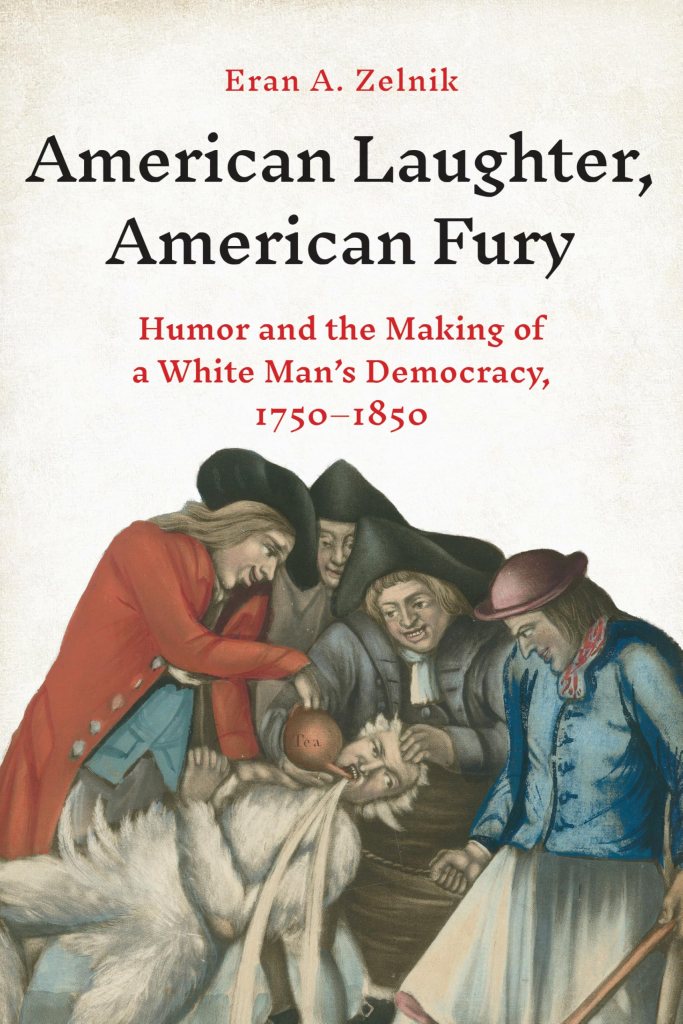 A joke is never just a joke―not even in the eighteenth century. In American Laughter, American Fury, Eran A. Zelnik offers a cultural history of early America that shows how humor among white men served to define and construct not only whiteness and masculinity but also American political culture and democracy more generally. Zelnik traces the emerging bonds of affinity that white male settlers in North America cultivated through their shared, transformative experience of mirth. This humor―a category that includes not only jokes but also play, riot, revelry, and mimicry―shaped the democratic and anti-elitist sensibilities of Americans. It also defined the borders of who could participate in politics, notably excluding those who were not white men. While this anti-authoritarian humor transformed the early United States into a country that abhorred elitism and class hierarchies, ultimately the story is one of democratization gone awry: this same humor allowed white men to draw the borders of the new nation exclusively around themselves. Zelnik analyzes several distinct forms of humor to make his case: tall tales, ‘Indian play’, Black dialect, riot and revelry, revolutionary protests, and blackface minstrelsy. This provocative study seeks to understand the vexing, contradictory interplay among humor, democracy, and violence at the heart of American history and culture that continues today.
Eran A. Zelnik is a lecturer in the Department of History at California State University, Chico.
c o n t e n t s
Introduction
Part I | Yankees and Gentlemen
1 The Joyous Multitude: Humor and the Premodern Crowd in the Revolutionary Era
2 The Witty Few: Augustan Humor and the Politics of Exclusion
Part II | From Backcountry to Frontier
3 Laughter in the Wilderness: Transgression and Mirth in Rural America
4 The Laughter and the Fury: Terror and Masquerade on the American Frontier
5 Alligator-Horses: The Frontier Jester and the Origins of Manifest Destiny
Part III | A Tale of Two Clowns
6 A Black Clown for a White Nation: The Origins and Context of Blackface Minstrelsy
7 American Folks: Black and White Jesters in Antebelluum Popular Culture
Epilogue: Laughter and Fury from the Klan to January 6, 2021
Acknowledgments
Notes
Index
New Book | Thomas Sully’s Philadelphians
Coming in April, from Penn Press:
Peter Conn, Thomas Sully’s Philadelphians: Painting the Athens of America (Philadelphia: The American Philosophical Society Press, 2025), 216 pages, ISBN: 978-1606180495, $40. Also available as an ebook.
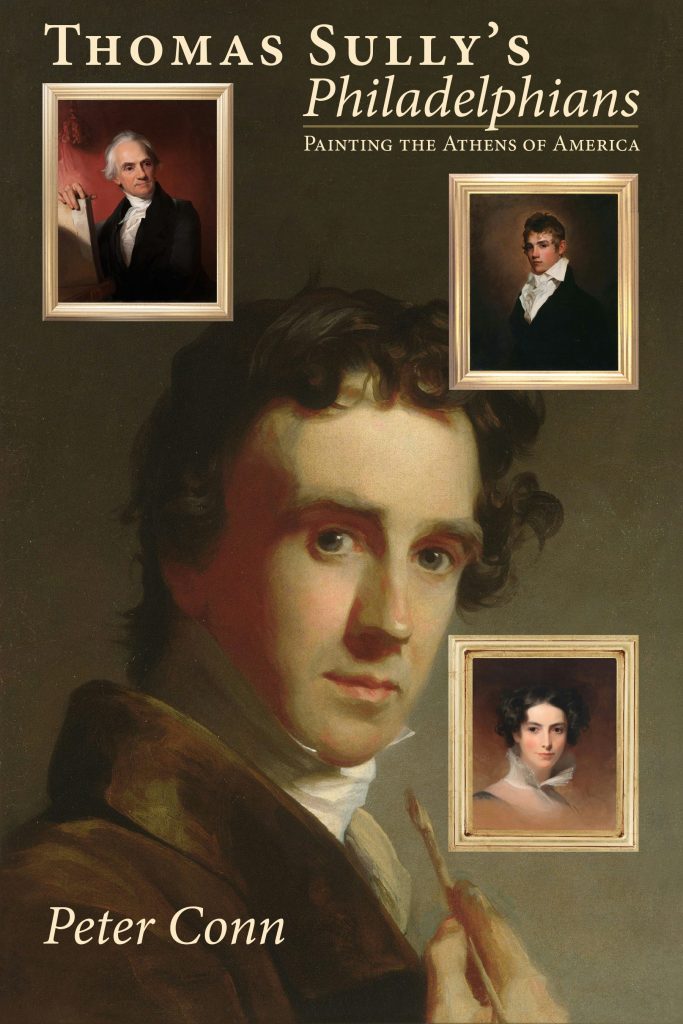 Philadelphia’s early national history represented in Thomas Sully’s portraits
Thomas Sully (1783–1872) is widely regarded as perhaps the most important portrait painter of the antebellum years. Using those portraits, Thomas Sully’s Philadelphians: Painting the Athens of America reconstructs many of the people, institutions, and events that combined to make Philadelphia—from the Revolution until the 1840s—at once the most cosmopolitan and most racially embattled city in America. The book approaches Sully’s portraits as visual documents in the history of Philadelphia in the first half of the nineteenth century. Gathered here under headings that include individuals, institutions, professions, and contemporary events, Sully’s portraits offer points of entry into much that was going on in early nineteenth-century Philadelphia. Peter Conn explores education, politics, theater, medicine, journalism, commerce, philanthropy, religion, and the fierce debate over slavery. Drawing upon wide research, including previously unpublished archival material, Thomas Sully’s Philadelphians brings to vivid life the men and women who were making the history of early national Philadelphia.
Peter Conn retired from the University of Pennsylvania as Vartan Gregorian Professor of English and Professor of Education and was a member of the graduate groups in the history of art and American civilization. His publications include The Divided Mind: Ideology and Imagination in America, 1898–1917 and Literature in America. Pearl S. Buck: A Cultural Biography was chosen as a New York Times Notable Book. The American 1930s: A Literary History was published in 2009. Conn wrote and presented a video course on American Best Sellers for the Teaching Company. He has given talks at the Brooklyn Museum of Art, the Pennsylvania Academy of Fine Arts, the Whitney Museum, the Philadelphia Museum of Art, and other institutions, on a number of American artists, including Edward Hopper, William Christenberry, Thomas Wilmer Dewing, Maxfield Parrish, Charles Sheeler, Winslow Homer, Wharton Esherick, and The Eight.
c o n t e n t s
1 Introduction
2 A Brief Biography
3 Pennsylvania Hospital
• Samuel Coates
• Benjamin Rush
4 The Second Bank of the United States
• Nicholas Biddle
5 The Theater
• George Frederick Cooke
• Fanny Kemble
• Charlotte Cushman
6 The Library Company of Philadelphia
• Zachariah Poulson
7 The Jews of Philadelphia
• Rebecca Gratz
8 The American Philosophical Society
• John Vaughan
• Peter Stephen Du Ponceau
9 Lafayette Returns to Philadelphia
10 The Historical Society of Pennsylvania
• William Rawle
11 Natural History
• William Wagner
• William Maclure
12 The University of Pennsylvania
• John Andrews
13 The Debate over Slavery
• William Henry Furness
• Benjamin Coates
• Daniel Bashiel Warner and Edward Roye
14 Epilogue: Thomas Sully and His Critics
• Jonathan Williams
• George Mifflin Dallas
Bibliography
Index
Eli Wilner & Co. Makes an 18th-C. Pier Mirror for Drayton Hall
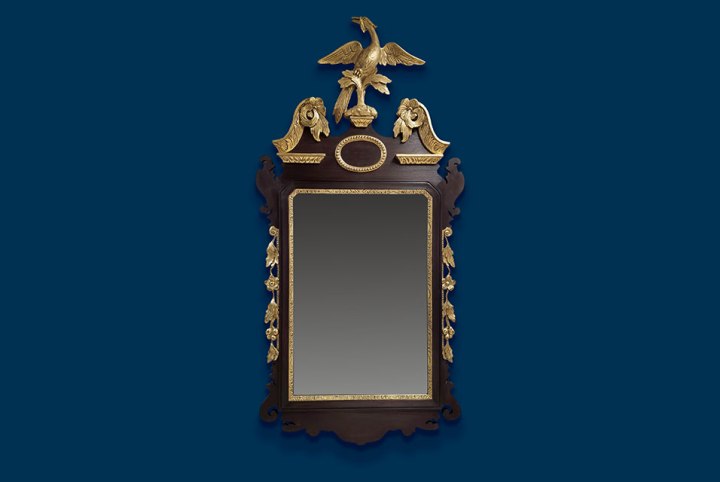
Late-18th-century-style pier mirror; walnut, basswood, and parcel-gilt; created in 2024–25 by Eli Wilner & Company for Drayton Hall Preservation Trust, Drayton Hall Museum Collection. The mirror was unveiled at the 2025 Charleston Show (March 21–23).
◊ ◊ ◊ ◊ ◊
As noted at Art Daily:
With assistance from their partial funding program for museums, Eli Wilner & Company recently completed the creation of a late 18th-century style pier mirror for Drayton Hall Preservation Trust. March has been another successful month for Eli Wilner & Company’s frame funding initiative, with $125,000 in partial grants having been distributed to date. Nearly $50,000 in funding is still available. Exciting new projects are being submitted on a daily basis by museums across the country. Remaining funds will be committed to new projects by 30 April 2025 and can be used for frame restoration, historic frame replication, or mirror replication projects. Interested institutions can apply by emailing the details of their reframing or frame restoration needs to info@eliwilner.com. No project is too large.
Patricia Lowe Smith, Drayton Hall’s Director of Preservation, initially contacted Wilner in the spring of 2024 about the potential project after they had discovered telltale marks on the original moldings surrounding the drawing room windows, indicating a lost pier mirror. Since no other documentation was found to provide the specifications or origin of the object, Wilner presented Drayton’s team with period-appropriate replacement options based on historical photographs and hand-tracings of Drayton’s walls.
The selected digital mockup was then printed to scale for Wilner’s master carpenters to begin construction of the walnut substrate and basswood blocks for the multiple hand carved elements. To get a better understanding of the depth proportions and construction methods that were not apparent in two-dimensional photographic images, they visited nearby institutions including the Metropolitan Museum of Art and the New-York Historical Society, and the Museum of the City of New York to examine similar objects.
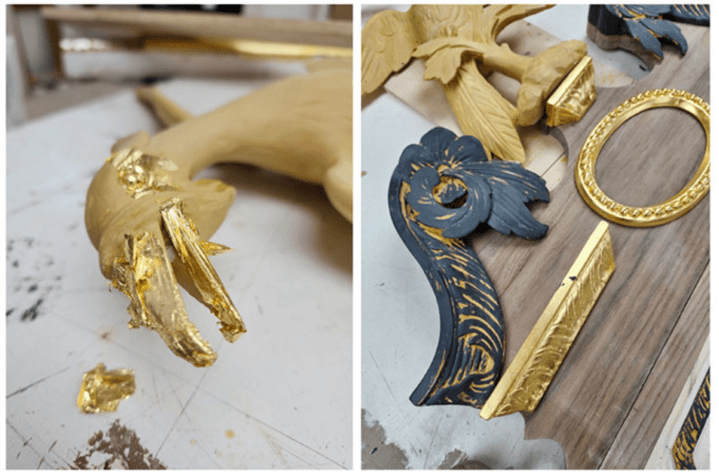 After several months of woodworking and carving, the basswood portions of the frame were prepared with layers of finely sanded gesso and bole (a liquid clay) and watergilded. These delicate elements were then burnished and patinated to a period appropriate character. Meanwhile, the walnut substrate sections were stained. Finally in February 2025, following an in-person studio visit with members from Drayton Hall’s preservation team, all portions of the frame were fully secured into position, and the glass and hanging hardware was installed.
Eli Wilner & Company has completed over 15,000 framing projects for private collectors, museums, and institutions including The Metropolitan Museum of Art, the Smithsonian American Art Museum, and The White House. Wilner was honored by the Historic Charleston Foundation with the Samuel Gaillard Stoney Conservation Craftsmanship Award, for their work in historic picture frame conservation. In 2024, Eli Wilner was presented with an Iris Award for Outstanding Dealer of the Year by the Bard Graduate Center in New York City.










 Enfilade
leave a comment