New Book | Rebellion 1776
I’m a big fan of Anderson’s Seeds of America Trilogy (Chains, Forge, and Ashes) and Fever, 1793. Her latest is set to be published April 1, from Simon and Schuster. –CH
Laurie Halse Anderson, Rebellion 1776 (New York: Atheneum/Caitlyn Dlouhy Books, 2025), 416 pages, ISBN: 978-1416968269, $19.
 From New York Times bestselling author Laurie Halse Anderson comes a “thoroughly researched, emotionally resonant” (Booklist, starred review) historical fiction middle grade adventure about a girl struggling to survive amid a smallpox epidemic, the public’s fear of inoculation, and the seething Revolutionary War.
In the spring of 1776, thirteen-year-old Elsbeth Culpepper wakes to the sound of cannons. It’s the Siege of Boston, the Patriots’ massive drive to push the Loyalists out that turns the city into a chaotic war zone. Elsbeth’s father—her only living relative—has gone missing, leaving her alone and adrift in a broken town while desperately seeking employment to avoid the orphanage. Just when things couldn’t feel worse, the smallpox epidemic sweeps across Boston. Now, Bostonians must fight for their lives against an invisible enemy in addition to the visible one. While a treatment is being frantically fine-tuned, thousands of people rush in from the countryside begging for inoculation. At the same time, others refuse protection, for the treatment is crude at best and at times more dangerous than the disease itself. Elsbeth, who had smallpox as a small child and is now immune, finds work taking care of a large, wealthy family with discord of their own as they await a turn at inoculation, but as the epidemic and the revolution rage on, will she find her father?
Laurie Halse Anderson is a New York Times bestselling author known for tackling tough subjects with humor and sensitivity. She’s twice been a National Book Award finalist, for Chains and Speak; Chains also received the 2009 Scott O’Dell Award for Historical Fiction. Laurie was chosen for the 2009 Margaret A. Edwards Award and received the Astrid Lindgren Memorial Award in 2023, presented to her by the Crown Princess of Sweden.
Exhibition | Return to Turtle Island
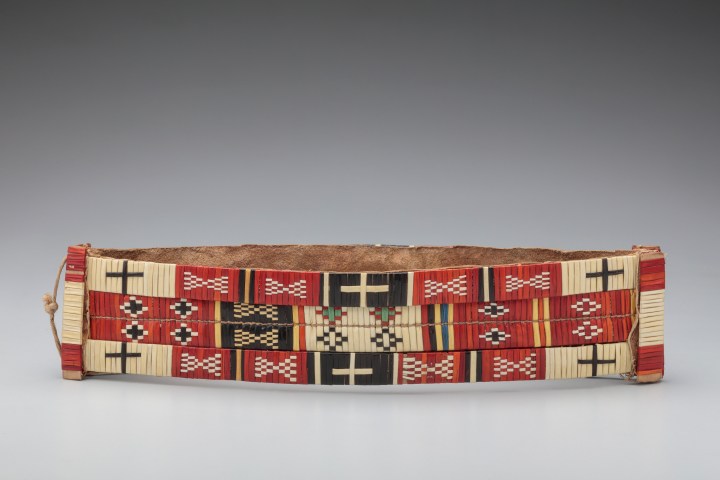
Ancestral Great Lakes artist, Quilled headband, mid-18th century; hide, birchbark, porcupine quills, natural dyes, and linen thread; 6 × 32 × 9 cm (Toledo Museum of Art, purchased with funds from The Joseph and Kathleen Magliochetti Fund, 2023.375).
◊ ◊ ◊ ◊ ◊
From the press release for the exhibition (the Rachel Ruysch show will also be on view at TMA starting April 12). . .
Return to Turtle Island: Indigenous Nation-Building in the Eighteenth Century
Toledo Museum of Art, 1 March — 29 June 2025
Curated by Johanna Minich, with the Great Lakes Research Alliance at the University of Toronto
The Toledo Museum of Art is pleased to present Return to Turtle Island: Indigenous Nation-Building in the Eighteenth Century, an exhibition that showcases recently acquired Eastern Woodlands objects and offers a rare exploration of early Indigenous artistry and diplomacy. This will be the first time these works, acquired by TMA in 2023, will be shown together by a public institution. The exhibition honors the remarkable journey of these cultural emissaries and welcomes them home.
Turtle Island, a name given to the North American continent by Anishinaabe, Haudenosaunee, and other Indigenous peoples, references the origin story of a landmass built on the back of a great turtle, symbolizing the interconnectedness of land and life.
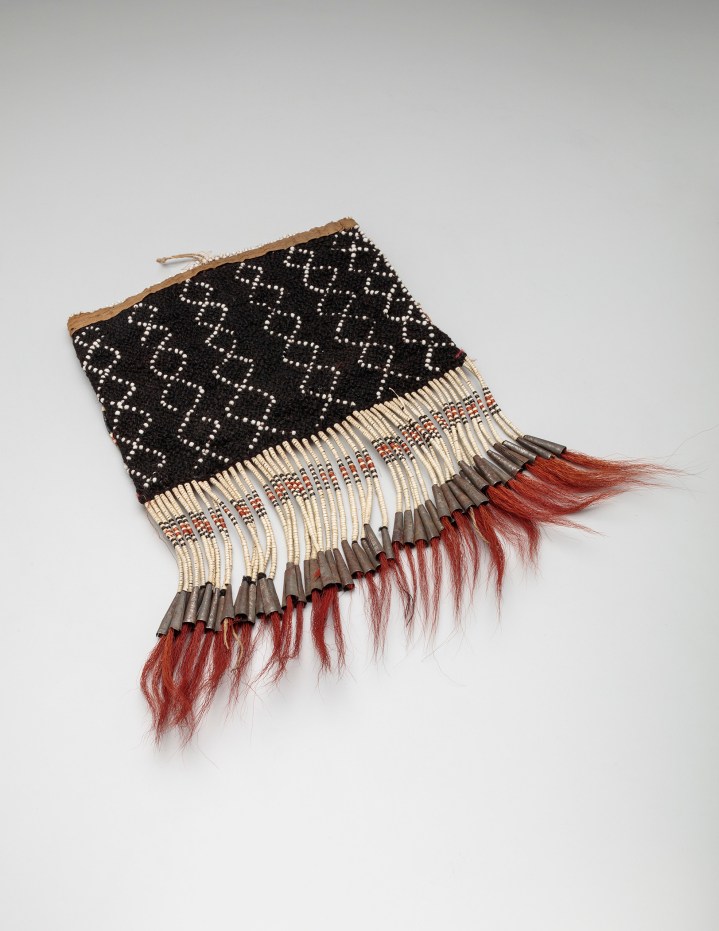
Ancestral Great Lakes artist, Quilled and beaded finger-woven pouch, mid-18th century; wool, birchbark, glass beads, silk, porcupine quills, natural dyes, tin, deer fur, and hide, 38 × 38 × 1 cm (Toledo Museum of Art, purchased with funds from the Florence Scott Libbey Bequest in Memory of her Father, Maurice A. Scott, 2023.357).
“Return to Turtle Island offers a unique window into a period of dynamic interaction between Indigenous and European communities in North America,” said Johanna Minich, the museum’s consulting curator of Native American art. “These objects represent far more than material goods—they serve as symbols of artistic knowledge, cultural exchange, and diplomacy that shaped early American history.”
Featuring 24 objects, including quillwork, beadwork, moosehair embroidery, and birchbark artforms acquired by TMA in 2023, this exhibition examines how Indigenous nations used these objects as tools of cultural expression, political alliance, and commerce during a time of dynamic interaction with European settlers.
“This exhibition exemplifies the Toledo Museum of Art’s strategy: That a relentless commitment to quality results in global and inclusive art history.” said Adam Levine, Edward Drummond and Florence Scott Libbey Director, President, and CEO. “By showcasing these extraordinary objects, we are fostering a deeper understanding of the interconnectedness of cultures and their enduring contributions to our shared history.”
The exhibition highlights the artistic skills of women and how their creative output was an integral part of nation-building, diplomacy, and economic sustainability. Indigenous leaders exchanged gifts and knowledge with their French and English allies during the sixteenth through eighteenth centuries, which had lasting implications for both Native and European communities.
Highlights include
• A quilled and beaded finger-woven pouch, a testament to the artistry of its makers.
• Beaded and quilled fingerwoven pictorial garter pendants, symbolizing the significance of proper attire when forming alliances.
• A birchbark model canoe and three dolls with assorted equipment, showcasing the cross-cultural artistic exchanges of the era.
The objects were originally collected through gift exchanges and purchases during the 18th century by Scottish officer Alexander Farquharson during his military travels through New York and Canada. For centuries, they remained in his family estate in Scotland before returning to North America in the early 2000s. TMA acquired the collection in late 2023.
To ensure the ethical conservation and presentation of these objects, TMA is collaborating with the Great Lakes Research Alliance (GRASAC) at the University of Toronto. Drawing on a network of Indigenous scholars and knowledge keepers, GRASAC provides guidance on the care and contextual display of these significant artworks.
“This collaboration with GRASAC ensures that the legacy of these objects is preserved with the utmost respect,” Minich added. “By working with descendants of their makers, we honor the original purpose of these works: sharing knowledge and strengthening relationships.”
Return to Turtle Island: Indigenous Nation-Building in the Eighteenth Century is made possible with the generous support of Presenting Sponsors Susan and Tom Palmer; Season Sponsors Taylor Automotive Family and the Rita Barbour Kern Foundation; Platinum Sponsor AGC of Northwest Ohio; and additional funding from the Ohio Arts Council, which receives support from the State of Ohio and the National Endowment for the Arts.
New Book | Beautiful Shells
From Bodleian Library Publishing, with distribution by The University of Chicago Press:
Mark Carnall, Beautiful Shells: George Perry’s Conchology (Oxford: Bodleian Library, 2025), 192 pages, ISBN: 978-1851246168, £25 / $40.
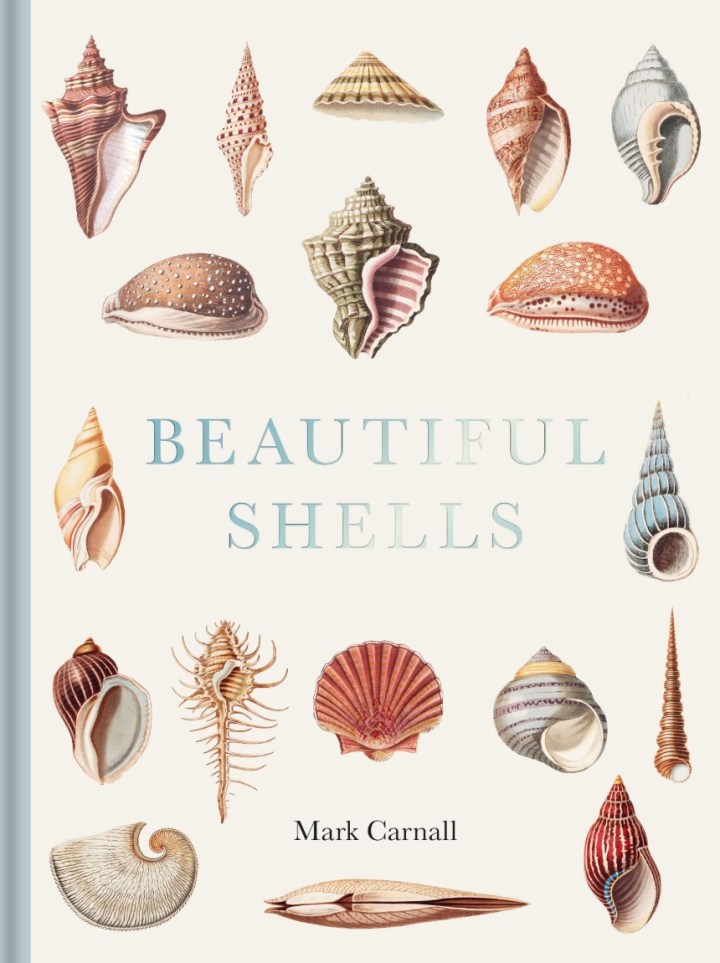 In 1811, architect, stone mason, and shell obsessive George Perry published his lavishly illustrated volume, Conchology or the Natural History of Shells. The work featured 348 beautifully illustrated mollusk shells with descriptions of species, many of which were new to science. Despite the effort that went into producing it—and at a time when conchophilia, or shell fancying, was at its height—Perry’s Conchology disappeared from scientific literature, after being suppressed by the leading conchologists of the day and then cruelly mocked for decades after. Beautiful Shells reproduces the stunning, exquisitely drawn, and sometimes fanciful shell illustrations from this extraordinary forgotten volume. Following an introduction exploring our fascination with shells and their impact on human history, culture, and science, each of the sixty-one color illustrations is included alongside a description of notable shells and what is known of the mysterious organisms that make them. From the common limpet and razor clam to the valuable cowry and spectacular divine conch, the wide range of featured shells form a treasure trove of natural beauty from our oceans and shores.
Mark Carnall is collections manager of human remains and non-insect invertebrate collections at the Oxford University Museum of Natural History.
c o n t e n t s
Introduction
The Shells
Appendix
Notes
Bibliography
Picture Credits
Index
New Book | Catesby’s Natural History
From Bodleian Library Publishing, with distribution by The University of Chicago Press:
Stephen Harris, Catesby’s Natural History (Oxford: Bodleian Library, 2024), 304 pages, ISBN: 978-1851246397, £50 / $75.
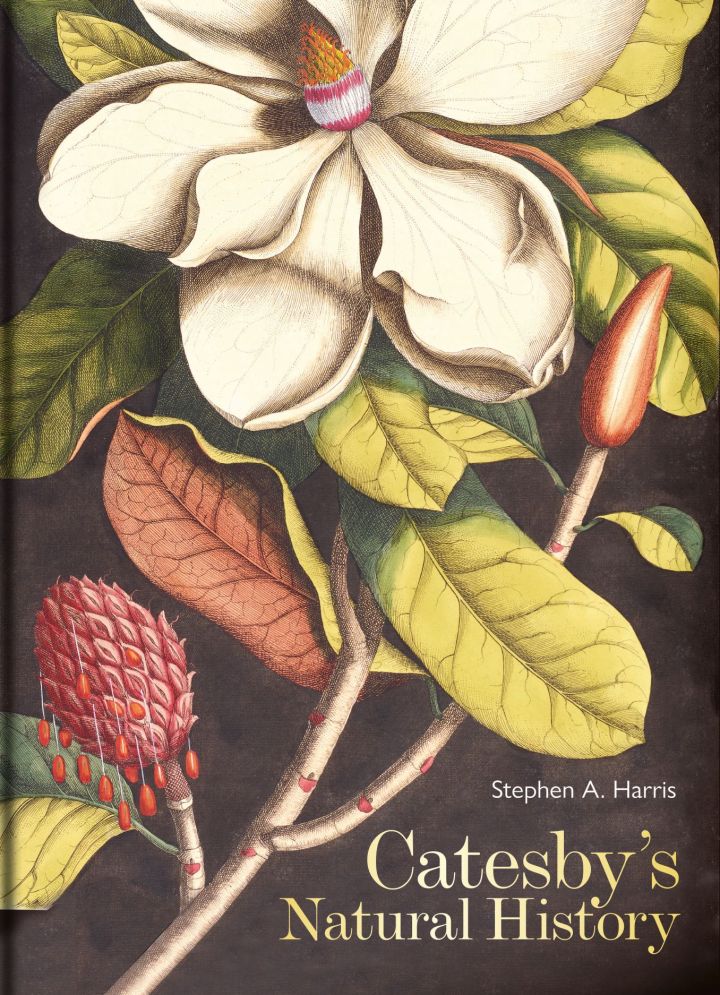 A beautiful reproduction of naturalist Mark Catesby’s flora and fauna illustrations of North America and the Caribbean.
Mark Catesby was an eighteenth-century naturalist and artist whose work on the natural history of North America and the Caribbean still resonates today. During several perilous trips, Catesby collected specimens and made extensive observations in the field, gathering material that would eventually become The Natural History of Carolina, Florida and the Bahama Islands, which featured 220 elaborate, distinctive hand-colored illustrations.
With their striking combinations of animals and plants paired together with the first-hand observations he made, Catesby’s stunning illustrations were widely appreciated in their time and catalyzed interest in the natural history of Colonial America. Ultimately, his work was established as a key reference for the scientific understanding of natural history. As an artist, Catesby meticulously recorded the environment, sifting fact from fiction about the lives of the plants and animals he observed. As a collector, he introduced many living plants to Britain, thereby changing European gardens forever. Catesby’s Natural History reproduces all the original plates and shows how Catesby’s practical field experience shaped his work in all areas. Whether through the now-extinct species he recorded or the cultural changes he witnessed, his research continues to be relevant, demonstrating the vulnerability and fragility of the natural world.
Stephen A. Harris is Druce Curator of Oxford University Herbaria.
c o n t e n t s
1 Natural History in the Thirteen Colonies
2 Who was Mark Catesby?
3 On Habitats and Uses
4 On Indigenous and Enslaved Peoples
5 On Collection and Cultivation
6 On Illustrations
7 On Publishing the Natural History
8 Legacy
Call for Essays | Rethinking the Material Afterlives of Animals
From ArtHist.net:
Essay Collection | Rethinking the Material Afterlives of Animals, 1500–1800
Edited by Catherine Girard and Sarah Grandin
Proposals due by 30 April 2025; final essays due February 2026
Do animals introduce a material difference to objects from the early modern period? Should scholars think differently about objects that include animal remains than they do about other materials? The editors of this volume invite essays that examine human and non-human animal relations through objects made of animal remains in the early modern period to investigate this possible difference. This era saw intensified zoological research alongside the expansion of armed trade, overland and maritime travel, and extractive industries dependent on biotic materials. These shifts shaped the ways in which animal remains were preserved, transformed, and recontextualized within artistic and economic networks. Rather than treating these materials in terms of visual encounters alone, contributors to this volume are asked to foreground the visceral and tactile engagements generated by objects crafted with materials such as fur, skin, quills, feathers, shells, ivory, and bones.
We encourage essays that stem from diverse epistemologies and that explore alternative approaches to thinking about artistic materials. How might perspectives that emphasize reciprocity and relationality, for instance, reshape art historical approaches to objects made with and from animals? How does animal presence both ‘construct and disrupt’ human culture? How are the material ‘affordances’ of biomatter—their ability to alert, lubricate, protect, join, support—preserved, distorted, or deferred in human-made objects? How do such materials maintain continuity with their former life and how are they fundamentally altered? We invite contributors to reflect on how their work can be a site of reconciliation, acknowledging both the original contexts of these materials and the contemporary responsibilities of their material, intellectual, and spiritual caretakers.
The book seeks full-length essays that examine moments of transformation in the lives of these animal materials: from the deep ecological knowledge of those who sourced these materials, to the artisans and artists who processed them, to the wearers and collectors who recontextualized them. How do the acts of sourcing, crafting, and collecting materialize particular worldviews? How do these objects navigate tensions between organic and inorganic, sentient and non-sentient entities? What are the limits of such categories?
We also invite shorter contributions that explore the specific ethical and methodological challenges that museological care and conservation raise. How does the field of conservation reckon with biotic materials’ instability and latent animacy? What are the ethical implications of working with such materials? How do artists, scholars, curators, and knowledge-keepers participate in the care of historical objects that include animal substrates?
As a whole, this volume aims to chart new methods for engaging with animal materials in the archive, interrogating how anthropocentrism and colonialism have shaped art history’s disciplinary practices and omissions. We welcome contributions from scholars in art history, visual and material culture, museum studies, and related disciplines who are interested in rethinking the material afterlives of animals from diverse cross-cultural, temporal, and methodological perspectives.
Please submit a 500-word abstract to Catherine Girard (St. Francis Xavier University, cgirard@stfx.ca) and Sarah Grandin (The Courtauld Institute of Art, Sarah.Grandin@courtauld.ac.uk) by 30 April 2025, specifying whether you are planning to write a full-length essay of up to 8000 words or a shorter contribution of up to 4000 words, including notes. Final essays will be due in February 2026.
Lecture | Jessica Riskin on Lamarck
Upcoming at Yale University:
Jessica Riskin
Professor of Insects and Worms: Jean-Baptiste Lamarck and his Life-Made World
27th Lewis Walpole Library Lecture
Yale University, New Haven, 30 April 2025, 5.30pm
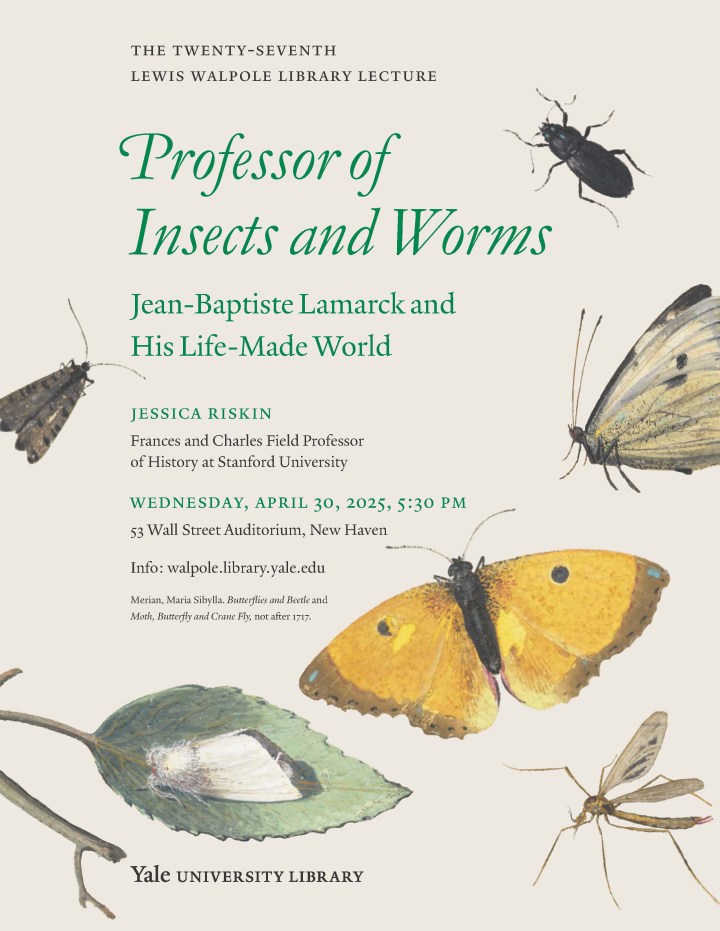 Jean-Baptiste Lamarck (1744–1829) was the Professor of Insects and Worms at the Museum of Natural History in Paris. Living through the storms of the French Revolution and Napoleonic period, he founded biology, coining the term to name a new science devoted to all and only living things, and authored the first theory of evolution. Lamarck’s science was foundational to modern biology, yet its radicalism—he usurped God’s monopoly on Creation and re-assigned it to mortal, living beings—brought him and his ideas plenty of trouble. During Lamarck’s lifetime, Napoleon and his scientific inner circle hated him and did what they could to undermine him. Charles Darwin then adopted central elements of Lamarck’s theory, but after Darwin’s death, his most influential followers re-interpreted his theory to eradicate all traces of Lamarckism, rendering organisms once again the passive objects of outside forces, allowing room for an omnipotent God working behind the scenes. This conception of living organisms as passive in the evolutionary process has remained dominant since the turn of the twentieth century. In contrast, in Lamarck’s theory, living beings were active, creative, self-making and world-making. Elements of this very different conception of living organisms have recently, gradually been returning to mainstream biology in fields such as niche construction and epigenetic inheritance.
The lecture will present Lamarck’s radical, embattled, and perhaps re-emerging approach to living things, their evolutionary and ecological agency, and the science that studies them. The event is free and open to the public, with no registration required.
Jessica Riskin, the Frances and Charles Field Professor of History at Stanford University, teaches modern European history and the history of science. Her work examines the changing nature of scientific explanation, the relations of science, culture and politics, and the history of theories of life and mind. Her books include The Restless Clock: A History of the Centuries-Long Argument over What Makes Living Things Tick (2016), which was awarded the 2021 Patrick Suppes Prize in the History of Science from the American Philosophical Society, and Science in the Age of Sensibility (2002), which received the American Historical Association’s J. Russell Major prize for best book in French history. She is a regular contributor to various publications including Aeon, the Los Angeles Review of Books, and The New York Review of Books.
Exhibition | Andrea Appiani (1754–1817)
Now on view at the Château de Bois-Préau in Rueil-Malmaison (as noted at Art History News) . . .
Andrea Appiani (1754–1817): Napoleon’s Painter in Italy
Musée national des châteaux de Malmaison et Bois-Préau, 16 March — 28 July 2025
Curated by Francesco Leone, Fernando Mazzocca, and Simone Ferraro
 Une centaine d’oeuvres—peintures, dessins, gravures, médailles appartenant à des collections européennes publiques et privées—sont réunies pour la première rétrospective organisée en France sur cet artiste, considéré comme le plus important peintre de la période néo-classique au nord de l’Italie. L’exposition révélera un portraitiste attachant et un fresquiste brillant, malgré la destruction d’une partie de ses décors peints au Palais Royal et dans certains hôtels particuliers milanais durant les bombardements de 1943.
Victorieux à la bataille du Pont de Lodi le 10 mai 1796, le général Bonaparte fait son entrée dans Milan le 15. Il y rencontre Appiani dont le talent est reconnu pour des décors de théâtre, d’hôtels particuliers et d’églises ainsi que des portraits. La manière de l’artiste a déjà perdu de la relative raideur de ses débuts et le peintre-décorateur sait combiner la précision et la fermeté du trait avec la délicatesse du modelé et la suavité de la matière. Trois ans plus tard, au retour des Français, à l’occasion de la Deuxième campagne d’Italie, Appiani se voit confier par Napoléon la charge de sélectionner les oeuvres d’art prélevées dans les églises et les couvents pour enrichir et faire rayonner les musées du Nord de la péninsule.
L’ascension d’Appiani, iconographe de la république puis du Royaume d’Italie est consacrée par le nombre important de commandes publiques et privées qu’il reçoit alors. En cinq séquences chronologiques et thématiques, l’exposition permet de montrer l’oeuvre de l’artiste à la fois fresquiste et peintre de chevalet : La carrière pré-napoléonienne, Les Fastes de Napoléon, Portraits publics et privés, Décors à fresque et, Fortune artistique d’Appiani.
Présentée dans les salons du château de Bois-Préau, l’exposition révèle au public le talent et la richesse de l’oeuvre de cet artiste au service de l’Empereur. L’exposition présente la manière sensible, monumentale ou intimiste du plus grand artiste milanais de son temps : les débuts d’un peintre formé au dix-huitième siècle, les scènes de la geste napoléonienne et de la république naissante, les effigies de Napoléon et Joséphine, les études et dessins préparatoires pour les décors des hôtels particuliers et des églises.
Exposition produite par le GrandPalaisRmn.
Rémi Cariel, ed., Andrea Appiani: Le peintre de Napoléon en Italie (Paris: Éditions Flammarion, 2025), 224 pages, ISBN: 978-2711880737, €40.
◊ ◊ ◊ ◊ ◊
At the Italian Cultural Institute in Paris:
Rémi Cariel and Alessandro Morandotti | Andrea Appiani et la tradition artistique de la Lombardie
Institut culturel italien, Paris, 31 March 2025, 6.30pm
A l’occasion de l’exposition temporaire Andrea Appiani (1754–1817): Le peintre de Napoléon en Italie, l’Institut Culturel Italien rend hommage à ce grand peintre italien avec une conférence autour de sa figure. La conférence explorera sa vie et sa carrière avec une attention particulière aux racines de sa culture. Avec Rémi Cariel, conservateur en chef du patrimoine en charge des collections de peintures, sculptures et arts graphiques du Musée Malmaison et Alessandro Morandotti, professeur d’histoire de l’art moderne et président du cursus d’Histoire de l’Art de l’Université de Turin.
Book tickets here»
New Book | The Soldier’s Reward
From Princeton UP:
Jennifer Ngaire Heuer, The Soldier’s Reward: Love and War in the Age of the French Revolution and Napoleon (Princeton: Princeton University Press, 2025), 384 pages, ISBN: 978-0691262574, £38 / $45.
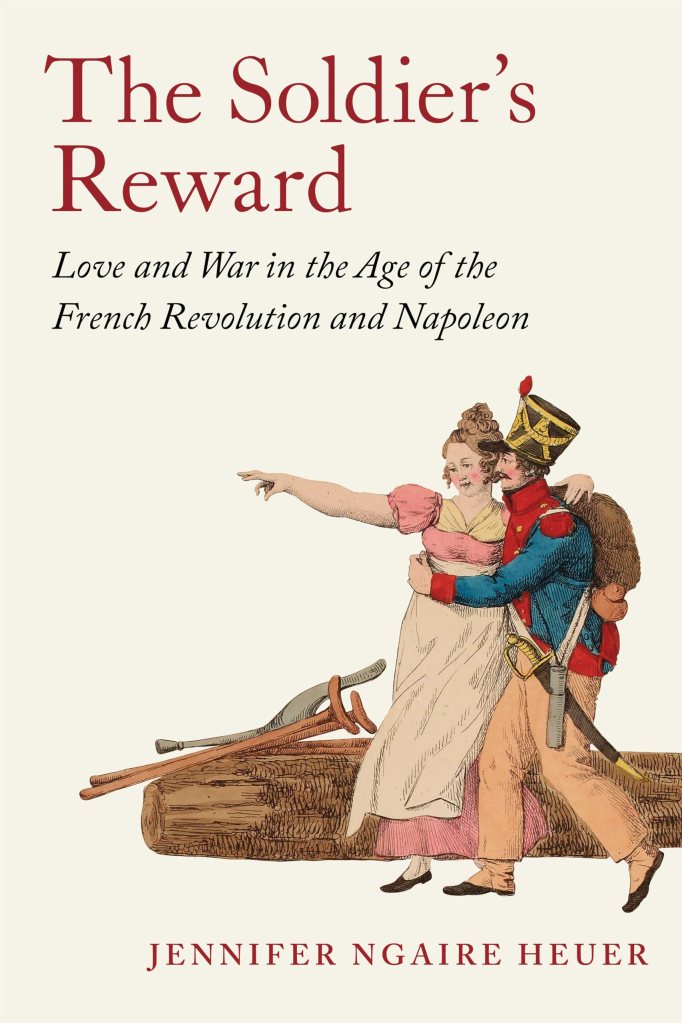
A sweeping history of intimacy and family life in France during the age of revolution
The French Revolution and Napoleonic Wars devastated Europe for nearly a quarter of a century. The Soldier’s Reward recovers the stories of soldiers and their relationships to family and domestic life during this period, revealing how prolonged warfare transformed family and gender dynamics and gave rise to new kinds of citizenship.
In this groundbreaking work combining social, cultural, gender, and military history, Jennifer Ngaire Heuer vividly describes how men fought for years with only fleeting moments of peace. Combatants were promised promotion, financial gain, and patriotic glory. They were also rewarded for their service by being allowed to return home to waiting families and love interests, and with marriages that were arranged and financially supported by the state. Heuer explores competing ideas of masculinity in France, as well as the experiences of the men and women who participated in such marriages. She argues that we cannot fully understand the changing nature of war and peace in this period without considering the important roles played by family, gender, and romantic entanglements. Casting new light on a turbulent era of mass mobilization and seemingly endless conflict, The Soldier’s Reward shows how, from the Revolution through the Restoration, war, intimacy, and citizenship intersected in France in new and unexpected ways.
Jennifer Ngaire Heuer is professor of history at the University of Massachusetts, Amherst. She is the author of The Family and the Nation: Gender and Citizenship in Revolutionary France, 1789–1830 and the editor (with Mette Harder) of Life in Revolutionary France.
Exhibition | Brenet: Painter to the King
As noted at Art History News, from the press materials for the exhibition:
Brenet: Un peintre du roi à Douai au 18e siècle
Musée de la Chartreuse, Douai, 19 March — 23 June 2025
Curated by Pierre Bonnaure and Marie Fournier
 Le musée de la Chartreuse de Douai présente la première exposition jamais consacrée au peintre Nicolas-Guy Brenet (Paris, 1728–1792), l’un des rénovateurs de la peinture d’Histoire à la veille de la Révolution.
Formé auprès des plus grands maîtres de la première moitié du 18e siècle (Charles Antoine Coypel, François Boucher et Carle Vanloo), puis à l’Académie de France à Rome, Nicolas-Guy Brenet est reçu à l’Académie royale de peinture et de sculpture en 1769, l’année même où il exécute de grands décors pour Douai. Il conçoit un cycle de six peintures allégoriques toujours en place au sein de l’actuel palais de justice, l’ancien parlement de Flandre. Il travaille également au décor de la collégiale Saint-Pierre en peignant un spectaculaire Triomphe de la Vierge, encore visible à son emplacement d’origine, dans la chapelle du Dôme. À Paris, il honore tout au long de sa carrière de prestigieuses commandes destinées principalement à l’Église, ainsi qu’aux rois Louis XV et Louis XVI.
Cette première exposition consacrée à Nicolas-Guy Brenet permet de découvrir à travers une sélection de tableaux, d’esquisses et de dessins, un artiste emblématique du renouveau de la peinture d’Histoire de la seconde moitié du siècle des Lumières et d’apprécier la richesse de la vie artistique douaisienne au temps des parlementaires de Flandre.
• 42 œuvres exposées dans la salle capitulaire du musée de la Chartreuse
• 37 prêteurs (particuliers et institutions), dont le musée du Louvre et le château de Versailles, les musées de Compiègne, Quimper, Dunkerque, Orléans, Strasbourg, Blois etc.
Information about Marie Fournier’s 2023 monograph on Brenet is available here»
The full exhibition brochure is available here»
Tavitian Foundation Donates 331 Works and $45millon to The Clark
A belated posting for a major announcement from October:
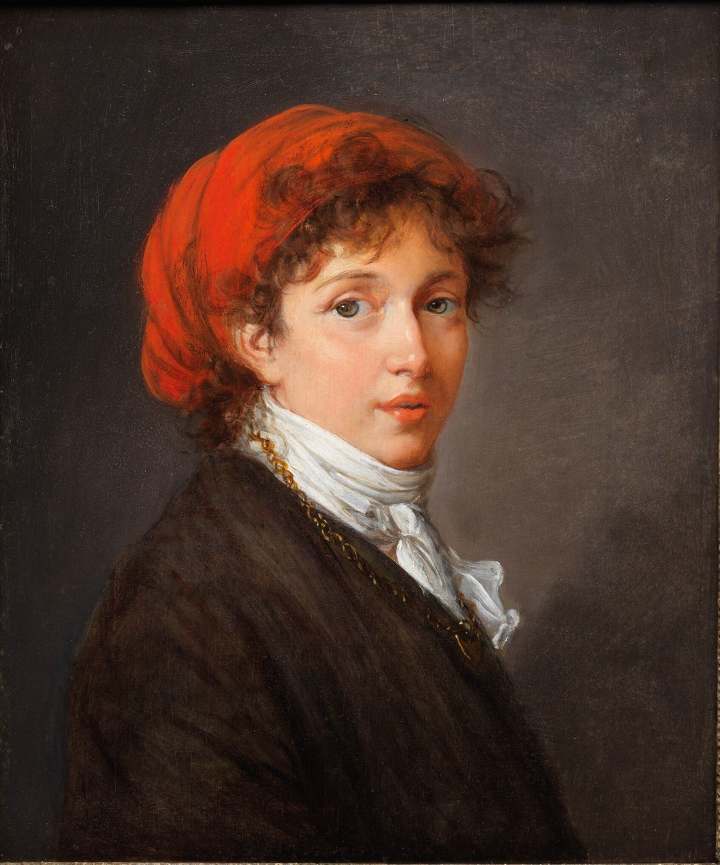
Élisabeth Louise Vigée Le Brun, Self Portrait in Studio Costume, ca. 1800 (Williamstown, Massachusetts: Clark Art Institute).
The Clark Art Institute has received one of the largest gifts in its history from the foundation of the late philanthropist Aso O. Tavitian. The gift includes 331 works of art from Mr. Tavitian’s personal collection and more than $45 million to endow a curatorial position to oversee the collection, provide necessary support for the collection’s long-term care, and fund construction of a new Aso O. Tavitian Wing at the Clark.
“It is an incredible honor to receive this transformational gift,” said Olivier Meslay, Hardymon Director of the Clark Art Institute. “During his lifetime, Aso Tavitian was a wonderful friend to the Clark and a generous supporter who provided us with exceptional leadership and dedication. We are deeply moved by his decision to place the heart of his collection in our trust and immensely grateful to the Trustees of his Foundation for their generosity in ensuring that we can fulfill his desire to share these treasures with the world through the addition of the new Aso O. Tavitian Wing that will house these remarkable works of art.”
Mr. Tavitian, who had homes in New York City and Stockbridge, Massachusetts, died in 2020. He served on the Clark’s Board of Trustees from 2006 to 2012 and remained engaged with the Clark throughout his lifetime. In 2011, Mr. Tavitian loaned thirty paintings and one sculpture from his collection to the Clark for the exhibition Eye to Eye: European Portraits, 1450–1850. Prior to his death, Mr. Tavitian made the decision to gift a significant portion of his collection to the Clark and had numerous conversations with the Institute’s leadership about his intentions.
The 331 works of art in the gift include 132 paintings, 130 sculptures, thirty-nine drawings, and thirty decorative arts objects, creating an important addition to the Clark’s holdings. The entirety of the Tavitian gift will be on view when the new Aso O. Tavitian Wing opens. Following an introductory presentation at the time of the new wing’s opening, the works on paper included in the gift will be made available for study purposes and be presented in periodic displays. The majority of paintings, sculpture, and decorative arts objects will be shown on a continual basis, both in the new Tavitian Wing and in the Clark’s permanent collection galleries.
The Tavitian gift is particularly rich in portraiture, including important works by Parmigianino, Peter Paul Rubens, Elizabeth Vigée Lebrun, Jean-Honoré Fragonard, and Jacques- Louis David, among others. Also included in the collection are landscapes by Hubert Robert, Claude-Joseph Vernet, and others, as well as religious paintings by artists including Jan van Eyck and Agnolo Bronzino. Sculpture is a great strength of the Tavitian Collection, with works in bronze, plaster, terracotta, marble, and other materials dating from the Renaissance through the late nineteenth-century by artists including Gian Lorenzo Bernini, Andrea della Robbia, Gil de Siloé, Clodion (Claude Michel), and Jean-Baptiste Carpeaux.
“Aso Tavitian’s collection of Early Modern paintings, sculpture, decorative arts, and drawings is truly one of the finest in the world,” said Esther Bell, Deputy Director and Robert and Martha Berman Lipp Chief Curator of the Clark. “In making this tremendous gift to the Clark, Aso ensured that the public will have access to these beautiful objects for future generations. We are eagerly anticipating the opportunity to share these works with our visitors.”
The Clark’s existing collection of paintings and sculpture ranges from the Renaissance to the end of the nineteenth century, with strengths in the second half of this period, and greater strength in paintings than in sculpture. The Tavitian gift covers the same period, but with strengths in the earlier periods, and with greater balance between paintings and sculpture. As such, this collection forms a perfect complement and addition to the Clark’s current holdings.
“Aso Tavitian was committed to creating a home for a significant part of his collection at the Clark, where the works that brought him such deep pleasure could be shared with the public,” said Candace Beinecke, President of the Aso O. Tavitian Foundation. “The trustees of the Tavitian Foundation are thrilled to see Aso’s wishes come to life in new galleries that will provide a glorious setting for his magnificent collection and a fitting tribute to this remarkable man’s legacy.”
In addition to the works of art and funding for a new addition, the gift creates an endowment for a new curatorial position, the Aso O. Tavitian Curator of Early Modern European Painting and Sculpture, as well as additional staffing to ensure continuous oversight of the works included in the collection. The gift also supports the publication of a catalogue documenting the collection, as well as the ongoing care and maintenance of the Tavitian Collection and the new facility.
The Aso O. Tavitian Wing
The Clark and the Trustees of the Tavitian Foundation jointly selected Selldorf Architects to design the new Aso O. Tavitian Wing that will be constructed on the Clark’s campus. The new facility will be positioned between the existing Museum Building and the Manton Research Center, creating a completely reconceived and more meaningful link between the two buildings and replacing the ‘bridge’ that was originally created during the 1973 addition designed by Pietro Belluschi and The Architects Collaborative, Cambridge, Massachusetts.
Annabelle Selldorf leads the design team on the project, marking her third major engagement with the Clark. Selldorf previously oversaw the 2014 renovation of the Museum Building and the 2016 renovation of the Manton Research Center’s public spaces and galleries. Completion of the new building is anticipated for some time between 2027 and 2028.
Highlights of the Tavitian Collection at The Clark
Beginning in 2004 and continuing until his death, Mr. Tavitian assembled one of the most important private groupings of Early Modern art amassed in this generation. Mr. Tavitian’s collection reflected his personal taste, his extraordinary eye, and his belief that seeing these works displayed together further illuminated each object.
Following Mr. Tavitian’s death, his foundation gifted two paintings from his collection to The Metropolitan Museum of Art (Francesco Salviati’s Bindo Altoviti, ca.1545) and The Frick Collection (Giovanni Battista Moroni’s Portrait of a Woman, ca.1575). These paintings featured prominently in exhibitions that were presented at these institutions in recent years. The gift to the Clark honors Mr. Tavitian’s wishes to keep a significant portion of his art collection intact so that the artworks could be displayed together.
The collection includes major works by many noted artists. Among the many important works included in the Tavitian gift are:
• Jan van Eyck (Netherlandish, ca. 1390–1441) and workshop, Madonna of the Fountain, ca. 1440, oil on panel. This rare panel is one of several period versions of one of Van Eyck’s last paintings, dated to 1439 and in the Koninklijk Museum voor Schone Kunsten in Antwerp.
• Andrea della Robbia (Italian, 1435–1525/1528), Portrait of a Youth, ca. 1470–80, glazed terracotta. This exceptional work by Ieading Italian Renaissance sculptor della Robbia is modeled in deep relief, with the head and neck set off against a simple roundel glazed in blue, resulting in a sculpture that is remarkably lifelike and modern.
• Gil de Siloé (Spanish, active 1486, died ca. 1501), Saint Cecile, ca. 1500, marble. This rare, delicately carved, sculpture was made by one of the leading Late Gothic artists of fifteenth-century northern Spain, likely as an object of private devotion.
• Jacopo da Pontormo (Italian, 1494–1557), Portrait of a Boy, ca. 1535–40 or later, oil on fired tile. This sensitive, Mannerist depiction of an unknown boy, possibly a studio assistant, is rendered on the unusual support of a thick terracotta tile.
• Peter Paul Rubens (Flemish, 1577–1640), Portrait of a Young Man, ca. 1613–15, oil on panel. While the identity of the sitter is no longer known, this portrait—made following the artist’s return from Rome in what is arguably his most fertile period—is a superb example of Rubens’s ability to capture the subtleties of character.
• Gian Lorenzo Bernini (Italian, 1598–1680), Countess Matilda of Canossa, ca. 1630–39, bronze. This small-scale bronze figure is a reduction of the over life-size marble Bernini made for the tomb of Countess Matilda in St. Peter’s Basilica, Rome. The Tavitian gift also includes a rare painting by Bernini, thought to be a portrait of his brother Luigi.
• Hubert Robert (French, 1733–1808), Colonnade and Gardens at the Villa Medici, ca. 1759, oil on canvas. The collection includes three landscapes by Hubert Robert, including this monumental plein air vista of gentlemen sketching on the grounds of the French Academy in Rome.
• Jean-Antoine Houdon (French, 1741–1828), Little Lise, 1775, marble. The delicate carving of the hair, ribbon, and face of a young woman demonstrates Houdon’s unparalleled artistic refinement.
• Elizabeth Louise Vigée-Lebrun (French, 1755–1842), Self-Portrait in Studio Costume, ca. 1800, oil on panel. Several works by women artists are included in the collection, including eighteenth-century portrait painter Vigée-Lebrun, who is represented by this confident self-portrait.
• Jacques Louis David (French, 1748–1825), Portrait of Dominique-Vincent Ramel de Nogaret, 1820, oil on canvas. The artist painted the former finance minister of France during a period when both men were in exile in Brussels following the final abdication of Napoleon in 1815. The gift also includes two other portraits by David, including the pendant portrait of Ramel de Nogaret’s wife, Ange-Pauline-Charlotte Ramel de Nogaret and the portrait of the artist’s son, Jules.










 Enfilade
leave a comment