At Auction | Chinese Export ‘Lady Washington States China’ Plate

◊ ◊ ◊ ◊ ◊
Martha Washington’s Birthday was last Monday (13 June 1731). A plate from her tea service sold earlier in the month at Grogan and Company:
A rare Chinese export ‘Lady Washington States China’ plate led the Grogan & Company’s June 5 auction in Boston. Capturing the attention of public institutions and private collectors alike, the ‘Lady Washington States China’ plate soared above its $25,000–50,000 pre-sale estimate when it fetched $244,000 in The June Auction (Sale 154, Lot 37). The plate is an example from Martha Washington’s porcelain tea service of approximately 40 pieces, presented to her in April 1796 by the Dutch trader Andreas van Braam Houckgeest. Designed for Mrs. Washington by van Braam himself, the service celebrated the nascent United States of America through the decorative motif repeated on each piece. Today, fewer than 20 pieces of the remarkable service remain.
Call for Nominations | SAH Publication Awards, 2017
From H-ArtHist:
The Society of Architectural Historians Publication Awards
Nominations due by 1 August 2016
The Society of Architectural Historians is accepting nominations for its 2017 Publication Awards. The program includes five awards that will be presented at the Society’s 2017 Annual International Conference (Glasgow, June 7–11). The deadline to submit is Monday, August 1, 2016.
• Alice Davis Hitchcock Book Award Presented for distinguished scholarship by a North American author in the history of architecture
• Philip Johnson Exhibition Catalogue Award Presented for excellence in published exhibition catalogues
• Antoinette Forrester Downing Book Award Presented for an outstanding publication devoted to historical issues in the preservation field
• Elisabeth Blair MacDougall Book Award Presented for distinguished scholarship in the history of landscape architecture or garden design
• Spiro Kostof Book Award Presented for work that focuses on urbanism and architecture and provides the greatest contribution to our understanding of historical development and change
Learn more and download a nomination form at the SAH website.
Exhibition | Emperors’ Treasures: Chinese Art from Taipei

Press release (2 May 2016) from the Asian Art Museum:
Emperors’ Treasures: Chinese Art from the National Palace Museum, Taipei
Asian Art Museum, San Francisco, 17 June — 18 September 2016
Museum of Fine Arts, Houston 23 October 2016 — 22 January 2017
Curated by Jay Xu and Li He
The centerpiece of the Asian Art Museum’s 50th anniversary year, Emperors’ Treasures: Chinese Art from the National Palace Museum, Taipei, presents nearly 150 imperial masterworks, many of which are making their North American debut. Visitors will discover a trove of exquisite paintings, ceramics, jades and more from one of the world’s greatest collections of Chinese art. The exhibition offers audiences a chance to behold the prized possessions of eight emperors and an empress, passed from dynasty to dynasty and once sheltered in Beijing’s Forbidden City. A glimpse into the artistic life inside an imperial palace, the exhibition showcases how family collections were refined over generations, showcasing rare pieces created by emperors themselves in private moments of inspiration.

Leng Mei, Illustrations of Farming and Weaving, ca. 1696; Qing dynasty (1644–1911), reign of Emperor Kangxi (1662–1722). Album leaves, colors on silk (Taipei: National Palace Museum)
“This is the absolute ‘best of the best’ of Chinese imperial art,” says Jay Xu, director of the Asian Art Museum. “By exploring how artistic taste was cultivated and evaluated—which created standards of beauty and elegance across Chinese culture—the exhibition reflects the museum’s mission of connecting audiences today with the great arts and traditions of Asia.”
The meticulously crafted public identities and carefully guarded private lives of each ruler will be told in a story narrated by the artworks of their eras, from the dignified Song to the bold yet subtle Yuan, from the celebrated brilliance of the Ming to the last days of the dazzling Qing dynasty.
While the National Palace Museum, Taipei, is renowned among Chinese art enthusiasts, historically its collection has not been widely accessible to the American public. Displays have traveled to the U.S. only a handful of times: in the 1960s and again in 1995–1996 for an exhibition presented by both The Metropolitan Museum of Art in New York and the Asian Art Museum—an exhibition that Xu also participated in organizing during his time as a junior research fellow there. “It’s exactly 20 years later,” Xu notes. “However, there are many works that haven’t been seen outside Asia before. In terms of the objects and time periods, it’s a fresh perspective for American audiences since the imperial court surrounded itself with the most important, avant-garde works of its time.”
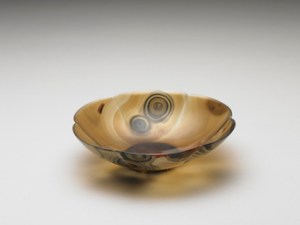
Imperial Workshop, Beijing, Hibiscus-shaped bowl; Qing dynasty, reign of Emperor Yongzheng (1723–1735). Agate (Taipei: National Palace Museum)
Organized around the lives of nine rulers—eight emperors and one empress who reigned from the early 12th through the early 20th centuries—the exhibition will explore how taste and connoisseurship as both personal virtues and statements of political power evolved over 800 years. By examining the distinct contributions of each subject, the rich styles and the variety of craftsmanship they prized, the exhibition outlines how Chinese art developed and flourished under Han Chinese, Mongol and later Manchu regimes. Through this exceptional selection of objects, Emperors’ Treasures presents a unique occasion for audiences to connect with powerful historical figures through their most cherished belongings, relating to them on an intimate, human scale that only art can express.
Emperors’ Treasures unfolds chronologically, allowing audiences to gauge how imperial tastes evolved from within China or due to external pressures, looking backward to ancient examples or blazing forward with new ideas. The exhibition flows through four galleries on the museum’s first floor.
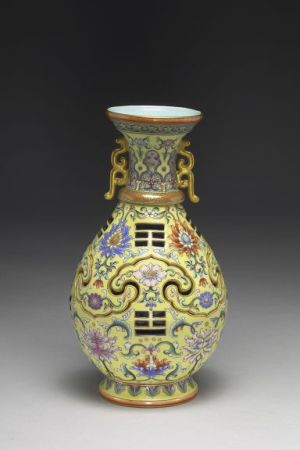
Vase with revolving core and eight-trigram design, ca. 1744. Jingdezhen, Jiangxi province, Qing dynasty, reign of Emperor Qianlong (1736–1795). Porcelain with golden glaze, multicolor decoration, and appliquéd sculpture. (Taipei: National Palace Museum)
Opening in the large Osher Gallery, audiences are introduced to the Song emperors (960–1279), celebrated for leading a renaissance in Chinese art more than 800 years ago. Here, visitors will discover the masterful landscapes and calligraphy of Emperor Huizong, recognized for his distinctive, influential ‘slender-gold’ script. Alongside these elegant works are the robust art pieces and an imposing portrait demanded by the mighty Yuan-dynasty (1271–1368) ruler Kublai Khan. Also in this gallery are legendary Ming porcelains (1368–1644), the pinnacle of ceramic art in China. Highlights include a rare cloisonné vessel; one of only two surviving blue-and-white Ming vases depicting West Asian entertainers; and the ‘holy grail’ of Chinese porcelains—a wine cup with a cock and hen design like the example recently sold at Sotheby’s for more than $36 million.
The adjacent Hambrecht Gallery features an overview of illustrious Qing-dynasty accomplishments (1644–1911). During this period, a dozen imperial workshops across the Chinese Empire were opened to fulfill the Forbidden City’s relentless appetite for lacquers, enamels and carved jade, like the paper-thin hibiscus-shaped bowl from the early 1700s, sculpted from a single piece of glowing, nut-brown agate.
Next door is the Lee Gallery, which paints an intimate portrait of the 18th-century Qianlong Emperor, known as the ‘Old Man of Ten Perfections’ and admired as the most prolific poet-monarch in Chinese history. Through a selection of paintings, carvings and other treasures, audiences will see how a single ruler caused a seismic shift in the creative output of China. While many of the masterworks remain quietly breathtaking in their elegance, others certainly call out to the interests of today. The White Falcon hanging scroll by Italian Jesuit Giuseppe Castiglione introduces visitors to an intriguing European figure who spent decades in the Qing court, serving under Emperors Kangxi, Yongzheng, and Qianlong. Having his Chinese name as Lang Shining, Castiglione’s collaboration on court portraits and paintings underscores a tradition of East-West cultural exchange that continues in the current globalized art arena.
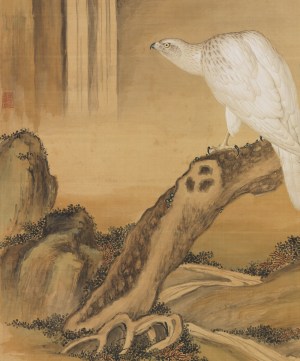
Lang Shining (Giuseppe Castiglione, Italian, 1688–1766), White Falcon; Qing dynasty, reign of the Qianlong emperor (1736–1795). Hanging scroll, colors on silk (Taipei: National Palace Museum)
The exhibition concludes in the museum’s Resource Room with a focus on the Empress Dowager Cixi, a Manchu concubine who rose to become the long-ruling power behind the final Qing emperors. Cixi recruited female artists to her ‘Studio of Great Elegance’, where, under her personal direction, the coterie combined traditional symbols and patterns with botanical study, setting a foundation for modern Chinese aesthetics.
An icon of the National Palace Museum, Taipei, the celebrated Qing-dynasty ‘Meat-shaped stone’ will also be traveling to the U.S. for the first time. The stone—a hunk of jasper carved and dyed to resemble a portion of braised pork belly fresh from the pot—exemplifies how the enduring appeal of traditional Chinese cooking has long inspired devotion. When on view in Japan in 2014, the stone was seen by an average of 6,000 people a day and generated a mini-boom in dongpo rou, the classic dish it closely resembles. In honor of the stone’s unusual appeal, a special edition of the Asian Art Museum’s popular Thursday evening programs will feature innovative new dishes inspired by the Meat-shaped stone and prepared by four local chefs. Their dishes—from street carts to haute cuisine—will be presented to the public on July 7. Additionally, from June 17 to July 18, more than a dozen San Francisco chefs, both up-and-coming and established, will feature versions of the mouthwatering, slow-simmered ‘priceless pork belly’ in their restaurants. Another take on the delicious dish developed by Melinda Quirino, chef at the museum’s own Cafe Asia, will be available for visitors to enjoy throughout the exhibition’s run.

Meat-shaped stone; Qing dynasty (1644–1911). Jasper, golden stand (Taipei: National Palace Museum)
“Emperors’ Treasures is about looking forward and starting the museum’s next 50 years on the right note,” says Xu. “We not only share and present exceptional works of art, but we help people understand their context, significance and relevance.”
Emperors’ Treasures was made possible by a generous grant from Presenting Sponsor, The Robert H. N. Ho Family Foundation. “This important support from The Robert H. N. Ho Family Foundation enables the Asian Art Museum to curate and present Emperors’ Treasures, which will expose a global audience to the beauty and depth of Chinese art and culture,” said Xu.
Ted Lipman, CEO of The Robert H. N. Ho Family Foundation, noted: “This exhibition marks the third collaboration between the Asian Art Museum and The Robert H. N. Ho Family Foundation. A key mission of the Foundation is to promote Chinese culture and the arts to Western audiences to increase understanding and appreciation of this ancient legacy. Nowhere does the 5,000 years of Chinese history manifest itself more beautifully and comprehensively than the exquisite imperial collection, which has been lovingly conserved and displayed at the National Palace Museum, Taipei. Through support for this significant exhibition, the Foundation seeks to provide visitors with an unprecedented opportunity to witness China’s vibrant cultural heritage first-hand.”
Emperors’ Treasures: Chinese Art from the National Palace Museum, Taipei is co-organized by the Asian Art Museum of San Francisco and the National Palace Museum, Taipei. The exhibition is curated by Asian Art Museum Director Jay Xu and Li He, associate curator of Chinese art.
◊ ◊ ◊ ◊ ◊
Jay Xu and He Li, eds., Emperors’ Treasures: Chinese Art from the National Palace Museum, Taipei (San Francisco, Asian Art Museum, 2016), 272 pages, ISBN: 978-0939117734, $50.
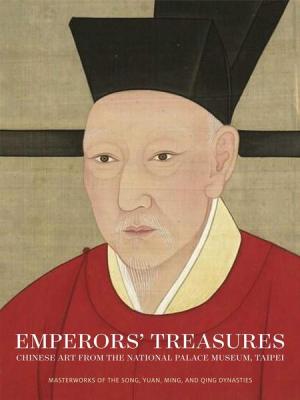 Emperors’ Treasures features artworks from the renowned National Palace Museum, Taipei. It encompasses paintings, calligraphy, bronzes, ceramics, lacquer ware, jades, and textiles exemplifying the finest craftsmanship and imperial taste. The exhibition catalog explores the identities of eight Chinese rulers—seven emperors and one empress—who reigned from the early 12th through early 20th centuries. They are portrayed in a story line that highlights artworks of their eras, from the dignified Song to the coarse yet subtle Yuan, and from the brilliant Ming until the final, dazzling Qing period. Emperors’ Treasures examines each ruler’s distinct contribution to the arts and how each developed his or her aesthetic and connoisseurship.
With contributions by Fung Ming-chu, Jay Xu, Ho Chuan-hsin, Alfreda Murck, Tianlong Jiao, Li He, and curators from the National Palace Museum and the Asian Art Museum.
Jay Xu is Executive Director of the Asian Art Museum of San Francisco. He is the first Chinese American director at a major US art museum and the first Asian American museum director elected to the American Academy of Arts and Sciences.
Li He is associate curator of Chinese Art at the Asian Art Museum of San Francisco and a visiting research fellow at the Palace Museum, Beijing. She is the author of Chinese Ceramics: A New Comprehensive History from the Asian Art Museum of San Francisco.
Conference | Staging the Holy
From H-ArtHist:
Internationaler Barocksommerkurs: Die Inszenierung des Heiligen
Bibliothek Werner Oechslin, Einsiedeln, Switzerland, 26–30 June 2016
Registration due by 24 June 2016
Mit Unterstützung der Schweizerischen Akademie der Geistes- und Sozialwissenschaften und des Schweizerischen Nationalfonds. Die Veranstaltung ist öffentlich. Gasthörer sind herzlich willkommen. Aus organisatorischen Gründen bitten wir um Anmeldung an: info@bibliothek-oechslin.ch.
S U N D A Y , 2 6 J U N E 2 0 1 6
I. Göttliches / Heiliges: Sakramente und Hostie
9.15 Round Table: Einführung mit Axel Christoph Gampp, Stefan Kummer, Werner Oechslin, Tristan Weddigen
9.50 Piet Lombaerde (Universität Antwerpen), Statues of the saints as mirrors of divine light in Jesuit Baroque architecture in the Southern Netherlands
10.30 Kaffeepause
11.00 Evangelia Papoulia (University of London), Pope Gregory XIII’s Staging of the Sacraments in the Lateran
11.40 Helen Boessenecker (Universität Bonn), Heiligenstatuen und “early christian revival”. Zur (Re-)Inszenierung des Heiligen in der römischen Altarskulptur um 1600
12.20 Reinhard Gruhl (Universität Hamburg), Frühneuzeitlich-calvinistische Kultanalyse und Kultkritik in Rivets großem Exodus-Kommentar
13.00 Mittagspause
14.30 Steffen Zierholz (Universität Bern), Bild und Rahmen. Zu Berninis Hauptaltar in Sant’Andrea al Quirinale in Rom
15.10 Tobias Glitsch (RWTH Aachen), Die Sakralisierung des Messgeschehens im Altarraum von S. Andrea al Quirinale
15.50 Kaffeepause
16.20 Mirjam Brandt (Universität Bonn), Gloriosa Antiquitas – Zur Wertschätzung mittelalterlicher vasa sacra im 17. und 18. Jahrhundert
17.00 Mateusz Kapustka (Universität Zürich), Barocke Bildgeometrie der Hostie?
18.30 Gemeinsames Abendessen
M O N D A Y , 2 7 J U N E 2 0 1 6
II. Apparate / Maschinen / Theater
9.00 Johannes Gebhardt (Universität Leipzig/Biblioteca Hertziana Rom), Apparitio Sacri – Occultatio Operis: Zeigen und Verbergen von Kultbildern im Italien des 17. Jahrhunderts
9.40 Ria Fabri (Universität Antwerpen), Staging the sacred: Mechanical systems and a hidden theatre in the Antwerp Jesuit church
10.20 Kaffeepause
10.50 Noria K. Litaker (University of Pennsylvania, Philadelphia), From Bits to Bodies: The Construction and Presentation of Whole-Body Catacomb Saints in Baroque Bavaria
11.30 Jens Niebaum (Universität Münster), “Plus Ultra”: Figuration des Heiligen an der Fassade der Wiener Karlskirche
12.10 Léon Lock (Leuven), Renewing devotional practices in Antwerp in the late 17th century: The role of sculpted saints
13.00 Mittagspause
14.30 Verena Villiger (Museum für Kunst und Geschichte Freiburg), Arbeit an der Inszenierung: Der Maler Hans Fries entwickelt ein Marienbild (um 1504/05)
15.10 Nina Niedermeier (Universität München), Filippo Neri umarmt Ignatius von Loyola – die strahlende Seele als Zeichen von Heiligkeit
15.50 Kaffeepause
16.20 Susanne Lang (Darmstadt), “also reden die Altär und Bildnussen” vom Sterben des Hl. Franz Xaver – zum Beispiel in Rastatt
17.00 Sabrina Leps (Staatliche Kunstsammlungen Dresden), Die Inszenierung des Heiligen Franz Xaver in der protestantischen Diaspora
17.50 Führung durch die Bibliothek
19.00 Gemeinsames Abendessen
T U E S D A Y , 2 8 J U N E 2 0 1 6
Day-long excursions to Hergiswald, Blatten, Lucerne, Sachseln, Beckenried, and Gersau
W E D N E S D A Y , 2 9 J U N E 2 0 1 6
III. Das Innen und Aussen des Heiligen
9.30 Lorenzo Santoro (Università della Calabria, Arcavacata), Giovanni Battista Guadagnini’s Critique of Via Crucis: The Question of the Station of the Cross Ritual in the Italian Late Enlightenment
10.10 Matija Jerkovic (Pontificia Università Gregoriana, Rom), Sacred Art and Its Liturgical Staging: Reliquary Bust of Saint Stephen of Hungary
10.50 Kaffeepause
11.20 Stephan Boll (Universität Stuttgart), Santa Rosalia von Palermo: Die Inszenierung einer neuen „alten“ Heiligen im Barock
12.00 Marek Pučalík (Karlsuniversität Prag), “Catholische Vergötterung des Heiligen Johann von Nepomuck“: Eine unbekannte Beschreibung der Triumphpforten zur Feier der Kanonisation des hl. Johann Nepomuk in Prag (1730)
13.00 Mittagspause
14.30 Barbara Lawatsch-Melton (Emory University, Atlanta), Celebrating Sanctity at Nonnenberg Abbey (1622–1682): Observing and Transcending Boundaries
15.10 Claire Guinomet (Humboldt-Forum Berlin), Die Inszenierung des Heiligen am Beispiel des Tempietto-Tabernakels im 16. und 17. Jahrhundert
15.50 Kaffeepause
16.20 Peter Heinrich Jahn (TU Dresden), Evozierte Sakralität in profanem Kontext – Inszenierungen der polnischen Königswürde in den Dresdner Residenzschlossplanungen des Matthäus Daniel Pöppelmann
17.00 Virgil Pop (Universitatea Tehnica din Cluj-Napoca), The Restorations of Medieval Churches in Transylvania in the Age of Baroque
T H U R S D A Y , 3 0 J U N E 2 0 1 6
IV. Orte und Wege
9.30 Thomas Wilke (Stuttgart), Das Turiner Grabtuch – die „Staatsreliquie“ der Savoyer
10.10 Silvia Tammaro (Universität Wien), Die Edicola del Santissimo Sacramento von Turin und ihre Darstellung im Theatrum Sabaudiae
10.50 Kaffeepause
11.20 Madleine Skarda (Universität Zürich), “Heiliger Weeg von Prag nach Alt-Bunzlau”: Die Nischenkapellen auf dem Weg zur Martyrienstätte des Heiligen Wenzelsplatz in Stará Boleslav
12.00 Kerstin Borchhardt (Universität Leipzig), Die göttliche Kausalität der Radiolarien-Ikonen: Ernst Haeckels Ästhetik und Inszenierung seiner monistischen Weltformel
13.00 Mittagspause
14.30 Stephan Wyss (Marly FR), Die Inszenierung des Heiligen in umgekehrter Perspektive. – Kunst und Theologie, Pavel Florenskij und Martin Buber
15.10 Joris van Gastel (Bibliotheca Hertziana Rom), Dressing Up the Holy: Stoffwechsel and Ephemerality in Baroque Naples
15.50 Kaffeepause
16.20 Jürgen Müller (TU Dresden), Caravaggio und das Heilige
17.00 Werner Oechslin (Stiftung Bibliothek Werner Oechslin, Einsiedeln), Afterthought: „die historische Construction des Christenthums“
18.30 Abschiedsabendessen
Exhibition | The English Rose: Feminine Beauty
Now on view at The Bowes Museum:
The English Rose: Feminine Beauty from Van Dyck to Sargent
The Bowes Museum, Barnard Castle, County Durham, 14 May — 25 September 2016
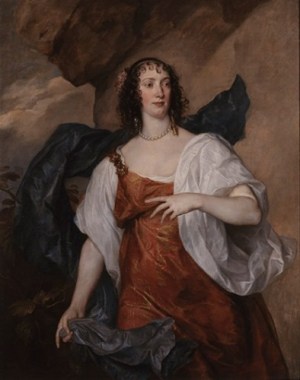
Anthony van Dyck, Portrait of Olivia Porter, ca. 1637 (The Bowes Museum)
The catalyst for The English Rose: Feminine Beauty from Van Dyck to Sargent—a salute to 400 years of society beauties—is a portrait recently acquired by The Bowes Museum via Arts Council England, in lieu of inheritance tax from the estate of the Duke of Northumberland. Olivia, Mrs. Endymion Porter, by court painter Van Dyck, was painted ca. 1637, when the artist was at the height of his career. One of his finest female portraits, it depicts Mrs. Porter, a lady-in-waiting to Queen Henrietta Maria—whose portrait also features in the show—in shift and pearls, displaying the ‘careless romance’ that is evident in many of Van Dyck’s images. Whilst this is an intimate domestic portrait commissioned by her husband, it also demonstrates his wealth, status, and prestige by the fact that he could afford to engage the King’s painter.
The exhibition’s themes centre on the artists represented, their sitters, and fashions and will follow a chronological order from the 17th to the 20th century. Alongside The Bowes Museum’s two Van Dyck’s will feature paintings by Gainsborough, Reynolds, George Romney, John Singer Sargent, and Peter Lely, loaned from galleries around the UK including the National Gallery, the V&A Museum, Dulwich Picture Gallery, The Holburne Museum, and the National Galleries of Scotland.

Thomas Gainsborough, Portrait of Elizabeth and Mary Linley, ca.1772, retouched 1785 (Dulwich Picture Gallery)
Many of the sitters are as famous as those engaged to paint them. Mrs. Sarah Siddons, the outstanding ‘tragic’ actress of her time, most famous for her dramatic portrayal of Lady Macbeth, reportedly had Gainsborough experiencing difficulties with her nose, leading him to exclaim, “Confound the nose, there’s no end to it.”
Fascinating beauties Elizabeth and Mary Linley, part of the famous 18th-century musical family known as ‘The Nest of the Nightingales’, also sat for Gainsborough, in the only known painting depicting both sisters together. The former had a colourful life: betrothed to a man of her father’s choice, a duel was fought between him and a then penniless Richard Brinsley Sheridan, soon to become a leading playwright, with Sheridan eventually winning her hand. Although the sisters’ extraordinary talents saw them perform privately for royalty and publicly at Covent Garden, both were forbidden to sing in public after marriage.
While female artists were thin on the ground in the 17th century, Mary Beale is represented in a self-portrait, ca. 1675—not unusual in those days, as there were few models to sit for them. Holding an artist’s palette, she is depicted as determined to challenge society’s intended role for her.
Adrian Jenkins, Director of The Bowes Museum, said: “We are delighted to celebrate the gift of this wonderful Van Dyck portrait, which will be central to our forthcoming exhibition. We also thank the Arts Council for their decision to retain this important painting in the North of England, where it will enhance The Bowes Museum’s permanent collection.”
Programming information is available here»
At Auction | The Marquis de Sade’s Chair
This week, the Agence France-Presse (AFP) reported that
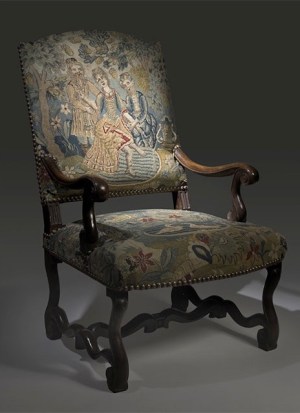
Louis XIII armchair owned by the Marquis de Sade; for auction at Drouot in Paris, 15 June 2016.
The chair on which France’s most notorious writer, the Marquis de Sade, wrote his most shocking work went under the hammer [at Drouot] in Paris Wednesday [15 June 2016] with nearly 100 of his rare surviving manuscripts. The aristocratic author of The 120 Days of Sodom and Philosophy in the Bedroom brought the Louis XIII armchair with him through a series of prisons after he was repeatedly locked up for his outrageous sexual antics. And it was on it that he wrote some of his most erotic and blasphemous works including his masterpiece Justine in 1791.
The chair and drafts of plays and letters belonging to the marquis were part of a secret cache found by his descendants sealed in a chest behind the shelves of the library of the family’s chateau at Conde-en-Brie in the northern Champagne region. . . .
The full article is available at Art Daily.
The piece weirdly fails to mention that the narrative depicted is that of Susanna and the Elders, and I’ve had no luck tracking down further details (including whether it actually sold). . . I just keeping thinking of Steve Martin’s brilliant performance in the 1979 film The Jerk. –CH
. . . And that’s it, and that’s the only thing I need, is this. I don’t need this or this. Just this ashtray. And this paddle game, the ashtray and the paddle game, and that’s all I need. And this remote control. The ashtray, the paddle game, and the remote control, and that’s all I need. And these matches. The ashtray, and these matches, and the remote control, and the paddle ball. And this lamp. The ashtray, this paddle game, and the remote control, and the lamp, and that’s all I need. And that’s all I need, too. I don’t need one other thing, not one—I need this. The paddle game, and the chair, and the remote control, and the matches, for sure. What are you looking at? What do you think I am? Some kind of jerk or something? And this. That’s all I need. The ashtray, the remote control, the paddle game, this magazine, and the chair.
Exhibition | Catherine the Great: Self-Polished Diamond
Now on view at the Hermitage Amsterdam:
Catherine the Greatest: Self-Polished Diamond of the Hermitage
Catharina, de Grootste: Zelfgeslepen diamant van de Hermitage
Hermitage Amsterdam, 18 June 2016 — 15 January 2017
 Two hundred and fifty years after Catherine the Great founded the Hermitage, the Hermitage Amsterdam presents her life story in a sumptuous exhibition on Europe’s longest-reigning empress. Her name has always been surrounded with stories and superlatives, often about her private life and court intrigues. Some of these stories belong to the realm of myth, but others are perfectly true.
At the age of fourteen, the German princess Catherine (1729–1796) was married off to the Russian tsar. She later overthrew her husband, Peter III, and claimed the throne for herself. Catherine would become the greatest tsarina of all times. She had ambitious plans to reform the whole empire and acted with great foresight. Although she encountered setbacks, her achievements were astounding.
Catherine had a tremendous passion for art and contributed more than anyone else to the world’s greatest art collection. She was an enlightened despot, corresponding with Voltaire and Diderot. She added a new territory to her empire as large as France, and including the Crimea. And in all her endeavours, she had a sharp eye for talented people who could help her, such as the Orlov brothers and her most influential lover, Potemkin. She was a diamond of her own making.
After her death, Catherine was central to hundreds of books, films, and plays, and she inspired great actresses like Marlene Dietrich, Bette Davis, Hildegard Knef, Catherine Deneuve, and Julia Ormond.
Aided by her memoirs and those of her contemporaries, we present more than 300 objects from the Hermitage in St Petersburg, which invite visitors into Catherine’s world. The exhibition unravels her life story and sketches her personality. It is also an exhibition like a jewellery box, with magnificent personal possessions such as dresses, bijoux, cameos, and snuff boxes, as well the finest art works from her vast collection: paintings, sculptures, exquisite crafts, and portraits of her friends and loved ones.
The poster reproduces a detail of Vigilius Eriksen’s Portrait of Catherine the Great on Horseback, 1762 (St Petersburg: State Hermitage Museum)
Call for Articles | Winterthur Portfolio
From The University of Chicago Press:
 “More images, please.” These words—all too rare in publishing—are commonplace for editors at Winterthur Portfolio: A Journal of American Material Culture. More than a bunch of pretty pictures, images act as essential evidence, allowing Portfolio readers to explore a wide range of topics based on substantive object-based research. Interdisciplinary material culture scholarship rests on seeing the objects, images, places, and spaces under discussion, and the editors of Winterthur Portfolio and the University of Chicago Press are committed to providing the highest level of image quality and editing for authors from any stage in their careers.
As a journal that appears both in print and digital formats, Winterthur Portfolio welcomes traditional manuscripts as well as innovative textual, graphic, and video content. We encourage authors to use a broad range of tools and media to bring new insights and spark conversations about the material world in the Americas. A generously illustrated article, a 3-D model, a digital photo essay, or an analytical model all have a place at Winterthur Portfolio, and we look forward to hearing your ideas for cutting-edge, interdisciplinary material culture research. For inquiries and questions, please contact Executive Editor Catharine Dann Roeber (croeber@winterthur.org), or Managing Editor Amy Earls (aearls@winterthur.org), or click here .
Call for Papers | Nomadic Objects: Material Circulations
From the conference website:
Nomadic Objects: Material Circulations, Appropriations, and the
Formation of Identities in the Early Modern Period, 1500–1800
Paris, 2–4 March 2017
Proposals are due by 15 September 2015

Domenico Remps, Trompe-l’oeil with an Open Cabinet (Cabinet of Curiosities), ca. 1690s (Florence: Museo dell’Opificio delle Pietre Dure)
This interdisciplinary conference, organized in partnership with two museums of the Paris region, the Musée National de la Renaissance in Écouen and the Musée Cognacq-Jay in Paris, seeks to confront the material history of early modern objects with their artistic and literary representations. It proposes to look at the various ‘traces’ left by material culture as it circulated and was appropriated. Studying the history of material culture (be it dress and personal accessories, everyday and decorative objects, art works, and technical, scientific, or musical instruments…) sheds light upon the various processes of cultural appropriation, transculturation or hybridization that accompanied such material circulations across Europe or between Europe and the rest of the world. Material objects, whether commodities, tools, devotional objects or works of art, can all be considered as bearers or vehicles of cultural identities. By travelling across space they call into question national, religious and linguistic boundaries. The early modern period (1500–1800) corresponds to a period when national identities became more firmly entrenched in Europe with the definition of clearer national territories, languages and religious traditions. The establishment of such boundaries resulted from the development of a new political philosophy, born in part in reaction to Renaissance court culture and its intrinsic nomadism (A. M. Thiesse, La Création des identités nationales, 1999). Following the trajectories of objects as they crossed these boundaries brings into focus the tension between sedentariness and nomadism that Daniel Roche identified as a key element in the advent of modernity (Humeurs vagabondes, 2003).
In addition to the tight network of material circulations within Europe linked to trade, diplomatic exchanges, aristocratic modes of life or religious exile at a time defined by intense religious and political strife, more complex trajectories yet are to be traced. In the context of proto-globalization and of the rise of international trading companies, goods often followed global paths, coming from distant locations and transiting through a number of countries or cultural spaces before reaching their destinations. Because these objects found their way into artistic and literary representations, they also generated in turn less material forms of circulation, posing the question of multi-layered processes of appropriation.
We are seeking proposals that address such processes of circulation and appropriation by looking at the reception of these objects in literature and the arts or at their production and consumption, and the craftsmanship, techniques or practices thereby implied. Suggested topics include, but are not limited to
• Legal and illegal networks for the circulation of objects and goods, whether through trade, smuggling or personal relationships
• Diplomatic gifts and exchanges
• Travelling objects in court culture
• Objects in exile and objects of the exiles
• The transmission of craftsmanship and technologies and its links to human migrations
• Decorative, artistic and literary motifs, and their circulations from one country to another
• The meaning and implications of literary and artistic appropriations of objects
• Processes of linguistic appropriation and cross-fertilization linked to the circulation of objects
• The notion of proto-globalization and its economic, social, material, cultural and artistic manifestations
We hope that this conference will bring into play a variety of methodologies and foster a fruitful dialogue between different disciplines (history, material culture, history of technologies, art history, European languages and literatures, anthropology, archaeology…). Outreach activities, such as workshops and round-tables open to the general public, will also be included in the program. We welcome proposals from established scholars, doctoral students, curators and other professionals working on or with early modern objects. We particularly encourage proposals discussing objects in the collections of the Musée de la Renaissance or the Musée Cognacq-Jay. 300-word proposals, along with a brief CV (1 page maximum), should be sent by September 15, 2016 to the conference organizers at objetsnomades2017@gmail.com.
Professor Giorgio Riello (University of Warwick) will be one of the keynote speakers.
Conference Organizers: Line Cottegnies (Sorbonne Nouvelle – Paris3); Anne-Valérie Dulac (Paris 13); Ariane Fennetaux (Paris Diderot – Paris 7); Anne-Marie Miller-Blaise (Sorbonne Nouvelle – Paris 3); Nancy Oddo (Sorbonne Nouvelle – Paris 3); Sandrine Parageau (Paris Ouest Nanterre La Défense); Laetitia Sansonetti (Paris Ouest Nanterre La Défense); Jean-Paul Sermain (Sorbonne Nouvelle – Paris 3)
Scientific Committee: Muriel Barbier (Conservateur du patrimoine, Musée d’Ecouen) ; Pascale Gorguet-Ballesteros (Conservateur du patrimoine, Palais Galliera) ; Isabelle Bour (Université Paris 3) ; Marie-Madeleine Fragonard (Professeur émérite, Université Sorbonne Nouvelle – Paris 3) ; Rose-Marie Herda-Mousseaux (Conservatrice du Patrimoine, Musée Cognacq-Jay) ; Beverly Lemire (University of Alberta) ; Angela McShane (Victoria & Albert Museum) ; Lesley Miller (Victoria & Albert Museum), Alain Montandon (Université Blaise Pascal – Clermont II) ; Ladan Niayesh (Université Paris Diderot – Paris 7) ; Isabelle Paresys (Université Lille 3) ; Joad Raymond (Queen Mary University of London) ; Helen Smith (Centre for Renaissance and Early Modern Studies University of York) ; Chantal Schütz (École Polytechnique).
PhD Studentship | Hans Sloane’s Books: An Early Enlightenment Library
From H-ArtHist:
AHRC Collaborative Doctoral Partnership
Hans Sloane’s Books: An Early Enlightenment Library and Its Material Relationships
London, 3 October 2016 — 30 September 2019
Applications due by 6 July 2016
Queen Mary University of London and the British Library intend to make a PhD studentship appointment under the AHRC Collaborative Doctoral Partnership scheme (CDP) from autumn 2016.
The project will investigate the intellectual significance of the library of Sir Hans Sloane (1660–1753) to the gathering and dissemination of medical and scientific knowledge in the Enlightenment period. It will focus on Sloane’s library (now housed within the British Library) in relation to his wider collection of natural and artificial specimens, now divided between the Natural History and British Museums. The research will be co-supervised by the British Library and Queen Mary. The project offers privileged access to Sloane’s books at shelf as well as extensive curatorial support in their study and interpretation, in addition to the standard academic doctoral training and supervision.
The project is open to either full-time or part-time students. Studentships are awarded for 3 years (or part-time equivalent) initially, at RCUK rates and subject to standard eligibility criteria for RCUK training grants. Additional Student Development Funding is available to allow time for further training and skills development opportunities that are agreed as part of the PhD programme. If required, this may be used to extend the studentship by up to six months (or part-time equivalent). The British Library also offers the student generous research expenses funding, specialist training, and access to work-space within its curatorial offices.
Application guidelines and a detailed description of the project are available here. Candidates with interests in bibliography, book history, the material book, the history of science and medicine, early-modern scientific literary writing, exchange networks, and the history of collections will be especially welcome. Once recruited, the successful PhD candidate will contribute to the development of the final agreed research topic. Potential candidates are welcome to contact Professor Claire Preston (Queen Mary – c.preston@qmul.ac.uk) and Dr Karen Limper-Herz (the British Library – Karen.limper-herz@bl.uk) for further details.










leave a comment