The Met Launches New Edition of the Heilbrunn Timeline of Art History
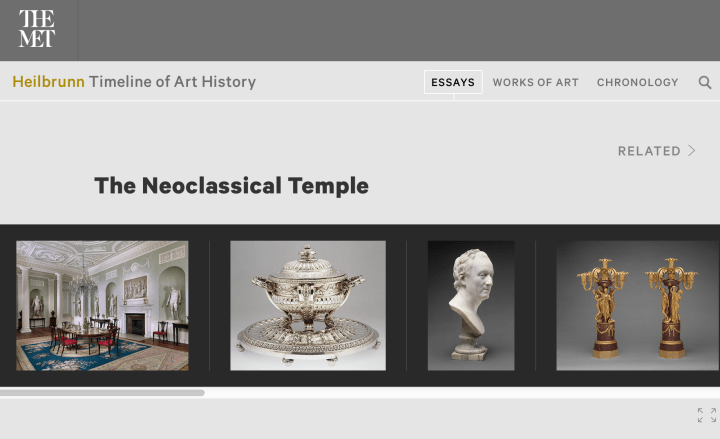
Screen shot (June 2016) of The Met’s Heilbrunn Timeline of Art History, with Cybele Gontar’s essay “The Neoclassical Temple” (October 2003).
◊ ◊ ◊ ◊ ◊
From H-ArtHist (13 June 2016). . .
Heilbrunn Timeline of Art History: The New Edition
The Heilbrunn Timeline of Art History is rethought with a new navigation and interface, updated images, and restructured editorial content. Still relational in nature, it allows a reader to find exactly what he or she needs while also encouraging total immersion through a seamless browsing experience. The new Timeline is fully optimized to be responsive on desktop and mobile devices, enabling easy access anywhere.
The Heilbrunn Timeline of Art History presents a chronological, geographical, and thematic exploration of global art history through The Met collection. It is a reference, research, and teaching tool conceived for students and scholars of art history. Authored by The Met’s experts, the Timeline comprises 300 chronologies, close to 1000 essays, and over 7000 works of art. It is regularly updated and enriched to provide new scholarship and insights on the collection, and draws 1 to 1.5 million visits per month during the academic year. The Met’s Heilbrunn Timeline of Art History is funded by the Heilbrunn Foundation, New Tamarind Foundation, and Zodiac Fund.
We would love to know what you think of the new site. For all questions and comments, please contact timeline@metmuseum.org.
Call for Essays | Interiority and the Interior
From H-ArtHist:
Interiorities: Artistic, Conceptual, and Historical Reassessments of the Interior
Palgrave Communications
Guest Editor: Vlad Ionescu (Faculty of Architecture and Art, Hasselt University, Belgium)
Article proposals due by 31 October 2016; full submissions due by February 2017
Palgrave Communications is inviting article proposals for a collection dedicated to the theme of ‘Interiority and the Interior’. The collection addresses interiority as a concept debated by artists and philosophers, historians and sociologists alike. The goal of this interdisciplinary collection is to approach interiority and the interior as relational entities that interact with architectural spaces, visual arts and music, social and political ideologies, geographical and historical structures. We welcome contributions that address the interior as an opportunity to research the status of the subjectivity in modernity and beyond. Article proposals and enquires should be sent to the Managing Editor at palcomms@palgrave.com.
Palgrave Communications is an open access online-only journal dedicated to publishing high quality original research across all areas of the humanities, the social sciences, and business. Multi-disciplinary in scope, Palgrave Communications also champions interdisciplinary research, fostering interaction, creativity, and reflection within and between the rich disciplines the journal encompasses. The journal is supported by an international Editorial Board and aspires to be the definitive peer-reviewed outlet for open access academic research in and between its subjects. Palgrave Communications is open to submissions on all theoretical and methodological perspectives.
Exhibition | Handel Exhibition at Boughton House

Boughton House, Northamptonshire. Most of the present building was undertaken by Ralph Montagu, 1st Duke of Montagu (d. 1709) who inherited the house in 1683. The Buccleuch Living Heritage Trust now looks after the house and estate.
◊ ◊ ◊ ◊ ◊
Later this summer at Boughton:
Handel Exhibition at Boughton House
Boughton House (near Kettering), Northamptonshire, August 2016
This August Boughton House celebrates the composer George Frideric Handel’s extraordinary legacy with items from the Buccleuch musical archives. The exhibition looks at key moments in Handel’s life, from his formative years in the palaces of cardinals and princes in Rome, to his rise as England musical genius presiding over London, the European capital of music theatre in the eighteenth century.
The exhibition will launch with an event hosted by the Duke of Buccleuch on Sunday, 17th July (see below). The Paris dance company, Les Corps Eloquents, will create a unique Handel performance in Boughton’s Great Hall, including re-created scenes from some of Handel’s most spectacular operas. London theatre-goers expected ballet in their opera, and Handel did not disappoint. He created over 70 works for the French dancers he had at his disposal, thanks to patrons like the Duke of Montagu.
The exhibition presents
• Glimpses of Handel’s early life in the palaces of cardinals in Rome
• Rare images of Handel and his colleagues, including a life size bust after Louis François Roubiliac
• Roubiliac’s terracotta model for the Handel statue in Vauxhall Pleasure Gardens
• A 1720 harpsichord thought to have belonged to Handel
• Original choreographies as used by Handel’s dancers at The Kings Theatre, Haymarket
• A small orchestra of Chelsea Porcelain musicians
• Rare scores and manuscripts including the first edition of The Messiah
• When Handel came to lunch: the menu and guest list from Montagu House April 1747
• Musical instruments as used in the music for the Royal Fireworks
Handel at Boughton
Boughton House (near Kettering), Northamptonshire, 17 July 2016
Hosted by the Duke of Buccleuch, this unique event begins with a welcoming coffee and the opportunity to stroll through Boughton’s glorious gardens and landscape. A buffet brunch is then followed by a tour of the house as well as a private view of Boughton’s 2016 Handel exhibition, which takes a fresh look at Handel’s life in Rome and London—with rare paintings, instruments, and original scores from the family archives, including The Messiah.
This one-off programme of events includes a splendid Handel performance in the Great Hall with counter-tenor James Laing and Paris dance company Les Corps Eloquents. Together they will re-create scenes from some of Handel’s most spectacular operas. You’ll also be treated to the first public performance of composer Luke Styles’s Passacaille—an extraordinary 21st-century re-imagining of Handel’s work through music, song, and dance. Tea and cakes will be served shortly afterwards. Luke Styles is one of the UK’s leading composers of his generation. Over the last four years his operas have been performed at Glyndebourne, the Royal Opera House Covent Garden, and the Vault Festival. Passacaille, his new piece for Boughton, is a re-imagining of an original Handel dance. For voice, instruments, and four dancers, its harmony, phrasing and melodic shapes are all given a 21st-century treatment, combining Sytles’s own musical language with the Handelian aesthetic.
The day starts at 11am and ends at 5pm. Please advise us in advance if you are a wheelchair user by calling 01536 515731 or emailing us. Early bird tickets cost £55 if purchased before 20th June and £65 thereafter.
Exhibition | Emma Hamilton: Seduction and Celebrity

◊ ◊ ◊ ◊ ◊
Looking ahead to the fall . . . press release from the National Maritime Museum:
Emma Hamilton: Seduction and Celebrity
National Maritime Museum, Greenwich, 3 November 2016 — 17 April 2016
From humble origins, Emma Hamilton rose to national and international fame as a model, performer, and interpreter of neo-classical fashion. Within the public mind, however, she typically continues to occupy a passive and supporting role and is often remembered simply as the mistress of Britain’s greatest naval hero, Admiral Lord Nelson. This landmark exhibition recovers Emma from myth and misrepresentation and reveals her to be an active and influential historical actor in her own right: one of the greatest female lives of her era.
Born into poverty in 1765, Emma’s talent and beauty brought her fame while still in her teens as muse to the great portrait artist George Romney. In her twenties she achieved still greater artistic prominence in Naples, the epicentre of the fashionable Grand Tour. Here, as the confidante of Queen Maria Carolina, she also came to wield considerable political power. Emma embarked on a passionate affair with Admiral Lord Nelson but risked her security and social status in the process. Her fortunes never recovered from the tragedy of his death at Trafalgar, and—following a period in debtor’s prison—she died in self-imposed exile in Calais in 1815.
The exhibition carries visitors through the arc of this remarkable story, revealing Emma’s driving ambition and her brilliance as a performer and placing in sharp relief the social conventions ranged against her. In an age when people tended to remain fixed in the social categories in which they began their lives, she crossed boundaries of all kinds, broke through barriers, and ultimately paid a heavy price.
Emma’s story will be told through over 200 objects from public and private lenders around a core from the Museum’s own collections. Emma’s compelling story will be explored through exceptional fine art, antiquities that inspired Emma’s famous ‘attitudes’, costumes that show her impact on contemporary fashions, prints and caricatures that carried her image to a mass audience, her personal letters and those of Nelson and William Hamilton, and finally the uniform coat that Nelson wore at Trafalgar, retained by Emma until destitution forced her to part with it.
◊ ◊ ◊ ◊ ◊
From Thames & Hudson:
Quintin Colville and Kate Williams, with contributions by Vic Gatrell, Hannah Greig, Jason Kelly, Margarette Lincoln, Christine Riding, and Gillian Russell, Emma Hamilton: Seduction and Celebrity (London: Thames & Hudson, 2016), 280 pages, ISBN: 978-0500252208, £30 / $50.
 Emma Hamilton (1765–1815) is widely known as a temptress who ensnared the naval hero Horatio Nelson and paid the price by dying in poverty in Calais. But this epic love affair, and the judgments surrounding it, have obscured a spectacular life story. This book, published to coincide with a major exhibition on Hamilton at the National Maritime Museum, Greenwich, explores her remarkable life and recovers Emma from myth and misrepresentation. Distinguished contributors provide a fresh evaluation of her artistic undertakings, cultural achievements, and legacy, as well as of the momentous years of her association with Nelson and the unravelling of her fortunes after his death at the Battle of Trafalgar in 1805. Illustrated with paintings, prints, and drawings capturing the beauty that propelled her to celebrity status, Emma Hamilton tells the story of an extraordinary woman who broke through barriers of class and privilege to win her own unique place in British history.
Quintin Colville is Curator of Naval History at the National Maritime Museum. He edited Nelson, Navy & Nation and is the author of The British Sailor of the First World War.
Kate Williams is Professor of History at the University of Reading. Her biography England’s Mistress: The Infamous Life of Emma Hamilton was published in 2006.
◊ ◊ ◊ ◊ ◊
Note (added 28 October 2016) — The original version of this posting used an earlier working title, Seduction and Celebrity: The Spectacular Life of Emma Hamilton. Other changes have been made to reflect updated information.
New Book | Batteux, The Fine Arts Reduced to a Single Principle
Published last fall by Oxford University Press:
Charles Batteux, The Fine Arts Reduced to a Single Principle, translated by James O. Young (Oxford: Oxford University Press, 2015), 208 pages, ISBN: 978-0198747116, $70.
 The Fine Arts Reduced to a Single Principle (1746) by Charles Batteux was arguably the most influential work on aesthetics published in the eighteenth century. It influenced every major aesthetician in the second half of the century: Diderot, Herder, Hume, Kant, Lessing, Mendelssohn, and others either adopted his views or reacted against them. It is the work generally credited with establishing the modern system of the arts: poetry, painting, music, sculpture and dance. Batteux’s book is also an invaluable aid to the interpretation of the arts of eighteenth century. And yet there has never been a complete or reliable translation of The Fine Arts into English. Now James Young, a leading contemporary philosopher of art, has provided an eminently readable and accurate translation. It is fully annotated and comes with a comprehensive introduction that identifies the figures who influenced Batteux and the writers who were, in turn, influenced by him. The introduction also discusses the ways in which The Fine Arts has continuing philosophical interest. In particular, Young demonstrates that Batteux’s work is an important contribution to aesthetic cognitivism (the view that works of art contribute importantly to knowledge) and that Batteux made a significant contribution to understanding the expressiveness of music. This book will be of interest to everyone interested in the arts of the eighteenth century, French studies, the history of European ideas, and philosophy of art.
James O. Young is Professor of Philosophy at the University of Victoria. He is the author of four books: Global Anti-realism (1995), Art and Knowledge (2001), Cultural Appropriation and the Arts (2008), Critique of Pure Music (2014), and over 50 articles in refereed journals. He has edited the four volume collection, Aesthetics: The Critical Concepts (2005) and (with Conrad Brunk) The Ethics of Cultural Appropriation (2009). Another collection of essays, The Semantics of Aesthetic Judgements, is forthcoming from Oxford. He is Artistic Director of the Early Music Society of the Islands.
C O N T E N T S
Acknowledgements
Translator’s Introduction
Epistle Dedicatory
Preface
Part One: Where we establish the nature of the arts by reference to the genius that produced them
1 Division and origin of the arts
2 Genius is only able to produce the arts by imitation; what imitation is
3 Genius must not imitate reality just as it is
4 The state genius must be in to imitate belle nature
5 On the manner in which the arts imitate
6 Why eloquence and architecture differ from the other arts
Part Two: Where we establish the principle of imitation by reference to nature and the laws of taste
1 What taste is
2 The subject of taste can only be nature
3: Evidence drawn from the history of taste
4 The purpose of the laws of taste is to imitate belle nature
5 Second general law of taste: belle nature must be imitated well
6 There are particular rules for each artwork and taste finds them only in nature
7 Conclusion I. There is only one general type of good taste, but several particular types
8 Conclusion II: Since the arts are imitators of nature, they must be judged by comparison to it
9 Conclusion III: Taste for nature and a taste for the arts being the same, there is only one taste that applies to everything, even to manners
10 Conclusion IV: How it is important to form taste in a timely manner and how we should go about forming it
Part Three: In which the principle of imitation is verified by its application to various arts
Section One: Poetical art consists in the imitation of belle nature
1 Alternatives to the principle of imitation are refuted
2 The divisions of poetry are found in [types of] imitation
3 The general rules of poetical content are contained in the principle of imitation
4 The rules of poetical style are contained in the imitation of belle nature
5 All rules of epic poetry come from the principle of imitation
6 On tragedy
7 On comedy
8 On pastoral poetry
9 On fables
10 On lyric poetry
Section Two: On Painting
Section Three: On Music and Dance
1 Gestures and tones of voice are the keys to understanding music and dance
2 The emotions are the principal subject of music and dance
3 All of music and dance must have a referent and a meaning
4 The expressive qualities that music and dance must have
5 On the union of the fine arts
Exhibition | Marseille in the Eighteenth Century, 1753–1793
Now on view at the Musée des Beaux-Arts in Marseille:
Marseille au XVIIIe siècle: Les années de l’Académie, 1753–1793
Le Musée des Beaux-Arts, Marseille, 17 June — 16 October 2016
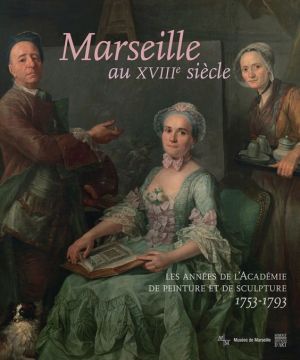 Pour la première fois le panorama artistique d’une période majeure de l’histoire de Marseille, le XVIIIe siècle, va être présenté au musée des Beaux-arts. Cent cinquante œuvres, peintures, sculptures et dessins, provenant des riches collections patrimoniales de la ville, musées, bibliothèque, archives, mais également des musées français et européens seront réunies pour retracer une histoire des arts dans une ville que le commerce a, de tout temps, ouvert aux influences extérieures.
Cette évocation débute pourtant par une tragédie, celle de l’épidémie de Peste dont les grandes toiles de Michel Serre, restaurées pour l’occasion, nous ont gardé l’exceptionnel souvenir. La ville saura se relever du désastre et au milieu du siècle, deux grands peintres, Dandré-Bardon et Joseph Vernet viendront redonner un nouveau souffle au milieu local.
En créant en 1753, l’académie de peinture et de sculpture de Marseille, Dandré-Bardon va faire de cette institution un extraordinaire vivier de jeunes artistes, y attirant également ceux qui sont en route vers l’Italie. Joseph Vernet, dont l’Europe entière s’arrache les marines, venant sur place peindre pour Louis XV le port de Marseille, va susciter de nombreux émules comme Lacroix de Marseille, Volaire ou Henry d’Arles, et faire des marines un genre particulièrement prisé des collectionneurs marseillais.
Du baroque au néo-classicisme, Marseillais ou non, installés à demeure ou simplement de passage, artistes et amateurs d’arts, ont fait de Marseille un des importants foyers artistiques de la France du XVIIIe siècle.
◊ ◊ ◊ ◊ ◊
From Somogy:
Luc Georget and Gérard Fabre, eds., Marseille au XVIIIe siècle: Les années de l’Académie, 1753–1793 (Paris: Somogy, 2016), 304 pages, ISBN: 978-2757210581, 39€.
Cet ouvrage rend compte de la vie artistique à Marseille au Siècle des lumières. L’Académie de peinture et de sculpture de Marseille, créée en 1753, est au cœur de ce récit. La naissance de cette institution concrétisait les efforts de ces hommes, artistes et amateurs d’art, qui voulaient doter leur ville d’un établissement capable de former peintres, sculpteurs et architectes. Ils rêvaient de faire de cette institution un soutien pour les jeunes artistes, un lieu d’accueil et de rencontre pour ceux qui étaient de passage et, par le réseau de relations qu’ils entretinrent avec le reste de l’Europe, un instrument du rayonnement de leur ville. Au cours de ses quarante années d’existence, l’Académie de peinture et de sculpture a formé des élèves qui connurent de grands succès, bien au-delà de Marseille, et des dessinateurs qui offrirent aux productions de ses manufactures un niveau inégalé. Fermée en 1793, comme toutes les académies en France, elle devait donner naissance, une fois la tourmente apaisée, à deux des plus importantes institutions culturelles du XIXe siècle : l’école des beaux-arts et le musée.
Sous la direction de Luc Georget, Conservateur en chef du Musée des Beaux-Arts de Marseille et Gérard Fabre, assistant de conservation au Musée des Beaux-Arts de Marseille – Avec la collaboration de Régis Bertrand, Marie-Claude Homet, Emilie Beck Saiello, Olivier Bonfait, Laëtitia Pierre, Markus Castor, Sylvain Bédard, Emilie Roffidal, Christine Germain-Donnat, Yves di Domenico, Alexandre Maral, et Claude Badet.
S O M M A I R E
• Luc Georget, Avant-propos
• Régis Bertrand, Le « glorieux » XVIIIe siècle marseillais: Marseille de la Régence à la Révolution
• Marie-Claude Homet, L’héritage baroque: Michel Serre
• Émilie Beck Saiello, De l’aristocratie du négoce aux cercles de l’Académie: Les réseaux marseillais de Joseph Vernet
• Olivier Bonfait, École de dessin, académie, académies: L’« Académie de Peinture, &c. de Marseille » dans l’espace des Lumières
• Gérard Fabre, De l’École académique de dessin à l’Académie de peinture, sculpture et architecture civile et navale de Marseille, 1753–1793
• Laëtitia Pierre et Markus Castor, Faire œuvre de pédagogie: Le directorat de Michel-François Dandré-Bardon à l’Académie de peinture et de sculpture de Marseille, 1749–1783
• Sylvain Bédard, Modèles parisiens: Un lot de figures académiques pour Marseille
• Luc Georget, Une académicienne: Françoise Duparc
• Émilie Roffidal, L’union des arts et du commerce
• Christine Germain-Donnat, La faïence de Marseille
• Yves di Domencio, Le cycle de l’Histoire de Tobie de Pierre Parrocel
• Alexandre Maral, Les sculpteurs de l’Académie de Marseille
• Luc Georget, L’architecture à l’Académie: Les morceaux de réception
• Luc Georget, Une commande singulière: Le Saint Roch intercède la Vierge pour la guérison des pestiférés de David
• Claude Badet, Marseille et la création artistique pendant la Révolution
Liste des œuvres exposées
Bibliographie
Index des noms de personnes
At Sotheby’s | Four Paintings of the British Siege and Capture of Havana

Dominic Serres, The Cathedral at Havana, August–September 1762: View of the Church of San Francisco de Asís, oil on canvas, 83.5 × 122.3 cm (estimate: £300,000–400,000)
◊ ◊ ◊ ◊ ◊
Press release (6 June 2016) from Sotheby’s:
This summer, Sotheby’s will present for sale some of the earliest views of Havana, Cuba (Evening Sale of Old Master and British Paintings, London, 6 July 2016, Sale L16033). Painted by Dominic Serres between 1770 and 1775, the four spectacular pictures depict specific stages of the British siege and capture of Havana in 1762. There were made either for General George Keppel, 3rd Earl of Albemarle (1724–1772) or for his brother, Admiral Augustus Keppel, 1st Viscount Keppel (1725–1786), both of whom played a decisive role in the British victory. Unseen on the market for almost 250 years, the works boast exceptional provenance, having remained in the possession of the Keppel family ever since they were painted.
Talking about the sale of the paintings, Julian Gascoigne, Specialist, British Paintings at Sotheby’s, commented: “These four views are not only of great historical significance; they are also remarkable works of art and some of the greatest British marine pictures ever painted, demonstrating the influence on Serres’s work of both Canaletto and Vernet, two masters of eighteenth-century Europe.”
Based on drawings made on the spot as events unfolded, the works belong to a group of eleven paintings depicting the siege and capture of Havana, all of which were—from 1948 onwards—on loan to the National Maritime Museum in Greenwich, London, and six of which now remain in the permanent collection there. The Albermale Havana Views demonstrate how Serres was intimately acquainted with the topography of the city and its surrounding environs. The French-born painter went to the West Indies as a young man and spent several years in Havana working as a ship’s captain on Spanish galleons, before being captured by the British and taken to London. In 1752 he returned to Havana once again, this time as master of an English merchantman.
The British capture of Havana in 1762 was the last major engagement of the Seven Years’ War and the decisive military action that finally brought to an end a conflict that ravaged the globe between 1756 and 1763. A contest for global supremacy, the war involved most of the major European powers of the day, as well as their colonies, divided into two giant coalitions led by Britain and France respectively. In 1761 Spain joined the conflict as an ally of France, and between March and August 1762 British naval and ground forces—under the joint command of General George Keppel, 3rd Earl of Albemarle and Admiral Sir George Pocock—besieged and captured the city of Havana, the capital of Spanish Cuba and Spain’s principal naval base in the West Indies. Also serving among the British forces were two of Albemarle’s younger brothers: Admiral Augustus Keppel, later 1st Viscount Keppel, who was second-in-command of the fleet, and Colonel William Keppel, who was one of his eldest brother’s two divisional commanders and later succeeded him as British Governor of Cuba.
Dominic Serres, View of the Morro Castle and Boom Defence before the Attack, 1770, oil on canvas, 85.5 × 176.5 cm (estimate: £400,000–600,000)
This painting shows the Spanish preparations before the siege. The port of Havana was a vitally important strategic target as both the capital of Spanish Cuba and Spain’s principal naval base in the Caribbean. On 6th June 1762, the British fleet was spotted approaching the city from the North. The Spanish garrison at Havana had expected an attack from the West, and the unexpected sighting of the fleet in the North created panic among the city’s defenders. A council of war was held by the Spanish governor, Juan de Prado Mayera Portocarrero y Luna (1716–1770), at which it was decided to sink three large ships across the narrow mouth of the harbour to block the British from entering but also trapping the Spanish fleet inside. To the left of the painting can be seen the Castillo de los Tres Reyes de Morro, known to the British as the Morro Castle, guarding the mouth of the harbour. On the right is the narrow channel that gave entrance to the harbour itself, blocked by the sunken ships and a floating boom defence strung across its mouth, whilst men and supplies are loaded into the fort. The large cloud of smoke rising from behind the fort indicates that the British bombardment from the landward side has begun.
Dominic Serres, The English Battery before the Morro Castle, 1770, oil on canvas, 84 × 122 cm (estimate: £200,000–300,000)
The British forces under General Albemarle had the benefit of a fairly detailed report on the defences at Havana. He knew that the weakest point in the Spanish defences was the rocky ridge of the Cabana hills, known to the Spanish as Los Cavannos. On high ground to the South-East of the city, the Cabana heights overlooked the Morro Castle, which commanded both the entrance to the harbour and the town on the west side of the bay. Whilst the castle itself was virtually impregnable, the Spanish defences on the ridge were relatively light. The British landed troops on 7th June, and on the 11th a successful assault was made on the heights. This painting shows the inside of the British battery. Beyond can be seen the fortress of El Morro, with its formidable ramparts. On the left is the bell tower of Havana cathedral silhouetted against the hills beyond.
Dominic Serres, The Taking of the Havana by British Forces under the Command of the Earl of Albemarle, 14 August 1762, oil on canvas, 125.7 × 187.9 cm (estimate: £800,000–1,200,000)
On 22nd June 1762, four British batteries of 12 heavy cannon and 38 mortars opened fire from their newly captured Cabana heights on the Morro Castle. By the end of the month, British gunners were scoring 500 direct hits a day, inflicting heavy casualties and exhausting Spanish efforts to repair the Castle walls. Finally on 29th July the British stormed El Morro, mortally wounding the Spanish commander during the fierce hand to hand fighting that ensued. With the fort captured, the British began their domination of the city. On the 11th August, following Spanish refusals to surrender, Albemarle opened fire on Havana. By 2pm, the Spanish governor was forced to surrender. This painting shows British land forces sailing to take possession of the Castle and the north gates of the city following conclusion of Spain’s capitulation terms on 13th August. On the left, the Union Jack fly from the flagpole atop the Morro Castle, whilst to the right is a magnificently detailed panoramic view of the walled city of Old Havana, arguably the finest and most important of its kind.
Dominic Serres, The Cathedral at Havana, August–September 1762: View of the Church of San Francisco de Asís, oil on canvas, 83.5 × 122.3 cm (estimate: £300,000–400,000)
This is one of two scenes painted by Serres depicting Havana after its capture by the British, the other being part of the National Maritime Museum’s collection. The central building is the monastic church of San Francisco de Asís, dating from the 1730s. In this picture, Serres is at pains to show British troops and Spanish civilians in harmony, reflecting the contemporary concern to grant the defeated Spanish magnanimous terms. The composition is taken from one of six prints produced by Elias Durnford, an engineer stationed in Havana under General Albemarle. The composition shows a debt to the work of the artist’s close friend Paul Sandby, as well as to Canaletto.
The works will be on view in London, 2–6 July 2016.
Exhibition | Olafur Eliasson at Versailles
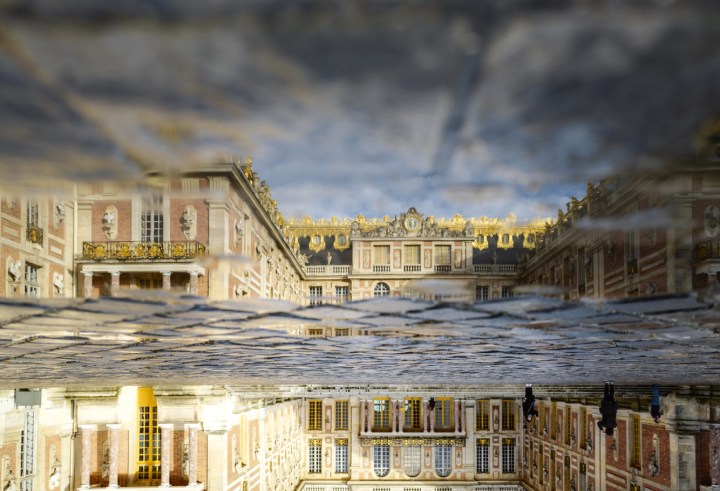
Olafur Eliasson, Versailles 2016 © Olafur Eliasson
◊ ◊ ◊ ◊ ◊
Press release from Versailles:
Olafur Eliasson at the Palace of Versailles
Château de Versailles, 7 June — 30 October 2016
Curated by Alfred Pacquement
The work of internationally acclaimed visual artist Olafur Eliasson investigates perception, movement, embodied experience, and feelings of self. He is best known for striking installations such as the hugely popular The Weather Project (2003) in the Turbine Hall of Tate Modern, London, which was seen by more than two million people, and The New York City Waterfalls (2008), four large-scale artificial waterfalls which were installed on the shorelines of Manhattan and Brooklyn.
Since 2008 the Palace of Versailles has put on a number of exhibitions dedicated to French or foreign artists, each one lasting a few months. Jeff Koons in 2008, Xavier Veilhan in 2009, Takashi Murakami in 2010, Bernar Venet in 2011, Joana Vasconcelos in 2012, Giuseppe Penone in 2013, Lee Ufan in 2014, and Anish Kapoor in 2015: these artists have all created a special dialogue between their works and the Palace and Gardens of Versailles. Since 2013 Alfred Pacquement is the curator of these exhibitions.
“With Olafur Eliasson, stars collide, the horizon slips away, and our perception blurs. The man who plays with light will make the contours of the Sun-King’s palace dance” says Catherine Pegard, President of the Château de Versailles.
“I am thrilled to be working with an iconic site like Versailles,” explains Olifur Eliasson. “As the palace and its gardens are so rich in history and meaning, in politics, dreams, and visions, it is an exciting challenge to create an artistic intervention that shifts visitors’ feeling of the place and offers a contemporary perspective on its strong tradition. I consider art to be a co-producer of reality, of our sense of now, society, and global togetherness. It is truly inspiring to have the opportunity to co-produce through art today’s perception of Versailles.”
Over the years, Eliasson has had significant exhibitions in France, from Chaque matin je me sens différent, chaque soir je me sens le même (2002) at the Musée d’art moderne de la ville de Paris, to Contact (2014), the first solo exhibition at the newly built Fondation Louis Vuitton, where Eliasson also created the permanent installation Inside the Horizon (2014). On the occasion of the COP21 United Nations Conference on Climate Change in Paris in December 2015, Eliasson made climate change tangible by leaving twelve massive blocks of Greenlandic glacial ice to melt in the Place du Panthéon for the installation Ice Watch.
In 2012, Eliasson and engineer Frederik Ottesen founded Little Sun. This social business and global project provides clean, affordable light to communities without access to electricity; encourages sustainable development through sales of the Little Sun solar-powered lamp and mobile charger, designed by Eliasson and Ottesen; and raises global awareness of the need for equal access to energy and light. Earlier this month in Davos, Eliasson received the prestigious Crystal Award for “creating inclusive communities”—a tribute to his work with Little Sun.
From 2009 to 2014, Eliasson ran the Institut für Raumexperimente (Institute for Spatial Experiments), an innovative model for art education affiliated with the Berlin University of the Arts. A comprehensive archive of the institute’s activities can be found online. In 2014, together with architect Sebastian Behmann, Eliasson founded Studio Other Spaces, an international office for art and architecture. As an architectural counterpart to Studio Olafur Eliasson, Studio Other Spaces focuses on interdisciplinary and experimental building projects and works in public space. Established in 1995, Eliasson’s studio today employs ninety craftsmen, specialised technicians, architects, archivists, administrators, and cooks. They work with Eliasson to develop and produce artworks and exhibitions, as well as to archive and communicate his work, digitally and in print. In addition to realising artworks in-house, the studio contracts with structural engineers and other specialists and collaborates worldwide with cultural practitioners, policy makers, and scientists.
A plan is available as a PDF file here»

The Coach Gallery at Versailles Open Once Again

Baptism Sedan of the Duc of Bordeaux
(Château de Versailles)
◊ ◊ ◊ ◊ ◊
The coaches at Versailles are once again on view:
The Coach Gallery of the Palace of Versailles, situated in the King’s Great Stables and closed to the public since 2007, will once again be opening its doors in the spring of 2016, thanks to sponsorship by the Michelin Corporate Foundation. This recently restored collection of coaches is one of the largest in Europe but is still very little known by the general public, and will be on display in a new and fully redesigned space.
Designed to be noticed, the carriages of Versailles are artistic masterpieces. Ostentatiously luxurious and extravagantly decorated with gold and sculpted detail, they were produced by the best artists of the French Court, including architects, carpenters, sculptors, cabinet-makers, bronze workers, chasers, gilders, upholsterers, embroiderers, and trimmings suppliers.
Besides its artistic quality, the collection is also a sort of ‘Vehicle Exhibition from the 18th and 19th centuries’, containing the finest prototypes and cutting-edge advances in French coach-making in terms of comfort, level of performance, and technique including traction, steering and suspension, and the first coupés and convertibles.
In addition, each coach tells a bit of French history through dynastic or political events such as christenings, marriages, coronations or funeral ceremonies. Above all else, the collection is a living testimony to life in the French Court and sumptuousness during the Ancien Régime, the French Empire, and the Restoration.
Visitors will discover these magnificent vehicles up close, such as the Berlins from the marriage of Napoleon I, the coach from the coronation of Charles X and the funeral carriage for Louis XVIII. They will also see finely decorated harnesses with gilded bronze, litters, the small coaches belonging to Marie-Antoinette’s children and an incredible collection of fantastical sledges made during the reign of Louis XV.
During the Ancien Régime the royal stables were located in the King’s Small Stables and Great Stables, a pair of buildings built opposite the Palace of Versailles by Jules Hardouin-Mansart. Pearls of classic French architecture, these two constructions were designed to house the horses and coaches of the King and the Court as well as the thousand or so people who formed the Institution, including horsemen, drivers, blacksmiths, wheelwrights, saddlers, doctors and even musicians.
At the time of the revolution, hundreds of vehicles that once served the King and Court were sold and dispersed, and then re-used during the War in the Vendée and to serve the needs of the revolutionary government. In 1837, when Louis-Philippe turned the Palace of Versailles into a museum dedicated to ‘All the glory of France’, he re-assembled the collection of historical Coaches.
The success of the exhibition Roulez Carrosses! in 2011–13 at the Arras Musée des Beaux-Arts revealed both the richness of the exhibition and the public’s interest in these works of art. It also brought to light the need to exhibit them in the Palace of Versailles and make them permanently available to the public.
The exhibition space is composed of two galleries and currently covers nearly 1000 m², allowing the collection to be comfortably spread out. The scenography will respect the spirit and architecture of the setting: the Royal Stables built by Jules Hardouin-Mansart between 1679 and 1682.
New Book | Fashionable Encounters
This collection of essays appeared in 2014, but I learned of it just a a few days ago—thanks to Michael Yonan’s Instagram: he’s in Denmark this week, participating in Attingham’s Study Programme. I’m hoping to start a list of Instagram feeds relevant to eighteenth-century art and architecture in the coming weeks, so please feel free to send me any of your favorites! -Craig Hanson
◊ ◊ ◊ ◊ ◊
From Oxbow Books:
Tove Engelhardt Mathiassen, Marie-Louise Nosch, Maj Ringgaard, Kirsten Toftegaard, and Mikkel Venborg Pederson, eds., Fashionable Encounters: Perspectives and Trends in Textile and Dress in the Early Modern Nordic World (Oxford: Oxbow Books, 2014), 256 pages, ISBN: 978-1782973829, £40.
 At the heart of this anthology lies the world of fashion—a concept that pervades the realm of clothes and dress, appearances and fashionable manners, interior design, ideas and attitudes. Here sixteen papers focus on the Nordic world (Denmark, Norway, Sweden Finland, Iceland, the Faroe Isles and Greenland) from 1500 to 1850. This was a period of rapid and far-reaching social, political and economic change, from feudal Europe through political revolution, industrialisation, development of international trade, religious upheaval, and technological innovation—changes impacting on every aspect of life and reflected in equally rapid and widespread changes in fashion at all levels of society. These papers present a broad image of the theme of fashion as a concept and as an empirical manifestation in the Nordic countries in early modernity, exploring a variety of ways in which that world encountered fashionable impressions in clothing and related aspects of material culture from Europe, the Russian Empire, and far beyond. The chapters range from object-based studies to theory-driven analysis. Elite and sophisticated fashions, the importation of luxuries and fashion garments, christening and bridal wear, silk knitted waistcoats, woollen sweaters and the influence of the whaling trade on women’s clothing are some of the diverse topics considered, as well as religious influences on perceptions of luxury and aspects of the garment trade and merchant inventories.
◊ ◊ ◊ ◊ ◊
C O N T E N T S
Prologue (Mikkel Venborg Pedersen)
1 The World of Foreign Goods and Imported Luxuries: Merchant and Shop Inventories in Late 17th-Century Denmark-Norway (Camilla Luise Dahl and Piia Lempiäinen)
2 Foreign Seductions: Sumptuary Laws, Consumption and National Identity in Early Modern Sweden (Eva I. Andersson)
3 Fashion from the Ship: Life, Fashion and Fashion Dissemination in and around Kokkola, Finland in the 18th Century (Seija Johnson)
4 Creating fashion: Tailors’ and Seamstresses’ Work with Cutting and Construction Techniques in Women’s Dress, ca. 1750–1830 (Pernilla Rasmussen)
5 Silk Knitted Waistcoats: A 17th-Century Fashion Item (Maj Ringgaard)
6 Fashioning the Early Modern Swedish Nobility, Mirrored in Preserved 17th-Century Liturgical Textiles (Lena Dahrén)
7 Reflections on Dress Practices and How to Get to Know the Past (Bjørn Sverre Hol Haugen)
8 The Queen of Denmark: An English Fashion Doll and Its Connections to the Nordic Countries (Cecilie Stöger Nachman)
9 At the Nordic Fringe of Global Consumption: A Copenhagen Bourgeois’ Home and the Use of New Goods in the Mid-18th Century (Mikkel Venborg Pedersen)
10 The Theft of Fashion: Circulation of Fashionable Textiles and Garments in 18th-Century Copenhagen (Vibe Maria Martens)
11 Bolette-Marie Harboe’s Bridal Dress: Fashionable Encounters Told in an 18th-Century Dress (Kirsten Toftegaard)
12 Luxurious Textiles in Danish Christening Garments: Fashionable Encounters across Social and Geographical Borders (Tove Engelhardt Mathiassen)
13 Fish-bones and Fashion: The Influence of Whaling on Women’s Clothes in Early Modern Europe (Christina Folke Ax)
14 From Doll Cups to Woollen Sweaters: Trends, Consumption, and Influentials in early 19th-Century Southern Disko Bay, Greenland (Peter Andreas Toft and Maria Mackinney-Valentin)
15 Abundance to Asceticism: Religious Influences on Perceptions of Luxury in Denmark and Great Britain in the 18th Century (Juliane Engelhardt)
16 Circulating Images of Unmanliness and Foreignness: Collector Niclas Holterman and European Caricatures in Sweden around 1800 (Patrik Steorn)
Acknowledgements
Illustrations
Contributors










leave a comment