Call for Papers | Understanding Material Loss
From the conference website:
Understanding Material Loss across Time and Space
University of Birmingham, 17–18 February 2017
Proposals due by 14 October 2016
 Understanding Material Loss across Time and Space is an innovative conference that will take place in 2017 at the University of Birmingham. Kate Smith, who works as Lecturer in Eighteenth-Century History, is organizing the conference to complement her current research on loss, lost property, and the making of modern Britain. Rather than focus solely on modern Britain, however, the conference seeks to consider the methodological and historical insights that might be revealed by utilizing loss as significant analytical framework across time and space, particularly when examining the material world.
Archaeologists, anthropologists, philosophers, literary scholars, sociologists and historians have increasingly come to understand the material world as an active and shaping force. Nevertheless, while significant, such studies have consistently privileged material presence as the basis for understanding how and why the material world has played an increasingly important role in the lives of humans. In contrast, Understanding Material Loss suggests that instances of absence, as much as presence, provide important means of understanding how and why the material world has shaped human life and historical processes.
Speculative and exploratory in nature, Understanding Material Loss asserts that in a period marked by ecological destruction, but also economic austerity, large scale migration, and increasing resource scarcity, it is important that historians work to better understand the ways in which humans have responded to material loss in the past and how such responses have shaped change. Understanding Material Loss asks: how have humans historically responded to material loss and how has this shaped historical processes? The conference will bring together a range of scholars in an effort more to begin to explore and frame a problem, than provide definitive answers.
Confirmed keynote speakers include
• Pamela Smith, History, Columbia
• Simon Werrett, Science and Technology Studies, UCL
• Maya Jasanoff, History, Harvard
• Jonathan Lamb, English, Vanderbilt
• Anthony Bale, English and Humanities, Birkbeck
• Astrid Swenson, Politics and History, Brunel
Understanding Material Loss seeks to uncover the multiple practices and institutions that emerged in response to different forms of material loss in the past and asks, how has loss shaped (and been shaped by) processes of acquisition, possession, stability, abundance and permanence? By doing so it seeks to gauge the extent to which ‘loss’ can be used as an organizing framework of study across different disciplines and subfields. Understanding Material Loss seeks papers from across a variety of time periods and geographies. Although open and speculative in nature, this conference will focus on three broad topics within the wider rubric of loss, in order to facilitate meaningful conversations and exchanges.
Using Materials
• How has the ‘loss’ of particular materials affected scientific practice, manufacturing, architectural design or development in the past?
• How have humans responded to the partial loss or decay of materials?
• How have ‘lost’ skills or knowledge affected the use of materials?
• How have humans re-appropriated or recycled seemingly damaged or obsolete materials?
Possessing Objects
• How have humans sought to maintain and mark the ownership of objects?
• How has the loss of possessions and property affected human mobility and constructions of identity?
• How have communities historically responded to the loss of particular objects? When and why have they sought to stave off the loss of things?
• Where, when and how have cultures of repair flourished?
• How has the loss of possessions and property (or the potential for loss) affected processes of production, consumption or financial stability?
Inhabiting Sites and Spaces
• When and why have particular sites or buildings been understood as destroyed or obsolete?
• How have past societies responded to the loss of particular sites?
• When and how have landscapes been actively purged of symbols and sites?
• How have past societies worked to rebuild or reclaim particular sites?
• What strategies did past societies develop to ensure the resilience of certain structures?
If you are interested in participating in the conference, please send proposals (250 words max per paper) for papers and panels to conference organizer Kate Smith (k.smith@bham.ac.uk) by Friday 14 October 2016. Papers should not exceed 20 minutes. Roundtable panels featuring 5–6 papers of 10 minutes each or other innovative formats are encouraged.
Thanks to Past & Present and the University of Birmingham for their generous support for the conference.
Call for Session Proposals | ASECS 2017, Minneapolis
Panel proposals are due this weekend:
2017 American Society for Eighteenth-Century Studies Conference
Minneapolis, 30 March — 2 April 2017
Session Proposals due by 15 May 2016
Proposals for panels at the at the 48th annual meeting of the American Society for Eighteenth-Century Studies, to take place in Minneapolis, are now being accepted. Please complete the form (available as a Word document) and email it to asecs@wfu.edu.
Please note that in accordance with the Handbook on the Annual Meeting, III. The Conduct and Procedures of Seminars [i.e. Sessions]; E. No person may present more than one paper at a single annual meeting or appear more than twice on the program excluding participants in plenary sessions and winners of the Innovative Course Design Competition. This means that in addition to presenting a paper, a person may also serve as either a session chair, a respondent, OR a panel discussant. A person who does not present a paper may serve in no more than two of these other capacities. It is not permitted for a session chair to present a paper in his/ her own session.
Please note also that in order to hold down the number of concurrent sessions, which has increased considerably over the last decade, the Executive Board has decided that requests for double sessions will no longer be entertained.
As a reminder, ASECS caucuses continue to be guaranteed two sessions and affiliate societies one session; regional societies are no longer guaranteed a session on the program unless they are meeting jointly with ASECS when it is in their region. Like individual members, affiliate societies, regional societies, and caucuses are encouraged to submit session proposals to be considered by the Program Committee.
Lecture | Amelia Smith on the Art Collections at Longford Castle
From the flyer for this evening’s lecture:
Amelia Smith, Art in the Archives: Insights into the
18th-Century Art Collections at Longford Castle, Wiltshire
Wiltshire and Swindon History Centre, Chippenham, 12 May 2016
Longford Castle, an Elizabethan country house situated near Salisbury in Wiltshire and owned by the Earls of Radnor, has been home to an art collection of national significance since the eighteenth century. The recent donation of the family papers to the Wiltshire and Swindon History Centre has enabled this important archive (reference 1946) to be studied for the first time. This talk will tell the story of the formation of the art collection, highlighting key documents from the archive, such as inventories, account books and letters, contextualising them alongside pictures from Longford itself.
Thursday, 12 May 2016, 7:00pm, at Wiltshire and Swindon History Centre. While the talk is free, it is essential to book a ticket in advance, from localstudies@wiltshire.gov.uk (or tel 01249 705500), to avoid disappointment. Tickets will be allocated on a first come, first served, basis.
Amelia Smith is writing a PhD on “Patronage, Acquisition and Display: Contextualising the Art Collections of Longford Castle during the Long Eighteenth Century,” a collaborative project between the National Gallery and Birkbeck, University of London. Her research draws upon the previously untapped archival material on Longford now housed at the Wiltshire and Swindon History Centre.
Exhibition | Turner and Color

J.M.W. Turner, Bonneville, Savoy with Mont Blanc, exhibited at the Royal Academy, 1803, oil on canvas, 92.1 x 123.2 cm (Dallas Museum of Art)
◊ ◊ ◊ ◊ ◊
Press release (via Art Daily) for the exhibition:
Turner et la couleur
Centre d’Art de l’Hôtel de Caumont, Aix-en-Provence, 4 May — 18 September 2016
Turner Contemporary, Margate, 8 October 2016 — 8 January 2017
Following the success of the exhibitions, Canaletto—Rome, London, Venice and The Collections of the Prince of Liechtenstein, the Hôtel de Caumont Centre d’Art in Aix-en-Provence presents a new exhibition, paying tribute to the work of Joseph Mallord William Turner (1775–1851), undoubtedly one of the most iconic English painters of the 19th century. The exhibition entitled Turner and Colour was organized in partnership with the Turner Contemporary of Margate (England) and benefits from the remarkable generosity of the Tate Gallery London, which provided over thirty of the masterpieces bequeathed by the artist to the British nation. With over 120 watercolours, gouaches and oils on display coming from some of the most prestigious English and international museums—the Royal Academy of London, the Ashmolean Museum of Oxford, and the Dallas Museum of Art, among others—this exhibition also provides the public with an opportunity to discover previously unseen works coming from private collections, as well as some ensembles of watercolours shown together for the first time.
With its emphasis on colour—the very essence of Turner’s creation—the exhibition invites visitors to rediscover the life and work of this great artist from a perspective that had gone unexplored in most of the major retrospectives devoted to the artist to date. In an exhibit organized by chronology, theme and geography, the public can follow the evolutions in Turner’s palette.
The first canvases and watercolours show how the young self-taught painter explored the work of the great colourists of the past, from Rembrandt to Poussin and from Titian to Claude Lorrain, before perfecting a uniquely personal technique thanks to his keen observation of natural phenomena and their endless chromatic variations, painted from life, in the open air.
One of the rooms of the exhibition space recreates the atmosphere of the artist’s studio, allowing the public to gain a greater insight into his way of working through the palettes, pigments and tools on display. Turner’s interest for scientific and philosophical theories on colour, from Newton to Goethe, is evident in this room, as well as his avant-gardist use of pigments and unusual techniques. While his bold experimentation resulted in harsh criticism from his contemporaries, it also earned him the admiration of some of the greatest art connoisseurs of the time.
A large section of the exhibition is devoted to the artist’s travels throughout Europe and illustrates the variety and lyricism of his golden sunsets, his seascapes in hues of blue, and the remarkable landscapes that are typical of his oeuvre. If Venice proved to be an ideal subject, thanks to the luminous reflections of the water in the lagoon, Provence was no less fascinating for the artist. Attracted by the warm light and the blue skies of the region, he immortalized his landscapes in an ensemble of watercolours and sketches which find, deservedly so, an important place in this exhibition in Aix-en-Provence.
From the delicate tones that colour the sketches executed during his travels to the powerful hues that fill some of the most famous of his later canvases, colour in Turner’s work reveals, from room to room of the exhibition space, the public and private face of this controversial artist, who was at once a mysterious figure and an adventure-loving explorer. The public will be struck by the qualities of this prodigious colourist and talented connoisseur of the visual and emotional effects of colour, to the extent that Claude Monet once described him as knowing “how to paint with his eyes open.” The major impact of his oeuvre on later generations of artists cannot be contested and indeed would have an influence, some decades later, on the Impressionist movement.
Focusing on the painter’s widespread travels, part of the exhibition however is also devoted to the time Turner spent in Margate, on the Kent coast in England. Towards the end of his life, Turner would spend much time in this small coastal village, attracted by the unique quality of its light. In Margate, Turner created some of his most beautiful pictorial experiments, and it is here that the exhibition can be seen from 8 October 2016 to 8 January 2017 at the Turner Contemporary.
Key figures of the exhibition
• 133 items exhibited, including 19 oil paintings, 99 watercolours and works on paper, 1 portrait, and 1 caricature of Turner, as well as archives, books, and painting materials once belonging to the artist
• 36 works lent by the Tate Gallery, London
Exhibition | Yinka Shonibare MBE

Yinka Shonibare MBE, The British Library. Courtesy the artist and Stephen Friedman Gallery, London, Co-commissioned by HOUSE 2014 and Brighton Festival, Photographer: Jonathan Bassett.
◊ ◊ ◊ ◊ ◊
Now on view at Turner Contemporary:
Yinka Shonibare MBE
Turner Contemporary, Margate, 22 March — 30 October 2016
As part of the 14-18 NOW programme of World War 1 Centenary Art commissions, Turner Contemporary’s Sunley Gallery is transformed by two major works by leading contemporary artist Yinka Shonibare MBE. Coinciding with the gallery’s fifth anniversary, Shonibare’s powerful work explores themes of conflict, empire and migration in the centenary year of The Battle of the Somme, poignantly shown at Turner Contemporary against the dramatic backdrop of the North Sea.
Co-commissioned by Turner Contemporary and 14-18 NOW, Shonibare’s newest sculptural work End of Empire explores how alliances forged in the First World War changed British society forever, and continue to affect us today. The new work features two figures dressed in the artist’s signature bright and patterned fabrics; their globe-heads highlighting the countries involved in the First World War. Seated on a Victorian see-saw, the entire work slowly pivots in the gallery space, offering a metaphor for dialogue, balance and conflict, while symbolising the possibility of compromise and resolution between two opposing forces.
Presented alongside this new commission is Shonibare’s The British Library, a colourful work, celebrating and questioning how immigration has contributed to the British culture that we live in today. Shelves of books covered in colourful wax fabric fill the Sunley Gallery, their spines bearing the names of immigrants who have enriched British society. From T.S. Eliot and Hans Holbein to Zaha Hadid, The British Library reminds us that the displacement of communities by global war has consequences that inform our lives and attitudes today.
Accompanying the exhibition, Shonibare discussed his exhibition and artistic practice in conversation broadcaster and journalist Kirsty Lang, with writer and broadcaster Barnaby Phillips, and SOAS Lecturer in International Relations Dr Meera Sabaratnam at Turner Contemporary on Tuesday 22 March at 6.30pm. End of Empire is co-commissioned by 14-18 NOW and Turner Contemporary The British Library was a HOUSE 2014 and Brighton Festival co-commission.
Exhibition | Yinka Shonibare MBE
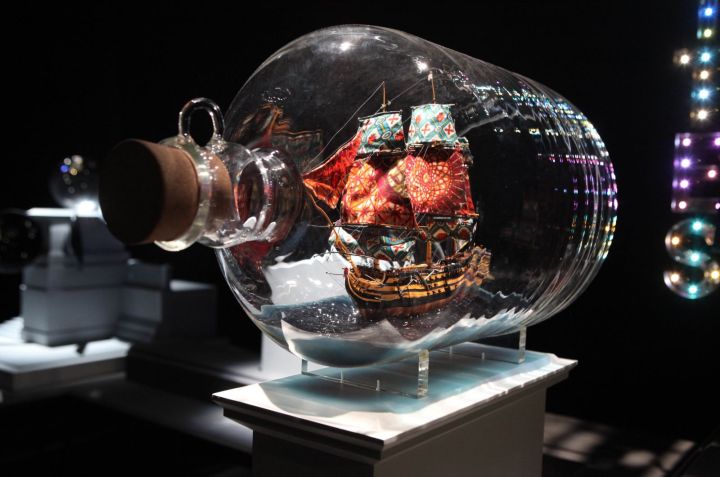
Yinka Shonibare MBE, Nelson’s Ship in a Bottle (maquette), 2007, as installed in the exhibition Fourth Plinth: Contemporary Monument (London: ICA, 2012–13).
◊ ◊ ◊ ◊ ◊
From the YCBA:
Yinka Shonibare MBE
Yale Center for British Art, New Haven, 1 September — 11 December 2016
Curated by Martina Droth
The contemporary British Nigerian artist Yinka Shonibare is best known for his explorations of the legacies of colonialism through sculpture, installations, film, and photography. This display, which coincides with the Center’s exhibition Spreading Canvas: Eighteenth-Century British Marine Painting, will focus on Shonibare’s interest in the British historical figure Admiral Lord Nelson, whom he uses as an emblem of Britain’s imperial history. An important feature of Shonibare’s work is the consistent use of colorful, wax-printed cotton fabrics, which are associated with Africa but originated in Indonesia and Holland, a product of global trade and imperial markets. The fabric sums up the themes at the heart of Shonibare’s work.
Yinka Shonibare MBE will be curated by Martina Droth, Deputy Director of Research and Curator of Sculpture, Yale Center for British Art.
Exhibition | Spreading Canvas

Charles Brooking, Shipping in the English Channel, ca. 1755, oil on canvas (New Haven: Yale Center for British Art, Paul Mellon Collection)
◊ ◊ ◊ ◊ ◊
From the YCBA:
Spreading Canvas: Eighteenth-Century British Marine Painting
Yale Center for British Art, New Haven, 15 September — 4 December 2016
Curated by Eleanor Hughes
This is the first major exhibition to survey the tradition of marine painting that was inextricably linked to Britain’s rise to prominence as a maritime and imperial power, and to position the genre at the heart of the burgeoning British art world of the eighteenth century. The demand for marine paintings—and the prints made after them—in the eighteenth century, from ship launches to shipwrecks, naval battles to serene coastal views, reflects Britain’s absolute dependence on the sea. In an age when Britain claimed to rule the waves, marine paintings found a new importance and helped the island nation tell its stories of triumph and disaster. This exhibition will reconstruct the full array of representational modes—pictorial, planimetric, narrative, and plastic—that were deployed throughout the century to represent the maritime exploits of the nation. Drawn primarily from the collections of the Yale Center for British Art and augmented by spectacular loans, Spreading Canvas will demonstrate that marine painting was both ubiquitous and fundamental to eighteenth-century British culture.
Spreading Canvas: Eighteenth-Century British Marine Painting has been organized by the Center and will be curated by Eleanor Hughes, Deputy Director for Art & Program at the Walters Art Museum. The organizing curator at the Center is Matthew Hargraves, Chief Curator of Art Collections and Head of Collections Information and Access.
◊ ◊ ◊ ◊ ◊
From Yale UP:
Eleanor Hughes, ed., with essays by Eleanor Hughes, Richard Johns, Geoff Quilley, Christine Riding, and Catherine Roach and contributions by Sophie Lynford, John McAleer, and Pieter van der Merwe, Spreading Canvas: Eighteenth-Century British Marine Painting (New Haven: Yale Center for British Art, 2016), 312 pages, ISBN 978-0300221572, $75.
 Spreading Canvas takes a close look at the tradition of marine painting that flourished in 18th-century Britain. Drawing primarily on the extensive collections of the Yale Center for British Art and the National Maritime Museum in Greenwich, London, this publication shows how the genre corresponded with Britain’s growing imperial power and celebrated its increasing military presence on the seas, representing the subject matter in a way that was both documentary and sublime. Works by leading purveyors of the style, including Peter Monamy, Samuel Scott, Dominic Serres, and Nicholas Pocock, are featured alongside sketches, letters, and other ephemera that help frame the political and geographic significance of these inspiring views, while also establishing the painters’ relationships to concurrent metropolitan art cultures. This survey, featuring a wealth of beautifully reproduced images, demonstrates marine painting’s overarching relevance to British culture of the era.
Exhibition | Moving Earth
From the YCBA:
Moving Earth: ‘Capability’ Brown, Humphry Repton, and the Creation of the English Landscape
Sterling Memorial Library, Yale University, New Haven, 7 March — 3 June 2016
Curated by Elizabeth Morris
Approximately one hundred objects from the Center’s collection are represented in this exhibition, which is on view at Yale’s Sterling Memorial Library. Curated by Beth Morris, Assistant Librarian at the Center, the exhibition includes items from the Reference Library and Archives, and reproductions from the Rare Books and Manuscripts, Prints and Drawings, and Paintings collections. Featured here are representations of work by Nathaniel Dance-Holland (Portrait of Lancelot ‘Capability’ Brown, 1773), William Taverner (Classical Landscape, ca. 1760), and Humphrey Repton (Sketches and hints on landscape gardening [London: W. Bulmer and Co., 1794]).
More information is available at the exhibition website.
YCBA Reopens on Wednesday
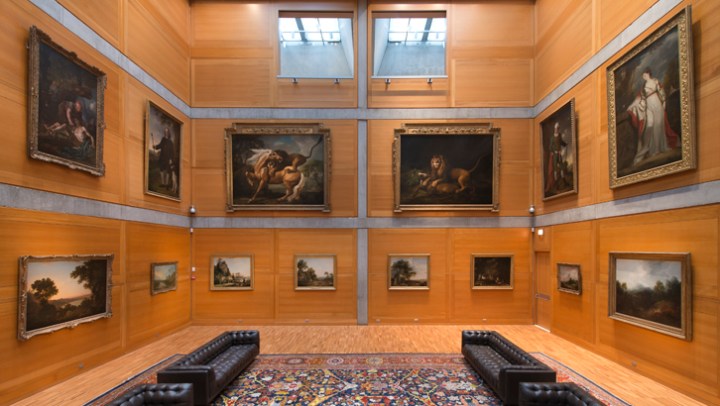
Yale Center for British Art, Library Court following reinstallation facing west, March 2016
Photo by Richard Caspole
◊ ◊ ◊ ◊ ◊
Press release for the reopening of the Yale Center for British Art upon the completion of the interior conservation of its landmark Louis Kahn building:
The Yale Center for British Art will reopen to the public on May 11, 2016, after completing the third phase of a major building conservation project. Visitors to the renovated building will experience a stimulating new installation of the Center’s unparalleled collection of more than five centuries of British art, largely the gift of the institution’s founder, Paul Mellon (Yale College, Class of 1929).
The Long Gallery, located on the fourth floor, will be wholly reconfigured, restoring the original conception of the space as a teaching and study gallery, as formulated by the Center’s founding director, Jules Prown, and as designed by Kahn. Over two hundred works will be installed from floor to ceiling across seven bays. Adjacent to this gallery, in a space that formerly served as an office, will be a new seminar room for faculty, students, and visiting scholars to engage in the close study of collection objects. In addition to the reinstallation of the collection, which explores the theme of “Britain in the World,” the reopening will also feature two special exhibitions.

Yale Center for British Art, fourth floor, Long Gallery following reinstallation, January 2016
Photo by Richard Caspole
◊ ◊ ◊ ◊ ◊
The Center first opened to the public in April 1977, and this project marks the most complex and comprehensive interior conservation work undertaken to date, affecting the entire structure, including the basement and roof. The project features significant mechanical, electrical, plumbing, and telecommunications upgrades, as well as important improvements to accessibility, re prevention systems, and patron amenities.
During the closure, construction crews have been busily restoring the galleries to pristine condition. Old linen and plywood were removed from the permanent walls, the former donated to the Yale School of Art and the latter given to the Hartford Area Habitat for Humanity. After insulation was removed from the exterior walls, the inside of the exterior stainless steel panels was revealed, allowing areas of corrosion to be treated and the interior of the walls to be rebuilt. Two layers of mineral wool insulation were covered with galvanized steel, re-rated plywood, and fresh Belgian linen. Worn synthetic carpet was replaced with new wool carpet, refinished wood trim was installed, and some travertine floor tiles were repaired or replaced. The existing moveable gallery partitions, known as “pogo” walls, were also dismantled, and will be replaced by new ‘pogo’ panels based closely on a drawing produced by Kahn shortly before his death in March 1974.
Extensive renovations also have also been undertaken in the Lecture Hall, which is the only remaining space that has never been refurbished. New seats have been configured in the center of the room, flanked by new steps and railings along each side wall. Five seats for disabled patrons have been installed, each with a companion seat. Audio/visual and lighting upgrades will enable better broadcasting and performance capabilities, including integrated video conferencing. There are also two new accessible public restrooms on the basement level, as well as a bank of new lockers for use by Center visitors.
As with past building conservation projects, the Center has benefited from the expertise and dedication of its partners in the Yale Office of Facilities; Knight Architecture LLC, New Haven; Peter Inskip + Peter Jenkins Architects, London; and Turner Construction Company; as well as the talents and hard work of numerous other collaborators.
This project follows more than a decade of research on the history of the design, construction, and renovation of the Center’s landmark building, as well as the publication in 2011 of Louis Kahn and the Yale Center for British Art: A Conservation Plan by the Center in association with Yale University Press. Written by Peter Inskip and Stephen Gee, in association with Constance Clement, the Center’s deputy director, this book details the conservation plan and proposes a series of policies for the building’s care and maintenance in the years ahead. The first of its kind in the United States, the conservation plan addresses the evolution and appropriate upkeep of a modern building, rather than the preservation of an historic structure, by identifying the key features characterizing its cultural significance and determining those which should be protected and others that could be allowed to change.
The first phase of work to be guided by the conservation plan involved the rehabilitation of the Center’s exterior Lower Court and extensive repairs to the adjacent Lecture Hall Lobby in 2010–2013. This was followed by two additional projects addressing the building’s interior spaces: The second phase, in 2013, focused on refurbishment of the department of Prints & Drawings and Rare Books & Manuscripts. Along with vitally increasing storage capacity for works on paper, behind-the-scenes renovations included the replacement of carpeting and wall coverings; the renewal of the finish on white oak storage cabinets; and the reconfiguration of offices to better accommodate the needs of staff. The third phase, begun in 2015, concentrated primarily on enhancing the Center’s public spaces, while also addressing extensive building-wide mechanical and electrical upgrades, as well as improvements to safety and accessibility.
The Yale Center for British Art houses the largest collection of British art outside the United Kingdom. Presented to the university by Paul Mellon, the collection reflects the development of British art and culture from the Elizabethan period onward. The Center’s collections include more than 2,000 paintings and 200 sculptures, 20,000 drawings and watercolors, 30,000 prints and 35,000 rare books and manuscripts. More than 30,000 volumes supporting research in British art and related fields are available in the Center’s library.
In celebration of the reopening, the Center will host extended hours on Wednesday, May 11, and Thursday, May 12, with special behind-the-scenes tours on opening day. On Saturday, May 14, the Center will welcome the community with a full day of programs and activities. Screenings of a brief documentary on the architecture of the institution’s iconic building, designed by Louis I. Kahn, will be shown in the newly refurbished Lecture Hall. The film will provide insight into the architecture, the building conservation project, and the relationship of the building to the collections. Visitors will be able to tour the reinstallation, which interprets the museum’s extraordinary collections of five centuries of British art in the context of the larger world. The reinstallation is presented in the galleries on the fourth and second floors. The special exhibitions Modernism and Memory: Rhoda Pritzker and the Art of Collecting (May 11–August 21, 2016) and Art in Focus: Relics of Old London (May 11–August 14, 2016) are located on the third-floor galleries. Everyone is welcome. Admission is free.
Exhibition | A Third Gender: Beautiful Youths in Japanese Prints
Press release (via Art Daily) for the exhibition now on view at ROM:
A Third Gender: Beautiful Youths in Japanese Prints
Royal Ontario Museum, Toronto, 7 May — 27 November 2016
Japan Society, New York, 10 March — 11 June 2017
Curated by Asato Ikeda

Suzuki Harunobu, Mitate-e of a Poem by Saigyō Hōshi. 1767/68 (Ontario: ROM, Sir Edmund Walker Collection 926.18.113)
The ground-breaking A Third Gender: Beautiful Youths in Japanese Prints opened at the Royal Ontario Museum on Saturday, May 7, 2016. Featuring stunning woodblock prints, samurai armor, a kimono, screen paintings, lacquerwork, and illustrated books, the exhibition explores issues of gender and tells a pivotal story of sexuality in Japan’s Edo period (1603–1868).
A Third Gender is the first North American display on wakashu. Four hundred years ago in Japan, a complex social structure existed in which gender involved more than a person’s biological sex. Age, position in the sexual hierarchy, and appearance were also considered. Fundamental to this structure were youths termed wakashu. Neither ‘adult man’ nor ‘woman’—each a separate gender—wakashu were objects of desire for both, playing distinct social and sexual roles. Constituting a third gender, they are visually represented in these Edo period woodblock prints.
The exhibition features approximately 60 woodblock prints (ukiyo-e), visually representing wakashu. Many never before displayed, they are from the ROM’s Japanese art collection—the largest in Canada. Produced since the 8th century in Japan, woodblock prints, created collaboratively by a designer, engraver, printer, and publisher, became popular in the 17th century. The exhibition’s prints were created in early 18th to mid-19th centuries by major ukiyo-e masters including Okumura Masanobu, Suzuki Harunobu, and Kitagawa Utamaro.
A Third Gender is curated by Dr. Asato Ikeda, Assistant Professor of Art History at Fordham University, New York and the ROM’s 2014–16 Bishop White Postdoctoral Fellow of Japanese Art and Culture. In Ikeda’s words, “A Third Gender invites ROM visitors to think differently about gender and sexuality and we anticipate the exhibition will be of interest to a diverse audience.”
◊ ◊ ◊ ◊ ◊
From Brill:
Joshua Mostow, Asato Ikeda, and Ryoko Matsuba, A Third Gender: Beautiful Youth in Japanese Edo-period Prints, 1600–1868 (Leiden: Hotei, 2016), 215 pages, ISBN 978-0888545145, $50.
 For the first time outside Japan, A Third Gender examines the fascination with wakashu in Edo-period culture and their visual representation in art, demonstrating how they destabilize the conventionally held model of gender binarism. The volume will reproduce, in color, over a hundred works, mostly woodblock prints and illustrated books from the eighteenth and nineteenth centuries produced by a number of designers ranging from such well-known artists as Okumura Masanobu, Suzuki Harunobu, Kitagawa Utamaro, and Utagawa Kunisada, to lesser known artists such as Shigemasa, Eishi, and Eiri. A Third Gender is based on the collection of the Royal Ontario Museum, which houses the largest collection of Japanese art in Canada, including more than 2500 woodblock prints.
Joshua S. Mostow is Professor of Asian Studies at the University of British Columbia, Vancouver. Asato Ikeda is Assistant Professor of Art History at Fordham University, New York and the ROM’s 2014–16 Bishop White Postdoctoral Fellow of Japanese Art and Culture.
◊ ◊ ◊ ◊ ◊
P R O G R A M S E R I E S
Elements of Sake
3 May 2016
Join Michael Tremblay for an introduction and guided tasting of sake, designed to demystify and engage. This special evening will explore the basics of sake, its production and history, and the culture that created it.
Japanese Visual Culture: Gender and Sexual Diversity
12 May 2016
Asato Ikeda, the curator of A Third Gender, will examine the role of male youths in Edo-period Japan and how this gender and sexuality system can be understood from a contemporary North American perspective.
It’s Complicated: Gender Ambiguity in Early-Mondern Japan
7 June 2016
Explore the roles of gender, sexuality, and erotic art in Japanese culture with internationally renowned scholar Joshua Mostow. Please note this lecture will contain explicit images and discussions of a sexual nature, and is not recommended for those under the age of 18.
Lost in Translation? Gender and Sexuality Across Time and Cultures
21 June 2016
How do we understand representations of sexuality, including same sex sexuality, across different historical and cultural moments without imposing contemporary norms? Join our panel as they explore concepts surrounding our exhibition A Third Gender.
The Art of Japan
16 October 2016
Experience the fundamentals of Japanese art in this in-depth workshop lead by ROM Educator George Hewson. This full day workshop includes a guided visit of the exhibition A Third Gender and lunch.
◊ ◊ ◊ ◊ ◊
Note (added 14 March 2017) — The original posting did not include the Japan Society as a venue.










leave a comment