CAA 2016, Washington, D.C.
104th Annual Conference of the College Art Association
Washington Marriott Wardman Park Hotel, 3–6 February 2016
The 2016 College Art Association conference takes place in Washington, D.C., February 3–6, at the Washington Marriott Wardman Park Hotel (2660 Woodley Rd NW, Washington, DC 20008).
Speaking for no one but myself, I’m frankly perplexed at how thin the eighteenth-century offerings are, indeed how little there is on any period prior to 1850! In 2010, I could identify eleven sessions with connections to the eighteenth century. This year, I came up with only four (out of 200 sessions). My sense is that CAA is beginning to understand how dissatisfied affiliates are. In any event, the format of the conference will apparently be substantially different next year (note the session on Wednesday addressing the changes). Will the changes matter? We’ll see. The call for submissions will be posted March 1. Stay tuned.
And yet for all that seems to be missing from this year’s schedule, I want to highlight the HECAA and ASECS sessions, both of which look fabulous! And so on Friday, at least, from 12:30 to 5:00, CAA will be a terrific conference.* –CH
* Wearing my hat as president of the Historians of British Art, I can vouch for affiliate frustration there, too. And yet, as with the eighteenth-century offerings, there will be a handful of treats for scholars in British studies, too. And for whatever things, I’ve overlooked, please feel free to note these in the comments section.
◊ ◊ ◊ ◊ ◊
Looking Ahead: Changes to the CAA Conference
Wednesday, 3 February 2016, 12:30—2:00, Wilson B, Mezzanine Level
Chair: Suzanne Preston Blier (Harvard University)
The CAA Annual Conference will undergo significant changes in future years, beginning with the 2017 conference. These changes will create more opportunities for participation. Among the changes:
a) The session grid will feature all 90-minute sessions.
b) The call for proposals will include not one but three main submission categories: sessions without panels, sessions with panels, and individual papers.
c) The call for submissions will be posted on March 1, 2016.
If you have questions about these important changes, please attend this session.
◊ ◊ ◊ ◊ ◊
Neatline for the Art Historian
Thursday, 4 February 2016, 2:30—4:30, Roosevelt 2, Exhibit Hall A, Exhibition Level
Lisa Reilly (University of Virginia) and Ronda Grizzle (Scholars’ Lab, University of Virginia Library). Limit: 25 Participants. $45 for members and $60 for non-members.
Using Neatline, anyone can create beautiful, interactive maps, timelines, and narrative sequences from collections of objects, architectural models, archives and artifacts, which tell scholarly stories in a whole new way. Neatline is a remarkable digital presentation tool that allows art and architectural historians to show change over time. Art historians can use it to create visual presentations which reveal building sequences, mapping of artistic influences and patterns of historic change. Join us for this hands-on introduction to Neatline which will also discuss applications for our discipline. This will be a hands-on workshop; attendees are encouraged to bring their own laptops to participate.
◊ ◊ ◊ ◊ ◊
The Mystery of Masonry Brought to Light:
Freemasonry and Art from the Eighteenth Century until Now
Friday, 5 February 2016, 9:30—12:00, Delaware Suite A, Lobby Level
Chair: Reva J. Wolf (State University of New York at New Paltz)
• David V. Bjelajac (George Washington University), Peter Pelham, Freemasonry and the Alchemical Cunning of John Singleton Copley
• Alisa L. Luxenberg (University of Georgia), Building Codes: New Light on F.*. Baron Taylor and Les Voyages pittoresques et romantiques dans l’ancienne France
• Talinn Grigor (University of California, Davis), Reveil de l’Iran: Freemasonry and Artistic Revivalism from Parsi Bombay to Qajar Tehran
• William D. Moore (Boston University), ‘To Consummate the Plan’: Solomon’s Temple in American Masonic Art, Architecture, and Popular Culture, 1865–1930
• David Martín López (University of Granada), What If Pombal, Goya and Lorca Were Freemasons? New Perspectives on the Masonic and Philo-masonic Presence in Portugal and Spain
Discussant: Aimee E. Newell (Scottish Rite Masonic Museum and Library)
◊ ◊ ◊ ◊ ◊
Eros and Enlightenment (ASECS Session)
Friday, 5 February 2016, 12:30—2:00, Washington 2, Exhibition Level
Chairs: Nina Dubin (University of Illinois at Chicago) and Hérica Valladares (University of North Carolina, Chapel Hill)
• Susanna Caviglia (University of Chicago), Painting of Love as Ideology of Harmony
• Paul Holmquist (Carleton University), Centralizing Love: Eros and Politics in the Oikéma of Claude-Nicolas Ledoux
• Camille Mathieu (University of Oxford and St. John’s College), Eros amongst Eagles: Iconographies of Alliance in Napoleonic France
Discussant: Mary Sheriff (University of North Carolina)
◊ ◊ ◊ ◊ ◊
Pastel: The Moment of a Medium in the Eighteenth Century (HECAA)
Friday, 5 February 2016, 2:30—5:00, Washington 6, Exhibition Level
Chairs: Iris J. Moon (Pratt Institute) and Esther Bell (Fine Arts Museums of San Francisco)
• Rochelle N. Ziskin (University of Missouri Kansas City), Pastel (and Other) Portraits Chez Mme Doublet
• Marjorie Shelley (The Metropolitan Museum of Art), Painting in Crayons: Pastel as an Artists’ Medium in the Cultural and Commercial Context of the Eighteenth Century
• Oliver Wunsch (Harvard University), Face Time: Permanence and Pastel Portraiture
◊ ◊ ◊ ◊ ◊
Taking Stock: Early Modern Art Now
Saturday, 6 February 2016, 9:30—12:00, Salon 1, Lobby Level
Chairs: Hanneke Grootenboer (University of Oxford) and Amy Knight Powell, University of California, Irvine
• Susan Dackerman (Getty Research Institute), The Paleontology of Print
• Itay Sapir (Université du Québec à Montréal), Patterns of Attention: Early Modern Art and the Potential Deceleration of Looking
• Claudia Swan (Northwestern University), Global Encounters Then and Now
• Marika T. Knowles (Harvard Society of Fellows), The Subject of History in the ‘Figures de différents caractères’ after Watteau
• Shira Brisman (University of Wisconsin-Madison), Hugo van der Goes and the Slip of Sin
New Book | Picture Titles
From Princeton UP:
Ruth Bernard Yeazell, Picture Titles: How and Why Western Paintings Acquired Their Names (Princeton: Princeton University Press, 2015), 352 pages, ISBN: 9780691165271, $35 / £25.
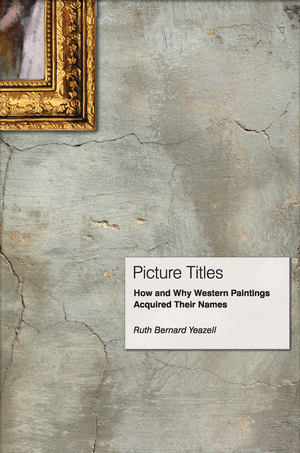 A picture’s title is often our first guide to understanding the image. Yet paintings didn’t always have titles, and many canvases acquired their names from curators, dealers, and printmakers—not the artists. Taking an original, historical look at how Western paintings were named, Picture Titles shows how the practice developed in response to the conditions of the modern art world and how titles have shaped the reception of artwork from the time of Bruegel and Rembrandt to the present.
Ruth Bernard Yeazell begins the story with the decline of patronage and the rise of the art market in the seventeenth and eighteenth centuries, as the increasing circulation of pictures and the democratization of the viewing public generated the need for a shorthand by which to identify works at a far remove from their creation. The spread of literacy both encouraged the practice of titling pictures and aroused new anxieties about relations between word and image, including fears that reading was taking the place of looking. Yeazell demonstrates that most titles composed before the nineteenth century were the work of middlemen, and even today many artists rely on others to name their pictures. A painter who wants a title to stick, Yeazell argues, must engage in an act of aggressive authorship. She investigates prominent cases, such as David’s Oath of the Horatii and works by Turner, Courbet, Whistler, Magritte, and Jasper Johns. Examining Western painting from the Renaissance to the present day, Picture Titles sheds new light on the ways that we interpret and appreciate visual art.
Ruth Bernard Yeazell is the Chace Family Professor of English and director of The Lewis Walpole Library at Yale University. Her books include Harems of the Mind: Passages of Western Art and Literature and Art of the Everyday: Dutch Painting and the Realist Novel (Princeton).
◊ ◊ ◊ ◊ ◊
C O N T E N T S
List of Illustrations
Prologue (This is not a title)
I Naming and Circulating: Middlemen
1 Before Titles
2 Dealers and Notaries
3 Early Cataloguers
4 Academies
5 Printmakers
6 Curators, Critics, Friends—and More Dealers
II Reading and Interpreting: Viewers
7 Reading by the Title
8 The Power of a Name
9 Many Can Read Print
10 Reading against the Title
III Authoring as well as Painting: Artists
11 The Force of David’s Oath
12 Turner’s Poetic Fallacies
13 Courbet’s Studio as Manifesto
14 Whistler’s Symphonies and Other Instructive Arrangements
15 Magritte and The Use of Words
16 Johns’s No and the Painted Word
Acknowledgments
Notes
Index
Exhibition | Reynolds at Plymouth
Now on view in Plymouth:
The Influence of Italy
Plymouth City Museum and Art Gallery, 24 October 2015 — 27 August 2016
 Taking as its focus our newly-acquired sketchbook, which was completed by Sir Joshua Reynolds between 1750 and 1752, this display investigates what attracted the young artist to Italy and the lasting influence his tour had on his life and art. Scroll through a digital version of our sketchbook and see what caught Reynolds’s eye as he sketched his way across Rome. Discover why Italy’s art, history and landscape has had such an enduring influence on centuries of artistic imagination. Featuring works by Wilson, Guardi and Northcote, plus supporting loans from the De Pass Collection at the Royal Cornwall Museum and the Royal Albert Memorial Museum, Exeter, join us for a journey to la bella Italia.
◊ ◊ ◊ ◊ ◊
Now on view in Plymouth:
In the Frame: Plymouth’s Portraits Revealed
Plymouth City Museum and Art Gallery, 13 December 2014 — 27 August 2016

Sir Joshua Reynolds, Self-Portrait, ca. 1746 (Plymouth City Council)
Come and see an exhibition that delves more deeply into Plymouth’s portrait collection and presents characters that are new or rarely seen as well as some more familiar faces. ‘In the Frame’ features one of our most recent acquisitions—an early self-portrait by Plympton-born 18th-century artist, Sir Joshua Reynolds. This is set amongst other paintings of artists including self-portraits by James Northcote and Edward Opie.
You can come face to face with some of Plymouth’s maritime greats, too—from Hawkins and Raleigh to 18th-century admirals and George Gibbon, the Lieutenant Governor of Plymouth in the early 1700s, painted by Thomas Hudson. Important local faces and families also feature—from the Edgcumbes and the Eliots, to William Cookworthy (the founder of the Plymouth Porcelain factory) and the last town crier of Devonport.
Find out more about the research and the development that took place for this exhibition on our Museum blog.
HBA Book Award Winners for 2014 Publications
From HBA:
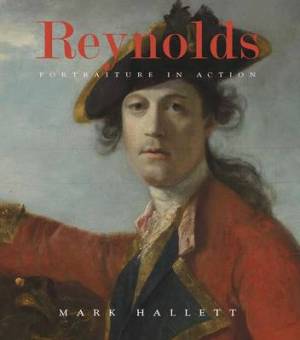 The Historians of British Art is pleased to announce Book Award winners for publications from 2014. The winners were chosen from a nominating list of over eighty books from more than twenty different presses. Awards are granted in three different categories, and this year two books share the award for single-author books dealing with a subject before 1800. Paul Binski’s Gothic Wonders: Art, Artifice, and the Decorated Style, 1290–1350 sets a major and understudied episode in medieval art in conversation with its Continental neighbors, dramatically enlivening both in the process. Mark Hallett’s Reynolds: Portraiture in Action breathes new life into one of Britain’s most thoroughly studied portraitists by tracing his work from studio conception to exhibition and beyond. John Potvin is the winner of the post-1800 single-author category for Bachelors of a Different Sort: Queer Aesthetics, Material Culture and the Modern Interior in Britain, a book that expands the scope of interior design and the insights that it can yield for British modern culture. Finally, British Art in the Nuclear Age, edited by Catherine Jolivette, is the winner of the multi-author category. Drawing on a wide array of artists and materials, this volume offers a subtle and surprising take on Britain’s cultural position during, and in relation to, the Cold War.
More information is available here»
New Book | Transatlantic Romanticism, 1790–1860
From the U of Massachusets Press:
Andrew Hemingway and Alan Wallach, eds., Transatlantic Romanticism: British and American Art and Literature, 1790–1860 (Amherst: University of Massachusetts Press, 2015), 336 pages, ISBN: 978-1625341143, $30.
 That the Romantic movement was an international phenomenon is a commonplace, yet to date, historical study of the movement has tended to focus primarily on its national manifestations. This volume offers a new perspective. In thirteen chapters devoted to artists and writers of the late eighteenth and early nineteenth centuries, leading scholars of the period examine the international exchanges that were crucial for the rise of Romanticism in England and the United States.
In the book’s introduction, Andrew Hemingway—building on the theoretical work of Michael Lowy and Robert Sayre—proposes that we need to remobilize the concept of Weltanschauung, or comprehensive worldview, in order to develop the kind of synthetic history of arts and ideas the phenomenon of Romanticism demands. The essays that follow focus on the London and New York art worlds and such key figures as Benjamin West, Thomas Bewick, John Vanderlyn, Washington Allston, John Martin, J. M. W. Turner, Thomas Cole, James Fenimore Cooper, George Catlin, Edgar Allan Poe, Harriet Beecher Stowe, and Herman Melville. Taken together, these essays plot the rise of a romantic anti-capitalist Weltanschauung as well as the dialectic between Romanticism’s national and international manifestations.
In addition to the volume editors, contributors include Matthew Beaumont, David Bindman, Leo Costello, Nicholas Grindle, Wayne Franklin, Janet Koenig, William Pressly, Robert Sayre, William Truettner, Dell Upton, and William Vaughan.
Andrew Hemingway is professor emeritus of art history, University College London, and author of The Mysticism of Money: Precisionist Painting and Machine Age America.
Alan Wallach is professor emeritus of art and art history, The College of William and Mary, and author of Exhibiting Contradiction: Essays on the Art Museum in the United States (University of Massachusetts Press, 1998).
◊ ◊ ◊ ◊ ◊
C O N T E N T S
Acknowledgments
Introduction: Capitalism, Nationalism, and the Romantic Weltanschauung, Andrew Hemingway
I The City
1 ‘The pit of modern art’: Practice and Ambition in the London Art World, William Vaughan
2 The Urban Ecology of Art in Antebellum New York, Dell Upton
3 Urban Convalescence in Lamb, Poe, and Baudelaire, Matthew Beaumont
II History
4 Sublime and Fall: Benjamin West and the Politics of the Sublime in Early Nineteenth-Century Marylebone, Nicholas Grindle
5 Benjamin West’s Royal Chapel at Windsor: Who’s in Charge, the Patron or the Painter?, William Pressly
6 The Politics of Style; Allston’s and Martin’s Belshazzars Compared, Andrew Hemingway
7 James Fenimore Coooper and American Artists in Europe: Art, Religion, and Politics, Wayne Franklin
III Landscape
8 John Martin, Thomas Cole, and Deep Time, David Bindman
9 ‘Gorgeous, but altogether false”: Turner, Cole, and Transatlantic Ideas of Decline, Leo Costello
10 Thomas Cole and Transatlantic Romanticism, Allan Wallach
IV Race
11 Picturing the Murder of Jane McCrea: A Critical Moment in Transatlantic Romanticism, William H. Truettner
12 The Romantic Indian Commodified: Text and Image in George Catlin’s Letters and Notes (1841), Robert Woods Sayre
13 Romantic Racialism and the Antislavery Novels of Stowe, Hildreth, and Melville, Janet Koenig
Notes on Contributors
Index
Call for Papers | All the Beauty of the World
From the Call for Papers:
All the Beauty of the World: The Western Market
for Non-European Artefacts, 18th–20th Centuries
Berlin, 13–15 October 2016
Proposals due by 15 February 2016
In the wake of the Western expansion, a fast growing number of non-European artefacts entered the European market. They initially made their way into princely cabinets of curiosities. Made possible by the forced opening and exploitation of more and more parts of the world and pushed by social and technological changes of the time, the 18th century brought a boom of the market of non-European artefacts in Europe. This came along with the emergence of a broader collecting culture and the development of a rich museumscape.
This market and its development in terms of methods and places of exchange and monetary and ideological value of the objects are in the focus of an international symposium organised by the Institute for Art History in cooperation with the Center for Art Market Studies at Technical University Berlin, in collaboration with the Institut d’histoire moderne et contemporaine (CNRS) and the Labex TransferS (PSL) in Paris. The keynote lecture will be given by Professor Timothy Brook, holder of the Republic of China Chair at the University of British Columbia.
The aim of the symposium is to examine how the market for non-European artefacts developed between the 18th and 20th centuries and to which extend it was entangled with the history of museums and private collections. The following five topics will serve as main axis: actors and networks, places of purchase and trade, transfer and transport, prices and value and expertise. The axes are entangled and should not be regarded as separated topics.
1 Actors and networks
Who were the actors of the market (e.g. art dealers, commercial agents, carriers but also diplomats, travellers, expats, missionaries or military as well as museums and collectors)? Which regional specifications can be identified? Who were the key figures of the market(s)? Which networks can be spotted? How did they work?
2 Places of purchase and trade
What were the centres of the purchase and/or trade of art objects (in the countries of origin as well as in Europe)? How did they develop in the course of the period of examination? Which significance did the primary markets and their political/social development have for the European market? Did the European market turn into the primary market at a certain time? What were the main places for purchase and trade in Europe (e.g. auctions houses, galleries, private houses)? What marketing methods can be identified?
3 Transfer and transport
What were the (political, social, technological) circumstances of the transactions? To what extent did technological developments (e.g. establishment of railway lines) influence the market offer? How were the objects brought to Europe (e.g. export and import regulations, methods of transport)?
4 Prices and value
Which payment methods or methods of exchange did exist? How did they impact the value of objects? How was the value of an object determined? To what extent did this value change in space and time (difference between primary and secondary market; development in the course of time)? Despite the monetary value of a price: which other function in the act of purchase can be identified (e.g. legitimation of possession)? And to what extent did the change of the price and value shape the European collections? Here, we are especially interested in the shift from an economy of looting or/and bazaar in the countries of origin to the pricing and “rational” marketing after the arrival and commercialisation of the objects in Europe.
5 Expertise
How did the perception of and the knowledge about non-European art develop? How was the knowledge generated and transferred? Which role did individual actors (e.g. dealers, museums, collectors) play in the development of the perception of the objects? To what extent did the development of expertise influence the supply, the display of the objects and the character of the collections?
The focus of the investigation will be on the development between the 18th and the 20th centuries. Papers exploring the market development before 18th century and especially those comparing the development before and after 1700 are also welcome. The conference language is English. Papers should be a maximum of 20 minutes in length, and preference will be given to proposals that stimulate dialogue and engage with broader topics. Please send proposals (max. 300 words) with a short academic CV to c.howald@tu-berlin.de by 15 February 2016 at the latest. Selected speakers will be notified by 15 March 2016. Financial assistance with travel expenses for speakers may be available (subject to grant approval).
Convenors
Bénédicte Savoy (TU Berlin)
Charlotte Guichard (CNRS, IHMC, Paris)
Christine Howald (TU Berlin)
New Book | Architecture at the End of the Earth
From Duke UP:
William Craft Brumfield, Architecture at the End of the Earth: Photographing the Russian North (Duke University Press, 2015), 256 pages, ISBN: 978-0822359067, $40.
 Carpeted in boreal forests, dotted with lakes, cut by rivers, and straddling the Arctic Circle, the region surrounding the White Sea, which is known as the Russian North, is sparsely populated and immensely isolated. It is also the home to architectural marvels, as many of the original wooden and brick churches and homes in the region’s ancient villages and towns still stand. Featuring nearly two hundred full color photographs of these beautiful centuries-old structures, Architecture at the End of the Earth is the most recent addition to William Craft Brumfield’s ongoing project to photographically document all aspects of Russian architecture.
The architectural masterpieces Brumfield photographed are diverse: they range from humble chapels to grand cathedrals, buildings that are either dilapidated or well cared for, and structures repurposed during the Soviet era. Included are onion-domed wooden churches such as the Church of the Dormition, built in 1674 in Varzuga; the massive walled Transfiguration Monastery on Great Solovetsky Island, which dates to the mid-1550s; the Ferapontov-Nativity Monastery’s frescoes, painted in 1502 by Dionisy, one of Russia’s greatest medieval painters; nineteenth-century log houses, both rustic and ornate; and the Cathedral of St. Sophia in Vologda, which was commissioned by Ivan the Terrible in the 1560s. The text that introduces the photographs outlines the region’s significance to Russian history and culture.
Brumfield is challenged by the immense difficulty of accessing the Russian North, and recounts traversing sketchy roads, crossing silt-clogged rivers on barges and ferries, improvising travel arrangements, being delayed by severe snowstorms, and seeing the region from the air aboard the small planes he needs to reach remote areas.
The buildings Brumfield photographed, some of which lie in near ruin, are at constant risk due to local indifference and vandalism, a lack of maintenance funds, clumsy restorations, or changes in local and national priorities. Brumfield is concerned with their futures and hopes that the region’s beautiful and vulnerable achievements of master Russian carpenters will be preserved. Architecture at the End of the Earth is at once an art book, a travel guide, and a personal document about the discovery of this bleak but beautiful region of Russia that most readers will see here for the first time.
William Craft Brumfield is Professor of Slavic Studies at Tulane University. Brumfield, who began photographing Russia in 1970, is the foremost authority in the West on Russian architecture. He is the author, editor, and photographer of numerous books, including Lost Russia: Photographing the Ruins of Russian Architecture, also published by Duke University Press. Brumfield is the recipient of a John Simon Guggenheim Memorial Fellowship and was a Fellow at the National Humanities Center. In 2002 he was elected to the State Russian Academy of Architecture and Construction Sciences, and in 2006 he was elected to the Russian Academy of Fine Arts. He is also the 2014 recipient of the D. S. Likhachev Prize for Outstanding Contributions to the Preservation of the Cultural Heritage of Russia. Brumfield’s photographs of Russian architecture have been exhibited at numerous galleries and museums and are part of the Image Collections at the National Gallery of Art in Washington, D.C.
Call for Articles | Material Fictions, Special Issue of ECF
From the Call for Articles:
Material Fictions
Special Issue of Eighteenth-Century Fiction, proposed for Autumn 2018
Completed manuscripts due by 15 July 2017
Edited by Eugenia Zuroski Jenkins and Michael Yonan
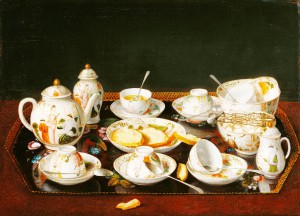 ECF invites manuscripts exploring material cultures of the long eighteenth century and the fictions crafted in and through objects, built environments, and other material entities. How did eighteenth-century things tell stories? How did the design of objects engender particular narratives, whether personal, political, or social? Did things collaborate with texts to generate broader fictions, or did they posit counter-fictions to written literature? What kinds of methodologies might we cultivate to ‘read’ eighteenth-century material culture, and what insight might such readings yield? Conversely, what might the material thing’s resistance to being ‘read’ tell us about the methods of interpretation and analysis we bring to the eighteenth century? This special issue will be an opportunity to explore the intersections between literary and cultural studies, art history, anthropology, and other fields. It is an opportunity to ask what the eighteenth century specifically can bring to the larger interdisciplinary project of material culture studies.
Deadline for manuscripts: 15 July 2017
Manuscripts: 6,000–8,000 words, French or English
Publication of this special issue is proposed for the autumn of 2018.
Editors Eugenia Zuroski Jenkins, McMaster University, and Michael Yonan, University of Missouri.
Eighteenth-Century Fiction, ecf@mcmaster.ca
‘Submissions’
En français:
Les Fictions matérielles
La rédaction sollicite des articles pour un numéro spécial consacré aux cultures matérielles du XVIIIe siècle et aux fictions conçues dans et à travers les objets, les environnements bâtis et d’autres entités matérielles. Au XVIIIe siècle, comment les objets ont-ils raconté des histoires? Comment la conception d’objets a-t-elle engendré des récits particuliers, qu’ils soient personnels, politiques ou sociaux? Comment les objets collaborent-ils à la composition textuelle générant des fictions plus larges, ou introduisant de la contre-fictions au sein de la littérature? Quels types de méthodologies peut-on cultiver (ou non) à la « lecture » la culture matérielle du XVIIIe siècle, et que pourraient apporter ces idées à notre lecture? Ce numéro spécial sera l’occasion d’explorer les intersections entre les études littéraires et culturelles, l’histoire de l’art, l’anthropologie, et d’autres domaines. C’est l’occasion de demander comment le XVIIIe siècle peut contribuer au plus grand projet interdisciplinaire d’études de la culture matérielle. Ce numéro est ouvert à la discussion de toutes sortes de représentations des cultures matérielles et ne se limite pas à la fiction narrative.
La date limite est le 15 juillet 2017 (6 000 – 8 000 mots).
La publication est proposée pour l’automne 2018.
Les rédacteurs: Eugenia Zuroski Jenkins de l’Université McMaster et Michael Yonan de l’Université de Missouri.
Eighteenth-Century Fiction, ecf@mcmaster.ca
‘Submissions’
Exhibition | The Power of Prints: The Legacy of Ivins and Mayor

Paul-César Helleu, Madame Helleu Looking at the Watteau Drawings in the Louvre, ca. 1896, drypoint, 38.8 × 51 cm (New York: The Metropolitan Museum of Art, The Elisha Whittelsey Collection, 59.599.19)
◊ ◊ ◊ ◊ ◊
Goya is the the important eighteenth-century offering here: Ivins was responsible for those acquisitions. Press release (21 January 2016) from The Met:
The Power of Prints: The Legacy of William M. Ivins and A. Hyatt Mayor
The Metropolitan Museum of Art, New York, 26 January 26 — 22 May 2016
Curated by Freyda Spira
The history of the Metropolitan Museum’s collection of works of art on paper—now one of the most important and most comprehensive in the world—began 100 years ago with the unlikely and astonishing story of its first two curators, neither of whom was trained as an art historian. Together, they challenged convention, engaged the public, and revolutionized the study of these works. Organized to commemorate the department’s centennial, the exhibition The Power of Prints: The Legacy of William M. Ivins and A. Hyatt Mayor sheds light on the fascinating careers of its founding curators and reveals how, from the very beginning, they artfully composed the print collection as a visual library: a corpus of works of art on paper—from the exceptional to the everyday. The story of this great American collection will be told through prints by Andrea Mantegna, Albrecht Dürer, Marcantonio Raimondi, Jacques Callot, Rembrandt van Rijn, Francisco de Goya y Lucientes, Honoré Daumier, James McNeill Whistler, Henri de Toulouse-Lautrec, Mary Cassatt, Edward Penfield, and Edward Hopper, among others.

Francisco de Goya y Lucientes, The Garroted Man (El agarrotado), ca. 1778–80, etching, 32.7 x 21.4 cm (New York: The Metropolitan Museum of Art, Rogers Fund, 1920, 20.22)
In 1916, William Mills Ivins (1881–1961) abandoned a successful law career to accept the job of founding curator of the Met’s Department of Prints. Although he was hired specifically to acquire the works of well-known 19th-century artists and old masters, Ivins set out instead to amass examples of technical, social, and historical interest as well. Notably, he championed the works of Goya, whose challenging and sometimes gruesome imagery was not appreciated in America at that time. Ivins first encountered these works as a student in Paris; the brutal images of war affected him profoundly and, in time, changed the course of his life. Almost all of the Met’s collection of nearly 300 Goya prints—one of the largest anywhere—was acquired by Ivins.
Before joining the Museum in 1932, Alpheus Hyatt Mayor (1901–1980) had studied modern languages, literature, and poetry, and worked as an arts critic, teacher, and occasional actor. Like Ivins, he was also an avid bibliophile with wide-ranging interests, a voracity for knowledge, and passion for social history. Brought on to assist Ivins and, eventually, to continue his legacy, Mayor expanded on Ivins’s foundational work by adding a new focus on lithography and popular prints. Pushing the boundaries of what had traditionally been collected as printed matter, he acquired for the Museum some of the most renowned American collections of popular prints. To Mayor, these items had value, because of the information they contained about all aspects of culture. He also recognized their future potential for research in diverse fields, from anthropology to urban planning.
As a result of Ivins’s and Mayor’s prescient collecting, the department now houses innumerable unique masterpieces, lauded for their exceptional artistry, as well as popular prints such as posters and trade cards that were printed in large numbers and never intended to last. By employing a conversational and colloquial tone in texts they drafted to describe these works, Ivins and Mayor transformed the way information about art objects was written. Excerpts from the writings of Ivins and Mayor will be included on labels throughout the exhibition.
To a certain extent, the history of the department is also the history of a series of extraordinary gifts and purchases of works of art. The gift of some 3,500 prints by paper manufacturer Harris Brisbane Dick led to the hiring of Ivins, to oversee them. An early gift of 10 prints by the artist Mary Cassatt came from Ivins’s friend Paul J. Sachs, assistant director at the Fogg Museum at Harvard University. (Sachs’s brother—also a friend of Ivins—gave an additional seven.) Engravings, woodcuts, and two woodblocks by Dürer entered the collection through gift and purchase from Junius Spencer Morgan, a noted collector of the artist’s works. Between 1949 and 1962, Mayor purchased more than 16,000 engravings, woodcuts, and mezzotints from Franz Joseph II, prince of Liechtenstein. The American sculptor Bessie Potter Vonnoh donated her entire collection of French and American posters of the 1890s. From Jefferson R. Burdick, the Museum received 300,000 examples of printed ephemera from the late 19th to the mid-20th century.
Just as Ivins and Mayor did, the exhibition will consider printed matter as the entrée to the information age, recognizing prints as functional objects that spread information to an ever-expanding audience and reflect a changing society. In the age of digital photography and the Internet, the power of prints, or the ability to disseminate images in identical form to a mass market, has special relevance to how we see, understand, and engage with works of art.
Arranged thematically and by technique, the exhibition has four parts. In the first section, the idea of taste is addressed in terms of Harris Brisbane Dick’s foundational gift of French, British, and American etchings and how it affected the collecting of etchings by the likes of Rembrandt and Goya. The second section considers engravings, amassed from the beginning with a focus on Renaissance artists such as Mantegna and Dürer. The third section shows the use of printed images in the spread of knowledge. Several rare early books, illustrated by woodcuts will be displayed. The books represent firsts of their kind on topics as diverse as costume, anatomy, and architecture. The final section features examples by Daumier, Toulouse-Lautrec, and other 19th-century artists whose works entered a truly mass market in the form of lithographs. Also in this section will be selected popular prints and ephemera from the late 19th and early 20th centuries.
The Power of Prints: The Legacy of William M. Ivins and A. Hyatt Mayor is organized by Freyda Spira, Associate Curator in the Metropolitan Museum’s Department of Drawings and Prints. Exhibition design is by Zoe Alexandra Florence, Exhibition Designer; graphics are by Ria Roberts, Graphic Designer; and lighting is by Clint Ross Coller and Richard Lichte, Lighting Design Managers, all of the Museum’s Design Department.
An illustrated checklist is available here»
◊ ◊ ◊ ◊ ◊
The catalogue is distributed by Yale UP:
Freyda Spira and Peter Parshall, The Power of Prints: The Legacy of William M. Ivins and A. Hyatt Mayor (New York: The Metropolitan Museum of Art, 2016), 192 pages, ISBN: 978-1588395856, $35 / £25.
 Metropolitan Museum curators William M. Ivins and his protégé A. Hyatt Mayor not only assembled a vast collection of prints, from Renaissance masterworks to ephemeral works, but also expanded the appreciation of prints as aesthetic objects, socio-historical documents, and tools of communication. More radically, by discussing these prints in accessible language, they changed our notions of how art reaches the wider public. Drawing on previously unpublished material, including personal letters and departmental records, this is the first comprehensive exploration of the lives, careers, theories, and influence of Ivins and Mayor. Also included are 120 exceptional prints that represent the breadth and depth of their acquisitions, including works by Dürer, Rembrandt, Callot, Goya, Whistler, Cassatt, and Toulouse-Lautrec.
Freyda Spira is associate curator in the Department of Drawings and Prints, The Metropolitan Museum of Art. Peter Parshall was formerly the Jane Neuberger Goodsell Professor of Art History and the Humanities at Reed College and curator and head of the Department of Old Master Prints at the National Gallery of Art, Washington, D.C.
Call for Papers | Art History for Artists
◊ ◊ ◊ ◊ ◊
Conference organizers stress that they welcome papers addressing the latter half of the eighteenth century, too! Details are available from the conference website. From the CFP:
Art History for Artists: Interactions between Scholarly
Discourse and Artistic Practice in the 19th Century
Berlin, 8–9 July 2016
Proposals due by 1 March 2016
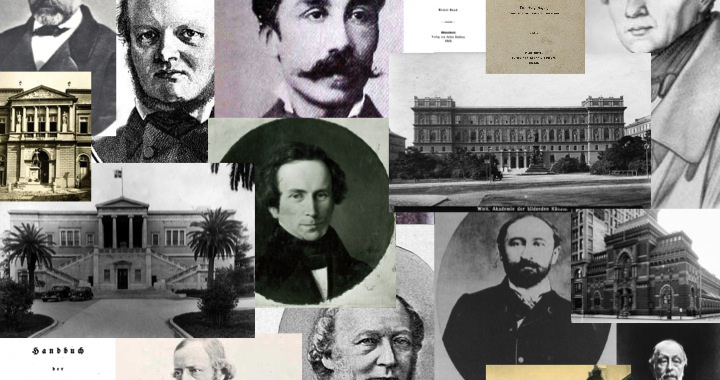
The conference seeks to examine the shaping of art history as a discipline during the 19th century in relation to artistic training and exchanges between artists and scholars. The development of art history has been associated with an array of socio-political and economic factors such as the formation of a bourgeois public, the politics of national identity and state legitimacy or the needs of an expanding art market. This conference aspires to explore yet another, less studied dimension: the extent to which the historical study of art was also rooted in an intention to inform contemporary artistic production.
The scholarship produced by the first generations of art historians in this period was intertwined with their interest in the art of their time, its quality and future development. Throughout the century many art historians made studies entirely dedicated to contemporary art and sought to provide artists with new ideals. The connection between scholarly discourse and artistic practice was also validated at an institutional level. Since the late 18th century courses in art history, along with courses in history, archaeology, art theory and aesthetics, had been systematically incorporated into the curricula of art academies, schools of design, academies of architecture and polytechnics. These spaces of art education were among the first institutional homes of art history, and played an important role in the shaping of the discipline well before the establishment of autonomous university chairs—a development largely overlooked in the history of art history, but also in the history of art education.
The historical study of art questioned academic normativity and multiplied the aesthetic models available for artists. Reacting against the growing commodification of art, many artists claimed a new role as creators for art history and for the museum, as an alternative to the market. At the same time, the influx of empirical knowledge on past art was often seen as a burden for artistic creativity. The overall reflective turn upon art and its past, tainted by the Hegelian announcement of the end of art, influenced the work of artists in multifarious ways that remain to be explored.
Three main axes of inquiry will be privileged:
1. Scholarly courses in art education: institutional frameworks
Based on concrete cases, papers may address the training in art history, archaeology, art theory and aesthetics offered in institutions of art education and consider the artistic, political or economic considerations linked to its introduction to the curriculum. Topics of interest may include teaching approaches and goals, the media and technologies of illustration (prints, casts, museum collections, photography), or the profile of professors.
What was the impact of a systematised art historical and theoretical knowledge on academic doctrines, practical training and the overall objectives of art education? How did the particular institutional framework of art education and exposure to the problems of artistic practice affect the scholarly discourses produced in this context? Did teaching artists, architects or craftsmen generate different objects of study, focuses, methods and ultimately a different kind of scholarship to that produced at universities or in museums?
2. The art historian and the present
Based on case studies, papers may explore the changing attitudes of art historians, archaeologists and art theorists towards their engagement in contemporary artistic production. From the 1870s onwards, primarily in Germany, such an engagement was downplayed in the name of objective and unbiased scholarship detached from practical considerations, alongside the growing academic recognition of art history and other art-related disciplines and their presence in the university. Nonetheless, the complex entanglement of scholarly discourse and contemporary art never really abated even well after this date.
A main focus of the conference is also on the extent to which contemporary artistic experimentations provided art scholars with new perspectives for evaluating past artistic achievements or for studying aesthetic experience. Papers exploring cases of fertile interactions or conflicts between artists and art scholars are particularly welcome.
3. The artist as producer of art discourse
This section seeks to explore the reactions of artists to the emergence of a community of professional specialists claiming control over art discourse and the formation of parallel or counter discourses by art practitioners. In focus here are the reformulations of art-historical canons by artists in their works, writings or teachings, as well as their contributions to art theory, aesthetics and criticism. Especially welcome are papers that look at artists’ attempts to visualise art history and explore the concerns shared by artists and historians about the various ways of representing history.
The conference will cover the period from the mid-18th century to the first two decades of the 20th century. Cases of peripheral, extra-European or colonial contexts, as well as contributions focusing on the circulation of teaching models, discourses and actors across institutions or national boundaries are particularly welcome. The conference languages will be English and German. Accommodation, and travel costs up to 100€ will be covered for all speakers. Full coverage of travel expenses may also be available, subject to grant approval.
The deadline for proposals is March 1st, 2016. Candidates will be informed within two weeks from this date on the outcome of their application. 25 minutes will be allowed for each paper. Please send proposals (max. 500 word abstract and short cv) to Eleonora Vratskidou: evratskidou@gmail.com.
Convenor
Eleonora Vratskidou, Alexander von Humboldt Postdoctoral Fellow-TU Berlin
Scientific Committee
Heinrich Dilly, Martin-Luther-Universität Halle-Wittenberg Pascal Griener, Université de Neuchâtel
Hubert Locher, Philipps-Universität Marburg
Olga Medvedkova, CNRS-ENS (Centre Jean Pépin) Michela Passini, CNRS-ENS (IHMC)
Matthew Rampley, University of Birmingham Bénédicte Savoy, TU Berlin
Eleonora Vratskidou, TU Berlin










 Enfilade
leave a comment