Conference | Chinese Wallpaper: Trade, Technique and Taste
From the conference website:
Chinese Wallpaper: Trade, Technique and Taste
Coutts & Co / V & A, London, 7–8 April 2016

Detail of the painted wallpaper in the Chinese Bedroom, Belton House. ©National Trust Images/Martin Trelawny
A conference on the subject of Chinese wallpaper will take place in London on 7 and 8 April 2016, with an optional excursion to Brighton on 9 April. The event is being organised jointly by the National Trust and the Victoria and Albert Museum, with generous support from Coutts & Co and the Royal College of Art.
Chinese wallpaper is a product that is finely balanced between east and west, art and design, trade and taste. It has been an important component of western interiors for about 250 years, but it has sometimes been taken for granted, literally fading into the background. However, over the last few decades the conservation of Chinese wallpapers has developed considerably. It is now also the subject of increasing scholarly interest. Traditional-style hand-made Chinese wallpaper is still being produced today and is now also in demand in China itself.
The aim of this conference is to stimulate the momentum of the research into Chinese wallpaper and to capture some of the recent findings. The papers to be presented will include European, American and Chinese perspectives and will look at Chinese wallpaper as art, as design, as cross-cultural exchange, as commodity and as material object.
The first day of the conference will be hosted by Coutts at their premises in the Strand—still containing the Chinese wallpaper acquired by banker Thomas Coutts in the late eighteenth century. The second day will be held at the Victoria and Albert Museum and will include the viewing of actual Chinese export wallpapers from the museum’s collection—the largest in the world, but much of it not normally on display. On 9 April there will be an optional excursion to the Royal Pavilion in Brighton, where Chinese wallpaper formed an important component of the Prince Regent’s decorative vision.
◊ ◊ ◊ ◊ ◊
T H U R S D A Y , 7 A P R I L 2 0 1 6
Coutts & Co.
9:00 Registration and coffee
9:30 Welcome
9:40 Introduction by Margot Finn, Chair in Modern British History, University College London
9:50 Session A
• Emile de Bruijn, ‘Chinese Wallpaper: a Global Product’
• Helen Clifford, ‘From Canton via Custom House to the Country House: Chinese Wallpaper in Transit and the Role of the East India Company, 1750–1850’
• Ming Wilson, ‘Chinese Paper as Commodity’
11:05 Coffee
11:25 Session B
• Xiaoming Wang, ‘Chinese Woodblock New Year Prints and Paintings Used as Wallpaper in Europe in the Eighteenth Century’
• Friederike Wappenschmidt, ‘”Talking Chinese”? Exotic Wall Coverings in German and Austrian Castles’
• Max Tillmann, ‘Chinese Wallpapers and Sensual Exoticism at the Badenburg, Munich’
12:40 Lunch
13:30 Session C
• David Skinner, ‘Using and Marketing “Indian Pictures” in Mid-Eighteenth-Century Dublin’
• Clare Taylor, ‘“A Large Assortment of Curious India Paper”: the Eighteenth-Century English Market for Chinese Wallpaper’
• Patrick Conner, ‘Chinese Wallpaper and Cantonese Export Painting: The Strathallan ‘Drummond’ Wallpaper (Peabody Essex Museum)’
14:45 Tea
15:05 Session D
• Anna Wu, ‘The Chinese Wallpapers at Coutts & Co., London: Mobilising Images of Chinese Life and Industry’
• Sarah Cheang, ‘Red, Black and Gold, and as Glossy as Possible: Modernism, Orientalism, Fashion and Wallpaper’
• Lizzie Deshayes, title TBC [Chinese wallpaper today as produced by Fromental]
• Dominic Evans-Freke, title TBC [Chinese wallpaper today as produced by De Gournay]
F R I D A Y , 8 A P R I L 2 0 1 6
Victoria and Albert Museum
10:00 Registration and coffee
10:25 Welcome by Anna Jackson, Keeper, Asian Department, Victoria and Albert Museum
10:30 Session E
• Andrew Bush, ‘Early Full-Height Block-Printed Chinese Wallpapers in the United Kingdom’
• Thomas Brain, ‘Observations made during the Conservation Treatment of Chinese Landscape Wallpaper at Oud Amelisweerd’
• T. K. McClintock, ‘Chinese Export Wallcoverings: their Conservation as Western and Asian Works’
11:45 Coffee
12:05 Session F
• Allyson McDermott, ‘The Conservation of Chinese Wallpapers’
• Pauline Webber, ‘The Conservation and restoration of Chinese Wallpapers: an Overview’
13:10 Lunch
14:00 Viewing Sessions
Four sessions for viewing Chinese wallpapers (with change-overs)
17:10 Drinks
S A T U R D A Y , 9 A P R I L 20 1 6
Royal Pavilion, Brighton
Optional excursion, travel under own steam, meeting at Royal Pavilion entrance at 11:30, where you will be met by curator Alexandra Loske and paper conservator Amy Junker-Heslip.
Abstracts and speakers’ biographies are available here»
Booking information is available here»
Colloquium | Le théâtre et la peinture dans les discours Académiques
From the colloquium programme:
La Vraisemblance ou les enjeux de la représentation: Le théâtre
et la peinture dans les discours Académiques, 1630–1730
Deutsches Forum Für Kunstgeschichte Paris, Hôtel Lully, 9–11 February 2016
Organized by Markus Castor and Kirsten Dickhaut
Epouser son père ; recevoir de la nourriture directement tombée du ciel ou encore vaincre un dragon… Ces récits mythographiques sont-ils encore aujourd’hui les vecteurs d’une quelconque vraisemblance ? Tous les exemples mentionnés – qu’il s’agisse du Cid de Corneille, du tableau de Poussin, du Saint-Michel de Raphaël ou de la tragédie de Médée de Pierre Corneille mise en musique par Marc-Antoine Charpentier semblent aujourd’hui en être totalement dépourvus. Déjà au XVIIe et au XVIIIe siècles, s’imposait la nécessité d’en rappeler les enjeux. La Querelle du Cid, qui agite les débats de l’Académie Française, a des répercussions au sein de l’Académie royale de peinture et de sculpture comme en témoigne ses conférences. Ces sujets doivent faire dorénavant l’objet d’une introduction préalable vis-à-vis du spectateur afin d’établir les supports cognitifs de cette vraisemblance. La vraisemblance constitue – conformément à la poétique aristotélicienne – l’ensemble des moyens rhétoriques qui permettent de représenter de manière crédible un évènement ou une action. Durant l’âge classique, l’exigence de vraisemblance ne prônait déjà plus une stricte application de ces codes. Au cours du XVIIe et du XVIIIe siècle, l’usage normatif de la vraisemblance ne se justifie pas non plus pleinement par le questionnement interprétatif du sujet. Seuls les sujets d’histoire religieuse échappent à cette révision comme en attestent les conférences académiques.
Cette journée d’étude interrogera les stratégies de relecture critique des œuvres théâtrales et artistiques à travers la réception des discours académiques. Ce sera l’occasion d’évaluer l’impact de certaines thèses jésuites et jansénistes sur les modes de représentation rhétoriques de la vraisemblance. Si au cours du XVIIe et du XVIIIe siècles, les normes de la vraisemblance prévalent à celles de la vérité en ce qui concerne les sujets d’histoire religieuse et mythologique, c’est parce qu’elles sont normalisées par un répertoire rhétorique et visuel intelligible par le public. Le principe de fonder ces normes d’après une appréciation rationnelle des faits et de leur déroulement est une conception qui se popularise progressivement tout au long de l’époque moderne. Au cours du XVIIIe siècle, s’opère un basculement entre deux types de vraisemblance: le premier se fonde sur la rhétorique et rejoint l’interprétation sensualiste des dispositifs scéniques et artistiques ; le second s’impose progressivement durant la seconde moitié du XVIIIe siècle et s’inscrit dans l’élaboration d’une perception rationaliste et mathématique de la représentation, pour aboutir à une projection abstraite de l’univers. La question épistémologique de la représentation est en fait la base de la discussion sur la qualité de toute vraisemblance. Dès la seconde moitié du XVIIe siècle, l’Académie royale de peinture et de sculpture à Paris revendique expressément la dimension intellectuelle de sa pratique des arts. Elle s’inspire des modèles des académies littéraires italiennes dans le but de se distinguer du corporatisme des fabriques artistiques. Cette démonstration s’exerce exclusivement par le biais du genre historique et l’élaboration d’une pédagogie de l’art fondée sur la conceptualisation des modèles artistiques. . . .
◊ ◊ ◊ ◊ ◊
M A R D I , 9 F É V R I E R 2 0 1 6
17:00 Jacqueline Lichtenstein, Université Paris-Sorbonne, Le peintre a-t-il comme le poète, le droit de tout oser? Vérité et vraisemblance dans les conférences académiques
Apéritif
M E R C R E D I , 1 0 F É V R I E R 2 0 1 6
9:00 Présidence de séance: Kirsten Dickhaut et Markus Castor
• Joachim Küpper, Freie Universität Berlin, Le concept de la vraisemblance chez Aristote
• Andreas Kablitz, Universität zu Köln, À propos de la transformation du concept aristotélicien de la vraisemblance dans la poétologie du XVIIe siècle
• Hannah Williams, Queen Mary University of London, Entre théâtre et académie : l’art religieux dans les églises parisiennes
Pause midi
14:00 Présidence de Séance: Markus Castor et Kirsten Dickhaut
• Florence Ferran, Université de Cergy-Pontoise, La Vraisemblance du théâtre
• Anne-Elisabeth Spica, Université de Metz, Paradoxes et points aveugles du paragone
• Élodie Ripoll, Université Koblenz-Landau, Rougir sur la scène classique. Enjeux scéniques et théoriques
• Christophe Henry, Académie de Versailles, Manières, plasticité, analogies: La vraisemblance académique à l’épreuve des scories ataviques et culturelles
• Kirsten Dickhaut, Université Koblenz-Landau, La vraisemblance merveilleuse – une catégorie chère à Corneille et aux Académiciens
J E U D I , 1 1 F É V R I E R 2 0 1 6
9:00 Présidence de Séance: Élodie Ripoll et Kirsten Dickhaut
• Susanne Friede, Alpen-Adria Universität Klagenfurt, Les règles de la vraisemblance et du genre : L’art de la représentation dans quelques comédies de Corneille
• Emmanuelle Hénin, Université de Reims, Vraisemblance et illusion : un discours en trompe-l’œil
• Laëtitia Pierre, Université Panthéon-Sorbonne, Tullia ou la violence représentée, 1667–1735
• Markus A. Castor, DFK Paris, La volonté n’est pas toujours la maîtresse de nos productions – La vraisemblance dans le discours académique et dans la pratique artistique, 1667–1740
Pause midi
13:30 Présidence de Séance: Laëtitia Pierre et Élodie Ripoll
• Lauren Cannady, Clark-Institute, Mass., La question de la vraisemblance dans la peinture selon l’abbé Dubos : une reprise de Roger de Piles ?
• Alain Viala, University of Oxford, Il faut bien des bergers, pour la vraisemblance : de Molière à Watteau
• Theodora Psychoyou, Université Paris-Sorbonne, « Représenter en musique » et « bruit poétique » : de quelques paradoxes de la vraisemblance musicale
Call for Papers | Books and the City
From H-ArtHist:
Books and the City
Maastricht, Netherlands, 23-24 June 2016
Proposals due by 1 March 2016
This symposium aims to investigate the relationships between books and urban spaces. Cities are complex networks that exist in a constant state of transformation. More than just the built environment of the metropolis, cities are constituted through a range of geographic, social, political and economic dynamics. Drawing together a range of interdisciplinary perspectives, the symposium seeks to investigate the ways in which these aspects of the city have been articulated by books, their production, distribution and collection.
Books and the City poses a number of questions: How has the city been represented in literature, travel guides, artists’ books, newspapers, prints, graphic novels or zines? How has the book been used to reflect, challenge or produce urban identities? To what extent is the book implicated in strategies of mapping, defining borders and city limits or articulating boundaries between the urban and suburban? What role have books played in constructing narratives about the history, memory or future transformations of the city? How do book collections, publishers and systems of distribution relate to notions of civic identity? How might the materiality of books and their preservation reveal the structures or concerns of city spaces and their communities? Papers exploring these questions and others are invited from artists, academics and professionals working across periods and geographies.
The symposium will be organized around sessions on
• Book history
• Artist’s books
• Representations of the city
• Travel
• Urban centers (London, Paris, etc.)
• Conceptions of space and time
• Books and city networks
• Circulation of books and reading practices in the city
These session themes are suggestions and are not an exhaustive list. The Books and the City symposium coincides with the Netherlands 2016 Year of the Book. Abstracts of 300 words (max) along with a short bio should be submitted to barbara.garrie@canterbury.ac.nz, p.fleskens@maastrichtuniversity and emilie.sitzia@maastrichtuniversity.nl by 1 March 2016. Panel proposals will also be considered.
New Book | Young Mr. Turner: The First Forty Years, 1775–1815
From Yale UP:
Eric Shanes, Young Mr. Turner: The First Forty Years, 1775–1815 (New Haven: Yale University Press, 2016), 552 pages, ISBN: 978-0300140651, $150.
 A complex figure, and divisive during his lifetime, Joseph Mallord William Turner (1775–1851) has long been considered Britain’s greatest painter. An artist of phenomenal invention, complexity, and industry, Turner is now one of the world’s most popular painters. This comprehensive new account of his early life draws together recent scholarship, corrects errors in the existing literature, and presents a wealth of new findings. In doing so, it furnishes a more detailed understanding than ever before of the connections between Turner’s life and art.
Taking a strictly chronological approach, Eric Shanes addresses Turner’s intellectual complexity and depth, his technical virtuosity, his personal contradictions, and his intricate social and cultural relations. Shanes draws on decades of familiarity with his subject, as well as newly discovered source material, such as the artist’s principal bank records, which shed significant light on his patronage and sales. The result, written in a warm, engaging style, is a comprehensive and magnificently illustrated volume which will fundamentally shape the future of Turner studies.
Eric Shanes is a professional painter, independent art historian, and lecturer. He is a leading expert on Turner, a vice president of the Turner Society, and the author of many books on the artist, including Turner’s England (1990) and Turner’s Watercolour Explorations (1997).
New Book | China and the Church: Chinoiserie in Global Context
From the University of California Press:
Christopher M. S. Johns, China and the Church: Chinoiserie in Global Context, Franklin D. Murphy Lectures (Los Angeses: University of California Press, 2016), 206 pages, ISBN: 978-0520284654, $50 / £35.
 This groundbreaking study examines decorative Chinese works of art and visual culture, known as chinoiserie, in the context of church and state politics, with a particular focus on the Catholic missions’ impact on Western attitudes toward China and the Chinese. Art-historical examinations of chinoiserie have largely ignored the role of the Church and its conversion efforts in Asia. Johns, however, demonstrates that the emperor’s 1722 prohibition against Catholic evangelization, which occurred after almost a century and a half of tolerance, prompted a remarkable change in European visualizations of China in Roman Catholic countries. China and the Church considers the progress of Christianity in China during the late Ming and early Qing dynasties, examines authentic works of Chinese art available to the European artists who produced chinoiserie, and explains how the East Asian male body in Western art changed from ‘normative’ depictions to whimsical, feminized grotesques after the collapse of the missionary efforts during the 1720s.
Christopher M. S. Johns is Norman and Roselea Goldberg Professor of History of Art at Vanderbilt University. He is author of Papal Art and Cultural Politics: Rome in the Age of Clement XI, Antonio Canova and the Politics of Patronage in Revolutionary and Napoleonic Europe, and The Visual Culture of Catholic Enlightenment.
Call for Papers | The Royal Palace in the Europe of Revolutions
The Royal Palace in the Europe of Revolutions, 1750–1850
Centre André Chastel, Paris, 28–29 October 2016
Proposals due by 1 May 2016
Organized by Basile Baudez and Adrián Almoguera
Since the publication of Nikolaus Pevsner’s History of Building Types in 1976, architectural historians have been alert to the importance of typologies for rethinking their discipline. As analyzed by Werner Szambien or Jacques Lucan, thinking through types allowed for the articulation of concepts of convenance, character and composition in both public and private commissions. Along with metropolitan churches and royal basilicas, in ancien régime Europe princely palaces represented the most prestigious program an architect could expect. For a period in which the divine right of kings was being called into question, however, what happened to the physical structures of royal or princely power, symbol of political authority and dynastic seats? Did the national models of the Escorial, Versailles, Het Loo or Saint James palaces still hold, even in light of new models made available through the publication of archeological discoveries in Rome or Split? The second half of the eighteenth and first half of the nineteenth century represent a moment of intense construction or reconstruction of the principal European palaces, from Caserta to Buckingham Palace, Saint-Petersburg to Lisbon, Versailles to Coblenz. This trend, addressed by Percier and Fontaine in their Résidences des souverains de France, d’Allemagne, de Russie, etc. (1833), took place in a Europe that was undergoing political developments that altogether changed the nature and symbolic structure of princely power.
This symposium, focused on Europe from roughly 1750 to 1850, aims to interrogate the manner in which architects and their patrons integrated the changing concepts of character in architecture and symbolic place of dynastic palaces, reconciling them with theory and/or practice through rethinking issues of distribution, construction, environmental situation, décor, function, reuse of interpretations of printed or drawn sources.
Submissions of 500 words (maximum) should be sent before May 1, 2016 to basile.baudez@gmail.com and af.almoguera@gmail.com.
Call for Papers | The Medium and the Message: European Architecture
From the University of Birmingham:
The Medium and the Message: Re-evaluating Form and
Meaning in European Architecture, 1400–1950
Barber Institute of Fine Arts, Birmingham, 1–2 July 2016
Proposals due by 1 April 2016
All buildings—whether polite, vernacular or somewhere in between—were initially informed by some kind of presiding idea or set of ideas. Some of these ideas presumed an audience (and are therefore part of the building’s rhetoric and essential to its intended ‘meaning’), while others did not (in being part, for example, of a production process, or allied with social and cultural contexts, and no more than that). All such ideas should concern the architectural historian, but the most engaging and historically resonant may well belong to the first category and also be ones that can be inferred and recovered from the buildings themselves. The architectural historian may also profit from a keener understanding of how the ideas initially underpinning a building may, in time, have become modified, or even eclipsed by associations of very different kinds.
The conference will investigate the ways in which ideas are conveyed by the physical and visual medium of architectural form. It will include case studies which will move us beyond explanations of architecture that borrow too liberally from literature and theory, and will thereby deepen our understanding both of the medium of architecture and of the construction and operation of architectural ‘meaning’. Moreover, by establishing or re-exploring the intellectual foundations sustaining the designs of certain key buildings, and by examining the ways in which they informed the physical realities of the buildings themselves, we hope to reinvigorate and enrich our understanding of significant moments in European architectural history.
We welcome papers that directly explore the relationship between message and medium through detailed historical case studies which directly address the agency of architecture itself in the conveying of meaning. Papers could tackle, for example, Filippo Brunelleschi’s innovative ‘Renaissance’ style of architecture; Inigo Jones’s Italianate classicism; Francesco Borromini’s departures from classical proprieties; complex stereotomy in French architecture of the early modern period; the new language and meanings of English Palladianism; the rarefied classicism of John Soane or Karl Friedrich Schinkel; form and association in the concrete architecture of Le Corbusier. In general, therefore, they will examine architecture’s expressive potential, through such topics as the materiality of buildings, the visual logic and implications of built form or the evocation (or not) of the historical past, and in relation to particular people, periods and places.
Papers should be of 20 minutes in length (followed by 5 or 10 minutes of questions). If you wish to apply, please write to Professor Anthony Geraghty (anthony.geraghty@york.ac.uk with the subject line Medium and Message), giving the subject and a brief synopsis (250 words) of your proposed topic. Please also specify your title and full name and your institutional affiliation (if any). The deadline for the submission of proposals is 1 April 2016, and we aim to have a decision on the acceptance of papers within 4 weeks of that date.
Convenors
David Hemsoll (University of Birmingham)
Anthony Geraghty (University of York)
Exhibition | The Lavish Prince Regent
From the MFAH:
The Lavish Prince Regent
Rienzi, The Museum of Fine Arts, Houston, 5 March — 30 July 2016

Henry Bone, King George IV, 1821, enamel on gold, 9k rose gold, embossed metallic foil, and glass (Museum of Fine Arts, Houston, Rienzi Collection)
Prior to his accession to the British throne in 1821, King George IV served as Prince Regent of the nation during the mental illness and incapacitation of his father, George III. Before and during his regency, the prince led an extravagant lifestyle that held great sway over the fashions of the day, which saw him advocating new forms of leisure, style, and taste.
During this period, he built the famous Royal Pavilion in Brighton, which was an Orientalist fantasy in architecture. As with the pavilion, the ‘Regency Style’ that the prince created was a mixture of the Antique and the exotic, the gilded and the decorated—and with an interest in elegant innovation. This exhibition presents a survey of this most sumptuous of historical styles
Exhibition | À la Mode: Fashioning European Silver
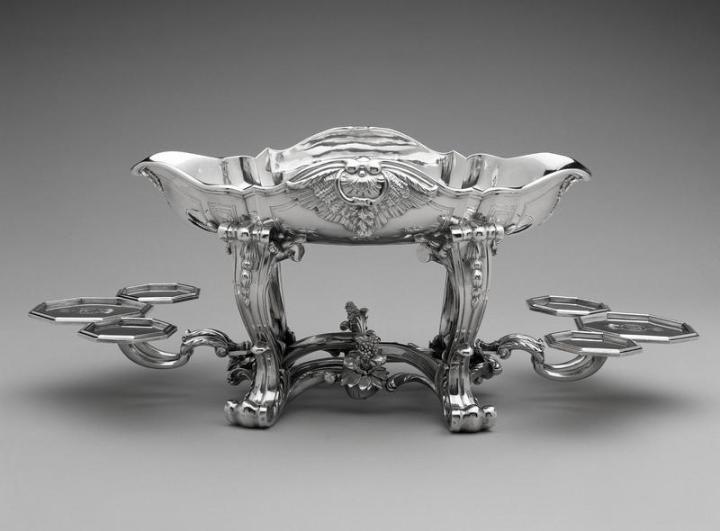
Paul Crespin, Epergne, 1742–43, sterling silver c
(Museum of Fine Arts, Houston)
◊ ◊ ◊ ◊ ◊
From the MFAH:
À la Mode: Fashioning European Silver, 1680–1825
Rienzi, The Museum of Fine Arts, Houston, 10 October 2015 — 7 February 2016
For centuries, silver was one of the most popular expressions of style and taste, with its universal appeal and powerful hold on the imagination making it the necessary luxury. Silver was designed for almost every occasion, from everyday drinking and dining to commemorating christenings and weddings.
À la Mode draws from the rich holdings of the MFAH, Rienzi, and two private collections to explore the social life of silver. The exhibition shows how prevailing attitudes and changes in fashion determined the form and function of objects, and how people thought about and lived with silver.
New Book | Companion to Glitterati: Portraits and Jewelry
The exhibition, which opened in December 2014, is on view through November 2016. The catalogue has just been published by the University of Oklahoma Press:
Donna Pierce and Julie Wilson Frick, Companion to Glitterati: Portraits and Jewelry from Colonial Latin America at the Denver Art Museum (Norman: University of Oklahoma Press, 2016), 96 pages, ISBN: 978-0914738756, $15.
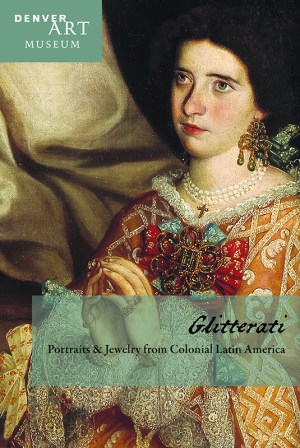 During the Spanish Colonial period in Latin America (1521–1850), precious gold and silver were crafted into elegant jewelry, then embellished with emeralds from Colombia, coral from Mexico, and pearls from Venezuela. To demonstrate their wealth and status, people were painted wearing their finest dress and elaborate jewelry. Selecting from its permanent collection, the Denver Art Museum installed the long-running exhibition Glitterati: Portraits and Jewelry in Colonial Latin America in its Spanish Colonial galleries in December 2014. This lavishly illustrated publication serves as a companion to the Glitterati exhibition and, on a larger scale, to the collection of Spanish Colonial jewelry and portraiture at the museum.
The Spanish Colonial collection at the Denver Art Museum is the most comprehensive of its kind in the United States and one of the best in the world with outstanding examples of painting, sculpture, furniture, decorative arts, silver and goldwork, and jewelry from all over Latin America during the time of the Spanish colonies. The Stapleton Foundation of Latin American Colonial Art, made possible by the Renchard family, gifted art acquired by the intrepid Daniel C. Stapleton between 1895 and 1914, when he worked in Ecuador, Colombia, and Venezuela overseeing plantations and emerald mines. Frederick and Jan Mayer worked closely with museum curators to build a collection of Mexican colonial art rich in many subjects and media, notably portrait paintings. Examples from both of these major collections are augmented by other pieces of jewelry and portraiture from the museum’s permanent collection in the Glitterati exhibition and in this volume.
Donna Pierce is Frederick and Jan Mayer Curator of Spanish Colonial Art at the Denver Art Museum and Head of the New World Department.
Julie Wilson Frick is the Mayer Center Program Coordinator and Junior Scholar in the New World Department at the Denver Art Museum.










 Enfilade
leave a comment