Exhibition | Venice, the Jews and Europe, 1516–2016
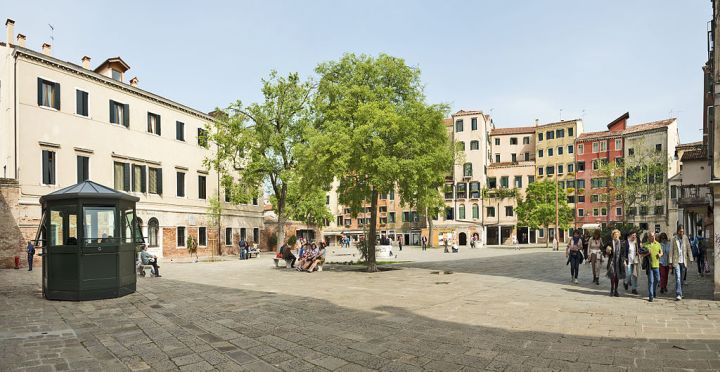
Campo de Ghetto Novo, Venezia
(Wikimedia Commons, 2013)
◊ ◊ ◊ ◊ ◊
As the Ghetto in Venice turns 500 on 29 March, the city marks the anniversary with events spread throughout the year, along with a major exhibition. David Laskin provides a preview for The New York Times (9 March 2016). From the website Venice Ghetto 500:
Venice, the Jews and Europe, 1516–2016
The Doge’s Apartments, Palazzo Ducale, Venice, 19 June — 13 November 2016
Curated by Donatella Calabi
The exhibition Venice, the Jews and Europe, 1516–2016 will be the highlight of the Quincentennial year of the Jewish Ghetto. Organized in collaboration with MUVE foundation of Venice in the prestigious venue of the Doge’s Palace, it will be a visible and symbolic event to mark this historic anniversary.
The exhibition, curated by Donatella Calabi, leading expert on the urban history of the Jewish Ghetto of Venice, aims at underscoring the wealth of relationships between the Jews and civic society throughout the history of their long residence in the lagoon, in the Veneto, and in Europe and the Mediterranean. It will recount the story of the Ghetto’s settlement, its growth, its architecture, its society, its trades, its daily life, and the relationships between the Jewish minority and the city at large, within the context of its relationships with other Jewish settlements in Europe and the Mediterranean basin.
The best of Venetian Jewish art and culture meet advanced and effective multimedia languages to show the reciprocal influence between the Jews and the society around them. (Paintings depicting biblical subjects will symbolize the age-old symbiosis between the Old Testament and the Veneto landscape). The virtual reconstruction of the Ghetto in its various historical phases will make it possible to trace the neighborhood’s development. Important, recently restored, silver ceremonial objects will help explain Jewish religious customs and traditions, fusing art and craftsmanship with culture. Books will bear witness to the extraordinary importance of Venetian Jewish printing, which was the first in Europe, through the example of the Talmud printed in Venice first and still in use today throughout the world.
Exhibition | I Am Here! Self-Portraits
Now on view at the Musée des Beaux-Arts de Lyon:
I Am Here! / Autoportraits: De Rembrandt du Selfie / Facing the World
Staatliche Kunsthalle Karlsruhe, 31 October 2015 — 31 January 2016
Musée des Beaux-Arts de Lyon, 26 March — 26 June 2016
Scottish National Portrait Gallery, Edinburgh, 16 July — 16 October 2016
Curated by Dorit Schäfer, Stéphane Paccoud, and Imogen Gibbon

Joseph Vivien, Self-portrait with Palette, 1715–20
The Staatliche Kunsthalle of Karlsruhe, the National Galleries of Scotland in Edinburgh, and the Museum of Fine Arts of Lyon established a partnership in 2011. The first exhibition to be created within this frame is on the theme of self-portraits and it will open in Lyon in spring of 2016.
The exhibition contains over 130 works from three major European museums, from the Renaissance period up to the 21st century, including paintings, drawings, prints, sculptures, photographs and videos. A specific genre in itself, self-portraits contain much information about their creators as well as their historical and social environment. At a time when selfies have become a true societal phenomenon, one that characterizes the digital era, the study of the traditions and usage of self portraits is more pertinent than it has ever been.
The exhibition offers a major chance to study the practice of self-portraits by artists in various forms that will be exhibited in seven sections
• The artist’s gaze
• the artist as a nobleman
• the artist at work
• the artist and his circle
• role-play
• the artist in his time
• the artist’s body
 Ich Bien Hier! Von Rembrandt zum Selfie (Cologne: Snoeck, 2016), 284 pages, ISBN: 978-3864421389. French and English editions will also be available.
Staatliche Kunsthalle de Karlsruhe
Pia Müller-Tamm, Director
Alexander Eiling, Curator
Dorit Schäfer, Curator, Drawings and Prints
Musée des Beaux-Arts de Lyon
Stéphane Paccoud, Chief Curator, Nineteenth-Century Paintings and Sculptures
Ludmila Virassamynaïken, Curator, Old Masters Paintings and Sculptures
National Galleries of Scotland
Michael Clarke, Director General
Imogen Gibbon, Curator
Seminar | ‘Those Wilder Sorts of Painting’: Revisiting Murals in Britain
From the seminar flyer:
‘Those Wilder Sorts of Painting’: Revisiting Murals in Britain, 1600–1750
Murray Edwards College, Cambridge, 16 September 2016
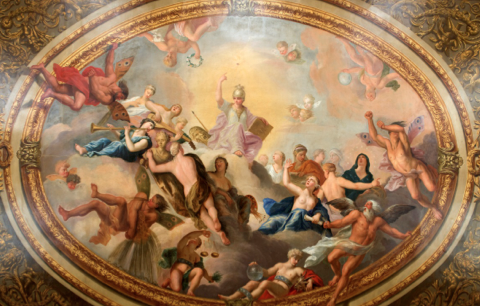
Antonio Verrio’s Ceiling for the Banqueting House at Hampton Court (Historic Royal Palaces)
This interdisciplinary seminar will focus on mural painting and its place within the cultural life of Britain in the seventeenth and early eighteenth centuries, highlighting new ways of looking at the work, its artists, and patrons. The aim is to stimulate interest in this often overlooked genre and its place in British art-historical studies. We hope to encourage curators, academics, and museum professionals to exchange ideas about the history, meaning, workshop practice, and iconography of mural art, as well as its significance within contemporary British and Continental visual cultures. The seminar is organised by the British Art Network Sub Group ‘British Mural Painting’. The event is free, but booking is essential; contact Lydia Hamlett, lkh25@cam.ac.uk.
Confirmed speakers and themes include
• Stijn Bussels (Leiden) and Ute Engel (LMU Munich) on Continental parallels
• Andrew Pinnock (Southampton) on opera
• Richard Johns (York) and David McNeil (Dalhousie) on architectural typologies
• Nick Nace (H-SC Virginia) on country house poetry
• Julie Farguson (Oxford) on artist/patron case studies
• Stacey Hickling (UCL) on Antonio Verrio
• Lydia Hamlett (Cambridge) on Louis Laguerre
• François Marandet (IESA) on Louis Chéron
• Anya Matthews (ORNC Greenwich) on James Thornhill
• Laurel Peterson (Yale) on Giovanni Antonio Pellegrini
New Book | Framing Majismo: Art and Royal Identity in Spain
From Penn State UP:
Tara Zanardi, Framing Majismo: Art and Royal Identity in Eighteenth-Century Spain (University Park: Penn State University Press, 2016), 264 pages, ISBN: 978-0271067247, $95.
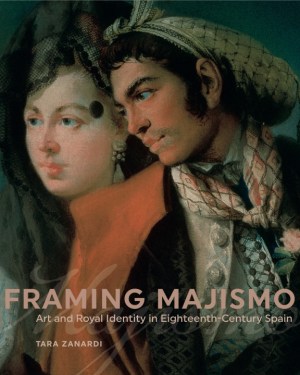 Majismo, a cultural phenomenon that embodied the popular aesthetic in Spain from the second half of the eighteenth century, served as a vehicle to ‘regain’ Spanish heritage. As expressed in visual representations of popular types participating in traditional customs and wearing garments viewed as historically Spanish, majismo conferred on Spanish ‘citizens’ the pictorial ideal of a shared national character.
In Framing Majismo, Tara Zanardi explores nobles’ fascination with and appropriation of the practices and types associated with majismo, as well as how this connection cultivated the formation of an elite Spanish identity in the late 1700s and aided the Bourbons’ objective to fashion themselves as the legitimate rulers of Spain. In particular, the book considers artistic and literary representations of the majo and the maja, purportedly native types who embodied and performed uniquely Spanish characteristics. Such visual examples of majismo emerge as critical and contentious sites for navigating eighteenth-century conceptions of gender, national character, and noble identity. Zanardi also examines how these bodies were contrasted with those regarded as ‘foreign’, finding that ‘foreign’ and ‘national’ bodies were frequently described and depicted in similar ways. She isolates and uncovers the nuances of bodily representation, ultimately showing how the body and the emergent nation were mutually constructed at a critical historical moment for both.
Tara Zanardi is Assistant Professor of Art History at Hunter College.
◊ ◊ ◊ ◊ ◊
C O N T E N T S
List of Illustrations
Acknowledgments
Introduction
1 Majismo, the Spanish National Character, and the Elite Cultivation of Cultural Patrimony
2 Swaggering Majos: Performing the Masculine Ideal
3 Performing the Bullfight: Spanish Bodies as Noble Spectacle
4 Majas, Elites, and Female Agency
5 Majismo and Elite Identity
Conclusion
Notes
Bibliography
Index
New Book | Thirty-Six Views: The Kangxi Emperor’s Mountain Estate
From Dumbarton Oaks Research Library:
Kangxi Emperor, translated by Richard Strassberg, with an introduction by Stephen Whiteman, Thirty-Six Views: The Kangxi Emperor’s Mountain Estate in Poetry and Prints (Washington, D.C.: Dumbarton Oaks Research Library, 2016), 316 pages, ISBN: 978-0884024095, $50.

In 1712, the Kangxi emperor published Imperial Poems on the Mountain Estate for Escaping the Heat (Yuzhi Bishu shanzhuang shi) to commemorate his recently completed summer palace. Through his perceptions of thirty-six of its most scenic views, his poems and descriptions present an unusually intimate self-portrait of the emperor at the age of sixty that reflected the pleasures of his life there as well as his ideals as the ruler of the Qing Empire. Kangxi was closely involved in the production of the book and ordered several of his outstanding court artists—the painter Shen Yu and the engravers Zhu Gui and Mei Yufeng—to produce woodblock prints of the thirty-six views, which set a new standard for topographical illustration. He also ordered Matteo Ripa, an Italian missionary serving as a court-artist, to translate these images into the medium of copperplate engraving, which introduced this technique to China. Ripa’s hybridized interpretations soon began to circulate in Europe and influenced contemporary aesthetic debates about the nature and virtues of the Chinese garden. This artistic collaboration between a Chinese emperor and a western missionary-artist thus marked a significant moment in intercultural imagination, production, and transmission during an earlier phase of globalization.
The British Art Journal (Winter 2015/16)
Items pertaining to the eighteenth century in the current issue:
The British Art Journal 16 (Winter 2015/16)
• Editorial: William MB Berger Prize for British Art History 2015 Winner: William Pressly, James Barry’s Murals at the Royal Society of Arts: Envisioning a New Public Art (2014).
• Romana Sammern, “Woman in Bed by Matthew William Peters (1742–1814): Titian, Reynolds, and Painted Revenge”
• M. T. W. Payne and J. E. Payne “Samuel Collings (d. 1810) and the Manifestation of ‘Annibal Scratch'”
• Neil Jeffares, “Francis Cotes (1726–1770) and His Family”
• Katherine McHale, “George Vertue and the Case of the Counterfeit Paintings: Rescuing the Reputations of Sebastiano Ricci (1659–1734) and Niccolo Cassana (1659–1713)”
• Alex Seltzer, “Catesby’s Conundrums: Mixing Representation with Metaphor”
• Peter S. Forsaith “‘A Far Greater Genius Than Sir Joshua’: Did Joshua Reynolds (1723–1789) Paint John Wesley (1703–1791)?”
• Charles S. Ellis, Review of Giulia Coco, Artisti, dilettanti e mercanti d’arte nel salotto fiorentino di sir Horace Mann (2014).
Exhibition | In Arcueil’s Leafy Groves: Drawing an 18th-Century Garden

Jean-Baptiste Oudry, Vue du parc d’Arcueil
(Musée du Louvre, dist. RMN – Grand Palais / Suzanne Nagy)
◊ ◊ ◊ ◊ ◊
From The Louvre:
In Arcueil’s Leafy Groves: Drawing an 18th-Century Garden
À l’ombre des frondaisons d’Arcueil: Dessiner un jardin du 18e siècle
Musée du Louvre, Paris, 24 March — 20 June 2016
Curated by Xavier Salmon
The Arcueil domain knew its golden age in the early 18th century. Situated near the aqueduct built for Marie de Medici between 1614 and 1624, the château was surrounded by a vast garden that included flowerbeds, woodland, covered galleries, and stairs. After the death of the Prince de Guise, the domain found a new owner, whose heirs subdivided it. When it was sold in 1752, the château and its grounds were razed under circumstances that remain unclear. Between the 19th and 20th centuries, the town of Arcueil sprang up around the aqueduct; of this substantial estate, with its sumptuous gardens and numerous outbuildings, only a few fragments now remain. Nonetheless, the memory of this historic site lives on in landscape drawings of Arcueil made by various artists in the 1740s. The goal of the exhibition is to present virtually all of these drawings for the first time.
New Book | Frederick the Great: King of Prussia
From Random House:
Tim Blanning, Frederick the Great: King of Prussia (London: Allen Lane, 2015), 688 pages, ISBN: 978-1400068128, $35.
 Few figures loom as large in European history as Frederick the Great. When he inherited the Prussian crown in 1740, he ruled over a kingdom of scattered territories, a minor Germanic backwater. By the end of his reign, the much larger and consolidated Prussia ranked among the continent’s great powers. In this magisterial biography, award-winning historian Tim Blanning gives us an intimate, in-depth portrait of a king who dominated the political, military, and cultural life of Europe half a century before Napoleon.
A brilliant, ambitious, sometimes ruthless monarch, Frederick was a man of immense contradictions. This consummate conqueror was also an ardent patron of the arts who attracted painters, architects, musicians, playwrights, and intellectuals to his court. Like his fellow autocrat Catherine the Great of Russia, Frederick was captivated by the ideals of the Enlightenment—for many years he kept up lively correspondence with Voltaire and other leading thinkers of the age. Yet, like Catherine, Frederick drew the line when it came to implementing Enlightenment principles that might curtail his royal authority.
Frederick’s terrifying father instilled in him a stern military discipline that would make the future king one of the most fearsome battlefield commanders of his day, while deriding as effeminate his son’s passion for modern ideas and fine art. Frederick, driven to surpass his father’s legacy, challenged the dominant German-speaking powers, including Saxony, Bavaria, and the Habsburg Monarchy. It was an audacious foreign policy gambit, one at which Frederick, against the expectations of his rivals, succeeded.
In examining Frederick’s private life, Blanning also carefully considers the long-debated question of Frederick’s sexuality, finding evidence that Frederick lavished gifts on his male friends and maintained homosexual relationships throughout his life, while limiting contact with his estranged, unloved queen to visits that were few and far between.
The story of one man’s life and the complete political and cultural transformation of a nation, Tim Blanning’s sweeping biography takes readers inside the mind of the monarch, giving us a fresh understanding of Frederick the Great’s remarkable reign.
Until his retirement in 2009, Tim Blanning was a professor of modern European history at the University of Cambridge, and he remains a fellow of Sidney Sussex College and of the British Academy. He is the general editor of The Oxford History of Modern Europe and The Short Oxford History of Europe. He is also the author of The Culture of Power and the Power of Culture, which won a prestigious German prize and was short-listed for the British Academy Book Prize; The New York Times bestseller The Pursuit of Glory; The Triumph of Music; and The Romantic Revolution. In 2000 he was awarded a Pilkington Prize for teaching by the University of Cambridge.
Exhibition | We are One: Mapping America’s Road
From The Boston Public Library:
We are One: Mapping America’s Road from Revolution to Independence
Boston Public Library, 2 May — 29 November 2015
DeWitt Wallace Decorative Arts Museum, Colonial Williamsburg, 5 March 2016 — 29 January 2017
New-York Historical Society, 2017
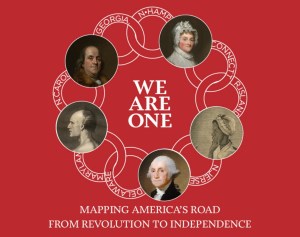 We Are One maps the American road to independence. It explores the tumultuous events that led thirteen colonies to join to forge a new nation. The exhibition takes its title from Benjamin Franklin’s early design for a note of American currency containing the phrase “We Are One.” This presaged the ‘E Pluribus Unum‘ found on the seal of the United States, adopted in 1782, and on all U.S. coins.
Using geographic and cartographic perspectives, the exhibition traces the American story from the strife of the French and Indian War to the creation of a new national government and the founding of Washington, D.C. as its home. Exhibited maps and graphics show America’s early status as a British possession: thirteen colonies in a larger trans-Atlantic empire. During and after the French and Indian War, protection of those thirteen colonies exhausted Britain economically and politically, and led Parliament to pass unpopular taxes and restrictions on her American colonial subjects. The Stamp Act, the Tea Act, and limits on colonial trade and industry incited protests and riots in Boston, as contemporaneous portrayals in the exhibition show.
When tensions between Britain and her American colonies erupted into war, British cartographers and other witnesses depicted military campaigns, battles, and their settings. These maps, drawings, and military artifacts now bring the long, bloody struggle for independence to life.
Finally, We Are One shows how, in the aftermath of the Revolution, America took stock of her new geography with surveys and maps. During this period, the Founders struggled to craft a new national government that would confederate thirteen colonies with different economic interests and cultures. European maps reflect their success by recognizing America’s triumphant new status of nationhood and her expanding territory.
More information is available here»
New Book | The Philadelphia Country House
From Johns Hopkins UP:
Mark Reinberger and Elizabeth McLean, The Philadelphia Country House: Architecture and Landscape in Colonial America (Baltimore: Johns Hopkins University Press, 2015), 464 pages, ISBN: 9781421411637, $70.
 Colonial Americans, if they could afford it, liked to emulate the fashions of London and the style and manners of English country society while at the same time thinking of themselves as distinctly American. The houses they built reflected this ongoing cultural tension. By the mid-eighteenth century, Americans had developed their own version of the bourgeois English countryseat, a class of estate equally distinct in social function and form from townhouses, rural plantations, and farms. The metropolis of Philadelphia was surrounded by a particularly extraordinary collection of country houses and landscapes. Taken together, these estates make up one of the most significant groups of homes in colonial America.
In this masterly volume, Mark Reinberger, a senior architectural historian, and Elizabeth McLean, an accomplished scholar of landscape history, examine the country houses that the urban gentry built on the outskirts of Philadelphia in response to both local and international economic forces, social imperatives, and fashion. What do these structures and their gardens say about the taste of the people who conceived and executed them? How did their evolving forms demonstrate the persistence of European templates while embodying the spirit of American adaptation?
The Philadelphia Country House explores the myriad ways in which these estates—which were located in the country but responded to the ideas and manners of the city—straddled the cultural divide between urban and rural. Moving from general trends and building principles to architectural interiors and landscape design, Reinberger and McLean take readers on an intimate tour of the fine, fashionable elements found in upstairs parlors and formal gardens. They also reveal the intricate working world of servants, cellars, and kitchen gardens. Highlighting an important aspect of American historic architecture, this handsome volume is illustrated with nearly 150 photographs, more than 60 line drawings, and two color galleries.
Mark Reinberger is a professor of architecture at the University of Georgia. He is the author of Utility and Beauty: Robert Wellford and Composition Ornament in America. Elizabeth McLean is a research associate in botany at the Academy of Natural Sciences of Drexel University. She is the coauthor of Peter Collinson and the Eighteenth-Century Natural History Exchange.










leave a comment