Exhibition | Exotic Creatures

Clara, the Rhinoceros, bronze, second half of the eighteenth century
(London: V&A, A.528-1910)
◊ ◊ ◊ ◊ ◊
Press release (19 August 2015) for the Royal Pavilion exhibition:
Exotic Creatures
Royal Pavilion, Brighton, 14 November 2015 — 28 February 2016
Curated by Alexandra Loske
A new exhibition at the Royal Pavilion, Brighton will explore how animals considered exotic by the Georgians and early Victorians were depicted, kept and presented. Exotic Creatures will look at animals owned by the Royal Family and in menageries and early zoos, as well as the ‘political beasts’ of the period (c.1740–1850). A painting of liger cubs (a cross between a tiger and a lion) born at Windsor in 1824, and presented to Royal Pavilion creator George IV shortly after, will be displayed to the public for the first time. Another rarely-seen painting will tell the story of the UK’s first living giraffe, given to George IV as a diplomatic gift by the Pasha of Egypt in 1826. Other works on show will include satirical prints, original menagerie bills, sculptural and ceramic pieces and paintings and archival material. The exhibition will take a hands-on, playful approach suitable for all the family, and a children’s Royal Pavilion Creature Trail will be available to buy at the admission desk.
The exhibition will be organised around four main themes:
Royal Menageries
George IV, himself considered exotic and unpredictable by many, kept a significant collection of exotic animals in his private menagerie at Windsor Great Park—continuing a tradition dating back to the keeping of lions at the Tower of London Menagerie in the early 13th century. The exhibition will tell the stories of individual exotic animals and explain the transition to public menageries, the establishment of the Zoological Society of London in 1826, and the opening of its Gardens—later known as London Zoo—in 1828.
Public and Travelling Menageries and Early Zoos
Many of the exhibits will have a strong connection with Brighton, whose residents enjoyed regular visits from travelling menageries and animal performances in the Royal Pavilion grounds. A permanent zoological gardens was proposed on the site now occupied by Park Crescent, where lions still top the gateposts of the southern garden wall.The late Georgian period saw a change in attitudes to how and why exotic animals where kept, and in the late 1820s the Zoological Society of London, devoted to scientific research, was founded. This led to the establishment of what is now London Zoo.

Jacques-Laurent Agasse, Nubian Giraffe, ca. 1827, (Royal Collection Trust / Her Majesty Queen Elizabeth II)
Royal Beasts
George’s mother Queen Charlotte kept a zebra in the 1760s and ordered a rhino for her children’s amusement, while George IV gave ostriches as presents to mistresses and kept kangaroos at Windsor Great Park. He also received the first living giraffe on British soil as a diplomatic gift. The young female arrived in August 1827 after a long and strenuous journey from Africa, by which time neither she nor George were in a good state of health. Cartoonists mercilessly poked fun at both, but the portrait by Swiss artist Jacques-Laurent Agasse is more sympathetic, depicting the giraffe in great detail with her keepers in Windsor Great Park. Although two Egyptian cows were drafted in as wet nurses, she struggled and died less than two years later.
Political Beasts
Animals were a popular device for mocking politicians and royals in Georgian satire and caricatures, as depicted in Brighton Museum and the Royal Pavilion’s collections.
The exhibition will demonstrate how the arrival of exotic animals influenced fashion and the decorative arts in Britain, with giraffe-patterned wallpaper, teapots and fabrics becoming hugely popular in the late 1820s. It will also address the challenges of creating anatomically correct images of non-native animals in the Georgian era, and the period’s simultaneous passions for scientific research and the use (and abuse) of animals in entertainment. As well as caricatures and striking Staffordshire figures from Brighton Museum & Art Gallery’s own collection, curator Alexandra Loske has sourced significant loans from the Victoria & Albert Museum, the British Museum, Royal Collection Trust and private collections.
Loske said: “We’re thrilled to have secured the loan of one of the most popular and beautiful animal paintings in British art, a portrait of George IV’s giraffe—commissioned by the king himself and still in the Royal Collection. Another highlight will be the V&A’s exquisite bronze statue of a rhino named Clara, which toured Europe in the 1740s and 1750s—of which only four survive. We’re also very proud to be displaying a painting of liger cubs, attributed to Richard Barrett Davis. The cubs were born in Windsor in 1824 and presented to George IV, and were painted by leading animal painters including Agasse. The painting in our exhibition was recently bought by a local collector and supporter of the Royal Pavilion Foundation, and will be displayed to the public for the very first time.”
New Book | Picturing Marie Leszczinska: Representing Queenship
From Ashgate:
Jennifer G. Germann, Picturing Marie Leszczinska (1703–1768): Representing Queenship in Eighteenth-Century France (Farnham: Ashgate, 2015), 258 pages, ISBN: 978-1409455820, $110.
 Portraits of Queen Marie Leszczyńska were highly visible in eighteenth-century France. Appearing in royal châteaux and, after 1737, in the Parisian Salons, the queen’s image was central to the visual construction of the monarchy. Her earliest portraits negotiated aspects of her ethnic difference, French gender norms, and royal rank to craft an image of an appropriate consort to the king. Later portraits by Maurice-Quentin de La Tour, Carle Van Loo, and Jean-Marc Nattier contributed to changing notions of queenship over the course of her 43 year tenure. Whether as royal wife, devout consort, or devoted mother, Marie Leszczinska’s image mattered. While she has often been seen as a weak consort, this study argues that queenly images were powerful and even necessary for Louis XV’s projection of authority. This is the first study dedicated to analyzing the portraits of Leszczynska. It engages feminist theory while setting the queen’s image in the context of portraiture in France, courtly factional conflict, and the history of the French monarchy. While this investigation is historically specific, it raises the larger problem of the power of women’s images versus the empowerment of women, a challenge that continues to plague the representation of political women today.
Jennifer G. Germann is Assistant Professor in the Department of Art History at Ithaca College.
◊ ◊ ◊ ◊ ◊
C O N T E N T S
List of Illustrations
Acknowledgments
Introduction
1 Framing Queenship in France
2 Incorporating Marie Leszczinska
3 Sons and Mothers
4 Gendering the French monarchy
5 The Queen’s New Image
Epilogue: Memorializing Marie Leszczinska
Bibliography
Index
New Book | The Wonder of the North
From Boydell Press:
Mark Newman, The Wonder of the North: Fountains Abbey and Studley Royal (Woodbridge: Boydell Press, 2015), ISBN: 978-1843838838, 406 pages, $60 / £30.

Dubbed the ‘Wonder of the North’ in 1732, the National Trust’s Fountains Abbey and Studley Royal Estate (now a World Heritage Site) encompasses one of the largest, most magnificent and beautiful designed landscapes ever created. This richly illustrated volume charts the landscape’s history from the first arrival of prehistoric hunters, via medieval monasticism, the Dissolution of the monasteries, eighteenth-century aestheticism and scandal, and the first ages of mass tourism, to the present day. At the heart of the story lies the rise and fall of England’s largest Cistercian monastery and how that shaped the origins of the Aislabie family’s breathtaking gardens. Their Studley Royal was at the forefront of every emergent landscape gardening fashion between 1670 and 1800. The book also describes the dramatic history of the family and the monumental scale of their achievements in this field, extending over many dozens of square miles of North Yorkshire—far beyond the limits of the garden as it is seen today (reduced to serve the more limited needs of Victorian day-trippers). The Wonder of the North brings social and garden history together with archaeology to reveal Fountains Abbey and Studley Royal—too often seen as ‘just’ a ruined medieval monastery—as one of the world’s greatest artistic creations.
Mark Newman has been the National Trust’s archaeological adviser for Fountains Abbey and Studley Royal estate since 1988. He was also resident there, living in Fountains Hall from 1988 to 1995.
◊ ◊ ◊ ◊ ◊
C O N T E N T S
1 Preface: The ‘Wonder of the North’
2 Priming the Canvas: Natural and Man-Made Landscapes before 1132
3 Utility and Sanctity: Fountains Abbey and its Surroundings, 1132–1540
4 From Dissolution to Resurrection: The Manors of Fountains and Studley, 1539–1667
5 Founding a Dynasty: The Emergence of Studley Royal
6 Emerging Wonders: The Unfolding of a Designed Landscape, 1723–42
7 Filling the Landscape: William Aislabie at Studley, 1742–67
8 Beyond Studley’s Domain: Kirkby Fleetham, Hackfall, Laver Banks and Fountains
9 Estates Combined: Fountains and Studley, 1768–81
10 Arcadia Declining: The Estate in the Earlier Nineteenth Century
11 A Place of Popular Resort: The Rising Tide of Visitors
12 Relicts of Our Own Days
13 Conclusion: A Future for Studley Royal
Exhibition | Pierre-Jean Mariette and the Art of Collecting Drawings
Opening next month at The Morgan:
Pierre-Jean Mariette and the Art of Collecting Drawings
The Morgan Library and Museum, New York, 22 January — 1 May 2016

Girolamo Francesco Maria Mazzola, called Il Parmigianino, Man Standing Beside a Plinth on which He Rests a Book, and a Study of Saint Luke, ca. 1530, Pen and brown ink, brown wash, on paper. Purchased by Pierpont Morgan in 1909 (The Morgan Library & Museum)
Pierre-Jean Mariette (1694–1774) was one of the earliest and most important collectors of drawings, and he played a pivotal role in shaping our modern conception of the artists who created them. The exhibition—the first ever devoted to the collector at a U.S. museum—will highlight the peculiar ways in which Mariette organized and presented his holdings.
In order to enhance the appearance of the drawings and to improve their legibility, Mariette often restored (completing, cleaning, and even dismembering) his sheets. He cut them, integrated them with additions, completed and assembled together fragmentary sheets, and sometimes split double-sided drawings using his extraordinary ability as a paper restorer. Moreover, Mariette provided his drawings with elaborate frame-like blue mounts, which are still highly prized by collectors. Drawings featured in this show include works from the Morgan’s collection as well as sheets from the Metropolitan Museum of Art and the Princeton University Art Museum. Among the artists represented are such masters as Parmigianino (1503–1540), Annibale Carracci (1560–1609), and Guercino (1591–1666).
This exhibition is a program of the Drawing Institute at the Morgan Library & Museum. Additional support is provided by Lowell Libson, Ltd.
New Book | Noah’s Ark: Essays on Architecture
From The MIT Press:
Hubert Damisch, Noah’s Ark: Essays on Architecture, edited and introduced by Anthony Vidler, translated by Julie Rose (Cambridge: The MIT Press, 2016), 392 pages, ISBN: 978-0262528580, $31.
 Trained as an art historian but viewing architecture from the perspective of a ‘displaced philosopher’, Hubert Damisch in these essays offers a meticulous parsing of language and structure to ‘think architecture in a different key’, as Anthony Vidler puts it in his introduction. Drawn to architecture because it provides ‘an open series of structural models’, Damisch examines the origin of architecture and then its structural development from the nineteenth through the twenty-first centuries. He leads the reader from Jean-François Blondel to Eugène Viollet-le-Duc to Mies van der Rohe to Diller + Scofidio, with stops along the way at the Temple of Jerusalem, Vitruvius’s De Architectura, and the Louvre. In the title essay, Damisch moves easily from Diderot’s Encylopédie to Noah’s Ark (discussing the provisioning, access, floor plan) to the Pan American Building to Le Corbusier to Ground Zero. Noah’s Ark marks the origin of construction, and thus of architecture itself. Diderot’s Encylopédie entry on architecture followed his entry on Noah’s Ark; architecture could only find its way after the Flood.
In these thirteen essays, written over a span of forty years, Damisch takes on other histories and theories of architecture to trace a unique trajectory of architectural structure and thought. The essays are, as Vidler says, ‘a set of exercises’ in thinking about architecture.
Hubert Damisch is Emeritus Professor of the History and Theory of Art at the École des Hautes Études en Sciences Sociales, Paris. Over the course of a long and distinguished career, he has held posts at Cornell University, Columbia University, and the Center for Advanced Studies in the Visual Arts, Washington. He is the author of The Origin of Perspective, The Judgment of Paris, Skyline: The Narcissistic City, and A Theory of Cloud: Toward a History of Painting.
Anthony Vidler is Dean and Professor of the Irwin S. Chanin School of Architecture at The Cooper Union, New York. He is the author of Warped Space: Art, Architecture, and Anxiety in Modern Culture (2000), and The Architectural Uncanny: Essays in the Modern Unhomely (1992), both published by The MIT Press, and other books.
British Art Studies, Autumn 2015
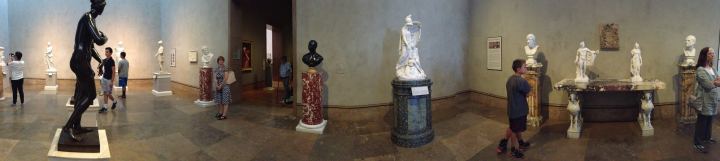
Ken Gonzales-Day, Panorama of Museum West Pavilion, 2015, chromogenic print, 20.32 x 99 cm, taken in the West Pavilion, J. Paul Getty Museum, Los Angeles, ©Ken Gonzales-Day.
◊ ◊ ◊ ◊ ◊
British Art Studies recently launched with an impressive premier issue and an exemplary commitment to free and open access, as detailed in the initial issue’s editorial statement. Congratulations! –CH
British Art Studies is free and open access: there are no subscriptions, no passwords, and no fees to pay. All content will be preserved as a free-to-use resource. The ethos of open access is one that YCBA and PMC have adopted for all their digital efforts, in the recognition that conventional proprietary models represent a major obstacle to scholarship. It is published under a Creative Commons CC BY-NC licence, meaning that you are free to share and re-use its contents for non-commercial purposes, provided that appropriate credit is given to the author/s. No permissions are needed. . . .
◊ ◊ ◊ ◊ ◊
The eighteenth century in BAS 1:
British Art Studies 1 (Autumn 2015)
Conversation Piece coordinated by Richard Johns, “There’s No Such Thing as British Art.”
‘Conversation Piece’ is a British Art Studies series that draws together a group of contributors to respond to an idea, provocation or question. The conversation will develop as more respondents enter the debate. Readers can also join in by adding a response.

Thomas Gainsborough, Charity Relieving Distress, ca. 1784, oil on canvas, 127.6 x 102.2 cm (Indianapolis Museum of Art).
Georgina Cole, “ ‘A Beautiful Assemblage of an Interesting Nature’: Gainsborough’s Charity Relieving Distress and the Reconciliation of High and Low Art.”
In the competitive environment of the eighteenth-century London art scene, Thomas Gainsborough and Sir Joshua Reynolds were often perceived as great rivals. While they shared patrons, sitters, and a stake in the future of British art, their differing artistic approaches caused considerable friction, indeed Gainsborough seceded from the Royal Academy of Art in 1784, boycotting its exhibitions and activities. This essay, however, argues that Gainsborough’s Charity Relieving Distress, painted in the year of his secession, proposes a charitable resolution of their aesthetic attitudes. The complex interrelation of allegorical and anecdotal form is interpreted as a pictorial attempt to reconcile their approaches through the concept of charity, a virtue of powerful artistic lineage in the western tradition, and of contemporary social importance.
Cyra Levenson and Chi-ming Yang, with a photo-essay by Ken Gonzales-Day, “Haptic Blackness: The Double Life of an 18th-Century Bust.”
‘One Object’ is a British Art Studies series that uses an object from a collection as a starting point for collaborative research. Cyra Levenson and Chi-ming Yang have co-authored this essay which is followed by a photo-essay by artist Ken Gonzales-Day and an interview between him and the authors.
Lecture | Mark Hallett on Gainsborough’s Landscapes
At The Morgan:
Mark Hallett, The Nomadic Eye: Traveling through Thomas Gainsborough’s Landscapes
The Morgan Library and Museum, New York, 9 December 2015
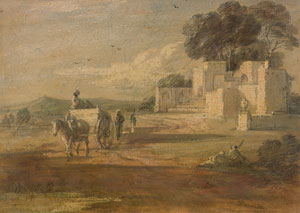
Thomas Gainsborough, Landscape with Horse and Cart, and Ruin, watercolor, oil and black chalk on laid paper; varnished (The Morgan Library and Museum)
Thomas Gainsborough’s landscape drawings and paintings take us into a distinction world. It is one in which we are typically granted the perspective a of a traveller wandering along a winding path, track or road. It is one in which we encounter a succession of familiar but also enigmatic subjects: the edges of woods, muddy banks, shadowed ponds, whitewashed ruins, figures resting on the road’s edges, shepherds with their flocks, men and women returning form the market. It is one in which trees often seem to dance and interact, and in which skies are constantly shifting. And finally, it is one in which we continually sense the echoes of earlier art—of dutch seventeenth-century landscape paintings, for example, or the territories painted by artists such as Rubens, Ruisdael, or Gaspard Dughet. In this illustrated lecture Professor Mark Hallett, Director of Studies at The Paul Mellon Centre for Studies in British Art, takes us on a tour of Gainsborough’s pastoral views and suggests how we might best understand and appreciate the pictorial world that the artist created in and through his landscapes. This program is organized by the Morgan Drawing Institute.
Wednesday, December 9, 6:30pm; admission is free.
Exhibition| Wordplay: Matthias Buchinger’s Drawings
Press release (19 November 2015) from The Met:
Wordplay: Matthias Buchinger’s Drawings from the Collection of Ricky Jay
The Metropolitan Museum of Art, New York, 5 January — 11 April 2016
Curated by Freyda Spira with Femke Speelberg and Jennifer Farrell

Approximately 22 drawings by the 18th-century German artist Matthias Buchinger (1674–1739), who was born without hands or feet, will be presented in Wordplay: Matthias Buchinger’s Drawings from the Collection of Ricky Jay, opening on January 5, 2016. Despite his disabilities, Buchinger was celebrated in his own time as a draftsman and calligrapher as well as a magician and musician, and poems were written in Europe about his many talents and achievements. Known as ‘the Little Man of Nuremberg’, because he was only 29 inches tall, Buchinger was said to have performed for German emperors, European princes, and for King George I of England. He was also a frequent guest at noble houses in England and Ireland, and performed at local fairs and inns from Amsterdam and Stockholm to Leipzig and Paris.
The Metropolitan Museum’s two drawings by Buchinger will be displayed alongside some 20 works from the collection of Ricky Jay, the celebrated illusionist, actor, and author. Framing Buchinger’s stupendous works, which were composed largely through calligraphy and micrography (employing minuscule script to create abstract shapes or figurative designs), will be works from the Metropolitan Museum’s collection that will demonstrate text as image. These additional works will include late medieval manuscripts, Renaissance typographical prints, 17th-century writing books, and contemporary works on paper.
Wordplay: Matthias Buchinger’s Drawings from the Collection of Ricky Jay is organized by Freyda Spira, Associate Curator with Femke Speelberg and Jennifer Farrell, also Associate Curators, of the Metropolitan Museum’s Department of Drawings and Prints.
The New York Times architecture critic Michael Kimmelman and Ricky Jay will discuss Matthias Buchinger in a ‘MetSpeaks’ ticketed talk on January 21, 2016.
◊ ◊ ◊ ◊ ◊
The accompanying publication is due out next March from Siglio:
Ricky Jay, Matthias Buchinger: The Greatest German Living (New York: Siglio Press, 2016), 160 pages, ISBN: 978-1938221125, $40.
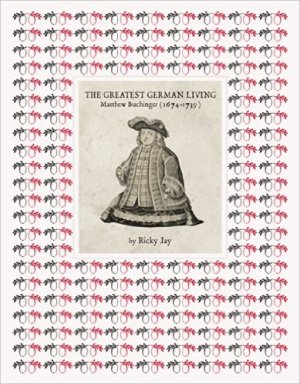 Matthias Buchinger (1674–1739) performed on more than a half-dozen musical instruments, some of his own invention. He exhibited trick shots with pistols, swords and bowling. He danced the hornpipe and deceived audiences with his skill in magic. He was a remarkable calligrapher specializing in micrography—precise handsome letters almost impossible to view with the naked eye—and he drew portraits, coats of arms, landscapes and family trees, many commissioned by royalty. Amazingly, Matthias Buchinger was just twenty-nine inches tall, and born without legs or arms. He lived to the ripe old age of sixty-five, survived three wives, wed a fourth, and fathered fourteen children.
Accompanying the Metropolitan Museum of Art exhibition Wordplay: Matthias Buchinger’s Inventive Drawings from the Collection of Ricky Jay, this book is a cabinet containing a single, multi-faceted wonder, refracted through acclaimed sleight-of-hand master Ricky Jay’s scholarship and storytelling. Alongside an unprecedented and sumptuously reproduced selection of Buchinger’s marvelous drawings and etchings, Jay delves into the history and mythology of the ‘Little Man’, while also chronicling his encounters with the many fascinating characters he meets in his passionate search for Buchinger.
Ricky Jay, one of the world’s great sleight-of-hand artists, has received accolades as a performer, actor, and author. He was recently profiled on the series American Masters and is the subject of the film Deceptive Practice: The Mysteries and Mentors of Ricky Jay. Jay has written frequently on unusual entertainments, and his Learned Pigs & Fireproof Women and Jay’s Journal of Anomalies were both New York Times ‘Notable Books of the Year’. The former curator of the Mulholland Library of Conjuring and the Allied Arts, he has defined the terms of his profession for the Encyclopedia Britannica and the Cambridge Guide to American Theater.
Exhibition | Drawing Versailles: Charles Le Brun
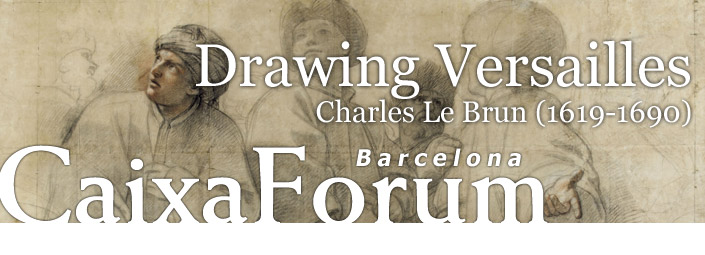
Summary of the exhibition now on view at the Caixa Forum in Barcelona (with thanks to Tobias Locker for noting it) . . .
Drawing Versailles: Studies and Cartoons of Charles Le Brun
Caixa Forum, Barcelona, 18 November 2015 to 14 February 2016
Curated by Bénédicte Gady
In 1682, Louis XIV transferred the French court to Versailles. The artist Charles Le Brun (1619–1690) was responsible for planning this work, to which he applied an ‘orchestral’ treatment, which involved the participation of hundreds of artisans and artists, the best from each discipline. Le Brun personally produced several pieces, including two particularly impressive compositions: the Staircase of the Ambassadors and the Hall of Mirrors, adorned by a series of mature paintings imbued with the most captivating beauty.
A little-known body of original material is conserved from this undertaking: the preparatory cartoons, which illustrate the final phase in the artist’s working process. The cartoons demonstrate Le Brun’s virtuosity as a draftsman, his talent for constructing scenes and his painstaking care, down to the last detail. The drawings include studies of characters, allegorical figures, trophies and animals that formed part of the artist’s compositions, conceived as a great symbolic jigsaw puzzle. Such cartoons were commonly used between the sixteenth and nineteenth centuries, but few have reached our days. Those produced by Le Brun are the exception: three hundred and fifty cartoons in a store of three thousand drawings found at the artist’s studio, requisitioned and added to the royal collections after his death in 1690.
The Staircase of the Ambassadors
Le Brun’s drawings provide a vision of the decoration, now lost, from the Staircase of the Ambassadors, featuring figures on the same scale, enriched with all the gravity and dramatic quality of drawing in black pencil. This staircase, which led up to the grand apartments of the king and queen, was the first space that represented the power of the monarch at Versailles. Designed in around 1671 and decorated between 1674 and 1679, the staircase was destroyed in 1752, during the reign of Louis XIV. In it, Le Brun made exceptional use of a narrow space that only received overhead lighting. Using optical illusion, he increased the sensation of space, mixing fact and fiction to create an allegorical composition that depicted the return of Louis XIV after one of his military victories. Le Brun surrounded the king by representatives from nations in the four continents, the kings of Antiquity, victories, cupids and the arts: a monumental composition to the honour and glory of the absolute monarch. The cartoons reveal that Le Brun worked on the Staircase of the Ambassadors to the last minute, retouching and improving his drawings.
The Hall of Mirrors
The paintings in the Hall of Mirrors enable us to follow, step by step, the artist’s working process, from the first small sketches, their pencil strokes embodying powerful movement, to the final drawings, which are the same size as the paintings themselves. Also conserved are the engraved copies of the overall work, produced for the purpose of making this artistic accomplishment known beyond French borders, adding to the monarch’s fame. In European painting, the figure of the king was traditionally represented by a mythological figure: Apollo, Hercules and so on. Le Brun, however, portrays the king himself, leading his armies to victory, wearing an ancient breastplate and a modern wig, in a dialogue with the gods and allegories. Two of the most important scenes on the ceiling are represented: the king’s decision to rule alone, and the war with Holland. One of the most famous episodes in this war, The Crossing of the Rhine in 1672, is shown through cartoons exactly as they were found in Le Brun’s studio.
From the Louvre Museum to CaixaForum
Over the past few years, the Graphic Arts Department of the Louvre Museum has carefully restored these drawings, enabling us to see them now for the first time in all their original splendour. The exhibition Drawing Versailles: Studies and Cartoons of Charles Le Brun (Dibuixar Versalles / Dibujar Versalles: Charles Le Brun) is the fruit of a strategic agreement between the Louvre Museum and ”la Caixa” Foundation. The purpose of this agreement is to bring to public attention artists, collections and periods in art history that are not represented in our galleries but which occupy eminent positions in the Louvre’s exhibition discourse: Mesopotamian culture, Coptic art, Pharaonic bestiary, women in Ancient Rome, the work of Eugène Delacroix, etc.
Dibujar Versalles: Bocetos y Cartones de Charles Le Brun (Barcelona: Fundació Ciaixa de Pensions, 2015), ISBN 978-8499001425, 232 pages, 35€.
The full press release is available here»

Charles Simonneau, Ceiling of the Great Staircase at Versailles, etching and burin, 38.7 x 70.5 cm. Chalcographic copper plate printing (RMN-Grand Palais, Musée du Louvre).
Exhibition | Neapolitan Crèche at the Art Institute of Chicago

Neapolitan Crèche, mid-eighteenth century
(Art Institute of Chicago)
◊ ◊ ◊ ◊ ◊
From the AIC:
Neapolitan Crèche
Art Institute of Chicago, 20 November 2015 — 3 January 2016
After its widely popular debut in 2013, our spectacular eighteenth-century Neapolitan crèche returns once again this holiday season. One of the very few and finest examples of such a work outside of Naples, the crèche is an intricate Nativity scene that reflects the vitality and artisanship that the city is still known for. The Art Institute’s crèche features over 200 figures—including no less than 50 animals and 41 items of food and drink—all staged in a spectacular Baroque cabinet with a painted backdrop. Elaborate, complex, and wondrous, the Neapolitan creche is a rare example of the genre and a once-in-a-lifetime acquisition for the Art Institute.
 Sacred imagery reenacting the Nativity has its roots in fourth-century Rome but by the thirteenth and fourteenth centuries—in part due to its association with St. Francis of Assisi—such scenes had become a permanent feature of Neapolitan churches. During the eighteenth century, the period from which most of the figures of the Art Institute’s crèche date, these relatively simple tableaux underwent a transformation into highly dramatic and theatrical renderings. Traditional sacred elements of Nativity scenes—the Holy Family, wise men, angels, and shepherds—were combined with profane aspects not of Bethlehem but of contemporary Neapolitan life—rowdy tavern scenes and bustling street activities—in dazzling displays of artistic techniques. Churches, wealthy citizens, members of the nobility, and the royal family all competed to commission the most complex presentations of this popular art form from leading artists and artisans, the same people who were creating monumental sculptures and altars for churches and palaces. These artists rendered figures in oil-painted terracotta to achieve the most realistic expressions in crèches and constructed painstakingly detailed costumes of luxurious fabrics that mimicked the fashions of the time. The Art Institute’s crèche represents the pinnacle of this artistic practice, born of the centuries-old tradition of Nativity scenes yet bursting with the energy of eighteenth-century Neapolitan life.
Sponsors
The Art Institute of Chicago is grateful to the following individuals for their generous support of the Neapolitan crèche: The Nativity and Three Wise Men and Their Courts and Treasures sponsored by Mr. and Mrs. James N. Bay; The Heavenly Host sponsored by Linda and Vincent Buonanno and Family in memory of Vincent Buonanno Jr.; The Taverna sponsored by the Eloise W. Martin Legacy Fund; and La Georgiana and Her Companions sponsored by Mrs. Robert O. Levitt.
Kyle MacMillan reported on the acquisition of the crèche for The Wall Street Journal (29 November 2013).










 Enfilade
leave a comment