Call for Papers | Romantic Legacies
From the Call for Papers and conference website:
Romantic Legacies
National Chengchi University (NCCU), Taipei, 18–19 November 2016
Proposals due by 15 May 2016
Keynote Speakers: Rachel Bowlby (Comparative Literature, Princeton University/English, University College, London) and Arthur Versluis (Religious Studies, Michigan State University)
In his seminal book The Roots of Romanticism (1999), Isaiah Berlin regards Romanticism as “the largest recent movement to transform the lives and the thoughts of the Western world.” Indeed, Romantic ideas and attitudes—embraced by Goethe, Hegel, Sade, de Staël, Rousseau, Baudelaire, Wollstonecraft, Wordsworth, Coleridge, Shelley, Beethoven, Schubert, Poe, Emerson, Thoreau, Dickinson, Turner, and Delacroix, to name but a few—not merely changed the course of history in the West in the late-eighteenth and nineteenth centuries but helped to fashion twentieth-century democracy, environmentalism, Surrealism, fascist nationalism, communist universalism, spiritualism, social liberalism, and so forth in the West as well as in the East. This two-day interdisciplinary conference aims to bring together academics from across the humanities and social sciences to explore the full spectrum of possible Romanticisms, the germination, maturation, and development of this heritage on both sides of the Atlantic and its afterlife in our global capitalist culture today.
We invite proposals for individual papers or collaborative panels from academics in the humanities and social sciences to reassess Romanticism and its legacies in different nations and disciplines. Possible topics may include, but are not limited to esotericism and spiritualism, emotion and neuroesthetics, Gothic and uncanny, imagination and memory, childhood, revolution and anarchy, geographies and the tourist gaze, romantic Victorians, romanticism as proto-modernism, romanticism and Abstract Expressionism, romanticism and empire, romanticism and its afterlife in the Far East, romanticism and Realism, the environmental humanities, romanticism and the inhuman, the Apocalypse, romanticism and the everyday, romanticism and world literature, the technological sublime, psychiatry and psychoanalysis, celebrity culture, gender performance, sensibility and social reform, solitude and sociability, the country and the city.
Proposals of no more than 300 words should be sent by 15 May 2016 via EasyChair. Should you have any questions or enquiries, please contact us at earn.nccu@gmail.com. We intend to produce an edited volume from the conference with a major academic publisher and a special issue for The Wenshan Review of Literature and Culture.
This conference is organised by the EARN (Enlightenment and Romanticism Network) in partnership with The Wenshan Review in the Department of English at NCCU.
Organising Committee
John Michael Corrigan (NCCU)
Yih-Dau Wu (NCCU)
Shun-liang Chao (NCCU)
Li-hsin Hsu (NCCU)
Jing-fen Su (NCCU)
Emily Sun (NTHU/Barnard College)
Alex Watson (Japan Women’s University)
Laurence Williams (University of Tokyo)
Lecture | Giorgio Riello, Towards a Global Cultural History?
Giorgio Riello, Towards a Global Cultural History? Gifts,
Commodities and Diplomacy in the First Global Age
Deutsches Haus, Columbia University Department of History, New York, 23 March 2016
Columbia University Department of History is pleased to present the Dr. S. T. Lee Annual Lecture in History: Towards a Global Cultural History? Gifts, Commodities and Diplomacy in the First Global Age, presented by Professor Giorgio Riello (University of Warwick, Department of History), Wednesday, March 23rd, Deutsches Haus (420 West 116th Street, between Amsterdam Avenue and Morningside Drive), 6:00–7:30pm. Reception to follow.
Giorgio Riello was trained as an economic historian, with a focus on material culture and the history of technology. After his work on the transformation of Italian and European industry in the eighteenth century, he began publishing on global history, becoming founding director of the Centre for Global History and Culture at Warwick University, one of the world’s leading programs focusing on the global history of material culture. His multiply award-winning publications have ranged from the global history of cotton to south Asian textile production, to the global industry of shoe production.
New Book | The Global Lives of Things
Published in December by Routledge:
Anne Gerritsen and Giorgio Riello, eds., The Global Lives of Things: The Material Culture of Connections in the Early Modern World (New York: Routledge, 2015), 266 pages, paperback ISBN: 978-1138776753, $50 / hardback ISBN: 978-1138776661, $160.
 The Global Lives of Things considers the ways in which ‘things’, ranging from commodities to works of art and precious materials, participated in the shaping of global connections in the period 1400–1800. By focusing on the material exchange between Asia, Europe, the Americas and Australia, this volume traces the movements of objects through human networks of commerce, colonialism and consumption. It argues that material objects mediated between the forces of global economic exchange and the constantly changing identities of individuals, as they were drawn into global circuits. It proposes a reconceptualization of early modern global history in the light of its material culture by asking the question: what can we learn about the early modern world by studying its objects?
This exciting new collection draws together the latest scholarship in the study of material culture and offers students a critique and explanation of the notion of commodity and a reinterpretation of the meaning of exchange. It engages with the concepts of ‘proto-globalization’, ‘the first global age’ and ‘commodities/consumption’. Divided into three parts, the volume considers in Part One, Objects of Global Knowledge, in Part Two, Objects of Global Connections, and finally, in Part Three, Objects of Global Consumption. The collection concludes with afterwords from three of the leading historians in the field, Maxine Berg, Suraiya Faroqhi and Paula Findlen, who offer their critical view of the methodologies and themes considered in the book and place its arguments within the wider field of scholarship. Extensively illustrated, and with chapters examining case studies from Northern Europe to China and Australia, this book will be essential reading for students of global history.
Anne Gerritsen is Associate Professor in the Department of History at the University of Warwick. Her previous publications include Ji’an Literati and the Local in Song-Yuan-Ming China (2007).
Giorgio Riello is Professor in the Department of History at the University of Warwick. In addition to several edited collections, he is the author of A Foot in the Past (2006) and Cotton: The Fabric that Made the Modern World (2013).
◊ ◊ ◊ ◊ ◊
C O N T E N T S
Introduction The Global Lives of Things: Material Culture in the First Global Age, Anne Gerritsen and Giorgio Riello
Part I: Objects of Global Knowledge
1 Itineraries of Matter and Knowledge in the Early Modern World, Pamela Smith
2 Towards a Global History of Shagreen, Christine Guth
3 The Coral Network: The Trade of Red Coral to the Qing Imperial Court in the Eighteenth Century, Pippa Lacey
Part II: Objects of Global Connections
4 Beyond the Kunstkammer: Brazilian Featherwork and the Northern European Court Festivals, Mariana Françozo
5 The Empire in the Duke’s Palace: Global Material Culture in Sixteenth-century Portugal, Nuno Senos
6 Dishes, Coins and Pipes: The Epistemological and Emotional Power of VOC Material Culture in Australia, Susan Broomhall
7 Encounters around the Material Object: French and Indian Consumers in Eighteenth-Century Pondicherry, Kévin Le Doudic
Part III: Objects of Global Consumption
8 Customs and Consumption: Russia’s Global Tobacco Habits in the Seventeenth and Eighteenth Centuries, Matthew P. Romaniello
9 Sugar Revisited: Sweetness and the Environment in the Early Modern World, Urmi Engineer
10 Coffee, Mind and Body: Global Material Culture and the Eighteenth-Century Hamburg Import Trade, Christine Fertig and Ulrich Pfister
Afterwords
Paula Findlen
Suraiya Faroqhi
Maxine Berg
Exhibition | Eighteenth-Century Porcelain Sculpture
Press release for the exhibition now on view at the NGV:
Eighteenth-Century Porcelain Sculpture
National Gallery of Victoria, Melbourne, 27 February — December 2016

Chelsea Porcelain Factory, London, Joseph Willems (modeller), Pietà, ca. 1761, porcelain (soft-paste), 38.5 x 28.5 x 22.8 cm (Melbourne: National Gallery of Victoria)
The NGV will present its renowned collection of eighteenth-century porcelain sculpture in an upcoming exhibition, revealing eighteenth-century baroque life and culture, from commoners and aristocrats to famous actors and musicians. Eighteenth-Century Porcelain Sculpture will showcase over eighty exquisite examples from famed European factories—including the German Meissen, French Sèvres, and English Derby factories—of intricately modelled porcelain figures, large-scale sculptural works, and celebrity portraits.
Tony Ellwood, Director, NGV, said, “The NGV holds the largest collection of porcelain sculpture in Australia, and this exhibition offers an opportunity to view a number of our rarest and most important works, including the Chelsea Porcelain Factory’s large-scale Pietà sculpture of which the NGV will present two of the only three examples in the world.”
Whilst today porcelain sculptures are often considered ‘decorative’ items, in the eighteenth century many of the finest artists of the time were drawn to the novel medium. The exhibition will include the work of key modellers such as Johann Joachim Kändler—the era’s most important ceramic sculptor and a major innovator—Franz Anton Bustelli, Johann Peter Melchior, and Giuseppe Gricci, court sculptor to King Charles VII of Naples.
The exhibition also includes rare porcelain sculptures of popular eighteenth-century London stage actors including Kitty Clive, Henry Woodward, David Garrick, and James Quinn. Collected by wealthy members of the elite, these figures give insight into the growing culture of celebrity in eighteenth-century England and demonstrate how porcelain became an important medium for the dissemination of popular imagery. Another highlight is the exceptionally rare Goffredo at the Tomb of Dudone, modelled by Giuseppe Gricci for the Neopolitan Capodimote factory, which portrays an episode from Tasso’s great Renaissance epic poem Jerusalem Liberated.
Due to the fragile nature of porcelain sculpture, NGV conservators have undertaken five months of restoration work to return many of these pieces to display. One sculpture, by the Italian Doccia factory of a shepherd and his companion, will be displayed for the first time in more than twenty years. Individual fingers no more than 2mm across were remade from porcelain and skilfully attached to the shepherd’s hand, an incredibly delicate procedure that required three attempts. Conservators have also removed discolouration from other pieces enabling them to be displayed once more in all of their original beauty.
The exhibition is accompanied by an online essay by Matthew Martin and public program offerings including floor talks which will provide unique insights into the period.
Call for Articles | Spring 2017 Issue of J18: Lifelike
◊ ◊ ◊ ◊ ◊
From J18:
Journal18, Issue #3 (Spring 2017) — Lifelike
Proposals due by 15 May 2016; finished articles will be due by 1 November 2016
During the eighteenth century, a range of artistic productions aimed to simulate motion and life, at the same time that individuals became ever more preoccupied with performing or embodying static works of art. This issue of Journal18 aims to explore such hybrid creations and the boundaries they challenged between animate and inanimate form, art and technology, nature and artifice, the living and the dead. Echoing contemporary discussions about vraisemblance and verisimilitude, as well as mimesis and imitation, in eighteenth-century artistic literature, these preoccupations also related to larger philosophical and scientific debates about matter, mankind and machines at a global level. What was considered ‘lifelike’ in the eighteenth century? How did artistic practices engage this notion and participate in redefining it?
Articles may focus on specific objects, such as automata created by Pierre Jacquet-Droz and others that imitated human acts of writing or harpsichord playing; hyperrealistic wax figures, sometimes displayed in groups, that were used for entertainment as well as pedagogical and medical purposes; ‘tableaux mécaniques’, or mixed-media paintings with motors on the back that enabled figures to move across their surfaces; and natural history materials, such as taxidermic animals, specimens or skeletons that were displayed in particular spaces. Other possible topics include the staging of collaborative tableaux vivants in eighteenth-century theaters, gardens, and salons; and related attempts to resurrect or animate ancient artifacts, as in Emma Hamilton’s ‘living statue’ performances. Articles that consider the eighteenth-century specificity of such artistic productions, introduce new methodological perspectives, or discuss relevant examples from outside of Europe are especially encouraged.
Proposals for #3 LIFELIKE are now being accepted. Deadline for proposals: 15 May 2016. To submit a proposal, send an abstract (200 words) and a brief CV to editor@journal18.org. Articles should not exceed 6000 words and will be due on 1 November 2016.
Issue Editors
Noémie Etienne, Getty Research Institute, Los Angeles
Meredith Martin, NYU and Institute of Fine Arts
Conference| Animating the Georgian London Town House
From The National Gallery:
Animating the Georgian London Town House
The National Gallery, London, 17 March 2016
Rediscovering and animating London town houses of the 18th and early 19th centuries
 Organised by the Paul Mellon Centre, London, the National Gallery, and Birkbeck College, University of London, this conference explores the position town houses once occupied in the lives of families and the nation as a whole. Some—such as Spencer House—have survived; many have left fragmentary traces; others have been completely destroyed and can only be recreated on the basis of inventories and descriptive accounts. There is much still to be uncovered about the collections of paintings, sculpture, and decorative arts which these buildings once housed, as well as about their furnishing, architecture, gardens, and refashionings over time.
This event follows on from the successful Animating the 18th-Century Country House conference held at the National Gallery in March 2015. Expert speakers will discuss both famed and little-remembered London town houses, considering how these residences were designed, furnished, and ornamented. Papers also explore the significance and function of these properties for owners and their families, together with the varied experiences of guests and visitors. To book tickets, please visit The National Gallery.
◊ ◊ ◊ ◊ ◊
P R O G R A M M E
10.00 Registration
10.20 Welcome by Susanna Avery-Quash and Kate Retford
10.30 Keynote Lecture
• Desmond Shawe Taylor, ‘Picture displays at Carlton House’
11.30 Coffee break
12.00 Construction and Reconstruction
• Matthew Jenkins and Charlotte Newman, ‘London in pieces: Building biographies in Georgian Mayfair’
• Neil Bingham, ‘The Regency transformation of Burlington House, Piccadilly, documented through the architectural drawings of Samuel Ware’
• Pat Hardy, ‘Canaletto’s town houses’
1.30 Lunch break
2.30 Fashioning and Inhabiting
• Jeremy Howard, ‘New light on Norfolk House: The decoration and furnishing of Norfolk House for the 9th Duke and Duchess of Norfolk’
• Anne Nellis Richter, ‘Glitter and fashion in the “Louvre of London”: Animating Cleveland House’
• Peter Nelson Lindfield, ‘London’s gothic pineapple: 18 Arlington Street’
4.00 Refreshment break
4.30 Keynote Lecture
• Adriano Aymonino and Manolo Guerci, ‘London’s greatest mansion in the Strand: Northumberland House, the urban palace of the 1st Duke and Duchess of Northumberland’
5.30 Closing remarks
◊ ◊ ◊ ◊ ◊
Note (added 2 March 2016) — The original version of this posting inadvertently omitted Anne Nellis Richter’s presentation.
At Sotheby’s | Pelham: The Public and the Private Collections
Press release (22 February 2016) from Sotheby’s:
Pelham: The Public and the Private Collections of Alan Rubin (L16322)
Sotheby’s London, 8 March 2016
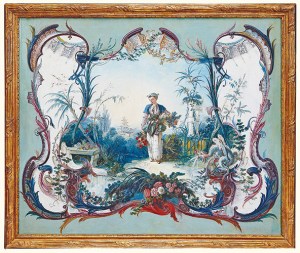
Lot 114: François Boucher, La Marchande de Fleurs in a Rocaille Surround, ca. 1742.
On 8th March 2016, Sotheby’s London will host an exceptional sale of furniture and works of art from the ‘public’ and ‘private’ collections of Alan Rubin of Pelham Galleries. The name Pelham is inextricably linked with the history of the 20th-century antiques trade. For almost 90 years, Pelham Galleries has been a mecca for international collectors, dealers and museums curators. The galleries in London and Paris have been instrumental in helping form some of today’s greatest collections, and treasures discovered by Alan Rubin, his father and uncle can be found in many of the world’s greatest museums including the Victoria and Albert Museum, The Metropolitan Museum, and the Louvre. The printed catalogue, which can be viewed online here, includes a substantial introduction by Alan Rubin with a fascinating history of the company and a masterly survey of the history of the London art trade, which will be a work of reference for future generations of dealers.
The sale will feature fascinating acquisitions made by two generations of antiques dealers with unrivalled expertise, alongside great rarities that have adorned Alan Rubin’s wonderful Queen Anne house in London for the past 30 years. Together, the 180 lots include outstanding examples of English and European furniture, an exceptionally rich group of Italian decorative arts, chinoiserie masterpieces and a number of items reflecting Alan Rubin’s passion for early music.
Commenting on the forthcoming auction, Alan Rubin said: “This sale marks a new chapter for Pelham Galleries which will now be run from our Paris gallery. The sale includes a number of pieces never previously offered to the public, some acquired by my family over sixty years ago. I hope they will give as much pleasure to their new owners as they have given to me.”
Henry House, Head of Sotheby’s Furniture and Decorative Arts Department added: “This sale celebrates the great eye, sublime taste and academic rigour that have contributed to Alan Rubin’s worldwide reputation. In addition to their extraordinary quality and rarity, many items in the sale come with fascinating provenances and carry the imprimatur of one of Britain’s most renowned antique dealing families.”
English Furniture
Pelham Galleries has been synonymous with the finest English Furniture since it was founded in 1928. The sale features outstanding pieces which were acquired either by Alan Rubin in his early years as a dealer or by his father, Ernest Rubin in the 1950s. Stunning examples of neo-classical furniture include a George III satinwood, harewood and tulipwood breakfront bookcase, circa 1780 by Mayhew and Ince, acquired from Lord and Lady Mountbatten in the 1950s (est. £40,000–60,000) and an important pair of George III painted and parcel-gilt satinwood pier tables, circa 1795 which adorned the Blue Room of the White House between 1972 and 2002. Formerly in the collection of the Dukes of Sutherland, these tables are among the finest examples of their period (est. £100,000–150,000).
Italian Decorative Arts
Alan Rubin’s profound interest in Italian decorative arts is reflected in an impressive ensemble of 18th-century furniture and works of art. Highlights comprise one of the finest pairs of Genoese giltwood torchères by Fillipo Parodi (1630–1702) ever to come on the market. These exceptional pieces are extremely rare in private hands. The majority of surviving examples are now in public collections or remain in situ in Genoese palaces (est. £50,000–100,000). Exceptional examples of English Palladian furniture include a George II mahogany breakfront secrétaire-cabinet, circa 1750, by William Hallett which was acquired privately from Wentworth Woodhouse over sixty years ago (est. £70,000–100,000) and a beautiful hall settee by William and John Linnell (est. £70,000–100,000). An astonishing painted trompe l’oeil and grisaille Cassapanca from first quarter 18th century (est. £25,000–50,000) and its matching torchères (est. £20,000–40,000) are a rare testament to the tradition of illusionist painting in Italian interiors. Such furniture often adorned the entrance halls of palazzi but most original pieces have now been lost or dispersed, which makes the survival of such a set remarkable. Equally fascinating, examples of Italian hardstone and mosaic works of art include an exquisite pair of micromosaics by the outstanding Roman mosaicist Giacomo Raffaelli (1753–1836) from the Hamilton Palace collection (est. £50,000–100,000) and a magnificent pietre dure plaque produced by the Grand Ducal Workshops in Florence in the 17th century (est. £20,000–30,000).
French Furniture and Works of Arts
Testament to Alan Rubin’s taste for Chinoiserie, the sale includes masterpieces by the great proponents of the style, including an unpublished work by François Boucher (1703–1770), La Marchande d’Oiseaux which was previously in the collection of Baron Edmond de Rothschild, circa 1915 (est. £100,000–150,000). The sale also features rare and evocative objects from 18th-century France, including the only recorded surviving life-size 18th-century French mannequin de mode, circa 1765 which recently featured in exhibitions at the Fitzwilliam Museum, Cambridge and the Musée Bourdelle, Paris (est. £30,000–50,000), a 1783 miniature recording the first flight in a hot-air balloon (est. £12,000–18,000) and an impressive Consulat armchair, circa 1796–1803 similar to the one in the Chateau de Malmaison, where Napoléon lived with his first wife, Joséphine de Beauharnais (est. £30,000–50,000).
Works of Art on the Theme of Music
A keen music lover and collector of early musical instruments, Alan Rubin also made fascinating acquisitions on the theme of music, such as a rare Indian duet stand, circa 1810 which once belonged to world famous violinist, Yehudi Menuhin (est. £5,000–7,000), a late-16th-century Italian harpsichord, (est. £30,000–50,000), and a pair of 17th-century musical still-lives attributed to Bettera of Bergamo (est. £20,000–30,000).
Summer Workshop | Visualizing Venice: The Ghetto of Venice

◊ ◊ ◊ ◊ ◊
From H-ArtHist, with more information available from Venice International University:
Visualizing Venice Workshop: Mapping and Modeling the Ghetto of Venice
Venice International University, 8–20 June 2016
Applications due by 31 March 2016
With the support of The Getty Foundation as part of its Digital Art History initiative, The Wired! Lab at Duke University, Università Iuav di Venezia, the University of Padua, and Venice International University are collaborating on a summer workshop that will train art, architectural, and urban historians with the digital media that can enhance or transform their research questions and their capacity to communicate narratives about objects, places, and spaces to the public.
This fifth annual 12-day workshop teaches a range of digital skills in mapping, 3D modeling, mobile application and web development, and time based media authorship to enable participants to engage historical questions with emerging digital tools. The course will engage with the Ghetto of Venice on the 500th anniversary of its creation as case study for training with a variety of technologies and applications. Instruction will be given in English by faculty and staff from Duke University’s Wired! Lab and Università Iuav di Venezia.
The workshop is designed for PhD or post doctoral participants in the interpretive humanities (including cultural patrimony, history of art, architecture and urbanism, history, geography, architecture, archaeology, and other relevant disciplines). Preference will be given to PhD students and recent PhD graduates in the history of art, architecture, and urbanism. The workshop is taught at Venice International University on the island of San Servolo in the Venetian Lagoon. Participants can live in the housing facilities of the island of San Servolo or arrange for accommodation in the city of Venice. Tuition fees are 1,000€ (+22%VAT). Scholarships are available in order to support tuition, travel, board, and accommodation expenses thanks to the generosity of The Getty Foundation.
Exhibition | Jefferson and Palladio: Constructing a New World
◊ ◊ ◊ ◊ ◊
From the Palladio Museum:
Jefferson and Palladio: Constructing a New World / Come costruire un mondo nuovo
Palladio Museum, Vicenza, 23 September 2015 — 28 March 2016
Curated by Guido Beltramini and Fulvio Lenzo
Visitors are introduced to the exhibition by a mirror reflecting the busts of Palladio and Thomas Jefferson. This raises the initial question in the show: how are forms and ideas ‘reflected’? Why, in this case, was an architect from a province in Northern Italy adopted as a model for the construction of the architecture of the New World?

Thomas Jefferson, Plan of the Rotunda of the University of Virginia (Charlottesville: Special Collections, University of Virginia Library)
The answer is linked to another fundamental question: what is Thomas Jefferson (1743–1826), the man who drafted the Declaration of Independence and was the third president of the United States, doing in a museum of architecture? The reason is that he more than any other American shaped the face of the new nation through art, architecture and regional planning. Visionary but also pragmatic, he was both a man of action and an intellectual who knew Latin and Greek. And he was convinced that the New World could only be built through reason and beauty.
Jefferson and Palladio: Constructing a New World is the first-ever exhibition dedicated to the great American Palladian in Europe. It will enable visitors to explore Jefferson’s world, his art collections, architectural designs, dreams, and also his contradictions, through drawings, sculptures, precious books, architectural models, films and multimedia. The exhibition also features 36 photographs by Filippo Romano, the result of a photographic survey specifically conducted in Virginia in Spring 2014. There are also three precious original bozzetti (models) by Antonio Canova for a statue of George Washington, commissioned by Thomas Jefferson. Visitors can enhance their experience of the exhibition by downloading a free smartphone app with descriptions by the curators and so move through the rooms accompanied by their words.
The exhibition is dedicated to the memory of Mario Valmarana, the still greatly cherished professor at the University of Virginia who devoted his life to creating bridges between Palladio’s Veneto and Jefferson’s Virginia. Sponsored by Roberto Coin, the exhibition has been made possible thanks to the support of the Regione del Veneto, the Fondazione Cariverona and Dainese, and is the result of collaboration with the Fondazione Canova di Possagno and the Stiftung Bibliothek Werner Oechslin, Einsiedeln, Switzerland. The exhibition is also part of a joint project developed with the Canadian Centre for Architecture, Montreal, which in October 2014 staged the photographic exhibition Found in Translation: Palladio-Jefferson, A narrative by Filippo Romano.
The exhibition has been curated by Guido Beltramini and Fulvio Lenzo, with the support of an Advisory Committee, chaired by Howard Burns (Scuola Normale Superiore, Pisa), and composed of James Ackerman (Harvard University), Bruce Boucher (University of Virginia), Travis C. McDonald (Corporation for Jefferson’s Poplar Forest), Damiana Paternò (IUAV, Venice), Mario Piana (IUAV, Venice), and Craig Reynolds (University of Virginia). The catalogue (available in English or Italian) is published by Officina Libraria. The exhibition layout has been designed by Alessandro Scandurra.
◊ ◊ ◊ ◊ ◊
◊ ◊ ◊ ◊ ◊
The catalogue is available from Artbooks.com:
Guido Beltramini and Fulvio Lenzo, eds., Jefferson and Palladio: Constructing a New World (Milan: Officina Libraria, 2016), 176 pages, ISBN: 9788897737780, $30.
 The catalogue offers an opportunity to acquire a deeper understanding of Jefferson’s architecture and, at the same time, leads to a clearer understanding of Palladio himself. Jefferson looked to Palladio because he was the architect of one of Europe’s few republics in which administrative power was in the hands of landed gentlemen who avoided the ostentation of princely manners and spent long periods of time in the countryside.
Thomas Jefferson (1743–1826), a cosmopolitan figure with rural roots, was a master of the knowledge of his time. He drafted The Declaration of Independence (1776), and thus founded a new view of the proper relation between governed and government. Jefferson was the architect of the new America, not just in a political sense, but in a literal sense as well. Architecture had an important place in his personal and public agenda. A self-taught architect, Jefferson buildings are among America’s most famous: Monticello, the Virginia State Capitol, and the University of Virginia are the starting points of American classical architecture. Jefferson was guided by his admiration for Palladio’s Four Books on Architecture, which provided him with key architectural forms and ideas. Palladio showed him how the admired building types of the ancient Romans could be adapted to modern purposes and provide a rational, harmonious framework for living and for building a new society.
Guido Beltramini is Director of the Centro Internazionale di Studi di Architettura Andrea Palladio, Vicenza. Fulvio Lenzo is Associate Professor in the history of architecture at the Universita IUAV di Venezia, Venice.
◊ ◊ ◊ ◊ ◊
C O N T E N T S
Palladio in America, James Ackerman
Jefferson and Palladio, Guido Beltramini
Jefferson: Architecture and Democracy, Fulvio Lenzo
Photographing Jefferson, Filippo Romano
Palladianism in America Before Jefferson, Bruce Boucher
The National Survey Grid and the American Democracy, Catherine Maumi
Jefferson’s Creation of American Classical Architecture, Richard Guy Wilson
Jefferson and the First Public Statues in the United States, Giovanna Capitelli
Canova and the Monument to George Washington, Mario Guderzo
Palladio: Materials and Building Techniques Damiana, Lucia Paterno
Jefferson Builder, Travis McDonald
Enrtries for Monticello, Virginia State Capitol, President’s House, Poplar Forest, Bremo, Barboursville, University of Virginia
Bibliography
Exhibition Checklist
New Appointment for Isabella Vitti
In January 2016, Isabella Vitti began her new position as Editor of Art History & Visual Studies at Routledge Taylor & Francis Group. She comes to the position after four years at Cambridge University Press, where she worked mainly on archaeology and Renaissance studies books—highly-illustrated projects that provided a lot of experience with image permissions, color plate sections, and high-resolution image files. Before Cambridge, Vitti worked at the Museum of Modern Art in the membership department—in her words, “an art historian’s dream!” She studied art history as an undergraduate at Wesleyan University.
Vitti stresses that most of Ashgate’s series covering the eighteenth century will continue. These include:
• The Histories of Material Culture and Collecting, 1700–1950
• Science and the Arts since 1750
• Visual Culture in Early Modernity
Routledge’s proposal guidelines are available here: Vitti’s email address is isabella.vitti@taylorandfrancis.com. She welcomes proposals for research monographs or edited collections.










leave a comment