Göttingen Summer School | Academic Collecting and Knowledge
From H-ArtHist:
Göttingen Spirit Summer School
Academic Collecting and the Knowledge of Objects, 1700–1900
Lichtenberg-Kolleg, Historic Observatory, University of Göttingen, 5–10 September 2016
Applications due by 1 May 2016
Experts/Speakers
Anne Mariss, University of Tuebingen
Maria Rentetzi, National Technical University of Athens, Lise Meitner fellow, University of Vienna
Kim Sloan, British Museum London
Emma Spary, University of Cambridge
Early modern cabinets of curiosities/Wunderkammern can be considered as an important space especially for those developing sciences that wanted to transcend text based scholasticism and base their knowledge solely on experience. Scholarly engagement with collections laid the foundations for knowledge production that was based on experiment and research with and on objects. Since this development took shape during the 17th century, collecting, storing, ordering, and the presentation of objects has become a strong concern for many academic disciplines.
Accordingly, technologies that transformed things into objects of knowledge and rendered them accessible and sustainable are equally practical as well as epistemological techniques. Current research in the history of science and knowledge focuses increasingly on practices of collecting, ordering and presenting. Thus highlighting how scientific research and its results are intertwined with and rely upon different cultures of materiality and the handling of objects is the main concern of the summer school.
In addition to questions concerning the role of objects and collections in the processes of knowledge production, we would also like to address the state and development of object based research in the humanities. How can humanities research be enhanced by engaging with objects? Which methods and theories can be successfully employed in order to achieve meaningful knowledge about these processes on a medium and larger scale? Each day of the summer school will be dedicated to a specific topic where four PhD candidates will present their research and give an introduction to their projects, with one expert commenting and leading the discussion for each project.
As we acknowledge the epistemic value of engaging with objects, visits to the relevant academic collections at the University of Göttingen are an integral part of the program. Two of our experts, Kim Sloan and Emma Spary, will also give keynote lectures on Monday and Wednesday respectively. On Thursday evening, Anne Mariss will introduce her recent book ‘A World of New Things’: Praktiken der Naturgeschichte bei Johann Reinhold Forster (Johann Reinhold Forster and the Practices of Natural History), thereby reflecting on her process of writing a thesis on praxeological aspects of knowledge production and engaging with material culture.
The four thematic sections are:
From encyclopaedic to specialised collecting: Practices of collecting and exhibiting, the role of collectors and things // Kim Sloan, British Museum
During the two centuries between 1700 and 1900, a far-reaching transformation took place that influenced both the scientific practices related to objects and the role of collectors. Burgeoning university collections differed considerably from most private or courtly cabinets of curiosities regarding their claims to establish order, classification and systematic comparison: the typical and the ordinary gradually replaced the rare and the unique, and the learned collector became the collecting scholar. The 18th century can be seen as a period of transition and the nineteenth 19th century was a threshold in the process of the differentiation of academic disciplines. This also influenced the collections, which were separated as well and thereby shed new light on the objects and thus eventually led to new ways of knowledge production. Accordingly, we especially invite presentations that address continuities and discontinuities in practices of collecting and the role of the collectors, as well as the actual order, presentation and spatial distribution of objects in the collections. Additionally, presentations that engage with wider epistemological, cultural, social and political contexts are equally welcome.
‘Putting nature in a box’ The material order of things: shelves, cabinets, boxes and other furniture of order // Maria Rentetzi, NTU Athens, University of Vienna
Furniture that helps to order and to store collections is an important part of the social world of collecting and is embedded in the epistemic practices surrounding collections as well. Material appliances influence the rules of the handling of objects and permit as well as prohibit certain practices. Thus, they are not neutral vessels but material conditions of possibilities regarding what and what cannot be known at a particular time and space. Which role do these vessels play concerning the development of object centred sciences in the18th and 19th century, especially concerning the production of knowledge and its contents? How did cabinets and other storage systems help natural historians to organise knowledge, and how did they help to create knowledge about the natural world? How did boxes become multifunctional tools in transferring the collected material into systematics? Could this furniture be regarded as a kind of laboratory that decontextualized and re-contextualised objects in changing spatial-systematic vicinities?
Networks, actors and objects // Emma Spary, Cambridge University
Current research in the history of science and knowledge no longer focuses solely on individual collectors and well-known collections, but also on complex and far-reaching networks of collecting that mobilised and thereby often transformed objects, actors and inscriptions. This approach lead to the decentralisation of the persona of the collector and collections were conceptualised in the Latourian framework as ‘centres of calculation’. Special emphasis was laid on the analysis of the diverse spaces within which objects of knowledge were constituted and circulated. This panel wants to address the complicated movements of objects, materials, specimen and living creatures (both humans and other animals) within these wide and heterogeneous networks. Studies that address their itineraries between various spaces of encounter, e.g. academic collections, the marketplace, the scholars’ houses, lecture halls, hospitals, etc. are especially welcome. Additionally, we are interested in the multitude and diversity of the actors in these spaces. Extending the research beyond the scholar as the classical focus in the history of science, we want to know about artisans, merchants and, very importantly, the members of the source communities from where the objects originated. It will be interesting to see if these diversities also produced different kinds of knowledge. Besides well-studied analytical and systematic forms of knowledge, other kinds, especially corporeal, implicit and tacit knowledge as well as technological, practical and artisanal competence—that all of these actors applied in one way or another—will be the focus of this panel. Calculation, Ordering and Classification are only three possible practices that would highlight these processes, and we are equally looking forward to presentations addressing further practices.
The long road to the image: strategies of visualisation in collections // N.N.
Images are also part of the transformation processes surrounding objects but they exemplify a special form of inscription in their claim to be mimetic. Current history of science and interdisciplinary visual culture studies have shown that the road from object to image is not as straightforward and simple as previously acknowledged. In order to understand the visual representation of collections, objects, and collectors, the manifold processes that lead from object/subject to image have to be analysed thoroughly. Traditions and conventions of image making have to be studied in order to show how social, epistemic and affective contexts of image production and presentation have influenced these processes.
Applications and selection procedure
The summer school will be held in English and welcomes PhD candidates or advanced postgraduates to apply. Up to 16 applicants will be admitted. Interested applicants are asked to send a cover letter, a CV and a research exposé (1500–2000 words/approx. 3–5 pages) preferably via e-mail as one pdf file to summerschool@kustodie.uni-goettingen.de by 1st of May 2016. The cover letter should address to which of the four sections the project would correspond to. Ideally, it should already mention a special interest in one or more academic collections from Göttingen, as well as contain a short explanation why the certain collection(s) would be interesting for the PhD or postgraduate project. The selection will be conducted by the convenors, the experts and the academic advisory board of the Zentrale Kustodie. Successful candidates will be informed early in June, and will then be asked to send in a more developed research exposé (up to 8000 words/approx. 15–20 pages) within 6 weeks of the invitation. These texts will be circulated among all participants of the summer school and will be the basis for the experts‘ commentaries and the discussions during the summer school. We ask all applicants to address not only the research content of their projects but also to include references to concepts and methodologies and an explication of their research agenda and the sources employed. A discussion on how objects and collections feature in the research project is very much appreciated.
Thanks to the generous support of the Goettingen Spirit Summer School program at the University of Göttingen, we are able to provide board and lodging for all participants. The participation fee is 50€. For further information and questions, please contact Christian Vogel (summerschool@kustodie.uni-goettingen.de).
Convenors
Marie Luisa Allemeyer (Zentrale Kustodie, University of Göttingen)
Dominik Hünniger (Lichtenberg-Kolleg, University of Göttingen)
Christian Vogel (Zentrale Kustodie, University of Göttingen)
◊ ◊ ◊ ◊ ◊
M O N D A Y , 5 S E P T E M B E R 2 0 1 6
5:00 Arrival and registration
6:30 Keynote lecture by Kim Sloan
8:00 Opening dinner
T U E S D A Y , 6 S E P T E M B E R 2 0 1 6
From encyclopaedic to specialised collecting: Practices of collecting and exhibiting, the role of collectors and things / Kim Sloan
9:30 Presentation of the chair
10:00 Two project presentations
1:30 Visit of a collection
4:00 Two project presentations
6:30 Guided tour Historic Observatory
8:00 Dinner
W E D N E S D A Y , 7 S E P T E M B E R 2 0 1 6
‘Putting nature in a box’: The material order of things: shelves, cabinets, boxes and other furniture of order / Maria Rentetzi
9:30 Presentation of the chair
10:00 Two project presentations
1:30 Visit of a collection
4:00 Two project presentations
6:30 Keynote lecture by Emma Spary
8:00 Dinner
T H U R S D A Y , 8 S E P T E M B E R 2 0 1 6
Networks, Actors and Objects / Emma Spary
9:30 Presentation of the chair
10:00 Two project presentations
1:30 Visit of a collection
4:00 Two project presentations
6:30 Book presentation by Anne Mariss
8:00 Dinner
F R I D A Y , 9 S E P T E M B E R 2 0 1 6
The long road to the image: strategies of visualisation in collections / N. N.
9:30 Presentation of the chair
10:00 Two project presentations
1:30 Visit of a collection
4:00 Two project presentations
6:30 Anthropology performance
8:00 Dinner
Exhibition | Scots in Italy: Artists and Adventurers
Press release, via Art Daily, for the exhibition now on view at the Scottish National Portrait Gallery:
Scots in Italy: Artists and Adventurers
Scottish National Portrait Gallery, Edinburgh, 5 March 2016 — 3 March 2019
Curated by Lucinda Lax
An enthralling new exhibition set to open at the Scottish National Portrait Gallery this spring will highlight Scotland’s fascination with Italy during the eighteenth century. Featuring a selection of stunning works from across the National Galleries of Scotland’s collection, Scots in Italy: Artists and Adventurers will bring to life the experiences of the numerous individuals who travelled in pursuit of the unique cultural and professional opportunities that the experience of Italian life and art offered over this period. A series of paintings, sculptures, drawings and prints will show the impact the journey made on scores of Scots, documenting their experiences and charting their influence, both in Italy and in Scotland.

Gavin Hamilton, Portrait of Douglas Hamilton, 8th Duke of Hamilton and 5th Duke of Brandon, with Dr John Moore and Sir John Moore as a Young Boy, 1775–77 (Edinburgh: Scottish National Portrait Gallery)
Celebrated as the centre of classical and modern European civilisation, Italy’s matchless heritage made it the foremost destination for lovers of art and architecture, history and literature. Artists and architects came to hone their skills in the studios and academies of Rome, Florence and Naples. Wealthy young aristocrats refined their manners and broadened their minds in the hope of preparing themselves for life in high society and government. Adventurers and loyalists—intent upon seeing a Jacobite restoration—flocked to the court of the exiled Stuart monarchy in Rome. Dealers and entrepreneurs, meanwhile, exploited a seemingly endless supply of artistic treasures.
Scots in Italy will focus on the striking Scottish personalities who played a key role in the cultural life of the two countries, and especially on their activities in the great cities of Rome and Naples. They included the painter Gavin Hamilton (1730–1803), who helped launch a revolutionary new artistic style, neo-classicism, that would soon spread across Europe; James Byres (1733–1817) of Tonley, who became the leading expert on the art and antiquities of Rome; Sir William Hamilton (1730–1803), a diplomat, collector and patron of the arts who was a central figure in the social and cultural life of Naples; and Robert Adam (1728–92), the leading Scottish architect, whose experience of ancient Roman architecture would help him transform the appearance of the Scottish capital.

Nathaniel Dance, Portrait of Angelica Kauffmann, watercolour, ca. 1764–66 (Edinburgh: Scottish National Portrait Gallery)
In addition, it reveals the close social, personal and professional networks that emerged around these key figures. Bonded by common loyalties, experiences and family connections, the Scots who travelled to Italy in this period formed a remarkably tight-knit and supportive group. Among the highlights of the exhibition will be some of the most stylish and striking images from the National Galleries’ rich collections of eighteenth-century paintings, sculptures, prints and drawings. Key examples include Gavin Hamilton’s outstanding portrait of Douglas Hamilton, 8th Duke of Hamilton and 5th Duke of Brandon with his tutor, Dr John Moore, and Moore’s son. Painted in Rome in 1775–77, it is one of the artist’s most important works. Brilliantly evoking its three sitters and their shared interest in the classical past, it shows the elegantly poised young duke at its centre, while Dr Moore gestures to the ancient ruins of the Roman Forum and the Temple of Concord. The duke, the artist implies, is not simply in Rome for pleasure, but to learn the lessons of history.
Also on show will be Pompeo Batoni’s magnificent full-length portrait of the 4th Duke of Gordon. Commissioned by the sitter during his visit to Rome of 1762–63, it is one of the finest portraits commissioned by a Scottish traveller from an Italian painter of the period. Other major works on display include Andrea Soldi’s depiction of the great Italian-trained Scottish architect, James Gibbs, standing before his most important commission, the Radcliffe Camera in Oxford; Franciszek Smuglevicz’s portrait of James Byres and his family, painted in Rome in the late 1770s; Domenico Corvi’s portrait of Scottish artist David Allan, who is shown painting from a cast of the Borghese Gladiator; and Paolo Monaldi’s spectacular view of the Palazzo del Re and the celebrations held to mark Henry Benedict’s appointment as a cardinal deacon in July 1747.
The exhibition has been curated by Dr Lucinda Lax, Senior Curator of Eighteenth-Century Collections at the Scottish National Portrait Gallery, where she is responsible for researching and presenting the Gallery’s outstanding collection of portraits between 1700 and 1830.
Symposium | Cross Media Porcelain

Two Vases, China, Qing Dynasty (1644–1911)
Porzellansammlung, Staatliche Kunstsammlungen Dresden
◊ ◊ ◊ ◊ ◊
From the Institut für Kunstgeschichte Ostasiens:
Cross Media Porcelain
Ruprecht-Karls-Universität Heidelberg, 31 March — 1 April 2016
Organized by Sarah Fraser and Cora Würmell
The Institute for East Asian Art History of Ruprecht-Karls-University Heidelberg would like to invite you to attend the symposium Cross Media Porcelain, which considers the migration of themes and motifs across media—woodblock prints, paintings, porcelains and ultimately early photographs—during the 17th, 18th, and19th centuries. The 17th-century transitional period in porcelain production when official kilns in Jingdezhen were shut during the Ming-Qing transition is our starting point. Participants discuss the expansion of narratives on porcelain surfaces and the emerging dominance of the female form, especially in vessels exported or made for export. Several symposium papers explore the emergence of chinoiserie and its imbededness in objects created in trans-cultural exchange between Europe and Asia.
Cross-Media-Porcelain is organised by the Institute of East Asian Art History, Heidelberg University in cooperation with the Staatliche Kunstsammlungen Dresden (SKD) and is generously funded by Field of Focus 3 Initiative ‘Cultural Dynamics in Globalised Worlds’. Due to limited seating, informal registration is necessary; please email Cecilia C. Zi, cecilia.zi@zo.uni-heidelberg.de.
◊ ◊ ◊ ◊ ◊
T H U R S D A Y , 3 1 M A R C H 2 0 1 6
9:00 Welcome and Introduction
• Sarah E. Fraser, The Emergence of Narrative and the (Female) Figure in Chinese Porcelain
9:30 Chinoiserie
• Adina Badescu, Between China and Europe: Watercolors in the Kupferstichkabinett Dresden, An Approach to Chinoiserie
• Cecilia C. Zi, Who Created Chinoiserie? Cross-media Motifs at the Saxony Court
• Aina Gu, A Case Study of the Chinese Image
10:30 Coffee Break
11:00 Women on Display
• Qiuzi Guo, The Male Gaze: Female Representation in Photography and Porcelain
• Yizhou Wang, Representation of Female Bodies and Narratives on Three-dimensional Dresden Porcelain Surfaces
• Ruoming Wu, Female Representations: Studies of Iconography on Chinese Porcelain in the SKD Collection
12:30 Lunch Break
13:30 Afternoon Presentation
• Anita Xiaoming Wang, Images of Women in Chinese Woodblock Prints in the 18th Century
14:15 Coffee Break
14:30 The World in Saxony
• Jan Hüsgen, ‘Sweetness and Power’: Porcelain and Colonial Consumption in Saxony
• Agnes Matthias, Exploring the Photographic Archive: Ethnography and Depicting the ‘Other’
15:30 Motifs and Visualization
• Lucie Olivova, Three Boys at Play
• Wenzhuo Qiu, ‘Sweeping the Elephant’: A Trans-media Example between Woodblock Prints and Porcelain
• Renyue He, Landscape on Porcelain: The ‘Orchid Pavilion Gathering’
F R I D A Y , 1 A P R I L 2 0 1 6
9:15 Morning Presentation: Dresden Collection
• Cora Würmell, Forgotten Treasures: The Dresden Inventories of the 18th Century
10:00 Global Porcelain
• Karolin Randhahn, Porcelain with Lacquer Application in the Dresden Inventories
• Lianming Wang, ‘European’ Cityscape on Chinese Plates
• Wenting Wu, Roundel, Panel, Lotus Petal: Elements of Byzantine Interior Design Appropriated in Ceramic Decoration, China and the Islamic World
11:30 Coffee Break
11:50 Porcelain in Transformation
• Xiaobing Fan, Transcultural Media: The Transformation of Motifs on Chinese Export Porcelain
• Muyu Zhou, Guangcai Porcelain and the Global Trade
• Feng He, Gazing at Earthly Paradise: Private Theater, Garden, and Female Representation on Early Qing Narrative Porcelain
13:00 Lunch Break
14:00 Afternoon Presentation
• Stacey Pierson, Export or Exported? Primary and Secondary Transfer in 17th- and early 18th-Century Chinese Porcelain
15:00 Final Discussion
Eve Straussman-Pflanzer to Head European Art at the DIA
Press release (2 March 2016) from the DIA:

Eve Straussman-Pflanzer © E. Rothstein.
The Detroit Institute of Arts (DIA) has hired Eve Straussman-Pflanzer as head of the European art department and Elizabeth and Allan Shelden curator of European paintings. Straussman-Pflanzer comes to the DIA from Wellesley College, where she is assistant director of curatorial affairs and senior curator of collections at Wellesley’s Davis Museum. She begins at the DIA on May 2, 2016.
“Eve brings exceptional connoisseurship, scholarship and administrative skills to our curatorial team,” said Salvador Salort-Pons, DIA director. “Her leadership, community engagement and highly collaborative abilities will bring our prestigious European art department and collection to the next level of accomplishment and accessibility. Eve’s expertise includes southern Baroque art and women artists and patrons. Her interest in gender studies will provide a fresh perspective to learning more about our world-class collection, acquiring new works and creating innovative exhibitions in conjunction with our Learning and Interpretation department.”
Straussman-Pflanzer previously held positions at the Metropolitan Museum of Art in New York and the Art Institute of Chicago (AIC), where she researched and published on European painting and sculpture from the Renaissance to the 18th century. At the AIC, she curated the exhibition Violence and Virtue: Artemisia Gentileschi’s ‘Judith Slaying Holofernes’ as well as installations on Ludovico Carracci and Picasso’s relationship to Spanish Golden Age painting. She contributed to the exhibition catalogues Kings, Queens and Courtiers: Art in Early Renaissance France and Capturing the Sublime: Five Centuries of Italian Drawing. Straussman-Pflanzer also taught courses on early modern art at the School of the Art Institute of Chicago and the University of Chicago.
At the Davis Museum, Straussman-Pflanzer led the curatorial team and organized special exhibitions, including Figment of the Past: Venetian Works on Paper, Hanging with the Old Masters, and Warhol@Wellesley. She also shepherded the reinstallation of the permanent collection and is curating the first monographic exhibition in America on the Florentine 17th-century painter Carlo Dolci to open at the Davis on February 8, 2017 with a second venue at the Nasher Museum of Art at Duke University in Durham, North Carolina, later that year.
Straussman-Pflanzer earned her BA from Smith College and her MA and PhD from the Institute of Fine Arts, New York University. Her dissertation focused on the art patronage of Grand Duchess Vittoria della Rovere, an illustrious member of the Medici family. Eve is a native New Yorker, an avid walker and an aficionado of all things edible.
Salon du Dessin 2016
From the art fair’s website:
Salon du Dessin 2016
Palais Brongniart, Paris, 30 March — 4 April 2016 / Symposium, 30–31 March 2016
 The Salon du Dessin is a unique event of worldwide renown, lead by its new chairman Louis de Bayser. Serving as a reference for drawing collectors, the Fair also gathers curators, experts or amateurs from across the globe. This year, the Salon du Dessin, will feature 39 prestigious galleries specialising in Old Masters, Modern and Contemporary drawings. More than 1000 drawings will be showcased in the prestigious Palais Brongniart.
To celebrate its 25th anniversary, special works from the Pushkin State Musuem will be unveiled for the first time in France. Curator of French drawings at the Pushkin State Museum and curator of the exhibition Vitaly Michine worked with curators from the private collections department along with the graphic arts department of the Pushkin State Museum to choose the twenty-six works that will be exhibited. Of the drawings, Russian artists produced seventeen, among which three come from Zilberstien collection; nine of the works were produced by European artists.
◊ ◊ ◊ ◊ ◊
Salon du Dessin 2016 Symposium
Palais Brongniart, Paris, 30–31 March 2016
W E D N E S D A Y , 3 0 M A R C H 2 0 1 6
• Sarah Catala, ‘Carcer Socratis Domus Honoris’: The Drawings of Hubert Robert in Prison
• Anne Lenoir and Sophie Join-Lambert, Joseph-Benoit Suvée: A New View of Italy, 1772–78
• Anna Ottani Cavina, Jean-Thomas Thibault: Italian Landscapes, 1788–92
• Emilie Beck Saiello, Typology of Vernet’s Sketchbooks
• Benjamin Couilleaux, Jean-Baptiste Huet: A Neoclassical Artist?
T H U R S D A Y , 3 1 M A R C H 2 0 1 6
• Louis-Antoine Prat, Some New Drawings by David
• Patrick Ramande, The Second Part of the Album of Jean-Germain Drouais de Rennes
• Sylain Laveissière, Prud’hon Draughtsman
• Mehdi Korchane, The Nude under His Skin: The Academic Drawings of Jean-Baptiste Regnault
• Isabelle Mayer-Michalon, Drawings by Charles-Toussaint Labadye for the 1798 Rome Competition: The Battle between the Horatii and the Curiatii
• Rébecca Duffeix, Drawings by Alexandre-Évariste Fragonard in Sèvres
2016 Summer Institute in Technical Art History for PhD Students
◊ ◊ ◊ ◊ ◊
From the Institute of Fine Art’s Conservation Center:
Manifestations of the Model in Art and Architecture
2016 Summer Institute in Technical Art History for PhD Students
Institute of Fine Arts, New York University, 6–17 June 2016
Applications due by 21 March 2016
The Summer Institute in Technical Art History (SITAH) is an intensive two-week course, geared towards PhD candidates in art history who are looking to delve more deeply into technical studies. Students are immersed into the world of technical art history and conservation of works of art, with faculty ranging from conservators to conservation scientists, curators, art historians, and artists. The course takes full advantage of the wonderful resources of New York City, and many sessions are held in local conservation labs, where attendees have the opportunity to closely examine works of art with experts in the field. Off-site visits also include artists’ studios, museum permanent collections, and, where relevant, special exhibitions and galleries. A priority is placed on case studies and discussions, and students are encouraged to build relationships within the group, in the hopes of enriching their own research.
This year’s Summer Institute in Technical Art History focuses on forms of the model in art and architecture. We will examine preparatory materials such as sketches, bozzetti, and architectural plans, as well as presentation models for sculpture and architecture, and will look for evidence of the model in the finished work of art. Our study will consider works that served as models for other media, like prints and lay figures; maps, globes, and three-dimensional botanical and medical replicas; so-called tomb models; the contemporary use of models in art making; and the afterlives of models as collection objects. This topic will allow us to explore questions of scale, material, and process through close examination of objects in New York City museums and conservation laboratories.
Participants will study with distinguished conservators, art historians, scholars and artists, with a focus on materiality and process through close looking at art objects. Hands-on studio sessions will introduce historic and contemporary working practices. Participants will discuss how these methodologies materially and theoretically inform their own diverse research interests. This seminar will provide a forum to develop critical skills in the interpretation of object-based analyses.
Generously funded by the Andrew W. Mellon Foundation, the seminar will be held at the Conservation Center of the Institute of Fine Arts, and in New York City’s leading museums. Participants will receive housing and a stipend of $1400 to help defray travel costs.
Students currently enrolled in or completing a doctoral program in the US and Canada are eligible to apply. No background in science or conservation is required. A maximum of fifteen participants will be admitted to the program. Applicants will be evaluated on the basis of their academic accomplishment to date and on their expressed interest in integrating technical art history into their own research.
Applicants should submit a cover letter addressed to Professor Michele Marincola, Conservation Center, Institute of Fine Arts, NYU; a statement of purpose (maximum 1200 words) expressing interest in integrating technical art history into their research; a letter of support from their advisor that addresses their academic standing and their interest in the topic; and an academic and professional CV. The application deadline is March 21, 2016. Please submit applications in electronic format to: Sarah Barack, course coordinator, sb340@nyu.edu.
Exhibition | Grezler’s Choices: Work from the ITAS Collection
Now on view at the Castello del Buonconsiglio:
Grezler’s Choices: Work from the ITAS Collection, 1500–1900
Le scelte di Grezler: Opere antiche della collezione Itas al Castello del Buonconsiglio
Castello del Buonconsiglio, Trento, 5 December 2015 — 1 May 2016
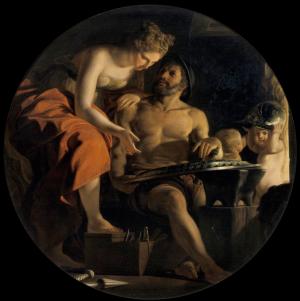
Bernardino Nocchi (previously attributed to Pompeo Batoni), Vulcan Delivering the Weapons of Aeneas to Venus, second half of the eighteenth century
Claudio Grezler, well known in Trento as having been president for over twenty years of the insurance company ITAS (Istituto Trentino Alto Adige per Assicurazioni), was also distinguished as a passionate art-lover. Over the years, this passion translated itself in the accumulation of a rich and varied personal collection of paintings. For the most part consisting of pictures by Italian and Flemish artists from the 1500s to the 1800s, his collection included outstanding works along the theme of the sacred and profane, of portraits, battles, and landscapes. By his own wish, his collection was merged with that of ITAS on his death and, in 1981, was exhibited in the prestigious setting of Buonconsiglio Castle. Claudio Grezler expressly wished that his collection, built up “with time, effort and sacrifice” should not be divided up and should instead become a public heritage.
Today, in gathering together this important patrimony, the Buonconsiglio Castle museum and ITAS have worked in harmonious synergy to pay homage to this important figure through a new initiative in appreciation of his collection. After assiduous research and a painstaking restoration process, the paintings are presented to the public in an exhibition that is further enriched by other exquisite works that Grezler, during his time as president, had added to the insurance company’s own collection.
Among the works exhibited are many that have only now, thanks to research conducted especially for this occasion, emerged from anonymity and been associated with their legitimate authors. We can, for instance, now admire Antonio Giuseppe Sartori’s baroque relief featuring the figure of Saint Florian, the patron saint of fire-fighters which is ideally suited to the insurance activities of ITAS. Present, too, is a delicate representation of Holy Conversation attributed to Nicolò de Barbari, alongside a sumptuous painting by Antonio Marini and an equally vivacious Bacchanalia from the Flemish school.
Call for Session Proposals | CAA in New York, 2017
From CAA News (22 January 2016). . .
105th Annual Conference of the College Art Association
New York, 15–18 February 2017
Proposals due by 18 April 2016
For the CAA 105th Annual Conference, CAA will change the format of the conference as we look to liven up the experience for all our members. The changes highlighted below are the result of a critical look at the event by the organization’s Annual Conference Committee.
• New time grid: All sessions will be ninety minutes in length, allowing for more sessions
• More types of submissions and therefore more ways to participate, such as complete session proposals, with participants chosen in advance; proposals to chairs, who will solicit speakers through a call for papers; and independent proposals of papers
• Individuals may participate in consecutive years, if their proposals are accepted
• Other Annual Conference Events (more information available here)
You can download and read the full report of recommendations by CAA’s Task Force on the Annual Conference. Please remember all participants will have to be members and registered for the conference for 2017.
Key Dates for the 2017 Conference
March 1 Call for Annual Conference session and paper proposals
April 18 Deadline for session and paper proposals
June 3 Annual Conference Committee meets to select sessions and papers
June 20 Notification sent regarding approved sessions
July 1 Call for Participation
July 1 Deadline for travel grant applications
August 30 Paper titles and abstracts due for sessions soliciting contributors
Mid-September Online conference registration opens
September 30 Deadline for chairs to choose speakers for sessions soliciting contributors
October 1 Deadline for Hot Topics session proposals
February 15–18 CAA 105th Annual Conference, New York
Affiliated Society Submissions
• One session per Affiliated Society will be accepted with a note of approval from the chair of the group; subsequent submissions may be submitted separately by individuals and require peer review by the Annual Conference Committee; these submissions will not be labeled as an Affiliated Society panel.
• Each Affiliated Society is still guaranteed one 90-minute session, as well as a business meeting, which will be tagged as an Affiliate Society meeting.
• Sessions should be submitted in the proposal submission process above.
Exhibition | The Splendor of Venice
◊ ◊ ◊ ◊ ◊
From Fondazione Cariplo:
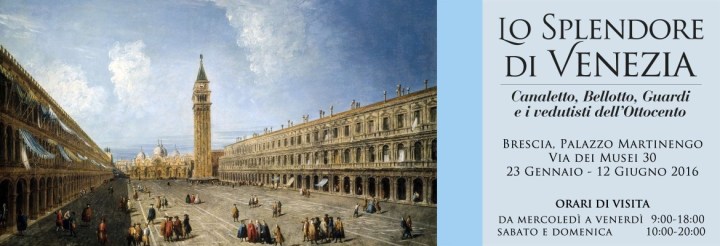
Lo Splendore di Venezia: Canaletto, Bellotto, Guardi e i Vedutisti dell’Ottocento
The Splendour of Venice: Canaletto, Bellotto, Guardi and the Vedutisti of the Nineteenth Century
Brescia, Palazzo Martinengo, Brescia, 23 January — 12 June 2016
Palazzo Martinengo is hosting a new international art exhibition to celebrate the city of Venice. The Splendour of Venice shows how the city has been and still is—more than any other city—a timeless legend in the world’s collective imagination. Down through the centuries, Venice has been immortalised by Italian and foreign artists so often that it was identified as the origin of vedutismo. ‘Veduta’ in English was a successful new landscape genre that was appreciated by the rich and educated Grand Tour travellers who wanted to return to their home countries with a lovely picture of the charming sights they had seen in Italy.
To tell the public about the origins and development of the glorious season of Venetian vedute, Palazzo Martinengo presens for the first time ever a selection of over one hundred masterpieces by Canaletto, Bellotto, Guardi, and other important vedutisti from the 18th and 19th centuries. The paintings, on loan from prestigious private and public collections in Italy and Europe, have been carefully selected by an international scientific committee. This artwork demonstrates that the popularity of the genre did not end with the Republic of Venice, which came about with the Treaty of Campo Formio, signed in 1797 by the French and the Austrians, but instead continued during the entire 19th century.
The exhibition will follow an interesting chronological itinerary, divided into ten thematic sections, which all feature a selection of Murano glass objects created by master craftsmen of the 20th century. The exhibition will end with a final surprise, set up in the section ‘Venice, theatre of life’, with scenes from daily life in the squares, open spaces, streets, and canals of the city. Fondazione Cariplo is present at this event with four masterpieces from its art collection, painted by Guglielmo Ciardi and Pietro Fragiacomo.
Study Day | Textiles and Diplomacy: Diplomats and Spies
From H-ArtHist:
Textiles and Diplomacy: Diplomats and Spies in the Early Modern Age
Centre for Textile Research, SAXO Institute, University of Copenhagen, 17 March 2016
Convened and introduced by Corinne Thépaut-Cabasset
13:00 Corinne Thépaut-Cabasset (CTR/SAXO Institute Copenhagen), ‘Textiles and Diplomacy: Diplomats and Spies in the Early Modern Age’
13:30 Axel Harms (Rosenborg Castle), ‘Splendour and Confidentiality: Rosenborg Castle and the Diplomacy of Christian IV’
14:00 Cecilia Candreus (Uppsala University), ‘An Embroidered Marriage Proposal to Elizabeth I of England’
14:30 Charlotte Paludan (Independent Textile Scholar Copenhagen), ‘French Espionage on Danish Textile Production’
15:00 Nadia Fernández de Pinedo (Universitad Autonóma Madrid), ‘Textile Consumption in Mid-18th Century-Madrid: Diplomats and Upper Middle Class’
15:30 Sidsel Frisch (University of Copenhagen), ‘Textile Diplomacy: Tapestries of War and Peace’










leave a comment