British Art Studies, Autumn 2015
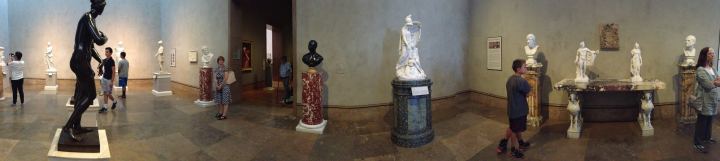
Ken Gonzales-Day, Panorama of Museum West Pavilion, 2015, chromogenic print, 20.32 x 99 cm, taken in the West Pavilion, J. Paul Getty Museum, Los Angeles, ©Ken Gonzales-Day.
◊ ◊ ◊ ◊ ◊
British Art Studies recently launched with an impressive premier issue and an exemplary commitment to free and open access, as detailed in the initial issue’s editorial statement. Congratulations! –CH
British Art Studies is free and open access: there are no subscriptions, no passwords, and no fees to pay. All content will be preserved as a free-to-use resource. The ethos of open access is one that YCBA and PMC have adopted for all their digital efforts, in the recognition that conventional proprietary models represent a major obstacle to scholarship. It is published under a Creative Commons CC BY-NC licence, meaning that you are free to share and re-use its contents for non-commercial purposes, provided that appropriate credit is given to the author/s. No permissions are needed. . . .
◊ ◊ ◊ ◊ ◊
The eighteenth century in BAS 1:
British Art Studies 1 (Autumn 2015)
Conversation Piece coordinated by Richard Johns, “There’s No Such Thing as British Art.”
‘Conversation Piece’ is a British Art Studies series that draws together a group of contributors to respond to an idea, provocation or question. The conversation will develop as more respondents enter the debate. Readers can also join in by adding a response.

Thomas Gainsborough, Charity Relieving Distress, ca. 1784, oil on canvas, 127.6 x 102.2 cm (Indianapolis Museum of Art).
Georgina Cole, “ ‘A Beautiful Assemblage of an Interesting Nature’: Gainsborough’s Charity Relieving Distress and the Reconciliation of High and Low Art.”
In the competitive environment of the eighteenth-century London art scene, Thomas Gainsborough and Sir Joshua Reynolds were often perceived as great rivals. While they shared patrons, sitters, and a stake in the future of British art, their differing artistic approaches caused considerable friction, indeed Gainsborough seceded from the Royal Academy of Art in 1784, boycotting its exhibitions and activities. This essay, however, argues that Gainsborough’s Charity Relieving Distress, painted in the year of his secession, proposes a charitable resolution of their aesthetic attitudes. The complex interrelation of allegorical and anecdotal form is interpreted as a pictorial attempt to reconcile their approaches through the concept of charity, a virtue of powerful artistic lineage in the western tradition, and of contemporary social importance.
Cyra Levenson and Chi-ming Yang, with a photo-essay by Ken Gonzales-Day, “Haptic Blackness: The Double Life of an 18th-Century Bust.”
‘One Object’ is a British Art Studies series that uses an object from a collection as a starting point for collaborative research. Cyra Levenson and Chi-ming Yang have co-authored this essay which is followed by a photo-essay by artist Ken Gonzales-Day and an interview between him and the authors.
Lecture | Mark Hallett on Gainsborough’s Landscapes
At The Morgan:
Mark Hallett, The Nomadic Eye: Traveling through Thomas Gainsborough’s Landscapes
The Morgan Library and Museum, New York, 9 December 2015
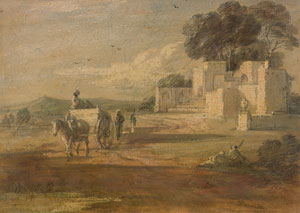
Thomas Gainsborough, Landscape with Horse and Cart, and Ruin, watercolor, oil and black chalk on laid paper; varnished (The Morgan Library and Museum)
Thomas Gainsborough’s landscape drawings and paintings take us into a distinction world. It is one in which we are typically granted the perspective a of a traveller wandering along a winding path, track or road. It is one in which we encounter a succession of familiar but also enigmatic subjects: the edges of woods, muddy banks, shadowed ponds, whitewashed ruins, figures resting on the road’s edges, shepherds with their flocks, men and women returning form the market. It is one in which trees often seem to dance and interact, and in which skies are constantly shifting. And finally, it is one in which we continually sense the echoes of earlier art—of dutch seventeenth-century landscape paintings, for example, or the territories painted by artists such as Rubens, Ruisdael, or Gaspard Dughet. In this illustrated lecture Professor Mark Hallett, Director of Studies at The Paul Mellon Centre for Studies in British Art, takes us on a tour of Gainsborough’s pastoral views and suggests how we might best understand and appreciate the pictorial world that the artist created in and through his landscapes. This program is organized by the Morgan Drawing Institute.
Wednesday, December 9, 6:30pm; admission is free.
Exhibition| Wordplay: Matthias Buchinger’s Drawings
Press release (19 November 2015) from The Met:
Wordplay: Matthias Buchinger’s Drawings from the Collection of Ricky Jay
The Metropolitan Museum of Art, New York, 5 January — 11 April 2016
Curated by Freyda Spira with Femke Speelberg and Jennifer Farrell

Approximately 22 drawings by the 18th-century German artist Matthias Buchinger (1674–1739), who was born without hands or feet, will be presented in Wordplay: Matthias Buchinger’s Drawings from the Collection of Ricky Jay, opening on January 5, 2016. Despite his disabilities, Buchinger was celebrated in his own time as a draftsman and calligrapher as well as a magician and musician, and poems were written in Europe about his many talents and achievements. Known as ‘the Little Man of Nuremberg’, because he was only 29 inches tall, Buchinger was said to have performed for German emperors, European princes, and for King George I of England. He was also a frequent guest at noble houses in England and Ireland, and performed at local fairs and inns from Amsterdam and Stockholm to Leipzig and Paris.
The Metropolitan Museum’s two drawings by Buchinger will be displayed alongside some 20 works from the collection of Ricky Jay, the celebrated illusionist, actor, and author. Framing Buchinger’s stupendous works, which were composed largely through calligraphy and micrography (employing minuscule script to create abstract shapes or figurative designs), will be works from the Metropolitan Museum’s collection that will demonstrate text as image. These additional works will include late medieval manuscripts, Renaissance typographical prints, 17th-century writing books, and contemporary works on paper.
Wordplay: Matthias Buchinger’s Drawings from the Collection of Ricky Jay is organized by Freyda Spira, Associate Curator with Femke Speelberg and Jennifer Farrell, also Associate Curators, of the Metropolitan Museum’s Department of Drawings and Prints.
The New York Times architecture critic Michael Kimmelman and Ricky Jay will discuss Matthias Buchinger in a ‘MetSpeaks’ ticketed talk on January 21, 2016.
◊ ◊ ◊ ◊ ◊
The accompanying publication is due out next March from Siglio:
Ricky Jay, Matthias Buchinger: The Greatest German Living (New York: Siglio Press, 2016), 160 pages, ISBN: 978-1938221125, $40.
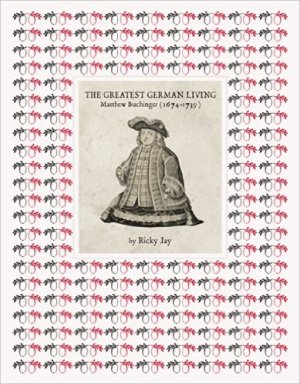 Matthias Buchinger (1674–1739) performed on more than a half-dozen musical instruments, some of his own invention. He exhibited trick shots with pistols, swords and bowling. He danced the hornpipe and deceived audiences with his skill in magic. He was a remarkable calligrapher specializing in micrography—precise handsome letters almost impossible to view with the naked eye—and he drew portraits, coats of arms, landscapes and family trees, many commissioned by royalty. Amazingly, Matthias Buchinger was just twenty-nine inches tall, and born without legs or arms. He lived to the ripe old age of sixty-five, survived three wives, wed a fourth, and fathered fourteen children.
Accompanying the Metropolitan Museum of Art exhibition Wordplay: Matthias Buchinger’s Inventive Drawings from the Collection of Ricky Jay, this book is a cabinet containing a single, multi-faceted wonder, refracted through acclaimed sleight-of-hand master Ricky Jay’s scholarship and storytelling. Alongside an unprecedented and sumptuously reproduced selection of Buchinger’s marvelous drawings and etchings, Jay delves into the history and mythology of the ‘Little Man’, while also chronicling his encounters with the many fascinating characters he meets in his passionate search for Buchinger.
Ricky Jay, one of the world’s great sleight-of-hand artists, has received accolades as a performer, actor, and author. He was recently profiled on the series American Masters and is the subject of the film Deceptive Practice: The Mysteries and Mentors of Ricky Jay. Jay has written frequently on unusual entertainments, and his Learned Pigs & Fireproof Women and Jay’s Journal of Anomalies were both New York Times ‘Notable Books of the Year’. The former curator of the Mulholland Library of Conjuring and the Allied Arts, he has defined the terms of his profession for the Encyclopedia Britannica and the Cambridge Guide to American Theater.
Exhibition | Drawing Versailles: Charles Le Brun
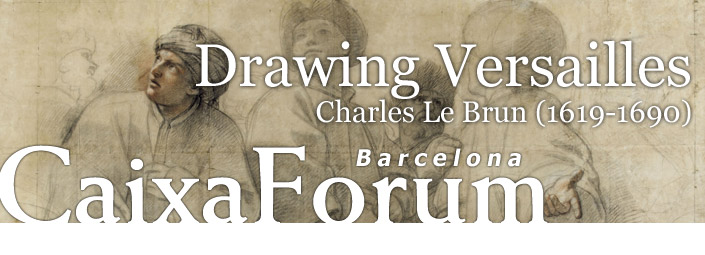
Summary of the exhibition now on view at the Caixa Forum in Barcelona (with thanks to Tobias Locker for noting it) . . .
Drawing Versailles: Studies and Cartoons of Charles Le Brun
Caixa Forum, Barcelona, 18 November 2015 to 14 February 2016
Curated by Bénédicte Gady
In 1682, Louis XIV transferred the French court to Versailles. The artist Charles Le Brun (1619–1690) was responsible for planning this work, to which he applied an ‘orchestral’ treatment, which involved the participation of hundreds of artisans and artists, the best from each discipline. Le Brun personally produced several pieces, including two particularly impressive compositions: the Staircase of the Ambassadors and the Hall of Mirrors, adorned by a series of mature paintings imbued with the most captivating beauty.
A little-known body of original material is conserved from this undertaking: the preparatory cartoons, which illustrate the final phase in the artist’s working process. The cartoons demonstrate Le Brun’s virtuosity as a draftsman, his talent for constructing scenes and his painstaking care, down to the last detail. The drawings include studies of characters, allegorical figures, trophies and animals that formed part of the artist’s compositions, conceived as a great symbolic jigsaw puzzle. Such cartoons were commonly used between the sixteenth and nineteenth centuries, but few have reached our days. Those produced by Le Brun are the exception: three hundred and fifty cartoons in a store of three thousand drawings found at the artist’s studio, requisitioned and added to the royal collections after his death in 1690.
The Staircase of the Ambassadors
Le Brun’s drawings provide a vision of the decoration, now lost, from the Staircase of the Ambassadors, featuring figures on the same scale, enriched with all the gravity and dramatic quality of drawing in black pencil. This staircase, which led up to the grand apartments of the king and queen, was the first space that represented the power of the monarch at Versailles. Designed in around 1671 and decorated between 1674 and 1679, the staircase was destroyed in 1752, during the reign of Louis XIV. In it, Le Brun made exceptional use of a narrow space that only received overhead lighting. Using optical illusion, he increased the sensation of space, mixing fact and fiction to create an allegorical composition that depicted the return of Louis XIV after one of his military victories. Le Brun surrounded the king by representatives from nations in the four continents, the kings of Antiquity, victories, cupids and the arts: a monumental composition to the honour and glory of the absolute monarch. The cartoons reveal that Le Brun worked on the Staircase of the Ambassadors to the last minute, retouching and improving his drawings.
The Hall of Mirrors
The paintings in the Hall of Mirrors enable us to follow, step by step, the artist’s working process, from the first small sketches, their pencil strokes embodying powerful movement, to the final drawings, which are the same size as the paintings themselves. Also conserved are the engraved copies of the overall work, produced for the purpose of making this artistic accomplishment known beyond French borders, adding to the monarch’s fame. In European painting, the figure of the king was traditionally represented by a mythological figure: Apollo, Hercules and so on. Le Brun, however, portrays the king himself, leading his armies to victory, wearing an ancient breastplate and a modern wig, in a dialogue with the gods and allegories. Two of the most important scenes on the ceiling are represented: the king’s decision to rule alone, and the war with Holland. One of the most famous episodes in this war, The Crossing of the Rhine in 1672, is shown through cartoons exactly as they were found in Le Brun’s studio.
From the Louvre Museum to CaixaForum
Over the past few years, the Graphic Arts Department of the Louvre Museum has carefully restored these drawings, enabling us to see them now for the first time in all their original splendour. The exhibition Drawing Versailles: Studies and Cartoons of Charles Le Brun (Dibuixar Versalles / Dibujar Versalles: Charles Le Brun) is the fruit of a strategic agreement between the Louvre Museum and ”la Caixa” Foundation. The purpose of this agreement is to bring to public attention artists, collections and periods in art history that are not represented in our galleries but which occupy eminent positions in the Louvre’s exhibition discourse: Mesopotamian culture, Coptic art, Pharaonic bestiary, women in Ancient Rome, the work of Eugène Delacroix, etc.
Dibujar Versalles: Bocetos y Cartones de Charles Le Brun (Barcelona: Fundació Ciaixa de Pensions, 2015), ISBN 978-8499001425, 232 pages, 35€.
The full press release is available here»

Charles Simonneau, Ceiling of the Great Staircase at Versailles, etching and burin, 38.7 x 70.5 cm. Chalcographic copper plate printing (RMN-Grand Palais, Musée du Louvre).
Exhibition | Neapolitan Crèche at the Art Institute of Chicago

Neapolitan Crèche, mid-eighteenth century
(Art Institute of Chicago)
◊ ◊ ◊ ◊ ◊
From the AIC:
Neapolitan Crèche
Art Institute of Chicago, 20 November 2015 — 3 January 2016
After its widely popular debut in 2013, our spectacular eighteenth-century Neapolitan crèche returns once again this holiday season. One of the very few and finest examples of such a work outside of Naples, the crèche is an intricate Nativity scene that reflects the vitality and artisanship that the city is still known for. The Art Institute’s crèche features over 200 figures—including no less than 50 animals and 41 items of food and drink—all staged in a spectacular Baroque cabinet with a painted backdrop. Elaborate, complex, and wondrous, the Neapolitan creche is a rare example of the genre and a once-in-a-lifetime acquisition for the Art Institute.
 Sacred imagery reenacting the Nativity has its roots in fourth-century Rome but by the thirteenth and fourteenth centuries—in part due to its association with St. Francis of Assisi—such scenes had become a permanent feature of Neapolitan churches. During the eighteenth century, the period from which most of the figures of the Art Institute’s crèche date, these relatively simple tableaux underwent a transformation into highly dramatic and theatrical renderings. Traditional sacred elements of Nativity scenes—the Holy Family, wise men, angels, and shepherds—were combined with profane aspects not of Bethlehem but of contemporary Neapolitan life—rowdy tavern scenes and bustling street activities—in dazzling displays of artistic techniques. Churches, wealthy citizens, members of the nobility, and the royal family all competed to commission the most complex presentations of this popular art form from leading artists and artisans, the same people who were creating monumental sculptures and altars for churches and palaces. These artists rendered figures in oil-painted terracotta to achieve the most realistic expressions in crèches and constructed painstakingly detailed costumes of luxurious fabrics that mimicked the fashions of the time. The Art Institute’s crèche represents the pinnacle of this artistic practice, born of the centuries-old tradition of Nativity scenes yet bursting with the energy of eighteenth-century Neapolitan life.
Sponsors
The Art Institute of Chicago is grateful to the following individuals for their generous support of the Neapolitan crèche: The Nativity and Three Wise Men and Their Courts and Treasures sponsored by Mr. and Mrs. James N. Bay; The Heavenly Host sponsored by Linda and Vincent Buonanno and Family in memory of Vincent Buonanno Jr.; The Taverna sponsored by the Eloise W. Martin Legacy Fund; and La Georgiana and Her Companions sponsored by Mrs. Robert O. Levitt.
Kyle MacMillan reported on the acquisition of the crèche for The Wall Street Journal (29 November 2013).
Exhibition | Schalcken: Painted Seduction
Press release for the exhibition now on view at the Wallraf-Richartz Museum:
Schalcken: Gemalte Verführung / Painted Seduction
Wallraf-Richartz-Museum & Fondation Corboud, Cologne, 25 September 2015 — 24 January 2016

Godefridus Schalcken, Self-Portrait, 1694 (Leamington Spa Art Gallery and Museum)
A lady looking into a mirror in the soft candlelight, proud, a little pert perhaps, but certainly enigmatic. Few artists have matched the ability of Godefridus Schalcken (1643–1706) to capture such magical moments on canvas so powerfully that they still compel attention three centuries later. In autumn 2015 the Wallraf-Richartz-Museum & Fondation Courboud launched in cooperation with the Dordrechts Museum the first-ever exhibition to survey Schalcken’s oeuvre as a whole, inviting a reassessment of this unique painter and seducing visitors to have a detailed look at the charming and enchanting art of Schalcken. More than eighty loans from public and private collections worldwide are on show, a third of his known painted oeuvre. Lenders include the Leiden Collection, New York, The Rose-Marie and Eijk van Otterloo Collection, Naples, Uffizi Florence, Rijksmuseum Amsterdam, Mauritshuis The Hague, National Gallery London, Národní galerie in Prague, Statens Museum Copenhagen, National Gallery of Scotland, Edinburgh, National Gallery of Ireland, Dublin, Ashmolaen Museum, Oxford, Städel Museum, Frankfurt, Hamburger Kunsthalle, Gemäldegalerie Dresden, Staatliche Kunsthalle Karlsruhe and Gemäldegalerie Alte Meister Kassel.
Schalcken will not have seemed predestined for an artistic career when he was born in 1643 into a family headed by a Protestant pastor. At the age of nineteen, following an apprenticeship with Samuel van Hoogstraten, a pupil of Rembrandt, he entered the workshop of Gerrit Dou, the celebrated founder of the school of artists known as the Leiden ‘fine’ painters. Dordrecht, London, The Hague and Dusseldorf were further stages in his impressive career. Despite the political and economic turmoils and an ailing art market: Schalcken established himself as a “self-branded artist”. His paintings fetched top prices and entered the most illustrious collections. Royal clients, such as Florence’s Grand Duke Cosimo III de’ Medici and Elector Palatine Johann Wilhelm in Dusseldorf, helped Schalcken to international fame.
As a master of light, especially candlelight, Schalcken entered the canon of art history and was lauded by art lovers—including even Johann Wolfgang von Goethe. First with the changes in taste that came in the nineteenth century did the ‘typically Dutch’, bourgeois art by painters like Vermeer, Rembrandt and Frans Hals gain in preference. Schalcken’s elegantly painted aristocratic gems languished in obscurity. With the consequence that the artist ranks today among the great unknowns of the Golden Age of Netherlandish painting.
Here in the first ever exhibition of his work, we are invited to set out on a journey of rediscovery. With rarely shown masterpieces, including many works from private collections, it opens up the painter’s rich world of imagery. A world that captivates by its wide range of genres and subjects, its tromp-l’oeil illusionism, and the gallant conversations that Schalcken invites us viewer to join.
The exhibition catalogue, with essays and extensive entries by Guido M.C. Jansen, Wayne Franits, Anja K. Sevcik, Nicole Elizabeth Cook, Eddy Schavemaker, Sander Paarlberg and Marcus Dekiert aims to update the meritorious catalogue raisonée by Thierry Beherman of 1988.
Wayne Franits, et al., Schalcken: Gemalte Verführung (Stuttgart: Belser Verlag, 2015), 312 pages, ISBN: 9783763027217, $88.
Conference | Versailles in the World, 1660–1789
◊ ◊ ◊ ◊ ◊
From the conference website:
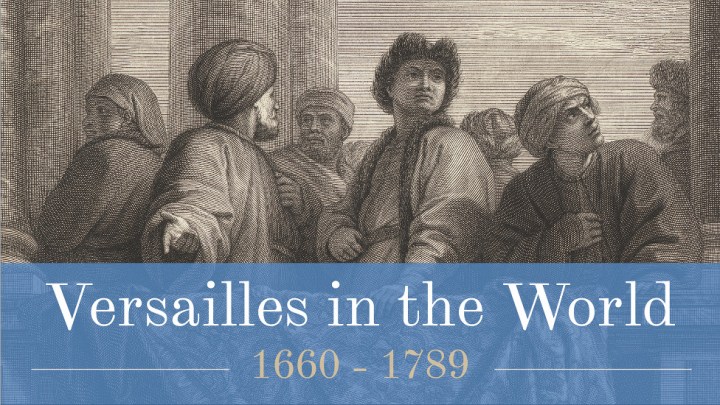
Versailles in the World, 1660–1789
New York University, 29 January 2016
Organized by Jeffrey Collins, Meredith Martin, and Robert Wellington
Versailles is often seen as the epitome of ‘Frenchness’, yet the palace and its contents were profoundly shaped by encounters with people and objects from around the world. This symposium builds upon recent colloquia and exhibitions such as La Chine à Versailles: art et diplomatie au XVIIIe siècle (2014) and Voyageurs étrangers à la cour de France, 1589–1789 (2014) to emphasize the international character of Versailles between the reigns of Louis XIV and Louis XVI and to situate its art and architecture in a global context.
The day-long public event at the Washington Square Campus of NYU brings together an international group of scholars to explore connections between Versailles and a wide variety of geographical regions and cultures, from Thailand to Tunisia to Dutch Brazil. Papers focus on a range of visual and material culture that relates to cross-cultural exchanges at Versailles in the late seventeenth and eighteenth centuries, including the depiction of ambassadorial visits to the palace; gifts to and from the French Court; objects and images made for Versailles and its inhabitants that depict non-European cultures or reveal cross-cultural resonances; exoticism and fashion; and examples of art and architecture made outside of Europe that were inspired by Versailles.
Versailles in the World, 1660–1789 is timed to coincide with the preparation of a major exhibition on the foreign visitor at Versailles that will open at the Metropolitan Museum of Art in May 2017. It has been made possible through the generous support of New York University, Bard Graduate Center, and The Metropolitan Museum of Art.
◊ ◊ ◊ ◊ ◊
P R O G R A M
10:00 Welcome and Opening Remarks: Versailles as a Site of Global Exchange, Meredith Martin, New York University
10:15 Curators Daniëlle Kisluk-Grosheide (Metropolitan Museum) and Bertrand Rondot (Musée National des Châteaux de Versailles et de Trianon) discuss their upcoming exhibition Visitors to Versailles, 1682–1789
11:00 Session I. Diplomatic Gifts and the French Court
• Mediating Spaces: Dutch Brazil at the French Court, Carrie Anderson, Middlebury College
• From Versailles to Nouvelle France: French ‘Indian Peace Medals’ of the Eighteenth Century, Robert Wellington, Australian National University
• Versailles, Beijing and the Eighteenth-Century Global Imaginary, Kristel Smentek, Massachusetts Institute of Technology
12:30 Lunch
1:45 Session 2. International Trade, Collecting, and Display
• From Ancient Carthage to Modern Tunis: The Cultural and Political Reception of Tunisia at the French Court of Versailles, Ridha Moumni, Institut de recherche sur le Maghreb contemporain (IRMC)
• Mercantilism, Entrepreneurship, and the French Silk Corridors to Persia, Junko Takeda, Syracuse University
• Native American Objects at Versailles, Noémie Etienne, Getty Research Institute
3:15 Break
3:30 Session 3. Fashion and Exoticism
• Fashion Will Travel: Dress and Diplomacy at the Court of Louis XVI and Marie-Antoinette, Kimberly Chrisman-Campbell, Independent scholar
4:15 Roundtable discussion led by Jeffrey Collins, Bard Graduate Center
5:15 Closing Reception
Exhibition | Pearls on a String
Press release (24 July 2015) for the exhibition now on view at The Walters:
Pearls on a String: Artists, Patrons, and Poets at the Great Islamic Courts
The Walters Art Museum, Baltimore, 8 November 2015 — 31 January 2016
Asian Art Museum, San Francisco, 25 February — 8 May 2016
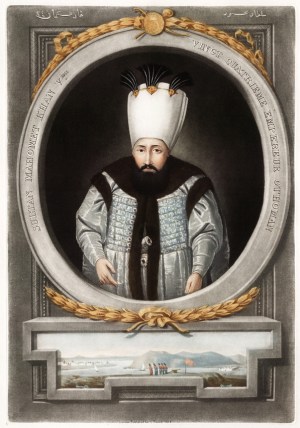
Portrait of Ottoman Sultan Mahmud I, 1815 (Baltimore: The Walters Art Museum)
The great Mughal, Safavid, and Ottoman empires flourished during a time of rapid change and artistic innovation in the Islamic world, as people, ideas, and technologies spread across Europe and Asia. At the heart of the empires’ courts were networks of individuals—writers, poets, artists, craftsmen— who produced extraordinary works of art for the ruling elite. From November 8, 2015, through January 31, 2016, the Walters Art Museum will present Pearls on a String: Artists, Patrons, and Poets at the Great Islamic Courts, the first major exhibition to focus on these influential and often charismatic individuals. The free exhibition features more than 120 works including paintings, calligraphy, textiles, ceramics, and jeweled luxury objects. Dating from the 16th to the 18th century, these exquisite works of art were created in historic India, Iran, and Turkey, a vast geographic area that extends from the Bay of Bengal to the Mediterranean Sea.
“Pearls on a String seeks to broaden public engagement with the cultural histories of Muslim societies by demonstrating how human imagination and collaboration can ignite extraordinary artistic creativity,” said Amy Landau, curator of the exhibition.
Three Vignettes
Pearls on a String is organized in a series of vignettes that spotlight a 16th-century writer, a 17th-century artist, and an 18th-century patron. Through poignant quotes, startling juxtapositions of artwork, and subtle references to the protagonists’ architectural surroundings, the exhibition will offer a rare glimpse into their worlds. The individuals also inform the exhibition’s poetic title: viewed independently, each is a gleaming ‘pearl’, yet collectively they constitute an even more vibrant ‘string of pearls’.
• Writer Abu’l Fazl (1551–1602): A prolific writer, visionary historian and intimate at the court of the third Mughal emperor Akbar in India, he was the most powerful voice in defining Akbar’s policies of political inclusion in the context of a demographically diverse empire.
• Painter Muhammad Zaman (c. 1650–1700): At the court of Safavid ruler Shah Sulayman, this imperial artist radically changed the course of Persian painting by introducing farangi-sazi, a European style, into the Persian tradition.
• Patron Sultan Mahmud I (1696–1754): An Ottoman ruler and active patron of the arts and architecture, this once-forgotten sultan commissioned fanciful jeweled objects as well as lavish libraries and mosques that define Istanbul’s skyline to this day.
“The Walters’ initiative to organize its first international loan exhibition dedicated to Islamic art springs from the quality of the museum’s collection, its intellectual resources and its dedication to providing free access,” said Julia Marciari-Alexander, the Andrea B. and John H. Laporte Director of the Walters Art Museum.
Loans and Support
Loans from national and international institutions include the Victoria and Albert Museum, London; the British Library, London; the Aga Khan Museum, Toronto; the Metropolitan Museum of Art, New York; and the National Gallery of Art, Washington, D.C. Approximately a third of the works are from the collection of the Walters Art Museum, which has one of the most comprehensive collections of Islamic art in North America. The exhibition was organized by the Walters Art Museum in partnership with the Asian Art Museum, and will be on view at the Asian Art Museum in San Francisco February 25 through May 8, 2016.
Pearls on a String has been generously supported by the National Endowment for the Humanities: Celebrating Fifty Years of Excellence; the Institute of Museum and Library Services; the National Endowment for the Arts; the Gary Vikan Exhibition Endowment Fund; Ellen and Edward Bernard; Douglas and Tsognie Hamilton; the Herb Silverman Fund; the Maryland Humanities Council and several anonymous donors.
◊ ◊ ◊ ◊ ◊
The catalogue is distributed by the University of Washington Press:
Amy Landau, ed., Pearls on a String: Artists, Patrons, and Poets at the Great Islamic Courts (Baltimore: Walters Art Museum, 2015), 256 pages, ISBN: 978-0295995243, $60.
 Pearls on a String presents the arts of historical Islamic cultures by focusing on specific people and relationships among cultural tastemakers, especially painters, calligraphers, poets, and their patrons. Through a series of chapters, the book spotlights certain historical moments from across the Islamic world. Each chapter pivots around patrons and their social networks. These independent sections allow different voices and perspectives to emerge, enabling the reader to see that Islamic societies are not monolithic but made up of a tapestry of individuals with distinct and varying views. Pearls on a String pays particular attention to individuals from different sectors of society, giving voice to anonymous artists and translators, merchants, and women of the harem. Islamic historical sources reinforce the book’s themes of writing in Islamic societies, artistic patronage, biographical traditions, and human connectivity.
Amy Landau is associate curator of Islamic and South Asian Art at the Walters Art Museum, Baltimore. Contributors include Paul Losensky, Sussan Babaie, Avinoam Shalem, Glaire Anderson, Mariam Rosser-Owen, Persis Berlekamp, Vivienne Lo, Wang Yidan, Willem Flinterman, Jo Van Steenbergen, David Roxburgh, Qamar Adamjee, Audrey Truschke, Bora Keskiner, Unver Rustem, and Tim Stanley.
New Book | The Bauers: Joseph, Franz & Ferdinand
From Prestel:
Hans Walter Lack, The Bauers: Joseph, Franz & Ferdinand, Masters of Botanical Illustration (London: Prestel, 2015), 496 pages, ISBN: 978-3791354897, $85, £60.
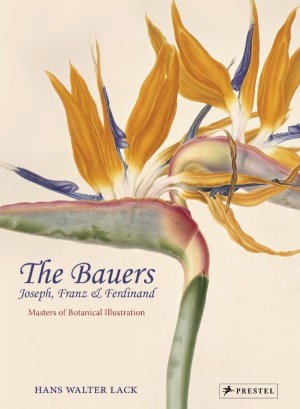 Filled with stunning 18th- and 19th-century illustrations of plants and other living creatures, this book is the first to bring together the life and art of the three Bauer Brothers, who came to be some of the most celebrated botanical artists of all time.
As artists, Joseph, Franz and Ferdinand Bauer were independently successful: Joseph as court painter to the Prince of Lichtenstein; Franz (later Francis) was employed at Kew Gardens as the ‘Botanick Painter to His Majesty’; and Ferdinand’s seminal collection of 1500 paintings created from sketches he made traveling in and around Australia is the first detailed account of the natural history of that continent. Drawn from all known worldwide sources of the Bauers’ extant illustrations, this illustrated history of the Bauers and their work unfolds chronologically, starting with the brothers’ formative years in Feldsberg, Austria, where they produced more than two thousand drawings of plant specimens under the guidance of the local abbot. Learning how to dissect plants as well as how to use microscopes to paint them in intricate detail, the Bauers became well known for their extraordinary precision. Their detail work, along with their incredibly beautiful and highly developed methods of coloring their paintings, comes to life in numerous superbly reproduced illustrations. A celebration of an indelible body of work, this unique volume recalls the Golden Age of botanical artistry through the lives and contributions of the renowned Bauer brothers.
Hans Walter Lack is Director of the Botanic Garden and Botanical Museum in Berlin, Germany. He has written extensively about botanical art.
New Book | Palais Royal: à la table des rois
From BnF:
Alina Cantau, Frédéric Manfrin et Dominique Wibault, Palais Royal: à la table des rois (Paris: Éditions de la Bibliothèque nationale de France, 2015), 224 pages, ISBN: 978-2717726695, 35€.
 De François Ier à Napoléon III, en passant par Louis XIV et Bonaparte, Palais royal invite les gourmands d’images et d’histoire à découvrir la cour de France sous un autre jour : quand elle passe à table. Au fil des siècles et des règnes, la culture culinaire évolue. Les voyages et leur cortège de découvertes viennent métisser les repas, au gré des échanges diplomatiques, des mariages princiers et du commerce. Mais toujours la gastronomie est affaire de plaisir. Comme l’écrit Guy Martin qui signe ici la préface, le palais naît d’une sensibilité, à la fois personnelle et collective, qui se cultive. À l’origine de la « cuisine française », les tables royales de France posaient les bases de ce qui allait faire sa renommée.
Alina Cantau est coordinatrice scientifique Gallica au sein du département de la Coopération à la Bibliothèque nationale de France. En charge de la gastronomie, elle a collaboré à plusieurs revues spécialisées et à l’Agenda gourmand (BnF). Elle a également participé à des actions de valorisation des collections gourmandes de la Bibliothèque nationale de France et de ses partenaires.
Frédéric Manfrin, conservateur, est depuis 2008 chef du service Histoire à la Bibliothèque nationale de France. Il a assuré le commissariat des expositions « Esprit[s] de Mai 68 », « Casanova, la passion de la liberté » et « Été 14 : les derniers jours de l’ancien monde », dont il a également codirigé le catalogue. Il donne depuis quelques années de nombreuses conférences sur l’histoire culturelle et politique de l’Europe aux XVIIe et XVIIIe siècles.
Dominique Wibault, chargée de collection en gastronomie au département Sciences et Techniques de la Bibliothèque nationale de France, a collaboré à l’édition 2015 de l’Agenda gourmand (BnF) et au dossier gastronomie « Du sens aux sens » du numéro 49 de la Revue de la BnF.










 Enfilade
3 comments