Call for Papers | HBA Young Scholar Session at CAA 2016
Historians of British Art Young Scholar Session
College Art Association, Washington, D.C., 5 February 2016
Proposals due by 18 December 2015
The Historians of British Art, a CAA-affiliated society, seeks papers for an upcoming mini-session of work by emerging scholars to be held during the HBA Business Meeting at CAA in Washington, D.C. (February 5, 2016). Current or recent graduate students are invited to submit proposals (if a Ph.D. recipient, the degree must have been earned within the past three years). Papers may address any topic related to British art, architecture, and visual culture and should be limited to fifteen minutes. This is an opportunity for informal presentations of new or ongoing research followed by open discussion.
To submit a paper for consideration, please send the following items to Craig Hanson, HBA President, at CraigAshleyHanson@gmail.com: (1) a one page abstract; (2) a C.V. (limited to two pages).; and (3) a brief cover letter explaining interest in the field. The deadline for submission is December 18, 2015. Upon selection, each presenter will be requested to join HBA if not already a member.
Attingham Offerings for 2016

George Barret the Elder, The West Front of Burton Constable,
oil on canvas, 1777
◊ ◊ ◊ ◊ ◊
Along with Attingham’s regular course offerings, next year’s study programme will be based in Denmark. More information and application form available at Attingham’s website. Applicants from the U.S. may contact Mary Ellen Whitford, admin@americanfriendsofattingham.org. Applicants from outside the U.S. may contact Rita Grudzień, rita.grudzien@attinghamtrust.org.
The London House Course, 19–25 April 2016
Applications due by 11 January 2016
This non-residential programme studies the development of the London house from the Renaissance to the present, as well as the history of planning and development in the city. Directed by Giles Waterfield and Sarah Nichols.
Attingham Study Programme: The Historic House in Denmark, 1–8 June 2016
Applications due by 24 January 2016
Commencing in Copenhagen this ambitious 8-day programme will concentrate on Denmark’s rich heritage of royal castles and manor houses virtually unknown outside the country. Ranging from the Middle Ages to the nineteenth century, a wide variety will be visited many still in private hands. The programme will be directed by Annabel Westman with the assistance of a Danish advisory committee.
The 65th Attingham Summer School, 30 June — 17 July 2016
Applications due by 31 January 2016
Directed by Elizabeth Jamieson and Andrew Moore, and accompanied by specialist tutors and lecturers, this intensive 18-day course will include visits to approximately 25 houses in Sussex, Nottinghamshire, Derbyshire and Yorkshire. The Summer School will examine the country house in terms of architectural and social history, and the decorative arts.
Royal Collection Studies, 4–13 September 2015
Applications due by 12 February 2016
Run on behalf of Royal Collection Trust, this strenuous 10-day course based near Windsor is directed by Giles Waterfield. The school will visit royal palaces in and around London with specialist tutors (many from the Royal Collection) and study the extensive patronage and collecting of the royal family from the Middle Ages onwards. The course is open to all but priority will be given to those with a professional or specialist knowledge of British architecture or history of the fine and decorative arts.
French 18th-Century Studies, 9–14 October 2016
Applications due by 30 April 2016
Directed by Helen Jacobson, and run for the fourth time, this 5-day non-residential program aims to foster a deeper knowledge and understanding of French eighteenth-century fine and decorative art. Based at the Wallace Collection with one full study day at Waddesdon Manor this course is intended primarily to aid professional development with object-based study, handling sessions and a look at behind-the-scenes conservation.
The Lewis Walpole Library 2016–17 Fellowships & Travel Grants
Applications due by 11 January 2016
The Lewis Walpole Library, a department of Yale University Library, invites applications to its 2016–2017 fellowship program. Located in Farmington, Connecticut, the Library offers short-term residential fellowships and travel grants to support research in the Library’s rich collections of eighteenth-century materials (mainly British), including important holdings of prints, drawings, manuscripts, rare books, and paintings. In addition, the Library offers a joint fellowship award with the Beinecke Rare Book and Manuscript Library to support up to eight weeks of research in both collections. Scholars pursuing postdoctoral or advanced research, as well as doctoral candidates at work on a dissertation, are encouraged to apply.
Recipients are expected to be in residence at the Library, to be free of other significant professional obligations during their stay, and to focus their research on the Lewis Walpole Library’s collections. Fellows also have access to additional resources at Yale, including those in the Sterling Memorial Library, the Beinecke Rare Book and Manuscript Library, and the Yale Center for British Art. Residential fellowships include the cost of travel to and from Farmington, accommodation for four weeks in an eighteenth-century house on the Library’s campus, and a per diem living allowance. Travel grants cover transportation costs to and from Farmington for research trips of shorter duration and include on-site accommodation.
The application deadline is January 11, 2016. Awards will be announced in March. For application details and requirements click here.
Exhibition | Dangerous Liaisons: The Art of the French Rococo

◊ ◊ ◊ ◊ ◊
Now on view at the Liebieghaus Skulpturensammlung:
Gefährliche Liebschaften: Die Kunst des französischen Rokoko
Dangerous Liaisons: The Art of the French Rococo
Liebieghaus Skulpturensammlung, Frankfurt, 4 November 2015 — 28 March 2016
Curated by Maraike Bückling
Featuring more than eighty outstanding works on loan, the show entitled Dangerous Liaisons focuses on the newly emerging concept of sentimental love and its preferred style of representation in French art around 1750, vividly illustrating the seductive powers of the Rococo. On view will be sculptures, biscuit-porcelain statuettes, paintings, and prints as well as arts-and-crafts objects from renowned international lenders such as the Rijksmuseum, the Musée du Louvre, the British Museum, the Victoria and Albert Museum, the Museo Thyssen-Bornemisza, the Wallraf-Richartz Museum & Fondation Corboud, and Munich’s Alte Pinakothek.
During the reign of French king Louis XV, not only art theoreticians and writers, but also visual artists began to reassess the meaning of passions and emotions. While formulaic enunciations of sentiments had still been commonplace in the seventeenth century, such preset expressions of passion lost the more of their significance in the first half of the eighteenth century, the more love came to be understood as an individual emotion that was glorified as giving meaning to life. New models of love and—along with them—nature as a courtly Arcadia informed the representational vocabulary of the fine arts. What is in the foreground of works by sculptors Étienne-Maurice Falconet (1716–1791) and Jean-Baptiste Pigalle (1714–1785) as well as painters Jean-Antoine Watteau (1684–1721), Nicolas Lancret (1690–1743), and François Boucher (1703–1770) and of porcelain sculptures by Johann Joachim Kaendler (1706–1775) is an artistic conception of naturalness. In addition, one room in the exhibition recreates, with mirrors, furniture, paintings, prints, and porcelain, the look of a typical eighteenth-century salon.
“The art of the French Rococo polarizes and enthralls. Back then, like today, it prompted widely diverse responses between fascination and repudiation, admiration and incomprehension. Thanks to noted works on loan from the most important collections of the world our large-scale exhibition at the Liebieghaus is able to convey the style-defining power of this unique epoch with its new ideas about love and the idealization of rural life by the aristocracy,” Max Hollein, director of the Liebieghaus Skulpturensammlung, explains.
“In the eighteenth century, artists like Jean-Antoine Watteau, François Boucher, Étienne-Maurice Falconet, Jean-Baptiste Pigalle, or Jean-Honoré Fragonard discovered quiet and serene loves scenes as their subject matter. Yet only a few years later, their pictures full of naturalness and the comforts of love were denounced as reprehensible, devoid of truth, and even dangerous by critics like Choderlos de Laclos. That they nevertheless count among the most beautiful works of Rococo art is what we want to show in this exhibition,” says Maraike Bückling, curator of the exhibition and head of the departments Renaissance to Neoclassicism at the Liebieghaus Skulpturensammlung.
In the early eighteenth century, love was considered to be the most common of feelings, which all people were capable of. Drawing on theater plays, fables, operas, and narratives, visual artists like Jean-Antoine Watteau or François Boucher gave pictorial expression to the new concepts of love. Love scenes no longer showed the destructive passions of gods and heroes, but depicted tender affection between individuals. By and by, the divine personages transformed into characters of the pastoral, the bucolic play. Genre scenes of shepherds and gardeners become almost paradigmatic of the portrayals of a more tranquil, tender love in the Arcadian courtly settings of the period. The aristocracy’s enthusiasm for these scenes with their leisurely casualness and naturalness also found its expression in their self-fashioning. Costume plays arranged around the shepherd and the shepherdess were highly popular. This fascination even led to the setting-up of idealized fake farmsteads, for example in the parks of Versailles, most of them lavishly furnished with exquisite wall coverings and porcelain services especially made in Sèvres. Given this enthusiasm for bucolic themes, it is quite unsurprising that they soon gained ground in all art genres. The sculptors Étienne-Maurice Falconet and Jean-Jacques Bachelier (1724–1806) also took to developing pastoral scenes, as for example in the biscuit groups Annette et Lubin (1764, Düsseldorf, Hetjens-Museum – German Museum of Ceramics) or La fée Urgèle (1767, Sèvres, Cité de la Céramique – Sèvres et Limoges, Musée national de Céramique). Like their painter colleagues, they drew on models from literature. Johann Joachim Kaendler, Laurentius Russinger (1739–1810), and Johann Peter Melchior (1747–1825) created entire countrified theme worlds for the porcelain manufactories in Meißen and Höchst. Without exception, these pastoral couples are depicted in the outdoors, in a nature that appears not at all pristine or uncultivated: rather, the lovers—always looking elegant and more like aristocratic figures in their rustic garb—are seen strolling through gardens or enchanted overgrown park landscapes.
While the Académie royale de peinture et de sculpture, founded in 1648, still only knew formulaic patterns for the representation of emotions, artists eventually discarded the seventeenth-century rulebook in turning toward spheres of more individualized emotions. The fact that the viewer’s gusto was increasingly seen as a valid critical category finally led to the abandonment of traditional precepts and guidelines. The goal was to move viewers. And this was to be effectuated through works that tapped into their own world, their living environment and emotional sphere. Rococo painting and porcelain sculpture did not depict high-flown ideals of virtue or admirable heroic exploits. Rather, the figures are characterized by mild manners and tenderness and, whether it is pastoral themes or scenes from ancient mythology, appear in graceful everyday postures.
 In the opening section of the exhibition Dangerous Liaisons: The Art of the French Rococo viewers are given an idea of the character of a Rococo salon. The first room shows a set of furnishings, as is typical of the time around 1750. Wall coverings, paintings, armchairs, chests of drawers, mirrors, candelabra, porcelain, tapestries—all details were carefully matched with one another so as to create a harmonious overall picture at that time. Following the model of literature and painting, different artisans also devoted themselves to genre scenes. This connection is illustrated by the coverings of two armchairs from the Munich Residency which were made after children’s portraits of François Boucher. These ‘Enfants Boucher’ were very popular in the mid-eighteenth century, also as motifs of porcelain groups.
Costumes are shown in the passageway from the first room to Villa Liebieg. These are garments made for a production of Un ballo in maschera by Guiseppe Verdi (1813–1901) at the Frankfurt Opera House. They correspond to historical Rococo attire and convey a specific idea of the life-world of the period. French Rococo fashion was informed by courtly taste. One type of gown that was particularly in vogue was the ‘Robe à la française’ which accentuated the female back with full-length pleats from the neckline down to the floor; a fashion detail that was given special attention by Jean-Antoine Watteau and his successors, so that it later came to be known as ‘Watteau pleat’.
After the prologue introducing visitors to the Rococo lifestyle, the adjoining room features one of the most celebrated works by sculptor Étienne-Maurice Falconet. His Menacing Love (Amour menaçant) of 1757 (Rijksmuseum, Amsterdam), created for Madame de Pompadour (1721–1764), ushers in the theme of love in the presentation. The marble sculpture marks a change of style in Falconet’s oeuvre, as the Seated Cupid, as its also called, is the first instance that he addresses what appears to be a lighter, less grave theme. The secretive look and the raised finger commanding silence make the viewer a confidant let in on the love god’s secret plans. With his other hand, the little boy is already pulling an arrow from his quiver. The poignancy with which Falconet engages the viewer in the work is reminiscent of the dramatic and theatrical stylistic devices of Roman Baroque.
 In the subsequent rooms the presentation is continued with a number of paraphrases and variants of sentimental love. An extraordinary couple of lovers Pygmalion and Galathea (1763, Paris, Musée du Louvre) by Falconet is juxtaposed with suggestive scenes such as The See-Saw (around 1755, Madrid, Museo Thyssen-Bornemisza) by Jean-Honoré Fragonard (1732–1806), Falconet’s biscuit pieces The Kiss (1765, London, British Museum) and La Feuille à l’envers (1760, Sévres, Cité de la Céramique-Sèvres et Limoges) or Les Trois Contents (1765, Munich, Bavarian National Museum).
Around the mid-eighteenth century, visual artists frequently took the inspiration for their modern ideas of naturalness and love from fables and theater plays. The pastoral works of, for example, François Boucher enjoyed such popularity that his compositions were mass-reproduced as prints and disseminated throughout Europe. So, eventually, Boucher’s renditions of motifs from popular tales, plays, or operas came to grace tableware services, tapestries, furniture, and porcelain statuettes. The exhibition juxtaposes a number of etchings illustrating a play entitled Grape Harvest in the Vale of Tempe with pastoral porcelain statuettes, including, for example, The Flute Lesson (c. 1752, Paris, Musée Jacquemart-André) after René Gaillard (c. 1719–1790) and The Grape Eaters (c. 1766–1772, Hamburg, Museum of Arts and Crafts) by Jean-Jacques Bachelier, both after François Boucher.
The predilection for the cutely small and intimate inherent in those pastoral motifs is carried on in Boucher’s work in a turn toward children’s figures, which is illustrated in the final section of the exhibition. Sculptors like Falconet and Bachelier soon followed the example of the painter and also produced children’s statuettes. Mostly acting like grown-ups, these children appear as street musicians, macaroon sellers, milkmaids, or organ grinders.
A different matter are the almost life-size marble statues created by both Pigalle and Falconet. The sculpture Boy with a Birdcage (1749, Musée du Louvre) is a much closer rendering of childlike physiognomy and agility. Pigalle very precisely brings out the fleshiness of the child, which gives the piece an appearance somewhere between putto, allegory, and portrait.
Dangerous Liaisons: The Art of the French Rococo is supported by Kulturfonds Frankfurt RheinMain gGmbH and the Georg und Franziska Speyer’sche Hochschulstiftung.
Mareike Bückling, ed., Gefährliche Liebschaften: Die Kunst des französischen Rokoko (Munich: Hirmer, 2015), 280 pages, ISBN: 978-3777424637, 45€.
Call for Papers | ‘Showing Off’: Design and Ostentation
From H-ArtHist:
‘Showing Off’: Design and Ostentation
The Twenty-Fifth Annual Parsons/Cooper Hewitt Graduate Student Symposium on the History of Design
Cooper Hewitt, Smithsonian Design Museum, New York, 7-8 April 2016
Proposals due by 25 January 2016
What makes an object desirable? And why do we show it off? From Veblen’s theories of conspicuous display to Bourdieu’s concept of “ostentatious discretion,” scholars have long been fascinated with how display and extravagance, or their converse (e.g. studied reserve or ironic shabbiness) act as signs of economic and/or cultural capital.
The symposium will explore issues relating to ornament and excess—or their conspicuous avoidance—in relation to social structures, aesthetics, technology, politics and economics. Proposals might consider the invention, uses and semiotics of materials whether natural or synthetic, mundane or exotic; relationships of beauty and value; luxury studies and branding; normcore and humblebragging in design; collecting and collections; or the display of objects, including virtual or cinematic display. Objects of study might include jewelry, fashion or other articles of personal adornment; interiors, interior design and furniture; industrial design, e.g. cars or home appliances; ostentatious technologies, e.g. watches, glasses, headsets or home theaters; or hotels, casinos, museums, apartment buildings, stores, theaters or other public or private sites of demonstrative architecture.
Proposals are welcome from graduate students at any level in fields such as Art History, History of Design, Design Studies, Fashion Studies, History of the Decorative Arts, Cultural Anthropology, History of Architecture, Consumer Studies, Design and Technology, Media Studies, Museum Studies, Food Studies, etc.
The symposium’s Catherine Hoover Voorsanger Keynote speaker will be Ulysses Grant Dietz, Chief Curator and Curator of Decorative Arts at the Newark Museum. The Keynote will be on Thursday evening, April 7, 2016 and the symposium sessions will be in the morning and afternoon on Friday, April 8.
To submit a proposal, send a two-page abstract, one-page bibliography and a c.v. to Ethan Robey, Associate Director, MA Program in the History of Design and Curatorial Studies, robeye@newschool.edu. The symposium is sponsored by the MA Program in the History of Design and Curatorial Studies offered jointly by Cooper Hewitt, Smithsonian Design Museum and Parsons School of Design.
Painting Restoration on View at The National Gallery of Denmark
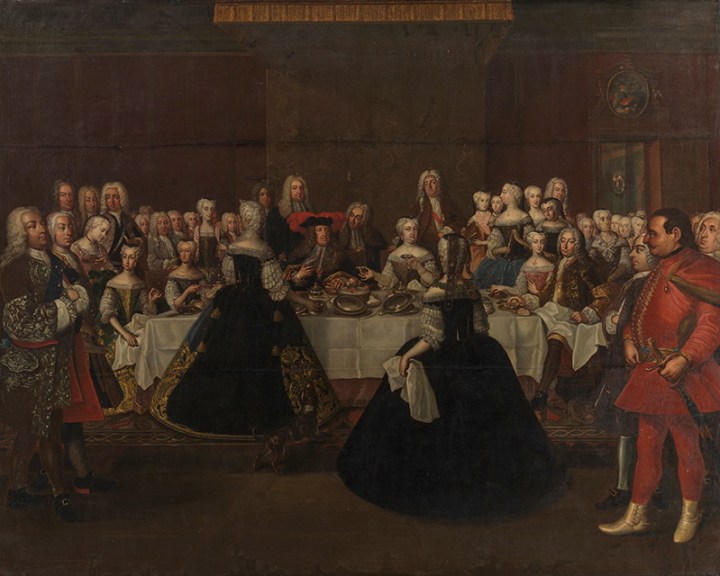
Johann Salomon Wahl, after an original by Martin van Meytens, A Banquet at the Court of the German Emperor Charles VI, 1741 (Danish Royal Collection)
◊ ◊ ◊ ◊ ◊
On view at the National Gallery of Denmark:
Open Studio: A Birthday Present for the Queen
Statens Museum for Kunst, Copenhagen, 29 October 2015 — 28 February 2016
For a four-month period, visitors to the SMK can watch the museum’s conservators at work, wielding scalpels and pigments to restore a painting that usually hangs on the wall of Her Majesty Queen Margrethe II’s private quarters. The restoration of J.S. Wahl’s painting A Banquet at the Court of the German Emperor Charles VI (1741) is the New Carlsberg Foundation’s gift to the Queen on the occasion of her 75th birthday.
 This large-scale painting has hung on the walls of Fredensborg Palace—now the private residence of H.M. Queen Margrethe II—since 1872. Painted by Johann Salomon Wahl in 1741, after an original by Martin van Meytens, the painting was acquired for the Royal Danish Kunstkammer in the year of its making and has been part of the royal collections ever since. With the passage of the years, the painting deteriorated to the point where it could no longer withstand being on display. A lack of adhesion between the paint layer and the canvas has caused paint to peel off in many areas, and even more paint threatens to fall off across the entire canvas. The painting is in need of thorough conservation and restoration.
Such restoration has now been made possible by a donation from the New Carlsberg Foundation, a birthday present to the Queen. The treatment requires more than 2,200 hours of painstaking work where the conservators will reattach unstable paint, laminate the canvas onto a new one and carry out extensive retouching of the damage sustained over the years. When the extensive conservation process is complete, the painting will once again be on display at Fredensborg Palace.
The SMK has many years of experience with opening up its conservators’ workshops to visitors. Doing so offers the general public a chance to gain insight into the work done behind the scenes at the museum. From 29 October 2015 to 28 February 2016 the SMK’s conservators will allow all visitors to peep into the museum’s engine room. During this period, visitors can follow the conservators’ work on this extensive restoration project—and will also have the opportunity to ask questions.
A Banquet at the Court of the German Emperor Charles VI was painted as a copy after an original by Martin van Meytens, created for the Viennese court in 1736. In the years that followed, several different versions were painted by a range of artists. The original work was probably painted in connection with either the wedding or the engagement between the emperor’s eldest daughter, Maria Theresa, and Francis Stefan of Lorraine. Their union was an important event in European history; upon her father’s death a few years later Maria Theresa became sovereign of the Austrian and Hungarian lands as the Habsburg family’s first female successor to the throne. When Francis Stefan was subsequently elected Holy Roman Emperor as Francis I, their marriage expanded and reaffirmed the Habsburg family’s power in Europe.
The ruling emperor and empress, Charles VI and Elisabeth Christine, are seated underneath a canopy at the centre of the table, whereas the bride and groom are seated at the end of the table to the right. To the left are the emperor’s sister, Maria Magdalena, and his second-eldest daughter, Maria Anna. They are surrounded by courtiers, members of the aristocracy and persons of prominent military rank.
Conference | Yankee Ingenuity and New England Decorative Arts
From Historic Deerfield:
Yankee Ingenuity and New England Decorative Arts, 1790–1840
Historic Deerfield, Deerfield, Massachusetts, 13–15 November 2015
Join us for an in-depth examination of the decorative arts of New England’s inventors, merchants and peddlers during the late 18th and early 19th centuries.
When President Adams moved into the new White House in 1800, innovation and adaptation already drove the creative designs of many New England-made objects. Even as elite tastes maintained traditional ties to European styles and materials, the consumer demands of an expanding middle class fueled inventive entrepreneurial approaches to making and selling cheaper, attractive, American-made goods. At times protected or even encouraged by embargo, war, and westward expansion, New Englanders made and sold a profusion of wares including patent clocks, popular prints, glassware, stoneware, tinware, pewter, cast iron stoves, and stenciled and painted furniture. First competing with and ultimately replacing European manufactures for many families, they infused their products with artistic energy and excitement that spurred a national impulse to ‘Buy American’. Forum speakers and demonstrators will include Peter Benes, Deborah Child, David Jaffee, Amanda Lange, Ned Lazaro, William McMillen, Mary Cheek Mills, Sumpter Priddy, Andrew Raftery, Christine Ritok, and Philip Zea.
◊ ◊ ◊ ◊ ◊
F R I D A Y , 1 3 N O V E M B E R 2 0 1 5
Participants who arrive early are welcome to walk The Street and enjoy Deerfield’s historic houses. The museum exhibits ingenious examples of New England decorative arts in the Museum’s Attic of the Flynt Center of Early New England Life and in the exhibition Into the Woods: Crafting Early American Furniture. Before the Forum begins, four optional workshops (additional fee required) and one estate planning workshop (no fee) are offered on Friday afternoon, November 13.
1:00–2:30 Optional Workshop: “Connoisseurship of Antique Tinware: The Trade, Materials, Tradesmen, Tools, and Products,” William McMillen, Master Tinsmith, Glenmont, NY
1:00–2:30 Optional Workshop: “Yankee Potters: New England-Made Ceramics,” Amanda Lange, Curatorial Department Director, Historic Deerfield
3:00–4:30 Optional Workshop: “Peddling Fashion: Accessories in Early New England, 1790–1840,” Ned Lazaro, Associate Curator of Textiles and Collections Manager, Historic Deerfield
3:00–4:30 Optional Workshop: “Glass in Early America: An Introduction to History and Technology,” Mary C. Mills, Historic Glass Specialist, Cultural Resources Management, AECOM
5:00 Opening Reception
6:00 Welcome by Philip Zea, President, Historic Deerfield, Inc.
6:10 Keynote Lecture: “Fashioning the New Nation in Post-Revolutionary New England,” David Jaffee, Professor and Head of New Media Research, Bard Graduate Center
7:30 Dinner on own or prix fixe dinner at the Deerfield Inn
S A T U R D A Y , 1 4 N O V E M B E R 2 0 1 5
8:30 Registration, coffee, and refreshments
9:30 Lecture: “American Fancy and Rural New England Creativity,” Sumpter Priddy, Historic Furnishings Consultant, Alexandria, VA
10:30 Break
11:00 Lecture: “Elegance and Innovation in Early New England Glassmaking,” Mary C. Mills, Historic Glass Specialist, Cultural Resources Management, AECOM
12:15 Lunch
2:00 Lecture: “Richard Brunton—Engraver to Early America –Legitimate and Otherwise,” Deborah M. Child, Author, Lecturer and Independent Curator
3:00 Break
3:30 Demonstration: “The Art and Craft of Copperplate Engraving,” Andrew Raftery, Professor of Printmaking, Rhode Island School of Design
5:30 Reception
6:45 Dinner on own or prix fixe dinner at the Deerfield Inn
S U N D A Y , 1 5 N O V E M B E R 2 0 1 5
8:30 Coffee and refreshments
9:30 Lecture: “’Rich and Tasty’ Vermont Furniture: Revolution to Reinvention,” Philip Zea, President, Historic Deerfield
10:30 Break
11:00 Lecture: “Inspiration/Innovation: Exemplary Furniture on The Street,” Christine Ritok, Associate Curator, Historic Deerfield
11:30 Lecture: “The ‘Yankee Peddler’: Notes Toward a Multicultural Perspective,” Peter Benes, Director of the Dublin Seminar for New England Folklife
Lunch
2:00 Optional Guided Tour: “Exploring Historic Deerfield’s Collection of New England Folk Portraiture: Paintings, Drawings, Watercolors, and Silhouettes,” Flynt Center of Early New England Life
Seminar | FHS Research Seminar on European Furniture
From the seminar programme:
The Furniture History Society’s Research Seminar on European Furniture
The Wallace Collection, London, 20 November 2015
Following the success of its two previous FHS Research Seminars, held in London in 2012 and in New York in 2014, The Furniture History Society is delighted to announce that a third Research Seminar will take place, once again hosted by the Wallace Collection, on 20 November 2015. This year, the Seminar will be held in honour of Sir Nicholas Goodison, in celebration of his 25 years as President of the Society. Ten speakers—all at an early stage of their career—will present short papers on their current research, with papers encompassing a broad chronological and geographical representation of European furniture history.
Tickets are priced at £15 (£5 for student concessions) and are available from the Grants Secretary, Joanna Norman, grants@furniturehistorysociety.org or 07790 669240. The FHS Research Seminar is generously supported by the Oliver Ford Trust and the Wallace Collection.
◊ ◊ ◊ ◊ ◊
P R O G R A M M E
10.00 Registration and coffee
10.20 Welcome
10.30 Ada de Wit (Radboud University, Nijmegen / The Wallace Collection), Anglo-Dutch relationships in seventeenth-century wood carving
10.55 Olivia Fryman (Historic Royal Palaces), A leather chest of drawers from the household of Queen Anne
11.20 Esther van der Hoorn (Rijksmuseum), Patterns of production, invention and taste in a late 17th-century design for a chaise à porteurs in the Rijksmuseum
11.45 Jean-Baptiste Corne (Ecole du Louvre), Georges Jacob and the Rousseau Brothers: Enlightenment of a brief cooperation
12.10 Annemarie Klootwijk (Duivenvoorde Castle, The Netherlands), A set of rococo trumeaus at Duivenvoorde castle
12.35 Discussion
13.00 Lunch (not included in ticket price)
14.00 Julie Godin (Université de Nantes), Regency furniture at Chatsworth: From classical revival to chinoiserie
14.25 Christiane Ernek-van der Goes (Staatliche Kunstsammlungen Dresden), Johann August Türpe: Rebel, entrepreneur and court cabinetmaker
14.50 Tea
15.15 Thomas Deshayes (Cultural Property section, Ministry of Defence, Paris), Léopold Double: A French Lord Hertford?
15.40 Caroline McCaffrey (University of Leeds), Design influences on the furniture of Robert Lorimer
16.05 Benjamin Zurstrassen (Musée Horta, Brussels), Henry van de Velde’s furniture: Between making and thinking
16.30 Discussion
16.50 Concluding remarks
Call for Papers | Placing Prints: New Developments, 1400–1800
From The Courtauld:
Placing Prints: New Developments in the Study of Print, 1400–1800
The Courtauld Institute of Art, London, 12–13 February 2016
Proposals due by 22 November 2015
 Traditionally, the history of printmaking has fallen in the space between art history and the history of the book. Often ‘reproductive’ and multiple in nature, prints have long been marginalized in art historical scholarship in favour of the traditional ‘high’ arts. The inherent complexities in the manufacture and sale of print, often involving multi-faceted networks of specialist craftsmen, artists, publishers and sellers, has also led to much confusion. Not knowing how prints are made has affected our ability to understand the medium and its aesthetic qualities. However, recent scholarship has opened up new avenues for placing prints in Renaissance and Early Modern Europe. From the techniques applied in the making of prints to the individuals involved in their production, distribution and use, current research is continuing to shape our understanding of this complex field.
This conference aims to showcase new developments in the study of prints, challenging and developing traditional approaches. We are looking for papers that address a wide variety of issues and plan, over
the course of the two-day conference, to have a series of panels devoted to different themes. Some issues to consider include, but are not limited to, the following:
• the question of the ‘reproductive’ print and the idea of originality in printmaking
• the print in art criticism
• the development of new genres of print
• the question of the ‘popular’ print and the place of cheap prints on the early modern market
• the relationship between word and image in print
• the social uses of prints, in collections and other environments
• seriality and sequencing in prints
• the role of prints as transmedial agents, triggering the production of the same composition in different media
• techniques and innovations in the making of prints
• networks and relationships behind the production and sale of prints; the notion of collaboration
• colour: coloured printing, hand-coloured prints and processes of translating colour into in a monotone linear medium
The conference will include a pop-up display in the Courtauld Gallery’s print room, curated for the occasion. This will provide the opportunity to engage directly with objects related to the themes discussed.
We invite papers from both established and emerging scholars in universities, museums and galleries. Our aim is to provide a platform for sharing approaches and developing future collaborations between scholars working with prints. For this reason, we are also willing to consider papers delivered in French, Italian and German. However, speakers must provide an English translation of their text and be willing to answer questions and contribute to discussions in English. Unfortunately, funding for speakers is not available and speakers from outside London are encouraged to apply to their institutions for subsidies to attend the colloquium.
Abstracts for 20-minute papers, not exceeding 250 words should be sent with a brief academic CV (100 words) by 22 November to: placingprints@courtauld.ac.uk.
Organised by Naomi Lebens, Tatiana Bissolati, Bryony Bartlett-Rawlings and Chloe Gilling (The Courtauld Institute of Art).
Online Learning | Sexing the Canvas: Art and Gender

Giovanni Battista Tiepolo, The Banquet of Cleopatra, 1744
(Melbourne: National Gallery of Victoria)
◊ ◊ ◊ ◊ ◊
Now in progress through Coursera (directed by Jeanette Hoorn with familiar faces including Jennifer Milam). . .
Coursera: Sexing the Canvas: Art and Gender
Directed by Jeanette Hoorn, 26 October — 13 December 2015
What do paintings tell us about sex? How is art gendered? Here we get up close to some of the great paintings in the world’s most famous museums, giving you insight into how art speaks to us about sex, sexuality and gender.
This course teaches masterpieces through the lens of sex and gender. We take you to the rich collections of New York’s Museum of Modern Art, Melbourne’s National Gallery of Victoria and California’s Huntington Library giving you access to outstanding works from the western tradition and expert tuition from specialist curators and renowned art historians.
Each unit will examine the circumstances in which paintings are produced and received, and how contemporary spectators and consumers of art view them. Why do works of art made centuries ago continue to speak so profoundly to us today? What do art historians mean when they talk about ‘the gaze’? Are Matisse’s paintings ‘sexy’? What do the nude and the sleeping gypsy signify in Henri Rousseau’s extraordinary pictures? Why do viewers find Frida Kahlo’s small and very personal paintings so powerful? What do Gainsborough’s portraits tell us about masculinity and sensibility in eighteenth century Britain? How is the Australian ‘dreaming’ gendered? These are some of the intriguing questions you will study in Sexing the Canvas: Art and Gender.
Course Syllabus
The course is taught over 7 weeks and is made up of 9 modules:
1 Introduction: Tiepolo’s Cleopatra: Painting, Agency and the Gaze
2 The Culture of Sensibility and the ‘Man of Feeling’: Thomas Gainsborough’s Portrait of the Officer of the Fourth Regiment of Foot
3 Gainsborough at the Huntington: The Role of Music, Costume, Theatre, Charity and Passion in the Gendered Culture of Sensibility
4 Sexual Codes in French Courtly Painting of the Eighteenth Century
5 Orientalism, Gender and Display: Painting in Morocco
6 Henri Rousseau: Challenging the Myth of the Passive Woman
7 Henri Matisse, Paul Cezanne and Max Dupain: Modernism, Gender and the Science of Movement
8 Sexuality and Dissonance: Frida Kahlo and the Struggle to Paint
9 What is Women’s Business?: Australian Indigenous Art and the Dreaming
Recommended Background
No background is required; all are welcome. Visit your local art museum or gallery and look at some paintings.
Suggested Readings
All readings needed to successfully complete the course will be supplied. A rich list of resources will also be supplied within the course to assist you with you study for this subject.
Course Format
The class will consist of lecture videos, which are between 8 and 12 minutes in length. Each unit has key readings, which, with the lectures, provide the content for the short weekly quizzes based on a multiple choice format.










 Enfilade
leave a comment