Seminar | African Ivory: Past and Present
From the seminar flyer:
African Ivory: Past and Present
Huguenot Museum, Rochester, 4 June 2025
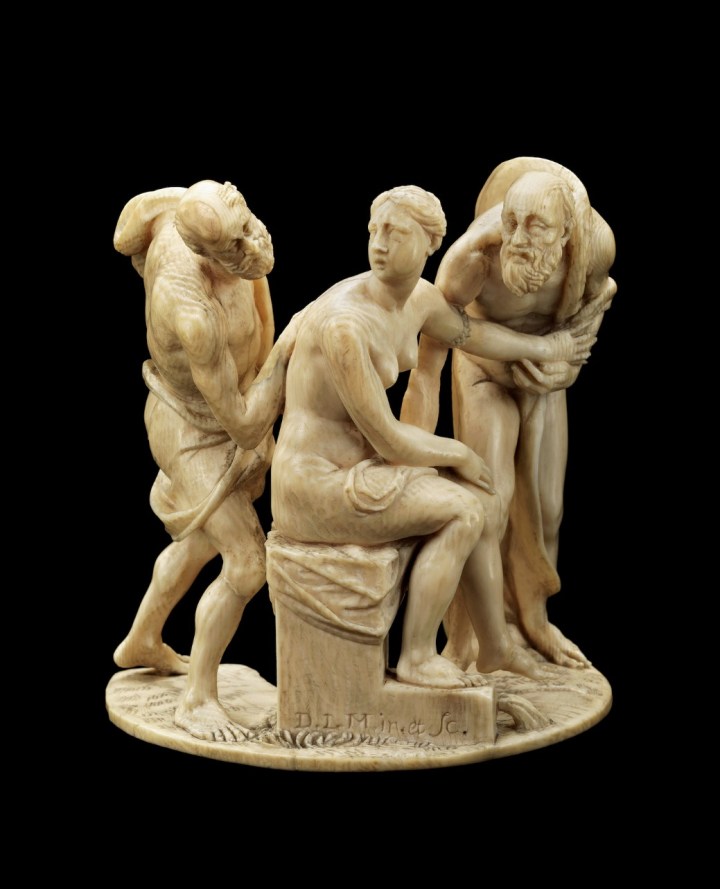
David Le Marchand, Susanna and the Elders, ca. 1720, African ivory (Rochester: Huguenot Museum). More information is available here.
Recent UK legislation—the Ivory Act of 2018 and the January 2025 amendment—makes the acquisition and loan of objects containing antique ivory challenging for regional and independent museums. This seminar hosted by the Huguenot Museum—following the acquisition, loan, and display of three ivory carvings by Huguenot sculptors—will share case studies, discuss best procedure in negotiating recent legislation, and consider approaches to press and marketing. To register, please send your name, email address, and institutional affiliation to Tessa Murdoch, chair@huguenotmuseum.org. The fee of £15 per person will include a buffet lunch. Payment can be made on the day in cash or card, or in advance by BACS transfer. Please note any dietary requirements.
p r o g r a m m e
11.00 Lucy Vigne (Independent Consultant) — Illicit Trade in African Ivory Today
11.40 Martin Levy, FSA — Ivory, the Antique Trade, and the Impact of Recent International Legislation
12.45 Lunch
1.35 Leanne Manfredi (V&A Purchase Grant Fund) and Mariam Rosser-Owen (Curator Middle East, Asia Department, V&A) — The Ivory Act of 2018 and Recent Amendments
Meeting the Challenges of the Ivory Act is a network led by the Pitt Rivers Museum and the Victoria and Albert Museum to support curators at Prescribed Institutions who are required to assess applications for exemption to the Ivory Act.
2.15 Nigel Israel (Independent Scholar) — Identifying Ivories
3.30 Tea
New Book | Objects and Material Cultures in the Dutch Republic
From Amsterdam UP:
Judith Noorman and Feike Dietz, eds., Objects, Commodities, and Material Cultures in the Dutch Republic: Exploring Early Modern Materiality across Disciplines (Amsterdam: Amsterdam University Press, 2024), 272 pages, ISBN: 978-9048562770, €129.
 How did objects move between places and people, and how did they reshape the Republic’s arts, cultures and sciences? ‘Objects’ were vitally significant for the early modern Dutch Republic, which is known as an early consumer society, a place famous for its exhaustive production of books, visual arts, and scientific instruments. What happens when we push these objects and their materiality to the centre of our research? How do they invite us to develop new perspectives on the early modern Dutch Republic? And how do they contest the boundaries of the academic disciplines that have traditionally organized our scholarship?
In Objects, Commodities and Material Cultures, the interdisciplinary community of specialists around the Amsterdam Centre for the Study of Early Modernity innovatively explores the diverse early modern world of objects. Its contributors take a single object or commodity as a point of departure to study and discuss various aspects of early modern art, culture, and history: from natural objects to consumer goods, from knowledge instruments to artistic materials. The volume aims to unravel how objects have moved through regions, cultures, and ages, and how objects impacted people who lived and worked in the Dutch Republic.
Judith Noorman is Associate Professor of Art History at the University of Amsterdam and leads the Dutch Research Council project The Female Impact, 2021–2026. As Director of the Amsterdam Centre for Studies in Early Modernity, she has organized the Object Colloquia Series, which laid the foundation for this book.
Feike Dietz is Professor of Global Dynamics of Dutch Literature at the University of Amsterdam. Her research focuses on the relationship between early modern texts, knowledge, and reading, with special attention devoted to youth, women, and girls.
c o n t e n t s
Acknowledgements
1 Feike Dietz and Judith Noorman — Introduction: Objects, Commodities and Material Cultures in the Dutch Republic
2 Weixuan Li and Lucas van der Deijl — The Anatomical Atlas: Govert Bidloo and Gerard de Lairesse’s Anatomia Humani Corporis (1685)
3 Djoeke van Netten — The Bullet and the Printing Press: Objects Celebrating the Battle of Gibraltar (1607)
4 Saskia Beranek — A Baluster: Amalia van Solms and the Global Trade in Japanese Lacquer
5 Lieke van Deinsen and Feike Dietz — The Graphometer and the Book: How Petronella Johanna de Timmerman (1723/1724–1786) Merged Science and Poetry
6 Hanneke Grootenboer, Cynthia Kok, and Marrigje Paijmans — Shells: Shaping Curiosity in the Dutch Republic
7 Gabri van Tussenbroek — The VOC Boardroom: A Forensic Investigation into the Built Environment
8 Maartje Stols-Witlox — The Muller: Insights into Practical Artistic Knowledge through Re-Making Experiments
9 Judith Noorman — Blue Paper: Its Life, Origin, History, and Artistic Exploration
List of illustrations with photo credits
Index
Call for Papers | Cemeteries as Part of the Landscape
From ArtHist.net:
Cemeteries as Part of the Landscape through the Centuries
Institute of Art History, Czech Academy of Sciences, Prague, 5–6 November 2025
Proposals due by 31 May 2025
The Institute of Art History of the Czech Academy of Sciences cordially invites you to participate in an international interdisciplinary conference focused on funerary culture, which will take place on 5 and 6 November 2025 in Prague. This conference builds upon a long-standing tradition of International Sessions on the Issue of Sepulchral Monuments, aiming to expand both the thematic and methodological scope of the discussion. This year’s theme is Cemeteries as Part of the Landscape through the Centuries, focusing on the role of burial grounds in social, urban, and natural environments. The conference seeks to create a space for scholars from various academic fields and methodological backgrounds and to offer a platform for discussing cemeteries’ historical, anthropological, artistic, and social aspects.
Suggested topics include, but are not limited to, the following:
• Cemeteries as part of the anthropological landscape — the role of cemeteries in collective memory and social identity
• Cemeteries as part of the cultural landscape — the role of burial sites in urban and natural environments, their preservation and transformation
• Cemeteries as part of the social landscape — the social role of burial grounds and their place within human communities
• The ‘sepulchralization’ of public space — from individual graves to family chapels, from churchyards to large cemeteries and memorial complexes, their development and functions across different cultural contexts
Contributions may address all aspects of the above topics, with a preference for materials or methodological approaches relating to Central Europe. We especially welcome contributions by early-career researchers, as well as studies on Jewish or Muslim sepulchral monuments, which may be included in a dedicated conference session. Conference languages: Czech, Slovak, German, and English. No conference fee will be charged.
Presentation formats
• Individual papers (20 minutes)
• Research reports (10 minutes)
• Panel presentations (including student panels)
Selected papers will be published in a collective volume within the Epigraphica & Sepulcralia—monographia series by Artefactum, the publishing house of the Institute of Art History, CAS. Other papers may be considered for publication in the journals Historie–Otázky–Problémy, Archivní časopis, or Studia historica et archivistica. The organizing committee reserves the right to select which papers will be published.
Please submit an abstract (max. 200 words) along with a short academic bio by 31 May 2025 to founova@udu.cas.cz. Authors will be notified of the acceptance or rejection of their papers by 15 June. We look forward to your contributions and engaging discussions.
On behalf of the organizing committee,
Vanda Fouňová, Eva Jarošová, Kristina Uhlíková
Institute of Art History, the Czech Academy of Sciences
Bethlehem’s Moravian District Added to UNESCO’s World Heritage List
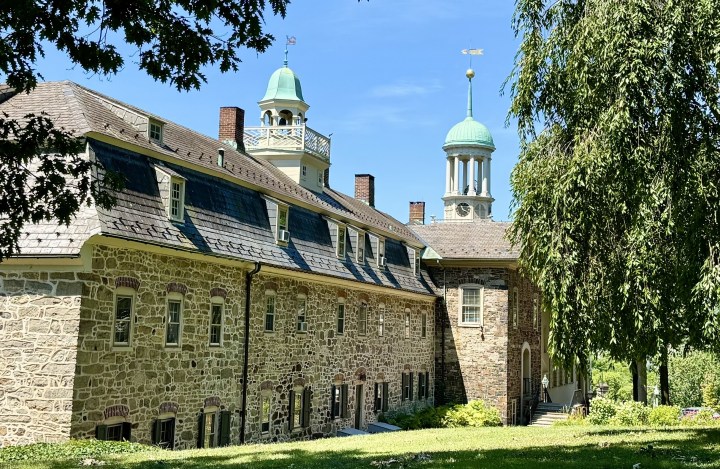
Bell House Complex, built in 1746, 56 West Church Street, Bethlehem.
◊ ◊ ◊ ◊ ◊
Last year, the Historic Moravian Bethlehem District in Pennsylvania (consisting of nine buildings, four ruins, and a cemetery) was added to UNESCO’s World Heritage List. Eve Kahn describes her visit to the city of Bethlehem (70 miles north of Philadelphia) in the latest issue of Preservation (Spring 2025) . . .
I am having a heady preservationist moment in mid-air. It’s a crystalline winter morning in Bethlehem, Pennsylvania, a city known for industriousness and architectural stewardship since the 1740s. I have been escorted up sinuous staircases to the domes belfry of Central Moravian Church’s Sanctuary, a gabled and stuccoed building that has welcome worshipers since it opened in 1806. From my perch overlooking Main Street, I admire the church’s well-kept tower clockfaces and its planes of gray slate roofing, supported by walls six feet thick. All around, Moravian setters’ 18th-century masonry buildings have adapted into bustling museums, businesses, and homes, cheek by jowl with their Victorian and Art Deco counterparts . . . (p. 21).
UNESCO designated the place [of Bethlehem] as part of what is officially called a “transnational serial property,” along with three 18th-century hamlets in Europe: Herrnhut in Germany, Gracehill in Northern Ireland, and Christiansfeld in Denmark. All were set up as Christian communities by members of the Moravian Church, a Protestant sect founded in the 1450s in what is not the Czech Republic. Fleeing persecution, the community dispersed, and in the 1700s a group of adherents revived the Moravian Church. They eventually scattered worldwide to worship and proselytize. In 1741, some especially intrepid Moravians settled on Pennsylvania acreage at the confluence of the Lehigh River and Monocacy Creek, on land that white explorers had recently swindled from the Lenape people (p. 22).
◊ ◊ ◊ ◊ ◊
From the National Park Service press release (26 July 2024) . . .
Secretary of the Interior Deb Haaland today applauded the selection of the Historic Moravian Bethlehem District in Bethlehem, Pennsylvania, to the United Nations Educational, Scientific and Cultural Organization’s (UNESCO) World Heritage List. The list highlights cultural and natural heritage sites around the world considered to be of outstanding value to humanity.
“The United States is deeply honored to be included in UNESCO’s World Heritage List with the listing of the Historic Moravian Bethlehem District where visitors from around the world are able to learn about the rich history of Moravian settlements, their cultural tradition and spiritual ideals,” said Secretary Haaland. “This designation is a recognition of the incredible work of the National Park Service and its local partners to preserve an important part of American—and world—history.”
This designation is UNESCO’s 26th—and the first transnational World Heritage listing—in the United States. In addition to the Historic Moravian Bethlehem District, the listing of Moravian Church Settlements includes the historic settlements of Herrnhut, founded in 1722 in Germany, and Gracehill, established in 1759 in Northern Ireland. The three areas join as an extension of the Moravian settlement of Christiansfeld in Denmark, founded in 1773, which was added to the World Heritage List in 2015, to form a single World Heritage listing for Moravian Church Settlements.
“This well-deserved designation demonstrates the lasting, global influence of the Moravian Church and the preservation of some of America’s most treasured landmarks that support and illustrate our heritage and history,” said National Park Service Director Chuck Sams.
The Historic Moravian Bethlehem District is also a national historic landmark. Established in 1741 as a planned community, it was the religious and administrative center of Moravian activities in North America. Similar to the other three settlements, many of its buildings still serve their original purpose. In 2022, Secretary Haaland authorized the National Park Service (NPS) to develop a nomination of Moravian Church Settlements for World Heritage List consideration.
NPS supported this effort with the full cooperation of property owners, the City of Bethlehem, Bethlehem Area Moravians and Moravian University. NPS advised the Bethlehem World Heritage Commission and guided them through the technical requirements of the nomination process as well as communicated with the governments of Germany, the United Kingdom, and Denmark on the development of the nomination.
The NPS is the principal U.S. government agency responsible for implementing the World Heritage Convention in cooperation with the Department of State. The NPS manages all or part of 19 of the 26 U.S. sites. Inclusion of a site in the World Heritage List does not affect U.S. sovereignty or management of the sites.
Restoration of the Williamsburg Bray School Completed
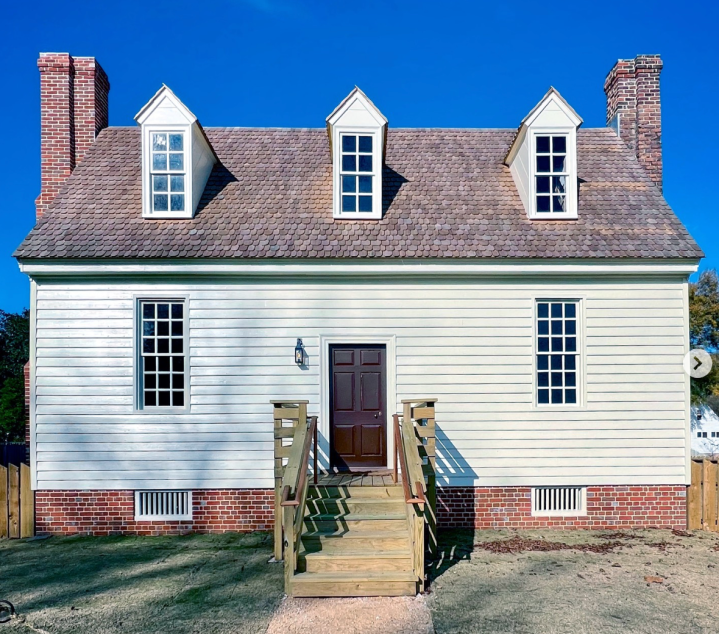
Opened in 1760, the Bray School is believed to be the oldest surviving building in the United States for the education of Black children. As noted by Lauren Walser in her Preservation article, the school “taught a pro-slavery, faith-based curriculum based on the teachings of the Church of England.” Photo from the Instagram account of Bruce A. deArmond, which foregrounds historic architecture.
◊ ◊ ◊ ◊ ◊
The story of the recovery of the Bray School at Colonial Williamsburg is recounted in the latest issue of Preservation (Spring 2025). The formal dedication of the restored building took place on 1 November 2024. It opens to the public this spring. From Colonial Williamsburg:
The Williamsburg Bray School was one of the earliest institutions dedicated to Black education in North America. From 1760 to 1774, teacher Ann Wager likely taught hundreds of students between the ages of three and ten. Students learned the tenets of the Anglican Church and subjects including reading, and for girls, sewing. The Bray School’s deeply flawed purpose was to convince enslaved students to accept their circumstances as divinely ordained. Hidden in plain sight on the William & Mary campus for over 200 years, the Williamsburg Bray School now stands in Colonial Williamsburg’s Historic Area as the Foundation’s 89th original structure. . . .
The Bray School will be used as a focal point for research, scholarship, and dialogue regarding the complicated story of race, religion, and education in Williamsburg and in America.
◊ ◊ ◊ ◊ ◊
From Colonial Williamsburg:
Maureen Elgersman Lee and Nicole Brown, eds., The Williamsburg Bray School: A History through Records, Reflections, and Rediscovery (Williamsburg: Colonial Williamsburg, 2024), 176 pages, ISBN: 978-0879353032, $20.
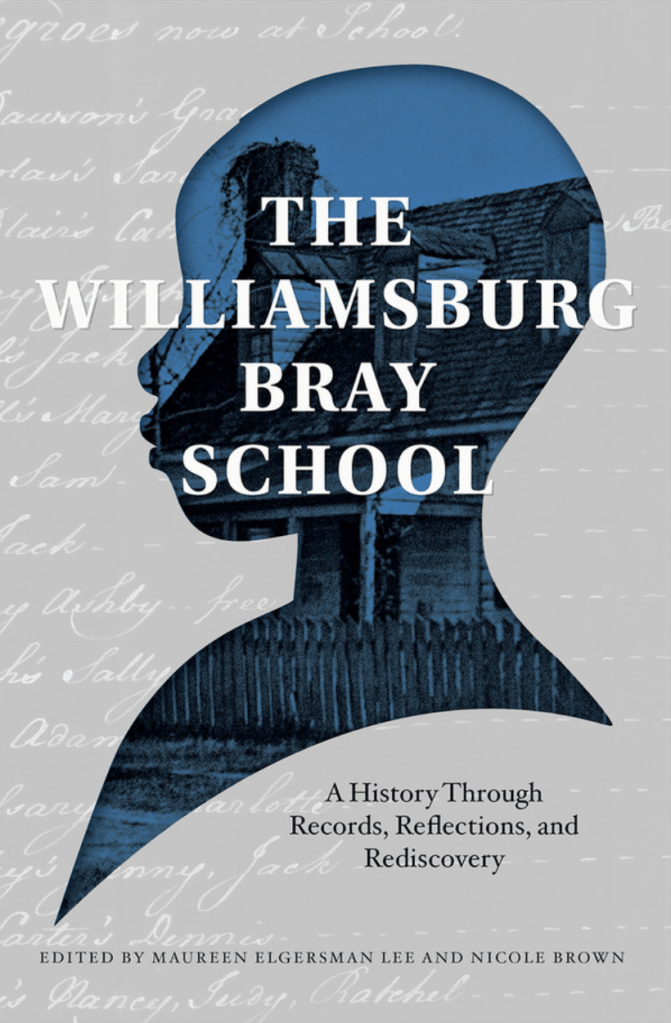 Seven letters tracing the arc of the Williamsburg Bray School—from its founding in 1760 to its closing in 1774—provide the foundation for a collection of essays that explore the school’s history and its implications for the enslaved and free Black children who attended. These letters are some of the surviving correspondence between the Williamsburg school’s administrators and the Associates of Dr. Thomas Bray, a London-based Anglican charity whose charge was to minister to what it saw as the spiritual needs of African Americans. The essayists reflect on the evolution of the Williamsburg Bray School, offering a variety of perspectives on the school and the children who attended it. Some pieces reflect years of research and writing on the establishment of the school. Others, including writings from some of the descendants of these students, represent more recent opportunities to reflect on the school and its historical context. In addition to a short history of the school, a map that pinpoints where the children resided in Virginia’s colonial capital, and photographs of the historic letters, the book delves into the 21st-century discovery of the Williamsburg Bray School building, its subsequent move from the William & Mary campus to Colonial Williamsburg’s Historic Area, and the restoration of the structure that can help tell the complicated story of race, religion, and education in Williamsburg and early America. Author Antonio Bly also shares the poignant story of Isaac Bee, a student at the school who broke the bonds of his enslavement to a Williamsburg planter and rose up from slavery to freedom.
Maureen Elgersman Lee, director of the William & Mary Bray School Lab, holds both a master’s degree and a doctorate in African American Studies. She is an award-winning professor and author of numerous books and articles on the history of Blacks in the Americas.
Nicole Brown is Graduate Assistant for the William & Mary Bray School Lab and a PhD Candidate in American Studies at William & Mary; she was previously a Program Design Manager at The Colonial Williamsburg Foundation. As a first-person historical interpreter, Brown portrays a variety of women including Ann Wager, the 18th-century white teacher at the Williamsburg Bray School, and Monticello’s Martha Wayles Skelton Jefferson. Brown’s ongoing academic research centers Black literacy in the Atlantic World via interdisciplinary and descendant-engaged scholarship.
Exhibition | Silver from Modest to Majestic

Daniel Garnier, Silver Chandelier, made in London, 1691–97, silver and iron (Colonial Williamsburg Foundation, Museum Purchase, 1938-42). Fashioned for King William III of England sometime between 1691 and 1697, this chandelier hung at St. James’s Palace in London. It is believed to have been sold for its silver value by King George III when it was seen as outdated. After remaining in private hands for more than a century, it was auctioned in 1924 to William Randolph Hearst, the prominent American newspaperman. Colonial Williamsburg acquired the chandelier shortly before WWII.
◊ ◊ ◊ ◊ ◊
From the press release (3 April 2025) for the exhibition:
Silver from Modest to Majestic
DeWitt Wallace Decorative Arts Museum, Colonial Williamsburg, 24 May 2025 — 24 May 2028
Work is currently underway at the Art Museums of Colonial Williamsburg on a new exhibition featuring more than 120 objects from the museum’s extensive collection of 17th- to 19th-century silver. Silver from Modest to Majestic will be on view in the museum’s newly relocated Mary Jewett Gaiser Silver Gallery, on the main floor of the museum until 24 May 2028.
The exhibition’s scope is wide-ranging, from a 49-lb chandelier made for a monarch to a simple spoon made by a Williamsburg silversmith, all displayed in brilliantly lit cases against dark blue backgrounds. While silver has long been associated with wealth and aristocracy, the items featured in this exhibition were crafted for use in nearly every setting imaginable ranging from churches, classrooms, and kitchens to businesses, battlefields, and bedrooms. One thing that every piece on display has in common is a powerful story. Some are objects of great beauty created with the highest level of skill, while others have lengthy pedigrees. Knowing who made a piece and who used it lets Colonial Williamsburg curators pinpoint that object in a time and a place, and then bring it forward through history, allowing it to tell its tale.
“Collecting objects where we know the ‘who, when, and where’ of their manufacture, plus their provenance, allows us to exhibit silver items which transcend the differences between artistic, historical, and functional,” said Erik Goldstein, Colonial Williamsburg’s senior curator of mechanical arts, metals and numismatics. “These particular objects are the pinnacle of early silver, no matter how humble they may be.”
This new exhibition replaces the museum’s previous silver exhibition, Silver from Mine to Masterpiece, which was on view from 2015 to 2023. While the former exhibition had a larger percentage of British silver, nearly half of the objects on display in the new exhibition are examples of early American-made silver, many of which were created for everyday use by ordinary people. Early colonists originally relied on imported British silver wares, but over time, the innovation, skill, and entrepreneurship of those early American tradespeople resulted in the establishment of a robust and exciting cohort of American silversmiths producing items that were touched by everyone from elite to enslaved individuals.
“Our collection of British silver is justly famous, but our decision to build a collection of American silver terrifically advances the museums’ goal of telling the varied stories of so many different craftspeople and consumers, each of whom influenced the tastes and styles of colonial America,” said Grahame Long, executive director of collections and deputy chief curator.

Punch Ladle, possibly made in Williamsburg, ca.1740–70, silver and wood (Colonial Williamsburg Foundation, Gift of A. Jefferson Lewis III in memory of Elizabeth Neville Miller and Margaret Prentis Miller Conner, 2023-101; photo by Jason Copes). This worn and lovingly preserved ladle, believed to have been made locally, descended in the Prentis family of Williamsburg.
◊ ◊ ◊ ◊ ◊
Visitors to Colonial Williamsburg will experience firsthand how the pieces featured in Silver from Modest to Majestic connect to the lives of Williamsburg’s 18th-century residents. One item in the exhibition—a silver punch ladle, owned by the Prentis family of Williamsburg and passed down in the family for 250 years—served as the model for a reproduction punch ladle created by Williamsburg’s silversmiths that visitors will find in the corner cupboard at the Williamsburg Bray School after it opens to the public in June 2025. Archaeological records show that Ann Wager, headmistress of the Williamsburg Bray School, had punch wares.
“Having the Prentis family’s original ladle gave us a wonderful opportunity to reproduce a piece that we know was used by an 18th-century Williamsburg family and put it in the context of the Bray School where it helps to tell that story,” said Goldstein.
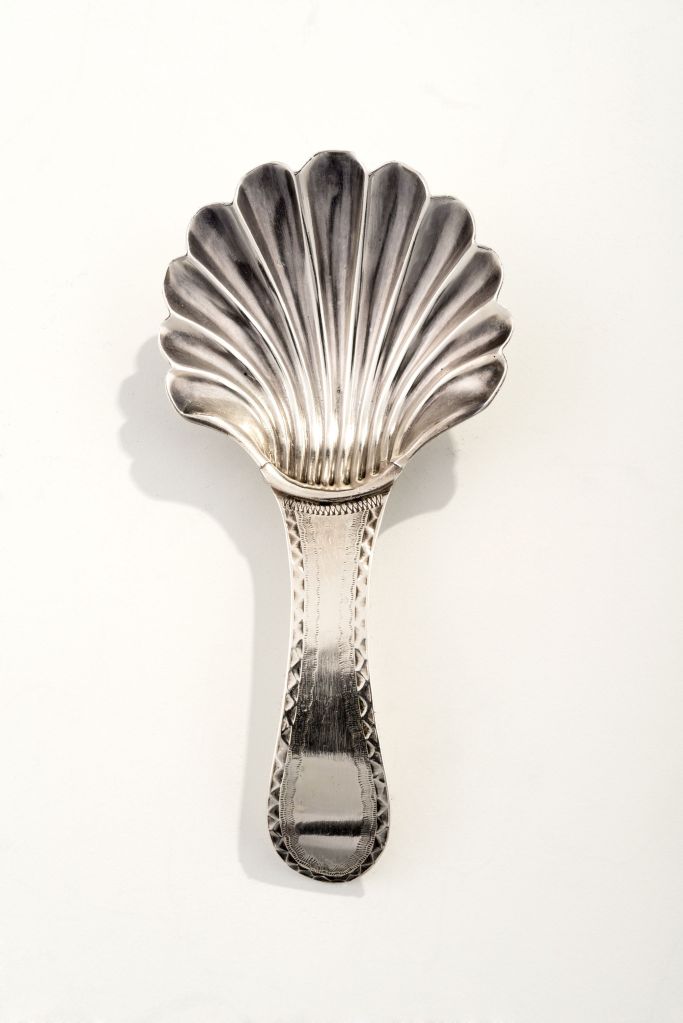
Caddy Spoon, marked by Hester Bateman (1708–1794), London, 1789–90, silver (Colonial Williamsburg Foundation, Gift of Mr. E. Palmer Taylor, 1998-92; photo by Jason Copes). Many now-anonymous British women worked in the silversmithing trade, producing small items like buttons or finishing and polishing larger wares. Standing out is Hester Bateman, who ran a thriving silversmith business after the death of her husband. She specialized in affordable items aimed at the rising middle class. When Bateman retired in 1790, the business was carried on by her sons and one of her daughters-in-law.
Other recently acquired highlights of the silver exhibition include the earliest-known Virginia-made horse racing trophy awarded to a horse named Madison in 1810; an Indian Peace medal struck by the U.S Mint during Thomas Jefferson’s presidency as a diplomatic gift for a Native American chief; and a church communion cup made in Massachusetts around 1670, the earliest piece of American silver in the Foundation’s collection. These pieces will join some of the extraordinary older items from the collection including a cache of British silver made between 1765 and 1771, which was discovered in 1961 in a field near Suffolk, Virginia. While the origins of the buried treasure, and the reason that no one ever returned to retrieve it, remain unknown to this day, this collection is a reminder of the high monetary—and not just aesthetic―value of silver in early America.
The objects on display in Silver from Modest to Majestic represent the work of a few dozen known silversmiths including Paul Revere (1735–1818), a hero of the American Revolution who learned the trade of silversmithing from his father; Myer Myers (1723–1795), the son of a Jewish refugee who became known as the leading silversmith of New York; and Hester Bateman (1708–1794), a female silversmith in London who ran a thriving business after the death of her husband, specializing in affordable items aimed at the rising middle class. Many items in the exhibition are unmarked, made by unknown makers including enslaved silversmiths. Even the items that are credited to known makers could have been made by smiths employed, apprenticed, or enslaved to the master of the shop. To learn exactly how the items in Silver from Modest to Majestic were created, visitors to the Art Museums of Colonial Williamsburg can visit the Silversmith shop in Colonial Williamsburg’s Historic Area where artisan historians preserve the trade by practicing it as their 18th-century counterparts would have.
This exhibition is generously funded by The Mary Jewett Gaiser Silver Study Gallery Endowment. Admission to the Art Museums of Colonial Williamsburg is free.
The Decorative Arts Trust Launches Collecting250
From the press release:
Collecting250
The Decorative Arts Trust
New Online Resource Commemorates the Semiquincentennial through 250 Objects from across America.
The Decorative Arts Trust is pleased to share Collecting250.org, an interactive online resource that celebrates the importance of objects in narrating the history and evolution of the United States and the communities contained within. To commemorate America’s 250th, the United States Semiquincentennial, the Trust asked museums and historical societies to submit images and information about objects in their collections that tell powerful stories about national, state, or local identity. Collecting250 showcases 250 objects from over 140 institutions, and the release is timed in conjunction with the commencement of festivities honoring the 250th anniversary of the American Revolution’s first salvos in Massachusetts in 1775.
“We sought objects that are attached to a specific place, time, and people,” shares Trust Executive Director Matthew A. Thurlow. “Our aim was to present 250 objects from public collections across the country, thereby drawing attention to the broad swath of institutions that steward decorative arts of historical significance. This project aligns beautifully with the Trust’s mission to promote and foster an interest in decorative arts and material culture through our role as a community foundation elevating curatorial efforts to steward and study objects.”
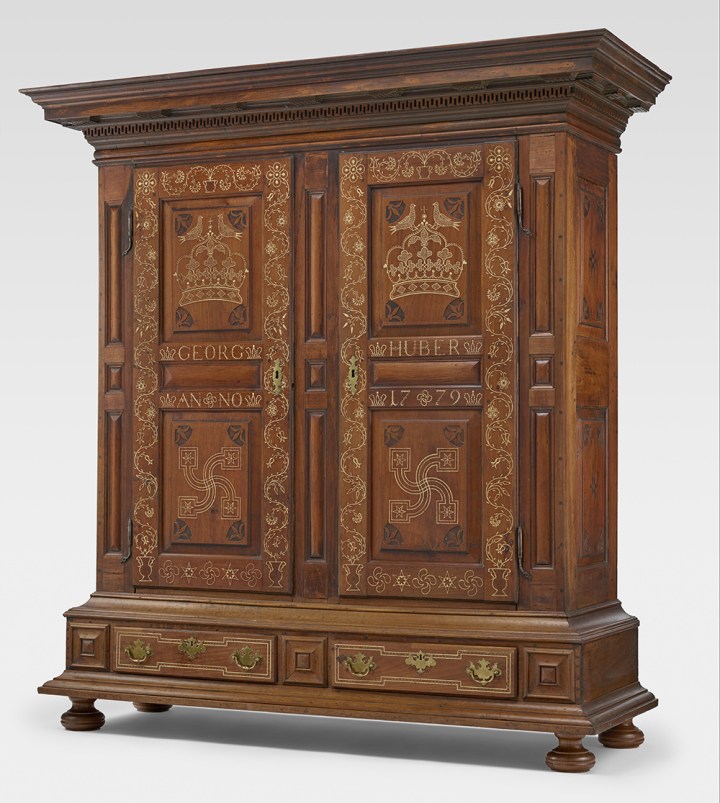
Kleiderschrank (Clothes Press), 1779, Lancaster County, Pennsylvania; walnut, yellow pine, oak, sulfur, iron; 6 feet 10 inches × 6 feet 6 inches × 27 inches (Philadelphia Museum of Art, 1957-30-1).
All 50 states and the District of Columbia are represented, and each record contains an image, tombstone information, and a description of the object’s importance. The ability to search for entries based on location, category, and keyword provides the chance to make exciting and enlightening discoveries in unexpected places. The Trust developed connections with museums and historical societies beyond our traditional network, allowing them to highlight extraordinary artistic achievements in the west, including a mid-19th-century bed covering (New Mexico History Museum) featuring churro wool yarn and colcha embroidery introduced by early Spanish settlers.
There is an interplay between objects that are isolated from one another by time, location, maker, and function. For example, two disparate entries associated with the care and storage of textiles: a humble, late-19th-century pressing iron (Illinois State Museum) that Mississippian Bettye Kelly brought to Joliet, IL, in the 1960s; and a stunning sulfur-inlaid kleiderschrank (Philadelphia Museum of Art) made in Manheim, Pennsylvania, in 1779 for Georg Huber. The former speaks to the Great Migration of African Americans northward in the 20th century; the latter to the Germanic communities that were thriving on the eastern seaboard during the American Revolution.
The tradition of basket weaving has been practiced and perfected by various cultures over the past 10,000 years. Two entries separated by a century and the entire continent of North America illustrate the cultural convergences and impulses behind the production of basketry. In 1905, Aleksandra Kudrin Reinken, the daughter of a Unangax̂ (Aleut) mother and Russian father used her community’s traditional weaving techniques to create a basket (Hood Museum of Art) for a tourist clientele that incorporates ornamentation from prints, magazines, and perhaps even a Whitman’s Chocolate Sampler box. In 2007, Mary Jackson, an internationally recognized master of sweetgrass basketry, completed Never Again (Gibbes Museum of Art), inspired by the traditional Gullah rice fanner baskets that she learned to create from her mother and grandmother and that were once made and used on Lowcountry plantations.
Collecting250 is free and open to the public. Visit Collecting250.org to start exploring. The Decorative Arts Trust, founded in 1977, is a nonprofit organization that promotes and fosters the appreciation and study of the decorative arts through programs, partnerships, and grants. Learn more at decorativeartstrust.org.
Four Educator Guides, designed specifically for the Collecting250 project, are also available.
◊ ◊ ◊ ◊ ◊
Note (added 20 December 2025) — The post was updated to include the link for the educator guides.
Call for Applications | Associate Editor, J. of the History of Collections
From Oxford UP:
Journal of the History of Collections
Associate Editor applications invited
Applications due by 19 May 2025
Oxford University Press (OUP) invites applications for the position of Associate Editor for the Journal of the History of Collections. We are particularly seeking candidates with expertise in Eastern European, Asian, 18th–21st-century Western art histories, and Classical art more broadly. We are not looking to expand our expertise in early modern or Renaissance art at this time. Ideally, the candidate will take up the position in mid-2025.
The journal is dedicated to the investigation and exploration of all aspects of collecting activity, with no limits on time period or subject matter. From its inception in 1989, the journal has sought to provide a platform from which researchers can speak to each other across disciplinary boundaries. The journal appeals to those with an interest in ethnography, natural sciences, archaeology, the history of medicine, decorative arts, the social history of museums and galleries, the collecting and display of painting and sculpture, and related fields.
Candidates should have a broad base of knowledge in the field of the journal; considerable experience in peer-reviewing; a strong record of recognised scholarship; time to devote to the journal; a strong grasp of the English language (particularly in written form); an interest in reading and publishing in the field of the history of collecting; the ability to undertake critical review of manuscripts; good communication skills; an appreciation of publication ethics; and good networks in the field. Previous journal editor experience is beneficial but not required.
Applicants can be based in any country. We particularly welcome applications from groups traditionally under-represented in academic publishing, including but not limited to women, Black and minority ethnic candidates, and those with disabilities. If you are interested in the role but unsure whether it is appropriate for you, please don’t hesitate to reach out to the Publisher for the Journal of the History of Collections at Oxford University Press, Sharmin Islam: sharmin.islam@oup.com.
Call for Papers | Legacies: Why Museum Histories Matter
From ArtHist.net:
Legacies: Why Museum Histories Matter
Leiden, 13–15 January 2026
Organized by Laurie Kalb Cosmo, Marika Keblusek, and Susanne Boersma
Proposals due by 1 June 2025
The 21st century is a particularly engaging moment to study the history of museums. Due to pressing concerns about new ways to make old art accessible, global art, decolonization, and the social, ecological, and political responsibilities of culture, museums are sustaining great periods of self-reflection and debate. One could argue that museums are renewing their 18th-century Enlightenment origins as institutions of civility and hope, although these values are also undergoing reevaluation and change, in a global world.
Amidst such profound and urgent topics, what about the ideas of museums themselves? How do their storied origins—as private palace collections and Wunderkammern, houses of worship, monuments to the nation, sites of commemoration, or new archistar containers for art—relate to their significance in contemporary life? How do their physical structures, be it cabinets, palaces, white cubes, temples, churches or mausolea, and their collections reflect the museums’ histories, wherever they may be in the contemporary world? How do we navigate the idea of the museum as an inherited construct, within the context of its many debates? What is it about a museum’s past that keeps us curious, and how does it inform what it does in the present?
This international conference invites papers that focus on museums with significant founding histories—broadly defined by their buildings, collections, commemorative functions, collectors, or founders—that are currently engaged in some manner of institutional introspection, by way of exhibitions, acquisitions, restitutions, or renovations. We invite papers that address, but are not limited to, the following questions:
Museums and Buildings
How does architecture shape a museum’s legacy and/or how does legacy shape a museum’s architecture?
Museums and Geopolitics
How do museums respond to war, vis-à-vis their collections, provenance, and national identities of the artists, whose work they exhibit or collect?
Museums and Social Responsibility
As museums take on ownership of their pasts, what do they owe the visiting public, and what do visitors owe them?
Museums and Their Pasts
How can a museum’s history be reconstructed through its collections, exhibitions and building?
Museum Founders and Their Legacies
How do founders’ stipulations inform contemporary museum practices?
Museums in the World
How are the legacies of Western museums realized and/or revised across the globe?
Please submit your abstract (200 words) and author biography (100 words) to Dr. Susanne Boersma via s.w.boersma@hum.leidenuniv.nl by Sunday, 1 June 2025. We welcome applications from the broadest range of researchers, scholars, and museum professionals. You will be notified about the acceptance of your proposal by 1 July 2025.
This in-person conference is organized by Dr. Laurie Kalb Cosmo, Dr. Marika Keblusek and Dr. Susanne Boersma, Leiden University Centre for the Arts in Society.
Call for Papers | Exhibition Catalogues beyond the Visual Arts
From ArtHist.net:
Autres objets, autres enjeux ?
Les catalogues d’exposition hors du champ des arts visuels
Université Grenoble Alpes and Musée dauphinois, 6–7 November 2025
Proposals due by 2 June 2025
Après plusieurs journées d’études appréhendant le catalogue d’exposition d’arts visuels comme un objet d’étude en soi (Paris 2023 et 2024, Bordeaux 2025), ce titre sous forme de question est volontairement provocateur. Il reprend en effet, pour évidemment le questionner, un partage entre musées des Beaux-arts et musées autres qui a structuré la vision des musées du point de vue de l’action publique, et qui a renvoyé dans une catégorie définie par défaut des musées extrêmement divers et hétérogènes. Il s’agit ici d’interroger les formes, les pratiques et les enjeux liés aux catalogues d’expositions et aux publications liées à celles-ci, dans les musées de société, les écomusées ou les musées de science, mais aussi les catalogues dédiés à des œuvres d’art de nature essentiellement allographique, c’est-à-dire qui ne se matérialisent pas dans un objet unique ou en un nombre limité d’exemplaires, mais qui s’incarnent sur le temps long dans des objets dont la diversité ne modifie pas l’œuvre idéale, comme le livre, la partition, et/ou qui s’interprètent sous des formes immatérielles, comme le concert, le spectacle de danse, la représentation théâtrale, etc.
Alors que la mise en exposition de tels artefacts a elle-même déjà fait l’objet de plusieurs travaux dans chacun de ces domaines, le catalogue qui l’accompagne n’a pas encore été vraiment interrogé, pas plus que ces différents domaines n’ont été traités ensemble. La réunion de ces différents domaines, très hétérogènes, doit d’ailleurs être immédiatement interrogée : y a-t-il réellement des différences essentielles entre le catalogue d’une exposition réunissant des œuvres autographiques (peinture, sculpture, etc.) et celui d’une exposition d’œuvres allographiques (littérature, musique, danse, etc.) ? Peut-on considérer les ouvrages édités à l’occasion d’expositions reliées à des problématiques en sciences humaines et sociales, comme des « catalogues », définis plutôt dans ce cas à partir d’un usage lié à la visite d’exposition ?
Existe-t-il vraiment des catalogues « autres », comme on a voulu désigner des musées « autres », ceux qui n’étaient pas des beaux-arts ? Y aurait-il d’un côté les catalogues d’exposition réunissant des artefacts d’abord considérés comme des œuvres d’art, de l’autre des catalogues réunissant des artefacts d’abord compris comme documents ? En retour, dans quelle mesure le choix même de la forme catalogue d’exposition témoigne-t-il du statut que l’on souhaite donner aux artefacts exposés ?
Cette journée d’étude propose de réfléchir à la fois aux similitudes et aux différences, aux enjeux communs et aux spécificités de chaque forme éditoriale, aux passages comme aux rejets, avec l’idée que cette réflexion peut permettre en retour d’éclairer le rôle des différents lieux d’exposition et d’interroger le statut des artefacts comme l’articulation entre le document et l’œuvre d’art. L’appel est donc ouvert aussi bien aux chercheur·euses qu’aux professionnel·les des musées, de l’exposition, de l’édition et de la médiation.
Les propositions pourront s’inscrire dans différents axes, qui ne sont néanmoins en rien exclusifs :
La diversité des formes, des auteur·trices et des échelles
Travailler sur les catalogues d’exposition hors du champ des arts visuels suppose de prendre en compte leur hétérogénéité, en ne se contentant pas d’une définition en creux. Une diversité thématique, d’abord, qui pose la question de la multiplicité des catalogues : peut-on penser de la même manière un catalogue portant sur la littérature ou sur les sciences, sur l’ethnologie ou sur la musique ? Une diversité d’auteur·trices, ensuite. Qui écrit dans des catalogues si divers ? S’agit-il de spécialistes de chacune de ces questions, de professionnel·les des musées ou de la médiation ? Une place peut-elle être faite aux historien·nes de l’art et des images ? Une diversité d’échelles, enfin : si certaines expositions thématiques sont de très grandes manifestations à la fréquentation exceptionnelle, nombre de musées de société sont au contraire de très petites structures. Cela pose donc la question de la possibilité même d’accompagner l’exposition d’un catalogue, et des formes d’édition choisies ou imposées, y compris par le recours à l’auto-édition.
La forme du catalogue
Le catalogue d’exposition artistique a longtemps été défini d’une part par les listes d’œuvres, d’autre part par la présence de notices pour chacune de ces œuvres, enfin par les reproductions. Dans le cadre d’expositions où les objets sont présentés plutôt pour leur valeur d’usage que pour leur valeur esthétique—ou pour leur intérêt tout à la fois documentaire et artistique—comment la forme catalogue d’exposition est-elle investie ? La question de la place des images, et de l’articulation entre texte et image paraît particulièrement pertinente, et participe du statut accordé à chacun des artefacts exposés. Par ailleurs, comment, par le catalogue, rendre compte de mises en exposition spécifiques ? Là où les musées de science misent souvent sur l’interactivité, où les musées de société ont une attention particulière à la participation des publics, l’objet catalogue ne pourrait-il pas sembler dépassé ou désuet ? Le catalogue d’exposition serait-il devenu dans ce cas un livre d’histoire ou un ouvrage accompagnant le thème de l’exposition mais sans faire catalogue ? Enfin, quand la distinction entre beau livre ou monographie d’art et catalogue d’exposition repose souvent sur l’apport heuristique du rapprochement physique des œuvres d’art en un lieu, quelle est la place de catalogues d’exposition de musées de science ou de société par rapport à des ouvrages thématiques sur les mêmes questions ?
Enjeux de médiation
L’un des enjeux principaux des catalogues d’exposition est celle de la médiation auprès des publics, lecteur·rices et spectateur·rices. Quels sont les points communs et les différences avec les catalogues d’expositions artistiques ? Dans quelle mesure les enjeux d’articulation entre science et société sont-ils portés par les catalogues d’exposition et quel public/lectorat est ici visé ? Comment s’emparer de ces enjeux dans un format historiquement et socialement situé ? Alors même que les musées de société mettent l’accent sur un activisme muséal et l’ancrage culturel dans la cité, donnant la parole aux publics, la question est ici double : les catalogues d’exposition peuvent-ils être le support de mémoires et d’histoires jusque-là non racontées, au même titre que les expositions elles-mêmes, et peuvent-ils s’adresser à des publics divers ? Dans quelle mesure ces catalogues peuvent-ils s’appuyer sur une co-construction avec les publics et sur une narration participative ? Enfin, alors même que le catalogue centré sur les arts visuels participe de la construction de la valeur des œuvres d’art, et a donc aussi une fonction économique, quelles fonctions remplissent d’autres formes de catalogues ?
Les propositions de communication (5 000 signes maximum), rédigées en français ou en anglais, seront accompagnées d’une courte bibliographie et de quelques lignes de présentation bio-bibliographique de l’auteur·ice. Elles sont à envoyer par mail jusqu’au 2 juin 2025 aux membres du comité d’organisation :
• Marie Gispert, professeure d’histoire de l’art contemporain, Université Grenoble Alpes, LARHRA : marie.gispert@univ-grenoble-alpes.fr
• Hélène Trespeuch, professeure d’histoire de l’art contemporain, Université Bordeaux Montaigne, CRHA – F.-G. Pariset : helene.trespeuch@u-bordeaux-montaigne.fr
Comité scientifique
Marie-Christine Bordeaux (Université Grenoble Alpes), Alice Buffet (Musée de la Résistance et de la Déportation de l’Isère), Marie-Charlotte Calafat (MUCEM), Olivier Cogne (Musée dauphinois), Marie Gispert (Université Grenoble Alpes), Aziza Gril-Mariotte (Musée des Tissus et des Arts Décoratifs de Lyon / Aix Marseille Université), Joëlle Le Marec (Museum National d’Histoire naturelle), Federica Tamarozzi (MEG, Genève), Hélène Trespeuch (Université Bordeaux Montaigne), Erika Wicky (Université Grenoble Alpes)










 Enfilade
leave a comment