Journée d’études | L’architecture et l’urbanisme des ingénieurs
From the conference programme:
L’architecture et l’urbanisme des ingénieurs, 1650–1850: Paris, province et capitales européennes
Versailles, Bibliothèque municipale Galerie des Affaires étrangères, 10 October 2015

Louis-Nicolas Van Blarenberghe, Vue de l’accident survenu en 1759 sur le chantier de l’Hôtel des Affaires étrangères et de la Marine à Versailles, 1759, BMV, ©Pierrick Daul
Les années 1980 furent propices à l’étude du travail des ingénieurs : en 1981, Anne Blanchard publiait un Dictionnaire des ingénieurs militaires actifs en France entre 1691 et 1791, témoignant par son volume de l’importance de leur activité, tandis qu’en 1988, Antoine Picon, dans son ouvrage Architectes et ingénieurs au siècle des Lumières, accordait enfin aux ingénieurs des Ponts l’attention qu’ils méritaient et examinait leur formation et leurs méthodes de travail au regard de celles des architectes de l’Académie royale d’architecture.
Au-delà des programmes attendus, fortifications, ouvrages hydrauliques, ponts et routes, les ingénieurs, militaires et des Ponts et Chaussées, honorèrent des commandes dans le domaine de l’architecture publique monumentale, de l’architecture religieuse et hospitalière, mais aussi dans celui de l’architecture domestique et de l’art des jardins.
L’historiographie fait la part belle aux architectes dans les embellissements de la capitale, mais l’action des ingénieurs en matière d’architecture et d’urbanisme reste à évaluer. Cette seconde journée sera l’occasion de présenter les limites de cette opposition architecte/ingénieur et d’initier un travail systématique sur l’activité de ces derniers du règne de Louis XIV à l’aube du Second Empire.
Après une première rencontre dédiée à l’habitat (8 novembre 2014), la seconde journée sera consacrée plus particulièrement au projet urbain et à l’architecture publique monumentale, à Paris, en province et dans les capitales européennes. Une troisième rencontre se déroulera au printemps 2016.
Journée d’études organisée par Basile Baudez, Alexia Lebeurre et Dominique Massounie avec le concours des Universités Bordeaux-Montaigne, Paris-Ouest-Nanterre, Paris-Sorbonne, de la Ville de Versailles et du GHAMU.
◊ ◊ ◊ ◊ ◊
P R O G R A M M E
9.30 Accueil café
10.00 Dominique Massounie (Université Paris-Ouest-Nanterre), Pour un inventaire de l’architecture des ingénieurs des Ponts et Chaussées au XVIIIe siècle
10.45 Béatrice Gaillard (LéaV-ENSAV), Le traité de l’ingénieur Antoine d’Alleman à la lumière de sa pratique architecturale
11.15 Robert Carvais (CNRS-CTAD) et Philippe Bernardi (CNRS- Lamop), Un ingénieur au pays de l’architecture. Antoine D’Alleman (1679–1760) et son traité inachevé
12.30 Pause déjeuner
14.00 Aline Lemonnier (GHAMU), Les phares normands de l’ingénieur Duchesne sous Louis XVI
14.30 Théodore Guuinic (Université Paris-Diderot), L’ingénieur Charles-Etienne Durand (1762–1840) : théorie et pratique de l’architecture pratique selon les principes antiques
15.00 Adrián Almoguera (Université Paris-Sorbonne), Ut urbis hortis: que la ville soit à l’image d’un jardin. Les ingénieurs et la transformation urbaine de Madrid au Siècle des Lumières
16.00 Basile Baudez (Université Paris-Sorbonne), Jean-Baptiste Berthier, ingénieur et architecte de l’administration
Visite de la Bibliothèque municipale de Versailles, ancien ministère des Affaires étrangères et de la Marine
Conclusion: Alexia Lebeurre (Université Bordeaux-Montaigne)
Symposium | Material World
This Saturday at Harvard Art Museums:
Material World
Harvard Art Museums, Cambridge MA, 26 September 2015
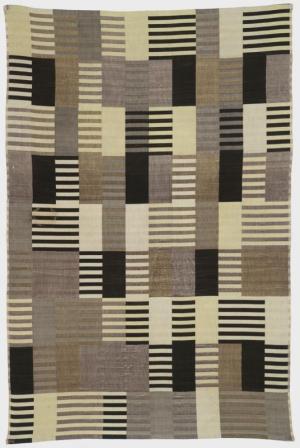 This one-day symposium considers the historical importance, artistry, and evolution of textiles, within the context of a world where traditional notions of textiles are constantly changing. The event is organized as part of the Andrew W. Mellon Postdoctoral Fellowship in Conservation Science.
S C H E D U L E
10:30 Welcome and introductory remarks by Georgina Rayner, Andrew W. Mellon Postdoctoral Fellow in Conservation Science, Harvard Art Museums
10:45 “Mentored by Textiles,” Mary Schoeser, Honorary President, The Textile Society, United Kingdom
11:35 “Textiles Matter: Theory through Practice,” Dinah Eastop, Honorary Senior Lecturer, Institute of Archaeology, University College London
12:25 Lunch break
1:50 “My Materials: Clothing, Fabric and Belonging,” Shinique Smith, Contemporary Artist
2:40 “Fashion in the Museum,” Valerie Steele, Director and Chief Curator, The Museum at FIT (Fashion Institute of Technology)
3:30 Break
4:00 “Textile Future: What Is a Textile?,” Matilda McQuaid, Deputy Director of Curatorial and Head of Textiles, Cooper Hewitt, Smithsonian Design Museum
4:50 Closing Remarks by Narayan Khandekar, Director of the Straus Center for Conservation and Technical Studies and Senior Conservation Scientist, Harvard Art Museums
The event will be held in Menschel Hall, Lower Level.
New Appointments Announced at the Harvard Art Museums
Press release (via Art Daily, 20 September 2015). . .
The Harvard Art Museums has announced the appointment of two new curators to the Division of European and American Art and the Division of Asian and Mediterranean Art, as well as the internal promotion of two curators in the Division of European and American Art.
Ethan Lasser has been named Head of the Division of European and American Art and was promoted to Theodore E. Stebbins, Jr., Curator of American Art—the first person to hold this endowed position at the museums. Lasser had served as acting head of the division since December 2014.
A. Cassandra Albinson has been appointed the new Margaret S. Winthrop Curator of European Art, and Elizabeth M. Rudy, who has been at the museums since 2011, was named the new Carl A. Weyerhaeuser Associate Curator of Prints.
In the Division of Asian and Mediterranean Art, Rachel Saunders has been named the Abby Aldrich Rockefeller Associate Curator of Asian Art; she is the first to hold this endowed position at the museums.
Comprised of the Fogg Museum, the Busch-Reisinger Museum, and the Arthur M. Sackler Museum, the Harvard Art Museums reopened to the public last November after a six-year renovation and expansion project. These curatorial appointments, with deep expertise in key areas of the museums’ world-class collections, will help fulfill the promise of the new facility.
“Last year, we unveiled a new model for a 21st-century university art museum—one that broke down barriers between traditional curatorial areas of expertise to create new opportunities for research, teaching and learning with the collections,” said Deborah Martin Kao, the Landon and Lavinia Clay Chief Curator and Interim Co-Director of the Harvard Art Museums. “These new curatorial appointments go to four extraordinary scholars who share our belief in the intrinsic power of original works of art, and who are committed to unlocking the full potential of Harvard’s great collections for all audiences. As representatives of a new generation of curators, they will bring energy, fresh ideas, and an intellectual dynamism that will help us grow into our future.”
The appointments, which begin this fall, were initiated and completed before Thomas W. Lentz, the former Elizabeth and John Moors Cabot Director of the Harvard Art Museums, stepped down in July.
 Lasser joined the Harvard Art Museums in 2012 as the Margaret S. Winthrop Associate Curator of American Art and played a key role in the Division of European and American Art as the museums prepared for reopening. Lasser developed a compelling cross-media and transnational approach to the European and American galleries, posing exciting and imaginative new questions that have propelled the field forward and contributed to the further refinement of the broader Collection Galleries program for European and American art. He also led the development of the Silver Cabinet and the galleries devoted to the Atlantic World and the interplay between painting and photography in the 19th century.
In 2017, the museums will open Lasser’s special exhibition, From the Philosophy Chamber: Harvard’s Lost Collection, 1766–1831, developed in collaboration with Harvard faculty partner Jennifer Roberts. For the first time since the early 19th century, an astounding collection of portraits, prints, scientific instruments, and various ‘curios’ obtained abroad by Harvard graduates will be reunited for display and study. The reassembled Philosophy Chamber will examine the role that images and objects can play in building, organizing, and transmitting new knowledge.
 Albinson brings more than a decade of curatorial experience and a commitment to teaching with original works of art. She comes from the Yale Center for British Art, where she was curator of paintings and sculpture and acting head of the department. Albinson also served as a lecturer at Yale, teaching courses on portraiture and on British and French art from the Rococo period through 1850. She has curated multiple exhibitions including The Critique of Reason: Romantic Art, 1760–1860 and Thomas Lawrence: Regency Power and Brilliance. The catalogue for the latter was awarded the Historians of British Art Book Prize for a multi-authored volume in 2011. Albinson was drawn to the Harvard Art Museums’ rich collections—notably, portraiture, works by Géricault, and Pre-Raphaelite art—and the museums’ new collaborative curatorial model, with experts across specializations working together to advance teaching, learning, and research. She is currently working on a project on the importance of the color pink in the 18th century in Britain and France, and is writing a book on portraits of aristocratic women in Victorian Britain.
As the former Cunningham Assistant Curator of European Art at the Harvard Art Museums, Rudy has in-depth knowledge of both Harvard and the Harvard Art Museums. She received her Ph.D. in art history at Harvard, with a dissertation titled “Pierre-Paul Prud’hon and the Problem of Allegory.” Rudy played a vital role in the reinstallation of the European and American galleries, and served as lead curator for the romanticism, impressionist, and Wertheim Collection galleries. She is currently working with Professor Ewa Lajer-Burcharth on a forthcoming show of French drawings, which involves multiple graduate and undergraduate collaborators. In addition to her experience at Harvard, Rudy also served as a curatorial fellow in the Department of Drawings and Prints at the Metropolitan Museum of Art in New York, and has maintained an impressive record of lectures and publications.
Saunders has just completed her Harvard dissertation on a fourteenth-century Japanese handscroll illustrating the journey to India of the Chinese monk Xuanzang. She joins the Harvard Art Museums from the Center for Advanced Study in the Visual Arts at the National Gallery of Art in Washington, D.C., where she was the Ittleson Fellow. From 2004 to 2011, Saunders was a research associate in Japanese art at the Museum of Fine Arts, Boston. There, she curated the exhibition Pursuits of Power: Falconry and the Samurai and led efforts to catalogue numerous rare, woodblock-printed books. Saunders specializes in Japanese art and maintains great interest in the larger framework of the entire East Asian cultural region. She will help unlock the museums’ powerful Asian art collections, buttressed by the extensive promised gift of Japanese works of art from the collection of Robert and Betsy Feinberg, through exhibitions and programs that will benefit Harvard students, faculty, and the wider public.
New Book | Figures Publiques: L’invention de la Célébrité, 1750–1850
From Fayard:
Antoine Lilti, Figures Publiques: L’invention de la Célébrité, 1750–1850 (Paris: Fayard, 2014), 436 pages, ISBN: 978-2213682389, 24€.
 Bien avant le cinéma, la presse à scandale et la télévision, les mécanismes de la célébrité se sont développés dans l’Europe des Lumières, puis épanouis à l’époque romantique sur les deux rives de l’Atlantique. Des écrivains comme Voltaire, des comédiens comme Garrick, des musiciens comme Liszt furent de véritables célébrités, suscitant la curiosité et l’attachement passionné de leurs « fans ». À Paris comme à Londres, puis à Berlin et New York, l’essor de la presse, les nouvelles techniques publicitaires et la commercialisation des loisirs entraînèrent une profonde transformation de la visibilité des personnes célèbres. On pouvait désormais acheter le portrait de chanteurs d’opéra et la biographie de courtisanes, dont les vies privées devenaient un spectacle public. La politique ne resta pas à l’écart de ce bouleversement culturel : Marie-Antoinette comme George Washington ou Napoléon furent les témoins d’un monde politique transformé par les nouvelles exigences de la célébrité. Lorsque le peuple surgit sur la scène révolutionnaire, il ne suffit plus d’être légitime, il importe désormais d’être populaire.
À travers cette histoire de la célébrité, Antoine Lilti retrace les profondes mutations de la société des Lumières et révèle les ambivalences de l’espace public. La trajectoire de Jean-Jacques Rousseau en témoigne de façon exemplaire. Écrivain célèbre et adulé, celui-ci finit pourtant par maudire les effets de sa « funeste célébrité », miné par le sentiment d’être devenu une figure publique que chacun pouvait façonner à sa guise. À la fois désirée et dénoncée, la célébrité apparaît comme la forme moderne du prestige personnel, adaptée aux sociétés démocratiques et médiatiques, comme la gloire était celle des sociétés aristocratiques. C’est pourtant une grandeur toujours contestée, dont l’histoire éclaire les contradictions de notre modernité.
Antoine Lilti est directeur d’études à l’École des hautes études en sciences sociales. Ses travaux portent sur l’histoire sociale et culturelle des Lumières. Il a notamment publié Le Monde des salons. Sociabilité et mondanité à Paris au xviiie siècle (Fayard, 2005).
For a review of the book, see Jessica Goodman, French Studies 69 (2015): 535–36.
Opening in December 2015: V&A’s ‘Europe 1600–1815’ Galleries
From the V&A press release:

Writing cabinet, 1750s, possibly by Michael Kimmel, or Kümmel (1715-1794) a cabinet-maker in Dresden (London: V&A, Purchased by H.M. Government from the estate of the 6th Earl of Rosebery and allocated to the Victoria and Albert Museum, W.63-1977)
The V&A’s Europe 1600–1815 galleries will open to the public in December 2015, following the transformation of seven galleries for the redisplay of the Museum’s unrivalled collection of 17th- and 18th-century European art and design. A major part of the V&A’s ongoing redevelopment programme known as FuturePlan, the £12.5m project will complete the restoration of the entire front wing of the Museum for the display of more than 1,100 objects.
In its prominent position next to the V&A’s grand entrance, Europe 1600–1815 will continue the story of art and design that begins in the award-winning Medieval & Renaissance Galleries (opened 2009). Four large galleries will introduce the story in chronological sequence, alternating with three smaller galleries that focus on specific activities: collecting in the Cabinet, enlightened thought in the Salon and entertainment and glamour in the Masquerade. In addition, three period rooms will invite visitors to imagine life in the personal spaces of the time including a 17th-century French bedroom, Madame de Sérilly’s cabinet and a mirrored room from 18th-century Italy.
The collection comprises some of the most magnificent works held by the V&A, including spectacular examples of textiles and fashion, painting and sculpture, ceramics and glass, furniture and metalwork, prints and books. Many objects were made in Europe by its finest artists and craftsmen for the period’s most discerning leaders of taste such as Louis XIV, Marie Antoinette, Catherine the Great and Napoleon.
Martin Roth, V&A Director, said: “These new galleries are a major development in our ambitious programme to renew the architecture of the V&A for the 21st century and, at the same time, re-examine and re-present our collection for our visitors. At a time when roles and relationships within Europe and the world are under scrutiny, it is interesting to explore the objects, makers and patrons of a period that was so influential upon the habits and lifestyle of Europe today.”
A large, highly ornate Rococo writing cabinet made for Augustus III and acquired in 1977 from the celebrated sale of Mentmore Towers, Buckinghamshire will be exhibited for the first time since its recent conservation. Another newly conserved highlight on display will be a grand 18th-century bed from the Parisian workshop of George Jacob. A supplier to royal courts across Europe, Jacob survived the French Revolution and later made furniture for Napoleon.
The displays will demonstrate how France succeeded Italy as the undisputed leader of fashionable art and design in Europe in the second half of the 17th century. They will also show how—for the first time ever—Europeans systematically explored, exploited and collected resources from Africa, Asia and the Americas.
The collection includes several outstanding bequests, notably from John Jones, a military tailor who left his exceptional collection of French decorative arts to the Museum in 1882 and who is the subject of a special display within the galleries. A number of significant new acquisitions will be exhibited for the first time at the Museum including a 17th- century Venetian table by Lucio de Lucci, acquired after a temporary export ban in 2012. The magnificent oil painting The Château de Juvisy, by Pierre-Denis Martin, a rare, accurate depiction of the architecture and bustling life of an estate near Paris in the 17th century, will be a centrepiece of the gallery exploring the rise of French cultural dominance during the period. The work was secured for the nation in 2014 thanks to a major public appeal and donations from the Friends of the V&A and the Art Fund.
Preparation for the reopening is underway with a full reinterpretation of the collection and important objects undergoing conservation: several large tapestries have been cleaned at De Wit Royal Manufacturers of Tapestries in Mechelen, Belgium, including the Gobelins tapestry after the Poussin painting The infant Moses tramples on Pharoah’s crown manufactured in Paris in the 1680s. Fashion garments, furniture and textiles have been conserved in the V&A’s world- renowned studios and a Meissen table fountain has been meticulously researched and rebuilt for the first time since its acquisition in 1870.
The V&A is working with architectural practice ZMMA on the redesign of the galleries. The project will see the complete removal of the interior cladding added in the 1970s and will reclaim back of house storage space. The combined effect will enlarge the galleries by almost a third to 1,550 square meters. Natural light will be returned to the spaces by uncovering windows previously obscured. Environmental controls will be upgraded to provide sustainable and stable conditions for the collection and new state-of-the-art cases that meet modern environmental and security requirements will be installed.
The Europe 1600-1815 galleries are being made possible thanks to a generous £4.75m lead grant from the Heritage Lottery Fund with further support from many other Trusts, Foundations and individuals.
Lesley Miller is lead curator and Joanna Norman is project curator of Europe 1600–1815. To mark the opening of the new galleries, the V&A will publish The Arts of Living: Europe 1600–1815, edited by Elizabeth Miller and Hilary Young.
Dawn Hoskin provides details (with photos) at the V&A’s Blog»
◊ ◊ ◊ ◊ ◊
From the V&A press release:
The V&A has commissioned the artist collective Los Carpinteros to create a contemporary installation for the Museum’s new Europe 1600–1815 galleries, opening to the public in December 2015. Established in 1992, Los Carpinteros have received international acclaim for their sculptural pieces. The duo work between Madrid and Havana, and this will be their first major project for a London museum.
Charged with devising a large-scale, imaginative and thought-provoking piece that would sit within the gallery examining the Enlightenment, Los Carpinteros proposed The Globe. It is a curved architectural sculpture made from a lattice of engineered beech that will form a ‘room within a room’ at the heart of the new Europe displays. Occupying a pivotal space—both architecturally and in terms of the narrative of the galleries—it will offer visitors an opportunity to pause and reflect, as well as encourage engagement with the complex concept of the Enlightenment. Seating up to 30 people, The Globe will also be used as a space for programmed salons, events and discussions.
The period represented the triumph of intellectual curiosity and enquiry, a culture of increasing literacy and debate, and a desire to acquire and classify knowledge. This is encapsulated in one of the most important publications of the 18th century, Diderot and Alembert’s Encyclopedia (1751–1772). A vast collaborative project involving many of the leading thinkers of the day, it aimed to gather all available knowledge, to examine it critically and rationally, and to bring it to a wide public. Bernard and Picart’s Religious Ceremonies and Customs of All the Peoples of the World (1723–1743) will be on display in the gallery. A number of sculptural busts from the period will be placed in dialogue around The Globe and be visible from inside the installation, recalling the intellectual environment and salon culture, and making connections between past and present.
Lesley Miller, lead curator for Europe 1600–1815, said: “Bringing alive the Enlightenment is a challenge for a curator—how might we represent intellectual thought and debate in a gallery? Los Carpinteros’ work, set among sculpture and books from the period, creates a fundamentally different experience for visitors—inviting them into a contemplative, calm place to reflect and think. The design of The Globe reflects not only the world but also, in its bookshelf, cell-like construction, the organisation of knowledge—central to Enlightenment thought. It also creates space for intellectual debate in a relatively informal setting—the V&A’s own 21st-century take on an 18th-century salon, if you like.”
Los Carpinteros said: “Our commission for the V&A is the culmination of a 20-year fascination with the idea of the ‘panopticon’. First devised in the 18th century by Jeremy Bentham, these structures promoted surveillance and control and were originally intended for prisons. The Globe reinterprets this format as an observation point midway through the Museum’s new galleries. It is a station for rest, contemplation and discussion that will relate closely to the objects that surround it. Our work to date has mainly been with museums and galleries dedicated to contemporary art, so it has been very exciting to work in the context of the V&A’s historical collection of objects, fine art and design; a world with which our practice has many familiarities and connections. Here our work as artists, craftsmen, designers and carpenters has a rare practical utility and function alongside its symbolism—with pleasingly ambiguous results.”
The V&A has an established reputation for working with contemporary artists and designers to respond to the permanent collections. Past collaborations have included site-specific commissions from Elmgreen & Dragset, Cornelia Parker, Edmund De Waal, Felice Varini, rAndom International, and Troika. . . .
Los Carpinteros (The Carpenters) are Marco Antonio Castillo Valdes (b. 1971) and Dagoberto Rodríguez Sanchez (b. 1969). A Havana-based collective, they have created some of the most important work to emerge from Latin America in the past decade. Formed in 1992 (with Alexandre Arrechea until his departure in June 2003), Los Carpinteros took their name in 1994, deciding to renounce the notion of individual authorship and refer back to an older guild tradition of artisans and skilled craftsmen. Merging architecture, design, and sculpture in unexpected and often playful ways, their work negotiates between the functional and the non-functional. Their carefully crafted drawings and installations use wit to set up contradiction between object and function as well as practicality and uselessness. Their work is in the permanent collections of many leading international museums and galleries.
The V&A invited proposals for “the creation of an imaginative, exciting and thought provoking work, or concept, that not only challenges and engages the audience but which also introduces them to a different kind of aesthetic experience”. The commission was conceived as a way of drawing visitors to the space and of encouraging visitors to engage with the challenging ideas of the Enlightenment.
The Globe has been made and installed by Tin Tab, a specialist creative engineering group and producers of highly innovative furniture and staircases. With the V&A and Los Carpinteros, they designed, engineered and manufactured hundreds of components out of Beech Multiply, worked on by hand and machine and completed like a giant 3D puzzle. Tin Tab has been established for over 17 years. Based in Newhaven, East Sussex, Tin Tab’s workshop has a team of 15 expert designers and makers from multi-disciplinary backgrounds.
Call for Panels and Papers | CSECS in Kingston, Ontario, 2016

James Gray, Kingston from Fort Henry, 1828, 29.6 x 54.9 cm (Montréal: McCord Museum, #M19883, via Wikimedia Commons). Fort Frontenac was founded on the site of what became Kingston in 1673. Fort Henry was constructed during the War of 1812.
◊ ◊ ◊ ◊ ◊
Canadian Society for Eighteenth-Century Studies Annual Conference
Kingston, Ontario, 26–30 October 2016
Proposals for panels due by 1 March 2016 / Proposals for papers due by 1 April 2016 [deadlines extended a month from their original dates of February and March]
The annual meeting of the Canadian Society for Eighteenth-Century Studies invites panel and paper submissions for its annual conference, to be held in Kingston, Ontario, 26–30 October 2016. This conference will be co-hosted by colleagues from Queen’s University and the Royal Military College of Canada. The conference theme is Secret/s & Surveillance. Plenary speakers will include Christophe Cave (Université Grenoble-Alpes) and Lisa Freeman (University of Illinois, Chicago).
Proposals for panels and papers might consider the following themes, though this is not an exhaustive list: treason; suspicion; espionage; voyeurism; surveys & surveying; informants & surveillance networks; secret code; private conduct & self-surveillance; anonymity & pseudonymity; ___ & ——s, or ‘types’ of secrecy; costume, disguise & cross dressing; masquerade; secret identity; passing; observation of religion; military intelligence; scandal; secret societies; spectatorship; audience; secret histories; secrets of the natural world; clandestinity & censorship.
Papers in either French or English are welcome. Please send panel proposals by 1 February 2016; paper proposals by 30 March 2016 to email CSECS2016@queensu.ca.
◊ ◊ ◊ ◊ ◊
Appel de communications
À l’occasion de son congrès annuel qui se tiendra à Kingston (Ontario) du 26 au 30 octobre 2016 grâce à la collaboration de collègues de l’Université Queen’s et du Collège militaire royal du Canada, la Société canadienne d’étude du dix-huitième siècle vous invite à proposer une séance ou une communication. Le thème du congrès est « Secret(s) & surveillance ». Les conférences plénières seront prononcées par Christophe Cave (Université Grenoble-Alpes) et Lisa Freeman (University of Illinois, Chicago).
Les propositions de séances et de communications peuvent aborder les thématiques suivantes, sans que cette liste soit exhaustive : trahison; suspicion; espionnage; voyeurisme; enquêtes & sondages; informateurs & réseaux de surveillance; code secret; comportement privé & surveillance de soi; anonymat & pseudonymie; costume, déguisement & travestissement; mascarade; identité secrète; renseignement militaire; scandale; sociétés secrètes; spectacles & spectateurs; mémoires secrets; secrets de la nature; clandestinité & censure.
Qu’elles soient en anglais ou en français, vos propositions de séance doivent parvenir à l’adresse suivante avant le 1er février 2016 et vos propositions de communication, avant le 30 mars 2016 : CSECS2016@queensu.ca.
Journée d’étude | Du ‘portrait du roi’ aux portraits du Regent
As noted at H-ArtHist:
Du ‘portrait du roi’ aux portraits du Régent: Philippe II d’Orléans, entre pouvoir et légitimité
Université Paris I Panthéon-Sorbonne, 23 September 2015
À l’occasion du tricentenaire de l’avènement de la Régence en septembre 2015, cette journée d’étude est consacrée à la figure de Philippe II d’Orléans (1674–1723). Elle interroge l’image du Régent comme objet de tensions entre représentation politique du pouvoir et quête de légitimité dynastique.
La ‘régence absolue’ fait le lien entre le long règne de Louis XIV et celui, encore naissant, de Louis XV. Existe-t-il un portrait politique du Régent qui s’appuie sur l’iconographie du corps sacré du roi, que ce soit celle de son illustre aïeul comme de celle du jeune souverain mineur ? A contrario, quel rôle a pu jouer la question anthropologique dans la représentation de Philippe d’Orléans qui ne détient aucun pouvoir de droit divin ?
Les organisateurs souhaitent s’appuyer sur cette dualité pour développer une réflexion propre à l’histoire de l’art, dans le cadre spécifique de la représentation visuelle. La question des portraits du Régent sera abordée selon l’angle anthropologique, politique, de la diffusion et de la métaphore.
Comité d’organisation
Étienne Jollet (université Paris I Panthéon-Sorbonne)
Valentine Toutain-Quittelier (université de Poitiers)
Contact
Valentine Toutain-Quittelier: valentinetoutain@yahoo.fr
Université Paris I Panthéon-Sorbonne:
Galerie Colbert – Salle Vasari
2 rue Vivienne, 75002 Paris
Métro: Bourse ou Palais-Royal-musée du Louvre
◊ ◊ ◊ ◊ ◊
P R O G R A M M E
9.30 Accueil des participants
9.40 Ouverture de la journée, Étienne Jollet (université Paris I Panthéon-Sorbonne)
9.50 Introduction, Valentine Toutain-Quittelier (université de Poitiers)
10.10 I. TRAITS ET PORTRAITS
Présidence de séance et intervention liminaire: Véronique Meyer (université de Poitiers)
• Christophe Henry (université Paris I Panthéon-Sorbonne), Du duc d’Orléans au Régent
• Françoise Joulie (musée du Louvre), Les allégories du Régent
11.10 Pause
11.20 II. L’EXERCICE DU POUVOIR
Présidence de séance et intervention liminaire: Étienne Jollet (université Paris I Panthéon-Sorbonne)
• Valentine Toutain-Quittelier (université de Poitiers), Le Régent et le Dauphin au plafond de la Banque royale: une dualité impossible?
• Christine Gouzi (université Paris IV Sorbonne), Un portrait littéraire du Régent: Philippe II d’Orléans d’après le Dictionnaire des artistes de l’abbé de Fontenai (1776)”
12.30 Déjeuner
14.30 III. CIRCULATION DES MODELES
Présidence de séance et intervention liminaire: Pascal Bertrand (université Bordeaux III)
• Véronique Meyer (université de Poitiers), Portraits gravés du Régent
• Sébastien Bontemps (université Paris I Panthéon-Sorbonne), Les portraits sculptés du Régent
15.40 Pause
16.00 IV. DECOR ET METAPHORE
Présidence de séance et intervention liminaire: Étienne Jollet (université Paris I Panthéon-Sorbonne)
• Jean-François Bédard (université de Syracuse, USA), Le Palais-Royal, portrait architectural du Régent
• Michaël Decrossas (INHA), À la gloire du Régent. Projet de décor allégorique pour le château de Saint-Cloud
17.10 Conclusion de la journée, Valentine Toutain-Quittelier (université de Poitiers)
Acquisitions | Set of Five Ivories by Le Marchand Bought for Scotland
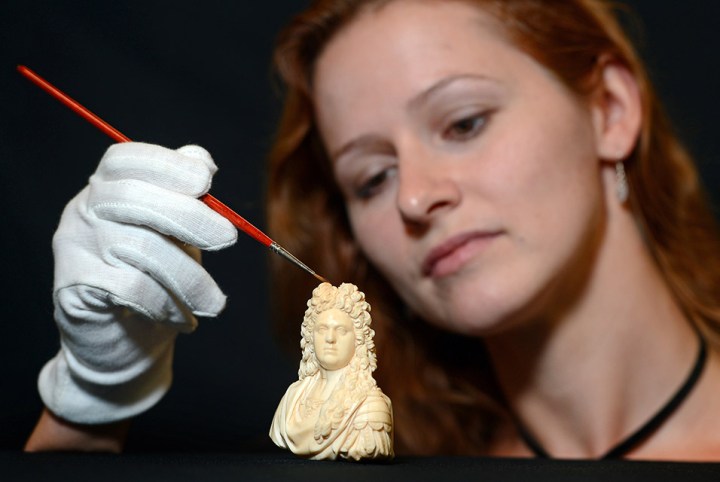
Lydia Messerschmidt, assistant conservator at National Museums Scotland, works on one of five ivories.
Photo: © Neil Hanna
◊ ◊ ◊ ◊ ◊
From the Art Fund:
David Le Marchand (1674–1726) was one of the most prominent ivory carvers and one of the most influential portraitists of his day in Britain. His works were highly prized for his extraordinary skill in rendering likeness and for the sheer expense of the ivory, his chosen specialist material. For Le Marchand, ivory held a nostalgic significance. He was born in 1674 in the northern French port of Dieppe, a town famed for its long tradition in ivory carving. However, following the edict of Nantes, which saw the ensuing persecution of French Protestants, Le Marchand fled his native France. Still in his early twenties, he settled in Edinburgh and was given a licence to practise the art of ivory cutting on the condition that he trained Scottish apprentices in the craft.
National Museums Scotland has acquired a rare group of five ivories by Le Marchand. The set was commissioned by the Mackenzie family and comprises of four medallions and a miniature bust. One of the medallions depicts Sir James Mackenzie of Royston and is dated 1696, the year Le Marchand arrived in Scotland suggesting that the ivories are likely to be the very first that he carved in Britain.
Stephen Deuchar, director of the Art Fund, said: “This interesting group of ivories, with its excellent provenance and rich object biographies, is an ideal fit for National Museums Scotland, particularly given the Museum’s interest in Scottish identity and its relationship with the rest of the world. Scotland now has a meaningful presence of works by Le Marchand, which will appeal to scholars, students, artists and families alike. I look forward to seeing them in the new galleries.”
The ivories will go on display in one of the ten new galleries opening next summer at the National Museum of Scotland.
Exhibition | Bawdy Bodies: Satires of Unruly Women

◊ ◊ ◊ ◊ ◊
Opening next week at The Lewis Walpole Library:
Bawdy Bodies: Satires of Unruly Women
The Lewis Walpole Library, Farmington, CT, 24 September 2015 — 26 February 2016
Curated by Hope Saska and Cynthia Roman with contributions by Jill Campbell
Characterized by comically grotesque figures performing lewd and vulgar actions, bawdy humor provided a poignant vehicle to target a variety of political and social issues in eighteenth-century Britain. Bawdy Bodies: Satires of Unruly Women explores the deployment of this humorous but derisive strategy toward the regulation of female behavior. The exhibition will present satirical images of women from a range of subject categories including the royal family, aging members of fashionable society, disparaged mothers, political activists, gamblers, medical wonders, artists, performers, and intellectuals.
The exhibition is co-curated by Hope Saska, Curator of Collections and Exhibitions at the Art Museum of the University of Colorado, Boulder, and Cynthia Roman, Curator of Prints, Drawings, and Paintings at the Lewis Walpole Library, with contributions by Yale Professor of English Jill Campbell. It will be on view at the Lewis Walpole Library, 154 Main Street, Farmington, Connecticut, on Wednesdays from 2:00 to 4:30 pm and by appointment.
◊ ◊ ◊ ◊ ◊
P U B L I C L E C T U R E
Amelia Rauser | Rock, Paper, Scissors: Dimensionality and
Neoclassical Aesthetics in the Art and Fashion of the 1790s
28 October 2015, 5:30 pm, Sterling Memorial Library Lecture Hall
In the 1790s, women dressed in imitation of antique statuary. Yet most devotees of the style had never seen the originals they emulated; rather, they were inspired by print representations of them, and this process of translation—from three-dimensional sculptures into two-dimensional paper representations and then back into fabric gowns swathed around moving bodies—created several interesting effects, including a pronounced emphasis on contour. This lecture will discuss the way 1790s fashionable dress was mediated by print, and connect this phenomenon to the contemporary vogue for John Flaxman’s outline drawings and other aspects of neoclassical taste.
Amelia Rauser is the author of Caricature Unmasked: Irony, Authenticity, and Individualism in Eighteenth-Century English Prints (2008). Her new project, “Living Statues: Neoclassical Culture and Fashionable Dress in the 1790s—London, Paris, Naples,” is a study of the radical style of undress in the 1790s and its connection to contemporary aesthetic, political, and scientific thought. Dr. Rauser is Professor of Art History at Franklin & Marshall College.
G R A D U A T E S T U D E N T W O R K S H O P S
Limited enrollment by application
Jill Campbell (Yale University) | ‘We are an injured body’: Collectivity and the Female Body
2 October 2015, Lewis Walpole Library
Amelia Rauser (Frankin & Marshall College) | Expressive Bodies in Eighteenth-Century Satirical Prints
30 October 2015, Lewis Walpole Library
Details for all of these events can be found here»
Exhibition | Aristocratic Life in the Eighteenth Century
From the Musée National de la Renaissance:
Être et paraître, la vie aristocratique au XVIIIe siècle:
Trésors cachés du Musée national de la Renaissance
Château de La Roche Guyon, 11 April — 29 November 2015
Curated by Muriel Barbier
 Sortis exceptionnellement des réserves du musée national de la Renaissance, des objets d’art du XVIIIe siècle retracent en dix tableaux les thèmes majeurs de la vie aristocratique à l’époque des Lumières. Au travers de quatre-vingt-cinq oeuvres, le quotidien de l’aristocratie du XVIIIe siècle revit dans les grands salons du château de La Roche Guyon ornés de leurs lambris d’époque et dépourvus de mobilier.
Une journée ordinaire dans une demeure seigneuriale au siècle des Lumières. L’exposition, articulée en dix vitrines, suit le déroulement d’une journée de la haute société des Lumières, en abordant les thèmes suivants : toilette et soins, parure et élégance, arts de la table, lecture et écriture, jeux et divertissements, priser et fumer, ouvrages de dames, prières et dévotions, armes d’apparât et chasse. Cette présentation, entend faire comprendre la fonction de ces objets, la préciosité de leur décor et leur utilisation. Elle propose une autre approche des arts décoratifs non fondée sur l’évolution des stymes et des techniques mais sur l’histoire des civilisations et des moeurs.
Muriel Barbier, Être et paraître: La vie aristocratique au XVIIIe siècle (Artlys, 2015), 142 pages, ISBN: 978-2854956108, 18€.
Bénédicte Bonnet Saint-Georges reviewed the exhibition for La Tribune de l’Art (21 August 2015).










 Enfilade
leave a comment