Symposium | Retail Realms in Eighteenth-Century Britain
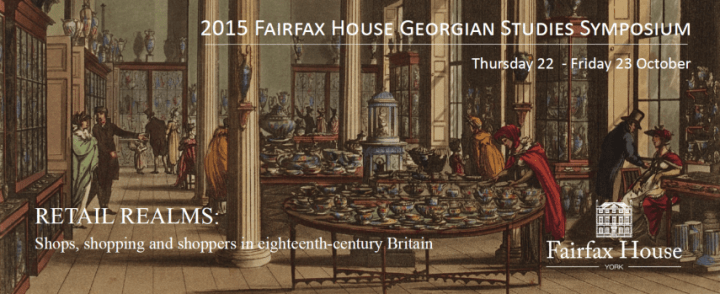
From the symposium flyer:
2015 Fairfax House Georgian Studies Symposium
Retail Realms: Shops, Shoppers and Shopping in Eighteenth-Century Britain, c.1680–1830
York Hilton Hotel and Fairfax House, York, 22–23 October 2015
The long eighteenth century was a transformative age for shops and shopping in Britain. Far-reaching changes took place in the way people shopped, the things they bought, the shops themselves and the ways in which they were run. For an increasing portion of Georgian ‘polite society’, shopping, from being primarily a matter of obtaining the necessities of life, became a pleasurable leisure activity in its own right, associated with sociability, sensory experience and the expression of identity. Many historians who have explored the social and cultural dynamics of shopping in the eighteenth century have argued that this period saw a ‘consumer revolution’.
The Georgian shopping experience was not just a social or economic process. Located in shops, showrooms and high streets, it extended to the assembly rooms and drawing rooms of polite society. It encompassed the way goods were packaged and advertised, included the strategic developments in shop design and was a contributing factor in the progressive refashioning of the urban environment. Indeed, the retail realm, as this symposium will examine, was a vital element in the physical reshaping of eighteenth-century British life.
Retail Realms: Shops, Shoppers and Shopping in Eighteenth-Century Britain (the third annual Fairfax House Symposium in Georgian Studies) will bring together research and material from museum professionals, academics, independent scholars and those with an interest in retail history or passion for Georgian studies. Linked to the museum’s exhibition Consuming Passions, the two-day conference will be focused around the core themes of consumerism, consumption and shopping in the long eighteenth century.
Registration details are available here»
◊ ◊ ◊ ◊ ◊
T H U R S D A Y , 2 2 O C T O B E R 2 0 1 5
9:15 Registration and coffee
9:45 Welcome and introduction by Hannah Phillip (Director, Fairfax House)
10:00 Panel 1: Objects of Desire
• In pursuit of oral perfection: dental retail in the eighteenth century, Rachel Bairsto (British Dental Association Museum)
• Mrs Bowes’ purchases in London, 1743–63, Howard Coutts (The Bowes Museum)
• Marketing quality in eighteenth-century England, Rachael Morton (University of Warwick)
• Shopping for shells, Beth Fowkes Tobin (University of Georgia)
11:40 Keynote Address
Retailing Luxuries: The Deards family’s toyshops in London, Bath and Yorkshire, Vanessa Brett (author of Bertrand’s Toyshop in Bath: Luxury Retailing 1685–1785)
12:30 Lunch break
13:30 Primary Materials: Parallel Discussion Sessions
• Mike Rendell – Richard Hall, Haberdasher, at No 1 London Bridge
• Valerie Jackson-Harris – The eighteenth-century trade card
14:10 Panel 2: The World of Consumption
• In pursuit of pastries, millinery and men: polite female consumption in eighteenth-century Bath, Rose McCormack (Aberystwyth University)
• Shopping for paintings in Georgian Bath, Amina Wright (Holburne Museum)
• A world of goods? Products, promotions and place names in English shops, 1740–1820, Jon Stobart (Manchester Metropolitan University)
15:20 Tea
15:40 Panel 3: Retail Environments
• ‘Behind great glass windows, absolutely everything one can think of is neatly, attractively displayed’: foreigners’ accounts of shopping in London, Alison O’Byrne (University of York)
• An ‘elegant, extensive, & convenient shew-room’: the architecture and interior design of the eighteenth-century shop, Ralph Harrington (University of Leeds)
• Antiquity and improvement: polite shopping Georgian York, Matt Jenkins (University of York)
16.50 Day 1 concluding remarks
17:30 Drinks reception and private view of the exhibition Consuming Passions: Luxury Shopping in Georgian Britain.
19:00 Conference dinner
F R I D A Y , 2 3 O C T O B E R 2 0 1 5
9:00 Registration
9:30 Panel 4: Branding Advertising, Display
• Josiah Wedgwood I – the salesman, Gaye Blake-Roberts (The Wedgwood Museum)
• Rethinking the eighteenth-century trade card: thoughts on their development, form and function, Elenor Ling (The Fitzwilliam Museum)
• Your humble and obedient servant, Sylvia Hogarth (textiles historian)
10:40 Coffee
11:00 Panel 5: Texts and the Retail Realm
• Catalogues of trivialities? Consumer experience in Austen’s writings, Jane Taylor (University College London)
• ‘Every employment delightful’: shops, self-sufficiency and feminine networks in Frances Burney’s Cecilia (1782) and The Wanderer (1814), Chloe Wigston Smith (University of Georgia)
• Browsing the past: Leigh Hunt and the memorial function of shopping, Markus Poetzsch (Wilfrid Laurier University)
12:20 Lunch break
13:20 Walking Tour: Exploring Georgian York’s Retail Realms
14:30 Keynote Address
Shopping & Sensibility, Helen Berry (Newcastle University)
15:30 Tea
15:50 Panel 6: Beyond Shopping
• ‘…the whole Consumpt of Scotland, or nearly so, has been Smuggled’: how tea smuggled from Gothenburgh dominated the market in the north east of England and Scotland, Derek Janes (University of Exeter)
• ‘Things that are not trifles’: purchasing, pilfering and peddling gloves in eighteenth-century England, Liza Foley (National College of Art and Design, Ireland)
• Sabine Winn and the art of long-distance shopping at Nostell Priory, 1775–1798, Kerry Bristol (University of Leeds)
17:00 Day 2 Concluding remarks
Please note that this programme is provisional and details are subject to change.
New Book | Antiquarianism and the Visual Histories of Louis XIV
From Ashgate:
Robert Wellington, Antiquarianism and the Visual Histories of Louis XIV: Artifacts for a Future Past (Farnham: Ashgate, 2015), 286 pages, ISBN: 978-1472460332, $110.
 Antiquarianism and the Visual Histories of Louis XIV: Artifacts for a Future Past provides a new interpretation of objects and images commissioned by Louis XIV (1638–1715) to document his reign for posterity. The Sun King’s image-makers based their prediction of how future historians would interpret the material remains of their culture on contemporary antiquarian methods, creating new works of art as artifacts for a future time. The need for such items to function as historical evidence led to many pictorial developments, and medals played a central role in this. Coin-like in form but not currency, the medal was the consummate antiquarian object, made in imitation of ancient coins used to study the past. Yet medals are often elided from the narrative of the arts of ancien régime France, their neglect wholly disproportionate to the cultural status that they once held. This revisionary study uncovers a numismatic sensibility throughout the iconography of Louis XIV, and in the defining monuments of his age. It looks beyond the standard political reading of the works of art made to document Louis XIV’s history, to argue that they are the results of a creative process wedded to antiquarianism, an intellectual culture that provided a model for the production of history in the grand siècle.
Robert Wellington is a lecturer at the Centre for Art History and Art Theory, Australian National University.
◊ ◊ ◊ ◊ ◊
C O N T E N T S
Introduction: Medals and the Material Turn in the King’s History
1 Antiquarianism at Court
2 The Petite Académie and the histoire métallique of Louis XIV
3 The Cabinet des Médailles at Versailles
4 Images Inscribed and Described by the Petite Académie
5 The Antiquarian Origins of Louis XIV’s Medals Books
6 Portraiture, Physiognomy, and the Numismatic Sensibility
7 Numismatic Resonances: Le Brun’s Cycle for the Hall of Mirrors at Versailles
Epilogue
Bibliography
Index
Call for Papers | Creativity and the City, 1600–2000
From H-ArtHist:
Creativity and the City, 1600–2000
University of Amsterdam, 27–29 October 2016
Proposals due by 15 November 2015
Organized by Amsterdam Centre for Cultural Heritage and Identity, University of Amsterdam, the Netherlands
Keynote Speakers
• Jo Guldi, Brown University
• Ilja Van Damme, Antwerp University
• Scott Weingart, Carnegie Mellon University
This international and interdisciplinary conference on the history of creativity and the city aims to bring together recent research in the fields of history, arts, and digital humanities. In the last decade, scholars in the humanities and social sciences have explored the complex interplay between places and their culture using a variety of methods and approaches. The conference examines the relationship between cultural artefacts (art, books, etc.) and the urban networks and spaces in which they were conceived, (re)produced, distributed, mediated, and consumed in early modern and modern Europe. How such issues can be studied by means of existing and novel (digital) methods, as well as comparative and long-term approaches, is the second major theme of the conference.
We invite researchers in the fields of history, arts and culture, urban studies, media studies and the digital humanities to submit abstracts. Papers may address all kinds of cultural expressions and products—from books, (applied) arts and theatre, to films, media and music. The committee particularly invites scholars who will reflect on methodological questions and the use of computational techniques for historical research.
The list of possible themes includes but is not limited to:
• Space and place (built environment, local amenities, spatial distribution, transnational connections, etc.)
• Entrepreneurs and firms (business strategies, networks, collaboration and competition etc.)
• Intermediaries and institutions (guilds, societies, museums, policy, etc.)
• Markets and labour markets (distribution, training, cross-sectoral linkages, etc.)
• Text analytics for historical corpora (information retrieval, pattern recognition, tagging and annotation, etc.)
• Digital cultural heritage (3D/4D modelling, visual and audio-visual content analysis, etc.)
• Analysis and visualization (prosopography, network analysis, discourse analysis, etc.)
Please submit your details, abstract (300 words max.) and 5 key words before 15 November 2015 through the conference management system. When your paper is embedded in a larger research project, please also provide its title and affiliation. A scientific committee will evaluate the abstracts and sessions will be formed on the basis of the selected papers. For inquiries, please contact us at achi.red@uva.nl.
Abstract submission: 15 November 2015
Notification of abstract acceptance: Early January 2016
Registration will open in February 2016
Advisory Committee: Rens Bod, Jan Hein Furnée, Lia van Gemert, Jaap Kamps, Joep Leerssen, Julia Noordegraaf, Harm Nijboer, and James Symonds.
Conference Organizers: Jan Bolten and Claartje Rasterhoff.
New Book | Pompeo Batoni: A Complete Catalogue of His Paintings
Scheduled for publication next month from Yale UP:
Edgar Peters Bowron, Pompeo Batoni: A Complete Catalogue of His Paintings (London: The Paul Mellon Centre for Studies in British Art in association with the Museum of Fine Arts, Houston, 2015), 2-volume boxed set, 750 pages, ISBN: 978-0300148169, $300.
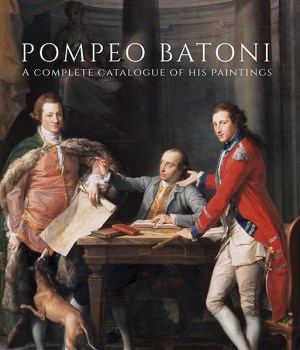 This meticulously researched catalogue presents an authoritative assessment of the works of Pompeo Batoni (1708–1787), one of the 18th century’s most celebrated painters. Born in Lucca, Batoni established himself in Rome and received commissions from popes, princes, and British aristocrats on the Grand Tour. Batoni was highly sought after for his theatrical yet incisive—and often flattering—portraits. Connoisseurs and cognoscenti also prized his learned and technically brilliant allegorical, religious, and mythological compositions.
With entries on more than 480 paintings and 250 drawings, this magnificent two-volume set provides the most complete examination to date of Batoni’s entire oeuvre. Featuring beautiful, high-quality reproductions, the book provides thorough details on provenance and exhibition history as well as biographies of the portrait sitters. New analysis of the works, resulting from decades of research, reinterprets some of Batoni’s iconography, identifies new textual and visual sources of his imagery, and reveals insights gleaned from unpublished archival materials.
Edgar Peters Bowron is the former Audrey Jones Beck Curator of European Art at the Museum of Fine Arts, Houston.
Call for Papers | Musical Theatre and Space
From H-ArtHist:
Musical Theatre and Space: Early Modern European Courts
Gotha, Friedenstein Castle, 27–29 October 2016
Proposals due by 15 September 2015
International Colloquium of the Rudolstädter Arbeitskreis zur Residenzkultur e.V., the Institut für Musikwissenschaft of the Universität des Saarlandes, the Institut für Kunstgeschichte of the Ludwig-Maximilians-Universität München and the Stiftung Schloss Friedenstein Gotha
The union of the arts in the Gesamtkunstwerk (‘total work of art’) of court opera has been repeatedly studied by diverging approaches of musical history research. However, although a wide range of different arts were involved in the realization of music-theatrical spectacles, still an interdisciplinary approach seems to be pursued rather hesitantly. Thus, for example, particular spatial-architectural aspects of court opera scarcely have been taken into account. Yet, music theater connotes scenic performance and architecture alike. Both constituted essential elements of aristocratic representation in the 17th and 18th centuries. Just as castles and palaces, the European nobility used operas and ballets as core media for the staging and representation of dynasty and person. In the Old Empire not only the imperial estate nobility initiated music-theatrical spectacles, but also lesser courts arranged ballets and operas according to their potentials. Even in the urban space opera-houses sporadically became installed, maintained by the aristocracy.
Hence, from a European perspective the colloquium shall focus upon the varied connections and interplays which existed between musical theatre and the court and its space in the narrow and broader sense. Mainly, scenic performance and architectural space are to be scrutinized. In this context the mutual relations between different forms of musical theatre, architecture, venue and stage are to be considered. In what ways and by what means a special ‘performance space’ became produced by the means of music, sound, language and movement (dance, facial expression and gesture), of architecture, picture and sculpture as well as light and technology? Which specific and corresponding spaces at court became created or converted, and which were the traditions being used? Within the scope of these issues, it is a significant question, to what extent the site of the spectacle on the one and the music-theatrical work of art on the other hand presupposed each other. To this effect the characteristics of Italian, French or Swedish musical theatre shall experience consideration in equal measure; terms of transfer and networks as well as the formation and development of certain types and models are to be analyzed. Against this background, it has to reconsidered, whether and to what extent at the courts there developed European standards, and whether these can be estimated to stand in accordance to the common national characteristics of ‘Italian’ and ‘French’. Furthermore, there shall be examined the recipients, the transfer in different social realms, the influence and participation of the court in the artistic realization, and finally the personal limits, which certainly existed.
As a vital point of all these thematic approaches it should be stressed, that the focus lies exclusively on the contexts of courts. Above all, the colloquium shall broach the genuine court conditions and shapes of performance and staging as they were implemented, understood and utilized by the European nobility only. Therefore, a core issue is posed by the problem of precise distinction, both socially and aesthetically, of the phenomena musical theatre and ‘court space’.
With the focus on court culture, we would be happy to receive contributions, preferably with an interdisciplinary approach, to the following range of topics:
• Court, opera and architecture as means of princely self-representation
• The ruler’s presence in the stage area
• Court venues and stage areas
• Music-theatrical staging within and beyond the stage area
• Stage technique, stage light, scenery and acoustics
• Motion in the stage area (stage dance, facial play, gesture)
• Forms, characteristics and sites of performance in comparison
• Different norms and practices at European courts
• The court audience
We encourage you to suggest also alternative topics. Please send an accordant proposal for presentation. The colloquium will take place subject to the acquisition or allocation of funds. A publication of the contributions is planned. We ask for proposals for the colloquium until 15th September 2015.
Dr. Heiko Laß: heiko.lass@kunstgeschichte.uni-muenchen.de
Dr. Margret Scharrer: m.scharrer@mx.uni-saarland.de
Call for Papers | Writing Buildings
From the University of Kent:
Writing Buildings
University of Kent, 14–16 July 2016
Proposals due by 30 September 2015
CREAte, the research centre for architecture and the humanities at the Kent School of University, University of Kent, is holding a conference in collaboration with The Architectural Review which will bring together quite different traditions of writing about historic buildings. The special character of this conference is that speakers will be drawn from both academic and non-academic fields, and from a range of disciplines that touch on architectural experience and history. In this way we aim to offer a new experience for writers on architecture, interior design and urban space. We are inviting papers from those in architecture, English, history, sociology, film and drama, landscape studies and related disciplines with a specialist interest in writing about buildings and urban spaces or experiences across different time periods. The common theme of the papers will be the uses of a variety of voices in creating architecture culture.
Writing Buildings will be a two-day conference on the subject of alternative ways of writing architectural history which will encourage experimentation in criticism through breaking disciplinary barriers. The programme will include papers from both academic disciplines and non-academic professions which engage with the built environment, for example, journalism, interior design and construction, as our keynote speakers demonstrate:
Iain Sinclair / Writer
Matthew Beaumont, UCL / Psychogeographer
Jonathan Meades / Writer and Film Maker
Alexandra Harris, University of Liverpool / Cultural Historian
Barbara Penner, Bartlett, UCL / Material Anthropologist
Jonathan Reed / Interior Designer
Ben Campkin, Bartlett, UCL / Urban Geographer
Ian Dungavell / former director, the Victorian Society
We will organise at least one project-based writing event outside the conference hall. We are currently planning to hold this in collaboration with Turner Contemporary as part of their innovative Waste Land project. We will update news about the conference, including information about events, talks and activities on this website.
Both previous CREAte conferences have resulted in edited books by leading international academic publishers and we anticipate that this will happen again this time. In addition, the widely read and respected international journal The Architectural Review will promote the conference and intends to publish papers from it.
Email your abstract of approximately 250 words to WritingBuildings@kent.ac.uk by 30 September 2015. Notification of acceptance of papers by 31 January 2015.
Conference Directors
Timothy Brittain-Catlin, Kent School of Architecture, University of Kent, tjb33@kent.ac.uk
Catherine Richardson, School of English, University of Kent, c.t.richardson@kent.ac.uk
Tom Wilkinson, History Editor, The Architectural Review
Colloquium | Think Small: Artistic Miniaturization
From the conference programme (with an English summary). . .
Think ‘Small’: Textual Approaches and Practices of Artistic Miniaturization from Antiquity to the Nineteenth Century / Penser le « petit » de l’Antiquité au XIXe siècle: Approches textuelles et pratiques de la miniaturisation artistique
Université Toulouse – Jean Jaurès Nouvelle Maison de la Recherche, 1–2 October 2015
 From Tanagra statuettes to the automata of the industrial age, there are many material manifestations of the ancient fascination with shapes, images, and tiny objects. Examples abound: carved micro-architectures of Gothic buildings, small engravings by Stefano della Bella or Sébastien Leclerc, eighteenth-century objects of vertu, and the Lilliputian creatures of children’s literature. Rare, however, are the historical sources that allow us to understand their cultural foundations. While the written sources usually consider the ‘small’ only in relationship to the ‘big’, the analysis of the consumption of these objects reveals a set of practical, symbolic, and artistic skills such as manoeuvrability, mobility, economy, poverty, preciousness, thoroughness, prettiness, and strangeness. Too often, the dominant sources focus on the size of the objects, which diminishes the presence of other considerations. At times miniaturization reduces the scale of a given object, while at other times it may be an independent creation governed by specific criteria. Whatever the case, miniaturization is based on a set of justifications, usages, and judgments that this conference aims to clarify.
◊ ◊ ◊ ◊ ◊
J E U D I , 1 O C T O B R E 2 0 1 5
Présidence de la journée : Jean-Marie Guillouët (université de Nantes)
9.00 Accueil par Sophie Duhem – Estelle Galbois – Anne Perrin Khelissa (université Toulouse – Jean Jaurès)
9.10 Introduction générale par Jean-Marie Guillouët (université de Nantes)
9.30 Techniques, esthétiques et fonctions du changement d’échelle
• Raffaella Da Vela (université de Bonn), Petit et très petit : miniaturisations des modèles grecs dans les ateliers de potiers et de sculpteurs de Volterra à l’époque hellénistique
• Véronique Sarrazin (université d’Angers), Le « format Collombat », ou comment le petit format d’un modeste livret est devenu une référence de goût et de commodité au XVIIIe siècle
• Cyril Lécosse (université de Lausanne), La vogue des grandes miniatures ou le développement d’une nouvelle catégorie de portrait autour de 1800
• Élodie Voillot (université Paris Ouest Nanterre), Un musée dans chaque foyer : les réductions de sculptures, du grand art au petit bibelot, 1839–1900
12.00 Pause déjeuner
14.00 Luxe, préciosité et réceptions de l’objet minuscule
• Alice Delage (Centre d’Études supérieures de la Renaissance de Tours), La microarchitecture dans l’orfèvrerie florentine : la Renaissance du « petit »
• Rori Bloom (université de Floride), « Voilà mon portrait que je vous donne » : Political, Gallant, and Aesthetic Uses of the Boîte à portrait in Two Seventeenth-Century French Texts
• Michel Sandras (université Paris – Diderot), « Le Poète est ciseleur » (Hugo). Histoire et signification d’un cliché : le terme « ciselé » appliqué au travail de l’écrivain
V E N D R E D I , 2 O C T O B R E 2 0 1 5
Présidence de la journée : Jan Blanc (université de Genève)
9.00 Accueil par Sophie Duhem – Estelle Galbois – Anne Perrin Khelissa (université Toulouse – Jean Jaurès)
9.10 Introduction générale par Jan Blanc (université de Genève)
9.30 Images et représentations du « petit » monde
• François Ripoll (université Toulouse – Jean Jaurès), « Si parua licet componere magnis » (Georg., IV, 176) : la dialectique du grand et du petit dans les chants III et IV des Géorgiques de Virgile
• Vincent Robert-Nicoud (université d’Oxford), Grand débat sur le « petit » monde : l’homme microcosme de Rabelais à Scève
• Sarah Grandin (université d’Harvard), « Cironalité » and Scale in Cyrano de Bergerac’s Les États et Empires de la Lune
• Nathalie Rizzoni (CNRS, université Paris – Sorbonne), « Les petits, toure lourirette / Valent bien les grands » : les enfants comédiens à Paris au XVIIIe siècle
12.00 Pause déjeuner
14.00 Pouvoirs mémoriels de l’objet miniature
• Audrey Dubernet (université Bordeaux – Michel de Montaigne), Souvenir d’une œuvre d’art ; les peintures et sculptures antiques transposées en glyptique
• Manuel Charpy (CNRS, université Lille 3), Fragments et réductions. Petites choses et espaces de l’intimité au XIXe siècle
• Manuel Royo (université François-Rabelais de Tours), Le « grand » dans le « petit », enjeux de la maquette d’architecture : le cas de Rome à la fin du XIXe siècle
• Claire Barbillon (université de Poitiers), Le paradoxe de la monumentalité en format réduit : la statuaire monumentale publique et la carte postale
15.40 Discussion et clôture du colloque
Symposium | Small Worlds: Dolls’ Houses
From the Bath Preservation Trust:
Symposium | Small Worlds: Dolls’ Houses from the 18th and 19th Centuries
Bath Royal Literary and Scientific Institution, Bath, 6 November 2015
Small Worlds, the current exhibition at No.1 Royal Crescent, aims to go beyond showing dolls’ houses simply as exquisite collector’s items by exploring wider themes, such as the part they played in girls’ education and women’s history, links with philanthropy (because toys for wealthy children were often furnished with the labours of the poorest), and their importance as material culture. We are holding a special day symposium to explore further some of these themes.
 To be chaired by Adrian Tinniswood and featuring Liza Antrim in conversation with Antique Roadshow’s Fergus Gambon, the event will bring together a panel of speakers who are experts in their fields. Kathryn Jones, Curator of Decorative Arts, the Royal Collection, will talk about Queen Mary’s Dolls’ House while curators from the V&A and the National Trust showcase other national treasures and their links with the English Country House. The idea of dolls houses as ‘emotional objects’ and their connection with philanthropy and the history of childhood is explored by Professor Joanne Bailey of Oxford Brooks and Dr. Mary Claire Martin of Greenwich University, while symbolic inspiration for film and literature, in particular the ghost story and all things gothic, is covered by Lucy Arnold of Leeds University in a splendidly named paper, ‘Shrinking in Terror’!
Tickets: £55, students £35. A limited number of bursary places are available to full or part time students. Click here for a link to our website and a copy of our bursary application form. Lunch and an exhibition drinks reception at No. 1 Royal Crescent is included within the ticket price. If you have any questions about
the symposium please email our Events Officer, Kate Rogers,
krogers@bptrust.org.uk.
◊ ◊ ◊ ◊ ◊
P R O G R A M M E
9.45 Registration
10.00 Welcome from Adrian Tinniswood
10.10 Liza Antrim and Fergus Gambon in conversation
10.40 The Voice of the House: Material Culture and Emotion, Joanne Bailey (Oxford Brooks University)
11.10 Questions
11.30 Coffee
11.45 The Utensil for Marriage? The Dutch Kitchen Cabinet and the Place of Women in the 17th Century, Rachel Barber
12.15 Furnishing the 18th-Century Baby House: A Working Country House in Miniature, Patricia Ferguson (National Trust external advisor on ceramics)
12.45 Questions
1.00 Lunch
2.00 Childhood and Philanthropy in Victorian England, Mary Clare Martin (University of Greenwich)
2.30 Upstairs, Downstairs: Queen Mary’s Dolls House as a Record of Edwardian England, Kathryn Jones (Curator of Decorative Arts, The Royal Collection)
3.00 Questions
3.15 Tea
3.45 Shrinking in Terror: Gothic and the Dolls House, Lucy Arnold (doctoral student at University of Leeds and administrator of Home, Crisis and the Imagination Network)
4.15 Small Stories: A Collection of Characters at the V&A Museum of Childhood, Alice Sage (Curator, V&A Museum of Childhood)
5.00 Questions
5.20 Summing Up by Adrian Tinniswood
6.00 Drinks reception and opportunity to view the exhibition at No.1 Royal Crescent
New Book | Ruins and Fragments: Tales of Loss and Rediscovery
Distributed by The University of Chicago Press:
Robert Harbison, Ruins and Fragments: Tales of Loss and Rediscovery (London: Reaktion Books, 2015), 208 pages, ISBN: 978-1780234472, $35.
 What is it about ruins that are so alluring, so puzzling, that they can hold some of us in endless wonder over the half-erased story they tell? In this elegant book, Robert Harbison explores the captivating hold these remains and broken pieces—from architecture, art, and literature—have on us. Why are we, he asks, so suspicious of things that are too smooth, too continuous? What makes us feel, when we look upon a fragment, that its very incompletion has a kind of meaning in itself? Is it that our experience on earth is inherently discontinuous, or that we are simply unable to believe in anything whole?
Harbison guides us through ruins and fragments, both ancient and modern, visual and textual, showing us how they are crucial to understanding our current mindset and how we arrived here. First looking at ancient fragments, he examines the ways we have recovered, restored, and exhibited them as artworks. Then he moves on to modernist architecture and the ways that it seeks a fragmentary form, examining modern projects that have been designed into existing ruins, such as the Castelvecchio in Verona, Italy and the reconstruction of the Neues Museum in Berlin. From there he explores literature and the works of T. S. Eliot, Montaigne, Coleridge, Joyce, and Sterne, and how they have used fragments as the foundation for creating new work. Likewise he examines the visual arts, from Schwitters’ collages to Ruskin’s drawings, as well as cinematic works from Sergei Eisenstein to Julien Temple, never shying from more deliberate creators of ruin, from Gordon Matta-Clark to countless graffiti artists.
From ancient to modern times and across every imaginable form of art, Harbison takes a poetic look at how ruins have offered us a way of understanding history and how they have enabled us to create the new.
Until his retirement, Robert Harbison was professor of architecture at London Metropolitan University. He is the author of many books, including Reflections on Baroque and Travels in the History of Architecture, both also published by Reaktion Books.
C O N T E N T S
Prologue
1 Rough Edges
2 Fragmented Wholes
3 Modernist Ruin
4 Interrupted Texts
5 Ruined Narratives
6 Art and Destruction
7 Dreams of Recovery
Epilogue: Remembering and Forgetting
Notes
Acknowledgements
Photo Acknowledgements
Index
Call for Papers | Reading Architecture across the Arts and Humanities
From the CFP:
Reading Architecture across the Arts and Humanities
University of Stirling, 5 December 2015
Proposals due by 26 September 2015
An interdisciplinary conference organised in cojunction with the AHRC-funded project, Writing Britain’s Ruins, 1700–1850: The Architectural Imagination at the University of Stirling.
The organisers of this one-day multidisciplinary conference seek to solicit proposals for 20-minute papers that consider the creation, expression and subject-areas across the Arts and Humanities. Papers should seek to address the creation, understanding, circulation and cultural impact of both real and international contexts. Original and creative accounts of how architecture might variously be ‘read’ and interpreted across such disciplines as welcome.
Plenary Speakers: Rosemary Hill and Olivia Horsfall Turner
Possible topics may include, but are by no means limited to, the following:
• Historicism
• Responses to, and recreations of, the architectural past
• Reflections upon architectural styles and ‘movements’
• Assessments of architecture and architectural practices
• Representations of architecture in film
• Architecture and the law
• Antiquarianism and architecture
• Architectural ruin and the tourist industry
• Architectural conservationism
• The politics of architectural form
• Literary representations of architecture
• Lives of architects
• The aesthetics of architectural form
• Historiography
• Architectural Heritage
300-word proposals should be emailed to the conference organisers, Dr Dale Townshend and Dr Peter N. Lindfield—architecture@stir.ac.uk—by 26 September 2015. The School of Arts and Humanities at the University of Stirling has generously agreed to fund a number of postgraduate travel-bursaries for this event. Please contact the conference organisers for further details.
This conference is the first event in a series of outputs arising from the AHRC-funded project, Writing Britain’s Ruins, 1700–1850: The Architectural Imagination at the University of Stirling (June 2015–December 2016).










 Enfilade
leave a comment