Exhibition | A Revolution of the Palette
Now on view at the Norton Simon:
A Revolution of the Palette: The First Synthetic Blues and Their Impact on French Artists
Norton Simon Museum, Pasadena, 17 July 2015 — 4 January 2016
Curated by John Griswold
The accidental discovery of Prussian blue in an alchemist’s laboratory around 1704 helped to open up new possibilities for artistic expression at the dawn of the Enlightenment. A Revolution of the Palette explores the use of this pigment, followed by the introduction of cobalt blue and synthetic ultramarine, by French artists from the Rococo period to the threshold of Impressionism.
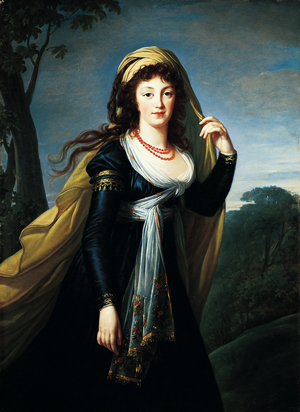
Marie-Louise-Elisabeth Vigée-Lebrun, Portrait of Theresa, Countess Kinsky,1793, oil on canvas, 54 x 39 inches, 138 x 100 cm (Pasadena: Norton Simon Art Foundation)
A new palette available to artists, thanks largely to the addition of Prussian blue in the 18th century, helped fuel the heated philosophical debates regarding Newtonian color theory. The fascinating new capabilities of artists to exploit sophisticated color relationships based on scientific optical principles became a core precept of Rococo painting, or peinture moderne as it was called at the time. Exquisite examples of the early use of Prussian blue by Fragonard and his immediate circle demonstrate their technical achievements. Paintings by Vigée-Lebrun, Prud’hon and Ingres show the masterful use of Prussian blue as Neoclassicism took hold. The sophisticated, subtle manipulations of color in academic painting of the period, exemplified by Ducis’ Sappho Recalled to Life by the Charm of Music and Degas’ early and ambitious emulation of a Poussin composition, The Rape of the Sabines, rely heavily on the ability of the new blues to deftly modulate tone and hue in ways never available to earlier painters.
As revolutionary as this new blue color proved to be, Prussian blue was a mere precursor to the explosion of available colors brought about by the Industrial Revolution. Indeed, the French government played an active role in catalyzing innovation at the dawn of the 19th century, as the country emerged from the Revolution with its economy in disarray. Chemist Louis Jacques Thénard’s development of the next synthetic blue, a vivid cobalt blue pigment, was inspired by the traditional cobalt oxide blue glazes seen on 18th-century Sèvres porcelain. An exquisite lidded vase on loan from the Huntington Library, Art Collections, and Botanical Gardens illustrates this.
The third synthetic blue to emerge was the culmination of centuries of searching for a cheap, plentiful, high-quality replacement for the most valuable of all pigments: natural ultramarine. This was a color derived from lapis lazuli, a rare, semiprecious gemstone mined almost exclusively in Afghanistan since the 6th century, and imported to Europe through Venice. It is famously known to have been more costly than gold during the Renaissance. Natural ultramarine provided a brilliant, royal blue hue, but only if coarsely ground and applied in a comparatively translucent glaze over a light-reflecting ground. Other blue colors, such as smalt, which was essentially composed of particles of colored glass, were available to help achieve the lovely hues of ultramarine, but the poor covering ability of the paint and the difficulty of its preparation and use were familiar limitations.
In 1824, the French government announced a competition among chemists to develop a true synthetic ultramarine. The prize was finally awarded in 1828 to Jean-Baptiste Guimet. Painters at last had an affordable, fully balanced palette of cool and warm colors spanning the full spectrum. This fact, combined with the innovation of ready-mixed tube oil colors, greatly facilitated the direct representation of nature. The ability of painters to capture a wide range of observed natural effects in the landscape en plein air are represented by the works of Corot, Guigou, Monticelli and Dupré. A Revolution of the Palette closes with two canvases representing the Impressionists’ full realization of the wide-open possibilities made possible by these new blues: Guillaumin’s The Seine at Charenton (formerly Daybreak), and Caillebotte’s Canoe on the Yerres River.
Exhibition | An Elegant Society: Adam Buck, Artist in the Age of Austen
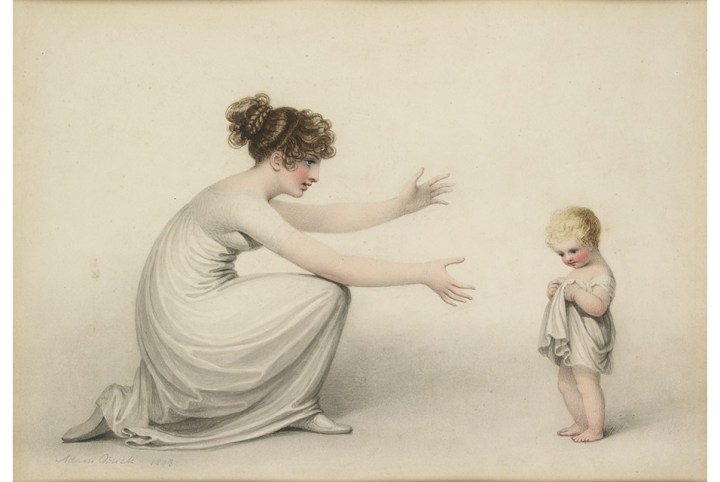
Adam Buck, First Steps, 1808. Watercolour, 28 x 35 cm
(Private Collection)
◊ ◊ ◊ ◊ ◊
Press release (23 April 2015) from the Ashmolean:
An Elegant Society: Adam Buck, Artist in the Age of Jane Austen
Ashmolean Museum, Oxford, 16 July — 4 October 2015
Crawford Art Gallery, Cork, 4 February — 9 April 2016
Curated by Peter Darvall
Well-known to collectors and Jane Austen enthusiasts, Irish artist Adam Buck (1759–1833) was one of Regency England’s most sought-after portrait painters. He worked in Ireland for twenty years, becoming an accomplished miniaturist; but moved to London in 1795 and immediately gained a roster of star clients including the Duke of York and his scandalous mistress, Mary Anne Clarke. This summer exhibition celebrates Adam Buck’s influence on Georgian art and style, showing over sixty works from private collections including watercolours, small portraits and miniatures, examples of his decorative designs for porcelain and fans, and his prints.
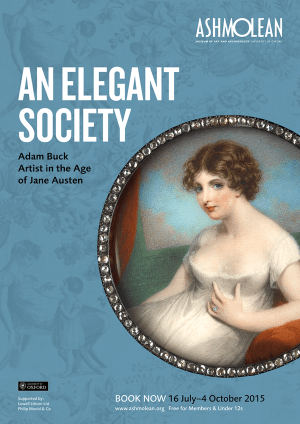 Buck was born to a family of silversmiths in Cork, the second of four surviving children. His younger brother, Frederick (1765–1840), became an established miniature painter who worked in Cork his entire life. Details of Adam’s career before he moved to London are elusive, but his early work is in many ways that of the quintessential Regency miniaturist. His first known pictures, dating from the late-1770s to the early-1780s, show an innate appreciation of the established Neoclassical style: his sitters are often shown in profile; their gowns styled like Grecian goddesses; group portraits arranged like a frieze. In emigrating to London in 1795, Buck took the route of many fellow Irishmen including several Cork-born artists and writers such as James Barry (1741–1806) and Alexander Pope (1759–1847). Buck’s first London home was in Piccadilly. As soon as he arrived, he began to exhibit at the Royal Academy where he showed a surprising total of 179 works over the following 38 years.
His success as a society artist was almost instant. By 1799 he had executed a full-length portrait of the Prince of Wales in his Garter Robes. He exhibited two portraits of Prince Frederick, Duke of York, at the Royal Academy in 1804 and 1812. Buck was also introduced to Mary Anne Clarke (1776–1852), the most celebrated of the Duke’s well-known mistresses. She was a famous beauty and maintained a fabulous household in London, subsidising her extravagant lifestyle by selling her influence with the Duke who was Commander in Chief of the Army. Rumours claiming that she could obtain commissions and appointments for a fee culminated in a parliamentary enquiry into the Duke’s conduct. While the Duke was ridiculed in caricatures and lampoons, Mary Anne, who put up a spirited defence of her role in the affair, became a public heroine. Her image was circulated in flattering portraits by Buck and other artists which were engraved and widely published. In 1813 she finally overreached herself and was imprisoned for nine months for libel, before leaving the country for Boulogne where she died in 1852.
Buck’s work was made popular largely through prints after his watercolours, chiefly published in London by William Holland and Rudolph Ackermann. His images, refined and elegant, contrasted with the savage caricatures and ribald pictures of contemporary artists like James Gillray and Isaac Cruikshank. The difference was humorously summed up in a Thomas Rowlandson print with the title, Buck’s Beauty and Rowlandson’s Connoisseur (1800), in which a rake in wig and frock coat, one of Rowlandson’s stock characters, leers through an eye-glass at a demure, pink-cheeked girl, drawn in Buck’s distinctive manner. With his name made in association with the colourful ranks of Regency society, Buck, from 1810 onwards, made a new reputation for himself with his sentimental images of women and children under titles such as The First Steps in Life and Mother’s Hope. By 1829 his work had been reproduced by at least twenty-eight different printmakers in England and by several in France and America.
Peter Darvall, Guest Curator, says: “I hope, with this exhibition and monograph on Adam Buck’s work, to bring his art to the attention of a wider audience. Buck was a hugely influential artist during his own time and his elegant portraits of royalty and officers, and his charming illustrations of Georgian life and manners have had an enduring impact on the popular imagination of Regency society.”
◊ ◊ ◊ ◊ ◊
From the Ashmolean shop:
Peter Darvall and Jon Whiteley, Adam Buck, 1759–1833 (Oxford: Ashmolean Museum Publications, 2015), 192 pages, ISBN: 978-1910807002, £20.
Adam Buck (1759–1833) was an Irish portrait painter, print-maker and miniaturist from Cork who migrated to London c.1795. His name is well-known to collectors and historians of British prints and watercolours and for many years his work has appeared regularly in sale catalogues. And yet, while there have been a few short articles published on his contribution to print-making, ceramic decoration and the study of Greek vases, it is surprising that no serious attempt has previously been made to collate the little that is known about his life and work. Moreover, he has never been the subject of a monographic exhibition apart from one at the Leicester Gallery in 1925 and, more recently, a small exhibition at the Cynthia O’Connor Gallery in Dublin in 1984 and another at the Alpine Gallery in London, mounted by Andrew Kimpton, in 1989.
◊ ◊ ◊ ◊ ◊
Note (added 6 February 2015) — At the Crawford Art Gallery, a distilled version of the show is entitled Adam Buck: A Regency Artist from Cork.
Exhibition | Yo, el Rey: La Monarquía Hispànica en el arte
The exhibition press release, via Art Daily (13 July 2015) . . .
Yo, el Rey: La Monarquía Hispànica en el arte
Museo Nacional de Arte, Mexico City, 1 July — 18 October 2015
Curated by Abraham Villavicencio
 The Instituto Nacional de Bellas Artes (INBA) presents the exhibition Yo, el Rey. La Monarquía Hispànica en el arte, curated and produced by the Museo Nacional de Arte. This is a comprehensive exhibit that offers the audience, through national and international masterpieces, a review of the figure of the Hispanic sovereign. The exhibition approaches the mechanisms and representation forms of the monarch with a selection of 200 works, amongst which are paintings, drawings, sculptures, textiles, jewelry, silverware, armors and historic documents.
Important international loans have been obtained through the leadership and management of the Museo Nacional de Arte, which come from the Museo Nacional del Prado, Colecciones Reales del Patrimonio Nacional, Museo de América, and Museo Lázaro Galdiano, from Spain; and The Metropolitan Museum of Art, The Hispanic Society of America and the Philadelphia Museum of Art, from the United States, as well as national collections, such as the National Museum of Art of San Carlos, Museo Nacional del Virreinato, Museo Franz Mayer, and Museo Regional de Querétaro. It also has the invaluable participation of religious institutions: Catedral de Sevilla, Catedral Metropolitana de la Cuidad de México, Templo de San Felipe Neri La Profesa, Museo de la Basílica de Guadalupe and more than 20 private collections.
It is important to address the decisive contribution of the Museo Nacional de Arte to the conservation of our national patrimony, because thanks to this exhibition many pieces have been restored in benefit of a better preservation of novohispanic pieces, among them the Retrato de Carlos III from Juan Patricio Morlete Ruiz.
The exhibition, which was curated by Abraham Villavicencio, Vice-royalty Art curator of the Museo Nacional de Arte, is developed in four thematic cores that revolve around the King as a unifying figure of the American kingdoms, and a vast politic system known as the Hispanic Monarchy.
La herencia iconográfica del pasado antiguo refers to the significance of the founding myths of royalty and kingdom, showing how, through symbolic elements of the Roman, Indigenous and German past, the image of the Hispanic monarch was built.
La efigie real. Recursos plásticos y retóricos suggests the constitution of the sovereign’s body image through attributes denoting power, which enhance the idea of authority among the royal houses of the Spanish Empire: the Habsburgo and the Borbón.
The third core, La monarquía mesiánica y el imaginario religioso, explores the king’s performance as patron of the church through his representation and the narrow link between the state and ecclesiastic institutions.
The exhibition closes with Ecos de la monarquía en el México independiente, in which the figures of Fernando VII, Agustín de Iturbide, and Maximiliano I of Mexico appear as witnesses of the survival of the mythic, politic and religious imageries of the viceroyalty of the Nueva España, even in the independent Mexico.

Jean Ranc Carlos de Borbón y Farnesio, niño (futuro Carlos III de España), hacia 1724. Óleo sobre lienzo. 145.5×116.5cm (Madrid: Prado)
According to Agustín Arteaga, director of the Museo Nacional de Arte, “the topic acquires a new vitality when being presented as an exhibition, not only for the scholars of the viceroyalty but for everyone who wants to familiarize himself with the works that are a part of the . . . past in which an empire, with particular forces and dynamics, was constituted.”
The exhibition articulates the development of political and juridical elements which visitors will be able to appreciate as a rich heritage that seeks to value the Hispanic, novo Hispanic, and Mexican creators as a group with the same political and cultural identity. Therefore, under the same curatorial speech, pieces from some of the most recognized European painters of the XVI and XVII centuries—the Siglo de Oro—up to the XIX century are reunited: Diego Velázquez, Francisco de Goya, Giovanni Battista Tiepolo, Francisco de Zubarán and Jean Ranc, with renowned novo Hispanic and Mexican artists, such as Cristóbal de Villalpando, Juan Correa, Baltasar de Echave Orio, Manuel Tolsá, Santiago Rebull and Felipe Sojo, amongst others.
The exhibition catalogue, with a bilingual edition, conjugates texts of six specialists from the Universitat Autónoma de Barcelona, the Instituto de Investigaciones Históricas of the Universidad Nacional Autónoma de México, the Colegio de México, the Escuela Nacional de Antropología e Historia, the Museo Nacional del Virreinato, and the Museo Nacional de Arte. The publication addresses political, legal, iconographical, and theological dimensions, besides making the historical and artistic transformations obvious with approximately 200 color illustrated pieces that narrate the construction of the image of the Hispanic monarch in the Indias. In addition, all the texts of the exhibit rooms will be displayed in English and Spanish.
The Museo Nacional de Arte recognizes and appreciates the support of: El Patronato del Museo Nacional de Arte, Amigos MUNAL Arte Mexicano: Promoción y Excelencia AC, Iberdrola, British Airways-Iberia, and NH Hotels for the efforts made towards the creation of new projects.
The Sound of Paris in the Eighteenth Century
◊ ◊ ◊ ◊ ◊
Audio Reconstruction of Eighteenth-Century Paris
A team from Université Lyon-2, led by Mylène Pardoen (Department of Music and Musicology), has reconstructed the soundscape of eighteenth-century Paris.
From Le Journal CNRS (Centre national de la recherche scientifique). . .
La musicologue Mylène Pardoen a reconstitué l’ambiance sonore du quartier du Grand Châtelet à Paris, au XVIIIe siècle. Présenté au salon de la valorisation en sciences humaines et sociales, à la Cité des sciences et de l’industrie, son projet associe historiens et spécialistes de la 3D.
Paris comme vous ne l’avez jamais entendu ! C’est l’expérience que propose la musicologue Mylène Pardoen, du laboratoire Passages XX-XXI, à travers le projet Bretez. Un nom qui n’a pas été choisi par hasard : la première reconstitution historique sonore conçue par ce collectif associant historiens, sociologues et spécialistes de la 3D1, a en effet pour décor le Paris du XVIIIe siècle cartographié par le célèbre plan Turgot-Bretez de 1739 – Turgot, prévost des marchands de Paris, en étant le commanditaire, et Bretez, l’ingénieur chargé du relevé des rues et immeubles de la capitale.
70 tableaux sonores
C’est plus précisément dans le quartier du Grand Châtelet, entre le pont au Change et le pont Notre-Dame, que la vidéo de 8 minutes 30 transporte le visiteur. « J’ai choisi ce quartier car il concentre 80 % des ambiances sonores du Paris de l’époque, raconte Mylène Pardoen. Que ce soit à travers les activités qu’on y trouve – marchands, artisans, bateliers, lavandières des bords de Seine… –, ou par la diversité des acoustiques possibles, comme l’écho qui se fait entendre sous un pont ou un passage couvert… » S’il existe déjà des vidéos sonorisées, c’est la première fois qu’une reconstitution en 3D est bâtie autour de l’ambiance sonore : les hauteurs des bâtiments comme les matériaux dans lesquels ils sont construits, torchis ou pierre, tiennent compte des sons perçus – étouffés, amplifiés… – et inversement. . . .
More information is available here»
Conference | Sculpture and Parisian Decorative Arts in Europe
From H-ArtHist:
The Role of Sculpture in the Design, Production, Collecting,
and Display of Parisian Decorative Arts in Europe, 1715–1815
Mons, Belgium, 29 August 2015
An international conference on the occasion of Mons European Capital of Culture 2015 and Waterloo 1815–2015 on Saturday, 29 August 2015
Between 1715 and 1830 Paris gradually became the capital of Europe, “a city of power and pleasure, a magnet for people of all nationalities that exerted an influence far beyond the reaches of France,” as Philip Mansel wrote, or as Prince Metternich phrased it, “When Paris sneezes, Europe catches cold.” Within this historical framework and in a time of profound societal change, the consumption and appreciation of luxury goods reached a peak in Paris. The focus of this one-day international conference will be the role of the sculptor in the design and production processes of Parisian decorative arts—from large-scale furniture and interior decoration projects to porcelain, silver, gilt bronzes, and clocks.
In the last few years a number of studies were carried out under the auspices of decorative arts museums and societies such as the Furniture History Society and the French Porcelain Society. It now seems appropriate to bring some of these together to encourage cross-disciplinary approaches on a European level and discussion between all those interested in the materiality and the three-dimensionality of their objects of study. The relationships between, on the one hand, architects, ornemanistes and other designers, and on the other sculptors, menuisiers, ébénistes, goldsmiths, porcelain manufacturers, bronze casters, and other producers, as well as the marchands merciers, will be at the heart of the studies about the design processes.
A second layer of understanding of the importance of sculpture in the decorative arts will be shown in the collecting and display in European capitals in subsequent generations, particularly those immediately after the French Revolution, as epitomised by King George IV. Overall, the intention of this conference is to shed light on the sculptural aspect of decorative arts produced in Paris in the long 18th century and collected and displayed in the capitals of Europe. Without pretending to be exhaustive, this study day—and its publication—hopes to bring together discussions about the histories and methodologies that could lead to furthering the study of hitherto all too often neglected aspects of the decorative arts.
◊ ◊ ◊ ◊ ◊
S A T U R D A Y , 2 9 A U G U S T 2 0 1 5
Maison de la Mémoire de Mons, ancien couvent des Sœurs Noires, rue des Sœurs Noires 2, accessible via the porch on rue du Grand Trou Oudart, Mons
9.00 Registration and coffee
9.45 Welcome and introduction by Jean Schils/Werner Oechslin/Léon Lock
10.00 Session 1: Sculpture as a theme / sculpture as an object, within French decorative arts
Chair: Guilhem Scherf, Musée du Louvre, Paris
• Luca Raschèr, Koller Auktionen, Zürich, Humanité et bestiaire en bronze sur les meubles français du XVIIIe siècle
• Charles Avery, Cambridge, An elephantine rivalry: The ménagerie clocks of Saint-Germain and Caffiéri
• Virginie Desrante, Cité de la Céramique, Sèvres, Petite sculpture et objets de luxe, le biscuit de Sèvres: Une révolution esthétique
• Xavier Duquenne, Brussels, Le sculpteur de la cour Augustin Ollivier, de Marseille, au Palais de Charles de Lorraine à Bruxelles
12.15 Lunch
13.15 Session 2: The role of the sculptor within the design and production processes
• Jean-Dominique Augarde, Centre de Recherches Historiques sur les Maîtres Ébénistes, Paris, De Houdon à Prud’hon, la collaboration entre sculpteurs et bronziers d’ameublement de 1760 à 1820
• Audrey Gay-Mazuel, Musée des Arts Décoratifs, Paris, Du dessin au montage, les sculpteurs dans l’atelier de l’orfèvre parisien Jean-Baptiste-Claude Odiot (1763–1850)
• Jean-Baptiste Corne, Ecole du Louvre/Ecole Pratique des Hautes Etudes, Paris, Le sculpteur ornemaniste à la veille de la Révolution. Une condition sociale en mutation?
15.00 Coffee
15.30 Session 3: French sculptural decorative arts in international perspective
Chair: Werner Oechslin, ETH Zürich/ SBWO Einsiedeln
• Léon Lock, University of Leuven, Comment la rocaille parisienne conquit Munich: Le rôle de l’architecte et ornemaniste François Cuvilliés (Soignies 1695–Munich 1768)
• Guido Jan Bral, Brussels, Les ducs d’Arenberg, mécènes des arts décoratifs parisiens à Bruxelles (1765–1820)
• Timothy Clifford, Former Director, National Galleries of Scotland, Edinburgh, Title to be confirmed.
16.55 Conclusions and discussion
17.15 Reception
◊ ◊ ◊ ◊ ◊
Registration
Free for members of the Low Countries Sculpture Society and of the Maison de la Mémoire of Mons, but registration compulsory: info@lcsculpture.org. Seating is limited so book early to avoid disappointment. Non-members €25 per person.
Optional Lunch
Full sit-down on-site lunch €25 per person, to be booked and paid in advance. Closing date for lunch applications and payments: Wednesday 26 August 2015 at 12 noon.
Hotel Accommodation and Travel from Paris
Hotel rooms have been pre-booked for foreign participants. Anyone wishing to take over these reservations, please contact us. A limited number of train tickets from Paris to Valenciennes and back (with transfer by car to/from Mons) is also available.
Payments
By bank transfer or by credit card (details/forms available on request)
Gala Evening on Friday, 28 August
Those who register for the international conference, will receive an invitation to attend the Gala Evening organised the night before in a spectacular country house not far from Mons. This evening will see the launch of the European Sculpture and Decorative Arts Library Appeal.
Exhibition | Scottish Artists 1750–1900: From Caledonia to the Continent
Press release (5 May 2015) from the Royal Collection Trust:
Scottish Artists 1750–1900: From Caledonia to the Continent
The Queen’s Gallery, Palace of Holyroodhouse, Edinburgh, 6 August 2015 — 7 February 2016
The Queen’s Gallery, Buckingham Palace, London, 18 March — 9 October 2016

Allan Ramsay, Queen Charlotte with her two Eldest Sons, ca. 1764-69 (London: Royal Collection Trust, RCIN 404922)
From the romantic landscapes of Caledonia to exotic scenes from the Continent, a new exhibition at The Queen’s Gallery, Palace of Holyroodhouse is the first dedicated to Scottish art in the Royal Collection. Bringing together over 80 works, including paintings and drawings by the celebrated artists Allan Ramsay and Sir David Wilkie, Scottish Artists 1750–1900: From Caledonia to the Continent tells the story of royal patronage and of the emergence of a distinctive Scottish school of art.
Allan Ramsay (1713–1784) was the first Scottish artist of European significance. A pre-eminent figure of the Enlightenment, the intellectual movement that swept across Europe in the 18th century, Ramsay maintained close friendships with philosophers such as David Hume and Jean-Jacques Rousseau. In 1760 he was commissioned to paint George III’s State portrait and subsequently became the first Scot to be appointed to the role of Principal Painter in Ordinary to His Majesty. Depicting the King in sumptuous coronation robes and breeches of cloth of gold, Ramsay produced the definitive image of George III and the most frequently copied royal portrait of all time.
Ramsay worked as a court artist, painting members of the royal family and producing copies of the coronation portrait for the King to send as gifts to ambassadors and governors. He enjoyed a good relationship with the Queen Consort, and his painting Queen Charlotte and her Two Eldest Sons, 1764, considered to be among Ramsay’s greatest works, combines the grandeur of a royal portrait with the intimacy of a domestic scene.
Over half a century later, Fife-born artist Sir David Wilkie (1785–1841) gained even wider recognition than Ramsay. His vivid, small-scale scenes of everyday life, inspired by those of the Dutch masters, were shown at the Royal Academy to great acclaim. Wilkie attracted the attention of the Prince Regent (the future George IV), who was acquiring 17th-century Dutch and Flemish genre paintings for his own collection. The artist’s reputation was sealed with two high-profile royal commissions – Blind-Man’s-Buff, 1812, and The Penny Wedding, 1818, which shows the uniquely Scottish custom of wedding guests contributing a penny towards the cost of the festivities and a home for the newly married couple.
George IV’s visit to Scotland in 1822, the first by a reigning British monarch for nearly two centuries, offered a major opportunity for royal patronage. Artists were given prime access to all of the events in the two-week programme, which was masterminded by the writer Sir Walter Scott. The entrance of the King to his Scottish residence is captured in Wilkie’s The Entrance of George IV to Holyroodhouse, 1822–30. The King is shown being presented with the keys to the Palace, while crowds of enthusiastic spectators clamber over every part of the building to see him.
After suffering a nervous breakdown, brought on by overwork and a series of family tragedies, Wilkie set off on a prolonged visit to the Continent. He was one of the first professional artists to visit Spain after the Spanish War of Independence of 1808–14. Wilkie’s travels proved to be a turning point in his art, which became much broader in style and took inspiration from contemporary events. On the artist’s return in 1828, the King summoned Wilkie to Windsor and purchased five continental pictures—A Roman Princess Washing the Feet of Pilgrims, 1827, I Pifferari, 1827, The Defence of Saragossa, 1828, The Spanish Posada, 1828, and The Guerilla’s Departure, 1828—and commissioned The Guerilla’s Return, 1830. The same year, the King appointed Wilkie to the position of Principal Painter in Ordinary, a post that the artist continued to hold under William IV and Queen Victoria.
Queen Victoria and Prince Albert saw their roles as patrons of the arts as part of the duty of Monarchy. Several pictures by Scottish artists were among the birthday and Christmas presents exchanged by the royal couple throughout their married life, including works by Sir Joseph Noël Paton (1821–1901), David Roberts (1796–1864), James Giles (1801–1870) and John Phillip (1817–1867). Queen Victoria had a deep love of Scotland and commissioned artists to record the country’s ‘inexpressibly beautiful’ scenery, including that of her recently acquired estate, Balmoral, in the Highlands. Among those artists was the Glaswegian William Leighton Leitch (1804–1883), who was appointed the Queen’s drawing master in 1846. Of all the Scottish artists whose work was collected by Victoria and Albert, it was William Dyce who was most in tune with Prince Albert’s tastes. Dyce was inspired by the early Italian art so admired by Albert, who purchased Dyce’s The Madonna and Child, 1845, and the following year commissioned a companion picture, St Joseph.
In the same period, the publication of travel books and growing interest in foreign cultures encouraged artists to seek inspiration abroad. David Roberts introduced British audiences to scenes of Egypt and the Holy Land, and was the first independent professional artist to travel extensively in the Middle East. A View of Cairo, 1840, shows the medieval Gate of Zuweyleh, and was one of Roberts’ first paintings of the region to be exhibited. Queen Victoria commissioned two Spanish pictures from Roberts as gifts for Prince Albert: A View of Toledo and the River Tagus, 1841, and The Fountain on the Prado, Madrid, 1841.
In the mid-19th century, there was a growing interest in Spanish culture, which was heavily romanticised in the literature of the day. When the artist John Phillip travelled to the country, his subject-matter changed from Scottish rural scenes to Spanish street life. Queen Victoria commissioned Phillip’s A Spanish Gypsy Mother, 1852, and purchased ‘El Paseo’, 1854, for Prince Albert. The Prince gave the Queen The Letter Writer of Seville, 1854, for Christmas. After a visit to the Royal Academy in 1858, Victoria acquired The Dying Contrabandista as a Christmas gift for the Prince that year. John Phillip was Queen Victoria’s favourite Scottish artist and, on his death in 1867, he was mourned by the monarch as ‘our greatest painter’.
Some notable Scottish works entered the Royal Collection in 1888, on the occasion of the opening of the Glasgow International Exhibition of Science, Art and Industry by the Prince of Wales (the future King Edward VII). This exhibition, held in Kelvingrove Park, was one of a series of international exhibitions and world fairs that dominated the cultural scene in the second half of the 19th century and the largest to be held in Scotland. The Prince and Princess of Wales were presented with ‘two elegant albums of paintings by members of the Glasgow Art Club’, including work by the Glasgow Boys: Sir James Guthrie (1859–1930), EA Walton (1860–1922) and Robert Macaulay Stevenson (1860–1952).
Scottish Artists 1750–1900: From Caledonia to the Continent is part of the Edinburgh Art Festival.
◊ ◊ ◊ ◊ ◊
Distributed in the U.S. by The University of Chicago Press:
Deborah Clarke and Vanessa Remington, Scottish Artists 1750–1900: From Caledonia to the Continent (London: Royal Collection Trust, 2015), 210 pages, ISBN: 978-1909741201, $25.
 Throughout its history, Scotland has produced a wealth of great works of art, and the Scottish Enlightenment in particular provided a powerful impetus for new forms of art and new artistic subjects. This survey of Scottish art in the Royal Collection brings together more than one hundred reproductions of works from the Enlightenment to the twentieth century to highlight the importance and influence of this period, while also sharing recent research on the subject.
The first book devoted to Scottish art in the Royal Collection, Scottish Artists fully explores this rich artistic tradition, incorporating discussions of artists whose inspiration remained firmly rooted in their native land, such as Alexander Nasmyth and James Giles, as well as artists who were born in Scotland and traveled abroad, from the eighteenth-century portraitist Allan Ramsay to David Wilkie, who traveled to London and is well-known for his paintings portraying everyday life. Broadly chronological, the book also traces the royal patronage of Scottish artists throughout the centuries, including works collected by monarchs from George III to Queen Victoria, and the official roles, Royal Limner for Scotland and King’s Painter in Ordinary.
New Title | Sir Robert Walpole’s Silver
From ACC Distribution:
Christopher Hartop, Sir Robert Walpole’s Silver, Special Issue of Silver Studies 30 (Cambridge: John Adamson, 2015), 64 pages, ISBN: 978-0954914431, $25.
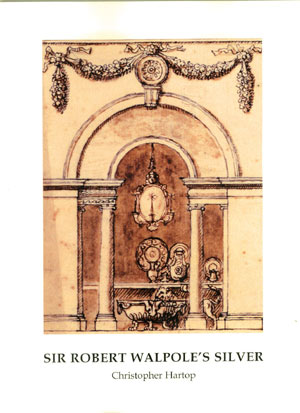 Sir Robert Walpole’s collection of Old Masters, and the building and furnishing of Houghton, the great Palladian house he built in Norfolk, have been the focus of extensive study in recent years, but his silver has not received the same attention. However, the discovery of inventories in the National Archives has allowed a picture to be built up of the sheer scale of Walpole’s silver holdings, which were, like everything else about the man, larger than life. What silver that survives includes some of the most celebrated pieces of Georgian silver, such as the square seal salver made by Paul de Lamerie and engraved by William Hogarth. Walpole probably had more silver than any of his contemporaries with the exception of the king, and the scale of his entertaining at court, in Downing Street and at Houghton was gargantuan.
Christopher Hartop, FSA is the author of numerous books on silver. In 2005 he curated the exhibition Royal Goldsmiths: The Art of Rundell & Bridge 1797–1843. He is a Liveryman of the Worshipful Company of Goldsmiths.
◊ ◊ ◊ ◊ ◊
C O N T E N T S
Chronology of Sir Robert Walpole’s life
Sir Robert Walpole’s Silver
Appendices (including plate in the Strawberry Hill sale, 1842)
Peabody Essex Museum Announces $650Million Advancement Plan
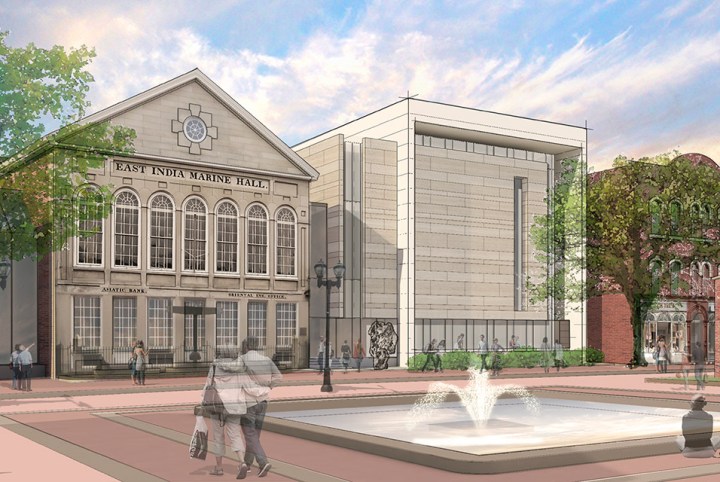
Rendering of the planned expansion of the Peabody Essex Museum in Salem, Massachusetts from Essex Street.
Photo: ©Ennead Architects
◊ ◊ ◊ ◊ ◊
Press release (9 July 2015) from PEM:
The Peabody Essex Museum (PEM) is pleased to announce an updated expansion and facilities plan, an array of infrastructure improvements and new programmatic initiatives as elements of PEM’s landmark $650 million Advancement Campaign, one of the largest art museum campaigns in the country.
“PEM’s Advancement Campaign defines a new model for museum finance, fundraising and operations. The updated plan emphasizes long-term financial stability through substantially increased endowment. By right-sizing facility and infrastructure investments, PEM gains a rare degree of freedom to advance our mission through sustained innovation and focus on new and enhanced programmatic initiatives,” said Dan Monroe, the Rose-Marie and Eijk van Otterloo Director and CEO of PEM.
Sam Byrne and Sean Healey, Co-Chairs of PEM’s Board of Trustees added, “We balanced priorities for this Campaign by allocating $350M to endowment, $200M to facility expansion, and $100M to various infrastructure improvements. To maintain these priorities we have restructured expansion plans to meet our highest priority facility needs, avoid overinvestment in bricks and mortar, and maintain our commitment to long-term financial sustainability and programs.” (more…)
New Book | Les funérailles princières en Europe (XVIe–XVIIIe siècle)
The third and final installment of the princely funeral series is published by Presses Universitaires de Rennes (and soon to be available from Artbooks.com):
Juliusz A. Chrościcki, Mark Hengerer, and Gérard Sabatier, eds., Les funérailles princières en Europe (XVIe–XVIIIe siècle), 3. Le deuil, la mémoire, la politique (Rennes: Presses Universitaires de Rennes, 2015), 440 pages, ISBN: 978-2753540750, 22€ / $42.50.
 Les funérailles princières à l’époque moderne sont médiatisées à travers des rapports d’ambassadeurs, des publications hagiographiques, des documents administratifs ou encore des articles de presse et des gravures à vocation commerciale. La pratique du deuil des souverains, très variable d’un pays à l’autre, est révélatrive de l’état des sociétés et du rapport entre le prince et ses sujets. Ce volume est le dernier d’une trilogie consacrée aux funérailles princières de l’Europe moderne. En coédition avec le Centre de recherche du château de Versailles.
◊ ◊ ◊ ◊ ◊
C O N T E N T S
• Juliusz A. Chroscicki, Mark Hengerer et Gérard Sabatier, Les funérailles princières en Europe, xvie–xviiie siècle
• Mark Hengerer et Gérard Sabatier, La communication, l’opinion publique, la politique
I. UN ÉVÉNEMENT MÉDIATIQUE
• Giovanni Ricci, Dépêches diplomatiques et plaquettes : la connaissance des funérailles royales françaises dans l’Italie de la Renaissance
• Philippe Martin, Une stratégie éditoriale : publier les funérailles de Charles III de Lorraine
• Michel Cassan, L’annonce de la mort d’Henri IV dans le royaume
• Stéphane Haffemayer, La mort des princes dans les gazettes au xviie siècle
• Friedrich Polleross, La gravure et la diffusion de la mort des Habsbourg, xvie–xviiie siècle
II. LE DEUIL DES SOUVERAINS DANS LEUR ROYAUME
• Leonardo Carvalho-Gonçalves, Les funérailles de Manuel Ier au Portugal et à Goa
• Luis Javier Cuesta Hernández, Les funérailles de Philippe IV dans les États de la Couronne d’Espagne
• Ulrich Niggemann, Deuil par condoléances pour Guillaume III en Angleterre
• Bernard Hours, Quand les villes pleurent leur prince: services funèbres provinciaux en France au xviiie siècle
• Britta Kägler, De Bavière ou d’Empire ? Double deuil pour l’empereur Charles VII
• Martin Papenheim, Deuils princiers et impériaux dans l’Empire au xviiie siècle
• Dmitri Zakharine, Le deuil du tsar dans la société russe
III. LES FUNÉRAILLES DES SOUVERAINS ÉTRANGERS : STRATÉGIES MÉMORIELLES
• Sylvène Édouard, « Les nouvelles de la mort du Roy d’Espagne » : réception d’un discours exemplaire
• Kerstin Weiand, La mort d’Henri IV et l’image du Warrior King en Angleterre
• Francis B. Assaf, La mort de Louis XIV commémorée par le premier Bourbon d’Espagne, Madrid 1716
• Sara Mamone, Funerali in effigie : défilé royal à Florence
• Martine Boiteux, Les usages politiques d’un rituel de majesté : les funérailles des souverains étrangers à Rome
• Gesa zur Nieden, L’accompagnement musical des funérailles romaines en l’honneur de princes européens, 1650–1750
• Mark Hengerer, Les monarchies comme famille : les pompes funèbres des souverains étrangers à Vienne, xviie-xixe siècle
• Jean-Marie Le Gall, Une stratégie d’impérialisme dynastique : les pompes funèbres des souverains étrangers à Notre-Dame de Paris, xvie–xviiie siècle
Conclusion
• Gérard Sabatier et Mark Hengerer, Les funérailles princières : un outillage politique performant
Index des noms de personnes
Index des toponymes
Les auteurs
Table des illustrations
Crédits photographiques
Exhibition | La Manufacture des Lumières: La Sculpture à Sèvres
Opening at Sèvres in September:
La Manufacture des Lumières: La Sculpture à Sèvres de Louis XV à la Révolution
Cité de la Céramique, Sèvres, 16 September 2015 — 18 January 2016
Curated by Guilhem Scherf
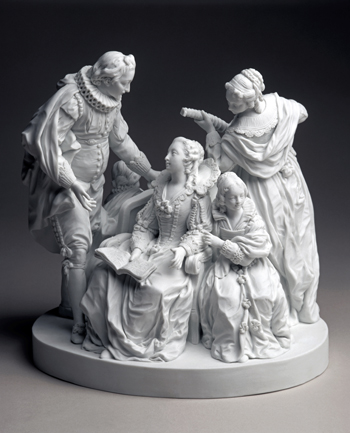
Jean-François Duret, La Mandoline ou La conversation espagnole, 1772 (Collection Sèvres—Cité de la céramique, SCC.2012.2.1)
Raconter l’histoire de la sculpture à Sèvres, de la création de la Manufacture par la volonté de Louis XV et de Madame de Pompadour jusqu’à la période révolutionnaire, permet de dévoiler tour à tour l’excellence du goût des élites de l’Ancien Régime pour la perfection des objets d’art et l’explosion d’une thématique nourrie par le siècle des Lumières.
La sculpture à Sèvres relève d’un processus minutieux partant d’un modèle en terre pour aboutir au biscuit de porcelaine. La surface de porcelaine, non émaillée mais polie, permet ainsi de rivaliser le marbre. Le biscuit de porcelaine, inventé par la Manufacture vers 1752, connait immédiatement un immense succès et a concurrencé la production venant de Chine puis celle de sa grand rivale saxonne, la Manufacture de Meissen.
Les artistes de la Manufacture ont su créer et diffuser des sujets remplis de charme, de délicatesse et de vie sur les thèmes de l’enfance, de la fable et de l’allégorie, de la littérature et de la vie quotidienne tout en innovant dans le domaine du portrait et de l’iconographie politique. Les biscuits exécutés sous la direction des sculpteurs du roi (Falconet, Pajou, Boizot), parfois inspirés par des compositions de Boucher ou de Coypel, ont délecté les amateurs du temps les plus exigeants.
L’exposition présente plus de 80 terres cuites et 120 biscuits de porcelaine, mais aussi des dessins, des estampes, ainsi que des modèles et des moules en plâtre originaux. Cette richesse des collections patrimoniales complétée par des prêts extérieurs, permet de montrer au mieux cette apothéose du goût et de l’excellence artistique que fut la création au XVIIIe siècle des célèbres biscuits de Sèvres.
Cet événement a été rendu possible grâce à la restauration financée par la Fondation BNP Paribas, des modèles originaux en terre cuite du XVIIIe siècle, étape initiale à la production des sculptures en porcelaine.
Après une introduction historique et technique, le parcours de l’exposition se décompose en dix sections. Elles abordent les thèmes du goût pour l’enfance, les animaux, la fable et l’allégorie, le surtout de table, la vie contemporaine, les sujets littéraires, les œuvres religieuses, les portraits, les statuettes des grands hommes et, enfin, la décennie révolutionnaire.
Aujourd’hui, la fabrication de biscuits se poursuit dans les ateliers de la Manufacture de Sèvres, pour certains issus du répertoire de Sèvres, pour d’autres fruits de l’imagination des artistes contemporains invités.
Le commissariat général de l’exposition est assuré par Guilhem Scherf, conservateur en chef au département des sculptures du musée du Louvre, spécialiste de la sculpture du XVIIIe siècle et auteur de nombreux ouvrages. La scénographie est confiée à Cécile Degos.
Le catalogue est édité sous la direction de Tamara Préaud par les éditions Faton. Une première partie traite de la Manufacture de Sèvres, des techniques et de la restauration des terres cuites et du dialogue des arts (l’estampe, la sculpture, le costume). La deuxième est le catalogue des œuvres exposées, selon dix sections. Quant à la dernière partie, elle présente le catalogue sommaire illustré de l’ensemble des sculptures du XVIIIe siècle conservées à Sèvres – Cité de la céramique.
La Cité de la céramique – Sèvres & Limoges et la Société Pyramis Design ont signé un accord de mécénat de compétence en matière de digitalisation 3D. Dans le cadre de l’exposition, grâce à cette technologie, une lecture inédite du surtout de table La Conversation espagnole sera proposée aux visiteurs, en regard de l’œuvre originale.
Tamara Préaud, ed., La Sculpture à Sèvres au XVIIIe Siècle (Dijon: Éditions Faton, 2015), 432 pages, 45€.










 Enfilade
leave a comment