Conference | Sculpture and Parisian Decorative Arts in Europe
From H-ArtHist:
The Role of Sculpture in the Design, Production, Collecting,
and Display of Parisian Decorative Arts in Europe, 1715–1815
Mons, Belgium, 29 August 2015
An international conference on the occasion of Mons European Capital of Culture 2015 and Waterloo 1815–2015 on Saturday, 29 August 2015
Between 1715 and 1830 Paris gradually became the capital of Europe, “a city of power and pleasure, a magnet for people of all nationalities that exerted an influence far beyond the reaches of France,” as Philip Mansel wrote, or as Prince Metternich phrased it, “When Paris sneezes, Europe catches cold.” Within this historical framework and in a time of profound societal change, the consumption and appreciation of luxury goods reached a peak in Paris. The focus of this one-day international conference will be the role of the sculptor in the design and production processes of Parisian decorative arts—from large-scale furniture and interior decoration projects to porcelain, silver, gilt bronzes, and clocks.
In the last few years a number of studies were carried out under the auspices of decorative arts museums and societies such as the Furniture History Society and the French Porcelain Society. It now seems appropriate to bring some of these together to encourage cross-disciplinary approaches on a European level and discussion between all those interested in the materiality and the three-dimensionality of their objects of study. The relationships between, on the one hand, architects, ornemanistes and other designers, and on the other sculptors, menuisiers, ébénistes, goldsmiths, porcelain manufacturers, bronze casters, and other producers, as well as the marchands merciers, will be at the heart of the studies about the design processes.
A second layer of understanding of the importance of sculpture in the decorative arts will be shown in the collecting and display in European capitals in subsequent generations, particularly those immediately after the French Revolution, as epitomised by King George IV. Overall, the intention of this conference is to shed light on the sculptural aspect of decorative arts produced in Paris in the long 18th century and collected and displayed in the capitals of Europe. Without pretending to be exhaustive, this study day—and its publication—hopes to bring together discussions about the histories and methodologies that could lead to furthering the study of hitherto all too often neglected aspects of the decorative arts.
◊ ◊ ◊ ◊ ◊
S A T U R D A Y , 2 9 A U G U S T 2 0 1 5
Maison de la Mémoire de Mons, ancien couvent des Sœurs Noires, rue des Sœurs Noires 2, accessible via the porch on rue du Grand Trou Oudart, Mons
9.00 Registration and coffee
9.45 Welcome and introduction by Jean Schils/Werner Oechslin/Léon Lock
10.00 Session 1: Sculpture as a theme / sculpture as an object, within French decorative arts
Chair: Guilhem Scherf, Musée du Louvre, Paris
• Luca Raschèr, Koller Auktionen, Zürich, Humanité et bestiaire en bronze sur les meubles français du XVIIIe siècle
• Charles Avery, Cambridge, An elephantine rivalry: The ménagerie clocks of Saint-Germain and Caffiéri
• Virginie Desrante, Cité de la Céramique, Sèvres, Petite sculpture et objets de luxe, le biscuit de Sèvres: Une révolution esthétique
• Xavier Duquenne, Brussels, Le sculpteur de la cour Augustin Ollivier, de Marseille, au Palais de Charles de Lorraine à Bruxelles
12.15 Lunch
13.15 Session 2: The role of the sculptor within the design and production processes
• Jean-Dominique Augarde, Centre de Recherches Historiques sur les Maîtres Ébénistes, Paris, De Houdon à Prud’hon, la collaboration entre sculpteurs et bronziers d’ameublement de 1760 à 1820
• Audrey Gay-Mazuel, Musée des Arts Décoratifs, Paris, Du dessin au montage, les sculpteurs dans l’atelier de l’orfèvre parisien Jean-Baptiste-Claude Odiot (1763–1850)
• Jean-Baptiste Corne, Ecole du Louvre/Ecole Pratique des Hautes Etudes, Paris, Le sculpteur ornemaniste à la veille de la Révolution. Une condition sociale en mutation?
15.00 Coffee
15.30 Session 3: French sculptural decorative arts in international perspective
Chair: Werner Oechslin, ETH Zürich/ SBWO Einsiedeln
• Léon Lock, University of Leuven, Comment la rocaille parisienne conquit Munich: Le rôle de l’architecte et ornemaniste François Cuvilliés (Soignies 1695–Munich 1768)
• Guido Jan Bral, Brussels, Les ducs d’Arenberg, mécènes des arts décoratifs parisiens à Bruxelles (1765–1820)
• Timothy Clifford, Former Director, National Galleries of Scotland, Edinburgh, Title to be confirmed.
16.55 Conclusions and discussion
17.15 Reception
◊ ◊ ◊ ◊ ◊
Registration
Free for members of the Low Countries Sculpture Society and of the Maison de la Mémoire of Mons, but registration compulsory: info@lcsculpture.org. Seating is limited so book early to avoid disappointment. Non-members €25 per person.
Optional Lunch
Full sit-down on-site lunch €25 per person, to be booked and paid in advance. Closing date for lunch applications and payments: Wednesday 26 August 2015 at 12 noon.
Hotel Accommodation and Travel from Paris
Hotel rooms have been pre-booked for foreign participants. Anyone wishing to take over these reservations, please contact us. A limited number of train tickets from Paris to Valenciennes and back (with transfer by car to/from Mons) is also available.
Payments
By bank transfer or by credit card (details/forms available on request)
Gala Evening on Friday, 28 August
Those who register for the international conference, will receive an invitation to attend the Gala Evening organised the night before in a spectacular country house not far from Mons. This evening will see the launch of the European Sculpture and Decorative Arts Library Appeal.
Exhibition | Scottish Artists 1750–1900: From Caledonia to the Continent
Press release (5 May 2015) from the Royal Collection Trust:
Scottish Artists 1750–1900: From Caledonia to the Continent
The Queen’s Gallery, Palace of Holyroodhouse, Edinburgh, 6 August 2015 — 7 February 2016
The Queen’s Gallery, Buckingham Palace, London, 18 March — 9 October 2016

Allan Ramsay, Queen Charlotte with her two Eldest Sons, ca. 1764-69 (London: Royal Collection Trust, RCIN 404922)
From the romantic landscapes of Caledonia to exotic scenes from the Continent, a new exhibition at The Queen’s Gallery, Palace of Holyroodhouse is the first dedicated to Scottish art in the Royal Collection. Bringing together over 80 works, including paintings and drawings by the celebrated artists Allan Ramsay and Sir David Wilkie, Scottish Artists 1750–1900: From Caledonia to the Continent tells the story of royal patronage and of the emergence of a distinctive Scottish school of art.
Allan Ramsay (1713–1784) was the first Scottish artist of European significance. A pre-eminent figure of the Enlightenment, the intellectual movement that swept across Europe in the 18th century, Ramsay maintained close friendships with philosophers such as David Hume and Jean-Jacques Rousseau. In 1760 he was commissioned to paint George III’s State portrait and subsequently became the first Scot to be appointed to the role of Principal Painter in Ordinary to His Majesty. Depicting the King in sumptuous coronation robes and breeches of cloth of gold, Ramsay produced the definitive image of George III and the most frequently copied royal portrait of all time.
Ramsay worked as a court artist, painting members of the royal family and producing copies of the coronation portrait for the King to send as gifts to ambassadors and governors. He enjoyed a good relationship with the Queen Consort, and his painting Queen Charlotte and her Two Eldest Sons, 1764, considered to be among Ramsay’s greatest works, combines the grandeur of a royal portrait with the intimacy of a domestic scene.
Over half a century later, Fife-born artist Sir David Wilkie (1785–1841) gained even wider recognition than Ramsay. His vivid, small-scale scenes of everyday life, inspired by those of the Dutch masters, were shown at the Royal Academy to great acclaim. Wilkie attracted the attention of the Prince Regent (the future George IV), who was acquiring 17th-century Dutch and Flemish genre paintings for his own collection. The artist’s reputation was sealed with two high-profile royal commissions – Blind-Man’s-Buff, 1812, and The Penny Wedding, 1818, which shows the uniquely Scottish custom of wedding guests contributing a penny towards the cost of the festivities and a home for the newly married couple.
George IV’s visit to Scotland in 1822, the first by a reigning British monarch for nearly two centuries, offered a major opportunity for royal patronage. Artists were given prime access to all of the events in the two-week programme, which was masterminded by the writer Sir Walter Scott. The entrance of the King to his Scottish residence is captured in Wilkie’s The Entrance of George IV to Holyroodhouse, 1822–30. The King is shown being presented with the keys to the Palace, while crowds of enthusiastic spectators clamber over every part of the building to see him.
After suffering a nervous breakdown, brought on by overwork and a series of family tragedies, Wilkie set off on a prolonged visit to the Continent. He was one of the first professional artists to visit Spain after the Spanish War of Independence of 1808–14. Wilkie’s travels proved to be a turning point in his art, which became much broader in style and took inspiration from contemporary events. On the artist’s return in 1828, the King summoned Wilkie to Windsor and purchased five continental pictures—A Roman Princess Washing the Feet of Pilgrims, 1827, I Pifferari, 1827, The Defence of Saragossa, 1828, The Spanish Posada, 1828, and The Guerilla’s Departure, 1828—and commissioned The Guerilla’s Return, 1830. The same year, the King appointed Wilkie to the position of Principal Painter in Ordinary, a post that the artist continued to hold under William IV and Queen Victoria.
Queen Victoria and Prince Albert saw their roles as patrons of the arts as part of the duty of Monarchy. Several pictures by Scottish artists were among the birthday and Christmas presents exchanged by the royal couple throughout their married life, including works by Sir Joseph Noël Paton (1821–1901), David Roberts (1796–1864), James Giles (1801–1870) and John Phillip (1817–1867). Queen Victoria had a deep love of Scotland and commissioned artists to record the country’s ‘inexpressibly beautiful’ scenery, including that of her recently acquired estate, Balmoral, in the Highlands. Among those artists was the Glaswegian William Leighton Leitch (1804–1883), who was appointed the Queen’s drawing master in 1846. Of all the Scottish artists whose work was collected by Victoria and Albert, it was William Dyce who was most in tune with Prince Albert’s tastes. Dyce was inspired by the early Italian art so admired by Albert, who purchased Dyce’s The Madonna and Child, 1845, and the following year commissioned a companion picture, St Joseph.
In the same period, the publication of travel books and growing interest in foreign cultures encouraged artists to seek inspiration abroad. David Roberts introduced British audiences to scenes of Egypt and the Holy Land, and was the first independent professional artist to travel extensively in the Middle East. A View of Cairo, 1840, shows the medieval Gate of Zuweyleh, and was one of Roberts’ first paintings of the region to be exhibited. Queen Victoria commissioned two Spanish pictures from Roberts as gifts for Prince Albert: A View of Toledo and the River Tagus, 1841, and The Fountain on the Prado, Madrid, 1841.
In the mid-19th century, there was a growing interest in Spanish culture, which was heavily romanticised in the literature of the day. When the artist John Phillip travelled to the country, his subject-matter changed from Scottish rural scenes to Spanish street life. Queen Victoria commissioned Phillip’s A Spanish Gypsy Mother, 1852, and purchased ‘El Paseo’, 1854, for Prince Albert. The Prince gave the Queen The Letter Writer of Seville, 1854, for Christmas. After a visit to the Royal Academy in 1858, Victoria acquired The Dying Contrabandista as a Christmas gift for the Prince that year. John Phillip was Queen Victoria’s favourite Scottish artist and, on his death in 1867, he was mourned by the monarch as ‘our greatest painter’.
Some notable Scottish works entered the Royal Collection in 1888, on the occasion of the opening of the Glasgow International Exhibition of Science, Art and Industry by the Prince of Wales (the future King Edward VII). This exhibition, held in Kelvingrove Park, was one of a series of international exhibitions and world fairs that dominated the cultural scene in the second half of the 19th century and the largest to be held in Scotland. The Prince and Princess of Wales were presented with ‘two elegant albums of paintings by members of the Glasgow Art Club’, including work by the Glasgow Boys: Sir James Guthrie (1859–1930), EA Walton (1860–1922) and Robert Macaulay Stevenson (1860–1952).
Scottish Artists 1750–1900: From Caledonia to the Continent is part of the Edinburgh Art Festival.
◊ ◊ ◊ ◊ ◊
Distributed in the U.S. by The University of Chicago Press:
Deborah Clarke and Vanessa Remington, Scottish Artists 1750–1900: From Caledonia to the Continent (London: Royal Collection Trust, 2015), 210 pages, ISBN: 978-1909741201, $25.
 Throughout its history, Scotland has produced a wealth of great works of art, and the Scottish Enlightenment in particular provided a powerful impetus for new forms of art and new artistic subjects. This survey of Scottish art in the Royal Collection brings together more than one hundred reproductions of works from the Enlightenment to the twentieth century to highlight the importance and influence of this period, while also sharing recent research on the subject.
The first book devoted to Scottish art in the Royal Collection, Scottish Artists fully explores this rich artistic tradition, incorporating discussions of artists whose inspiration remained firmly rooted in their native land, such as Alexander Nasmyth and James Giles, as well as artists who were born in Scotland and traveled abroad, from the eighteenth-century portraitist Allan Ramsay to David Wilkie, who traveled to London and is well-known for his paintings portraying everyday life. Broadly chronological, the book also traces the royal patronage of Scottish artists throughout the centuries, including works collected by monarchs from George III to Queen Victoria, and the official roles, Royal Limner for Scotland and King’s Painter in Ordinary.
New Title | Sir Robert Walpole’s Silver
From ACC Distribution:
Christopher Hartop, Sir Robert Walpole’s Silver, Special Issue of Silver Studies 30 (Cambridge: John Adamson, 2015), 64 pages, ISBN: 978-0954914431, $25.
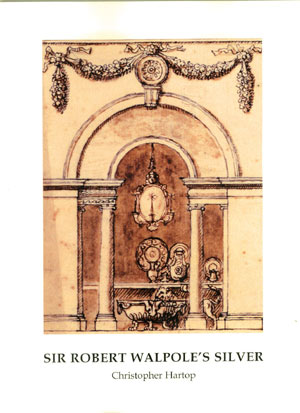 Sir Robert Walpole’s collection of Old Masters, and the building and furnishing of Houghton, the great Palladian house he built in Norfolk, have been the focus of extensive study in recent years, but his silver has not received the same attention. However, the discovery of inventories in the National Archives has allowed a picture to be built up of the sheer scale of Walpole’s silver holdings, which were, like everything else about the man, larger than life. What silver that survives includes some of the most celebrated pieces of Georgian silver, such as the square seal salver made by Paul de Lamerie and engraved by William Hogarth. Walpole probably had more silver than any of his contemporaries with the exception of the king, and the scale of his entertaining at court, in Downing Street and at Houghton was gargantuan.
Christopher Hartop, FSA is the author of numerous books on silver. In 2005 he curated the exhibition Royal Goldsmiths: The Art of Rundell & Bridge 1797–1843. He is a Liveryman of the Worshipful Company of Goldsmiths.
◊ ◊ ◊ ◊ ◊
C O N T E N T S
Chronology of Sir Robert Walpole’s life
Sir Robert Walpole’s Silver
Appendices (including plate in the Strawberry Hill sale, 1842)
Peabody Essex Museum Announces $650Million Advancement Plan
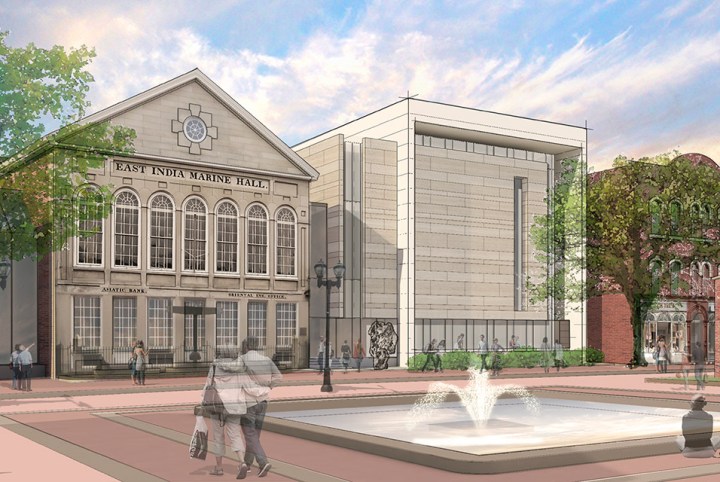
Rendering of the planned expansion of the Peabody Essex Museum in Salem, Massachusetts from Essex Street.
Photo: ©Ennead Architects
◊ ◊ ◊ ◊ ◊
Press release (9 July 2015) from PEM:
The Peabody Essex Museum (PEM) is pleased to announce an updated expansion and facilities plan, an array of infrastructure improvements and new programmatic initiatives as elements of PEM’s landmark $650 million Advancement Campaign, one of the largest art museum campaigns in the country.
“PEM’s Advancement Campaign defines a new model for museum finance, fundraising and operations. The updated plan emphasizes long-term financial stability through substantially increased endowment. By right-sizing facility and infrastructure investments, PEM gains a rare degree of freedom to advance our mission through sustained innovation and focus on new and enhanced programmatic initiatives,” said Dan Monroe, the Rose-Marie and Eijk van Otterloo Director and CEO of PEM.
Sam Byrne and Sean Healey, Co-Chairs of PEM’s Board of Trustees added, “We balanced priorities for this Campaign by allocating $350M to endowment, $200M to facility expansion, and $100M to various infrastructure improvements. To maintain these priorities we have restructured expansion plans to meet our highest priority facility needs, avoid overinvestment in bricks and mortar, and maintain our commitment to long-term financial sustainability and programs.” (more…)
New Book | Les funérailles princières en Europe (XVIe–XVIIIe siècle)
The third and final installment of the princely funeral series is published by Presses Universitaires de Rennes (and soon to be available from Artbooks.com):
Juliusz A. Chrościcki, Mark Hengerer, and Gérard Sabatier, eds., Les funérailles princières en Europe (XVIe–XVIIIe siècle), 3. Le deuil, la mémoire, la politique (Rennes: Presses Universitaires de Rennes, 2015), 440 pages, ISBN: 978-2753540750, 22€ / $42.50.
 Les funérailles princières à l’époque moderne sont médiatisées à travers des rapports d’ambassadeurs, des publications hagiographiques, des documents administratifs ou encore des articles de presse et des gravures à vocation commerciale. La pratique du deuil des souverains, très variable d’un pays à l’autre, est révélatrive de l’état des sociétés et du rapport entre le prince et ses sujets. Ce volume est le dernier d’une trilogie consacrée aux funérailles princières de l’Europe moderne. En coédition avec le Centre de recherche du château de Versailles.
◊ ◊ ◊ ◊ ◊
C O N T E N T S
• Juliusz A. Chroscicki, Mark Hengerer et Gérard Sabatier, Les funérailles princières en Europe, xvie–xviiie siècle
• Mark Hengerer et Gérard Sabatier, La communication, l’opinion publique, la politique
I. UN ÉVÉNEMENT MÉDIATIQUE
• Giovanni Ricci, Dépêches diplomatiques et plaquettes : la connaissance des funérailles royales françaises dans l’Italie de la Renaissance
• Philippe Martin, Une stratégie éditoriale : publier les funérailles de Charles III de Lorraine
• Michel Cassan, L’annonce de la mort d’Henri IV dans le royaume
• Stéphane Haffemayer, La mort des princes dans les gazettes au xviie siècle
• Friedrich Polleross, La gravure et la diffusion de la mort des Habsbourg, xvie–xviiie siècle
II. LE DEUIL DES SOUVERAINS DANS LEUR ROYAUME
• Leonardo Carvalho-Gonçalves, Les funérailles de Manuel Ier au Portugal et à Goa
• Luis Javier Cuesta Hernández, Les funérailles de Philippe IV dans les États de la Couronne d’Espagne
• Ulrich Niggemann, Deuil par condoléances pour Guillaume III en Angleterre
• Bernard Hours, Quand les villes pleurent leur prince: services funèbres provinciaux en France au xviiie siècle
• Britta Kägler, De Bavière ou d’Empire ? Double deuil pour l’empereur Charles VII
• Martin Papenheim, Deuils princiers et impériaux dans l’Empire au xviiie siècle
• Dmitri Zakharine, Le deuil du tsar dans la société russe
III. LES FUNÉRAILLES DES SOUVERAINS ÉTRANGERS : STRATÉGIES MÉMORIELLES
• Sylvène Édouard, « Les nouvelles de la mort du Roy d’Espagne » : réception d’un discours exemplaire
• Kerstin Weiand, La mort d’Henri IV et l’image du Warrior King en Angleterre
• Francis B. Assaf, La mort de Louis XIV commémorée par le premier Bourbon d’Espagne, Madrid 1716
• Sara Mamone, Funerali in effigie : défilé royal à Florence
• Martine Boiteux, Les usages politiques d’un rituel de majesté : les funérailles des souverains étrangers à Rome
• Gesa zur Nieden, L’accompagnement musical des funérailles romaines en l’honneur de princes européens, 1650–1750
• Mark Hengerer, Les monarchies comme famille : les pompes funèbres des souverains étrangers à Vienne, xviie-xixe siècle
• Jean-Marie Le Gall, Une stratégie d’impérialisme dynastique : les pompes funèbres des souverains étrangers à Notre-Dame de Paris, xvie–xviiie siècle
Conclusion
• Gérard Sabatier et Mark Hengerer, Les funérailles princières : un outillage politique performant
Index des noms de personnes
Index des toponymes
Les auteurs
Table des illustrations
Crédits photographiques
Exhibition | La Manufacture des Lumières: La Sculpture à Sèvres
Opening at Sèvres in September:
La Manufacture des Lumières: La Sculpture à Sèvres de Louis XV à la Révolution
Cité de la Céramique, Sèvres, 16 September 2015 — 18 January 2016
Curated by Guilhem Scherf
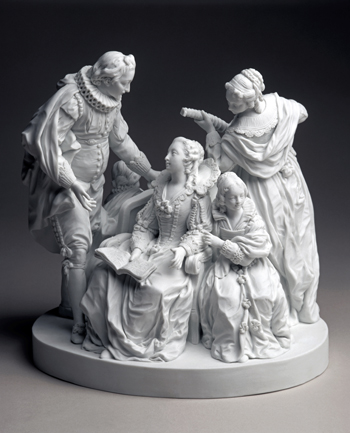
Jean-François Duret, La Mandoline ou La conversation espagnole, 1772 (Collection Sèvres—Cité de la céramique, SCC.2012.2.1)
Raconter l’histoire de la sculpture à Sèvres, de la création de la Manufacture par la volonté de Louis XV et de Madame de Pompadour jusqu’à la période révolutionnaire, permet de dévoiler tour à tour l’excellence du goût des élites de l’Ancien Régime pour la perfection des objets d’art et l’explosion d’une thématique nourrie par le siècle des Lumières.
La sculpture à Sèvres relève d’un processus minutieux partant d’un modèle en terre pour aboutir au biscuit de porcelaine. La surface de porcelaine, non émaillée mais polie, permet ainsi de rivaliser le marbre. Le biscuit de porcelaine, inventé par la Manufacture vers 1752, connait immédiatement un immense succès et a concurrencé la production venant de Chine puis celle de sa grand rivale saxonne, la Manufacture de Meissen.
Les artistes de la Manufacture ont su créer et diffuser des sujets remplis de charme, de délicatesse et de vie sur les thèmes de l’enfance, de la fable et de l’allégorie, de la littérature et de la vie quotidienne tout en innovant dans le domaine du portrait et de l’iconographie politique. Les biscuits exécutés sous la direction des sculpteurs du roi (Falconet, Pajou, Boizot), parfois inspirés par des compositions de Boucher ou de Coypel, ont délecté les amateurs du temps les plus exigeants.
L’exposition présente plus de 80 terres cuites et 120 biscuits de porcelaine, mais aussi des dessins, des estampes, ainsi que des modèles et des moules en plâtre originaux. Cette richesse des collections patrimoniales complétée par des prêts extérieurs, permet de montrer au mieux cette apothéose du goût et de l’excellence artistique que fut la création au XVIIIe siècle des célèbres biscuits de Sèvres.
Cet événement a été rendu possible grâce à la restauration financée par la Fondation BNP Paribas, des modèles originaux en terre cuite du XVIIIe siècle, étape initiale à la production des sculptures en porcelaine.
Après une introduction historique et technique, le parcours de l’exposition se décompose en dix sections. Elles abordent les thèmes du goût pour l’enfance, les animaux, la fable et l’allégorie, le surtout de table, la vie contemporaine, les sujets littéraires, les œuvres religieuses, les portraits, les statuettes des grands hommes et, enfin, la décennie révolutionnaire.
Aujourd’hui, la fabrication de biscuits se poursuit dans les ateliers de la Manufacture de Sèvres, pour certains issus du répertoire de Sèvres, pour d’autres fruits de l’imagination des artistes contemporains invités.
Le commissariat général de l’exposition est assuré par Guilhem Scherf, conservateur en chef au département des sculptures du musée du Louvre, spécialiste de la sculpture du XVIIIe siècle et auteur de nombreux ouvrages. La scénographie est confiée à Cécile Degos.
Le catalogue est édité sous la direction de Tamara Préaud par les éditions Faton. Une première partie traite de la Manufacture de Sèvres, des techniques et de la restauration des terres cuites et du dialogue des arts (l’estampe, la sculpture, le costume). La deuxième est le catalogue des œuvres exposées, selon dix sections. Quant à la dernière partie, elle présente le catalogue sommaire illustré de l’ensemble des sculptures du XVIIIe siècle conservées à Sèvres – Cité de la céramique.
La Cité de la céramique – Sèvres & Limoges et la Société Pyramis Design ont signé un accord de mécénat de compétence en matière de digitalisation 3D. Dans le cadre de l’exposition, grâce à cette technologie, une lecture inédite du surtout de table La Conversation espagnole sera proposée aux visiteurs, en regard de l’œuvre originale.
Tamara Préaud, ed., La Sculpture à Sèvres au XVIIIe Siècle (Dijon: Éditions Faton, 2015), 432 pages, 45€.
The Alamo Now a World Heritage Site
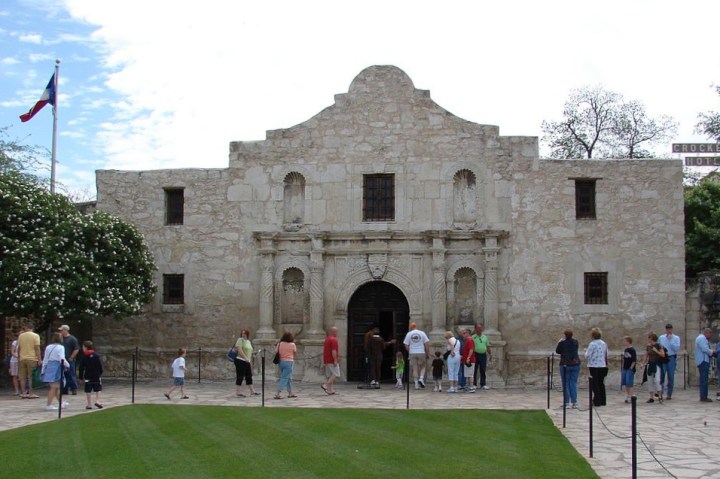
The Alamo, San Antonio
(Wikimedia Commons, 18 April 2007)
◊ ◊ ◊ ◊ ◊
As reported by Reuters, via The Guardian (5 July 2015). . .
Alamo Named First World Heritage Site in Texas after Nine-Year Campaign
Spanish colonial missions in San Antonio chosen as part of 23rd US site deemed of ‘outstanding importance’ to human heritage
A United Nations agency on Sunday [5 July 2015] named the Alamo and the four Spanish colonial Catholic missions in San Antonio a World Heritage Site, making them the first places in Texas deemed to be of “outstanding cultural or natural importance to the common heritage of humanity.”
The decision capped a nine-year campaign by San Antonio and Texas to have the early 18th-century missions listed alongside world treasures such as Stonehenge, the Taj Mahal and Angkor Wat. The missions are now the 23rd World Heritage Site in the US.
“The city of San Antonio is delighted with Unesco’s decision today and the recognition that our Spanish colonial missions are of outstanding value to the people of the world,” mayor Ivy Taylor said from Bonn, Germany, where the announcement was made.
Sarah Gould, archivist at the Institute of Texan Cultures, said there were many reasons for the listing of the four missions, which are still used as Catholic churches, and the Alamo, a fortified church, barracks and other buildings that was the scene of the 1836 battle for Texan independence. . . .
But the designation has not been entirely embraced in Texas, where the phrase ‘United Nations’ provokes suspicion among some. . . .
The full article is available here»
Call for Papers | Fabrications: Designing for Silk in the 18th Century
From H-ArtHist:
Fabrications: Designing for Silk in the 18th Century
The Courtauld Institute of Art, London, 5 March 2016
Proposals due by 4 September 2015
Organised by Katie Scott and Lesley Miller
Joubert de la Hiberderie’s Le Dessinateur d’étoffes d’or, d’argent, et de soie (1765) was the first book to be published on textile design in Europe. In preparation for the publication of an English translation and critical edition of the text this one day conference calls for papers that will analyse, critique, contextualise, review or otherwise engage with the Le Dessinateur in the light of its themes: production, design, technology, education, botany and art. Joubert’s manual argues for both a liberal and a technological education for the ideal designer. Such a person must, he argues, have detailed knowledge of the materials, technologies and traditions of patterned silk in order successfully to propose new designs; he or she must also have taste and an eye for beauty, which call, he says, for travel in order to see both the beauties of nature and those of art gathered in the gardens and galleries of Paris and the île de France.
We invite contributions from historians—of the book, of art and design, of science, of technology, and of matters social, industrial and economic. General questions we hope the conference will consider are: Who did Joubert hope to address through his book and to what end? What was the international reach of the book? And what other texts were its competitors? What does Le Dessinateur tell us about the status, role and skills of the designer? How did attitudes to gender inform Joubert’s notion of design and manufacture? How did his ideal designer compare to what we know about the careers and livelihoods of designers at Lyons and elsewhere? What relationship did Joubert envisage between design and technology, drawing and weaving? We welcome proposals that address silk in its uniqueness and also those attentive to its relations of difference and similarity to other textile technologies. Finally, we welcome submissions from writers and critics on contemporary textiles interested in thinking about issues of fabric threaded through concerns and examples from the past.
Whatever the historical perspective, we call for submissions that engage with the priorities and explicit arguments of Joubert’s text and also those that look at it awry: for example, with a view to the phenomenology as well as the technology of production, or with respect to the cut, tuck and fold as well than the plane in design, with regard also to the iterations of pattern in use as well as the invention of singular design motifs, or to give one last example, in relation to tradition and memory as well as novelty and fashion.
Please send your proposed title, a brief 150 word abstract and a short CV to Katie Scott (katie.scott@courtauld.ac.uk) and Lesley Miller (le.miller@vam.ac.uk) by Friday, 4th September. Some financial support for travel expenses may be available.
Call for Papers | Symposium of the Association of Print Scholars
Inaugural Symposium of the Association of Print Scholars
Hunter College, City University of New York (CUNY), New York, 7 November 2015
Proposals due by 15 August 2015
Organized by Maeve Coudrelle (Tyler School of Art, Temple University), Allison Rudnick (The Graduate Center, CUNY and The Metropolitan Museum of Art), Britany Salsbury (RISD Museum), and Christina Weyl (Independent Scholar)
The Association of Print Scholars (APS) is pleased to announce a symposium to support new critical ideas and research about printmaking. The event will occur during Print Week in New York, which includes major events such as the IFPDA Print Fair, the E/AB Fair and more. We invite two types of proposals:
• 20-minute papers for a scholarly panel entitled ‘Method, Material and Meaning: Technical Art History and the Study of Prints’ (details below)
• 5-minute presentations for the Graduate Student Lightning Round; proposed papers should come from
current graduate students at the dissertation stage
Interested participants are invited to submit an abstract of no more than 500 words along with a CV or brief biographical statement by August 15 to symposium@printscholars.org. Please indicate in the subject line which type of paper (scholarly session or lightning round) you are proposing and apply to only one session type. Non-members may submit abstracts, but presenters must be APS members by the time of the symposium.
Method, Material, and Meaning: Technical Art History and the Study of Prints
Technical art history, an interdisciplinary methodology with growing popularity among scholars, curators, and conservators, draws connections between an object’s making and its interpretation. The application of technical art history to the study of prints is particularly fruitful as printmakers often draw upon diverse and complex techniques in order to generate imagery. From the sixteenth-century engravings of Hendrik Goltzius, who skillfully imitated other media, to the prints of contemporary artist Kiki Smith, who produces fleshy bodies on thin, skin-like Gampi paper, printmakers throughout history have engaged a variety of processes and materials in order to elicit particular ideas, emotions, or interactions. The selection of technique, matrix, ink, varnish or support may have a profound effect on the final product and its meaning.
This conference seeks to investigate the relationship between specific technical choices made by printmakers, printers, or publishers in order to rethink more broadly the relationship between process, material and meaning in the graphic arts. We seek papers that focus on a wide range of chronological periods and geographic locations in order to highlight overarching methodological issues. Questions to consider:
• How can technical analysis aid in understanding artists’ strategic decisions, including their use of printmaking within a larger multimedia practice?
• What can conservation science tell us about the life and contemporary importance of a print?
• How has print scholarship grown beyond connoisseurship, towards a more holistic account of engagement with the viewer?
• How does the transfer of information from the matrix to the receiving surface affect the resulting imagery and its significance?
APS is a nonprofit members’ group for enthusiasts of printmaking that brings together the diverse print community: curators, collectors, academics, graduate students, artists, conservators, critics, independent scholars, and art dealers. APS’s goals are to encourage innovative and interdisciplinary study of printmaking and to facilitate dialogue among its members.
Call for Papers | Early Modern Artistic Lexicography, 1600–1750
From H-ArtHist:
Early Modern Artistic Lexicography: Words for Theory, Words for Practice
Forms, Uses, and Issues in Early Modern Artistic Lexicography, 1600–1750
Montpellier, 15–17 June 2016
Proposals due by 15 October 2015
In the prospect of the circulation of concepts and practices and the permeability of artistic boundaries, the project LexArt—Words of Art: The Rise of a Terminology (1600–1750) which began in April 2013, studies the development of artistic vocabulary in the seventeenth-century, beginning with the Italian vocabulary of the great foundational texts, and how it transforms in the first part of the eighteenth-century among North European theorists in relation with artistic practices in France, Germany, England and the Netherlands. Words are agents in the circulation of concepts, and turn out to be a significant site of experimentation, dissemination, transfers and networks across artistic communities in early modern Europe. Though the chronological and geographical boundaries, as well as the scope of the LexArt project itself are defined precisely, the purpose of this symposium is the necessary confrontation with other patterns from a methodological and conceptual perspective, and the extending of precise themes in order to provide a theoretical as well as concrete framework for the tools being developed by the LexArt project, namely the database (web application with interface under development), and the Encyclopedic Dictionary of artistic Terminology (in preparation) which are both based on publication of specific and targeted sources. This symposium proposes various directions and fields of research through interdisciplinary and related approaches, to better grasp and define the forms, uses and issues of early modern artistic theory.
1. Books on art
This interdisciplinary session examines the book as object in the broadest possible sense: from the publication of a book to its dissemination and its audiences, but also its composition (index, glossaries, table of contents). It may also consider the place and role of illustrations in texts on art, the complementarity or discrepancy between illustrations and text, the use and revival of models, as well as the confrontation between literary and visual descriptions of the work of art.
2. Languages: the book as lexical laboratory
To provide a more comprehensive account of the issues at stake, this session considers topics that lie beyond the geographical and chronological scope of the LexArt Project. Different approaches may be imagined from examples found in historical lexicography from Baldinucci to the Encyclopédie méthodique: the mutation of lexical models from classical antiquity or from foundational Italian texts in early modern Europe; the vocabulary of theoretical texts versus that of artistic biographies; poetical language in the theory of art: words and the idiom of an artistic theory.
3. Words and practices: from the studio to the Academy
This session addresses the rapport between theory and practice, and more specifically the transfer of knowledge through the words used in texts on art. It will explore the connections and differences between the appearance of a word and its practice as well as more generally the question of jargon or the relation between words and artistic professions.
4. Translating words
The session approaches artistic lexicography by looking at strategies and process of transfers in textual translations from the early modern era. As well as focusing on networks, it may examine the use of multilingualism in historical lexicography, the notion of transfer as an element of conciliation or differentiation, or even leading to loss of meaning, and more generally on the life of European transfer networks between vivification, transformation, forgotten or abandonment, or the role of the translator as creator of words.
5. Workshop (or round table discussion): Questions, themes and perspectives
This session welcomes contributions that focus on methods of research or more general issues of methodology related to the construction of databases or other web-based instruments.
• The publication of illustrations: selection and indexation of images in databases.
• Cartography, the atlas of words, and the dictionary: the genealogy and typology of words and their topography, the transfer of words from a text to a figured word in an atlas.
• Paradigms of research and interactivity in databases: computerization, digitalization, navigation.
• Questions and perspectives: using concrete examples to think about the use of computer systems for the study of artistic lexicography according to different objects (whether monographic or transversal) but also to raise questions about use and misuse of these new tools.
Submission Modalities
• abstracts for papers should be no longer than 400 or 500 words and be headed by a title
• they can be in either French or English
• they should be complemented by a CV
• each proposal will be examined by the Scientific Committee of LexArt
Proposals should be sent to these two addresses: michele-caroline.heck@univ-montp3.fr and marianne.freyssinet@univ-montp3.fr
Scientific Committee
• Michèle-Caroline Heck, porteur du projet LexArt, Professeur d’histoire de l’art moderne – Université Paul-Valéry Montpellier 3
• Jan Blanc, Professeur d’histoire de l’art moderne – Université de Genève
• Olivier Bonfait, Professeur d’histoire de l’art moderne – Université de Bourgogne
• Ralph Dekoninck, Professeur d’histoire de l’art moderne – Université catholique de Louvain
• Emmanuelle Henin, Professeur de littérature française – Université de Reims Champagne-Ardenne
• Cecilia Hurley, Enseignant-chercheur (HDR) – Ecole du Louvre et Université de Neuchâtel
• Thomas Kirchner, Professeur d’histoire de l’art moderne – Directeur du Deutsches Forum für Kunstgeschichte – Max Weber Stifung
• Christian Michel, Professeur d’histoire de l’art moderne – Université de Lausanne
• Alessandro Nova, Professeur d’histoire de l’art – Directeur du Kunsthistorisches Institut in Florenz – Max-Planck-Institut
• Caroline Van Eck, Professeur d’histoire de l’art moderne – Universiteit Leiden










 Enfilade
leave a comment