New Book | Ireland: Crossroads of Art and Design, 1690–1840
In connection with the exhibition now on view the Art Institute of Chicago, Yale University Press is distributing the catalogue (congratulations, Ireland, on an inspiring weekend). –CH
William Laffan and Christopher Monkhouse, eds., with Leslie Fitzpatrick, Ireland: Crossroads of Art and Design, 1690–1840 (New Haven: Yale University Press, 2015), 288 pages, ISBN: 978-0300210606, $50.
 This groundbreaking book captures a period in Ireland’s history when countless foreign architects, artisans, and artists worked side by side with their native counterparts. Nearly all of the works within this remarkable volume—many of them never published before—have been drawn from North American collections. This catalogue accompanies the first exhibition to celebrate the Irish as artists, collectors, and patrons over 150 years of Ireland’s sometimes turbulent history.
Featuring the work of a wide range of artists—known and unknown—and a diverse array of media, the catalogue also includes an impressive assembly of essays by a pre-eminent group of international experts working on the art and cultural history of Ireland. Major essays discuss the subjects of the Irish landscape and tourism, Irish country houses, and Dublin’s role as a center of culture and commerce. Also included are numerous shorter essays covering a full spectrum of topics and artworks, including bookbinding, ceramics, furniture, glass, mezzotints, miniatures, musical instruments, pastels, silver, and textiles.
William Laffan is an art historian and author, and former editor of Irish Architectural and Decorative Studies: The Journal of the Irish Georgian Society. Christopher Monkhouse is the chair and Eloise W. Martin Curator, Department of European Decorative Arts, at the Art Institute of Chicago.
Exhibition | Shifting Patterns: Pacific Barkcloth Clothing
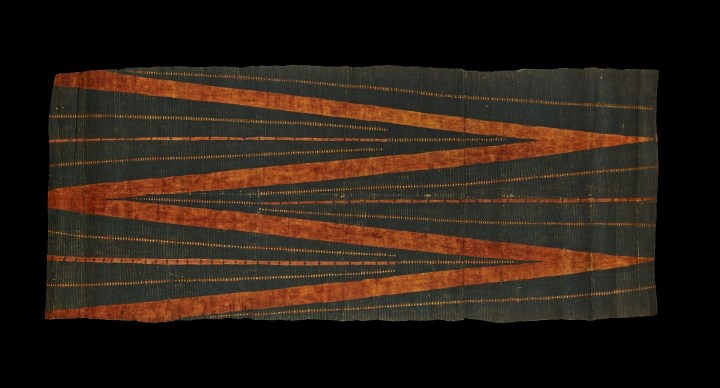
Barkcloth, kua’ula, Hawaiian Islands, Eastern Polynesia, late 18th Century
(London: The British Museum)
◊ ◊ ◊ ◊ ◊
Now on view at The British Museum:
Shifting Patterns: Pacific Barkcloth Clothing
The British Museum, London, 5 February — 6 December 2015
Discover a selection of textiles from the Pacific made from barkcloth. Used to wrap, drape and adorn the body in a myriad of styles and designs, these garments demonstrate the long history of barkcloth, and its ongoing relevance today.
In the islands of the Pacific, cloth made from the inner bark of trees is a distinctive art tradition. Probably brought to the region at least 5,000 years ago by some of the first human settlers, its designs reflect the histories of each island group and the creativity of the makers. Spanning the region from New Guinea in the west to Rapa Nui (Easter Island) in the east, the exhibition will show a selection of 77 garments, headdresses, masks and body adornments from the Museum’s collection. Dating from the 1700s to 2014, the pieces on display include those worn as everyday items and ceremonial costumes linked to key life cycle events such as initiation and marriage.
Barkcloth is generally made and decorated by women, but garments intended for ritual purposes may be made by men. This is particularly true in the masking traditions of Papua New Guinea. The Baining people who live on the large island of New Britain continue to make masks for day and night dances. In the exhibition, an elaborately decorated Baining mask made in the 1970s demonstrates how barkcloth can be used in dramatic three-dimensional creations.
Imported cloth and the changes brought by colonial activities across the region have had different impacts on the art form. In some locations, such as Tonga, barkcloth making never completely stopped. In others, such as Hawaii, the practice has actively been revived and Hawaiian kapa is now worn for high profile hula performances. The exhibition considers these recent developments, and shows a barkcloth dance skirt made in 2014 by Hawaiian practitioner Dalani Tanahy alongside some fine examples of early Hawaiian cloth, including a cloth with striking red and black designs thought to have been made in the late 1700s.
New arenas for cultural expression continue to emerge through barkcloth creations, as urban Pacific Island designers incorporate barkcloth elements and patterns into garments intended for the catwalk. A stunning wedding dress made by New Zealand-based Samoan designer, Paula Chan Cheuk illustrates this movement and reflects the continuing relevance of barkcloth as a flexible, resilient art tradition.
Study Day | Close-up and Personal: Eighteenth-Century Gold Boxes
In conjunction with the exhibition Close-up & Personal, The Fitzwilliam is hosting a study day in June:
Gold Boxes: Manufacture and Marketing from the 18th Century to the Present Day
A Rosalinde and Arthur Gilbert Collection Study Day
The Fitzwilliam Museum, Cambridge, 26 June 2015
Lavish and intricate gold boxes of the eighteenth century are amongst the most beautiful objects ever made. These delicate and refined miniatures contained snuff—powdered tobacco. These boxes enjoy a unique status as objects of desire. Speakers including expert auctioneers, conservators, curators, goldsmiths, and scholars will celebrate their exquisite materials and subtle significance. The day is made possible through the generosity of the Gilbert Trust for the Arts, London. £10. Booking is essential: telephone 01223 332904 or email education@fitzmuseum.cam.ac.uk.
◊ ◊ ◊ ◊ ◊
 P R O G R A M M E
10:30 Registration and coffee
11:00 Welcome and introduction, Heike Zech, Senior Gilbert Curator, Victoria and Albert Museum
11:10 ‘Buying and Selling Gold Boxes’, Vanessa Brett, Independent Scholar, Wiltshire
11:35 ‘Swiss Automata of the Late Eighteenth and Early Nineteenth Centuries’, Julia Clarke, Independent scholar and consultant to Sotheby’s, London
12:00 ‘From London to St Petersburg: The Career of the Swiss Craftsman Jean-Pierre Ador’, Roger Smith, Independent scholar, London
12:25 ‘In a Rush: California’s Twentieth-Century Collectors of Gold Boxes’, Rosie Mills, The Rosalinde and Arthur Gilbert Foundation Associate Curator, Los Angeles County Museum of Art
12:50 Discussion
13.00 Lunch provided
14:00 ‘Attention to Detail: Case Studies’, chaired by Tessa Murdoch, Deputy Keeper, Sculpture, Metalwork, Ceramics and Glass
14:10 ‘Diamonds and Coloured Gems: What Lies Beneath’, Joanna Whalley, Gemmologist and Senior Metals Conservator Victoria and Albert Museum
14:30 ‘Micromosaics’, Heike Zech, Rosalinde and Arthur Gilbert Senior Curator, Victoria and Albert Museum
14:50 ‘Enamels’, Sheila McDonald, Enameller and Jeweller, in conversation with Mélodie Doumy, Rosalinde and Arthur Gilbert Assistant Curator, Victoria and Albert Museum
15:10 ‘Chasing Gold’, Rod Kelly, Contemporary goldsmith, Norfolk
15:30 Discussion
15:45 Tea and coffee
16:00 Study visit to Close-Up and Personal: Eighteenth-Century Gold Boxes from the Rosalinde and Arthur Gilbert Collection accompanied by the curators
16:45 Fitzwilliam Museum closes
Please be aware this programme may be subject to change.
◊ ◊ ◊ ◊ ◊
At the V&A’s blog, Assistant Curator Melodie Doumy also notes the following lunchtime talks at the Fitzwilliam Museum:
• ‘Snuff-taking, fashion and accessories‘ by Tessa Murdoch, 27 May 2015
• ‘François Boucher on enamelled snuffboxes: The art of adapting Rococo engravings‘ by Mélodie Doumy, 10 June 2015
• ‘Inside a Paris goldsmiths’ workshop: from design to gold box‘ by Heike Zech, 1 July 2015
Workshop | Collections in Use
From the conference website:
Collections in Use
Anatomy Lecture Theatre, King’s College London, 6 July 2015
Over the past few decades, material turns taking place across a number of disciplines have established the importance of placing objects within their broad geographical, conceptual, social and cultural contexts in order to understand the multiplicity of meanings with which they were invested within past societies. Objects are understood to have their own ‘social lives’, illustrated in the various ways in which they were exchanged, acquired, accumulated and displayed.
The history of collecting, in particular, has been a central node in discussions regarding the meanings of objects in the past, because it encompasses a range of activities within and across societies around the world. As such, scholars working on early modern material culture are amassing a great deal of knowledge regarding the precise motivations for collecting objects, how specific objects entered into collections, and which people facilitated this.
Much less is known, however, about what happened within collections, both to the objects and the people who interacted with them. In order to fully understanding the role of objects, collections and collectors within early modern society, therefore, we need to generate more discussion around this issue using the broadest possible sense of the word ‘collection’, including but not limited to: cabinets, museums, sculpture galleries, literary miscellanies, menageries, herbaria, gardens, and houses.
Collections in Use is a one-day workshop designed to bring together early modern scholars across several disciplines to showcase their work across a variety of collections: anatomical, medical, domestic, princely, antiquarian, natural historical, literary, and artistic. To book tickets and for more information, please go to the Eventbrite page.
◊ ◊ ◊ ◊ ◊
P R O G R A M M E
9:30 Registration and coffee
9:50 Welcome by Alice Marples and Victoria Pickering
10:00 Managing Collections: Collecting, Cataloguing, Curating
Chair: Felicity Roberts (King’s College London/British Museum)
• Bert van de Roemer (Universiteit van Amsterdam) – The Act of Assembling Objects
• Mia Jackson (Queen Mary University of London) – The Collections of the Illustres: Collections in Use in the Louvre
•Fabio Morabito (King’s College London) – In Search of His Own Signature: Luigi Cherubini’s Collection of Autographs by Other Composers
11:15 Coffee break
11:45 Experimental Collections: In, With, For
Chair: Alice Marples (King’s College London/British Library)
• Sally Osborn (University of Roehampton) – ‘To be placed with experements’: Developing Knowledge through the Collection and Use of Medical Recipes
• Helen McCormack (Glasgow School of Art) – Superb Cabinets or Splendid Anachronisms? ‘Experimental’ Collecting in Early Scientific Interiors
• Reese Arnott-Davies (Birkbeck University) – ‘Some Dark Emblem’: Visibility, Obscurity and Exhibiting Egypt at Montagu House
1:00 Lunch
2:00 Disseminating Collections: Publication and Practice
Chair: Victoria Pickering (Queen Mary University of London/Natural History Museum)
• Barbara Furlotti – Through Drawings and by Word of Mouth: Circulating Information on Antiquarian Collections in the Early Modern Period
• Isabelle Charmantier (The Linnean Society) – The Linnaean Workshop: Practices of Disseminating Botanical Knowledge
• Dominik Huenniger (University of Göttingen) – ‘Academies of Natural History’: Continental Utilisation of Collections in Eighteenth-Century Britain
3:15 Coffee break
3:45 Researching Collections: Current Methods
Chair: Martha Fleming (Reconstructing Sloane Project)
• Jed Foland (Bodleian Library) – Museums as Laboratories: Reenacting Scientific Discovery Using the Microscope
• Clare Hickman (King’s College London) – Reconsidering the Role of Botanic Gardens
• Alexandra Cook (University of Hong Kong) – Looking at the Herbarium as a Robust Scientific Object
5:00 Roundtable
Chair: Elizabeth Eger (King’s College London)
• Anne Goldgar (King’s College London)
• Alexander Marr (University of Cambridge)
• Mark Carnall (Grant Museum of Zoology)
• Lisa Skogh (Victoria and Albert Museum)
6:00 Wine reception
Exhibition | Napoleon’s Artists in Australia
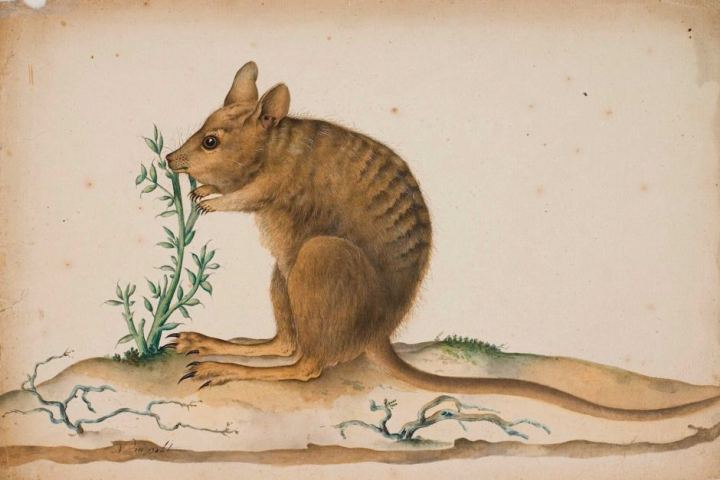
Lagostrophus fasciatus (Banded Hare Wallaby), Péron and Lesueur, 1807, Watercolour and ink on paper, Western Australia (Muséum d’Histoire Naturelle du Havre).
◊ ◊ ◊ ◊ ◊
Press release (15 May 2015) from the National Museum of Australia:
Napoleon’s Artists in Australia
South Australian Maritime Museum, Adelaide, from July 2016
Tasmanian Museum and Art Gallery, Hobart, from early 2017
National Museum of Australia, Canberra, from September 2017
TBA
Exquisite illustrations by French artists made during Nicolas Baudin’s exploration of Australia will come to Australia as the result of a deal clinched in Canberra between the Museum of Natural History in Le Havre, France and six Australian museums. Under the Memorandum of Understanding (MOU) between the French and Australian museums, stunning original watercolours and drawings by Baudin expedition artists Charles-Alexandre Lesueur and Nicolas-Martin Petit will be showcased at venues across the country.

New Holland – Mororé, Nicolas-Martin Petit, Pierre noire or charcoal and sanguine on paper (Muséum d’Histoire Naturelle du Havre)
The French artists explored Australian waters between 1800 and 1804 with the expedition of Baudin, who was commissioned by Napoléon Bonaparte, First Consul of France, to investigate Nouvelle Hollande—particularly its uncharted southern coast. As Baudin’s two ships charted the continent’s coastline, the artists captured the wonders of a new land in vivid watercolours of animals, people, and landscapes.
The working title of the planned exhibition is Napoleon’s Artists in Australia. Most of the anticipated 100 illustrations have never been displayed in Australia before. The project was instigated by the Museum of Natural History in Le Havre and the South Australian Maritime Museum (Adelaide). It also involves the Australian National Maritime Museum (Sydney), the Western Australian Museum (Perth), the Queen Victoria Museum and Art Gallery (Launceston), the Tasmanian Museum and Art Gallery (Hobart), and the National Museum of Australia (Canberra).
Minister for the Arts, Senator the Hon George Brandis QC, welcomed the collaboration. “This partnership will allow audiences across the country to see unique depictions of life in Australia though French eyes,” said Senator Brandis.
National Museum of Australia director Mathew Trinca said that the illustrations are a rare window into the lives of the First Australians before European settlement. “These illustrations provide unique insights into life in Australia before European colonisation and I’m excited to be involved in bringing them to the country,” said Dr Trinca.
A delegation from France, led by the Mayor of Le Havre, Edouard Philippe, was on hand in Canberra to sign the MOU.

New Holland – Mororé, Nicolas-Martin Petit, Pierre noire or charcoal and sanguine on paper (Muséum d’Histoire Naturelle du Havre)
Museum of Natural History director, Cedric Cremiere said: “It is wonderful that after that first French encounter with Australia more than 200 years ago, we can share these discoveries and sense of wonder with Australian audiences.”
The French Ambassador to Australia, Christophe Lecourtier, said Lesueur was a magnificent artist, a pioneering naturalist and an astute observer.
“These extraordinary illustrations will be showcased in six Australian museums thanks to a fruitful partnership with the Muséum d’Histoire Naturelle du Havre—which was created to house Lesueur’s work—and for which we have the pleasure to thank, the Mayor of Le Havre, Mr Edouard Philippe. Mr Philippe is here with us today on his first ever visit to Australia. This is an extraordinary opportunity for the public to discover Australia, as the first explorers and French navigators did, more than 200 years ago,” said Ambassador Lecourtier.
Illustrations featured in the exhibition will include: evocative portraits of Indigenous Australians in NSW and Tasmania; images of Indigenous baskets and watercraft; whimsical watercolours of strange marine invertebrates; highly accurate profiles of the coastline; and drawings of Australian mammals such as Kangaroo Island’s dwarf emu, which have now disappeared. The exhibition will open in Adelaide in July 2016, before touring the country until May 2018. It will open in Canberra at the National Museum of Australia in September 2017.
Commemorating the Aboriginal Warrior Pemulwuy

This engraving by Samuel John Neele of James Grant’s image of ‘Pimbloy’ is believed to be the only known depiction of Pemulwuy. It was published in Grant’s The Narrative of a Voyage of Discovery, Performed in His Majesty’s Vessel the Lady Nelson, of Sixty Tons Burthen, with Sliding Keels, in the Years 1800, 1801 and 1802, to New South Wales, 1803 (State Library of New South Wales Q80/18).
◊ ◊ ◊ ◊ ◊
Press release (20 March 2015) from the National Museum of Australia in Canberra:
Defining Moment in Australia’s History
National Museum Honours Aboriginal Warrior Pemulwuy
The life of Aboriginal warrior Pemulwuy is commemorated today at the National Museum of Australia as part of its Defining Moments project, which explores key dates that have defined the country’s history over more than 50,000 years.
As Australia’s first Aboriginal resistance leader and a member of the Bidjigal people, Pemulwuy fought the British at Sydney from 1792 by leading attacks on farms, burning crops and dispersing stock in an attempt to starve the settlers out. After surviving a number of battles he was finally killed by settlers in June 1802 at the age of about 52 years. His body was dishonoured with the removal of his head, which was sent to the naturalist Joseph Banks in England. It has yet to be found. The National Museum is working in collaboration with the Ministry for the Arts Museums and Repatriation unit, to undertake research into the possible whereabouts of Pemulwuy’s remains.
The National Museum today [20 March 2015] unveils a plaque in its Main Hall, commemorating Pemulwuy’s campaign of resistance.
The Minister for Education and Training, Christopher Pyne, representing the Australian Government at the ceremony, said Pemulwuy was a figure of Aboriginal defiance, and his legacy remains an important part of Indigenous culture in Australia. “For some years I have been working with Alex Hartman, a member of the National Museum of Australia Council to help find and repatriate the remains of Pemulwuy,” Pyne said. “Pemulwuy’s story is an important one and he deserves to be commemorated in this way.”
National Museum director Mathew Trinca said Pemulwuy was a hero to Aboriginal people. “Pemulwuy’s daring leadership impressed enemies and comrades alike and the story of his concerted campaign of resistance against British colonists should be more widely known,” said Trinca.
Bidjigal elder Uncle Vic Simms said, “What the Museum is doing is so important for getting the history right about Pemulwuy as a Bidjigal man, who resisted and rebelled against the settlers and stood up against them when they were giving blackfellas such a hard time.”
Defining Moments is a National Museum project supported by patrons, the Hon Michael Kirby AC CMG and Mr Michael Ball AM. Under the project, the National Museum is releasing online content for an initial list of 100 Defining Moments and is encouraging people to contribute their own ideas on historical dates of importance. The Museum’s list is a starting point for discussions and is not intended to be definitive.
Smithsonian American Art Museum Fellows, 2015–16
Among this upcoming year’s 14 new Smithsonian American Art Museum Fellows is
• Emily Casey, Terra Foundation Predoctoral Fellow in American Art, University of Delaware; “Waterscapes: Representing the Sea in the American Imagination, 1760–1815.”
A full list is available here»
Since 1970, the museum has hosted more than 565 scholars who now occupy positions in academic and cultural institutions across the United States and in Australia, Asia, the Caribbean, Europe, the Middle East and South America. Fellowship opportunities include the Joe and Wanda Corn Fellowship for research that spans American art and American history; the Douglass Foundation Fellowship; the Patricia and Phillip Frost Fellowship; the George Gurney Fellowship; the James Renwick Fellowship in American Craft; the Sara Roby Fellowship in 20th-Century American Realism; the Joshua C. Taylor Fellowship; the Terra Foundation for American Art Fellowships for the cross-cultural study of art of the United States; the William H. Truettner Fellowship; and the Wyeth Foundation Predoctoral Fellowship for the study of excellence in all aspects of American art. The museum also hosts fellows supported by the Smithsonian’s general fellowship fund. For additional information, call (202) 633-8353 or email americanartfellowships@si.edu. The deadline for applications is December 1, 2016.
Conference | Orientality: Beyond Foreign Affairs

◊ ◊ ◊ ◊ ◊
From the conference website:
Orientality: Beyond Foreign Affairs
National Portrait Gallery, London, 2–3 June 2015
A biennial conference series developed by the Orientalist Museum, Doha
The inaugural conference Orientality: Cultural Orientalism and Mentality took place at Cambridge University in 2013. The subsequent conference is scheduled for the National Portrait Gallery, London, 2015. The only conference of its kind, Orientality gives international art and museum professionals an opportunity to come together and discuss the art, history, politics and future of the Orientalist art movement. The conference aims to develop understanding between east and west, and showcase the continued vibrancy of the Orientalist art movement in the 21st century.
The conference title orientality is a combination of two terms—orientalism and mentality. The term orientalism has been used in art history since the early nineteenth century in association with works of art on Middle Eastern and North African subjects pioneered by French artists. The term mentality is defined as “way of thinking of a person or a group,” and can be metaphorically translated as an “opinion,” formed and shaped, in our case, under various historical, political, social and cultural circumstances and environments, what allows the orientalism to be seen and interpreted in various ways by different societies. The theme of cultural orientalism and mentality captured the scholarly imaginations largely because we were able to articulate the dialog in both artistic and sociological terms, spanning the geographical area of orientalism and widening its historical borders.
We hope that our interpretation of orientality will influence many other disciplinary areas in the social sciences, humanities and beyond. Orientalism as a historical and cultural event has been uniting various aspects of cultural life for a number of centuries—literature, fine arts, architecture, music, philosophy—and generating an exotic image within our consciousness, one that had a right to its own existence.
Entry to the conference is free, and all are welcome. We do ask that you register your attendance ahead of time to ensure we have adequate seating available.
◊ ◊ ◊ ◊ ◊
T U E S D A Y , 2 J U N E 2 0 1 5
8:30 Coffee and registration
9:30 Opening and welcome
9:45 Art and Nation Building
• The Somerset House Painting of 1604: How a Turkey Carpet Became a Symbol of British Imperialism, Gerald MacLean
• Design Reform at the British Embassy: James Wild’s Arabesque Hall in Qajar Tehran, Moya Carey
• Ottoman Photography and Late Nineteenth-Century Modernity, Zeynep Çelik
11:45 Lunch break
13:15 Diplomatic Gifts
• Across Religious Borders: Diplomatic Gifts at the Mamluk Court, Doris Behrens-Abouseif
• Pearls, Bezoar Stones, Carpets and Diplomatic Gifts: The Portuguese Luxury Trade in the North of the Indian Ocean and the Gulf, Jean Michel Massing
• Illustrated Manuscripts as Persian Diplomatic Gifts to the Russian Court, Firuza Melville
W E D N E S D A Y , 3 J U N E 2 0 1 5
8:30 Coffee and registration
9:30 Opening and welcome
9:45 Art and Politics
• Bellini, Bronze and Bombards: Sultan Mehmed II’s Requests Reconsidered, Antonia Gatward Cevizli
• Collecting Arts for Imperial Needs: Acquisitions of Russian Military Men and Diplomats in Levant during the Russo-Turkish war of 1768–1774, Elena Borisovna Smilyanskaya
• The Von Celsing Family History and the Eighteenth-Century Collection of Ottoman Art at Biby, Anna-Sophia von Celsing
• Searching for the Meaning of the Rare Mughal Animal Carpet in David Wilkie’s Painting The Preaching of Knox before the Lords of the Congregation, 10th June 1559, Dorota Chudzicka
12:25 Lunch break
14:00 Oriental Encounters
• ‘Speak of Me as I Am’: A Portrait of a Moorish Ambassador to Queen Elizabeth I, Sophie Bostock
• Iconographies of the Levant, ca. 1800, Paolo Girardelli
• Mme Lucas-Robiquet’s Artistic Portrayal of Late Nineteenth-Century Algeria, Mary Healy
New Book | Voltaire, Siècle de Louis XIV, volumes 1–6
From the Voltaire Foundation:
Voltaire, Siècle de Louis XIV, volumes 1–6, edited by Diego Venturino, et al. (Oxford: Voltaire Foundation, 2015–17).

Attributed to Antoine Benoist (1632–1717), Portrait of Louis XIV, lead pencil, sanguine and white chalk (Château de Versailles)
2015 marks the 300th anniversary of the death of Louis XIV (1638–1715), the Sun King, whose reign defined the era of the ‘Grand Siècle’ and saw France rise to become the dominant player on the European stage. To mark this anniversary, the Voltaire Foundation, in collaboration with the Château de Versailles, is publishing Voltaire’s seminal account of his reign, the Siècle de Louis XIV (1751), the first major overall account of the reign of Louis XIV. This text is the starting-point for any reflection on the political and cultural history of the era of the Sun King, and is a monument of eighteenth-century historiography, paving the way for both modern historiography and literary history. The lasting success of this flagship work is due to the depth of Voltaire’s insight into the people and events that he is describing and to his historical method, which was remarkable for its day. The emphasis on first-hand accounts from those who witnessed events and on the perspective of the age as a whole rather than a parade of facts bears the stamp of Voltaire. This edition is the first-ever full critical edition, and will be published in volumes 11–13 of the Complete Works of Voltaire. It takes as its base text the last version of the work that Voltaire authorised (1775), and gives variant readings from all preceding versions of the text. It will include the Catalogue des écrivains français qui ont paru dans le siècle de Louis XIV, an important and fascinating work in its own right. The edition will be supplied with an index with full names and dates of all persons mentioned in the text. These volumes are published with the support of the Centre de recherche du château de Versailles.
See “The Sun King and Voltaire: 300 Years On” for an overview of good reading relating to Louis XIV and his era, along with our Siècle de Louis XIV blog pieces: “Picturing the Reign of Louis XIV” and “Shadows at the Court of the Sun King.”
◊ ◊ ◊ ◊ ◊
• Œuvres complètes de Voltaire, tome 11 | Siècle de Louis XIV (I): Introduction, Textes annexes, Index (Oxford: Voltaire Foundation, 2017), ISBN: 978-0729411462.
• Œuvres complètes de Voltaire, tome 12 | Siècle de Louis XIV (II): Listes et Catalogue des écrivains (Oxford: Voltaire Foundation, 2016), ISBN: 978-0729411479.
• Œuvres complètes de Voltaire, tome 13A | Siècle de Louis XIV (III): Chapitres 1–12 (Oxford: Voltaire Foundation, 2015), ISBN 978-0729409650.
• Œuvres complètes de Voltaire, tome 13B | Siècle de Louis XIV (IV): Chapitres 13–24 (Oxford: Voltaire Foundation, 2015), ISBN: 978-0729411561.
• Œuvres complètes de Voltaire, tome 13C | Siècle de Louis XIV (V): Chapitres 25–30 (Oxford: Voltaire Foundation, 2015), ISBN: 978-0729411578.
• Œuvres complètes de Voltaire, tome 13D | Siècle de Louis XIV (VI): Chapitres 31–39 (Oxford: Voltaire Foundation, 2016), ISBN: 978-0729411554.
Colloquium | Perception Machines
From the University of Geneva:
Machines à Percevoir / Perception Machines
Université de Genève, 29–30 May 2015
Organised by Marie Theres Stauffer and Stefan Kristensen
Le colloque traite des différents types de machines construites entre le 17e et le 20e siècle et dont la fonction consiste à produire des expériences esthétiques. Il sera question, d’une part, des processus et phénomènes perceptifs déclenchés par les machines et, d’autre part, de la conception souvent complexe de ces dispositifs. La période historique très large, qui est envisagée, permettra de dégager des liens thématiques et structurels, de localiser des processus d’innovation et de discuter la signification de la conception, de l’usage et des transformations de l’usage de ces machines dans une perspective d’histoire des savoirs. Enfin, il s’agit également de dégager les différences entre les objets particuliers et leurs contextes historiques.
Le colloque réunira des perspectives de l’histoire des arts visuels et scéniques, de l’histoire des techniques, ainsi que de la philosophie. Il est organisé par l’Unité d’histoire de l’art et la Société suisse de théorie de la culture et de sémiotique.
L’entrée est libre et toute personne intéressée est la bienvenue.
◊ ◊ ◊ ◊ ◊
F R I D A Y , 2 9 M A Y 2 0 1 5
9:30 Welcome
9:45 Julia Zons, Universität Konstanz: Qui a tué le beau monstre noir? Life and death of the pantelegraph (1855–1867)
10:30 Veronica Peselmann, Freie Universität Berlin: The Kaiser-Panorama. Mobilizing spaces of perception in the late 19th century
11:15 Break
11:45 Benoît Turquéty, Université de Lausanne: Machines imageantes, machines- images
12:30 Lunch break
14:30 Guillaume Sibertin-Blanc, Université de Toulouse: Désir et perception chez Deleuze et Guattari
15:15 Bianca Westermann, Ruhr-Universität Bochum: Biomorphic automats in the 18th century
16:00 Break
16:30 Marie Theres Stauffer, Université de Genève: La reconstruction de machines catoptriques. L’intérêt et ses défis
17:15 Philip Ursprung, ETH Zürich: Olafur Eliasson’s machines
18:15 Assemblée générale de l’ASSC
S A T U R D A Y , 3 0 M A Y 2 0 1 5
9:30 Nina Zschokke, ETH Zürich: Machines, instructions, skills, rewards. Jon Kessler’s The Web (2012) and the production of perception in the 21st century
10:15 Dieter Dietz, EPF Lausanne: Immersive devices. The expanded eye in space
11:00 Break
11:30 Holle Rössler, Herzog August Bibliothek Wolffenbüttel: Spectacular Delusions. Perception Machines and the Perception of Machines in the History of Theater
12:15 Lunch break
14:00 Stefan Kristensen, Université de Genève: Les « machines à influencer » entre esthétique et psychopathologie
14:45 Felix Thürlemann, Universität Konstanz: Le miroir-transparent chez Lee Friedlander ou l’alternative rendue simultanée
15:30 Closing remarks










 Enfilade
2 comments