Exhibition | A Golden Age of China: Qianlong Emperor, 1736–1795

Jin Tingbiao, Chinese active (c. 1750–68), and Giuseppe Castiglione (attributed to), Italian 1688–1766, worked in China 1714–66, The Qianlong Emperor Enjoying the Pleasures of Life, poem inscribed by Qianlong Emperor in the spring of 1763, coloured inks on silk, 168 x 320 cm (The Palace Museum, Beijing, Gu5278)
◊ ◊ ◊ ◊ ◊
From the press release (26 March 2015) for the exhibition:
A Golden Age of China: Qianlong Emperor, 1736–1795
National Gallery of Victoria, Melbourne, 27 March — 21 June 2015
Hidden treasures from Beijing’s Palace Museum in the Forbidden City have come to Melbourne for the first time, in an Australian exclusive exhibition. A Golden Age of China: Qianlong Emperor, 1736–1795 tells the story of China’s foremost art collector Qianlong Emperor, one of China’s most successful rulers, fourth emperor of the Qing dynasty (1644–1911) and longest living emperor in Chinese history.
This exhibition provides an unprecedented opportunity to explore a rich concentration of more than 120 works from the Palace Museum’s art collection, which is built on the imperial collection of the Ming and Qing dynasties and holds some of China’s most rare and valuable works of art in its collection. . . .

Giuseppe Castiglione, Portrait of Qianlong Emperor in Ceremonial Court Robe, 1736, coloured inks on silk, 239 x 179 cm (The Palace Museum, Beijing, Gu6464)
The Qianlong Emperor’s long 60-year reign (1736–1795) was a particularly fascinating time in China’s history. Under his rule, China was the wealthiest and most populous nation in the world. Qianlong’s ability to preserve and foster his Manchu warrior-huntsman traditions whilst adopting the Confucian principles of political and cultural leadership, resulted in the successful governing of 150 million Chinese people.
It was his ability to adopt Chinese ways, yet honour his Manchu traditions that made him one of the most successful emperors of the Qing dynasty. He studied Chinese painting, loved to paint, and particularly loved to practice calligraphy. He was a passionate poet and essayist, and over 40,000 poems and 1300 pieces of prose are recorded in his collected writings. Qianlong wrote more poetry in his lifetime than all the poets in the Tang dynasty (618–906) combined, a dynasty known for its golden age of poetry. Aside from his own art practice, Qianlong combined his passion for collecting art with his role as preserver and restorer of Chinese cultural heritage. He also embraced the arts of other cultures: European, Japanese and Indian. Giuseppe Castiglione, an Italian Jesuit brother, exerted a great deal of influence over the arts in the court
academy of the Qianlong Emperor.
The exhibition puts the spotlight on Qianlong’s reign and art in five separate sections: Manchu Emperor, Son of Heaven, Imperial art under the Emperor’s patronage, Imperial art of religion and Chinese scholar, art connoisseur and collector. Visitors can enjoy a lavish display of paintings on silk and paper, silk court robes, precious-stone inlayed objet d’art and portraits of the Qianlong Emperor, Empress and imperial concubines; paintings of hunting scenes, court ceremonies and the private life of the Qianlong Emperor; and paintings of the Emperor as scholar and art collector. The exhibition also presents paintings and calligraphy by the Emperor himself as well as classical paintings in his collection. The exhibition includes a sumptuous display of ceremonial weapons of swords, bows and arrows, a chair made of antlers’ horns, silk court robes and ceremonial hats, amongst other ceremonial and palace treasures.
New Book | The Vitruvian Tradition in Enlightenment Poland
Forthcoming from Penn State UP:
Ignacy Potocki, Remarks on Architecture: The Vitruvian Tradition in Enlightenment Poland, edited and translated by Carolyn C. Guile (University Park: The Pennsylvania State University Press, 2015), 176 pages, ISBN: 978-0271066288, $75.
 At the end of the eighteenth century, the authors of Poland’s 3 May 1791 Constitution became the heirs to a defunct state whose territory had been partitioned by Russia, Prussia, and Austria. At this moment of intensive national postmortem, Ignacy Potocki, an eminent statesman and co-author of the Constitution, composed an architectural treatise. One of the best-preserved examples of early modern Polish architectural thought, published and translated here for the first time, the Remarks on Architecture announces itself as a project of national introspection, with architecture playing a direct role in the betterment of the nation. In it, Potocki addresses his remarks to the contemporary Polish nobility and conveys the lessons of a Vitruvian canon that shaped Continental classical architectural theory and practice throughout the early modern period. He argues that architecture is a vessel for cultural values and that it plays an important part in the formation and critique of broader national traditions. In her introduction, Carolyn Guile further explores Polish Enlightenment architectural writing as an example of cultural exchange, inheritance, and transformation.
Carolyn C. Guile is Assistant Professor of Art History at Colgate University.
Exhibition | Thé, Café ou Chocolat?
From the Musée Cognacq-Jay:
Thé, Café ou Chocolat? l’essor des boissons exotiques au XVIIIe siècle
Tea, Coffee, or Chocolate? The Boom of Exotic Drinks in the Eighteenth Century
Musée Cognacq-Jay, Paris, 26 May — 27 September 2015
Curated by Rose-Marie Herda-Mousseaux
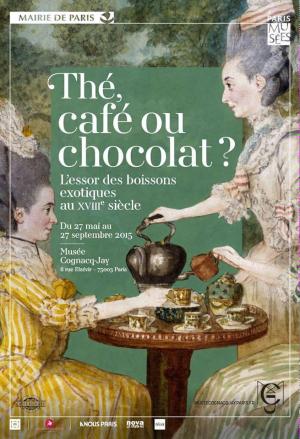 Praised for their medical and therapeutic virtues, the ‘exotic’ beverages, introduced to Europe in the 17th century became a real cornerstone of pleasure and social life during the 18th century. Drinks made with cocoa, coffee and tea—plants not grown in Europe—became an integral part of aristocratic and the upper middle class society following their official introductions to the courts of Europe. As an imported material, their high purchase price in the 17th and 18th centuries classed tea, coffee and chocolate as luxury goods and enhanced their prestigious. This was reflected in items of furniture and tableware designed for the consumption of these new drinks. Porcelain tea sets and other beautiful and luxurious pieces were produced in specialised manufactories. The rise of these products also created a new need for places designed for the public consumption of these drinks, such as cafes, and new mealtime additions such as at breakfast and afternoon tea, that spread throughout society. This exhibition offers a new overview of these beverages and their entry into the rituals of everyday life, presenting works by many iconic 18th-century artists such as Boucher and Chardin.
Louées pour leurs vertus médicales et thérapeutiques, les boissons dites « exotiques », introduites au XVIIe siècle en Europe, ont été associées aux plaisirs et aux sociabilités du XVIIIe siècle. Les boissons issues du cacaoyer, du caféier et du théier—plantes exogènes à l’Europe—ont fait partie intégrante des sociabilités de l’aristocratie et de la haute bourgeoisie dès leurs introductions officielles auprès des cours d’Europe. En tant que matière importée, leur coût d’achat classe au XVIIe et au XVIIIe siècles le thé, le café et le chocolat parmi les produits de luxe et ajoute à leur consommation celle de l’image affichée du prestige. Leur consommation s’est matérialisée dans l’apparition de mobiliers et de nécessaires ou services produits dans les manufactures. Elle a aussi permis l’existence de lieux de consommation publique, les cafés, et de nouvelles pratiques de table, telles le petit déjeuner et le goûter, qui se diffusent progressivement dans la société. Organisée autour de trois axes—« Vertus et dangers des boissons exotiques », « Cercles de consommation » et « Nouveaux services »—cette exposition propose une nouvelle lecture de ces boissons entrées dans les rituels du quotidien, en présentant des oeuvres de nombreux artistes emblématiques du XVIIIe siècle comme Boucher ou Chardin.
Commissaire: Rose-Marie Herda-Mousseaux, conservateur du patrimoine et directrice du musée Cognacq-Jay, avec la collaboration scientifique de Patrick Rambourg, chercheur et historien spécialiste de la cuisine et de la gastronomie, et de Guillaume Séret, docteur en histoire de l’art, spécialiste de la porcelaine de Sèvres.
Rose-Marie Herda-Mousseaux, Patrick Rambourg, Guillaume Séret, Thé, Café ou Chocolat? l’essor des boissons exotiques au XVIIIe siècle (Paris Musées, 2015), 176 pages, ISBN: 978-2759602834, 35€.
The press release (a 14-page PDF file) is available here»
Exhibition | From Sèvres to Fifth Avenue
Now on view at The Frick:
From Sèvres to Fifth Avenue: French Porcelain at The Frick Collection
The Frick Collection, New York, 28 April 2015 — 24 April 2016
Curated by Charlotte Vignon
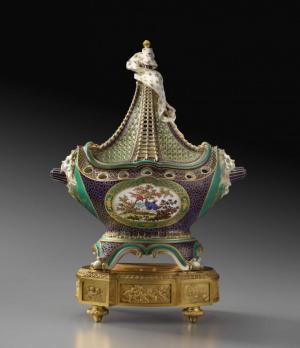 Between 1916 and 1918, Henry Clay Frick purchased several important pieces of porcelain to decorate his New York mansion. Made at Sèvres, the preeminent eighteenth-century French porcelain manufactory, the objects—including vases, potpourris, jugs and basins, plates, a tea service, and a table—were displayed throughout Frick’s residence. From Sèvres to Fifth Avenue brings them together in the Portico Gallery, along with a selection of pieces acquired at a later date, some of which are rarely on view. The exhibition presents a new perspective on the collection by exploring the role Sèvres porcelain played in eighteenth-century France, as well as during the American Gilded Age.
Conference | Archival Afterlives
From The Royal Society:
Archival Afterlives: Life, Death, and Knowledge-Making
in Early Modern British Scientific and Medical Archives
The Royal Society, London, 2 June 2015
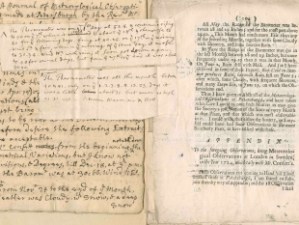
William Derham’s annotated proof of Philosophical Transactions (RS L&P/121/1/5)
Early modern naturalists collected, generated, and shared massive amounts of paper. Inspired by calls for the wholesale reform of natural philosophy and schooled in humanist note-taking practices, they generated correspondence, reading notes (in margins, on scraps, in notebooks), experimental and observational reports, and drafts (rough, partial, fair) of treatises intended for circulation in manuscript or further replication in print. If naturalists claimed all knowledge as their province, natural philosophy was a paper empire. In our own day, naturalists’ materials, ensconced in archives, libraries, and (occasionally) private hands, are now the foundation of a history of science that has taken a material turn towards paper, ink, pen, and filing systems as technologies of communication, information management, and knowledge production. Recently, the creation of such papers, and their originators’ organization of them and intentions for them have received much attention. The lives archives lived after their creators’ deaths have been explored less often. The posthumous fortunes of archives are crucial both to their survival as historical sources today and to their use as scientific sources in the past.
How did (often) disorderly collections of paper come to be “the archives of the Scientific Revolution”? The proposed conference considers the histories of these papers from the early modern past to the digital present, including collections of material initially assembled by Samuel Hartlib, John Ray, Francis Willughby, Isaac Newton, Hans Sloane, Martin Lister, Edward Lhwyd, Robert Hooke, and Théodore de Mayerne. The histories unearthed—of wrangling over the control and organization of the papers of dead naturalists (and by extension, of the legacies of the dead and the living), of putting the scraps and half- finished experiments cast off by fertile minds to work, of extending and preserving their legacies in print —serve not only as an index of the cultural position of scientific activity since the early modern period. They also engage us in thinking about genealogies of scientific influence, the material and intellectual resources that had to be deployed to continue the scientific project beyond the life of any one individual, the creation and management of scientific genius as a posthumous project, and scientific activity as a collective endeavor in which scribes, archives and library keepers, editors, digital humanists and naturalists’ surviving friends and family members had a stake.
◊ ◊ ◊ ◊ ◊
P R O G R A M M E
9:15 Registration and coffee
9:30 Welcome and Introduction by Vera Keller, Anna Marie Roos, and Elizabeth Yale
9:45 Session I | Archival Afterlives: Miscellanies and Method
Chair: Anna Marie Roos, University of Lincoln
• Vera Keller, University of Oregon: Scarlet Letters: The Mayerne Papers within the Royal Society Archives
• Richard Serjeantson, Trinity College, Cambridge University: University Natural Philosophy in the Archives
11:00 Tea and coffee
11:15 Session II | Archival Afterlives: Natural Histories
Chair: Felicity Henderson, University of Exeter
• Elizabeth Yale, University of Iowa: ‘A Dying Hand’: Crafting the Posthumous Legacies of John Ray
• Anna Marie Roos, University of Lincoln: ‘Fossilised Remains’: William Huddesford, and the Lhwyd and Lister Ephemera in the Bodleian Library
12:30 Lunch
1:45 Session III | Archival Afterlives: Script and Print in the Sloane Collections
Chair: Anne Goldgar, King’s College, London
• Arnold Hunt, King’s College London, Under Sloane’s Shadow: The Archive of James Petiver
• Alison Walker, British Library: Collecting Knowledge: Annotated Material in the Library of Sir Hans Sloane
3:00 Session IV | Archival Afterlives: Archiving for Future Pasts
Chair: TBA
• Leigh Penman, University of Queensland: ‘Omnium exposita rapinae’: A Biography of the Papers of Samuel Hartlib, 1662–2015
•Victoria Sloyan, Wellcome Library: Collecting Genomics: Archiving Modern, Collaborative Science
4:15 Tea and coffee
4.30 Commentary and discussion led by Michael Hunter, Birkbeck College, University of London
5:30 Plenary Session
• Lauren Kassell, Pembroke College, Cambridge: Stars and Scribes, Astrology and Archives (simulcast University of Oregon)
Abstracts are available here»
Exhibition | Drawn from the Antique: Artists and the Classical Ideal
From the Teylers Museum:
Drawn from the Antique: Artists and the Classical Ideal
Teylers Museum, Haarlem, 11 March – 31 May 2015
Sir John Soane’s Museum, London, 25 June — 26 September 2015
Curated by Adriano Aymonino and Anne Varick Lauder
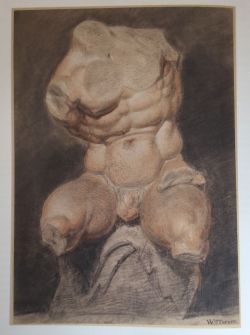
J.M.W. Turner, Study of the Belvedere Torso, black, red, and white chalks (London: V&A)
Famous statues from classical antiquity such as the Apollo Belvedere, the Laocoön and the Venus Pudica were for many centuries the chief attractions of Rome. These ‘heroes’, or plaster copies of them, were depicted in innumerable paintings, drawings and prints. It was above all the heroic nude from antiquity that inspired artists from all over Europe to produce new—in some cases trail-blazing—creations. Young artists depicted antique sculptures, or copies of them, as part of their training: this was believed to be the best way of learning how to render the classical ideal. The exhibition will include paintings and drawings of academies of art, workshops, and individual studios in which artists are hard at work vying with the ancients.
The works on display are of outstanding quality. Some of them have never been exhibited before. For this exhibition, the private collector and art dealer Katrin Bellinger has provided on loan a substantial proportion of her collection of works featuring artists’ studios. Bellinger, whose husband is the well-known entrepreneur Christoph Henkel, is a leading actor in the international art trade, specialising in old drawings. Besides the works from Katrin Bellinger’s private collection, the exhibition also includes loans from museums including the British Museum, the Rijksmuseum, and the Victoria and Albert Museum.
A useful review is available at Lowell Libson, Ltd.
◊ ◊ ◊ ◊ ◊
The catalogue will be available from Artbooks.com:
Adriano Aymonino and Anne Varick Lauder, Drawn from the Antique: Artists and the Classical Ideal (London: Sir John Soane’s Museum, 2015), 256 pages, ISBN: 978-0957339897, $50.
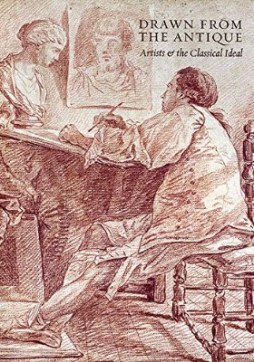 This exhibition and the accompanying catalogue examine one of the most important educational tools and sources of inspiration for Western artists for over five hundred years: drawing after the Antique. From the Renaissance to the nineteenth century, classical statues offered young artists idealised models from which they could learn to represent the volumes, poses and expressions of the human figure and which, simultaneously, provided perfected examples of anatomy and proportion. For established artists, antique statues and reliefs presented an immense repertory of forms that they could use as inspiration for their own creations. Through a selection of thirty-nine drawings, prints and paintings, covering more than four hundred years and by artists as different as Baccio Bandinelli, Federico Zuccaro, Hendrick Goltzius, Peter Paul Rubens, Michael Sweerts, Charles-Joseph Natoire, Henry Fuseli and Joseph Mallord William Turner, this catalogue provides the first overview of a phenomenon crucial for the understanding and appreciation of European art.
Exhibition | Drawn with Spirit: Pennsylvania German Fraktur
The exhibition at the Philadelphia Museum of Art closed last week; the catalogue is distributed by Yale UP:
Lisa Minardi, with an interview by Ann Percy, Drawn with Spirit: Pennsylvania German Fraktur from the Joan and Victor Johnson Collection (New Haven: Yale University Press, 2015), 364 pages, ISBN: 978-0300210521, $65.
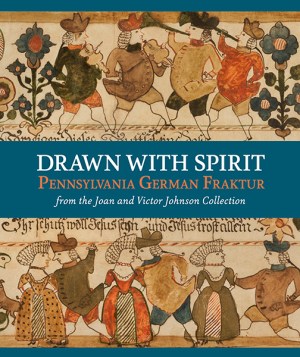 Among the most beloved forms of American folk art, fraktur is a Germanic tradition of decorated manuscripts and printed documents noted for its use of bold colors and whimsical motifs. This publication makes a landmark contribution to the study of Pennsylvania German fraktur, and offers the most comprehensive study of the topic in over 50 years. The featured objects, most of which have never been published, accompany significant new information about the artists who made these works and the people who owned them. An introductory essay sets the renowned Johnson Collection within the context of collecting and scholarship on Pennsylvania German folk art and then highlights major new discoveries, including connections between fraktur and related examples of furniture and prints. An interview with the collectors offers valuable insights into the formation of this special group of objects, which includes birth and baptismal certificates, bookplates, religious texts, writing samples, house blessings, cutworks, and printed broadsides. The splendid color illustrations reveal schools of artistic and regional influence, giving a nuanced understanding of how artists took inspiration from one another and how designs were transferred to new locations. Detailed catalogue entries include extensive information about each piece as well as complete translations.
Lisa Minardi is an assistant curator at Winterthur Museum and a specialist in Pennsylvania German art and culture.
Call for Papers | Women in the Global Eighteenth Century
Women in the Global Eighteenth Century
The 2015 Biennial Conference of The Aphra Behn Society for Women in the Arts, 1660–1830
Seton Hall University, South Orange, New Jersey, 5–6 November 2015
Proposals due by 15 May 2015
In The Global Eighteenth Century, Felicity Nussbaum and her contributors urged scholars to see the eighteenth century as “wide”: a period with a geographical as well as temporal sweep. Such a perspective, Nussbaum contended, would require different, more complex narratives of the people, events, systems, and discourses of the age. In the spirit of our namesake Aphra Behn, whose poetry, drama, plays, and translations reflect a complex awareness of a widening world, The Aphra Behn Society for Women in the Arts, 1660–1830 takes up the challenge posed by The Global Eighteenth Century to invite papers exploring any aspect of women and the arts in this “global eighteenth century.” How does a wider, potentially global, lens change the view of people, places, and things both familiar and strange, domestic and imperial, Us and Other? How does gender affect those views?
The Aphra Behn Society for Women and the Arts invites papers addressing the intersection of gender and the global eighteenth century from a wide variety of disciplines, including but not limited to Literature, History, Art History, Music History, Modern Languages, Philosophy, Religious Studies, and Women and Gender Studies. We welcome papers on this topic from all sub-fields of these disciplines.
Papers might address the following topics:
- Investigations or representations of ‘difference’ in literature and the sister arts
- Representations of social and political authority
- The arts, women, and empire
- Women and the construction of literary, artistic, domestic, public, national, imperial, and colonial spaces
- Women and travel writing
- Women and diaspora
- Women and the metropole
- Women and indigenous knowledge
- Women, genre (textual, visual, musical, etc.), and space/place
- Notions of performance and gender
- Notions of gender and race, class, religion, or other markers, perhaps under pressure in a widening context
- Gender and encountering the Other
- Women, modernity, and post-colonial situations
- Women and the colonial or post-colonial Enlightenment
As always, we also welcome abstracts for papers not related to the conference theme. Please upload 1–2 page abstracts or panels by May 15, 2015. In addition, the Society and its journal, ABO are sponsoring a pre-conference Wikipedia Edit-a-Thon on Wednesday, November 4th, from 12:00 to 5:00 pm at the Grand Summit Hotel. Participation is free and open to everyone, although participants must supply their own laptops. Registration for this event is on the conference registration form.
The registration fee includes all conference events, including the Wikipedia Edit-a-thon, the luncheon, the concluding banquet, a performance by Seton Hall students, and a reception with the rare books librarians and university archivists to view highlights of the university’s collection. The Society also sponsors a graduate student travel award ($150) and a graduate student essay prize ($150 and the possibility of publication in ABO: Interactive Journal for Women in the Arts, 1640–1830). For more information, see the conference website or contact the conference organizers, Dr. Kirsten Schultz at Kirsten.schultz@shu.edu or Dr. Karen Gevirtz at Karen.gevirtz@shu.edu.
Plenary lecture by Dr. Lynn Festa, Associate Professor of English, Rutgers University.
Sponsored by The Aphra Behn Society for Women in the Arts, 1660–1830, the College of Arts and Sciences, and the Women and Gender Studies Program at Seton Hall University.
Conference | Representing the Habsburg-Lorraine Dynasty, c. 1618–1918
From the conference programme:
Representing the Habsburg-Lorraine Dynasty in Music,
Visual Media, and Architecture, c. 1618–1918
Institute of History of Art and Musicology, Austrian Academy of Sciences, Vienna, 8–10 June 2015
 This international conference will take place in Vienna from the 8th to the 10th of June 2015. It will be devoted to the new interdisciplinary research program ‘Representing Habsburg’—one of the main current research fields of the Institute for History of Art and Musicology (IKM) of the Austrian Academy of Sciences focusing on the history of fine arts and music in Austria and Central Europe in their general European context. Please register at:
kunstgeschichte@oeaw.ac.at.
◊ ◊ ◊ ◊ ◊
M O N D A Y , 8 J U N E 2 0 1 5
10:30 Registration
11:00 Opening, Werner Telesko, Director of the Institute of History of Art and Musicology
11:30 Topics and Media of Representation
Chair: Alexander Rausch, Werner Telesko
• Andrea Lindmayr-Brandl, University of Salzburg | Vom Volkslied zur Kaiserhymne: „Gott erhalte, Gott beschütze / unsern Kaiser, unser Land!“
• Friedrich Polleroß, University of Vienna | Repräsentation und Reproduktion. Der „Kaiserstil“ in den zeitgenössischen „Massenmedien“
13:00 Lunch Break
14:30 Topics and Media of Representation, Part 2
• Adriana De Feo, Mozarteum Foundation, Salzburg | Selbstdarstellung und höfische Repräsentanz: dramatische Sujets zur Glorifizierung des Geschlechts der Habsburger in der barocken Librettistik
• Irena Veselá, Moravian Museum, Brno | „Venga quel dì felice!“ Dynastisch-politische Botschaften in musikali- schen Huldigungswerken für Karl VI. und Elisabeth Christine (1723)
• Allison Goudie, The National Gallery, London | Habsburg Portraiture face-to-face with the French Revolution
• Olivia Gruber Florek, Delaware County Community College | The Absent Empress: Photomontage, the Habsburg Monarchy, and Celebrity in the Nineteenth Century
18:30 Evening Lecture
• Michael Yonan, University of Missouri, Columbia | Interdisciplinary Material Culture Studies and the Problems of Habsburg Representation
T U E S D A Y , 9 J U N E 2 0 1 5
9:00 Dynasty, State, and Nation
Chair: Richard Kurdiovsky, Stefan Schmidl
• Andrea Baotic-Rustanbegovic, University of Sarajevo | Presentation of the Habsburg Dynasty in Bosnia and Herzegovina under the Austro-Hungarian Rule, 1878–1918: The Case of Public Monuments
• Nataša Ivanovic, ́Research Institute for Visual Culture, Ljubljana | State and National Representation in the Case of Ljubljana Town Hall
• Timo Hagen, Kunsthistorisches Institut in Florenz | K.u.k. Militärbauten als Repräsentanten der Gesamtmonarchie in der siebenbürgischen „Peripherie“
• András Gero, Eötvös Loránd University, Budapest | Francis Joseph: The Hungarian Hero
12:30 Lunch Break
14:00 Agencies and Networks
Chair: Anna Mader-Kratky, Stefan Schmidl
• Milan Pelc, Institute of Art History, Zagreb | Leopold I. in der Sammlung Valvasor – Ikonographie des Kaisers aus der Perspektive eines Zeitgenossen
• Stefan Seitschek, Austrian State Archives, Vienna | Der Wiener Hof in den Tagebüchern Kaiser Karls VI.
• Martin Krummholz, The Czech Academy of Sciences, Prague | Habsburgische Propaganda in Rom zur Zeit des Botschafters Johann Wenzel von Gallas
• Jana Perutková, Masaryk University, Brno | Die von der mährischen Aristokratie in der ersten Hälfte des 18. Jahrhunderts veranstalteten musikdramatischen Aufführungen als Spiegel der musikalischen Feste am Wiener Kaiserhof
W E D N E S D A Y , 1 0 J U N E 2 0 1 5
9:00 Ceremonial Spaces and the „Public“
Chair: Elisabeth Hilscher, Herbert Karner
• Thomas Hochradner, Mozarteum University Salzburg | Spielball der Repräsentation? Überlegungen zur Kirchenmusik von Johann Joseph Fux
• Andrea Zedler, University of Regensburg / Michael Pölzl, University of Vienna | Tafelzeremoniell, „Schau-Essen“ und Musik als Mittel der Repräsentation im Zuge der Hochzeitsfeierlichkeiten von Erzherzogin Maria Amalia und Kurprinz Karl Albrecht in Wien (1722)
• Mirjana Repanic ́-braun, Institute of Art History, Zagreb | Representation of Habsburgs in the Croatian Historical Lands: Public Spaces and Art as Political Apparatus
• Anne-Marie Wurster, University of Freiburg i.B. | „Unter Trompetten- und Paucken-Schall“: Die Fronleichnamsfeierlich- keiten zur Zeit Maria Theresias als Demonstration imperialer Macht
12:30 Lunch Break
14:00 Ceremonial Spaces and the „Public,“ Part 2
• Peter Konecný – Miroslav Lacko, Slovak Academy of Sciences, Bratislava | Der Herrscher im Bergwerk: Die Visitationsreisen der Habsburg- Lothringer in die ungarischen (slowakischen) Bergstädte (1751–1852)
• Filip Šimetin Šegvic, University of Zagreb | Zagreb/Agram als zeremonieller Raum im Jahr 1895: Kaiser Franz Joseph und die dynastische Repräsentation
15:30 Concluding Discussion
New Book | Perspectives on the Honours Systems
From The Royal Swedish Academy:
Antti Matikkala and Staffan Rosén, eds., Perspectives on the Honours Systems: Proceedings of the Symposiums Swedish and Russian Orders 1700–2000 and the Honour of Diplomacy (Stockholm: The Royal Swedish Academy of Letters, History and Antiquities, 2015), 322 pages, ISBN: 978-9174024302, 311SEK.
 Perspectives on the Honours Systems opens new multidisciplinary avenues for research on both historical and current methods by which monarchs, heads of state and governments have honoured individuals in different contexts, primarily in the Nordic countries and Russia. The essays are mostly based on papers given at two symposiums (in Stockholm 2009 and in Helsinki 2011).
The essays have been arranged in six thematic and broadly chronological parts. The first part analyses the foundation of the Swedish orders of knighthood and the background debates beginning in the 1690s. The second part looks at the orders of knighthood as instruments of diplomacy from the late Middle Ages mostly up to the Napoleonic period, while the third part approaches the material aspect of honours. The fourth part is chronological, concentrating on the first half of the twentieth century from the perspective of diplomacy as well as the wearing of orders and decorations. The fifth part, with emphasis on the Far East, discusses honorific contacts with Denmark and Russia. The sixth and last part describes the current diplomatic use of Finnish and Swedish orders as well as the Russian award system of today.
By taking a long perspective, 14 historians, archivists, museum curators, officers of orders and diplomats address fundamental questions related to honours: why honours systems have been established, what kind of role they have played in different historical situations and their current relevance in modern societies.
Antti Matikkala is a historian specializing in the honours systems. He was Fellow at the Helsinki Collegium for Advanced Studies, University of Helsinki, 2009–2012.
Staffan Rosén is Vice Chancellor and Secretary of the Swedish Royal Orders of Knighthood. He is retired Professor of Korean Studies at Stockholm University and a member of the Royal Swedish Academy of Letters, History and Antiquities.










 Enfilade
leave a comment