New Book | The Danish Country House
Published by Museum Tusculanum Press and distributed by The University of Chicago Press:
John Erichsen and Mikkel Venborg Pedersen, The Danish Country House (Copenhagen: Museum Tusculanum Press, 2014), 253 pages, ISBN: 978-8763543064, 51€ / $80.
 Denmark’s many manors are a treasure trove of natural and cultural riches. As well as the scenic beauty and magnificent architecture they have to offer, they also stand as monuments to more than five centuries of Danish history. The landscapes and buildings of Denmark’s manors form a fascinating universe and a key part of the country’s cultural heritage. Denmark’s famous fairytale author Hans Christian Andersen and the internationally renowned storyteller Karen Blixen (Isak Dinesen) were both fascinated by the unique atmosphere of the Danish country house, which—as their fairy tales and stories reveal—was a lasting source of inspiration in their writings. Also today, the cultural and natural environment of the manor appeals to the heart and soul. This book provides the reader with the key to understanding and experiencing this cultural heritage. More than one hundred of Denmark’s 700 manors are now partially or wholly open to the public. This book is your guide to them all.
John Erichsen, M.A. in History and Art History, is the former director of The Museum of Copenhagen and Vice Director of The National Museum of Denmark. Since 1997 he has run the cultural history research and publishing company HISTORISMUS. He has published extensively, also on the cultural history of the manor.
Mikkel Venborg Pedersen, PhD and DPhil. in European Ethnology and Cultural History. Senior researcher at The National Museum of Denmark. He has worked professionally with both elite and mass culture in Early Modern Europe, and has published extensively on cultural history, as well as on ethnological and historical theory and methodology.
Call for Papers | Antoine Galland et l’Orient des Savants
From H-ArtHist:
Antoine Galland et l’Orient des Savants
Société Asiatique, Paris, 3–4 December 2015
Proposals due by 31 May 2015
Parmi les savants qui ont marqué l’histoire de l’orientalisme, Antoine Galland (1646–1715) représente sans doute l’une des figures les plus remarquables et les plus attachantes. Il a laissé un nombre important de travaux, a tenu au quotidien un journal et accompli de longs voyages dans l’empire ottoman. Mais il suffit ici de rappeler deux écrits, assez différents l’un de l’autre, pour donner une idée de sa culture, de sa vision et de son impact sur ses contemporains: d’une part, son «Discours pour servir de préface», dans la Bibliothèque orientale, ou Dictionnaire universel contenant généralement tout ce qui regarde la connaissance des peuples de l’Orient, ouvrage de référence de Barthélemy d’Herbelot (m. 1695), publié après deux années de travail en 1697 par Antoine Galland (voir http://gallica.bnf.fr/ark:/12148/bpt6k82422h); d’autre part, ses Mille et une nuits, Contes arabes, dont il a assuré la première traduction de 1704 à 1717 dans une langue européenne. Sa participation à la Bibliothèque orientale marque son implication profonde dans le tissu savant de l’époque, et sa préface fournit une très belle synthèse de l’ouvrage encyclopédique, signifiant l’ampleur de son érudition.
Elle indique aussi cependant ses engagements personnels à propos des religions ou de l’histoire de l’humanité, ou plus simplement à propos du rôle de la poésie, comme lorsqu’il écrit : « Et l’on peut compter comme une marque de la délicatesse de leur esprit, le nombre considérable de leurs poètes (…) Car en quelque nation que ce soit, la poésie a cela par-dessus la prose, qu’elle s’exprime plus noblement (…) ». En ce qui concerne sa traduction des Mille et une nuits, il n’est pas besoin de s’étendre sur son impact, qui a affecté très rapidement toute l’Europe du XVIIIe siècle.
Les compétences et les intérêts d’Antoine Galland pour l’Orient ont été en effet multiples, et c’est cette multiplicité que ce colloque entend traiter, non seulement avec le monde arabe, turc ou persan, mais bien au-delà, y compris par exemple le monde grec, à travers les médailles, ou le monde arménien à travers les manuscrits, ou bien encore à travers des phénomènes de société passés d’Orient en Occident, comme le café. Ajoutons à cela que rien ne qualifiait au départ Antoine Galland, né à Rollot en Picardie d’une famille des plus modestes, à devenir au terme de sa carrière professeur au Collège royal et membre de l’Académie.
Cela permet de proposer un certain nombre de thèmes pour intervenir à ce colloque : Devenir orientaliste au XVIIe siècle (qui ? comment ?); les voyages de Galland et son journal ; ses travaux sur les textes narratifs (Kalîla et Dimna, Mille et une nuits) ; ses traités et anthologie (De l’origine et du progrès du café, Les paroles remarquables) ; la collecte des médailles et manuscrits ; la Bibliothèque orientale et l’érudition ; les Académies, les sociétés savantes et leurs organes de diffusion.
Les propositions de communication de dix à vingt lignes, accompagnées d’une brève présentation du conférencier (fonctions, coordonnées, bibliographie), doivent être envoyées sous forme d’un fichier texte word ou équivalent avant le 31 mai sur l’adresse: antoinegalland2015@gmail.com. Elles seront évaluées avant le 30 juin et une réponse sera envoyée au plus tard à cette date à tous les participants. La durée de chaque communication est de 20 mn. Les frais éventuels de transport et de séjour sont à la charge des participants. Pour plus d’informations n’hésitez pas à contacter: antoinegalland2015@gmail.com.
At Sotheby’s | Sale of Exceptional Louis XVI Vases
From Sotheby’s:
A Mansion: A Private Collection (L15318)
Sotheby’s, London, 28 April 2015
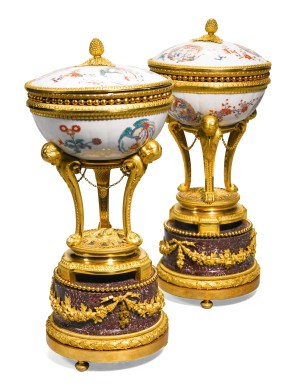 This week at Sotheby’s London a pair of exceptional vases once owned by Louis XVI sold for 10 times the estimate at a staggering £1,985,000 (lot 112, estimate: £150,000–250,000), a worldwide record price for a Louis XVI gilt bronze mounted porcelain work of art. Telling the tale of both French Royalty and revolution, the Brûle Parfums once formed part of the collection of Louis XVI, who bought them in 1782 with the intention of placing them in the Louvre Museum. With his demise. . . the vases were then taken to the State repository, the Dépôt de Nesle. The Dépôt was one of the cornerstones of the revolutionary drive to reorganize cultural properties and was fundamental to the success of the creation of national and provincial museums. Given their importance, in 1797 these vases were exchanged for a significant natural history collection. Decorated with delicate phoenix birds and dragons, this exquisite 18th-century Japanese porcelain is of the finest quality. The gilt-bronze-mounts, later added by the great connoisseur the Duc d’Aumont, were executed by Pierre Gouthière probably to a design by François-Joseph Belanger and date to Louis XVI, circa 1770–75. The auction launched a series of exceptional house sales taking place this year. Exceeding the high estimate, the sale totalled £6,631,065.
More information about the vases is available here»
New Book | Studies in Ephemera
First published in 2013, Studies in Ephemera was recently released in paperback:
Kevin Murphy and Sally O’Driscoll, eds., Studies in Ephemera: Text and Image in Eighteenth-Century Print (Lewisburg, PA: Bucknell University Press, 2015), 318 pages, ISBN: 978-1611484946 (hardback), ISBN: 978-1611486612 (paperback), ISBN: 978-1611484953 (ebook), $90 / $45.
 Studies in Ephemera: Text and Image in Eighteenth-Century Print brings together established and emerging scholars of early modern print culture to explore the dynamic relationships between words and illustrations in a wide variety of popular cheap print from the seventeenth to the early nineteenth century. While ephemera was ubiquitous in the period, it is scarcely visible to us now, because only a handful of the thousands of examples once in existence have been preserved. Nonetheless, single-sheet printed works, as well as pamphlets and chapbooks, constituted a central part of visual and literary culture, and were eagerly consumed by rich and poor alike in Great Britain, North America, and on the Continent. Displayed in homes, posted in taverns and other public spaces, or visible in shop windows on city streets, ephemeral works used sensational means to address themes of great topicality. The English broadside ballad, of central concern in this volume, grew out of oral culture; the genre addressed issues of nationality, history, gender and sexuality, economics, and more.
Richly illustrated and well researched, Studies in Ephemera offers interdisciplinary perspectives into how ephemeral works reached their audiences through visual and textual means. It also includes essays that describe how collections of ephemera are categorized in digital and conventional archives, and how our understanding of these works is shaped by their organization into collections. This timely and fascinating book will appeal to archivists, and students and scholars in many fields, including art history, comparative literature, social and economic history, and English literature.
Kevin D. Murphy is professor and executive officer in the PhD Program in Art History at the CUNY Graduate Center. He is the author of Jonathan Fisher of Blue Hill, Maine: Commerce, Culture, and Community on the Eastern Frontier (2010), as well as articles on nineteenth- and twentieth-century subjects in the Journal of the Society of Architectural Historians, Winterthur Portfolio, and the Journal of Urban History.
Sally O’Driscoll teaches English at Fairfield University. Her work on eighteenth-century literature and culture has appeared in such journals as Signs, Tulsa Studies in Women’s Literature, and Eighteenth-Century: Theory and Interpretation.
◊ ◊ ◊ ◊ ◊
C O N T E N T S
Illustrations
Acknowledgments
1 Introduction — ‘Fugitive Pieces’ and ‘Gaudy Books’: Textual, Historical, and Visual Interpretations of Ephemera in the Long Eighteenth Century, Kevin D. Murphy and Sally O’Driscoll
Part I: Definitions and Categorizations
2 Of Grubs and Other Insects: Constructing the Categories of ‘Ephemera’ and ‘Literature’ in Eighteenth-Century British Writing, Paula McDowell
3 Digitizing Ephemera and Its Discontents: EBBA’s Quest to Capture the Protean Broadside Ballad, Patricia Fumerton
4 What Gets Printed from Oral Tradition: Anna Gordon’s Ephemeral Ballads, Ruth Perry
5 Approaches to Ephemera: Scottish Broadsides, 1679–1746, Adam Fox
6 Ephemera at the American Antiquarian Society: Perspectives on Commercial Life in the Long Eighteenth Century, Georgia Barnhill
Part II: Text and Image
7 Making Sense of Broadside Ballad Illustrations in the Seventeenth and Eighteenth Centuries, Alexandra Franklin
8 ‘A Battleground Around the Crime’: The Visuality of Execution Ephemera and Its Cultural Significances in Late Seventeenth-Century England, Tara Burk
9 From ‘The Easter Wedding’ to ‘The Frantick Lover’: The Repeated Woodcut and Its Shifting Roles, Theodore Barrow
10 What Kind of Man Do the Clothes Make? Print Culture and the Meanings of Macaroni Effeminacy, Sally O’Driscoll
Bibliography
Index
New Book | Les Chasseurs de Marly et les œuvres de Nicolas Coustou
From Somogy:
Geneviève Bresc-Bautier, Les Chasseurs de Marly et les œuvres de Nicolas Coustou au musée du Louvre (Paris: Somogy éditions d’Art, 2015), 144 pages, ISBN: 978-2757207598, 19€.
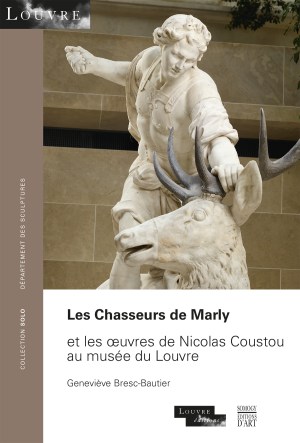 Le sculpteur Nicolas Coustou a manifesté ses talents à la fin du règne de Louis XIV et au début du règne de Louis XV par de grands marbres, animés par un souffle épique ou par la grâce féminine. La plupart de ses œuvres destinées au parc de Marly sont désormais exposées dans la cour Marly au Louvre. Art royal, officiel, il est cependant traversé de touches personnelles, faites de dynamisme, et d’un sens puissant des volumes que magnifient des draperies volantes et des mouvements contrastés.
Le parc de Marly et son décor appartiennent aux grandes réalisations du règne de Louis XIV. C’est en effet sur cette colline, déjà habitée mais en lisière des grandes forêts de chasse, que Louis XIV a choisi de se faire construire, par Jules Hardouin-Mansart, une résidence plus intime que Versailles. Alors que les bâtiments ont été détruits à la Révolution, et que le parc reste seul à évoquer la grandeur passée, la sculpture a été transférée dès le XVIIIe siècle au jardin des Tuileries. Le musée du Louvre, gestionnaire du jardin, s’en trouve donc l’héritier et a entrepris depuis 1870 la sauvegarde et l’exposition des œuvres provenant du parc de Marly. En 1993, l’ouverture de la cour Marly qui présente la majeure partie des sculptures connues a été l’occasion de mettre en valeur les marbres les plus célèbres, dont les emblématiques Chevaux de Marly d’Antoine Coysevox et de Guillaume Coustou.
En 1703, une commande prestigieuse fut adressée à Nicolas Coustou, neveu d’Antoine Coysevox, celle de deux grands groupes en marbre, Méléagre tuant le cerf et Méléagre tuant le sanglier, première œuvre d’envergure pour l’artiste. Dès 1706, les Chasseurs sont achevés et mis à une place d’honneur à proximité du Pavillon royal de Marly.
Le Louvre expose déjà dans la cour Marly l’ensemble des sculptures de la grande perspective du domaine de Marly : les chevaux de Coysevox, les groupes de fleuves, les statues de Neptune, Amphitrite, la Seine et la Marne, et les deux groupes de trois statues qui étaient situées non loin des deux Méléagre, Faune, Adonis et des Nymphes. Les deux Méléagre étaient les seules pièces manquantes à ce grand axe, rythmé par des statues qui se répondent deux à deux. Ils sont le complément du groupe d’Adonis et des Nymphes, pour évoquer la glorification de la nature sauvage qui est un thème majeur de l’iconographie du lieu, fait d’eaux et de bois.
◊ ◊ ◊ ◊ ◊
S O M M A I R E
Nicolas Coustou, dans le sillage de son oncle et de son frère
À Rome : la découverte de l’antique
Sous l’égide de l’Académie de peinture et de sculpture
Sous l’autorité de Jules Hardouin-Mansart
Jules César
Les œuvres de Nicolas Coustou dans le parc de Marly
Les premiers vases
Les vases de pierre
Les plombs dorés
Les groupes et les grands vases du bassin des Nappes
Les vases aux instruments de musique champêtre
La Seine et la Marne
Les deux groupes de Chasseurs
Le Chasseur et les Nymphes chasseresses
Apollon poursuivant Daphné
Sous la direction de Robert de Cotte
Monuments funéraires
Le Tombeau du prince de Conti
Les portraits
Portrait du Grand Dauphin
Louis XV en Jupiter
La cour Marly et les sculptures du parc de Louis XIV
Catalogue des œuvres de Nicolas Coustou au musée du Louvre
Bibliographie
New Book | Artful Virtue
From Ashgate:
Leslie Ellen Brown, Artful Virtue: The Interplay of the Beautiful and the Good in the Scottish Enlightenment (Farnham: Ashgate Publishing, 2015), 284 pages, ISBN: 978-1472448484, $120.
 During the Scottish Enlightenment the relationship between aesthetics and ethics became deeply ingrained: beauty was the sensible manifestation of virtue; the fine arts represented the actions of a virtuous mind; to deeply understand artful and natural beauty was to identify with moral beauty; and the aesthetic experience was indispensable in making value judgments. This book reveals the history of how the Scots applied the vast landscape of moral philosophy to the specific territories of beauty—in nature, aesthetics and ethics—in the eighteenth century. The author explores a wide variety of sources, from academic lectures and institutional record, to more popular texts such as newspapers and pamphlets, to show how the idea that beauty and art made individuals and society more virtuous was elevated and understood in Scottish society.
Leslie Ellen Brown is Professor Emerita of Music at Ripon College. Her earliest publications were in the field of early eighteenth-century French opera, with her later work concentrating on eighteenth-century Scottish studies.
◊ ◊ ◊ ◊ ◊
C O N T E N T S
Introduction
1 The Senses
2 Virtue
3 Beauty
4 Sentiment
5 Taste
6 Experience
7 Cultivation
8 Traditions
Afterword
Select Bibliography
Index
Helen Jacobsen on The Wallace Collection’s Sphinx Clock, 1781

◊ ◊ ◊ ◊ ◊
This afternoon at The Wallace Collection:
The Wallace Collection Treasure of the Month, April 2015 | Sphinx Clock, France, 1781
Gallery Talk by Helen Jacobsen, The Wallace Collection, London, 27 April 2015
In the late summer of 1777, Queen Marie-Antoinette wagered her brother-in-law 100,000 livres that he could not build a ‘pleasure house’ in less than 100 days; she lost the bet and the charming Pavillon de Bagatelle in the Bois de Boulogne was the result, although the interiors took several years to complete. Designed by the comte’s architect, François-Joseph Bélanger (1744–1818), it was intended for parties and enjoyment, with a billiard room, a dining room and a salon on the ground floor. Everything was in the latest neo-classical taste, executed by the group of talented decorators, sculptors and cabinet-makers around Bélanger and d’Artois.
The walls of the circular salon were decorated with panels of painted and gilded stucco decoration in the Antique style made fashionable by English and French architects such as Robert Adam and Charles-Louis Clérisseau, while the silk curtains and velvet chairs were of ‘English green’. Bélanger designed a clock for the room that reflected this decoration and when it was finally delivered in 1781 it was considered to be of such superb workmanship that it sat under a glass shade on the chimneypiece. The king’s clock-maker, Jean-Baptiste Lepaute (1727–1801), charged d’Artois the enormous sum of 7,500 livres for the clock, and also made one for his older brother, the comte de Provence. This clock is most likely the one made for Bagatelle. . . .
More information about the clock is available here»
A gallery talk on the clock by Helen Jacobsen, Senior Curator and Curator of 18th-Century Decorative Arts will take place Monday, 27 April 2015, at 1:00pm.
Exhibition | Handel: A Life with Friends
From the Handel House Museum:
Handel: A Life with Friends
Handel House Museum, London, 1 July 2015 — 10 January 2016
Curated by Ellen Harris
 What was it like to live next to the great composer Handel? Who would call at his house? Who did he visit? In this new exhibition, Handel scholar Ellen Harris will explore the composer’s domestic life at 25 Brook Street and the many friends and neighbours who visited him at the new, fashionable residential district called ‘May Fair’.
Handel’s music brought this disparate group of men and women together, as amateur performers in their own homes and as audiences at performances of his operas and oratorios. With important loans from national, local and private collections, the exhibition—inspired by Ellen Harris’s new book George Frideric Handel: A Life With Friends—will offer a rare glimpse into the public and private lives of some of Handel’s closest friends.
◊ ◊ ◊ ◊ ◊
From Norton:
Ellen T. Harris, George Frideric Handel: A Life with Friends (New York: Norton, 2014), 496 pages, ISBN: 978-0393088953, $40.
 An intimate portrait of Handel’s life and inner circle, modeled after one of the composer’s favorite forms: the fugue.
During his lifetime, the sounds of Handel’s music reached from court to theater, echoed in cathedrals, and filled crowded taverns, but the man himself—known to most as the composer of Messiah—is a bit of a mystery. Though he took meticulous care of his musical manuscripts and even provided for their preservation on his death, very little of an intimate nature survives.
One document—Handel’s will—offers us a narrow window into his personal life. In it, he remembers not only family and close colleagues but also neighborhood friends. In search of the private man behind the public figure, Ellen Harris has spent years tracking down the letters, diaries, personal accounts, legal cases, and other documents connected to these bequests. The result is a tightly woven tapestry of London in the first half of the eighteenth century, one that interlaces vibrant descriptions of Handel’s music with stories of loyalty, cunning, and betrayal.
With this wholly new approach, Harris has achieved something greater than biography. Layering the interconnecting stories of Handel’s friends like the subjects and countersubjects of a fugue, Harris introduces us to an ambitious, shrewd, generous, brilliant, and flawed man, hiding in full view behind his public persona.
Ellen T. Harris is professor emeritus at MIT and has served on the music faculties of Columbia University and The University of Chicago. Her previous books include Handel as Orpheus: Voice and Desire in the Chamber Cantatas, and she has spoken at Lincoln Center and appeared on PBS NewsHour and BBC Radio 3. She lives in Newton, Massachusetts.
Exhibition | A Year in the Life of Handel: 1738
 From the Handel House Museum:
A Year in the Life of Handel: 1738
Handel House Museum, London, 1 October 2014 — 28 June 2015
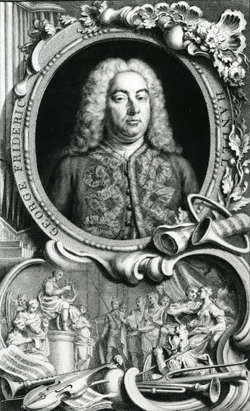
Our series of exhibitions looking in depth at a single year in Handel’s life continues with 1738. It was a year of varying fortunes for Handel—the Italian opera was failing and he was turning increasingly to the new form of the English oratorio. But at the same time a magnificent statue of him was unveiled at Spring Gardens in Vauxhall, celebrating his pre-eminent position in London society. It was the year in which Handel helped create the Fund for Decay’d Musicians, the roots of the new Methodist ministry were established, and Fortnum and Mason invented the Scotch Egg.
Once again a team of Handel House Volunteers will research and curate the exhibition, and the story of 1738 will be told through images and objects from the Handel House Collection, together with loans from other museums.
Exhibition | Pope Pius VII and Napoleon at Fontainebleau
From Napoleon.org and the Château de Fontainebleau:
Pie VII Face à Napoléon: La Tiare dans les Serres de l’Aigle
Château de Fontainebleau, 28 March — 29 June 2015
Curated by Christophe Beyeler and Jean Vittet
The Château of Fontainebleau hosted Pope Pius VII twice: first as a guest as he travelled to Napoleon’s coronation in 1804 and then as prisoner between 1812 and 1814. From 1796 until 1814, Rome and Paris were most notably embroiled in a bitter struggle over iconography. The exhibition at Fontainebleau looks at their diplomatic gifts, stolen artistic treasures, and the official French propaganda celebrating the Concordat of 1801 and defending the invasion of the Papal States in 1808 and the arrest of Pius VII in 1809. Napoleon I and Pius VII finally came head-to-head in 1812 at Fontainebleau. The exhibition contains nearly 130 items, some never displayed before, including loans from the Vatican museum and the papal sacristy.
◊ ◊ ◊ ◊ ◊
Le château de Fontainebleau a accueilli par deux fois le pape Pie VII, comme hôte sur le chemin du sacre en 1804, puis comme prisonnier entre 1812 et 1814. L’appartement des Reines-Mères, baptisé depuis lors « appartement du Pape », en conserve aujourd’hui le souvenir.
 Fontainebleau est à cet égard l’un des lieux qui incarne le mieux les relations tumultueuses entre Rome et Paris, dont l’une des expressions est la « guerre d’image » que se livrent les deux puissances, de 1796 à 1814.
L’exposition évoque d’abord la mainmise des Français sur quelques-uns des trésors de la collection pontificale, la célébration du concordat de 1801 par l’imagerie officielle ou encore l’iconographie subtile des cadeaux diplomatiques lors du sacre de 1804. La guerre de propagande, qui atteint son paroxysme avec l’invasion des États pontificaux en 1808 et l’arrestation de Pie VII en 1809, est ensuite décryptée à travers l’image d’une Rome antique renaissant grâce au « César moderne ». Le Pape, retenu à Savone depuis 1809, est conduit à Fontainebleau en 1812, où les deux protagonistes s’affrontent. L’Empereur parvient à arracher en janvier 1813 un éphémère concordat au Pape qui, libéré en 1814, est accueilli à Rome par une imagerie triomphaliste.
Près de 130 œuvres, parmi lesquelles des acquisitions inédites, ainsi que des prêts exceptionnels des musées du Vatican ou de la Sacristie pontificale, illustrent un affrontement où se combinent enjeux religieux, politiques et artistiques. En écho, sur les lieux mêmes de sa détention, les éléments retrouvés et restaurés du mobilier qu’a connu Pie VII sont rassemblés pour la première fois depuis le Premier Empire.
The 13-page press package is available here»
◊ ◊ ◊ ◊ ◊
The catalogue is available from Dessin Original:
Christophe Beyeler, ed., Pie VII Face à Napoléon: La Tiare dans les Serres de l’Aigle (Paris: RMN, 2015), 248 pages, ISBN: 978-2711862474, 39€.










 Enfilade
leave a comment