Exhibition | George Morland: In the Margins
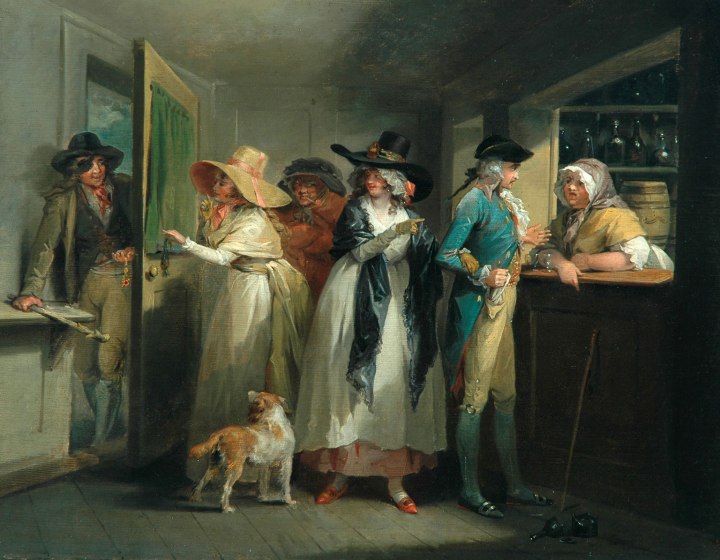
George Morland, Easy Money, 1788 (Huddersfield Art Gallery)
◊ ◊ ◊ ◊ ◊
Now on view at the University of Leeds:
George Morland: In the Margins
The Stanley & Audrey Burton Gallery, University of Leeds, 18 March — 11 July 2015
Curated by Nicholas Grindle
This exhibition looks at migrants and margins in the work of the painter George Morland (1763–1804), a popular painter whose lifestyle and early death earned him lasting notoriety. Over 250 of his works are held by public collections in the UK and US alone. His paintings of smugglers, gypsies, pedlars, soldiers, and families, which represent some of his best compositions, as well as how they mirrored his own life, raise compelling questions about who, and where, is ‘marginal’ in society. There has been no exhibition of his work since a small show in Reading in 1975 and no substantial discussion of his work since a thesis written in Stanford in 1977 and a chapter in John Barrell’s book Dark Side of the Landscape in 1980. His pictures resonate with contemporary issues such as migration and marginality in a way that was not evident thirty years ago.
The exhibition will run at The Stanley & Audrey Burton Gallery from 18 March 2015 until 11 July 2015, with a possible UK tour from August 2015 onwards.
◊ ◊ ◊ ◊ ◊
A symposium is scheduled for the end of May:
Bohemians and Marginal Communities in the 18th Century: George Morland in Context
The Stanley & Audrey Burton Gallery, University of Leeds, 29 May 2015
The Stanley & Audrey Burton Gallery presents a free symposium, bringing together academic discussion of the work of late 18th-century English painter George Morland. To coincide with our current exhibition George Morland: In the Margins, the Gallery is delighted to welcome experts and academics from a range of fields, to discuss the wider context of Morland’s work. These speakers will include the exhibition’s guest-curator Dr Nick Grindle (UCL); Professor of History of Art at Oxford Brookes University, Christiana Payne; social geographer, Dr Martin Purvis; independent art historian, Dr Anthony Lynch; and UEA MPhil student Francesca Bove.
The speakers will address representations of social margins in Morland’s artistic output and look at the parallels between his life and works. What can his representation of gypsies, smugglers, pedlars and families tell us about the societal conditions of the late 1800s and how do they reflect our own times? Morland was living on the brink of industrialisation, witnessing an increasingly capitalist culture and significant, sudden movements of people around the country; conditions which are still relevant to modern-day Britain. The worries of Morland’s contemporaries about the moral character and palatability of his works raises questions surrounding class relations and art’s role as social commentary and criticism.
Friday, 29 May 2015, 9:00–17:00. Free, though booking is essential. This event is kindly supported by the Paul Mellon Centre for Studies in British Art.
More information about programming for the exhibition is available here»
◊ ◊ ◊ ◊ ◊
The catalogue is available from the University of Leeds online bookstore:
Nicholas Grindle, ed., with essays by David Alexander, Kerry Bristol, Sue Ecclestone, Nicholas Grindle, and Martin Purvis, George Morland: Art, Traffic and Society in Late Eighteenth-Century England (Leeds: The Stanley & Audrey Burton Gallery, 2015), 99 pages, ISBN: 978-1874331544, £12.
 George Morland: Art, Traffic and Society in Late Eighteenth-Century England looks at the life and work of popular painter George Morland (1763–1804), whose remarkable talent, prodigious output, bohemian lifestyle and early death earned him lasting notoriety. Morland was the most infamous artist in Britain at the time of his death in 1804. His paintings enjoyed a stellar reputation, which was enhanced by stories about his fabulous earnings, prodigal spending, legendary drinking, and staggering debt. He was renowned for his associations with smugglers, gypsies and pugilists, as well as his constant attempts to evade his creditors. His best work is breathtaking in its ambition and execution, while the popularity of his drawings, paintings, and the prints after his work rose throughout his lifetime. Within months of his death, no fewer than four books had been published packed with anecdotes—many apocryphal—about his life and work. No other artist of the late eighteenth and early nineteenth centuries commanded such a profile.
Morland was reputed to have painted thousands of canvases and made hundreds of drawings. But in spite of his immense popular and critical stature, recent scholarly attention has been patchy, and this is the first publication to seriously review the artist in over thirty years. It includes five new essays which use recent perspectives in historical geography and studies of print and exhibition culture to help us look in new ways at his work and practice, as well as catalogue entries that bring scholarship on his paintings up to date.
Lecture | Philippe Blanchard on the Tombs of the Dukes of Épernon
From Inrap:
Philippe Blanchard | Étude historique et archéologique du caveau
des ducs d’Épernon, XVIIe–XVIIIe siècle, Eure-et-Loir
Musée du Louvre, Paris, 21 May 2015

Crânes sciés, famille des ducs d’Épernon (1661–1690), église Saint-Pierre d’Épernon © Philippe Blanchard, Inrap.
Cette conférence est donnée dans le cadre du cycle de conférences Actualité de la recherche archéologique.
Sous l’égide des départements du musée du Louvre, des spécialistes sont invités à présenter leurs plus récentes découvertes et les orientations de la recherche archéologique. En partenariat média avec Archéologia le magazine de l’actualité archéologique.
Auditorium du Louvre
Cour Carrée et Pyramide du Louvre
75058 Paris
Jeudi 21 mai 2015, à 12 h 30. Durée : 1 h
Entrée libre
New Book | La Peinture des Lumières: De Watteau à Goya
From the publisher:
Tzvetan Todorov, La Peinture des Lumières: De Watteau à Goya (Paris: Éditions du Seuil, 2014), 216 pages, ISBN: 978-2021108828, 45€.
 La peinture ne naît jamais dans un monde isolé, elle entre en résonance avec les mouvements social et intellectuel de son époque, et participe elle-même de la pensée. Il s’agit là d’un échange à double sens : les artistes sont imprégnés de l’esprit de leur temps, que pourtant ils transforment et enrichissent. Au XVIIIe siècle, le mouvement des Lumières bouleversera l’ordre de la société ; notre modernité en est issue.
La peinture des Lumières place l’être humain comme objet central de la représentation. Elle renonce à figurer les surhommes (dieux, personnages mythologiques, héros légendaires), pour se tourner vers des personnes ordinaires, engagées dans leurs activités quotidiennes. Elle met en scène leur variété, montrant hommes et femmes, enfants et vieillards, riches et pauvres, de toutes professions, y compris ceux qui se trouvent en marge de la société, fous, criminels et prostituées. Elle représente les facettes multiples de la nature humaine : l’amour sous toutes ses formes, mais aussi la violence, les réjouissances et les désespoirs, les activités religieuses et politiques. Parallèlement les règles de la représentation se transforment.
Cet ouvrage, illustré par une centaine de tableaux, dessins et gravures en couleurs, analyse la peinture des Lumières dans deux séries de chapitres. Les uns sont consacrés à la figure de quatre grands peintres européens : Antoine Watteau, Alessandro Magnasco, William Hogarth, Francisco Goya. Les autres chapitres examinent quelques sujets révélateurs : les personnages situés aux marges de la vie sociale (enfants, gueux, étrangers), les activités illustrant les marges de l’esprit (fantasmes, érotisme, travestissements), ou encore certains sous-genres picturaux, comme les portraits, les paysages, ou les natures mortes.
Tzvetan Todorov est historien des idées et essayiste, directeur de recherche honoraire au CNRS. Auteur d’une trentaine d’ouvrages, il a consacré plusieurs livres à l’étude de la peinture, dont Eloge du quotidien (1993, sur la peinture hollandaise du XVIIe siècle), Eloge de l’individu (2000, sur la peinture flamande du XVe siècle) et Goya à l’ombre des Lumières (2011). Il est également l’auteur d’un essai intitulé L’esprit des Lumières (2006).
Conference | Motion and Emotion in the French Enlightenment
From the conference program:
Body Narratives: Motion and Emotion in the French Enlightenment
Department of Art History, The University of Chicago, 10 April 2015
Organized by Susanna Caviglia
 8:30 Welcome, Christine Merhing, University of Chicago
8:40 Introduction, Susanna Caviglia, University of Chicago
9:00 Body Language: Narrative and Metaphor
Chair: Anne Leonard, Smart Museum of Art
• Anti-Pygmalion: Jean-Bernard Restout’s Diogenes Asking for Alms (1767) and the Question of Body Movement, Étienne Jollet, Université Paris 1 Panthéon-Sorbonne/Columbia University
• The Body Speaks: Anatomical Narratives in French Enlightenment Sculpture, Dorothy Johnson, University of Iowa
10:30 Coffee
11:00 The Mobile Body: Social Identity and Visual Dynamics
Chair: Nina Dubin, University of Illinois at Chicago
• Engaging Tapestries at the Hôtel de Soubise: Attention, Mobility, Intercorporeality, Mimi Hellman, Skidmore College
• Watching Her Step: Women and the Art of Walking after Marie-Antoinette, Melissa Hyde, University of Florida
12:30 Lunch
2:00 Body Temporality: Aesthetics of Walking
Chair: Robert Morrissey, University of Chicago
• Movement and Stasis: Mapping Cythera, Mary D. Sheriff, University of North Carolina at Chapel Hill
• Strolling Time, Ewa Lajer-Burcharth, Harvard University
3:30 Coffee
4:00 Roundtable
Chair: Rebecca Zorach, University of Chicago
• Basile Baudez, Université Paris-Sorbonne, Paris IV
• Richard Neer, University of Chicago
• Larry Norman, University of Chicago
• Andrei Pop, University of Chicago
5:30 Conclusions
6:00 Reception
Poster Image: Pierre Subleyras, Charon Ferrying the Shades (Paris: Louvre).
Exhibition | El Retrato en las Colecciones Reales

◊ ◊ ◊ ◊ ◊
Now in its final weeks, this portrait exhibition contains over 100 objects spanning the past five hundred years. Rocío Martínez provides an extremely useful review (in English) for the Royal Studies Journal Blog. The exhibition website provides one of the finest virtual experiences I’ve ever encountered in terms of documenting an exhibition visually. Finally, thanks to Jennifer Germann for pointing all of this out to me (my apologies that it didn’t appear back in December!). –CH
El Retrato en las Colecciones Reales: De Juan de Flandes a Antonio López
The Portrait in the Royal Collections: from Juan de Flandes to Antonio López
Royal Palace, Madrid, 4 December 2014 — 19 April 2015
Curated by Carmen García-Frías Checa and Javier Jordán de Urríes
La exposición El Retrato en las Colecciones Reales. De Juan de Flandes a Antonio López ofrece una visión general del retrato de corte en España, tanto en tiempos de la Casa de Austria como de la Casa de Borbón, desde el siglo XV al XXI, trazando un recorrido por la evolución de la imagen de los monarcas en ese largo medio milenio. Un itinerario jalonado por obras maestras de la pintura y del género del retrato, con los mejores ejemplos conservados en las colecciones de Patrimonio Nacional, que se exponen en doce salas de la planta baja del Palacio Real de Madrid, con el acompañamiento de algunas esculturas, pequeños bronces, varios dibujos y grabados, y un par de tapices-retrato. La exposición se estructura en dos grandes secciones, Casa de Austria y Casa de Borbón, con diferentes apartados que siguen un orden cronológico por reinados.
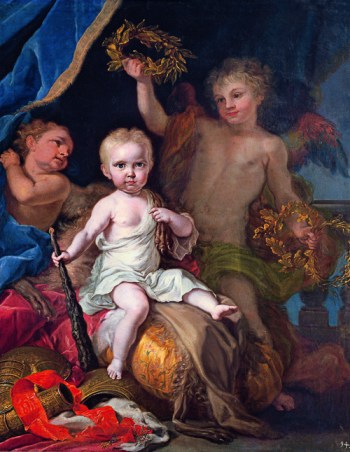
Giuseppe Bonito, Carlos Antonio de Borbón as the Child Hercules, 1748, oil on canvas, 128.5 x 102.5 cm (Madrid: Royal Palace)
La primera sección abre con los inicios de la dinastía habsbúrgica en España, mostrando como antecedentes retratos fundamentales de sus antepasados, el Retrato del duque de Felipe el Bueno del taller de Rogier Van der Weyden (de la Casa de Borgoña) y la imagen más fidedigna de la reina Isabel la Católica de Juan de Flandes (de la Casa de los Trastámara). A los grandes retratos oficiales de Carlos V de Jakob Seisenegger y de Felipe II en versión pictórica de Antonio Moro y escultórica de Pompeo Leoni, se une una importantísima muestra de retratos familiares por los pintores más famosos de la corte española de los siglos XVI y principios del siglo XVII, como Alonso Sánchez Coello, Joris Van der Straeten, Juan Pantoja de la Cruz, Bartolomé González o Rodrigo de Villandrando, así como de otras cortes europeas, como Frans Pourbus el Joven o Marcin Kover. Ya en pleno siglo XVII, la magnífica miniatura del conde-duque de Olivares de Diego Velázquez, o el grandioso retrato ecuestre de Juan José de Ribera, sin olvidar a los dos grandes retratistas del reinado de Carlos II, con varios ejemplares de Juan Carreño de
Miranda y Claudio Coello.
En la segunda sección dedicada a la Casa de Borbón desde el siglo XVIII hasta el presente, se exponen los mejores ejemplos del retrato borbónico en Patrimonio Nacional, como el monumental retrato ecuestre de Felipe V, por Louis-Michel van Loo; el de Carlos III con el hábito de su Orden, por Mariano Salvador Maella, también retratos de Giuseppe Bonito y Anton Raphael Mengs; una de las parejas de Carlos IV y María Luisa de Parma, por Francisco de Goya, la espléndida del rey de cazador y la reina con mantilla; destacados ejemplos del retrato decimonónico, con obras de Vicente López, Federico de Madrazo o Franz Xaver Winterhalter, y, finalmente, retratos de Alfonso XIII por Ramón Casas y Joaquín Sorolla para llegar al reinado de Juan Carlos I con El Príncipe de ensueño de Salvador Dalí y el retrato de La familia de Juan Carlos I pintado por Antonio López, que se presenta al público con motivo de esta exposición.
Junto a esas obras maestras de la pintura se exhiben, como complemento, algunos pequeños bronces, un par de tapices-retrato y destacadas esculturas, desde un Felipe II por Pompeo Leoni hasta el retrato doble de los reyes Alfonso XIII y Victoria Eugenia, por Mariano Benlliure. Esas piezas entran así en relación con la pretensión de tridimensionalidad de la pintura.
◊ ◊ ◊ ◊ ◊
The catalogue is available from ArtBooks.com:
Carmen García-Frías Checa and Javier Jordán de Urríes, eds., El Retrato en las Colecciones Reales: De Juan de Flandes a Antonio López (Madrid: Patrimonio Nacional, 2014), 536 pages, ISBN: 978-8471204981, $85.
 Fundación Banco Santander colabora con Patrimonio Nacional en la preparación de esta muestra títulada El retrato en las Colecciones Reales. De Juan de Flandes a Antonio López. La importancia del género retratístico en las Colecciones Reales se comprende fácilmente, teniendo en cuenta que los mejores artistas de cada momento, han sido grandes retratistas de la Monarquía Española, por lo que las grandes obras de estos excelentes pintores forman parte de los fondos de Patrimonio Nacional. En este exposición contaremos con artistas de la talla de Juan de Flandes, Sánchez Coello, Rubens, Velázquez, Goya, Sorolla, Dalí o Antonio López.
Conference | Origins and the Legitimacy of Architecture in Europe
From the research program’s website (it includes lots of interesting materials in addition to details of the upcoming conference). . .
Origins and the Legitimacy of Architecture in Europe, 1750–1850
Leiden University and the Rijksmuseum van Oudheden, Leiden, 1–2 May 2015
Organised by Maarten Delbeke, Sigrid de Jong, and Linda Bleijenberg
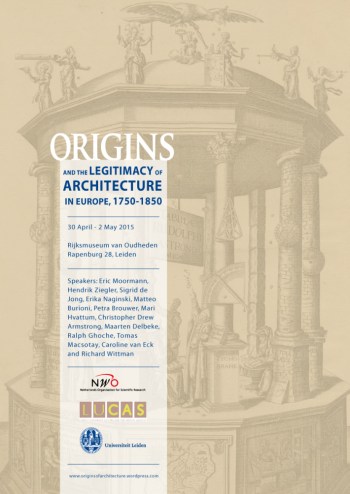 From Thursday 30 April to Saturday 2 May 2015 we will host an international conference at the Rijksmuseum van Oudheden in Leiden, to conclude our research program at the Leiden University Centre for the Arts in Society (LUCAS). Supported with generous funding from NWO, the project aimed at understanding how, between 1750 and 1850, changing views about the origins of civilization and the arts have affected the theory and practice of architecture in Europe. More in particular, the project aimed to understand how these views of origins, and especially the primitivism they often imply, have been adopted in architectural discourse to buttress the legitimacy of architecture in society.
The questions the conference wishes to address include: how do architectural origins relate to questions of architecture’s legitimacy as an artistic and cultural practice in the period under consideration? Why are origins deemed relevant to address these questions? To which particular architectural problems does the question of origins pertain? With which intellectual contexts and debates do architectural theory and practice enter in dialogue through the matter of origins? How do architectural origins relate to the primitivism that is manifest across a wide range of intellectual and artistic practices of the period? How do notions about origins sustained in historiography writ large affect architectural history and ideas about the historicity of buildings?
◊ ◊ ◊ ◊ ◊
F R I D A Y , 1 M A Y 2 0 1 5
9.30 Registration and coffee
10.00 Welcome by Maarten Delbeke
10.15 Session I. Myths
• Eric Moormann, ‘Mehr Modell und Puppenschrank als Gebäude’: How Pompeii Did Not Enhance Architectural Studies in the Eighteenth Century
• Hendrik Ziegler, Goethe and the Classical Canon in Architecture
• Sigrid de Jong, Myths of Origins: Stonehenge in the Royal Academy’s Architectural Histories
12.30 Lunch break
14.00 Session II. Histories
• Erika Naginski, On the Colonial Origins of Architecture: Building the ‘Maison Rustique’ in Cayenne, French Guiana
• Matteo Burioni, Imaginary Geographies and Imagined Beginnings: Pietro della Valle, Fischer von Erlach, Jean-Nicolas-Louis Durand
• Petra Brouwer, Origins of Architecture in the First Architectural History Survey Texts of James Fergusson, Franz Kugler, and Wilhelm Lübke
17.00 Book presentations, Sigrid de Jong and Caroline van Eck
18.00 Keynote Lecture
• Mari Hvattum, Heteronomic Historicism
19.00 Reception
S A T U R D A Y , 2 M A Y 2 0 1 5
9.30 Registration and coffee
10.00 Session III: Objects and Language
• Christopher Drew Armstrong, Theorizing the Orient: The Discourse on Origins, Language and Identity in the Paris Académie des Inscriptions
• Maarten Delbeke, Complexity and Contradiction in Architecture around 1820
• Ralph Ghoche, ‘La pensée simple que présente un cône’: Unity and Simultaneity in Simon-Claude Constant-Dufeux’s Tomb of Dumont d’Urville
12.15 Lunch break
13.45 Session IV: Religions and Rituals
• Tomas Macsotay, The Distracted Believer and the Return to the First Basilicae: Marqués de Ureña’s Reflexiones sobre la arquitectura, ornato, y música del templo (1785)
• Caroline van Eck, Quatremère de Quincy on the Origins of Architecture, Sculpture and Society: The Debate about Primitivism among Enlightenment Critics of Religion
• Richard Wittman, The Purity of Origins: Architecture in Rome after Napoleon
British Museum Director, Neil MacGregor, to Retire
From The British Museum:
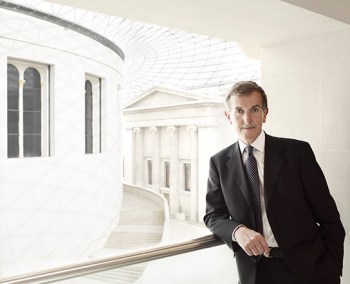
Neil MacGregor, Director of the British Museum. Copyright Jason Bell.
Neil MacGregor announced to his colleagues at the British Museum this morning [8 April 2015] that he has decided to step down as Director at the end of December 2015.
MacGregor said, “It’s a very difficult thing to leave the British Museum. Working with this collection and above all with the colleagues here has been the greatest privilege of my professional life. But I’ve decided that now is the time to retire from full-time employment and the end of this year seems a good time to go. The new building has been completed, so we at last have proper exhibition space, new conservation and scientific facilities, and first class accommodation for our growing research activities. We have built strong partnerships with fellow museums across the UK, and are rapidly expanding our programme of loans and training around the world.
The Museum is now ready to embark on a new phase—deploying the collection to present different histories of the world. It is an exhilarating prospect, and it will start with the new Islamic Galleries and with plans for the future of the Old Reading Room.
The Museum is in a strong position to respond to these energising challenges. It has a distinguished international Board under a new Chairman Sir Richard Lambert. To everything it does the BM brings the highest levels of professionalism. Around the world it is a valued partner and the Board has clearly defined the British Museum’s role as a worldwide resource for the understanding of humanity, to be made available as widely and as freely as possible.”
MacGregor added, “Although I shall no longer be working full-time I shall be involved in a number of projects. I shall be working with the BBC and the BM on a new Radio 4 series on Faith and Society. I shall be chairing an Advisory Board to make recommendations to the German Minister of Culture, Monika Grütters, on how the Humboldt-Forum, drawing on the outstanding resources of the Berlin collections, can become a place where different narratives of world cultures can be explored and debated. In Mumbai, I look forward to working on the presentation of world cultures with the CSMVS Museum and its Director Mr Sabyasachi Mukherjee under whose tenure it has emerged as one of the finest and most active museums in South/South East Asia.”
The full press release is available here»
New Book | Graffitis: Inscrire son nom à Rome, XVIe–XIXe siècle
From the publisher:
Charlotte Guichard, Graffitis: Inscrire son nom à Rome, XVIe–XIXe siècle (Paris: Éditions du Seuil, 2014), 176 pages, ISBN: 978‑2021172027 20€.
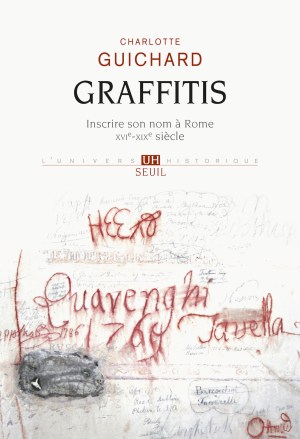 Vues de près, les peintures antiques de la villa Adriana à Tivoli, les fresques de Raphaël au palais du Vatican, mais aussi celles de la galerie des Carrache dans le palais Farnèse, et tant d’autres, offrent un spectacle étonnant. Ce sont des œuvres striées de noms, de dates et même d’esquisses, très différentes des images lisses, intactes et éclatantes auxquelles les livres d’art nous ont habitués. Les graffitis y sont omniprésents. Ils furent réalisés par des artistes parfois célèbres, au cours de leur période de formation à Rome, par des amateurs lors du Grand Tour, par des soldats ou des touristes de passage à Rome entre les XVIe et XIXe siècles.
Ces graffitis nous mènent au cœur de la tradition artistique européenne et occidentale. Apposés sur des œuvres majeures, ils sont la survivance de gestes d’empreinte, d’attestation et d’inscription, de signatures et d’écritures individuelles. Trace urbaine griffant les hauts lieux de Rome, le graffiti manifeste un rapport matériel et familier aux œuvres.
Ce livre invite à un autre regard sur l’art et son histoire : non pas esthétique mais archéologique ; un regard de biais, littéralement. Ainsi rendus à leur visibilité, les graffitis donnent à voir une autre histoire du chef-d’œuvre, matérielle, tactile et anthropologique.
Lauréate de la villa Médicis (2012–13), Charlotte Guichard est chargée de recherche au CNRS (Institut d’histoire moderne et contemporaine, Paris). Ses travaux portent sur l’histoire de l’art et du patrimoine au XVIIIe siècle. Elle a notamment publié Les Amateurs d’art à Paris au XVIIIe siècle (Champ Vallon, 2008).
New Book | The Gardens of the British Working Class
From Yale UP:
Margaret Willes, The Gardens of the British Working Class (New Haven: Yale University Press, 2014), 416 pages, ISBN: 978-0300187847, $40.
 This magnificently illustrated people’s history celebrates the extraordinary feats of cultivation by the working class in Britain, even if the land they toiled, planted, and loved was not their own. Spanning more than four centuries, from the earliest records of the laboring classes in the country to today, Margaret Willes’s research unearths lush gardens nurtured outside rough workers’ cottages and horticultural miracles performed in blackened yards, and reveals the ingenious, sometimes devious, methods employed by determined, obsessive, and eccentric workers to make their drab surroundings bloom. She also explores the stories of the great philanthropic industrialists who provided gardens for their workforces, the fashionable rich stealing the gardening ideas of the poor, alehouse syndicates and fierce rivalries between vegetable growers, flower-fanciers cultivating exotic blooms on their city windowsills, and the rich lore handed down from gardener to gardener through generations. This is a sumptuous record of the myriad ways in which the popular cultivation of plants, vegetables, and flowers has played—and continues to play—an integral role in everyday British life.
Margaret Willes is an enthusiastic gardener and the former publisher at the National Trust.
Call for Articles | Art and Art History Libraries
From H-ArtHist:
Art and Art History Libraries
2016 Issue of Perspective: La Revue de l’INHA
Proposals due by 15 June 2015; finished papers due by 1 June 2016
The next special issue of Perspective (the journal of the Institut national d’histoire de l’art) will focus on topics relating to art and art-history libraries and their specificity as bibliographic, artistic, and documentary resources. We will examine these places, which make information pertaining to our discipline available to artists and researchers, while at the same time endeavoring to conserve their collections of texts and images. This double purpose requires examining the practices and profiles of users, the way in which people visit these institutions, either by consulting the images in reading rooms or websites (consultation of reproductions as opposed to reading monographs, digital access to works, etc.), and also a study of their collections: in addition to books and magazines, art libraries also preserve prints, photographs, manuscripts, artist books, etc.
The interest of such a project for an art-historical review lies partly in the difficulty in defining the exact scope of an art library. However, the planned reopening by the INHA in 2016 of the Salle Labrouste, which will house one of the most important art libraries in the world in terms of its number of volumes, its symbolic importance, and its accessibility, offers a unique opportunity for a collective historical and aesthetic reflection on the forms and ambitions of these collections of art and knowledge, past and present. Nevertheless, this issue will not be limited exclusively to the example of the INHA. On the contrary, consistent with the editorial philosophy of Perspective,
the volume will contain articles that cover a historical range in their study of art libraries in general and present the most innovative studies from an international standpoint. At the same time, we aim to publish original papers on the place of the library in the work of artists and architects.
We would like to suggest several potentially interesting paths, without excluding others: issues related to the conservation and dissemination of ephemera and small publications such as invitation cards, almanacs, booklets, announcements, etc.; the study of exceptional bibliophiles such as, for example, Doucet, Wyder, and Oechslin; the correlation between library holdings and research topics (the Mesnil collection given to the Warburg Institute and research projects at University College, London in the 2000s); the study of art libraries during wartime similar to research on artworks plundered during such extreme periods; evaluation of the losses and gains following the merger of disparate collections originally belonging to art schools, museums, universities (for example, the INHA Library); the particular fate of iconographic documentation (Bildarchiv Foto Marburg); the recent foundation of specialized research centers with libraries created from scratch like the Canadian Centre for Architecture in Montreal; and also the inclusion of various media resources, including recordings, such as oral archives at the British Library (artists’ interviews) or performance videos in the Kandinsky Library of the Centre Georges Pompidou. Finally, projects are certainly needed from the perspective of the history of art education, on specialized establishments for art craftsmen such as the Bibliotheque Forney and the Ratti Center at the Metropolitan Museum of Art, without neglecting the opportunity offered by digital technology in new ways of disseminating collections.
The proposals could range from a synthetic short article focusing on a specific aspect of the art library, or on relations between art and the library in a given period and in a particular geographic area (25,000 characters), to a detailed and multidisciplinary study of a moment in art library history, or even the problematization of their absence in time and space (45,000 characters).
The intention of this call for papers is not to cover all possible topics exhaustively: all proposals are welcome. However, within the framework of an art-historical review dedicated to recent international research in the field, we wish to emphasize historical and aesthetic approaches, rather than research relevant to library studies proper. Projects in whatever language—Perspective takes responsibility for translations—will be reviewed by the scientific committee consisting of Laurent Baridon, Ewa Bobrowska, Anne-Élisabeth Buxtorf, Penelope Curtis, Godehard Janzig, Thomas Kirchner, Rémi Labrusse, Anne Lafont, Johanne Lamoureux, Antoinette Le Normand-Romain, Michel Melot, Pierre-Michel Menger, Philippe Saunier, Jean-Claude Schmitt, Valérie Sueur-Hermel, Veerle Thielemans and Bernard Vouilloux.
Please submit your proposals (2000–3000 character summary and a 2–3 line biography) to revue-perspective@inha.fr up to and including June 15, 2015. Full texts of accepted contributions will need to be sent by June 1, 2016.










 Enfilade
leave a comment