Display | Wedgwood and Darwin
From the V&A press release:
Wedgwood and Darwin
V&A Wedgwood Collection, Barlaston, Stoke-on-Trent, 24 February — June 2025
This display will explore the story of Josiah Wedgwood’s grandson Charles Darwin (1809–1882) and how the family link inspired Wedgwood ceramics creative output. Thirty-five historic objects from the collection will go on display alongside the acquisitions from Wedgwood’s new range inspired by Darwin’s Voyage of the Beagle. The display forms part of an ambitious new public events programme for 2025, marking ten years since the Wedgwood Collection was saved for the nation following a successful fundraising campaign spearheaded by Art Fund. Housed alongside the working Wedgwood factory at World of Wedgwood in Stoke-on-Trent, the collection celebrates the legacy of British potter and entrepreneur Josiah Wedgwood (1730–1795) and forms a unique record of over 260 years of British ceramic production, evolving tastes, changing fashions, and manufacturing innovation.
The press release marking the 10th anniversary of the V&A Wedgwood Collection is available here»
Conference | Guillaume Werniers and Tapestry-Making in 18th-C. France
From ArtHist.net:
Guillaume Werniers and Tapestry-Making in Eighteenth-Century France
Guillaume Werniers et la tapisserie dans le Nord de la France au XVIIIe siècle
Université de Lille, 1 April 2025
In 1700, Brussels-born Guillaume Werniers took over the tapestry factory founded a dozen years earlier in Lille by his father-in-law Jean de Melter. He took on local commissions (from the Etats de Flandres, churches, and convents) and specialized in tapestries depicting scenes of daily life in the manner of the Flemish painter David Teniers. These tapestries were known as ‘Tenières’ and were destined for wealthy international costumers. On the death of Werniers in 1738, his widow Catherine Ghuys took over the company until 1778, ensuring its prosperity for some forty years. This study day will bring together professionals and researchers specializing in the art of tapestry and its history (museum curators, restorers, academics, antique dealers, collectors, as well as enthusiasts) to present the latest advances in research on the subject. It will also show that tapestry occupied a place of choice in the most refined interiors during the early modern period, even though this art form is today little-known by students and the general public alike. The proceedings will be published in the Revue du Nord with the support of the Manufacture royale De Wit.
Comité scientifique
• Jan Blanc, Université de Lausanne
• Jérémie Cerman, Université d’Artois
• Anne Perrin Khelissa, Université de Toulouse
Comité d’organisation
• Pascal Bertrand, Université de Bordeaux-Montaigne
• Gaëtane Maës, Université de Lille, gaetane.maes@univ-lille.fr
• Soersha Dyon, Université de Lille
Administration
• Céline Delrue, IRHiS, ULille, celine.delrue@univ-lille.fr
p r o g r a m m e
9.30 Accueil
9.45 Ouverture — Charles Mériaux (Directeur de l’IRHiS, ULille), Soersha Dyon, Gaëtane Maës (IRHiS, ULille)
10.00 Introduction — Pascal-François Bertrand (UBordeaux Montaigne)
10.15 Context et Approche Historique de la Tapisserie Lilloise
Modérateur: Jérémie Cerman (CREHS, UArtois)
• Hélène Lobir (Musée de l’Hospice Comtesse) — La collection de tapisseries des musées de Lille
• Martine VanWelden (KULeuven, Belgique) — Contacts et comparaisons entre les centres de tapisserie de Lille et d’Audenarde
• Dominique Delgrange (Société française d’héraldique et de sigillographie) and Evrard Van Zuylen (Développeur de la base de données webaldic) — Lecture et identification des armoiries présentes dans plusieurs tapisseries de Werniers
12.00 Déjeuner
13.30 Peinture et Tapisserie
Modératrice: Juliette Singer (Palais des Beaux-Arts, Musée de l’Hospice Comtesse)
• Jean Vittet (Château de Fontainebleau) — Le peintre Arnould de Vuez (1644–1720) et la tapisserie
• Koen Brosens (KULeuven, Belgique) — Teniers, Teniers, Teniers. And Teniers. The European market for tapestries ‘à la manière de Teniers’ around 1700
• Pascal-François Bertrand (UBordeaux Montaigne) — Les Tenières de la manufacture De Melter et Werniers de Lille
15.15 Table Ronde: Autour des Attributions aux Ateliers de Lille et du Nord de La France
Modératrice: Florence Raymond (Musée de l’Hospice Comtesse)
• Guy Delmarcel (KULeuven, Belgique), les intervenants, le public
16.15 Conclusion — Gaëtane Maës (IRHiS, ULille)
The Burlington Magazine, February 2025
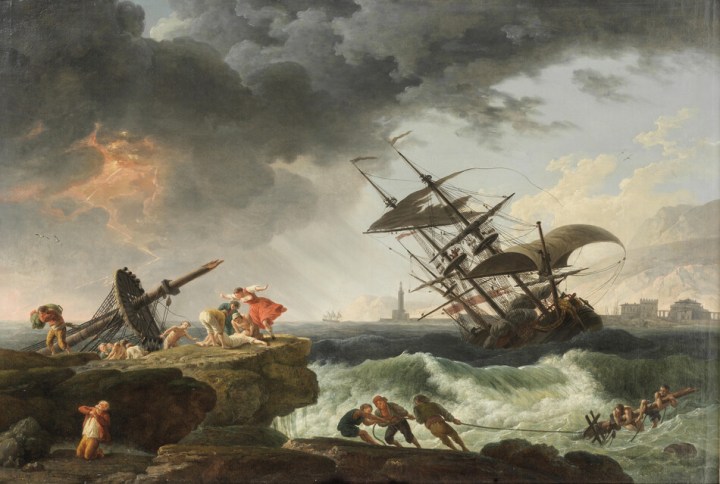
Claude-Joseph Vernet, Shipwreck on a Rocky Coast, 1775, oil on canvas, 74 × 108 cm (Private Collection). The work and its pendant, Harbour Scene at Sunset, are identified by Yuriko Jackall as paintings acquired directly from the artist by François-Marie Ménage de Pressigny, who likely commissioned The Swing by Fragonard. In contrast to the latter, which in 1794 was valued at 400 livres, the two paintings by Vernet were valued at 4,000 livres—the most valuable paintings owned by Ménage de Pressigny.
◊ ◊ ◊ ◊ ◊
The long 18th century in the February issue of The Burlington:
The Burlington Magazine 167 (February 2025)
e d i t o r i a l
• “Cataloguing,” p. 79.
It is one of the basic responsibilities of major collections to research and publish the works of art in their care. Such projects can take many years to mature and are often abandoned because of a lack of funding or shifting institutional priorities. It might be imagined, therefore, that because of these threats and the formidable cost of producing specialist and richly illustrated books, that collection catalogues would have become an extinct species. However, happily, a close reading of this Magazine in recent months would suggest otherwise, across a wide range of media and in terms of a broad chronological span . . .
 a r t i c l e s
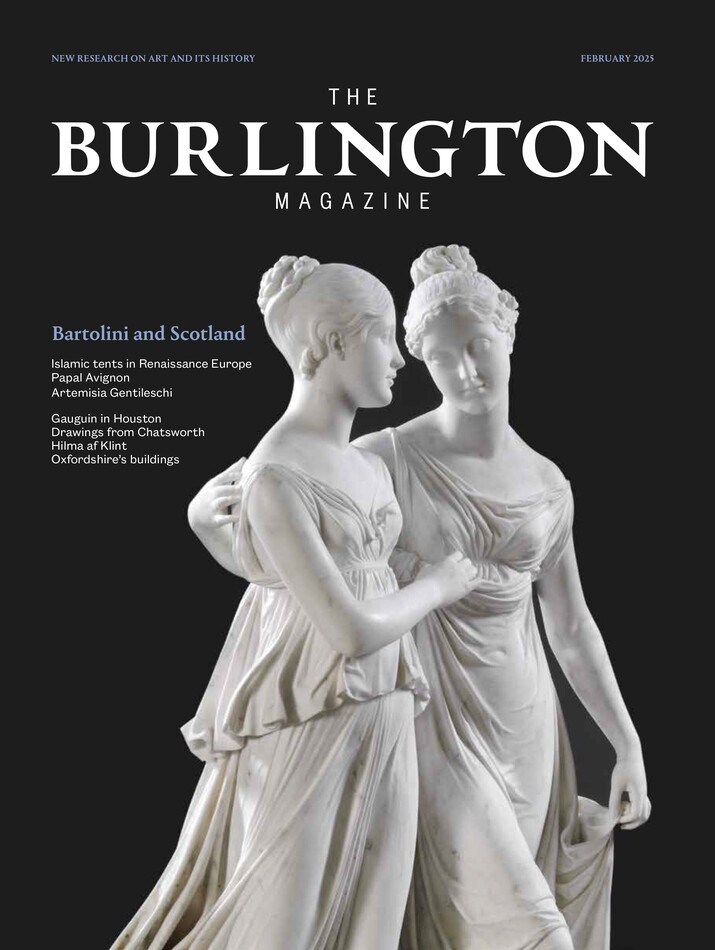
• Lucy Wood and Timothy Stevens, “The Elder Sisters of The Campbell Sisters: William Gordon Cumming’s Patronage of Lorenzo Bartolini,” pp. 126–53.
s h o r t e r n o t i c e s
• Yuriko Jackall, “Ménage de Pressigny and His Art Collection,” pp. 157–61.
• Dyfri Williams, “Lusieri’s Mysterious Wooded Lake Identified,” pp. 161–63.
r e v i e w s
• Marjorie Trusted, Review of the exhibition Luisa Roldán: Escultora Real (Museo Nacional de Escultura, Valladolid, 2024–25), pp. 164–66.
• Karin Hellwig, Review of the exhibition Hand in Hand: Sculpture and Colour in the Spanish Golden Age (Prado, 2024–25), pp. 166–69.
• William Whyte, Review of Simon Bradley, Nikolaus Pevsner and Jennifer Sherwood, Oxfordshire: Oxford and the South-East, The Buildings of England (Yale UP, 2023), pp. 188–89.
• Elizabeth Savage, Review of Esther Chadwick, The Radical Print: Art and Politics in Late Eighteenth-Century Britain (Paul Mellon Centre for Studies in British Art, 2024), pp. 194–96.
Online Talk | Conserving Paper with Live Demonstration
From The Linnean Society:
John Abbott | How to Conserve 18th- and 19th-Century Paper with Live Demonstration
Online and in-person, The Linnean Society, Burlington House, 5 March 2025, 2pm
The Linnean Society takes the preservation of its collections seriously. The Society has a full-time conservator, Janet Ashdown, and an adopt-an-item programme (AdoptLINN). The Society is also incredibly fortunate in having had an experienced volunteer and retired paper conservator, John Abbott, who has been working with Janet since 2018. In the past seven years, John has conserved many illustrations within the Society Papers Collection, and in this talk, he will demonstrate how to conserve loose 18th- and early 19th-century papers. By showcasing papers in need of conservation, John will reveal the decision-making process even before the start of conservation, and then undertake a live conservation demonstration. The demonstration will cover cleaning as well as repairing paper. We will send the link for this online event two hours before it starts.
Registration is available here»
John Abbott is a retired archive conservator who worked for the National Archives and its predecessor The Public Record Office for 43 years. He was involved in the conservation and preservation of archival material including paper and parchment manuscripts, maps, plans, designs, posters, photographs, and seals. Between 1984 and 1986 John was part of a team of three (two archive conservators and one book conservator) involved in the conservation and rebinding of Great and Little Domesday books.
Call for Papers | Creating the Museum, 1600–2025
From ArtHist.net:
Creating the Museum: Exploring the Museum Impulse in Local, Regional, and National Contexts
Conference of the National Gallery and the Museums and Galleries History Group
London, 26–27 September 2025 (dates still to be confirmed)
Proposals due by 14 March 2025
While the birth of the concept of the museum has attracted lots of scholarly attention and the desire to create new museums is now a global phenomenon, the question of how individual museums, their collections, buildings, and personnel come into being has not been widely considered. As complex organisations, museums have been created through multifaceted sets of initiatives, practices, and activities—raising money, sourcing or commissioning buildings and storage, assembling, organising and interpreting collections, developing expertise, engaging communities, fulfilling a purpose which some groups were more able to prosecute than others. Various periods have seen the flourishing of local, regional, national museums, of large or smaller scale, and of different specialisms and audiences, with varying models of governance. Some passionately wished for museums ultimately stalled, and some proposed museums never quite appeared. Some museums were created for particular audiences, at particular moments, while others evolved from earlier forms of collecting; some required particular buildings in order to begin; some have taken up residence like hermit crabs in whichever spaces were available.
To develop our understanding of the reasons for creating museums and to coincide with the 200th anniversary of the creation of the National Gallery in London, we invite proposals for a conference hosted by the National Gallery and the Museums C Galleries History Group (MGHG). The conference will focus on why and how galleries and museums internationally/globally have emerged and evolved. It will explore the different ways in which museums and public art galleries come into existence and the impulses, rationales, and objectives for ‘creating’ museums, foregrounding the wide range and variety of museum creation and exploring core questions of purpose, meaning, and context, whilst also drawing attention to the specificity of the National Gallery, reflecting on the contexts for its founding impulses and exploring the future roles, purpose, and functions of (inter)national galleries.
We seek papers covering any aspect of museum creation between about 1600 and the present day, for any type of museum, anywhere in the world. Papers should be 15–20 minutes in length; we invite individual proposals as well as proposals for a panel of papers (maximum 4 papers for a panel).
Papers may respond to these questions:
• What impulses led to the creation of museums?
• Under what circumstances have completely new types of museum been created?
• What can museums that never quite came into being, or museums that came and went, tell us?
• What role do collections (if any) play in the creation of museums?
• What role do museum buildings play in acts of creating the museum, or how has the need for physical space of various kinds impacted on the creation of museums?
• What has it taken to create a museum from public funds such as local or national taxes?
• Which individuals have created museums, out of philanthropy, passion, memorialisation or other motivations, and how?
• Is the creation of museums distinctive by specialism (natural history, art gallery, social history, etc)?
• How has the orientation of museums towards particular audiences promoted museum creation in particular ways?
• How do museums’ links with other organisations such as libraries impact on their creation?
• Are there museums whose creation is inexplicable?
• How has the National Gallery positioned itself in relation to other London, UK, and international museums in the past?
• What are the aims and objectives, benefits and drawbacks of branch museums emerging from the ‘centre’ (e.g. VCA, Tate, Guggenheim)?
• How have partnerships developed and what have been the fruits of such partnerships in diverse areas of museum life including Research, Conservation, and Education/Learning?
• What are the funding models currently available which ensure openness and parity within the sector which are worth highlighting for future reference?
• Are there any historical or actual international collaborations which offer particularly positive models for current and future practice (e.g. ICOM)?
• How should an institution like the National Gallery relate to other institutions today?
• How and in what ways is a museum like the National Gallery representative of ‘national’ art?
Please send proposals (200–300 words) with an indication of affiliation and job title to contact@mghg.info by Friday, 14 March 2025. Successful proposals will be informed by 30 April 2025. We welcome proposals from researchers at all career stages. As the conference will be exclusively ‘in person’, please note that successful speakers will be responsible for their own expenses. We gratefully acknowledge the support of the Paul Mellon Centre for Studies in British Art.
New Book | The Revolutionary Self
From Norton:
Lynn Hunt, The Revolutionary Self: Social Change and the Emergence of the Modern Individual, 1770–1800 (New York: W. W. Norton & Company, 2025), 208 pages, ISBN: 978-1324079033, $35.
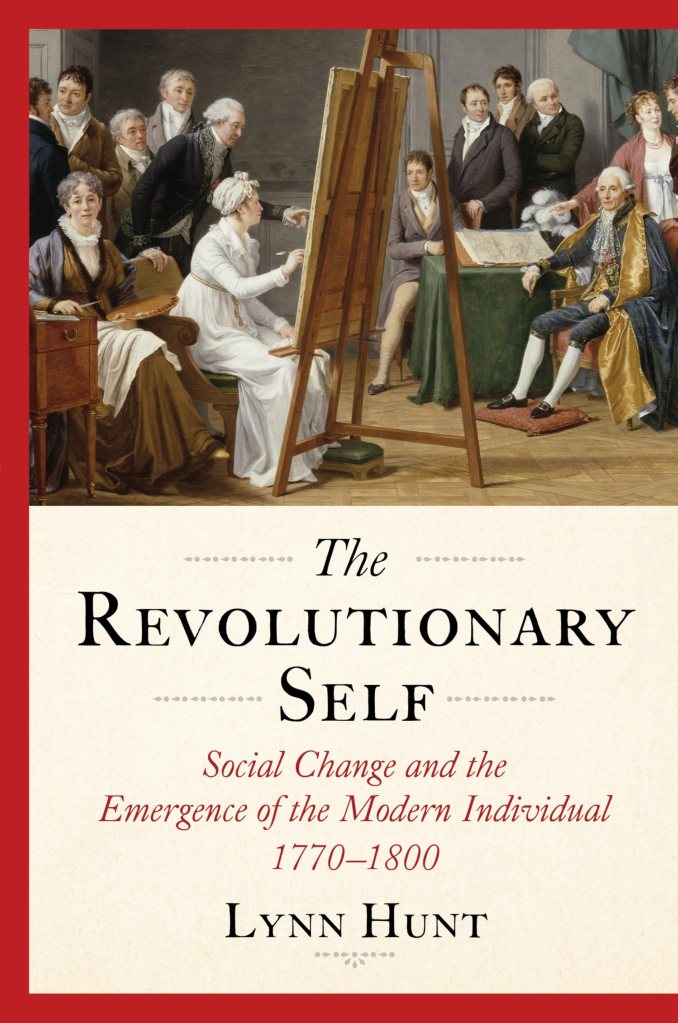
An illuminating exploration of the tensions between self and society in the age of revolutions.
The eighteenth century was a time of cultural friction: individuals began to assert greater independence and there was a new emphasis on social equality. In this surprising history, Lynn Hunt examines women’s expanding societal roles, such as using tea to facilitate conversation between the sexes in Britain. In France, women also pushed boundaries by becoming artists, and printmakers’ satiric takes on the elite gave the lower classes a chance to laugh at the upper classes and imagine the potential of political upheaval. Hunt also explores how promotion in French revolutionary armies was based on men’s singular capabilities, rather than noble blood, and how the invention of financial instruments such as life insurance and national debt related to a changing idea of national identity. Wide-ranging and thought-provoking, The Revolutionary Self is a fascinating exploration of the conflict between individualism and the group ties that continues to shape our lives today.
Lynn Hunt is Distinguished Research Professor at the University of California, Los Angeles. The author of numerous works, including Inventing Human Rights and Writing History in the Global Era and former president of the American Historical Association, she lives in Los Angeles.
c o n t e n t s
Introduction: How the Smallest Things Lead to Big Changes
1 Tea and How Women Became ‘Civilized’
2 Revolutionary Imagery and the Uncovering of Society
3 Art, Fashion, and One Woman’s Experience
4 Revolutionary Armies and the Strategies of War
5 Money, Self-Interest, and Making a Republic
Epilogue: Self Society and Equality
Acknowledgments
Notes
Index
Exhibition | Get to Work! The Work and Toil of Women

.
Francisco Muntaner, The Spinners, detail, 1796, engraving
(Staatliche Museen zu Berlin, Kupferstichkabinett / Dietmar Katz)
◊ ◊ ◊ ◊ ◊
From the Staatliche Museen zu Berlin:
Get to Work! The Work and Toil of Women
An die Arbeit! Vom Schaffen und Schuften der Frauen
Kupferstichkabinett, Gemäldegalerie, Berlin 18 February — 18 May 2025
Curated by Dagmar Korbacher, Mailena Mallach, and Christien Melzer
Women’s contributions to society are often unseen and seldom considered in art. Many women’s names and their stories have long since been forgotten. Using French, German, Italian, Spanish and Dutch works on paper, this exhibition looks behind the allegorical scenes to shed light on women’s work in early modern Europe.
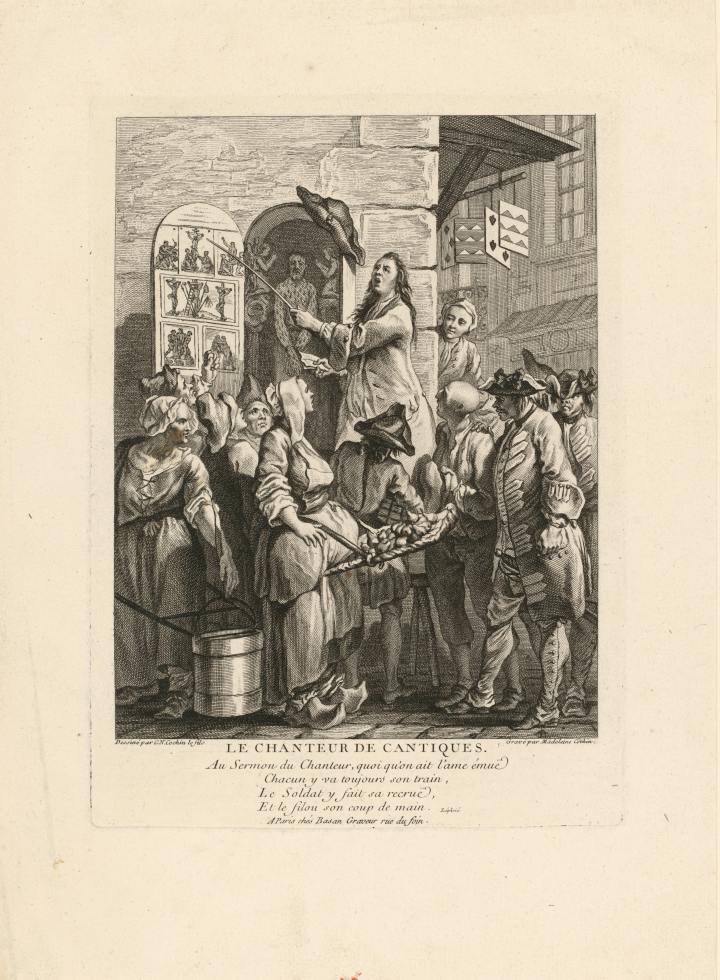
Louise Madeleine Cochin, after Charles-Nicolas Cochin the Younger, Le Chanteur de Cantiques, 1742, engraving and etching, 38 × 28 cm (Staatliche Museen zu Berlin, Kupferstichkabinett / Dietmar Katz).
This small thematic exhibition presents 25 French, German, Italian, Spanish, and Dutch prints from the 16th to 18th centuries preserved in the Kupferstichkabinett’s (Museum of Prints and Drawings) rich holdings. Works have been selected that show women in everyday activities, working as peasants, farmhands, teachers, maids, midwives and courtesans. One focus provide insight into the professions practised by women, including attending to births as midwives; another shows those areas of society where men and women went about their daily tasks side by side (as equals?). Beneath the allegorical layers of meaning, the viewer often discovers self-confident women going about their lives, yet the hardship of everyday travail is evident. To this day, so-called care work for children and the elderly receives little recognition; efforts are being made to reconcile work and family life and to achieve equality between women and men, including in financial matters, but these goals have yet to be fully attained. At the same time, it becomes clear that many of the depictions displayed were created by men—Albrecht Dürer, Lucas Cranach, and Rembrandt—to name just a few. Their (male) view of women characterised societal perspectives for centuries. Also represented, however, are two women artists, Louise Magdeleine Horthemels (1686–1767) and Marguerite Ponce (1745–1800), who earned their livings creating art.
An die Arbeit! Vom Schaffen und Schuften der Frauen is the Kupferstichkabinett’s contribution to Women’s Month in March, as well as to Equal Pay Day (7 March) and Labour Day (1 May in Europe). The exhibition is curated by Dagmar Korbacher, director; Mailena Mallach, curator of German art before 1800; and Christien Melzer, curator of Dutch and English art before 1800, Kupferstichkabinett, Staatliche Museen zu Berlin.
Call for Papers | Fashioning the Body: Dress in New England, 1600–1900
From the Call for Papers:
Fashioning the Body: Dress in New England, 1600–1900
Historic Deerfield, Deerfield, Massachusetts, 12–13 September 2025
Organized by Lauren Whitley
Proposals due by 3 May 2025
Fashion has garnered great interest in recent decades, and research into the history of clothing has yielded new insights into culturally embedded ideas around self-styling and the body. Understanding the mechanisms of stylish dress was the subject of several publications including Extreme Beauty (Metropolitan Museum of Art, 2001), Fashioning the Body (Bard Museum, 2015), and Structuring Fashion: Foundation Garments through History (Bayerisches Nationalmuseum, 2019). Yet, few studies have explored New England’s relationship with styling the body and fashionable dress.
In conjunction with the exhibition Body by Design: Fashionable Silhouettes from the Ideal to the Real, opening 3 May 2025, Historic Deerfield will host a Fall Forum, Fashioning the Body: Dress in New England 1600–1900, that aims to examine men’s and women’s fashion through a specific New England lens by convening a group of experts in the field to explore the rich history of dressing the body in this region. The Forum seeks to explore the following questions:
• What was distinctive about dress in New England, 1600–1900?
• How did aspirational fashion silhouettes form an aspect of New England dress?
• Was the cold weather of New England a factor in attaining stylishness?
• What were the connections between the clothing practices of indigenous people and English Colonists?
• What was the connection between religion and clothing in New England?
• How did attitudes around the body in New England influence self-styling?
• How were foundation garments a factor in New England clothing?
• What was the role of homespun in New England clothing?
• What can we say about either agency or subjugation in the dress of enslaved New Englanders?
• How was New England a place of innovation in fashion?
• If not aligned with prevailing fashions, how did New Englanders express anti-fashion?
• How was New England’s past revisited in Colonial Revival fancy dress?
• What is the role of painted portraits in documenting clothing styles or presenting an aspirational ideal? Does the representation of clothing in photography play a different role?
Historic Deerfield invites paper proposals for its two-day forum. Priority will be given to paper submissions that present new research and examine topics in non-traditional ways. Submissions beyond the geographical scope of New England but informative to this area are also encouraged. Topics and themes might include but are not limited to:
• Object Studies
• Artisan/Artist Biographies
• Analysis and Conservation
• Collectors and Collections
• Social and Cultural Meanings
To submit a proposal, please send (as a single email attachment) a lecture title, a 250-word abstract that describes the lecture, and a one-page vita or biography to Lauren Whitley, Curator of Historic Textiles and Clothing and Forum organizer, at lwhitley@historic-deerfield.org. Papers should be 25 minutes in length and must be object/image based. Proposals will be accepted until 3 May 2025. You will be notified of the status of your proposal no later than 24 May 2025. Speakers whose papers are accepted will be given complimentary registration to the symposium, lodging, and meals. The forum will convene in Deerfield, Massachusetts, as a hybrid program, with both on-site and virtual registration options for attendees. Speakers are expected to present their papers on site at Historic Deerfield.
Historic Deerfield is home to one of the finest collections of New England architecture, interiors, and decorative arts, including clothing. Historic dress was a particular interest of Historic Deerfield’s founder, Helen Flynt (1895–1986), who in the 1940s actively acquired high-style European dress as well as clothing made and worn locally in New England. The textile and clothing collection now boasts 8,000 objects including important examples of fashionable 18th– and 19th-century European, English, and American dresses and suits, the undergarments that were worn with them, and stylish accessories such as shoes, hats, gloves, purses, and aprons. Over the course of the last fifty years, Historic Deerfield has also amassed related materials, from fashion plates to original account books, that document the role of fashion in the lives of New Englanders.
Exhibition | Body by Design: Fashionable Silhouettes
Opening in May at Historic Deerfield:
Body by Design: Fashionable Silhouettes from the Ideal to the Real
Historic Deerfield, Deerfield, Massachusetts, 3 May 2025 — 22 February 2026

Gown or robe à la française, made in France or Amsterdam, ca. 1765; blue and white brocade weave silk (paduasoy?, bleached plain weave linen lining, and silk knotted fringe (Historic Deerfield, F.355).
This exhibition explores the enduring interest in clothing our bodies to achieve fashionable shapes. It will feature twenty-five ensembles from the 18th to 21st centuries drawn predominantly from Historic Deerfield’s renowned clothing collection. Displayed along with the historical garments will be the understructures—stays, corsets, hoops skirts, and bustles—that helped shape, exaggerate, or reduce bodies to fit fashionable ideals. The show follows a loose chronological organization starting with two garments from the 1760s: a woman’s formal dress with exaggerated wide skirt supported by hooped petticoats and a man’s pink and gold brocaded suit. Fashions from the 19th century highlight huge sleeves, corseted torsos, and skirts that were supported by crinolines and bustles. Fashion plates from the museum’s collection will help contextualize styles within their time while select modern fashions, juxtaposed with historical garments, offer interesting connections between the past and today.
Call for Papers | Luxury in Fabrics and Fashion
From ArtHist.net:
Luxury in Fabrics and Fashion: 5th Colloquium of Textile and Fashion Researchers
El luxe en els teixits i la moda / El lujo en los tejidos y la moda
Barcelona Design Museum, 6–7 November 2025
Organized by Sílvia Rosés and Sílvia Ventosa
Proposals due by 31 March 2025
The Design History Foundation and Catalonia’s textile museums announce their 5th Colloquium of Textile and Fashion Researchers, to be held at the Barcelona Design Museum on 6 and 7 November 2025. This year’s theme is textiles and fashion as powerful instruments of social stratification and distinction. On the one hand, luxury has positioned itself at the service of the ruling classes by consolidating established, imposed hierarchies, although, on the other hand, it has also helped to blur and rewrite them. This is why the concept of luxury has been one of the best-guarded bastions by the privileged sectors, given that it is one of the most powerful resources of social significance, the legitimation of power and the recognition of the elites. What is understood as luxury has consequently changed its semantics in order to adapt to the various facets that power has assumed.
In the past, colours such as purple or black, the quality of fabrics or jewellery were major indicators of status. Items of clothing such as ruffles, chopines, corsets, togas or crinoline indicated the high social class of those who did not have to work. Today, more subtle aspects such as hygiene, the cut of suits, the concept of good taste or the recent obsession with brands have become intangible added values that distinguish those who have political or economic power from those who do not.
This congress aims to examine the various facets of luxury, both in the field of fabrics and clothing and the changes in meaning that this concept has undergone at different times throughout history and in various cultures. It intends to provide an in-depth analysis from a historical and sociological perspective (through its role in shaping societies), from a technical perspective (through the tradition and innovation of crafts and their adaptation to the industrial paradigm), from an anthropological perspective (through the analysis of multiple cultural realities), and from an economic perspective (through the study of the implications of luxury in the configuration of fashion systems).
This 5th Colloquium therefore proposes various strands to submit your papers:
• Luxury throughout History
• The Aesthetics of Luxury: Tastes and Ornaments
• Luxury and Elitism
• The Moral and Psychological Implications of Practicing Luxury
• The Semantics of Luxury
• The Production of Luxurious Objects
• Craftsmanship and Luxury: Tradition, Innovation, and Modernity
• Economy and Luxury
• Luxury and the Issue of Gender
• Luxury and Sustainability
With this fifth edition of the TFR Colloquium—prior editions were held in 2017, 2019, 2021, and 2023—the Design History Foundation and Catalonia’s textile museums have established themselves as a forum for exchange designed to promote top-level research and the dissemination of knowledge in the fields of textiles and fashion. These Colloquiums have showcased public and private archives and collections and have helped to place the spotlight on a group of historians and scholars who had previously worked in isolation. The TFR Colloquium brings together people of the highest academic level. The committee will not accept abstracts from artists and designers who come to promote their work.
The conference languages will be Catalan, Spanish, and English, and the papers to be presented in person during the conference will last a maximum of 15 minutes. Registered participants will receive a certificate, as will the researchers presenting the papers. The papers will be published in the conference proceedings. They will have a DOI if they are published online and an ISBN if they are published in paper form.
Proposals (maximum of 500 words) should address the general aims of the research, theoretical framework (reference authors), methodology, and the originality of research within context of textile and fashion history and studies. Proposals should also include a paper title and details of the researcher (full name, academic post, current occupation, and email address), as well as the strand in which the abstract belongs. Abstracts must be sent in Word format (absolutely not in PDF format) to coloquiotextil@gmail.com, with no images or citations, for subsequent processing on paper and/or in digital format.
Once the abstract has been accepted, the researcher will register through the website of the Design History Foundation. All researchers must register and pay the appropriate fee, which will be announced when the programme is published. Diplomas will be issued only to registered individuals in the case of group research. The organisation reserves the right to cancel the colloquium in the event of exceptional circumstances beyond its control.










 Enfilade
leave a comment